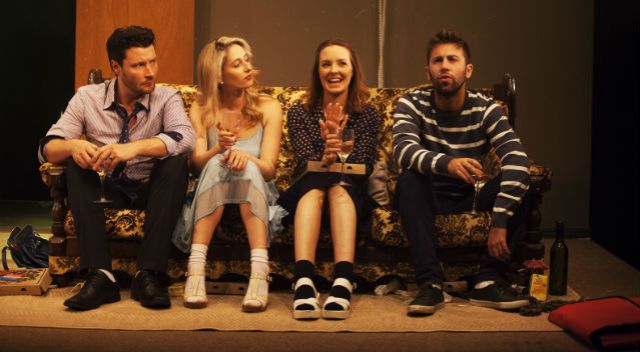
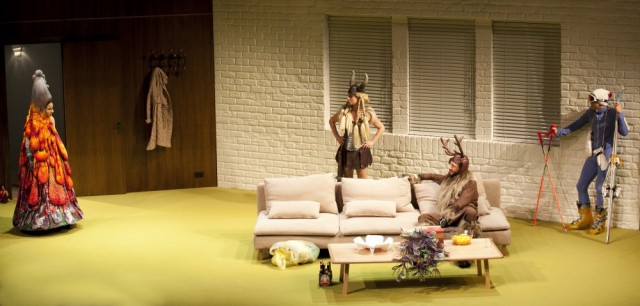
Review: Mr Kolpert (Pantsguys)

pantsguysVenue: ATYP (Walsh Bay NSW), Jul 30 – Aug 16, 2014
Playwright: David Gieselmann (translated by David Tushingham)
Director: James Dalton
Cast: Paige Gardiner, Garth Holcombe, Claire Lovering, Tim Reuden, Edan Lacey, Tom Christophersen
Image by Gez Xavier Mansfield

Theatre review
The theatre is a gift that takes many forms. Audiences sit in darkness full of anticipation, waiting for a revelation, never really knowing what is to be unraveled. Mr Kolpert quickly assures us that it is intent on providing entertainment and laughter, but we discover very soon, that the comedy is black, and the true depth of its morbidity is not known until we arrive at the very end. Although tremendously funny, the comical work is first and foremost an absurdist one. We might be laughing from start to finish, but it is only the loudness of that reaction that disguises a greater response that occurs, in which our minds and emotions are constantly being confronted and agitated, and we struggle to grapple with our own morals and etiquette.

The play presents an omnibus of transgressions through a series of unrealistic and improbable events, and every taboo that the narrative comes into contact with, it aggressively explores, keeping us unnerved and outraged. The comedy that comes along with these controversies is the additional challenge it issues, and we are constantly questioning the appropriateness of our laughter. It makes us wonder if we are keeping polite company in this quite classy venue. Theatre is a communal event, and the meaning of laughter in this social setting can be contentious, but the extremity of what transpires on stage protects our civility. It is simply silly to assume that any of the crowd’s giggles or guffaws can ever be taken as a sign of condonation of the horrific behaviour we see. Still, we are never allowed to feel too at ease. The show is at its core, a disturbing one.

James Dalton’s marvelous direction is sensitive not only to our senses, but also to our hearts and minds. He keeps us fascinated by everything we see and hear, and always keeps our intellect and emotions engaged. His is a theatre that feels all encompassing, intensely engaging and completely stimulating. Dalton does not allow the audience to sit back and observe. This is art without passivity, and he wants us to be on tenterhooks.

Assisting with Dalton’s vision is an excellent team of designers, including composer Marty Jamieson, who also partners up with Alistair Wallace for sound design. Their work provides rich textural variation between scenes, and is often crucial in heightening the quality of irony in the work. Lighting by Benjamin Brockman establishes the production’s aesthetic sophistication, and is memorable for his adventurous sensibility. The extent to which Brockman pushes his creativity is impressive, especially with fairly limited facilities, but two moments of bloodshed are too darkly shadowed, causing momentary, and unintended ambiguity.

The team of actors is exuberant, animated and bold. The playfulness they inject is hugely important to the enjoyment of the piece, with Paige Gardiner’s performance as Edith Mole standing out as a delightful highlight. Gardiner’s remarkable and confident comic ability is showcased perfectly by a creation that is at once, wild yet nuanced. There is a fierce determination to connect, with both cast and viewers, that makes her work irresistible, and thoroughly hilarious. Equally compelling is Claire Lovering, who consistently surprises with a gentle presence that readily transforms into convincing madness. Lovering demonstrates greater subtlety than other cast members but never fails to attack with savagery at every appropriate opportunity. This production of Mr Kolpert features thoughtful and skilled entertainers who must all be commended for a brilliantly vibrant show.

David Gieselmann’s writing exposes the chaos of this thing we call life, and our ravenous need for making logic out of randomness. He talks about the abnormal that resides within everything that seems normal, thereby tempting us to dismantle our standards of morality and ethics, in order to realise their artifice, frailty and inconstancy. The show is about society’s hypocrisies as well as its requirement for order. It does not say that our lives are lies, but it does encourage us to think about the rules we live by, how they are manufactured and the svengalis who might be behind them all.

www.pantsguys.com

Review: Mojo (Sydney Theatre Company)

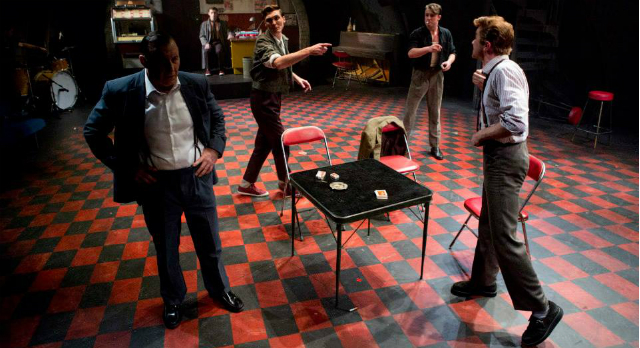
mojoVenue: Wharf 1 Sydney Theatre Company (Walsh Bay NSW), May 17 – Jul 5, 2014
Playwright: Jez Butterworth
Director: Iain Sinclair
Cast: Tony Martin, Lindsay Farris, Eamon Farren, Ben O’Toole, Josh McConville
Images by Brett Boardman

Theatre review (originally published at auditoriummag.com)
When boys grow up and begin to find their feet in the adult world as men of stature, the acquisition of masculinity often becomes critically important. The characters in Jez Butterworth’s Mojo seem to spend all their waking moments satisfying that overwhelming and insatiable need to be seen and treated as men of worth, and in the London underground gangland of the late 1950s, this involves unthinkable violence, and outrageous criminality. Butterworth’s daring and extravagantly brutal 1995 script illustrates a world of sex, drugs and rock and roll, where sons are raped, fathers are murdered, and honour is maleficently displaced.

Butterworth’s work starts up in high gear. He gets to the mayhem quickly without setting up thorough introductions for its story. There is a disorientation that occurs in the beginning, and the viewer is required to be alert, in order to decipher manic events while keeping up with the fantastically rich dialogue. Iain Sinclair’s direction in the initial scenes emphasises speed and energy, which can be a challenge for the plot, but a hyper-reality is firmly established for the play’s time and space. We are transported to a past that fits our imagination in part, but also controversial. The play’s rampant drug taking and extreme profanity is a far cry from the innocence of Grease, and the sophistication of Orson Welles’ Touch Of Evil. Sinclair’s work owes more to David Lynch’s 1986 masterpiece Blue Velvet in its handling of ultraviolence and surreal personalities. An air of menace sets in quickly and the pressure it exerts is unrelenting. The production has a magnetic quality in spite of its obscure otherness. It plays like a riddle, glutted with suspense and eccentricity, and we are seduced at every step, desperate to peek around every impending corner.

Indeed, the production succeeds as a piece of narrative-driven entertainment. It is engrossing, amusing and thrilling, with a good amount of shock value thrown in for a sense of gangster authenticity that also gives the show a cool edge. Its themes are not immediately evident, but they resonate afterward. The show does not ask questions directly, but it certainly encourages us to question what had been seen. Sinclair might be comfortable with dramatics that strike like a sledgehammer, but his ability to probe our conscience about bigger issues is as accomplished as it is subtle.

Also displaying excellence is Sinclair’s design team. Visual aspects, including lighting, costumes and sets are adventurously creative and intelligent. Nicholas Rayment’s lights are exhaustively explored, fulfilling functional and aesthetic requirements equally brilliantly. There are moments of beauty that look to be inspired by film noir, and also memorable incidences of dread that are as sinister as a dank lane way in any cosmopolitan city at 3am. Pip Runciman’s set design ingeniously creates spaces out of the usually nondescript Wharf Theatre stage. Levels and doorways are introduced to great effect, and the representation of a nightclub that is attractive in front, and dilapidated behind, is efficiently managed.

Percussionist Alon Ilsar’s work is perhaps the most inventive. He provides accompaniment for most of the scenes, underscoring action by amplifying mood and manufacturing tension. Ilsar’s background sounds are noticeable but not intrusive. When it does come to the fore, it is in the style of experimental jazz, which adds considerable sophistication to the production.

Chemistry in the cast is strong, and mesmerising. The actors are perfectly in tune, and together, they present a microcosm that we find believable in spite of its irrationality, and irresistible even though it is deeply repulsive. Josh McConville is comically frantic as the amphetamine fuelled Potts. His consistent buoyancy gives the play a propelling energy, and prevents the darker sections from becoming too melancholic. There is an enjoyable vibrancy to his performance that keeps an important sense of youth and juvenility in the story. Together with Ben O’Toole’s slightly more innocent Sweet, they portray a couple of young men keen to prove themselves, and to make a mark in their sordid world. Lindsay Farris is enigmatic as Baby, a deranged personality who is central to the play’s interest in maturity and manhood. Farris takes the opportunity to depict his unorthodox character with a liberal measure of offbeat artistic choices, and carves out a fascinating performance that is simultaneously alluring and poignant.

The young men in Mojo are in a state of confusion. We see them exercise the impulse to impress, to emulate, and to succeed, but their role models are severely impaired. Masculinity is highly valued, and in many of our lives, it is through acquiring masculinity that men achieve social acceptance and establish status. The definition of masculinity is then a matter of great concern. Greed, violence, destruction, deception, betrayal and criminality are all inextricably linked with notions of success and fulfillment in Mojo. It is a bleak picture painted of the past, but it seems that the proposition made here is that evolution is illusory, and that boys will be boys.

www.sydneytheatre.com.au

Review: #Three Jerks (Sweatshop)

rsz_sweatshopVenue: Wharf 2 Sydney Theatre Company (Walsh Bay NSW), May 24, 2014
Playwrights: Michael Mohammed Ahmad, Peter Polites, Luke Carman
Director: Roslyn Oades
Performers: Michael Mohammed Ahmad, Peter Polites, Luke Carman
Image from ABC TV

Theatre review
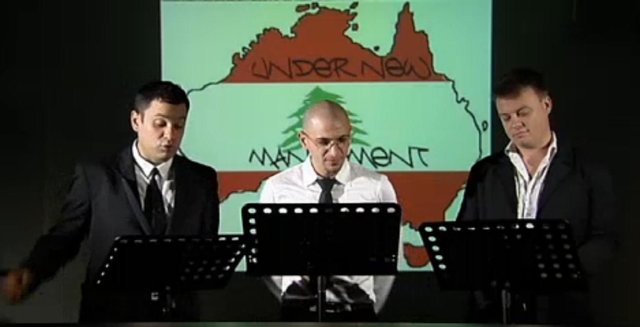
The show takes the form of a rehearsed spoken word presentation. Three authors are positioned with scripts on music stands, and a projection screen behind them bearing the image of an Australian map with the words “Under New Managment (sic)” scribbled across. The men read their own stories, and chime in with the others’ for dramatic emphasis when required. There is very minimal movement involved, and there are no costumes. This production is not in any way elaborate, but the writers work thoroughly with their voices to communicate their vivid and powerful writing.

The script is essentially composed of three soliloquies, interestingly combined, and there is potential for a more conventional theatrical rendering. #Three Jerks is fresh, original, and gutsy, with characters that many will find intriguing. It is a frank representation of young men and teenagers from Western Sydney, and providing them a voice in our cultural landscape is of great importance. The writing is colourful and dynamic, and works well in its current state, but even though the authors’ readings are surprisingly vibrant, the text calls out desperately for actors to memorise the lines, and to deliver them not just verbally but also physically. The liveliness of the stories and the power of its vernacular will provide the right theatrical practitioners with an opportunity for a work that contemporary Australian art has been hankering for.

#Three Jerks offers insight into a slice of Sydney life that seems to exist for mainstream society only in our news media. Self-assertion is necessary to correct misrepresentations of one’s own identity. Dominant cultures will always be in positions of power that uphold systems, whether intentionally or otherwise, that attempt to subjugate minority groups into persistent positions of disadvantage, and it is up to the disadvantaged to effect revolutions, and here is a solid early step.

www.sweatshop.ws

Review: Perplex (Sydney Theatre Company)

phpwU61WAPMVenue: Wharf 1 Sydney Theatre Company (Walsh Bay NSW), Mar 31 – May 3, 2014
Playwright: Marius von Mayenburg (translated by Maja Zade)
Director: Sarah Giles
Actors: Andrea Demetriades, Glenn Hazeldine, Rebecca Massey, Tim Walter
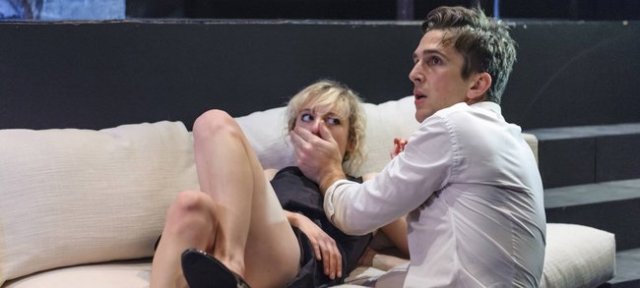
Images by Lisa Tomasetti

Theatre review (originally published at auditoriummag.com)
Life is what you make of it, and in Perplex, life is a comedy no matter what shape our circumstances may take. Marius von Mayenburg’s script is a mischievous existentialist meditation on middle class life, and a work that uses the stage as a laboratory to examine wide ranging beliefs about the nature of being human and our various theological conceptions of what occurs beyond.

Mayenburg’s writing is also interested in narrative construction, and how stories are told in ultimately predictable and typified successions. Things have to make sense, and Perplex exposes our ravenous need for logic in both life and narratives, to be farcical. There are no real characters in the play, only actors who use their own names, playing different scenarios that are only momentarily coherent, before subtle shifts in time and space bring everything into disorientation and a new scenario emerges. It is a crucial point that despite these shifts of contexts, the actors attempt to portray basically the same selves. This elasticity of being brings into question the constitution of personal identities, and the congruity of fate and destiny.

This is a very funny show. Its absurdity allows for performances to stretch as far as the players’ abilities can reach, and fortunately, this is a cast of great talent and gumption. Andrea Demetriades brings with her a sense of the everyday person. She looks and feels like the person next door, without an overbearing star quality or flamboyant theatricality. Her presence is strong, but she sets herself apart with an ability to portray ordinariness, which sits perfectly with the show’s attempt at dissecting our daily realities. Demetriades’ sense of humour is understated but effective. She works consciously with her flashier cast members, often creating counterbalances to ensure that the jokes translate well.

Perplex‘s surrealness is not outlandish but it is thorough and insistent. Rebecca Massey embodies this quality strongest. Her creation is consistently bizarre, but always hidden just under the skin. She juxtaposes normalcy with its opposite, almost in deception. It is this simultaneous duality that gives her creation an enigmatic intrigue. Her characterisations are also the most fluid and unfettered, which makes her the most unpredictable of the cast. A crucial feature of the play is its dramatically shifting plot trajectories, and Massey manages them with great flair.

Tim Walter provides the cerebral element of the quartet. In the production’s more obvious moments of intellectualism, he is the mouthpiece for Charles Darwin, Friedrich Nietzsche and Plato. The decision for Walter to appear completely naked for two lengthy sections discussing Evolution and the Allegory of the Cave, is an interesting one. The play is determined to restrict the impulse that may give excessive gravity to any of the big ideas it may conjure. Everything must reveal its shortfalls and temporalness. Walter’s commitment and focus is commendable. He is clearly an actor in control, with an excellent understanding of the economy of movement, which reaps maximum results with minimal (but well considered) effort.

On hand to provide all the show’s fortissimo quality of madness is Glenn Hazeldine. His penchant for physical comedy, and instinctual connection with the audience makes him an irresistibly funny actor. Slapstick is not to everyone’s tastes, but when deftly executed, it becomes disconcertingly amusing. Hazeldine knows how to create laughter, but more to the point, he understands emotions. A highlight of his performance comes after an exceptionally unorthodox sex scene when the entire theatre is in dizzying heights of fitful hilarity. Hazeldine dissolves from mania to depression before our eyes, while we have yet to catch our breath. His tears are flowing even before our laughter has subsided.

It must be noted that this an ensemble of impressive unity. The balance they achieve in supporting each other’s strengths, and the incredible comfort at which they encompass different personal approaches to humour, are the reasons for the production’s success at enthralling its audience, especially considering the lack of, or perhaps “non-sense” brand of narrative.

It might not be clear whether director Sarah Giles could have achieved as funny a show with a lesser cast, but there is no doubt that the clarity at which Perplex‘s big existentialist questions are communicated, affirms the strength of her faculty and vision. It is tempting to lose oneself in an absurd, surreal and illogical wilderness that delivers only entertainment and jubilance, but Giles’ work here fastidiously unearths the true and central essence of the scripts ideas and themes.

The show ends with a song, sung in the style of Kurt Weill. It is a tribute and acknowledgement of course, to the work of both Weill and Bertolt Brecht. Indeed, the Verfremdungseffekt features heavily. We laugh because we are made to see the normal and the familiar in different lights. It is how we live that is on show, and it is the subversive way we are made to look at ourselves that tickles. Perplex might not inspire much talk about politics and governments, but it is nonetheless entirely about our social selves. Sydney Theatre Company’s take on the “epic theatre” might just be applauded by Brecht in heaven, even if God is dead.

www.sydneytheatre.com.au

Review: Travelling North (Sydney Theatre Company)

rsz_398087-6086798c-83c3-11e3-b691-c4bd5b62f2b6Venue: Wharf 1 Sydney Theatre Company (Walsh Bay NSW), Jan 10 – Mar 22, 2014
Playwright: David Williamson
Director: Andrew Upton
Actors: Alison Whyte, Bryan Brown, Harriet Dyer, Russell Kiefel, Emily Russell, Andrew Tighe, Sara West

Theatre review
David Williamson’s 1979 play about a Melbourne couple moving up north, finds new life with the Sydney Theatre Company. Andrew Upton once again focuses attention on people and stories, and keeps visual design to a minimum. Set and props are rendered virtually invisible, except for an effective three tiered curved stage reminiscent of Australian landscapes. Upton’s direction brings out the realism of relationships and characters, creating everyday personalities that we are able to identify and relate to easily. There is a tendency for Williamson’s concepts to appear overly mundane as a result of Upton’s minimalist vision, but the production is kept buoyant by a healthy dose of humour that thrives in the midst of its pervasive simplicity.

Bryan Brown is miscast as the elderly Frank. Brown is charming, handsome and carries an air of magnificence that is completely at odds with the story about a sick man at the end of his days. We love his performance, which is always funny and sometimes poignant, and we understand everything his character goes through, but ultimately Brown’s celebrity gets in the way of the depiction of a regular old “cobber” we should feel sorry for.

Alison Whyte plays Frances with a lovely balance of strength and gentility, and while her role makes life choices that might not be entirely clear, the actor manages enough conviction and solidness to sell us her story. Noteworthy in the support cast include Harriet Dyer who does not miss any opportunity for comedy, and Andrew Tighe who makes good use of his physicality and costumes to carve out a very memorable character. Tighe brings authenticity and lightness to the production, and we anticipate his every appearance.

The relevance of Travelling North‘s staging today is not immediately relevant. Its themes of family, marriage, ageing, and seachanges unify many of our lives, but this 35 year-old play struggles to make a fresh statement about the Australian experience. It does, however, showcase some of our idiosyncrasies as a people, and is an occasion for us to excel at quite a bit of self-deprecating humour.

www.sydneytheatre.com.au

Suzy Goes See’s Best Of 2013

Images from a few 2013 stand-outs: A Sign Of The Times, Dirty Rotten Scoundrels, All My Sons, Hamlet, Empire: Terror On The High Seas, Hay Fever, Bodytorque.Technique, Waiting For Godot.

Images from a few 2013 stand-outs: A Sign Of The Times, Dirty Rotten Scoundrels, All My Sons, Hamlet, Empire: Terror On The High Seas, Hay Fever, Bodytorque.Technique, Waiting For Godot.

This is a wrap up of special moments since the commencement of Suzy Goes See in April 2013. A personal selection from over 100 productions seen in Sydney. Thank you to artists, companies, publicists and punters who have supported Suzy Goes See in 2013. I cannot wait for more shenanigans with you in the new year!

Update: Click here for the Best Of 2014 list.

Suzy x

♥ Avant Garde Angels
The bravest and most creative experimental works in 2013.

♥ Quirky Questers
The most unusual and colourful characters to appear on our stages in 2013.

♥ Design Doyennes
Outstanding visual design in 2013. Fabulous lights, sets and costumes.

♥ Darlings Of Dance
Breathtaking brilliance in the dance space of 2013.

♥ Musical Marvels
Outstanding performers in cabaret and musicals in 2013.

♥ Second Fiddle Superstars
Scene-stealers of 2013 in supporting roles.

♥ Champs Of Comedy
The cleverest, sharpest, and funniest performances of 2013.

♥ Daredevils Of Drama
Bold and excellent acting in dramatic roles in 2013.

♥ Wise With Words
The most interesting and intelligent scripts of 2013.

♥ Directorial Dominance
The most impressive work in direction for 2013.

♥ Shows Of The Year
Nice coincidence to have different genres represented: drama, musical, dance, comedy and cabaret.

♥ Suzy’s Special Soft Spot
For an exceptional work I saw in Melbourne.

End

Best of 2018 | Best of 2017 | Best of 2016Best of 2015Best Of 2014

Sweet Nothings (Pantsguys)

rsz_902884_626394167418141_1051080144_oVenue: ATYP Under The Wharf (Walsh Bay NSW), Nov 7 – 23, 2013
Playwright: David Harrower, after Arthur Schnitzler
Director: John Kachoyan
Actors: Graeme McRae, Owen Little, Clementine Mills, Matilda Ridgway, Lucy Miller, Mark Lee, Alistair Wallace

Theatre review
Sweet Nothings is an adaptation of a 118 year-old play by Arthur Schnitzler, the Austrian writer whose work, in more recent times, inspired David Hare’s The Blue Room and Stanley Kubrick’s Eyes Wide Shut. Under John Kachoyan’s direction, the frank sexual content that Shnitzler is known for does feature prominently in the opening scenes but fortunately no actor is subject to gratuitous nudity. This is a difficult script to manage. Its lead character Christine tends to appear “pre-feminist”, and is challenging for contemporary sensibilities. It is a tragic love story with a gender imbalance that some of us may find hard to stomach.

Playing Christine is Matilda Ridgway who is extremely committed  but her understated performance is too internalised, which would probably suit film and television more than it does the stage. Owen Little is by far the strongest in this cast. He does have the most outlandish character to play with, but he more than fulfils his brief, giving the audience a playful vivaciousness that counteracts the low-key style of the leads. Mark Lee works hard to lift energy levels in the second half, and his experience shines through even if his role is fairly undemanding.

Set design by Sophie Fletcher is effective and beautiful. The transformation from an apartment in Act 1 into Christine’s home in Act 2 is well-considered and executed with elegance. The contrast between both sets helps convey character dynamics and provides colour to the plot. Not all facets of the show are quite as accomplished, but the show is in general, a polished one, and would no doubt act as a springboard for further achievements.

www.pantsguys.com

Waiting For Godot (Sydney Theatre Company)

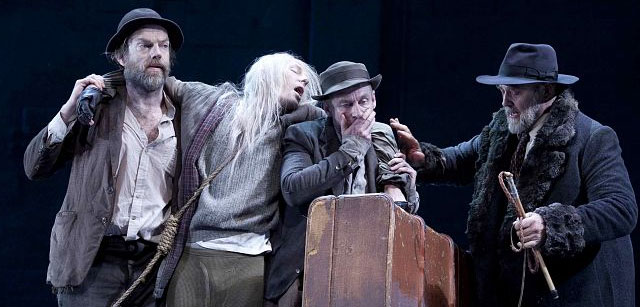
godotVenue: Sydney Theatre at Walsh Bay (Sydney NSW), Nov 12 – Dec 21, 2013
Playwright: Samuel Beckett
Director: Andrew Upton
Actors: Richard Roxburgh, Hugo Weaving, Philip Quast, Luke Mullins

Theatre review
Andrew Upton was brought in last minute to direct Sydney Theatre Company’s production of Waiting For Godot. The original director had taken ill, so the company’s artistic director steps up to the challenge, and, like a blessing in disguise, presents to us a skilfully crafted rendition of Samuel Beckett’s masterpiece. The script’s absurdist nature, along with its surreal elements are retained, but the work lays emphasis on psychological validity, which allows for a more accessible reading and indeed, a very entertaining night at the theatre. Upton’s interpretation of Beckett’s words encourages his audience to reflect upon existentialist themes, such as death, memory, isolation, time, and of course, life itself. One would argue that Beckett’s script might be legendary, but when in the wrong hands, those themes easily become muddled and obtuse, In this case however, his ideas are intriguing and thought-provoking. There is still a sense of abstraction in Upton’s version of events, but the show provides excellent inspiration for a good intellectual work out.

The star studded cast does a great job of luring huge numbers of punters into the theatre, and they do more than their fair share of pleasing the crowds. Hugo Weaving and Richard Roxburgh are truly brilliant. Their genius fills the auditorium, and we are privileged to witness their craft in motion. Of course, having such a rich text to play with does provide them with a solid platform on which to showcase the depth of their abilities, but they are both able to bring out so much life and meaning from it, and the level of poignancy they create in a single show is a remarkable achievement. Roxburgh is a surprisingly funny performer. His comic timing is impressive, and the laughter he creates prevents the show from developing overly dark. Weaving has the uncanny ability to make every utterance sound profound, and his use of silence and stillness to drive a point through is simply masterful.

Sydney Theatre Company’s Waiting For Godot is a hit. As a theatrical production, it entertains and inspires; and as a work of art, it challenges and confounds. It gives you a guiding hand to hold on to, but will not give away all its secrets and mysteries. It strikes the balance between accessibility and wonderment, and leaves us with a better, more open (and thinking) mind.

www.sydneytheatre.com.au

Bodytorque.Technique (The Australian Ballet)

bodytorqueVenue: Sydney Theatre at Walsh Bay (Sydney NSW), Oct 31 – Nov 3, 2013
Choreographers: Joshua Consadine, Halania Hills, Richard House, Ty King-Wall, Ben Stuart-Carberry, Alice Topp
Image by Branco Gaica

Theatre review
The Bodytorque seasons by The Australian Ballet feature works by emerging choreographers, and this year the company presents six excellent and diverse pieces. There is an emphasis on the idea of technique this season, and these young artists have all brought to the event their individual perspectives, which are distinct, confident, and strong.

Alice Topp’s Tinted Windows is modern and romantic, with an immense sensuality that is quite overwhelming. It conveys romance so effectively, proving that narrative storytelling is no match for dance forms when appealing to those emotions of longing and intimacy.
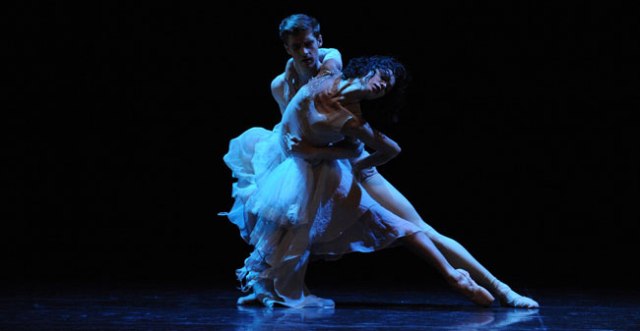
Finding The Calm by Richard House is memorable for its theatrical sensibility, juxtaposing stillness with dance to create poignantly moving moments. Some of the shapes he creates in various pas de deux are surprising, and deeply affecting in a way that only flesh on flesh connection can communicate.

In Polymorphia, Benjamin Stuart-Carberry focuses on the beauty of movement, as well as of the human body. It is the perfect commencement to the night’s program, and is immediately arresting and captivating.
The dancers are of course, divine. Vivienne Wong exudes extraordinary aura from every pore; she is a real star of the evening. Jarryd Madden has the rare ability to create dramatic tension in his dance, with minimal reliance on facial expression. Chengwu Guo’s athleticism and the uniqueness of his discipline allows him to stand out, and his abilities are showcased perfectly in Ty King-Wall’s The Art Of War.

This is a breathtaking night at the theatre. Some of the music is performed live, and listening to these emotive and sometimes euphoric classical compositions is a truly special experience. The same euphoria is delivered time and time again through each choreographer’s work, all varied but all accomplished. Ballet is not always for everyone, but this program has wide appeal, and it is hard to imagine anyone able to resist the unquestionable genius of these artistic triumphs.

www.australianballet.com.au

5 Questions with Richard House

richardhouseWhat is your favourite swear word?
Just in case my mum reads this I’d better not be too creative when choosing my favourite swear word. I’m a big fan of South Park and Butters (one of the characters from the show) has a great expression in times of frustration. “SON OF A BISCUIT”.

What are you wearing?
I’m in-between rehearsals at the moment so currently I’m in sweaty tights, a sweaty bandana, sweaty ballet shoes and a sweaty t-shirt with Rafael Nadal on it.

What is love?
Love is a large Big Mac meal from McDonald’s. Ha! It’s also an enticing emotion that once you experience the completeness it brings, you’re always craving for more.

What was the last show you saw, and how many stars do you give it?
Well I haven’t seen a show in quite a while due to being incredibly busy, but I am seeing Beyonce perform this week and I can only assume she will rock my world and it will be a 100 stars out of 100 stars show!

Is your new show going to be any good?
Well it premieres on the 31st of October which is also my birthday and I have never heard of anything less than awesome happening on that date!

Richard House is starring in Bodytorque.Technique, with The Australian Ballet.
Show dates: 31 Oct – 3 Nov, 2013
Show venue: Sydney Theatre at Walsh Bay