Review: Cain And Abel (Belvoir St Theatre / The Rabble)

rabbleVenue: Belvoir St Theatre (Surry Hills NSW), May 15 – Jun 8, 2014
Creators: Kate Davis, Emma Valente
Director: Emma Valente
Actors: Dana Miltins, Mary Helen Sassman
Image by Brett Boardman

Theatre review
In certain religious texts, Cain and Abel were the first children born of Eve, and Abel was the first human to die. The brothers’ story is one that has undergone much speculation and scrutiny, with Cain’s motives for murder being the key point of contention. In Kate Davis and Emma Valente’s subversive vision, the first children are daughters, so it is a woman who inflicts the first act of violence. They do not investigate the reasons for the infamous slaying, but explore instead, by substituting male for female, meanings and expressions of gender and its social perceptions in relation to human traits and behaviour.

This is a theatrical work that is heavily influenced by fine art. Dialogue is sparse and reliance on words to create and communicate meaning is minimal. Davis and Valente are concerned with arresting the senses and talking viscerally, resulting in a fascinating show that is almost hypnotic in its appeal. Shades of Japanese Noh theatre can be observed in the mesmerising leading ladies, Dana Miltins and Mary Helen Sassman, who work with a grave stillness that has more to do with spirituality and metaphysicality than storytelling. In this Cain And Abel, we are required to read not only with our eyes and ears, but also to engage with its energies and instincts. As an Australian work, it is distinctively original, even within the realm of experimental theatre.

Miltins performs an understated but terrifying aggression. Her Cain is not a femme fatale, as women do not exist as temptresses on this stage. In multiple scenes depicting various imagined manifestations of the fabled carnage, we are forced to witness her sister’s slaughter repeatedly, and to contemplate wildly, our own ideas about the artist’s themes, and beyond. Indeed, the abstraction of the piece resonates strongly, and in the absence of simple narratives, our personal thoughts are taken on adventurous odysseys.

Visual and sound design are not facilitators for something greater, they are integral to the theatrical experience, and executed to perfection. A main feature is an enclosed set made of clear acrylic, that allows for brutality to be contained (along with assorted offending liquids). The creation of distance provides a membrane of psychological protection, so that our minds gain enough detachment and security to indulge in meditations over the blood-letting before us.

Davis and Valente’s work is brave, iconoclastic and important. Religion is deeply rooted in many, and its unchecked authority affects every society. This disruption of the Cain and Abel story is emancipatory, because it encourages an intellectual response that is evolved and compassionate. It asks questions that matter, and it is incumbent upon us to consider them with a pure conscience.

www.belvoir.com.au | www.therabble.com.au

Review: The Government Inspector (Belvoir St Theatre / Malthouse Theatre)

rsz_12941006184_c9638e943c_bVenue: Belvoir St Theatre (Surry Hills NSW), Mar 27 – May 18, 2014
Playwrights: Simon Stone, Emily Barclay (inspired by Nikolai Gogol)
Songs: Stefan Gregory
Director: Simon Stone
Actors: Fayssal Bazzi, Mitchell Butel, Gareth Davies, Robert Menzies, Zahra Newman, Eryn Jean Norvill, Greg Stone
Images by Lisa Tomasetti

Theatre review (originally published at auditoriummag.com)
First published in 1836, Nikolai Gogol’s The Government Inspector has long been considered a masterpiece in comedy, farce, and political criticism. This co-production by Sydney’s Belvoir St Theatre and Melbourne’s Malthouse Theatre takes inspiration from Gogol’s work, but strays as far as is imaginable with drastically transformed contexts and characters, while retaining certain thematic and structural features of the original.

Simon Stone writes and directs this new version, continuing his passion for adapting and modernising eminent classics of the stage. Fresh from last year’s successful, and bloody, re-telling of August Strindberg’s Miss Julie, he once again presents an interpretation that is radical and completely surprising. This production is a “last minute” replacement for The Philadelphia Story by Philip Barry and Ellen Barry, which had been removed from its programmed slot due to unforeseen copyright issues. It is unclear how much time was available for Stone and his team to rehearse and workshop their take on The Government Inspector, but the volume of ideas and creativity it contains, more than lives up to the famed hilarity of its inceptive roots.

Adding to the theme of mistaken identities, Stone’s show takes on a layer of complexity by embracing and incorporating the experience of losing one script and gaining another. The actors play out a farce that represents their predicament, and uses the opportunity to create a work about the artistic process. Their creation comes out of their anxiety, and a need to satisfy the paying audience, so what results is a piece of theatre that is thoroughly crowd pleasing, and relentless in its pursuit of laughter.

Stone’s courage and edginess as an artist translates curiously well in this madcap comedy format. Popular culture and theatre references are utilised to great effect, but it is Stone’s liberal amount of sarcasm and irony that gives the production an air of intelligence and pointed sophistication. It is a very fine line between silliness and stupidity, but we are never lured into any realm of coarseness or vulgarity. The show plays for laughs but it doggedly rejects cheap ones.

Performances are excellent. The cast of seven might not be uniform in ability and experience, but the ensemble they have created is impressively even. The chemistry between all is stunning, and a tremendous highlight. Eryn Jean Norvill delights with a subtle approach that demonstrates preparedness and confidence. The character she creates is a familiar one, but instead of placing too much emphasis on becoming convincing, Norvill brings with her a sense of knowing, always applying a level of commentary to her actor and character selves. Her attempted defiance against a moment of sexism in the “play within a play”, is poignant and pitch perfect. Zahra Newman is the only actor with two roles, including Dolores de la Cruz, a janitor who delivers some of the biggest laughs by lampooning the thespians. In one of the show’s few political moments, the actors discuss Newman’s ethnicity being an element that provides unfair advantage in the casting process, and it is a pleasure watching her turn an uncomfortable taboo subject into something quite memorable and meaningful.

Gareth Davies is a show-stealer for the duration in which he plays a version of the misidentified inspector. More than any other in the cast, Davies’ execution of the production’s improvisational tone is most credible and exciting. The frantic energy is particularly raw and unhinged when Davies takes focus of the plot. Greg Stone’s exuberant charisma and zeal for self-deprecation quickly endears him to the crowd. His thorough grasp of the material at hand is reflected in his outstanding comic timing. A simple throwaway line about obtaining a job in an office is transformed into a biting joke about the state of the arts in Australia.

Design aspects are fairly basic, but the introduction of a revolving stage that essentially removes the need for extra time to facilitate set changes, and speeds up entrances and exits, makes for a very fast paced, dynamic affair that keeps the audience attentive, and the atmosphere persistently buoyant. No time is wasted between scenes, and we are kept laughing from beginning to end.

There is an extended musical portion in the show that could have felt extraneous, but its insertion is handled with great wit, and we not only forgive its inclusion, we actually find ourselves at new dizzying heights of outrageous comedy. The Government Inspector by Simon Stone and co-writer Emily Barclay, is an exceptionally funny show, but it cannot be denied that the political resonances in Gogol’s writing have all but disappeared. Of course, theatre does not have to be political in order to be valid or indeed meritorious, but radical adaptations of classics will always be controversial, especially when a key feature that has made something legendary is left behind.

www.belvoir.com.au

www.malthousetheatre.com.au

Review: Once In Royal David’s City (Belvoir St Theatre)

rsz_auditorium-onceinroyaldavidscityThis review first published in Auditorium Magazine (Spring 2014)

Venue: Belvoir St Theatre (Surry Hills NSW), Feb 8 – March 23, 2014
Playwright: Michael Gow
Director: Eamon Flack
Actors: Helen Buday, Brendan Cowell, Maggie Dence, Harry Greenwood, Lech Mackiewicz, Tara Morice, Helen Morse, Anthony Phelan

Theatre review
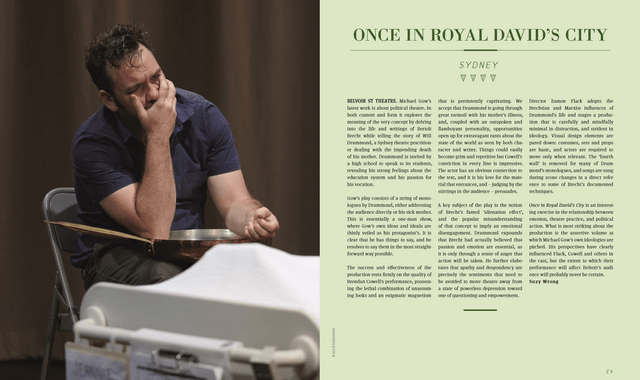
Michael Gow’s latest work is about political theatre. In both content and form, it explores the meaning of the very concept by delving into the life and writings of Bertolt Brecht, and by telling the story of Will Drummond, a Sydney theatre practitioner dealing with the impending death of his mother. Drummond is invited by a high school to speak to its students on the very topic of political theatre, revealing to us Drummond’s strong feelings about the education system and his passion for his vocation.

Gow’s play consists of a string of monologues by Drummond, either addressing the audience directly, or his sick mother who sleeps through his speeches. Minor characters appear sporadically to assist with plot trajectories, but they exist mostly to illustrate Drummond’s points of discussion. This is essentially a one-man show, where Gow’s own ideas and ideals are thinly veiled as his protagonist’s. It is clear that he has things to say, and he resolves to say them in the most straightforward way possible.

Brendan Cowell is the leading man, and the success and effectiveness of the production rests firmly on the quality of his performance. Cowell possesses the lethal, and contradictory, combination of unassuming looks and enigmatic magnetism. He plays the down-to-earth regular guy with ease, but has a star quality that is persistently captivating.

Cowell plays up his character’s theatricality. We accept that Drummond is going through great turmoil with his mother’s illness, and coupled with an outspoken and flamboyant personality, opportunities open up for impassioned and extravagant rants about the state of the world as seen by both character and writer. Things could easily become grim and repetitive but Cowell’s conviction in every line is impressive, and believable. The actor has an obvious connection to the text, and it is his love for the material that makes us listen, and judging by some of the stirrings in the audience, possibly even persuasive.

A key subject of the play, is the notion of Brecht’s famed “alienation effect” from the original “verfremdungseffekt”, and the popular misunderstanding of that concept to imply an emotional disengagement. Drummond, in his school lecture, expounds that Brecht had actually believed that passion and emotion are in fact important, as it is only through a sense of anger that action will be taken. He further elaborates that apathy and despondency are precisely the sentiments that need to be avoided, and that theatre needs to move away from a state of powerless depression, toward one of questioning and empowerment.

Director Eamon Flack adopts the Brechtian and Marxist influences of Drummond’s life, and stages a production that is carefully and self-awaredly minimal in distraction, and strident with its ideology. Visual design elements are pared down. Lighting is fairly sophisticated, but costumes, sets and props are basic, and only engaged when necessary. Actors are required to be still, only moving when relevant. The “fourth wall” is removed for many of Drummond’s monologues, and songs are sung during scene changes as direct reference to some of Brecht’s documented techniques.

Once In Royal David’s City is an interesting exercise in the relationship between emotion, theatre practice, and political action. We see a theatre director gradually becoming more socially active through his work, as his personal circumstances turn increasingly emotional. This is not entirely convincing as a storyline, but what is most striking about the production is the assertive volume at which Michael Gow’s own ideologies are pitched. His perspectives have clearly influenced Flack, Cowell and others in the cast, but the extent to which their performance will affect Belvoir’s audience can probably never be certain.

www.belvoir.com.au

Suzy Goes See’s Best Of 2013

Images from a few 2013 stand-outs: A Sign Of The Times, Dirty Rotten Scoundrels, All My Sons, Hamlet, Empire: Terror On The High Seas, Hay Fever, Bodytorque.Technique, Waiting For Godot.

Images from a few 2013 stand-outs: A Sign Of The Times, Dirty Rotten Scoundrels, All My Sons, Hamlet, Empire: Terror On The High Seas, Hay Fever, Bodytorque.Technique, Waiting For Godot.

This is a wrap up of special moments since the commencement of Suzy Goes See in April 2013. A personal selection from over 100 productions seen in Sydney. Thank you to artists, companies, publicists and punters who have supported Suzy Goes See in 2013. I cannot wait for more shenanigans with you in the new year!

Update: Click here for the Best Of 2014 list.

Suzy x

♥ Avant Garde Angels
The bravest and most creative experimental works in 2013.

♥ Quirky Questers
The most unusual and colourful characters to appear on our stages in 2013.

♥ Design Doyennes
Outstanding visual design in 2013. Fabulous lights, sets and costumes.

♥ Darlings Of Dance
Breathtaking brilliance in the dance space of 2013.

♥ Musical Marvels
Outstanding performers in cabaret and musicals in 2013.

♥ Second Fiddle Superstars
Scene-stealers of 2013 in supporting roles.

♥ Champs Of Comedy
The cleverest, sharpest, and funniest performances of 2013.

♥ Daredevils Of Drama
Bold and excellent acting in dramatic roles in 2013.

♥ Wise With Words
The most interesting and intelligent scripts of 2013.

♥ Directorial Dominance
The most impressive work in direction for 2013.

♥ Shows Of The Year
Nice coincidence to have different genres represented: drama, musical, dance, comedy and cabaret.

♥ Suzy’s Special Soft Spot
For an exceptional work I saw in Melbourne.

End

Best of 2018 | Best of 2017 | Best of 2016Best of 2015Best Of 2014

2014 Season Programs In Sydney

What to go see? Here’s a handy guide to who’s doing what in 2014.

If you’re reading this in 2013 or early 2014, now is a good time to book your generously discounted season tickets and subscriptions! If you’re accessing this page overseas, here’s a good list for planning your theatre experiences in Sydney in 2014.

The Australian Ballet

The Australian Ballet

Bell Shakespeare

Bell Shakespeare

Belvoir St Theatre

Belvoir St Theatre

Carriageworks

Carriageworks

Darlinghurst Theatre Co

Darlinghurst Theatre Co

Ensemble Theatre

Ensemble Theatre

The Genesian Theatre

The Genesian Theatre

Griffin Theatre Co

Griffin Theatre Co

King Street Theatre

King Street Theatre

New Theatre

New Theatre

The Old 505 Theatre

The Old 505 Theatre

Opera Australia

Opera Australia

Reginald Seymour Centre

Reginald Seymour Centre

Riverside Theatres

Riverside Theatres

2014-rocksurfers

Rock Surfers Theatre Co

Sydney Dance Co

Sydney Dance Co

Sydney Theatre Co

Sydney Theatre Co

Sydney Independent Theatre Co

Sydney Independent Theatre Co

5 Questions with Irma Woods

irmawoodsWhat is your favourite swear word?
Can I offer a line not a word? One of my favourites is Kris as Dolly Pickles in the adaption of Tim Winton’s Cloudstreet, by Nick Enright and Justin Monjo. Love the way Kris McQuade delivered the line. I will never be able to say it like Kris but i can’t resist it… the sound of the entire sentence, if you’re going to say it you must say it all.

Dolly: Thank you Lady Luck, you rotten slut.

What are you wearing?
A nice red lipstick.

What is love?
The Kiss by Gustav Klimt.

What was the last show you saw, and how many stars do you give it?
I’m Your Man by Roslyn Oades. How are you rating shows – does it go up to 5? 5 out of 5 stars. Saw Billy Mc and the team deliver a rockin’ show in Perth.

Is your new show going to be any good?
Why don’t you come and find out? Read Suzy’s review of The Cake Man here

Irma Woods stars in The Cake Man.
Show dates: 14 Nov – 8 Dec, 2013
Show venue: Belvoir St Theatre

The Cake Man (Yirra Yaakin / Belvoir St Theatre)

thecakeman1Venue: Belvoir St Theatre (Surry Hills NSW), Nov 14 – Dec 8, 2013
Playwright: Robert J. Merritt
Director: Kyle J. Morrison
Actors: Luke Carroll, Oscar Redding, George Shevtsov, James Slee, Tim Solly, Irma Woods

Theatre review
The Cake Man was written and staged originally in the early 1970s, from the perspective of Aboriginal Australians, about life on a mission in country NSW. Forty years on, a contemporary staging remains relevant and poignant. There is nothing dated or unfamiliar about the characters and their plight, and therein lies the tragedy. Robert J. Merritt’s script is colourful and textured. It is also honest and brave, giving voice to the original occupants of our land who are now ethnic minorities as a result of systematic genocide over generations. Works of this nature are highly important, and fundamental to the rebuilding and atonements that need to be made.

Director Kyle J. Morrison’s use of space is sensitive, instinctual and intelligent. He creates a sense of campfire storytelling that draws us in, and the earthiness he evokes by keeping all actors on stage at all times, gives the production a rare intimacy and purity. The work has a beautiful languidness, but a couple of scenes could benefit from a tighter pace, or maybe slight edits would add further interest to the plot.

Young actor James Slee is certainly one to watch. He has a natural ease on stage, and performs with a kind of naturalism that is striking in its simplicity but also lively and passionate. Irma Woods is above all, a performer with great sincerity and authenticity. There is no sense of a character being put on, only the most thorough blurring of lines between actor and role. Luke Carroll in The Cake Man shows himself to be one of the best actors of his generation. His charisma is undeniable, magnetic and powerful.  His use of voice and movement is animated yet realistic, and completely delightful to watch. The fearlessness in Carroll’s portrayal of Sweet William elevates the play, giving it an emotional quality that all audiences will find irresistible.

At the heart of The Cake Man is a burning desire for recovery, progression, and emancipation. It is a small morsul of the Aboriginal experience, but it encapsulates so much that is true in contemporary Australian lives, and so much that needs to be examined and advanced. We need stories like this, and we need them to propel from the fringes to the big, wide mainstream.

www.belvoir.com.au
www.yirrayaakin.com.au

5 Questions with Ewen Leslie

ewenleslieWhat is your favourite swear word?
I could be creative here but it’s hard to go past ‘fuck’. It’s certainly the one that comes out involuntarily so, fuck it, I’ll go with that.

What are you wearing?
Black jeans, white shirt, grey blazer. I just auditioned to play a ‘handsome academic’. The ‘handsome’ part is well out of my control, so I’m hoping the blazer took care of the ‘academic’ part.

What is love?
Unconditional. Wonderful. Easy. Hard. Beautiful. Painful. Amazing. Necessary.

What was the last show you saw, and how many stars do you give it?
Small And Tired at Downstairs Belvoir. I really loved the writing and I thought the performances were great. I would love to do a show in that space. It’s so intimate. I’m going to give it 4 stars. Margaret? [David, I would have to agree, 4 stars from me. – Suzy]
Read Suzy’s review of Small And Tired here

Is your new show going to be any good?
Will Hamlet be any good? A lot of people have already seen it and formed their own opinions. I personally love the production. As one of his best friends, I think it’s the best thing Toby has ever done. Will mine be different? We’re different people so I guess it naturally will be. Having said that there are many things within the production that are set and can’t be changed, and that includes acting choices. If anyone felt that Toby didn’t bring enough fear and panic to the role, I’ll certainly be providing that. Who needs six weeks rehearsal?
Read Suzy’s review of Hamlet (with Toby Schmitz in the title role) here

Ewen Leslie stars in Hamlet.
Show dates: 19 Nov – 1 Dec, 2013
Show venue: Belvoir St Theatre
Image by Daniel Boud

Hamlet (Belvoir St Theatre)

hamletVenue: Belvoir St Theatre (Surry Hills NSW), Oct 12 – Dec 1, 2013
Playwright: William Shakespeare
Director: Simon Stone
Actors: Toby Schmitz, Emily Barclay, Luke Byrne, Thomas Campbell, John Gaden, Nathan Lovejoy, Robyn Nevin, Anthony Phelan, Maximilian Riebl, Greg Stone

Theatre review
Shakespeare’s tragedies are vehicles for artists to express the extremities of human emotion and inconceivable psychological torment. When created well, a staging of plays like Hamlet will allow for the most outlandish and ostentatious of acting styles. In Belvoir’s production, Toby Schmitz pushes his portrayal of Hamlet over the edge of sanity, giving us one of the year’s most memorable theatrical performances.

Taking the brave decision to remove the ambiguity of the protagonist’s insanity, director Simon Stone’s version of events presents a Hamlet that is as much about mental disorders as it is about death and betrayal. Consequently, Schmitz’s choices are liberated, and he explores states of grief and madness with great intensity and high-octane drama. It is a delicious performance and the actor is magnetically powerful, while being controlled and considered. Schmitz is as intelligent as he is artistic, and the combination is lethal.

Greg Stone plays Polonius with great flair and confidence. This is an actor who loves Shakespeare’s words and knows how to use them. His performance is a real delight. Robyn Nevin’s role is less substantial, but she delivers what we have come to expect of her. Loads of gravitas and focus, and incredible elegance.

Many liberties are taken in Stone’s work, including a very clever take on the “play within a play” scene in which Lord Hamlet’s death is re-enacted, and some of the best use of incidental music in a long while. Stone displays not just originality and ingenuity, but also a keen sense of playfulness. His Hamlet is surprising, intriguing and taut. It runs slightly over two hours, and every moment is imbued with wonder and tension. This is exhilarating theatre. Stone’s show has a dangerous flirtation with abstraction which adds to its intrigue and seductive quality, but unfortunately becomes overwhelming in the final scenes. The play closes strongly but the journey at the end is slightly rocky. Nevertheless, this slightly abridged Hamlet is a courageous and accomplished work, one that showcases some of the best theatre practitioners and their dedication to, and faith in the art form.

www.belvoir.com.au