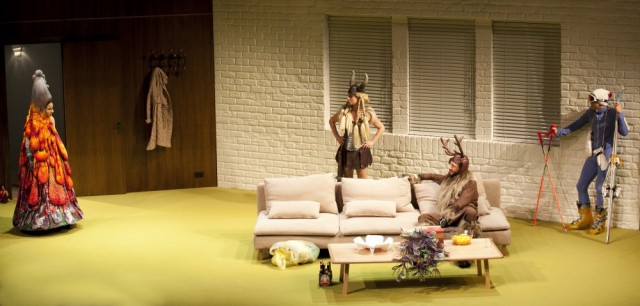
Review: Perplex (Sydney Theatre Company)

phpwU61WAPMVenue: Wharf 1 Sydney Theatre Company (Walsh Bay NSW), Mar 31 – May 3, 2014
Playwright: Marius von Mayenburg (translated by Maja Zade)
Director: Sarah Giles
Actors: Andrea Demetriades, Glenn Hazeldine, Rebecca Massey, Tim Walter
Images by Lisa Tomasetti

Theatre review (originally published at auditoriummag.com)
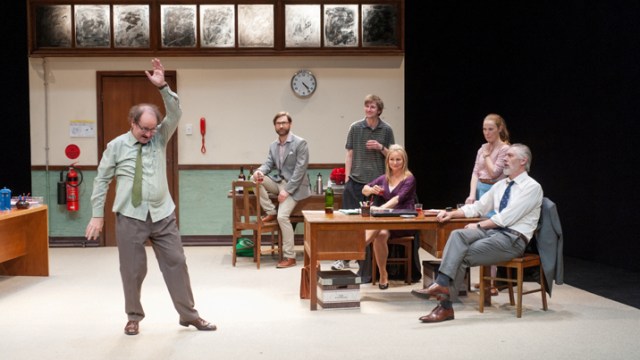
Life is what you make of it, and in Perplex, life is a comedy no matter what shape our circumstances may take. Marius von Mayenburg’s script is a mischievous existentialist meditation on middle class life, and a work that uses the stage as a laboratory to examine wide ranging beliefs about the nature of being human and our various theological conceptions of what occurs beyond.

Mayenburg’s writing is also interested in narrative construction, and how stories are told in ultimately predictable and typified successions. Things have to make sense, and Perplex exposes our ravenous need for logic in both life and narratives, to be farcical. There are no real characters in the play, only actors who use their own names, playing different scenarios that are only momentarily coherent, before subtle shifts in time and space bring everything into disorientation and a new scenario emerges. It is a crucial point that despite these shifts of contexts, the actors attempt to portray basically the same selves. This elasticity of being brings into question the constitution of personal identities, and the congruity of fate and destiny.

This is a very funny show. Its absurdity allows for performances to stretch as far as the players’ abilities can reach, and fortunately, this is a cast of great talent and gumption. Andrea Demetriades brings with her a sense of the everyday person. She looks and feels like the person next door, without an overbearing star quality or flamboyant theatricality. Her presence is strong, but she sets herself apart with an ability to portray ordinariness, which sits perfectly with the show’s attempt at dissecting our daily realities. Demetriades’ sense of humour is understated but effective. She works consciously with her flashier cast members, often creating counterbalances to ensure that the jokes translate well.

Perplex‘s surrealness is not outlandish but it is thorough and insistent. Rebecca Massey embodies this quality strongest. Her creation is consistently bizarre, but always hidden just under the skin. She juxtaposes normalcy with its opposite, almost in deception. It is this simultaneous duality that gives her creation an enigmatic intrigue. Her characterisations are also the most fluid and unfettered, which makes her the most unpredictable of the cast. A crucial feature of the play is its dramatically shifting plot trajectories, and Massey manages them with great flair.

Tim Walter provides the cerebral element of the quartet. In the production’s more obvious moments of intellectualism, he is the mouthpiece for Charles Darwin, Friedrich Nietzsche and Plato. The decision for Walter to appear completely naked for two lengthy sections discussing Evolution and the Allegory of the Cave, is an interesting one. The play is determined to restrict the impulse that may give excessive gravity to any of the big ideas it may conjure. Everything must reveal its shortfalls and temporalness. Walter’s commitment and focus is commendable. He is clearly an actor in control, with an excellent understanding of the economy of movement, which reaps maximum results with minimal (but well considered) effort.

On hand to provide all the show’s fortissimo quality of madness is Glenn Hazeldine. His penchant for physical comedy, and instinctual connection with the audience makes him an irresistibly funny actor. Slapstick is not to everyone’s tastes, but when deftly executed, it becomes disconcertingly amusing. Hazeldine knows how to create laughter, but more to the point, he understands emotions. A highlight of his performance comes after an exceptionally unorthodox sex scene when the entire theatre is in dizzying heights of fitful hilarity. Hazeldine dissolves from mania to depression before our eyes, while we have yet to catch our breath. His tears are flowing even before our laughter has subsided.

It must be noted that this an ensemble of impressive unity. The balance they achieve in supporting each other’s strengths, and the incredible comfort at which they encompass different personal approaches to humour, are the reasons for the production’s success at enthralling its audience, especially considering the lack of, or perhaps “non-sense” brand of narrative.

It might not be clear whether director Sarah Giles could have achieved as funny a show with a lesser cast, but there is no doubt that the clarity at which Perplex‘s big existentialist questions are communicated, affirms the strength of her faculty and vision. It is tempting to lose oneself in an absurd, surreal and illogical wilderness that delivers only entertainment and jubilance, but Giles’ work here fastidiously unearths the true and central essence of the scripts ideas and themes.

The show ends with a song, sung in the style of Kurt Weill. It is a tribute and acknowledgement of course, to the work of both Weill and Bertolt Brecht. Indeed, the Verfremdungseffekt features heavily. We laugh because we are made to see the normal and the familiar in different lights. It is how we live that is on show, and it is the subversive way we are made to look at ourselves that tickles. Perplex might not inspire much talk about politics and governments, but it is nonetheless entirely about our social selves. Sydney Theatre Company’s take on the “epic theatre” might just be applauded by Brecht in heaven, even if God is dead.

www.sydneytheatre.com.au

Review: Travelling North (Sydney Theatre Company)

rsz_398087-6086798c-83c3-11e3-b691-c4bd5b62f2b6Venue: Wharf 1 Sydney Theatre Company (Walsh Bay NSW), Jan 10 – Mar 22, 2014

Playwright: David Williamson
Director: Andrew Upton
Actors: Alison Whyte, Bryan Brown, Harriet Dyer, Russell Kiefel, Emily Russell, Andrew Tighe, Sara West

Theatre review
David Williamson’s 1979 play about a Melbourne couple moving up north, finds new life with the Sydney Theatre Company. Andrew Upton once again focuses attention on people and stories, and keeps visual design to a minimum. Set and props are rendered virtually invisible, except for an effective three tiered curved stage reminiscent of Australian landscapes. Upton’s direction brings out the realism of relationships and characters, creating everyday personalities that we are able to identify and relate to easily. There is a tendency for Williamson’s concepts to appear overly mundane as a result of Upton’s minimalist vision, but the production is kept buoyant by a healthy dose of humour that thrives in the midst of its pervasive simplicity.

Bryan Brown is miscast as the elderly Frank. Brown is charming, handsome and carries an air of magnificence that is completely at odds with the story about a sick man at the end of his days. We love his performance, which is always funny and sometimes poignant, and we understand everything his character goes through, but ultimately Brown’s celebrity gets in the way of the depiction of a regular old “cobber” we should feel sorry for.

Alison Whyte plays Frances with a lovely balance of strength and gentility, and while her role makes life choices that might not be entirely clear, the actor manages enough conviction and solidness to sell us her story. Noteworthy in the support cast include Harriet Dyer who does not miss any opportunity for comedy, and Andrew Tighe who makes good use of his physicality and costumes to carve out a very memorable character. Tighe brings authenticity and lightness to the production, and we anticipate his every appearance.

The relevance of Travelling North‘s staging today is not immediately relevant. Its themes of family, marriage, ageing, and seachanges unify many of our lives, but this 35 year-old play struggles to make a fresh statement about the Australian experience. It does, however, showcase some of our idiosyncrasies as a people, and is an occasion for us to excel at quite a bit of self-deprecating humour.

www.sydneytheatre.com.au

Review: Noises Off (Sydney Theatre Company)

noisesoffVenue: Sydney Opera House (Sydney NSW), Feb 17 – Apr 5, 2014
Playwright: Michael Frayn
Director: Jonathan Biggins
Actors: Alan Dukes, Lindsay Farris, Marcus Graham, Ron Haddrick, Danielle King, Genevieve Lemon, Tracy Mann, Josh McConville, Ash Ricardo

Theatre review
Sydney Theatre Company’s new production of the now classic farce, Noises Off, is comedy at its broadest. This comedy of errors is not sophisticated in concept but its execution under the directorship of Jonathan Biggins is highly accomplished and outlandishly dynamic. From men falling off staircases to women sitting on sardines, and girls in gartered lingerie to boys in bell bottoms and mullet hair cuts, Biggins approaches Frayn’s 1982 work with the most basic of motivations. He wants to make us laugh, and he is determined to pull out all the stops to make it happen.

The cast Biggins has assembled shares his vision. They show no qualms in playing for laughs at every available opportunity, which means that not all characters are clearly defined, and some plot lines get lost in all the mayhem, but the entertainment value of their show is guaranteed. Josh McConville as Roger/Garry impresses with his athletic agility and the most exaggerated physical gags in the production. The volume of his performance sets the standard for how extravagant the actors can go on that stage.

Tracy Mann plays Flavia/Belinda with more subtlety, but her use of voice is strongest in the cast. The excessively, and comically, stagey English accent from the era not only assists with a more distinct characterisation, its overt articulation actually provides clarity to the many twists and turns that occur in the busy story. Ash Ricardo as the Vicki/Brooke “bimbo” characters triumphs in spite of the restrictive and narrow scope given. Her energetic interpretation brings a fresh edginess, and the running joke about her contact lens is a big crowd pleaser. Marcus Graham, usually known for dramatically serious roles, is surprisingly effective as Lloyd. Like the rest of the cast, his enjoyment of the show is genuine, and infectious.

Laughter is the best medicine. Theatre goers can often be an uptight bunch. Jonathan Biggins’ Noises Off forces us to open up and it speaks to a different part of our minds. Like the brilliant extended section in Act 2 where virtually no words are spoken, but the biggest laughs are heard, our senses are kept busy. We work overtime to keep up, not with lines and ideas, but by observing all the funny unfold and responding with the thoroughly visceral, and biological, guttural guffaws from deep within… that space which is too often hidden away from the light of day.

www.sydneytheatre.com.au

Suzy Goes See’s Best Of 2013

Images from a few 2013 stand-outs: A Sign Of The Times, Dirty Rotten Scoundrels, All My Sons, Hamlet, Empire: Terror On The High Seas, Hay Fever, Bodytorque.Technique, Waiting For Godot.

Images from a few 2013 stand-outs: A Sign Of The Times, Dirty Rotten Scoundrels, All My Sons, Hamlet, Empire: Terror On The High Seas, Hay Fever, Bodytorque.Technique, Waiting For Godot.

This is a wrap up of special moments since the commencement of Suzy Goes See in April 2013. A personal selection from over 100 productions seen in Sydney. Thank you to artists, companies, publicists and punters who have supported Suzy Goes See in 2013. I cannot wait for more shenanigans with you in the new year!

Update: Click here for the Best Of 2014 list.

Suzy x

♥ Avant Garde Angels
The bravest and most creative experimental works in 2013.

♥ Quirky Questers
The most unusual and colourful characters to appear on our stages in 2013.

♥ Design Doyennes
Outstanding visual design in 2013. Fabulous lights, sets and costumes.

♥ Darlings Of Dance
Breathtaking brilliance in the dance space of 2013.

♥ Musical Marvels
Outstanding performers in cabaret and musicals in 2013.

♥ Second Fiddle Superstars
Scene-stealers of 2013 in supporting roles.

♥ Champs Of Comedy
The cleverest, sharpest, and funniest performances of 2013.

♥ Daredevils Of Drama
Bold and excellent acting in dramatic roles in 2013.

♥ Wise With Words
The most interesting and intelligent scripts of 2013.

♥ Directorial Dominance
The most impressive work in direction for 2013.

♥ Shows Of The Year
Nice coincidence to have different genres represented: drama, musical, dance, comedy and cabaret.

♥ Suzy’s Special Soft Spot
For an exceptional work I saw in Melbourne.

End

Best of 2018 | Best of 2017 | Best of 2016Best of 2015Best Of 2014

2014 Season Programs In Sydney

What to go see? Here’s a handy guide to who’s doing what in 2014.

If you’re reading this in 2013 or early 2014, now is a good time to book your generously discounted season tickets and subscriptions! If you’re accessing this page overseas, here’s a good list for planning your theatre experiences in Sydney in 2014.

The Australian Ballet

The Australian Ballet

Bell Shakespeare

Bell Shakespeare

Belvoir St Theatre

Belvoir St Theatre

Carriageworks

Carriageworks

Darlinghurst Theatre Co

Darlinghurst Theatre Co

Ensemble Theatre

Ensemble Theatre

The Genesian Theatre

The Genesian Theatre

Griffin Theatre Co

Griffin Theatre Co

King Street Theatre

King Street Theatre

New Theatre

New Theatre

The Old 505 Theatre

The Old 505 Theatre

Opera Australia

Opera Australia

Reginald Seymour Centre

Reginald Seymour Centre

Riverside Theatres

Riverside Theatres

2014-rocksurfers

Rock Surfers Theatre Co

Sydney Dance Co

Sydney Dance Co

Sydney Theatre Co

Sydney Theatre Co

Sydney Independent Theatre Co

Sydney Independent Theatre Co

Vere (Faith) (Sydney Theatre Company)

Photo by Matt NettheimVenue: Sydney Opera House (Sydney NSW), Nov 6 – Dec 7, 2013
Playwright: John Doyle
Director: Sarah Goodes
Actors: Paul Blackwell, Matilda Bailey, Matthew Gregan, Ksenja Logos, Rebecca Massey, Geoff Morrell, Yalin Ozucelik

Theatre review
This is a story about a highly regarded physicist, Vere, who falls victim to Parkinson’s disease. Vere has built a life based on science and intellect, but is now faced with the cruel obliteration of his mental capacities by dementia. John Doyle’s play explores the remains of a life, as its subject goes through a metamorphosis so exhaustive and fundamental. In Vere’s disintegration, we see the curious way in which memory functions, and from it, we gain an appreciation of what is immortal and invaluable. Themes of love, relationships, religion, work, mortality, and the transience of life itself, are meaningfully woven along with humour and pathos to create a show that is simultaneously entertaining and profound.

The first half is set in a university before Vere’s disorder takes effect, and the second, at his home when it is in full swing. The show speaks at first to our minds, with exuberant and witty repartee among cerebral academics, then to our hearts, as family dynamics come into play with decidedly greater sentimentality. It is as though Vere’s illness can wipe out the contents and function of the brain, but the soul is unbreakable and eternal. Director Sarah Goode’s work is quiet, and not particularly showy, but her hand is a confident one. She understands the strengths of the script, and ensures those strengths shine through with minimal intrusion.

Design elements are excellent, if a little conservative. The production is demanding of the actors, who (aside from the lead) each play two sets of characters, and they rise to the challenge beautifully. Geoff Morrell’s flamboyant style ensures that his characters are memorable, and his vivacity is a welcome addition to any event. Rebecca Massey portrays an unintelligent character with brilliant irony and meticulous timing. She delivers many laughs with a camp sensibility but is careful to retain a level of realism and believability.

Paul Blackwell’s performance is sublime. His presence is remarkable and the audience falls for his Vere from the very first words. He fascinates us, and we are completely enthralled, like putty in his hands. Blackwell’s biggest success is the ability to elicit great empathy while depicting a very sick man with utmost dignity. Through him, we see the humour in our fragility, but that frailty he depicts is also deeply touching. Blackwell, and Vere, guide us through a poignant meditation on growing old, on lost love, and on death, and we conclude at a place that is, surprisingly, not very frightening at all.

www.sydneytheatre.com.au

Waiting For Godot (Sydney Theatre Company)

godotVenue: Sydney Theatre at Walsh Bay (Sydney NSW), Nov 12 – Dec 21, 2013
Playwright: Samuel Beckett
Director: Andrew Upton
Actors: Richard Roxburgh, Hugo Weaving, Philip Quast, Luke Mullins

Theatre review
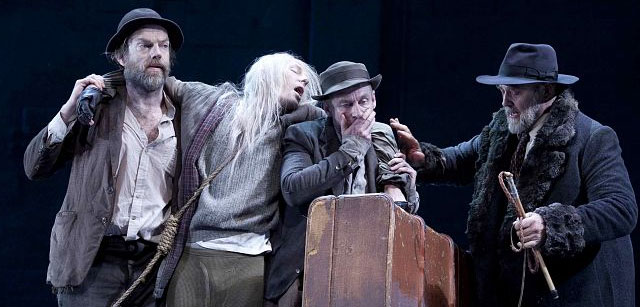
Andrew Upton was brought in last minute to direct Sydney Theatre Company’s production of Waiting For Godot. The original director had taken ill, so the company’s artistic director steps up to the challenge, and, like a blessing in disguise, presents to us a skilfully crafted rendition of Samuel Beckett’s masterpiece. The script’s absurdist nature, along with its surreal elements are retained, but the work lays emphasis on psychological validity, which allows for a more accessible reading and indeed, a very entertaining night at the theatre. Upton’s interpretation of Beckett’s words encourages his audience to reflect upon existentialist themes, such as death, memory, isolation, time, and of course, life itself. One would argue that Beckett’s script might be legendary, but when in the wrong hands, those themes easily become muddled and obtuse, In this case however, his ideas are intriguing and thought-provoking. There is still a sense of abstraction in Upton’s version of events, but the show provides excellent inspiration for a good intellectual work out.

The star studded cast does a great job of luring huge numbers of punters into the theatre, and they do more than their fair share of pleasing the crowds. Hugo Weaving and Richard Roxburgh are truly brilliant. Their genius fills the auditorium, and we are privileged to witness their craft in motion. Of course, having such a rich text to play with does provide them with a solid platform on which to showcase the depth of their abilities, but they are both able to bring out so much life and meaning from it, and the level of poignancy they create in a single show is a remarkable achievement. Roxburgh is a surprisingly funny performer. His comic timing is impressive, and the laughter he creates prevents the show from developing overly dark. Weaving has the uncanny ability to make every utterance sound profound, and his use of silence and stillness to drive a point through is simply masterful.

Sydney Theatre Company’s Waiting For Godot is a hit. As a theatrical production, it entertains and inspires; and as a work of art, it challenges and confounds. It gives you a guiding hand to hold on to, but will not give away all its secrets and mysteries. It strikes the balance between accessibility and wonderment, and leaves us with a better, more open (and thinking) mind.

www.sydneytheatre.com.au

Rosencrantz And Guildenstern Are Dead (Sydney Theatre Company)

art-hamlet-202-620x349[1]Venue: Sydney Theatre at Walsh Bay (Sydney NSW), Aug 6 – Sep 14, 2013
Playwright: Tom Stoppard
Director: Simon Phillips
Actors: Tim Minchin, Toby Schmitz, Ewen Leslie

Theatre review
Tom Stoppard’s 1966 work is embraced by many for its extraordinary wit and intellect. Sydney Theatre Company attracts vasts numbers of audiences, and it is a brave choice to present this play that many a lay person will find too wordy, philosophical, and abstract. Big chunks of text and their associated big ideas are delivered successively and quickly, and it is a challenging experience trying to keep up with every concept being discussed. However, like many great works of art, it is not only what you understand, but also what you don’t understand that makes the consumption of it necessary and worthwhile. Art inspires and elevates, even while it confuses.

From a technical perspective, the company continues to impress. Design elements are faultless, and execution of sound and lighting are perfectly honed to a fine craft. The theatre seats 900 people but it never feels too vast, even for a show like this where majority of the action involves just two actors. Performances are excellent, with Tim Minchin’s uncanny ability to blur the line between actor and role consistently outshining his counterparts. He seems so completely natural on stage, one can hardly imagine a different “real person” existing separately when the show is over. Ewen Leslie is the real showman in this production. He creates a mischievous character, infectious in his playfulness, and setting the stage alight at every entrance. After Cat On A Hot Tin Roof with Belvoir St Theatre, and the Tony Krawitz film, Dead Europe, it is thrilling to see Leslie’s departure from dark and broody roles to one that is full of vigour and hilarity.

Rosencrantz and Guildenstern Are Dead can be considered highbrow, but it’s central theme of “life and death” is universal. Playing with words, theatrical mechanisms, philosophical theories will not appeal to all, but we can relate to the existential conundrum that is the one constant in our lives. It is infinitely more satisfying to watch Rosencrantz and Guildenstern wrestling with the meaning of life, than for one to be engaged in endless self-examination. With any luck, you might even encounter ideas that could provide some level of enlightenment and make that arduous process, sometimes known as life, a bit more bearable.

www.sydneytheatre.com.au

Mrs Warren’s Profession (Sydney Theatre Company)

STC_MrsWarrensProfession_HelenLizzie_AM18323.jpg  788×1181Venue: Wharf 1 Sydney Theatre Company (Walsh Bay NSW), Jul 4 – 20, 2013
Playwright: George Bernard Shaw
Director: Sarah Giles
Actors: Helen Thomson, Lizzie Schebesta, Eamon Farren, Drew Forsythe, Martin Jacobs, David Whitney

Theatre review
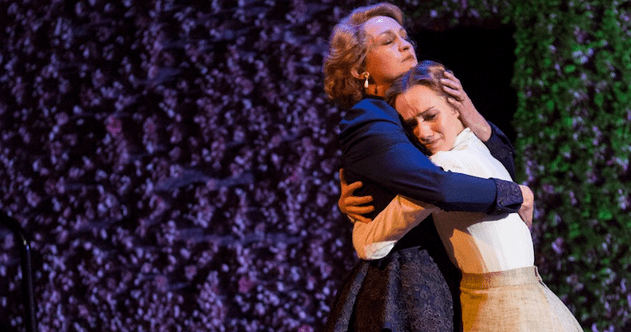
This cast of six in Shaw’s late 19th century work is truly remarkable. All players are convincing, nuanced and colourful, and their chemistry with each other is frequently breathtaking. The two female leads are particularly enthralling, both effortless with their magnetic charisma. It is important that this mother-daughter pairing appeals to the audience symmetrically in order for the philosophical ideas in Shaw’s work to be effective, and in the case of this production, this balance is indeed one of its great strengths.

Ms Helen Thomson plays Mrs. Kitty Warren, and her performance is astoundingly brilliant. With every entrance, the stage is lit by her luminous presence, which is entirely appropriate and necessary for such a grandiose and controversial character. Thomson’s every calculated variation in her voice and perfectly designed physical gestures create not only the most alluring and commanding character onstage, but also presents a vigorous philosophical argument to the central theme of morality that could have easily collapsed at the hands of a lesser actor.

While it is easy to be lost in the actors’ magnificence, this production of Mrs Warren’s Profession explores morals, money and motherhood both effectively and intriguingly. It is a testament to the strength of Giles’ direction that the themes in this 120 year-old play still come across contentious and fascinating.

Special mention must be made of the beautiful costume and hair design, which are effectively transformative for the players, and help to create a sense of time and space within the minimal set design. The backdrop, also visually stunning, works effectively in conjuring up visions of splendid English gardens within the confines of a modern black box theatre. Music between scenes sets the tone perfectly for the action that is about to begin again.

Mrs Warren’s Profession by the Sydney Theatre Company is quite simply unmissable.

www.sydneytheatre.com.au

The Maids (Sydney Theatre Company)

906946-130601-rev-theatre2[1]Venue: Sydney Theatre at Walsh Bay (Sydney NSW), Jun 4 – Jul 20, 2013
Playwright: Jean Genet
Director: Benedict Andrews
Actors: Cate Blanchett, Isabelle Huppert, Elizabeth Debicki

Theatre review
It’s difficult to find Genet’s script relevant in Australia today, as the concept of “domestic help” is far removed from our day-to-day realities. Of course, the employee/employer relationship is commonplace, but our experience of it isn’t quite as oppressive and stifling an environment as portrayed in the play. Therefore, it is form rather than content that is of interest in this production by the Sydney Theatre Company.

All three actors are charismatic, vibrant and thoughtful in their interpretations of the text. There are many macabrely humorous moments played with twisted aplomb by these fearless women, providing not just comic relief, but also a sense of gravity and doom while avoiding a monotonous heaviness that could have easily permeated throughout. A very large screen captures these enigmatic faces in tight close ups (with cameras in the wings), feeding the adoring audience with the star power they desire. This same medium however, is also often distracting and awkward. Our eyes are kept too busy, trying to keep up with too much action, and we quite literally lose the plot at several points.

The set design and lighting are sumptuous. Several costumes look like real couture pieces the script proclaims them to be, and they are truly mesmerising (one is said to be a McQueen). The seductive glamour and luxury of the visual design makes sense within the context of the decadent world in which they dwell. On the other hand, the choice and use of music does not work nearly as well, with inappropriate tunes jumping jarringly in at several points, as though someone had clicked the wrong button on an iPod.

Ultimately, this production is about performance, and the art of acting. Huppert’s less than perfect command of the English language is a minor fault, but witnessing the best in the world onstage tackle an outlandish and flamboyant text is not only satisfying, but thoroughly and wonderfully exhilarating.

www.sydneytheatre.com.au