Review: Gloria (Griffin Theatre Company)

griffinVenue: SBW Stables Theatre (Kings Cross NSW), Aug 26 – Oct 8, 2016
Playwright: Benedict Andrews
Director: Lee Lewis
Cast: Kristy Best, Chloe Bayliss, Marta Dusseldorp, Louis Fontaine, Huw Higginson, Meyne Wyatt, Pierce Wilcox
Image by Brett Boardman

Theatre review
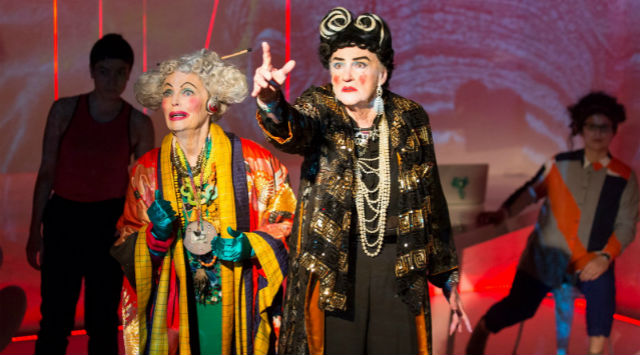
Gloria is a mother and a wife, but to everyone around her and to herself, she is first and foremost, a star of the stage. Having spent her life playing many legendary tragic heroines, Gloria knows more about the fictional women of Western theatre than she does the actor who portrays them. Benedict Andrew’s script is stylised and abstract, an imaginative creation that parallels Gloria’s struggle for coherence. The leading lady’s existence is one of disorientation and tumult, and Andrew’s writing relishes in that chaos for a work striking in its originality and remarkable boldness.

Equally audacious is director Lee Lewis’ resolve to reach the truth in the enigmatic world of Gloria, where obfuscation and secrets are given their due, while a foundation of instinctive authenticity is established with absolute imperviousness. Every artistic and mysterious flourish, no matter how flamboyant (including Steve Toulmin’s extraordinary music), is anchored in startling emotional precision and intensity, conveyed through a captivating combination of deep understanding and steely determination.

The actors provide an unforgettable experience, visceral and immediate, persistently surprising and colourful, with a baroque sensibility that elevates the theatrical form to a rare level of infectious excitement. Marta Dusseldorp is devastating as Gloria. In a state of constant distress and confusion, Dusseldorp’s embodiment of Gloria is tenacious, powerful and very, very dark.

The play is intentionally coy about Gloria’s problems, therefore even though emotions are almost always at a fever pitch, its moments of melodrama are few. The audience is then free to find an interpretation of her narrative, so we rely on our own faculties to impose upon Gloria, a reading of her story that will only ever be partially accurate. The actor wishes to step onto the stage with nothing of herself, and everything of the person she represents. An emptiness resides in her, and because the soul is constantly morphing for another, it forgets itself.

www.griffintheatre.com.au

Review: Tribunal (Powerhouse Youth Theatre / Griffin Theatre Company)

pytVenue: SBW Stables Theatre (Kings Cross NSW), Aug 12 – 20, 2016
Concept: Karen Therese
Collaborators/text/performers: Sarah Coconis, Paul Dwyer, Iman Etri, Katie Green, Rhonda Grovenor Dixon, Bilal Hafda, Mahdi Mohammadi, Karen Therese, Jawad Yaqoubi
Image by Gracie Partridge

Theatre review
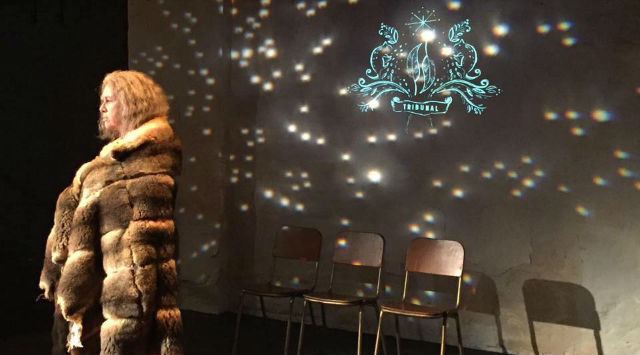
Any story can be told at the theatre, whether exaggerated or realistic, but to create something convincing is often a struggle for practitioners. In Tribunal, key personalities play themselves, leaving no room for us to doubt their authenticity. The presentation is a discussion of colonialism in Australia, with a particular focus on our habitual mistreatment through the years, of groups that are systematically subjugated and persecuted by a rapacious government, and its complicit populace. The production places side by side, an Aboriginal elder and an Iranian refugee, not only to convey the injustices inflicted upon them, but also to emphasise the delusionary insistence by White Australia of the land’s Westernness and its racist exclusion of all that it considers “other”.

Our weathered sensibilities may no longer be able to react with shock at the show’s revelations, but its verbatim, anecdotal format is unquestionably powerful, due especially to the sheer presence of those who have suffered under our cruelty. The act of putting on display their pain and damage, creates a palpable state of emergency and crisis that we simply cannot extricate ourselves from. In the guise of a tribunal hearing, the production turns its passive audience into the awakened body politic; we are all implicated in these harrowing recounts, no matter how long ago or how far away these events had taken place. Powerless individuals who shirk responsibility are, for the moment at least, given passionate idealism, and the audience begins to think about its part, as citizens involved in the machinations contributing to the humanitarian catastrophes that must be addressed.

We may not all run off into the night with radical courses of action inspired by Tribunal, but it sows the seeds required for a nation to evolve stronger morals and to inculcate better humanitarian values into its every decision, especially the tough ones. Bringing people from abstract consciousness, into a real life sharing of space, is theatrical magic that can do wonders to how we experience society. It is easy being inhumane to those who only live in imagination, but when confronted face to face, we can only be guided by compassion and love, which are after all, the most valued of all our qualities as the earth’s beings.

www.pyt.com.auwww.griffintheatre.com.au

Review: The Literati (Bell Shakespeare / Griffin Theatre Company)

griffinVenue: SBW Stables Theatre (Kings Cross NSW), May 27 – Jul 16, 2016
Playwright: Justin Fleming (after Molière)
Director: Lee Lewis
Cast: Caroline Brazier, Gareth Davies, Jamie Oxenbould, Kate Mulvany, Miranda Tapsell
Image by Daniel Boud

Theatre review
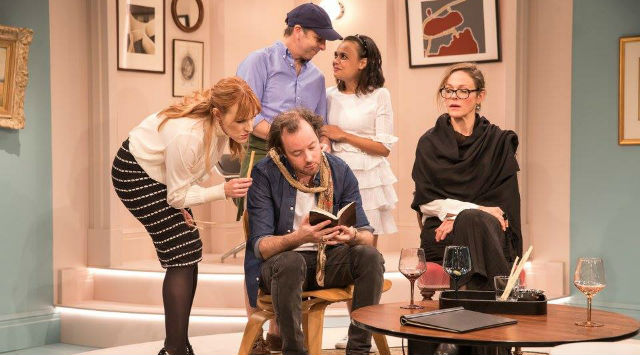
There are two halves to the family in Justin Fleming’s The Literati. Philomena and her elder daughter Amanda have aspirations for a sophisticated existence, both enamoured with books and language, while Christopher and younger daughter Juliet are of a simpler ilk, down-to-earth like true blue Aussies never to be caught dead with tickets on themselves. The play is about pretension, and the meaning of knowledge. We explore what it is to be good people, in a world where values are easily misplaced and ideas about virtue are unstable and skewed. Its message is uncomplicated, with a plot that proves to be entirely predictable, but The Literati is gorgeously written, with inexhaustible wit permeating every rhyming couplet in this thoughtful adaptation of Les Femmes Savantes by Molière. The jokes come fast and furious, along with inspired ruminations about diverse subjects including romance, intellectualism, purity and class.

Characters in The Literati are archetypal, but convenient moralistic jabs at “the bad guys” are thankfully few. The play wrestles with the problematic duo of Philomena and Amanda, shallow on one hand, but admirably ambitious on the other. Their desires are noble, but their mode of pursuance is misguided. The play sets up an old-fashioned dichotomy of pure and impure, but allows itself to negotiate between the two, so that we achieve a more textured understanding of good and bad within the story. Director Lee Lewis makes the appropriate decision of placing effect before depth, for a work that has nothing unusual to say but has very impressive ways of expressing its beliefs. The comedy is often flamboyant, but Fleming’s exquisite words are always in the spotlight, full of evocative power and mischievous vigour. The production is buoyant from start to finish, and although occasionally repetitious with its methods of eliciting laughter, we are kept engrossed in its electrifying showmanship.

Playing Christopher and Clinton is the one endearing Jamie Oxenbould, convincing and dynamic in his diverse roles. A memorable sequence features the actor alone on a revolving stage performing with meticulous clarity, and an exuberant sense of absurdity, both his characters in passionate dialogue with each other, completely absorbent of our attention, astonishment and adoration. Gareth Davies and Kate Mulvany offer up very broad humour with outlandish interpretations of their caricatures, finding every opportunity to perform their unrestrained comedy to a very appreciative and delighted crowd.

People in The Literati fight over the redundancy of words and culture, when notions of style are not validated by substance. The moral of Molière’s story is neither controversial nor surprising, but we are captivated by the production’s theatricality and the resonance of its language. In some ways, the show defeats its own argument, for what keeps us enthralled is not its idealistic core, but the talent that emanates from it. We fall in love with its gestures and articulations, but pay little heed to its very point of contention. We can look at art without the need for a presumed frame of reference or an indication of something behind, something deeper. Art is not a means to an end, but a sacred entity meaningful on its own terms. “If you want to know all about Andy Warhol, just look at the surface of my paintings and films and me, and there I am. There’s nothing behind it.”

www.bellshakespeare.com.auwww.griffintheatre.com.au

Review: As We Forgive (Griffin Theatre Company / Tasmania Performs)

griffinVenue: SBW Stables Theatre (Kings Cross NSW), May 11 – 21, 2016
Playwright: Tom Holloway
Director: Julian Meyrick
Cast: Robert Jarman

Theatre review
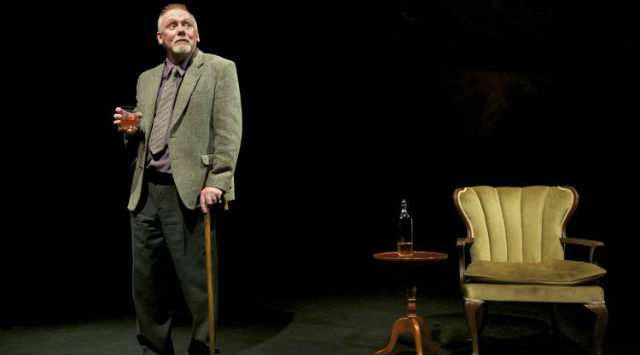
Forgiveness is complicated and unstable, and where it is most needed, its difficulty is at its greatest. In Tom Holloway’s As We Forgive, three monologues featuring an older man demonstrate the purpose of forgiveness, as it relates to a self that needs to find emancipation that can only be derived from an act of absolution. When we realise that life is short, the urgency for deliverance becomes even more pronounced, and Holloway uses the mechanism of age in his storytelling to amplify the poignancy of his message.

The writing is sublime, with evocative and powerful imagery that connect on levels of emotion, spirituality and intellect. Actor Robert Jarman does an exquisite job of the words, sensitively articulating each sentence so that the text communicates with richness and lucidity. Although quiet in presence and at times too gentle with his approach, Jarman is a charismatic personality effective at conveying profound sentimentality. There is an elegance to his work that is memorable for its simplicity, as well as an inner authenticity that contributes to the cogency of the play’s concepts.

The production is melancholic, beautifully so, but a more dynamic atmosphere would perhaps provide an experience that is more engrossing. Lisa Garland’s photo projections and Raffaele Marcellino’s music add tender dimensions to an already delicate staging for an overall effect that is undoubtedly appealing, but for its eighty-minute duration, greater fluctuations in energy levels is required.

The men in As We Forgive are consumed by vengeance, hatred and remorse. Their stories are dramatised but we perceive their feelings to be familiar and true. All our lives parallel, and no matter the obstacles we face, our humanity binds us, allowing us to recognise each other’s wounds and suffering. We may not all be lonely people, but finding forgiveness is a solitary task, and those who succeed are the luckier ones.

www.griffintheatre.com.au | www.tasperforms.com

Review: Replay (Griffin Theatre Company)

griffinVenue: SBW Stables Theatre (Kings Cross NSW), Apr 2 – May 7, 2016
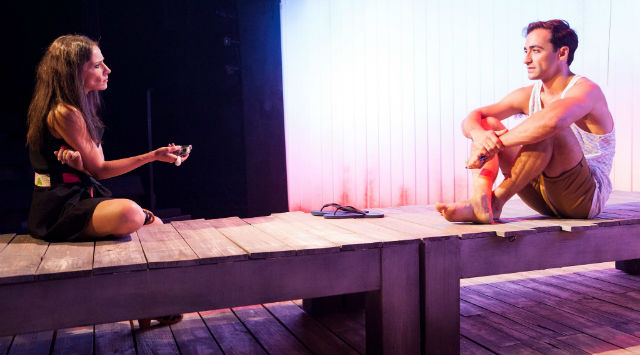
Playwright: Phillip Kavanagh
Director: Lee Lewis
Cast: Jack Finsterer, Alfie Gledhill, Anthony Gooley
Image by Brett Boardman

Theatre review
It is an experimental script that plays with the elasticity of characters. We expect a certain amount of consistency from personalities in plays, and indeed in life, but Phillip Kavanagh’s Replay uses the idea of regret as motivation, to allow people in his story to go back in time to make amends, thus altering histories that lead to the present being inevitably changed. The concept fascinates, but the unconventional plot disrupts any emotional arc that could take hold, and we are presented with the challenge of engaging with characters who never become familiar.

The production is elegantly formed, with only minimal amounts of embellishment indicating its supernatural qualities. Director Lee Lewis is intent on giving a sense of authenticity to every moment, which results in scenes that are individually captivating, but the unusual writing prevents a feeling of poignancy to translate even though the intensity on stage is unmistakeable.

Performances are lively, with actors tending to do a little more than is necessary, but their energy and cohesive chemistry make them an endearing group that sustains our interest throughout the piece. Jack Finsterer is particularly delightful. Even when adopting the show’s animated tone of performance, the actor is able to retain a psychological and emotional accuracy amidst the constantly shifting time and space in which we find ourselves. Alfie Gledhill and Anthony Gooley are expressive actors who bring logic and coherence to a narrative that can easily turn confusing, both with a spirited approach that provides solid entertainment.

We have all experienced regret, and many of us have pasts that hold on too tightly. In our fantasies, the rules of time can be broken, and we can make every wrong right, so that life becomes completely disencumbered. Life without any difficulty is however, akin to death. It is fundamental to humanity that we strive to make things better. Stillness is a privilege that everyone must be able to savour every so often, but the essence of life is in its movement; of forging ahead, and of growing up. Regression can be made to look real on stage, but it ultimately is of service to no one. Looking back is sometimes necessary, but care must be taken so that we do not remain shackled by histories. It is the great unknown of the future that requires our attention, and we must endeavour to make the most of it.

www.griffintheatre.com.au

Review: Ladies Day (Griffin Theatre Company)

griffinVenue: SBW Stables Theatre (Kings Cross NSW), Feb 5 – Mar 26, 2016
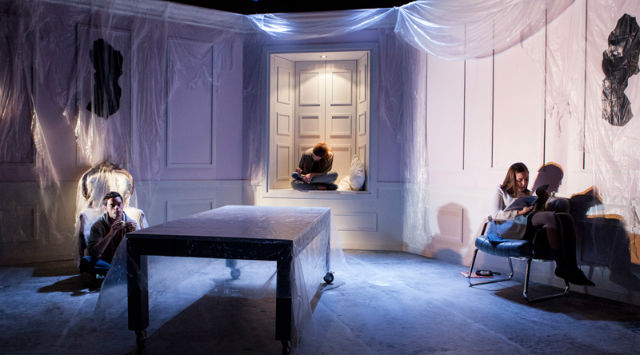
Playwright: Alana Valentine
Director: Darren Yap
Cast: Matthew Backer, Wade Briggs, Lucia Mastrantone, Elan Zavelsky
Image by Brett Boardman

Theatre review
It is not a promising start to the play. There is a lot of old-fashioned talk about “how gays have different lives from straights”, “how many shades of gay are there”, and “look, there’s a gay man enjoying himself in a dress in a country town”. We are reminded that Priscilla happened 22 years ago and that things have thankfully moved on a considerable amount. Alana Valentine’s Ladies Day does however, take a turn for the better when its central concern begins to take shape. Sexual assault is a tricky subject for art because it can seem to lack complexity, and making work about the topic can often feel somewhat obvious, as if preaching to the choir, but Valentine’s script finds surprising nuance, and provides new insight to help us gain a deeper understanding of the victim’s experience. The structure of the play can be further refined, but there are strong elements to be found. For every scene that feels excessively derivative, we discover riveting moments in later sections where its superficial conceits are shed to reveal the devastating honesty that lies beneath.

Darren Yap’s direction gives the production an enjoyable texture with sensitive and regular transformations in atmosphere, and its amplified emotions make for a compelling dynamic range that keeps us attentive. Sound and music by Max Lambert and Roger Lock add great drama to the piece, and quirky interludes of song give the show its character. All four actors contribute powerful performances, with Lucia Mastrantone’s incredible vulnerability leaving the greatest impression. Through her depiction of suffering, we observe that it is often the strength that emerges from pain that is truly moving. Mastrantone is passionate, articulate but also subtle, elevating her relatively simple roles into something altogether more substantial. Similarly compelling is Elan Zavelsky as the sad and bitter Rodney, with a quiet intensity and meaningful introspection that keeps us captivated. Strangely miscast as a man past his prime, the clearly attractive and youthful Zavelsky’s depiction of desperation is nevertheless committed and very accurate.

It might not be very elegant at Ladies Day, but its concluding moral is a surprising, sobering one. At the theatre, we tell the truth through fabrications because our minds can prefer them over facts. We are receptive to stories if they are told well, regardless of how veracities are achieved. From the storyteller perspective too, it is often through analogy and metaphor that truths can be better portrayed, especially when actualities evade expression. Facts are hard to capture, but our humanity can hear the truth ringing no matter what guise it takes.

www.griffintheatre.com.au

Review: Minus One Sister (Stories Like These)

storiesliketheseVenue: SBW Stables Theatre (Kings Cross NSW), Sep 9 – Oct 3, 2015
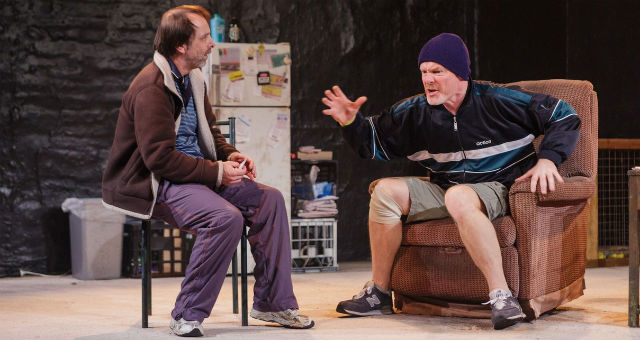
Playwright: Anna Barnes
Director: Luke Rogers
Cast: Kate Cheel, Lucy Heffernan, Liam Nunan, Contessa Treffone
Image by Brett Boardman

Theatre review
Unlike Abraham’s sacrifice of Isaac that did not eventuate, Agamemnon killed his daughter Iphegenia to appease the goddess Artemis, in order that the lives of many others could be saved. In Anna Barnes’ retelling of the ancient tale, place becomes Australia and the time is now. Her poetic language borrows from Greek theatrical traditions and combines it with the speech of today, for a fascinating and modern take on the dramatic form. Early passages are slow-moving, with repetitions that do not seem to serve a clear enough purpose, but when the blood-letting begins, Minus One Sister takes on the intense energy of a classic tragedy. Transposing the story to a contemporary context involves a hindrance that the play tends to evade. The chain of murders originates at a point of supernaturality, which in Barnes’ version for the twenty-first century, is not entirely reasonable or convincing. Even though her revenge narratives are powerful and full of intrigue, the first transgression occurs with insufficient persuasiveness, and without that foundation, emotional investment in the piece becomes challenging.

Luke Rogers’ direction brings to the stage a wild and decadent destructiveness that is often mesmerising, in the shape of a finely tuned drama that provides many exciting moments. Although the production does not deliver great poignancy, its sensuality resonates effectively, with beautifully crafted tension holding together a show that is full of fragility and volatility. Marvellously designed by the dynamic team of Georgia Hopkins (set and costumes), Sian James-Holland (lights) and Nate Edmondson (sound), we are transfixed and overcome by a sordid world populated by unimaginably dark thoughts and evil plans. The ruin of purity could perhaps be handled with a harsher brutality, but the family’s misery is depicted with a melancholic, almost gothic, sensibility that appeals to our taste for storytelling with an edge of morbidity.

The four young actors make a compelling cast, each with a distinctive presence, and an enthusiasm for agile atmospheric shifts that keeps the show from turning predictable. Contessa Treffone, as Chrysothemis and Clytemnestra, is especially powerful, and impressive with the range of temperaments that she is able to conjure up for her scenes. Tender, resolute or cruel, she is full of conviction and we are consistently drawn to her every surprising expression. Electra, the angry and vengeful sister, is played by Kate Cheel whose ability to portray chilling ruthlessness gives the play a gravity and a foreboding that are essential to its apocalyptic plot trajectory. Cheel’s climatic moment of devastation requires greater passion, but her work is memorable for its intellectual clarity and her flair for sombreness.

Minus One Sister is concerned with the disruption of family and innocence, but its message comes across mildly, in spite of its severe and horrific episodes. There are obvious efforts at making key personalities empathetic, but their experiences do not come close enough to our reality. Nevertheless, the production is a polished and sometimes spectacular one. There is a generous amount of talent on display, and every one of its fabulous facets welcomes our genuine and immediate admiration.

www.storieslikethese.com

Review: The Dapto Chaser (Apocalypse Theatre Company / Griffin Theatre Company)

apocalypseVenue: SBW Stables Theatre (Kings Cross NSW), Jul 1 – 25, 2015
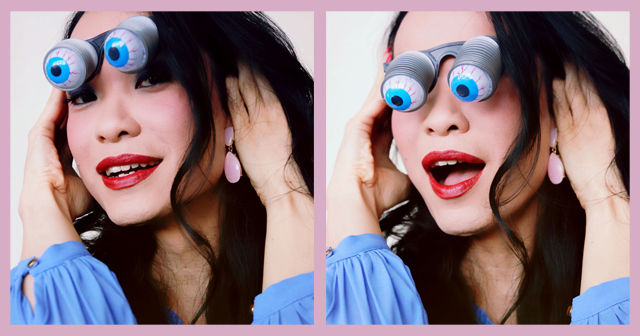
Playwright: Mary Rachel Brown
Director: Glynn Nicholas
Cast: Danny Adcock, Noel Hodda, Jamie Oxenbould, Richard Sydenham
Image by Robert Catto

Theatre review
Stories can have universal appeal, or they can be culturally specific. The two are not mutually exclusive, but it is a tall order to expect any work of the theatre to be able to explore unusual themes and contexts at great depth, while still being able to speak to everyone. Mary Rachel Brown’s The Dapto Chaser is not a work that can enthral every kind of audience, but it certainly represents a segment of society that is rarely seen on our stages, even if their existence in real life is ubiquitous and undeniable. Four men entrenched in the world of greyhound racing, staking their lives on the ambiguous divide between skill and chance. At its core, the work is about poverty and kinship, and although it can be seen as being critical of gambling, and does portray its addictive qualities as such, great care is taken to provide a sense of accuracy to the lives it depicts. The experiences resonate with a documentary-like truth, but without a watered down presentation, the play is not palatable to all.

Human resilience and the popular notion of the Aussie battler doing it tough, are expressed thoroughly and fluently by director Glynn Nicholas, who brings to the stage a microcosm of a disadvantaged family that is rarely revealed at such powerful and intimate detail. An invisible fifth character, the dog at the symbolic centre of its entire narrative, is given presence by a hint of deftly generated magical realism, but it is the hyper realistic delivery of very domestic scenarios that impress.

Four actors, all perfectly cast, each giving spectacular performances that leave no imaginable room for improvement. Richard Sydenham is flamboyant and wild as Cess Sinclair. He plays the role big and broad, but his comedy is cunningly subtle and genuinely funny. With a less than attractive character at hand, Sydenham brings to the fore unexpected tenderness and humanity at every opportunity, and we cannot help but surrender our empathy to his marvellous work. Jimmy is the younger Sinclair, more vulnerable and much less boisterous. Played by Jamie Oxenbould, whose authenticity on every level is disarmingly incredible. Oxenbould seems to refuse any glimpse of the actor, allowing us only to see the character he embodies. The show is unquestionably heightened in its naturalism, and the actor makes good dramatic use of his lines to highlight the story’s poignancies, but his creation is entirely believable, and at many points, captivating in its emotional sensitivity.

We all know the pain that comes with blood that flows thicker than water, and most of us understand the struggles of falling short at life’s promises, but our stories are not all the same. Diversity in media and the arts is a serious concern, and we must guard against the conformism that comes from a twisted misunderstanding of democracy that is determined to produce a universal blandness. On one hand, our tall poppy mindset persists, and on the other, our middle class aspirations keep our cultural cringes in check. What is generally acceptable, becomes narrower by the minute. Small stories are necessary, because it is in the deep excavation of a singular site, that the most meaningful inspirations can surface, even if they are not immediately accessible to every Tom, Dick and Harry.

www.apocalypsetheatrecompany.comwww.griffintheatre.com.au

Suzy Goes See’s Best Of 2014

sgs-best2014

2014 has been a busy year. Choosing memorable moments from the 194 shows I had reviewed in these 12 months is a mind-bending exercise, but a wonderful opportunity that shows just how amazing and vibrant, theatre people are in Sydney. Thank you to artists, companies, publicists and punters who continue to support Suzy Goes See. Have a lovely holiday season and a happy new year! Now on to the Best Of 2014 list (all in random order)…

Suzy x

 Avant Garde Angels
The bravest and most creatively experimental works in 2014.

 Quirky Questers
The most unusual and colourful characters to appear on our stages in 2014.

♥ Design Doyennes
Outstanding visual design in 2014. Fabulous lights, sets and costumes.

♥ Darlings Of Dance
Breathtaking brilliance in the dance space of 2014.

♥ Musical Marvels
Outstanding performers in cabaret and musicals in 2014.

♥ Second Fiddle Superstars
Scene-stealers of 2014 in supporting roles.

♥ Ensemble Excellence
Casts in 2014 rich with chemistry and talent.

♥ Champs Of Comedy
Best comedic performances of 2014.

♥ Daredevils Of Drama
Best actors in dramatic roles in 2014.

♥ Wise With Words
Best new scripts of 2014.

 Directorial Dominance
Best direction in 2014.

♥ Shows Of The Year
The mighty Top 10.

♥ Suzy’s Special Soft Spot
A special mention for the diversity of cultures that have featured in its programming this year.

  • ATYP

End

sgs-best2014a

Photography by Roderick Ng, Dec 2014

End

Best of 2018 | Best of 2017 | Best of 2016Best of 2015Best Of 2013

Review: Unholy Ghosts (White Box Theatre / Griffin Theatre Company)

griffintheatreVenue: SBW Stables Theatre (Kings Cross NSW), Aug 27 – Sep 20, 2014
Playwright: Campion Decent
Director: Kim Hardwick
Cast: Robert Alexander, James Lugton, Anna Volska
Image by Danielle Lyonne

Theatre review (originally published at Auditorium Magazine)
We often go to the theatre for a dose of fantasy. It can be escapism that we seek, or a quest for inspiration, and it becomes easy to conceive of fantasy as a thing severed from daily lives where in fact, nothing can make good sense unless it bases itself in reality. Campion Decent’s Unholy Ghosts is mostly autobiographical. It deals with family and death, probably the most real of all concepts to undertake, and also the most difficult of things to articulate. Through art and the guise of theatrical fantasy, Decent enacts a way to analyse, heal and mourn the inevitable but deepest losses one can experience.

Family ties are uniquely challenging. Some of us are gifted more pleasant circumstances than others, but we all understand the unyielding nature of those bonds. Regardless of time and distance, only a very few can truly claim to have made clean cuts from their closest blood relations. We all know what family can make us feel, and it is that intensity of love (and hate) that makes Unholy Ghosts immutable and its effects inescapable. Decent’s writing is humorous but gentle, with a sublime melancholy that appeals to the tenderest of our sentiments. Its thorough honesty is quite confronting. We cannot resist empathising, which means that we cannot help but reflect upon the ones we hold dear, and the invisible, but persistently lingering notion of death that threatens and surrounds us.

The characters are named in the programme simply as Son, Mother and Father, and the script provides what seems to be factual information about their lives and defining events through the years, including the tragic passing of the unseen Daughter. It is a compilation of Decent’s recollections, as well as invented scenarios that help with gaining insight, or at least to find some kind of understanding, so that pain can be tamed and the living can move on. The play’s structure is hugely enjoyable. The confusion between fact and fiction, laughter and tears, victims and wrongdoers, creates a complexity that is undeniably resonant in its familiarity.

Direction is provided by Kim Hardwick, who does an excellent job of locating comedy and pathos in every moment, and allowing them to co-exist in an unusual harmony. Liberal amounts of dark humour pervades the stage, but there is also a surprising compassion that always makes its presence felt. We see resentment, anger and bitterness in the family members, but their conflicts only exist for a love that requires resolution. The intimacy of the space gives the audience easy access to the people on stage, and their terrific chemistry keeps us spellbound. Hardwick has achieved the remarkable feat of crafting a show where we fall for all of its characters at first sight. Unholy Ghosts is unashamedly sentimental, but it is also thoughtful. There are very strong emotions that surface towards the conclusion, but they are not of the wallowing type. The play keeps a level head, always maintaining a level of self-examination, which makes the sadness much more profound.

James Lugton plays the Son, a version of the playwright himself. Lugton’s emotional fortitude is a great asset to the production, for he lets us see the depth of suffering a person endures without a need for predictable and obvious gesturing. The strength he portrays is so genuine and pronounced, that it conveys the sorrow that he cannot reveal. The more he strives to keep a positive outlook, the more we hurt. It is a confident performance that deceives us with its relaxed nonchalance. It looks the opposite of melodrama, but its results are more affecting. There are moments however, where the actor seems to lose focus and he trips over lines several times, causing one to wonder if certain sections are less rehearsed. Also periodically distracted is Robert Alexander who plays Father, but like Lugton, his lapses are negligible. Alexander’s work is colourful, and the miserly man he depicts is charmingly comical and unexpectedly likable. The accuracy at which he performs the role of the “regular older man”, is brilliantly reminiscent of the literal and figurative fathers of our lives, complete with annoying quirks and disappointing imperfections. There are actors who win us over even before their first scene finishes, and Alexander is a shining example. His charisma is magical, and partnered with a clear affection for the stage, his creation is one that endears and impresses.

Mother is a creature of flamboyance and mischief, who had bought her son the Bette Midler book, A View From A Broad for his sixteenth birthday. The divine Anna Volska is electrifying. Her work ranges from outlandish and grotesque, to delicate and introspective. It is a tremendous role, and the actor fulfills every brief and requirement. Volska delivers many instances of sheer hilarity, but the delicious poignancy she invokes at every appearance is unforgettable.

Visual design is minimal and unobtrusive. No great flair is showcased, but nothing feels lacking. Sound design assists well with mood changes but several keyboard interludes are slightly too conspicuous and outmoded. In the final scene, lighting makes a drastic transformation to accompany the uplifting end. The choice to shift tone so extravagantly is questionable. It is clear that optimism and the celebration of life is a key message, but stating the case so literally may not be necessary. Also unnecessary is the compulsion to release the audience in such upbeat fashion.

The play’s happy ending however, is solid and convincing. Whether exuberant or subdued, we understand the spiritual and psychological journey that Campion Decent has taken, and we appreciate the position of enlightenment he presents. Life ends and relationships end, and it is their brief temporality that gives them value. We only wish for something to last forever when we know that its end approaches. It is tempting to declare that nothing is eternal, but the fact is that art can outlive us, and great writing endures for generations. How splendid the thought that ghosts can prevail, if the artist’s life is well lived.

www.whiteboxtheatre.com.auwww.griffintheatre.com.au