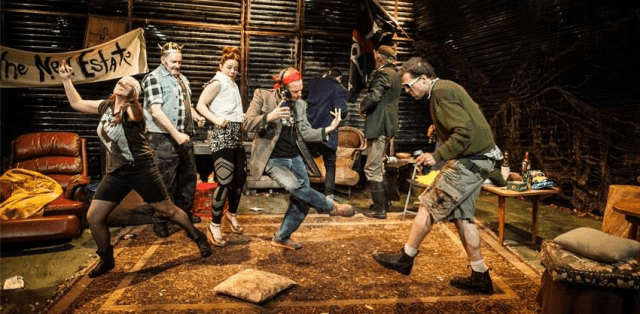
Jerusalem (New Theatre)

New TheatreVenue: New Theatre (Newtown NSW), Aug 21 – Sep 14, 2013
Playwright: Jez Butterworth
Director: Helen Tonkin
Actors: Nicholas Eadie, Jeremy Waters, Peter Nettell, Emma Louise, Peter McAllum
Image by Matthias Engesser

Theatre review
Upon entering the theatre, one is immediately struck by the power of the production design. Set design in particular is a highlight of this production. Tom Bannerman’s conversion of the stage into a dramatically evocative backdrop is absolutely essential to the storytelling. The creation of five different entrances is intelligent, and along with lighting, mood is established long before the first actor appears.

Nicholas Eadie is charismatic in the lead role. He brings variety to his performance, which provides entertainment and also creates a character that is multi-faceted and mysterious. He does however, have inconsistencies with the accent in his speech that could be distracting for some audiences. Jeremy Waters is a delightful actor, full of vigour and presence. He plays Ginger with great flair, equally confident with comic as well as dramatic moments. Peter Nettell is scarily convincing in his portrayal of Wesley. It is a very committed and genuine performance that leaves a lasting impression in spite of the part being a smaller one.

At the heart of Jerusalem is a tale about land rights and commercialism. It has interesting parallels with contemporary Australian issues involving our Aboriginal communities and how they are situated within the economy. This English play makes arguments about territorial ownership in relation to ancestry and money, and how these tensions manifest socially. If Butterworth’s ideas had been applied to a more localised context, their impact could have been even greater. Instead, the show is left intact and unmodified from its foreignness, which gives it an eccentric and exotic quality, but it demands more from the audience, as its cultural specificity is at times challenging and complicated.

www.newtheatre.org.au

A Feat Incomplete (Old 505 Theatre)

afeatincomplete1Venue: Old 505 Theatre (Surry Hills NSW), Aug 21 – 25, 2013
Playwright: Erica J Brennan, David Buckley
Actors: Erica J Brennan, David Buckley

Theatre review
This is an honest and simple work that meditates on the nature of theatre creation. It deconstructs both form and content to get to the core of what it means to make a work for the theatre. It is the process of stripping down, rather than building up, that characterises this piece.

The run time is fairly short, which keeps the delivery of ideas sharp and fresh, and thankfully prevents things from being too drawn out and self indulgent, which is a fate that tends to befall many experimental theatre practitioners. There is however, a lack of elegance in the visual elements of the production. Aside from Brennan’s red eyes and horns, and Buckley’s nudity, more work could have been put into the execution of design aspects.

Attention is placed instead on the relationship between author and muse, resulting in charming sequences that explore love and intimacy, as well as the mystical space between “dreaming and death”. The artists also deal with the notion of “story” and the tension that exists in relation to narrative structures and lack thereof, in the creation of their art. A Feat Incomplete is brave in its conscious resistance against conventions of storytelling. This is a risky undertaking that can easily lead to an overly alienating experience, but both artists give performances that fascinate and intrigue.

www.venue505.com/theatre

The Merchant Of Venice (Sydney Shakespeare Company)

Sydney Shakespeare CompanyVenue: TAP Gallery (Darlinghurst NSW), Aug 7 – 24, 2013
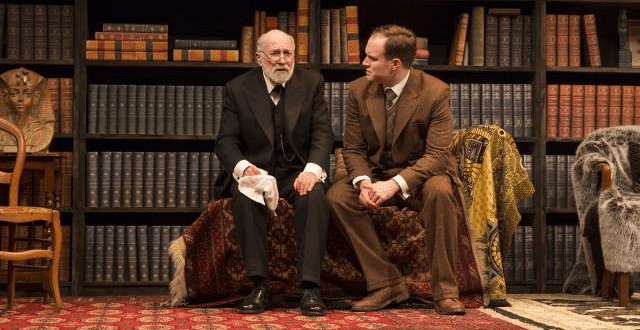
Playwright: William Shakespeare
Director: Steven Hopley
Actors: Mark Lee, Lizzie Schebesta, Anthony Campanella, Alex Nicholas
Image by Rob Studdert

Theatre review
In the modern age of advanced technology and new media, our attention spans continue to diminish at alarming rates. The prospect of sitting through any film or play that runs over 90 minutes can spell torture, but director Steven Hopley’s production makes three hours shrink into just a few blinks of an eye. It is true that time flies when you’re having fun. The Merchant Of Venice is mostly a comedy, and the cast makes full use of comic opportunities, unafraid to explore with silliness and to play for laughs. It can be argued that some of the players are engaged mainly for their ability to make us laugh, and this a decision we are grateful for.

The stand-out actors however, are the ones who excel with the drama they bring to the show. Mark Lee is by far the most accomplished of the group, and is enthralling as Shylock. Lee’s level of focus and conviction in his role brings a level of dignity to the “problematic villain” created by Shakespeare 4 centuries ago. This is an intense and disciplined performance that lifts the entire production, giving it a surprisingly polished gleam. Lizzie Schebesta brings youth and gravitas simultaneously, providing credibility to the otherwise frivolous central love story. Her strong presence holds its own within the male-dominated group, and her Portia impresses as an unexpected feminist figure (as much as the Shakespearean text could allow). Anthony Campanella plays the secondary role of Antonio, but he impresses from the start with excellent command of his lines, somehow able to make every word ring with clarity and truth.

Antonio however, has an awkward relationship with Portia’s fiancé Bassanio, The closeness of these characters is overplayed with a palpable sexual chemistry. This does not lend to the overall balance of the play, especially at its conclusion where all’s well that ends well and Bassanio and Portia are overjoyed at being together at last, with Antonio forgotten in the background. Another matter of disquiet is the handling of the anti-semitic nature of Shakespeare’s work. This production is faithful to its original vision, which does not sit well with contemporary Australian audiences and is a genuine quandary. This issue lingers on after the play has concluded, and one is left with quite shocking ideas of racial prejudice to ponder over, which of course, is never a bad thing.

www.sydneyshakespearecompany.com

Freud’s Last Session (Strange Duck Productions)

freudVenue: Theatre Royal (Sydney NSW), Aug 14 – Sep 1, 2013
Playwright: Mark St. Germain
Director: Adam Cook
Actors: Henri Szeps, Douglas Hansell

Theatre review
Theatre Royal is one of Sydney’s more beautiful theatres, usually showcasing large scale theatrical and musical productions due to its stage size and audience capacity. With just two actors and no scenic changes, Freud’s Last Session comes to Royal with extraordinary confidence. Mark Thompson’s set design is elegant, charming and effective, carefully carving out a perfectly sized performance space out of a very vast stage. It is, however, unfortunate that less attention is paid to acoustics resulting in poor volume levels for seats further back. The actors do not appear to be assisted by microphones, which is peculiar and fairly disappointing.

Henri Szeps is endearing as Sigmund Freud in his final days. His outlandish and controversial statements are presented with conviction and humour by Szeps, who presents to the audience a Freud who is unexpectedly affable. His masterful physical depiction of a feisty old man suffering from cancer is a joyful vision of experience and skill. Douglas Hansell is meticulous and detailed in his portrayal of C.S. Lewis. He delivers to the audience a sense of what London must have been like in the 1930s. Through his performance, we experience a time and place that is at once amusing and magical. The actors work well together, with a comfortable chemistry and excellent timing as a result of thorough familiarity with the material.

This is not a play with hugely dramatic moments that manipulates your emotions but its themes of religion and death are eternally fascinating, and they are dealt with with maturity, creativity and intellect. The characters see themselves as polar opposites, an atheist and a Christian, and argue engagingly about the differences in their belief systems and moralities. The play appeals to our human need to understand the afterlife and to question the existence of God, and it addresses the constant tension that resides between every point of view. Its conclusion is surprisingly universal and strangely satisfying.

www.freudslastsession.com.au

Rosencrantz And Guildenstern Are Dead (Sydney Theatre Company)

art-hamlet-202-620x349[1]Venue: Sydney Theatre at Walsh Bay (Sydney NSW), Aug 6 – Sep 14, 2013
Playwright: Tom Stoppard
Director: Simon Phillips
Actors: Tim Minchin, Toby Schmitz, Ewen Leslie

Theatre review
Tom Stoppard’s 1966 work is embraced by many for its extraordinary wit and intellect. Sydney Theatre Company attracts vasts numbers of audiences, and it is a brave choice to present this play that many a lay person will find too wordy, philosophical, and abstract. Big chunks of text and their associated big ideas are delivered successively and quickly, and it is a challenging experience trying to keep up with every concept being discussed. However, like many great works of art, it is not only what you understand, but also what you don’t understand that makes the consumption of it necessary and worthwhile. Art inspires and elevates, even while it confuses.

From a technical perspective, the company continues to impress. Design elements are faultless, and execution of sound and lighting are perfectly honed to a fine craft. The theatre seats 900 people but it never feels too vast, even for a show like this where majority of the action involves just two actors. Performances are excellent, with Tim Minchin’s uncanny ability to blur the line between actor and role consistently outshining his counterparts. He seems so completely natural on stage, one can hardly imagine a different “real person” existing separately when the show is over. Ewen Leslie is the real showman in this production. He creates a mischievous character, infectious in his playfulness, and setting the stage alight at every entrance. After Cat On A Hot Tin Roof with Belvoir St Theatre, and the Tony Krawitz film, Dead Europe, it is thrilling to see Leslie’s departure from dark and broody roles to one that is full of vigour and hilarity.

Rosencrantz and Guildenstern Are Dead can be considered highbrow, but it’s central theme of “life and death” is universal. Playing with words, theatrical mechanisms, philosophical theories will not appeal to all, but we can relate to the existential conundrum that is the one constant in our lives. It is infinitely more satisfying to watch Rosencrantz and Guildenstern wrestling with the meaning of life, than for one to be engaged in endless self-examination. With any luck, you might even encounter ideas that could provide some level of enlightenment and make that arduous process, sometimes known as life, a bit more bearable.

www.sydneytheatre.com.au

Friday (Sydney Independent Theatre Company)

friday2Venue: Old Fitzroy Theatre (Woolloomooloo NSW), Aug 6 – 31, 2013
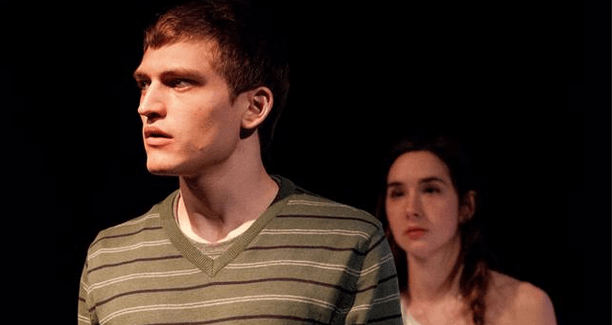
Playwright: Daniela Giorgi
Director: Julie Baz
Actors: Peter Hayes, Gemma Scoble, Gertraud Ingeborg, Cherilyn Price, David Ritchie, Sarah Robinson

Theatre review
Daniela Giorgi’s political satire has an unambiguous message. In its prologue and epilogue, the play talks about the importance of active participation being the only means to effect change in politics and in life. This all sounds very dry and serious, but thankfully, the play’s structure is exuberantly quick and sharp, with succinct scenes that get straight to the point. It has a gentle sense of humour that keeps the proceedings light and entertaining, but this same lightness does seem to prevent a couple of heavier scenes from taking flight emotionally.

Peter Hayes’ performance is strong as the lead character Bill, a well-meaning and left-leaning Minister for Transport with a penchant for colourful language. His depiction of a gentle giant in government is endearing and central to the empathetic effectiveness of the narrative. Cherilyn Price is eminently believable as a well worn public servant, and provides some of the most genuine and lively moments. There are good performances from other members of the cast, but many suffer from playing their roles too plainly, resulting in two-dimensional, archetypal versions of “people in government”, “media types”, or “tourists” that on occasion fail to translate with much credibility.

There are lots of characters and many different ideas, but they all add to the tale, with none allowed to slow down the pace. The story is told with crystal clarity in spite of all the frantic action, and it is to the credit of both writer and director, that the audience is always connected to the plot. Colourful and delightful diversions are introduced throughout the play, entering and exiting seamlessly. It is noteworthy that spacial and psychological transitions that happen between scene changes are established with great flair. Friday might not hold the key to the great political challenges of our times, but it does showcase those challenges well, and presents them in the guise of a great night at the theatre.

www.sitco.net.au

Fireface (Stories Like These)

FIREFACE   Production PhotosVenue: ATYP Under The Wharf (Walsh Bay NSW), Aug 1 – 17, 2013
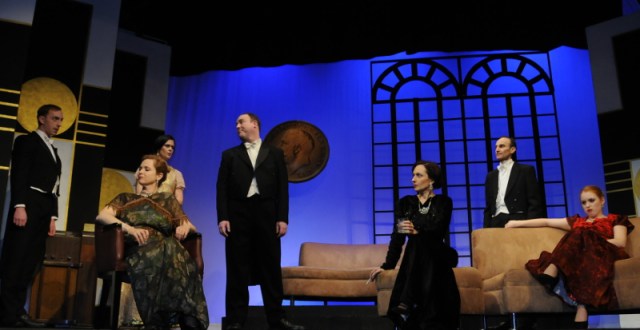
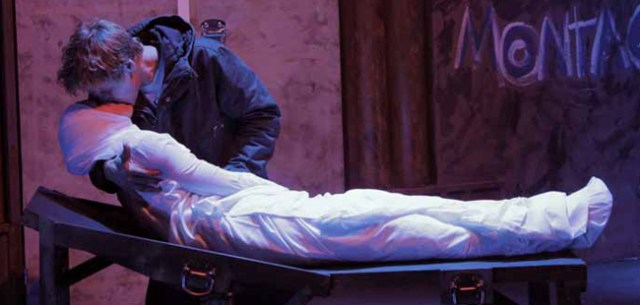
Playwright: Marius Von Mayenburg, translated by Maja Zade
Director: Luke Rogers
Actors: Darcy Brown, Darcie Irwin-Simpson, James Lugton, Lucy Miller, Ryan Bennett
Image credit: Phyllis Wong

Theatre review
The “nurture vs nature” debate is always a lively one, so building a play around that theme almost guarantees an exciting and instantly controversial exercise. Director Luke Rogers’ take on Fireface is powerful and thought-provoking. He deliberately restricts his work from providing easy answers, relying instead on the strength of the questions themselves to captivate his audience. Arguments and counter-arguments are presented with subtlety, producing theatre that is cerebral and discursive.

Set design is beautifully simple. The director’s use of the awkward wedge-shaped stage, basing all the action around a singular big table shows talent and thoughtfulness. Lighting and sound are pushed to their limit in terms of how much they can be utilised in what is essentially a narrative based play. They add to the drama, and assist with the innumerable scene changes in Von Mayenburg’s script, but are at times too noticeable and distracting. The final moments are fractured by several successive black outs, which unfortunately impede the story from developing with a greater sense of urgency.

Darcy Brown stars in the lead role and turns in a stunning performance. In addition to his enigmatic charisma, his artistic choices always feel just right, and the character he has created is simultaneously strange, compelling and frightening. James Lugton plays the distant, withdrawn father with painful accuracy. His role might be characterised by stupefying inanity, but the actor’s every appearance is entrancing. This is a strong cast, and their cohesion within the show’s unusual style and tone is thoroughly impressive. Together with Rogers, the work they have created here is intellectually demanding, and an artful triumph.

www.storieslikethese.com

Dangerous Corner (The Genesian Theatre)

Dangerous Corner 1Venue: The Genesian Theatre (Sydney NSW), Jul 5 – Aug 10, 2013
Playwright: J.B. Priestley
Director: Peter Lavelle
Actors: Elizabeth MacGregor, Elinor Portch, Amy Fisher, Tom Massey, John Grinston, John Willis-Richards
Image credit: Craig O’Regan

Theatre review
Dangerous Corner was first staged in the early 30s, and this production is faithful to that era in every way possible. Every effort is made to provide a glimpse into early twentieth century England, without any distractions in gratuitous attempts at bringing the show “up to date”. The undeniable charm of the period is experienced through costume design, acting style and of course, The Genesian Theatre itself with its wondrous vintage space. Modern theatre cultures in the last thirty years, have been intently concerned with the dismantling of live performance traditions, but in director Peter Lavelle’s vision, the proscenium arch and all that it represents is revived, honoured and adored.

Hair design is beautiful and highly accomplished. Minute details and secondary elements in a production like this play a big part in winning over its audience. Set design is effective but somewhat minimal. There are no changes and movements to the stage set pieces, so one can imagine that further ornamentation could have been introduced fairly easily to enhance the sense of luxury and wealth of the characters.

Elizabeth MacGregor plays Olwen Peel with a quiet confidence. She takes command of the stage with her effortless and exquisite physicality, gesturing and gliding from one position to another with careful and genuine intent. Her lines are delivered with superb clarity, and this is true for the entire cast who are a real treat in regard to their use of voice. Elinor Portch plays the supporting role of Freda Caplan delightfully, performing with precision even when in the background, always listening and reacting appropriately, thereby heightening the effects of her co-players’ words.

The play ends spectacularly. A surprising epilogue is presented and the audience is mesmerised. Without giving too much away, it is a great few minutes of theatre that is at once fascinating and thrilling, letting one leave the theatre with a feeling that is quite thoroughly modern.

www.genesiantheatre.com.au

Romeo & Juliet (Impulse Theatre)

romeojulietVenue: King Street Theatre (Newtown NSW), Jul 31 – Aug 24, 2013
Playwright: William Shakespeare
Director: Stephen Wallace
Actors: Rainee Lyleson, Dan Webber, Byron Hajduczok, Lisa Peers

Theatre review
This production of Romeo & Juliet transports the Montague and Capulet families to modern day Sydney, casting them as “Anglo-Saxon” and “Lebanese Muslim” adversaries. This is a well-meaning decision but its execution is rather less straightforward. Differences in religious beliefs are more complex than a family feud, which is essentially what the script offers, and presents a “square peg in a round hole” scenario, as the director works hard to make this vision work within the confines of Shakespeare’s classic text.

Young actor Dan Webber plays Romeo and does a marvellous job, especially in his scenes with Juliet. He sometimes rushes through scenes due to being so high energy, but the earnestness he brings to the role is exciting and refreshing. Rainee Lyleson plays a Muslim version of Juliet, but thankfully does not “perform” the religion beyond costume choices. She is a delightful sprightly girl, and comes alive in romantic moments with Romeo. Byron Hajduczok’s Mercutio and Lisa Peers’ Nurse are stronger performances in the show, both displaying confidence in their cleverly entertaining work.

Lighting design is utilised well, especially with scene changes, providing the audience with meaningful visual cues that introduce new settings efficiently. Set design is basic but effective, allowing for a wide variation in character blocking, which is a strength of this production. The actors move freely and use the stage to their best advantage. It is to the director’s credit that he leaves no room for stagnation, always careful to keep the play moving fast and lively.

www.impulsetheatre.com.au

Two Rooms (Ledlight Theatre Company)

tworoomsVenue: TAP Gallery (Darlinghurst NSW), Jul 17 – Aug 4, 2013
Playwright: Lee Blessing
Director: Duncan Maurice
Actors: Nick Dale, Laura Huxley, Coralie Bywater, Eli King

Theatre review
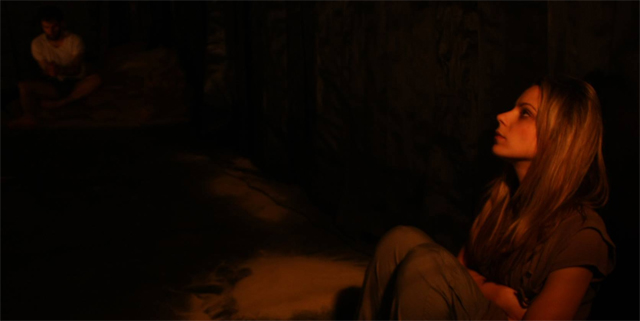
This is a story about terrorism and love. It goes into dark territory, dealing with loss and death, and the devastating failings of government. Design elements of the production are appropriately bleak and menacing. Both set and lighting work around the limitations of the space beautifully, creating a mood of foreboding that locates the story in a space of terror all post-9/11 audiences are familiar with. The theatre is totally darkened before the show begins, and members of the audience are given flash lights to navigate the way to their seats. These flash lights also allow an “interrogative process” to take place when we illuminate the actors already positioned on stage, both in states of distress, one with wrists bound and a bag covering his head. The implication of our complicity in the act of terrorism is immediately engaging, and spine-chilling.

Nick Dale’s performance as the captive, Michael, hits many right notes. He is on stage for virtually the entire duration, and the energy he is able to sustain in the portrayal of a disintegrating man gives the show its air of calamity and relentless tension. The actor’s physicality with his overgrown hair, unshaven face, and gaunt body is a manifestation of the level of commitment he brings to the role. Laura Huxley performs the depression and fear experienced by her character convincingly, and the slightness of her stature amplifies that mournful sadness. There is however, a lack of rage, or at least a more energetic edge that she could introduce, to create a more palpable sense of believability.

The play has beautiful moments when the lovers meet, figuratively or metaphysically. Perhaps sound could have been more effectively utilised to make those scenes more extraordinary, but it remains a great strength of the writing, that Lee Blessing is able to meld both worlds together. Two Rooms become one, and they become its other; it is the deconstruction of “us and them” that will always be a crucial element in the discussion of war, politics and (dare we imagine it?) peace.

www.facebook.com/…