Moving Parts (Will O_Rourke)

Colin-FrielsVenue: NIDA Parade Theatres (Kensington NSW), Jul 25 – Aug 10, 2013
Playwright: David Nobay
Director: Steve Rogers
Actors: Colin Friels, Josh McConville

Theatre review
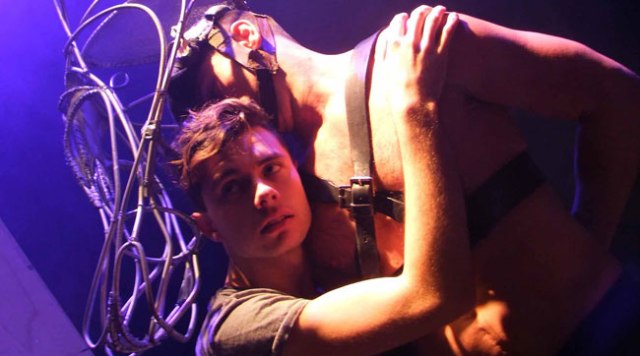
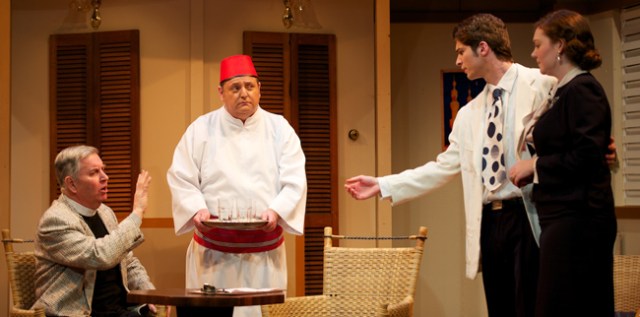
Moving Parts begins with the image of a lonely old man in a small but upscale watch dealership. Intrigue quickly follows when a second, younger man comes into the picture enquiring about a very large, expensive watch. A strange tension permeates from the start in this seemingly mundane scenario, and the audience is drawn into its irresistible allure. Soon, a series of revelations appear like little explosions, producing sequences that surprise not only with the trajectories of its narrative but also with the emotional depths it explores. This is a story about family dysfunction and love, told in the most honest way through two white male characters. The process of deconstructing these apathetic, unemotional archetypes involves the transgression of fundamental truths in family dynamics, resulting in a level of intense emotionality that any theatre-goer would relish.

Technical aspects of the production are highly accomplished. Every aspect is rendered virtually imperceptible to be in service to the actors and the story. Lighting design in particular is sensitive and meaningful, never drawing focus unto itself but always effectively assisting with the emotional fluctuations of the narrative.

Josh McConville plays Sean, with great internal fortitude. His depiction of a damaged, insecure man at the end of his tether is easily recognisable and indeed, heartbreaking. Even without the benefit of a filmic close-up, the audience is able to witness through his eyes, the inner devastation from which his character suffers.

One cannot overemphasize Colin Friels’ brilliance in the role of Roy. The psychological complexity that he brings to this man, is the crux of the show. All the contradictions of being human, and all the difficulty of life itself is displayed in his very corporeality. His mental jostles in dealing with the meaning of love, fleshes out for the audience the core concern of the script. Friels surprises with the amount of physical activity he introduces into his work, embellishing his lines with so much attention to gestural detail, which not only is a tremendous joy to watch but also amplifies beautifully the emotive qualities of the play.

In spite of a somewhat rushed and unexpected conclusion, Moving Parts is a great work that investigates the universal theme of family ties deeply and truthfully. Steve Rogers’ direction and David Nobay’s writing is a potent combination, creating theatre that is passionate and enthralling. Along with the best actors in the business, they have on their hands, something very memorable and actually, very moving.

www.willorourke.com

Short Plays #1 (Tamarama Rock Surfers)

shorts1Venue: Bondi Pavilion Theatre (Bondi NSW), Jul 17 & 24
Playwrights: Jessica Tuckwell, Chris Summers, Mark Rogers, Nakkiah Lui
Directors: Kate Gaul, Corey McMahon, Phil Spencer, Matilda Ridgway
Actors: Sandie Eldridge, Lorna Munro, Huw McKinnon, Madeleine Levins, Simon Corfield
Image from Facebook

Theatre review
Four plays with different themes, styles and ideas, all with its own appeal. The opportunities a short play presents is manifold, but chiefly, it allows for the exploration of a single idea with minimal distraction from sub-plots, secondary characters and other auxiliary elements.

Dessert is a macabre story about marriage and death. Sandie Eldridge’s performance of a middle-aged widow impressively positions the play in a delusional psychological space but carefully presents her character with empathy and sadness.  The balance between shock value and sensitivity in this work is exquisite.Washer Woman also features a lone female character. Jessica Tuckwell’s script is poetic and abstract, and Madeleine Levins brings to the piece enough tension and drama to create a semblance of narrative to keep its audience engaged.

The Buck tackles mateship and Aussie bloke culture. The piece creates a formidable air of violence in the theatre, effectively focussing on the dark side to contemporary Australian lives. Similarly working with danger and brutality is Ideginaiety, which presents a harrowing perspective of revenge and colonialism. This is an interesting exploration into indigenous culture through a prism of metaphysicality and crime. The structure of the script and the brave choices it makes is original and powerful, and definitely warrants an extended rendering.

www.bondifeast.com.au

My Life In The Nude (La Mama Theatre)

maudeVenue: La Mama Theatre (Carlton VIC), Jul 3 – 21, 2013
Devised and Performed by: Maude Davey
Director: Anni Davey

Theatre review
Maude Davey is a living legend in the Melbourne burlesque scene, having performed over 20 years in varying stages of nudity, combining various forms of theatrical disciplines. In this swan song My Life In The Nude, Davey takes an intimate look back at that career, presenting memories in monologue sequences, as well as performing key burlesque/cabaret pieces, almost in a “greatest hits” format. She reprises a 1991 competition winning work involving a secret strawberry, which kick started her work exploring nudity, and goes through a phenomenal repertoire, culminating in an emotional Butoh-style work about ageing, with a character reminiscent of Grizabella from the Cats musical.

Even though every sequence is meticulously choreographed and always packing a powerful political punch, tenacious in the representation of queer and feminist ideologies, it is ultimately the presence of the artist that makes the show the masterpiece that it is. Davey’s craft is honed to perfection. The audience simply has no where to run when she is onstage, lost in her charisma, her humour, her every gesture and every poignant utterance. Davey imbues each moment on stage with great reverence and generosity, and it is in that spirit of giving of her self that we find ourselves in awe and in the receiving end of a rare gift, not just of masterful showmanship but also of sheer naked humanity.

www.lamama.com.au

Say Hello First (Cupboard Love)

sayhellofirstVenue: Old Fitzroy Theatre (Woolloomooloo NSW), Jul 2 – 27, 2013
Playwright: Danielle Maas
Director: Jason Langley
Actors: Danielle Maas, Joe Kernahan

Theatre review
Not all subject matters and themes can be universal, but a performance needs to know its audience if it intends to communicate (and one would argue to keep your show in your living room should communication not be of any concern). Of course, we would like to think that there are shared fundamental truths in our human experience that connects between lives, but sometimes, one man’s meat is indeed another man’s poison. Say Hello First concerns itself entirely with romance and its implications on one’s self-image. It assumes that these themes are intrinsic and elemental, but for those who do not appreciate them quite so naturally, this play can present quite a challenge. There is no exploration into the autobiographical protagonist Danielle’s huge interest in the idea of “boyfriends” and her insistence at utilising them as mirrors into her own existence, and this is problematic for some audiences who might fail to understand this fixation. Appropriately, she is left stranded at the end of the play, bewildered by the inexplicability of it all.

From a technical perspective, design elements provide a gravitas to the production. Lighting and set are accomplished with a good level of professionalism. There is a strong reliance on projections, and those visuals are thoughtfully curated and presented. The set makes good use of the studio, establishing a space that enhances the intimate quality of the actors’ performances, and also provides an aesthetic that is delightfully whimsical (a quality the script seems to crave).

Joe Kernahan plays the objectified male through many different guises with great confidence, and brings a sense of lightness to the proceedings. Watching an actor have fun on stage is always a joy, and Kernahan certainly comes across as though there is nowhere else he would rather be. His dedication is impressive and along with his charming, spritely demeanour, would surely see him feature in more substantive work in the near future.

www.sitco.net.au

The Twelfth Dawn (Old 505 Theatre)

twelfthdawnVenue: Old 505 Theatre (Surry Hills NSW), Jul 3 – 28, 2013
Devised and Performed by: Kerri Glasscock, Gareth Boylan, Michael Pigott

Theatre review
This original, unorthodox work tells a story to your heart first, before your brain is allowed to discover the logic behind the emotions. It is at times a dance performance, sometimes a surrealist exploration, and on occasion naturalism sets in when you least expect, but through some unfathomable genius, all these forms are blended together seamlessly. The Twelfth Dawn takes its audience on a journey of the senses and emotions, but removes the reliance on conventional, narrative driven storytelling. A key to the effectiveness of the work, is the empathy its players are able to elicit from the audience in spite of the lack of a story. It is a very pleasant surprise that experimental theatre can look so real and feel so emotional. Within this realm of avant-gardism, all three artists are of the highest calibre.

Michael Pigott creates a character palpable in its authenticity, relying on his extraordinary physical dexterity as well as restrained but precise facial expressions. Kerri Glasscock’s capacity at portraying intense emotions anchor the work in a place that is dark and honest. The level of fragility and vulnerability that she brings to her performance is confronting yet seductive. Gareth Boylan provides the bridge between the audience and the stage action. His timing is impeccable, jumping in and out of the world in which “the couple” inhabit, breaking tensions and moving courses.

The theatrical arts is at its best when all the actors’ facilities, beyond words and speech, are employed, and The Twelfth Dawn is a prime example of what can be achieved. It is disappointing to report that there were less than ten in the audience last night, presumably because an “important sporting event” was taking place simultaneously. It is however, incredibly fortunate that Sydney can give rise to the production and staging of a work of this quality, even if it does struggle to find a bigger audience.

www.venue505.com/theatre

Haus (Black Raven Productions)

Haus at the Tap Gallery 9th 14thVenue: TAP Gallery (Darlinghurst NSW), Jul 9 – 14, 2013
Playwright: Dimitri Armatas
Director: Dimitri Armatas
Actors: Ruth Murphy, Jorjia Gillis, Paddy Lester, Zacharie Di Ferdinando

Theatre review
A small stage, at a small venue, telling a little tale, set in a tiny cellar, with simplicity and elegance. This is bare bones theatre, but with charming and meticulously thought out set and props. The script fits in perfectly with the space. All the action convincingly surrounds a table, content in the production’s budgetary and spacial limitations. Some effort is made with lighting to provide variation in mood and tone, but while design is effective, its realisation is unsteady. Perhaps the equipment lacks the flexibility required for its desired effects.

The story itself is a dramatic one, set in Nazi occupied Poland. The central theme of family allows some level of identification but the historic nature of the work is alienating. A good amount of tension and emotion is achieved, principally through the determination and stamina of actor Ruth Murphy, but one questions the relevance of a tale that seems to bear no contemporary parallels, and no obvious allegorical applications.  Additionally, the female characters are bewilderingly weak, and their powerlessness is discomforting and distracting.

Jorjia Gillis is miscast, but shows great potential. Although lacking in maturity, she has good presence and displays an unwavering devotion to her matronly character. Similarly, Paddy Lester shows great promise with a natural charm and has good physical agility that seems to elude most young actors. The aforementioned Murphy is a real talent, taking charge of the entire play through sheer grit and with meaningful clarity. Her thorough understanding of the play’s inner workings shows a very intelligent actor who understands not just acting, but also writing. She outshines other members of the cast at the play’s climax, and performs with such intense emotion that one is reminded of early twentieth century German Expressionism, which is completely delightful and suits perfectly the context of the work.

Director and playwright Dimitri Armatas is a brave young man with an idiosyncratic vision. Artists with original voices stand the test of time. There is no doubt that his creative facilities will flourish and the Armatas voice will reverberate for years to come.

www.facebook.com/…

Top Girls (New Theatre)

New TheatreVenue: New Theatre (Newtown NSW), Jul 9 – Aug 3, 2013
Playwright: Caryl Churchill
Director: Alice Livingstone
Actors: Sarah Aubrey, Claudia Barrie, Julia Billington, Maeve MacGregor, Ainslie McGlynn, Bishanyia Vincent, Cheryl Ward

Theatre review
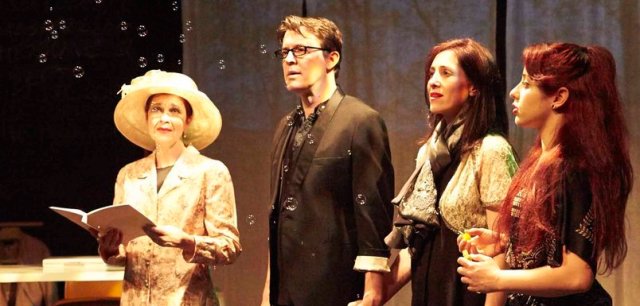
Top Girls first appeared on the English stage 31 years ago in the Thatcher era. While feminism has evolved since that time, it is a concept that remains relevant, and to many, still a critically meaningful one. This landmark play is known to posit individual career successes of women as being similar to or even an extension of traditional patriarchy, thus retarding the gains of a common “sisterhood” movement. Times have changed, and Alice Livingstone presents a less critical view of that individual success, although carefully retaining the original intentions in espousing the importance of the collective, as though acknowledging that women’s choices today are all valid in their wild variances.

The surreal first act presents a group of historical women at a dinner party, all talking over one another, as if presenting monologues to very uninterested, self-absorbed listeners. This makes for difficult viewing, but establishes a context for the narrative that follows. This sequence also introduces the actors who very efficiently take over the space with tremendous confidence and in spite of the arduousness of the script, are all fascinating, convincing and importantly, very vigorously rehearsed. When the more conventional narrative begins in Act Two, these women seem to burst into life, presenting characters that are all flesh and blood where everything they say and do seems completely real. Livingstone has a knack for making every second count and every line meaningful. This is a group of actors who cherish every word, and nothing is left to waste. It is indeed an irregular occurrence at the theatre that one gets to be lost in the events unfolding, enthralled in all the action, hungering to see what is about to happen next. Julia Billington and Sarah Aubrey’s sibling rivalry, along with Claudia Barrie and Maeve MacGregor’s youthful innocence are at turns heartbreaking, and glorious.

Getting wrapped up in all the drama, however, runs the risk of distracting from the political arguments of the work. The lack of distance from the show’s magnetic characters almost encourages the audience to wallow too deeply in their individual turmoils, without an opportunity to “see the forest for the trees”. Does the enjoyment of a work like Top Girls have to muffle its subversive reverberations? Or is its agenda able to affect its viewer unconsciously? Regardless of the “big message” that this production’s audience may or may not receive, they will undoubtedly leave this theatre thoroughly sated and utterly invigorated.

www.newtheatre.org.au

Relative Merits (Lambert House Enterprises)

Les SolomonVenue: King Street Theatre (Newtown NSW), Jul 14 – 28, 2013
Playwright: Barry Lowe
Director: Les Solomon
Actors: Jeff Teale, James Wright

Theatre review
This 20th anniversary production of Relative Merits provides nostalgic value in abundance. The early 90s was a time when the Australian gay movement had reached its peak. The Mardi Gras held stronger socio-political meanings, and Sydney gays were still waiting for Ian Roberts to come out of the closet. Thankfully, some of the play’s content is outdated, such as the depiction of HIV and AIDS, which understandably colours its melancholic conclusion, but most of its themes still ring true and judging from the audience’s response, very much appreciated.

There were two moments of “television news reports” that seem overdone and probably would have been less intrusive as audio-only “radio broadcasts”, but lighting design was thoughtful and sensitive. The show’s staging is interesting, making good use of the awkward space that the theatre provides. The actors are forced to move around, encouraging a more physical performance than the script actually demands. This assists the young actors, and prevents them from being left with too many stagnant monologues. The director Les Solomon is particularly effective in the highly emotive passages (which are many). It is impressive to see the two young men deliver passionate and moving performances, not just drawing the audience into the drama of the work, but also displaying a reminder of the intensity that was fundamental to the political atmosphere of the time.

The actors are quite clearly inexperienced, and they do play things very big and loud, but their performances are compelling and serve the story very well. There is a lot of dignity and purity in their work. Their depth of understanding of the text is admittedly surprising, and it is the very clear and earnest telling of their stories that is the highlight of the show. The intimacy created on stage is undoubtedly moving, and is a real accomplishment with all due credit to both players and their director.

www.kingstreettheatre.com.au

Tiger Country (Little Spoon Theatre Co)

Little Spoon Theatre Co.Venue: Sidetrack Theatre (Marrickville NSW), Jul 3 – 13, 2013
Playwright: Jonathan Gavin
Director: Lara Kerestes
Actors: Leighton Cardno, Wade Doolan, Karli Evans, Lara Lightfoot, Matt Stewart

Theatre review
Advance promotional imagery for Tiger Country has been polished and seductive in spite of its “rough as guts” subject matter. Accordingly, visual design of this production is also exceptional. Most costume pieces are well thought out, helping to  materialise some of the most frightful and revolting characters on the Australian stage. Set design is innovative, efficient, and creates the appropriately sinister and vulgar mood in which all the action takes place. Lighting design is sophisticatedly intelligent, operated accurately and sensitively by the show’s crew. Design and stage management for this low budget production is truly incomparable.

Disappointingly, the performance feels under-rehearsed even though the actors do genuinely display a good level of commitment and discipline. Lara Lightfoot stands out with a certain interior authenticity that matches her character’s physical crudeness. In addition to the fragility inherent in the script, she brings strength and bravery that help create a fascinating and multi-dimensional role.

The pace of the entire piece feels monotonously slow, which is more fitting in its darker moments, but the show fails to buoy up in several key scenes that need to be contrastingly lighter or louder. Perhaps several edits should have been made for things to be more taut and tense. The plot tries to gravitate toward a central character, “Chuckles” who takes centre stage at the conclusion, but too many sub-plots and support characters dilute and distract from what would have been a more gratifying and direct narrative.

www.littlespoontheatre.com

Mrs Warren’s Profession (Sydney Theatre Company)

STC_MrsWarrensProfession_HelenLizzie_AM18323.jpg  788×1181Venue: Wharf 1 Sydney Theatre Company (Walsh Bay NSW), Jul 4 – 20, 2013
Playwright: George Bernard Shaw
Director: Sarah Giles
Actors: Helen Thomson, Lizzie Schebesta, Eamon Farren, Drew Forsythe, Martin Jacobs, David Whitney

Theatre review
This cast of six in Shaw’s late 19th century work is truly remarkable. All players are convincing, nuanced and colourful, and their chemistry with each other is frequently breathtaking. The two female leads are particularly enthralling, both effortless with their magnetic charisma. It is important that this mother-daughter pairing appeals to the audience symmetrically in order for the philosophical ideas in Shaw’s work to be effective, and in the case of this production, this balance is indeed one of its great strengths.

Ms Helen Thomson plays Mrs. Kitty Warren, and her performance is astoundingly brilliant. With every entrance, the stage is lit by her luminous presence, which is entirely appropriate and necessary for such a grandiose and controversial character. Thomson’s every calculated variation in her voice and perfectly designed physical gestures create not only the most alluring and commanding character onstage, but also presents a vigorous philosophical argument to the central theme of morality that could have easily collapsed at the hands of a lesser actor.

While it is easy to be lost in the actors’ magnificence, this production of Mrs Warren’s Profession explores morals, money and motherhood both effectively and intriguingly. It is a testament to the strength of Giles’ direction that the themes in this 120 year-old play still come across contentious and fascinating.

Special mention must be made of the beautiful costume and hair design, which are effectively transformative for the players, and help to create a sense of time and space within the minimal set design. The backdrop, also visually stunning, works effectively in conjuring up visions of splendid English gardens within the confines of a modern black box theatre. Music between scenes sets the tone perfectly for the action that is about to begin again.

Mrs Warren’s Profession by the Sydney Theatre Company is quite simply unmissable.

www.sydneytheatre.com.au