Review: No Pay? No Way! (Sydney Theatre Company)

Venue: Sydney Opera House (Sydney NSW), Feb 10 – Apr 4, 2020
Playwright: Dario Fo (adapted by Marieke Hardy)
Director: Sarah Giles
Cast: Glenn Hazeldine, Rahel Romahn, Helen Thomson, Aaron Tsindos, Catherine Văn-Davies
Images by Prudence Upton

Theatre review ⭐️⭐️⭐️⭐️
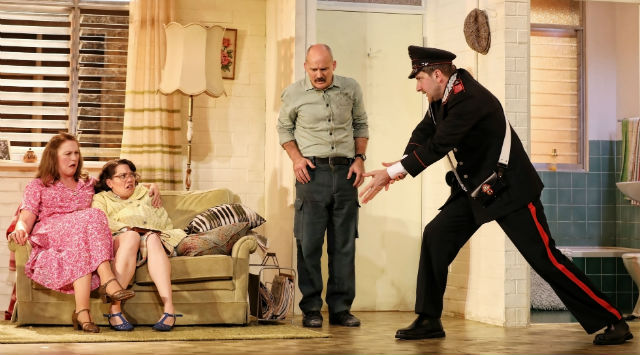
Margherita was only lending Antonia a hand with her groceries, when it was discovered that none of the goods had been paid for, and because the authorities are now on the hunt for all the women who had robbed a supermarket, Margherita inadvertently finds herself pretending to be pregnant, with bags of food hiding under her coat. Dario Fo’s No Pay? No Way! is concerned with the working class in 70’s Italy, and their awakening to the fact that the bourgeoisie has been taking advantage of them for far too long, and that it is finally time to revolt.

The absurdist comedy is adapted by Marieke Hardy, who bridges gaps of time and space, for a magnificent new version that makes the story feel pertinent and surprisingly urgent. In her process of language conversion, Hardy shines a light on 21st century Australian neo-liberalism, to create a rousing work that has us questioning the state of our economy. Director Sarah Giles’ rendering of the play is relentlessly energetic, for scenes of hilarity that tickle us from start to end. Although the laughs are incessant, hearty and thoroughly enjoyable, not one moment goes by that lets us forget the politics being discussed. Giles is as cutting as she is funny, and her production is satisfying beyond the entertainment value that it obviously offers.

A glorious set design by Charles Davis facilitates the raucous activity of characters, whilst providing evocative visual cues that relate to the sociopolitical climate being interrogated. Davis’ costumes too, help to depict a world that is distant yet resonant, allowing us to peer into somewhere far away but achieving an intimate understanding about who these people are. Lights by Paul Jackson are extravagantly designed, to create an inexhaustible sense of dynamism for the staging; his work adds powerful amplification to both comic and dramatic qualities of the play, cleverly creating imagery that keeps us invested, no matter where the story chooses to wander.

Five extraordinary talents take the stage, with Helen Thomson’s performance as Antonia setting the tone, through a sophisticated blend of dazzling slapstick and fierce intelligence. Catherine Văn-Davies adds strong commentary to her interpretation of the slightly ditsy Margherita, bringing meaningful elevation to the role, as she executes some seriously boisterous manoeuvres that has us howling. Playing the husbands are Glenn Hazeldine and Rahel Romahn, who display impressive skill not only in their impeccable timing, but also laudable in terms of the narrative depth they convey for these battlers. Aaron Tsindos is unforgettable in all of his quirky roles, wonderfully precise and confident in the wild artistic choices he invests for each of his distinct and very delightful manifestations.

When all the delicious humour comes to a crashing halt at the show’s conclusion, we face the stark reality of what the farce is all about. Dario Fo’s Marxist influences sing beautifully, and painfully, as we confront the increasingly lamentable problems of our society. Demonstrations and rallies are gradually increasing in potency on Australian streets, but truly radical action still seems unimaginable. We are unable to concede to the desperation that has become permanent in our lives, always choosing to believe that the way things are can be improved, instead of daring to completely do away with the old, so that we can be in search of something new. We fool ourselves into thinking that necessary evils are worth the good that we do possess, never allowing idealism to take us somewhere better. We are given crumbs and are expected to be content with our lot. Unlike Antonia and Margherita, who arrive at the last straw of their exploitation, we carry on hating so much of what surrounds us, believing that this is as good as it gets.

www.sydneytheatre.com.au

Review: Wake In Fright (Sydney Opera House)

Venue: Sydney Opera House (Sydney NSW), Feb 11 – 15, 2020
Playwright: Declan Greene with Zahra Newman (adapted from the novel by Kenneth Cook)
Director: Declan Greene
Cast: Zahra Newman
Images by Daniel Boud

Theatre review
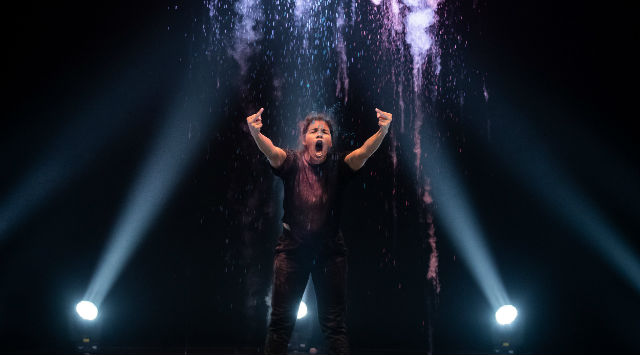
Included in the price of entry, are a pair of earplugs. There are some loud noises in the production that delicate members of the audience might want to shield themselves from, but symbolically, they are a sarcastic dig at our Australian propensity to shut out any discussion about race that goes too close to the bone. Kenneth Cook’s 1961 novel Wake In Fright is re-framed by director Declan Greene and performer Zahra Newman, so that the classic gothic horror becomes an apparatus that exposes the anxiety of the white man on this colonised land. School teacher John is trapped in a country town, where he encounters a string of dubious characters determined to inflict degradation, using alcohol and other vices, so that he turns into one of them, over the course of a weekend.

More than a tall poppy story, this reiteration of Wake In Fright is about Western masculinity’s relentless need for destruction. The Indigenous have long disappeared from fictitious Bundanyabba, but the carnage continues, now with European settlers exerting their irrepressible barbarism onto themselves. Having once been a scary movie, this bleak tale is again given the genre treatment, with outstanding work by Verity Hampson on light and projections, alongside James Paul’s thrilling sound design and Melbourne duo friendships’ intuitive music, providing eerie and meaningful discombobulation to our experience of the show. Although not frightening in a sensorial manner that films are notoriously capable of, director Greene certainly conveys powerfully, the fearsome quality of this dark tale. Aussie larrikins gone wild are not to be toyed with.

The exceptional Newman is breathtaking in her one-woman show, unforgettable for delivering extraordinary complexity with what could have been a simple story. She has us on the edge of our seats for the show’s entirety, keeping our minds active with the many dimensions and depths that she alchemizes on stage. It is noteworthy that this version of Wake In Fright works particularly well with a woman of colour at its helm. Newman’s gender and skin are constant cues that prevent us from forgetting about the masculinity and whiteness that are central to the catastrophe unfolding.

The earbuds remain a personal choice. Many will choose to ignore the obvious, because much of the power of the status quo relies on its ability to keep us feeling debilitated. It also succeeds at misleading many into insisting that the problems with society are about deficient individuals, and not the overarching systems that govern us. It is no coincidence that the horrors that overwhelm John are imposed by people who fit a particular description. We need to learn to see patterns, and form understandings that will help us in more substantive ways, than to replace bad eggs in structures that will never accommodate good ones. The outback town in Wake In Fright is sick, but we fear the overhaul that is required, and choose instead to let it languish in perpetual revulsion.

www.malthousetheatre.com.au

Review: Songs For Nobodies (Sydney Opera House)

Venue: Sydney Opera House (Sydney NSW), Jan 23 – Feb 9, 2020
Playwright: Joanna Murray-Smith
Director: Simon Phillips
Cast: Bernadette Robinson

Theatre review
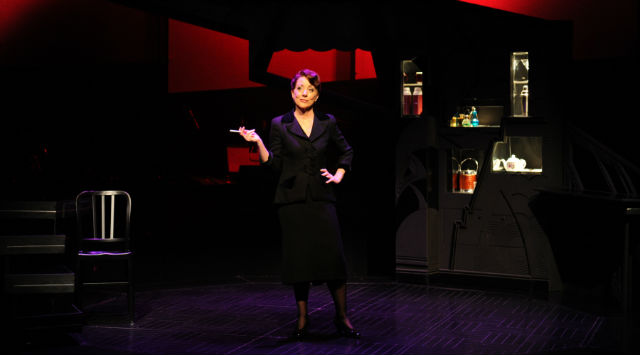
There are ten women in Joanna Murray-Smith’s Songs For Nobodies, a collection of five stories about famous singers and the ordinary lives they had touched. It is a series of juxtapositions, of diva and goddess, of women on stage and women from other walks of life, all being put through their paces in one form or another. Murray-Smith’s poignant humour works a charm, able to imbue each character with dignity along with a sense of the divine, not only for the celebrities, but also for the women-next-door that it depicts so lovingly. All women can be regarded with reverence, if we know to value them appropriately.

Bernadette Robinson is the extraordinary talent who introduces us to all the characters in Songs For Nobodies. When impersonating Maria Callas, Patsy Cline, Judy Garland, Billie Holiday and Edith Piaf, she is impressive not only for the likeness that she quite magically achieves, but also for the very virtuosity she displays in each of the unforgettable standards that she sings. Her portrayals of the every woman too, are commanding, whether American, English or Irish, Robinson is convincing, engaging and gloriously charming, able to elevate forgotten souls, as a reminder that all women are sometimes truly sublime.

Directed by Simon Phillips, the show is elegantly rendered, very subtle in approach, but nonetheless affecting. Orchestrations by Ian McDonald are dramatic and highly evocative, able to seize our imagination in a flash, to transport us through time and space for momentary immersions, that make us feel as though in the presence of legends. Scott Rogers’ lights too are notable, for their romantic warmth, able to take us away from the humdrum and the mundane, that we too often think of as the only reality.

Very few women ever get to see things from the top, but there is no rat race that we should feel compelled to participate in. More than the rich and famous, are the many examples of fulfilling and self-determined existences that are plain to see. Many of us will not know what it is like to influence millions, and to never have succeeded in accordance with stipulations of dominant paradigms, but in this current moment of a new understanding around centuries of relentless destruction, we should more than ever before, appreciate those we think of small people, who have had no power in our collective journey to impending extinction.

www.duetgroup.com

Review: Six (Sydney Opera House)

Venue: Sydney Opera House (Sydney NSW), Jan 4 – Mar 5, 2020
Creators: Toby Marlow, Lucy Moss
Directors: Jamie Armitage, Lucy Moss
Cast: Kiana Daniele, Kala Gare, Loren Hunter, Vidya Makan, Courtney Monsma, Chloé Zuel
Images by James D. Morgan
Theatre review
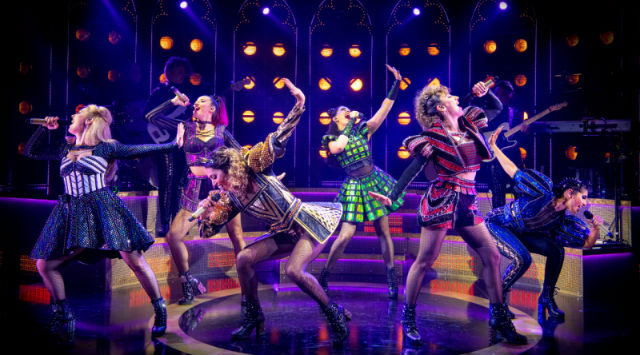
King Henry VIII of England is famous for having had six wives, and each of those women are in turn remembered only for her short reign as queen, having to share that position with many others. To tell the story of quick successions between the years 1509 and 1547, Toby Marlow and Lucy Moss create a work of musical theatre, by having the queens form a pop group in the tradition of the Spice Girls; each member bears a distinct personality type, but are collectively a cohesive whole. The show takes the form of a pop concert, comprising solo numbers during which each individual provides an account of her instalment in the narrative arc, and two group songs bookending those episodes.

Cleverly conceived, but insufficiently witty, Six feels to be squarely targeting a teenage crowd, complete with a multitude of bleeped out expletives. Composition and arrangement of music is undoubtedly joyful, and completely scintillating, and like most pop concerts, Six relies on a connection of instincts, rather than appealing to our analytical capacities. At just 75 minutes, many stones are left unturned, but the show is probably satisfying enough for those seeking light entertainment without a lot of nuance and complexity.

The six Australian performers present an imaginary girl group so dynamic and technically proficient, one can hardly recall ever seeing the real thing anywhere near this level of expertise. Kiana Daniele and Chloé Zuel are sassiest of the bunch, with presences so strong, one often wishes that the staging focuses only on their two characters, Cleves and Aragon. Funny ladies Kala Gare and Courtney Monsma bring on the laughs, as Boleyn and Howard, both with splendid timing offering a sense of much needed theatricality to proceedings. Big sentimental ballads are sung by Loren Hunter and Vidya Makan, memorable for knocking our socks off with some truly remarkable vocal acrobatics.

Six tries to offer an opportunity for the queens to reclaim power, even if they seem destined to remain in their king’s shadow. It is now the dawn of 2020, and the Duchess of Sussex has announced intention to “step back” from responsibilities as a senior royal. This comes after persistent abuse by the English press since announcement of her ascendance in 2017. It can be interpreted that Meghan Markle is in fact taking charge of her personal destiny in the most daring and radical way. We have all operated within systems not of our own choosing, but few of us have been willing to cut our losses, and go where our integrity tells us. For women, this is the difference between yesterday and today. It might be true that we continue to find ourselves inadvertently falling into situations that we recognise to be unjust, but for many of us, to disengage is now a realistic option.

www.sixthemusical.com | www.sydneyoperahouse.com

Review: Così (Sydney Theatre Company)

Venue: Sydney Opera House (Sydney NSW), Nov 1 – Dec 14, 2019
Playwright: Louis Nowra
Director: Sarah Goodes
Cast: Gabriel Fancourt, Esther Hannaford, Glenn Hazeldine, Bessie Holland, Sean Keenan, Robert Menzies, Rahel Romahn, Katherine Tonkin, George Zhao
Images by Jeff Busby

Theatre review
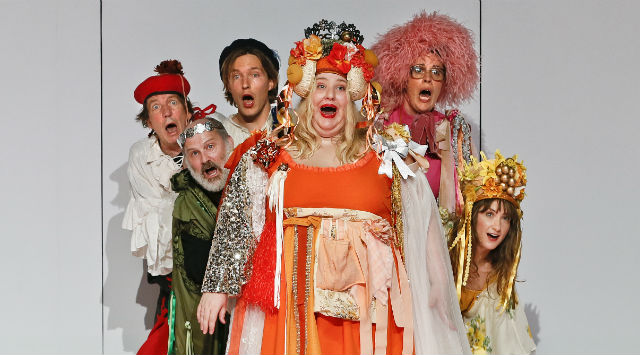
Theatre director Lewis finds himself at a mental asylum, not as a patient, but as a facilitator for a one-night-only staging of Mozart’s Così fan tutte, starring clients of the home. This is 1972, many years before deinstitutionalisation had begun, and the personalities Lewis meets are varied in capacities, but uniformly charming. Louis Nowra’s Così is a 1992 comedy with a premise that remains intriguing, but much of its humour has lost its lustre. We have learned to regard mental illness with a diminished sense of alienation, and characters in the play have lost their sense of otherness accordingly, causing many of its jokes to feel archaic.

The production is directed by Sarah Goodes, who does extensive work to reflect a modern sensibility in her iteration of Così. While it does provide an updated sense of cultural appropriateness, with a renewed perspective of people with mental health challenges, we discover that there is little at its heart that truly resonates for today’s audiences. Nevertheless, it is a smartly designed show, with Dale Ferguson’s set and Jonathon Oxlade’s costumes providing a valuable sense of playfulness. Lights by Niklas Pajanti, along with Chris Williams’ music, keep the action jaunty and energised.

Actor Sean Keenan is convincing as the unassuming and somewhat meek Lewis, a sturdy presence who lets his colourful counterparts occupy our attention. Unofficial ringmaster Roy is played by Robert Menzies, who is powerful in the role, and effective in having us invest in his passions for Mozart and classical opera. Bessie Holland is unforgettable as the brassy Cherry, impressive in her ability to deliver big laughs, even with Nowra’s dubious dialogue. Similarly charismatic is Rahel Romahn, consistently and effortlessly funny as Doug the pyromaniac, setting the stage alight at every appearance.

In Così fan tutte, people pretend to be somebody else to discover truths about themselves. Così too, features playacting, with patients of the asylum masquerading as characters in an opera, as though on a recess from their real lives. Individuals can come to new understandings of themselves, when they experience distance from their own existences. Art allows us to step out, and observe the world from a different perspective, which is an immense benefit for all of us who forget the diminutiveness of being, and the inanity of any ego.

www.sydneytheatre.com.au | www.mtc.com.au

Review: Much Ado About Nothing (Bell Shakespeare)

Venue: Sydney Opera House (Sydney NSW), Oct 22 – Nov 24, 2019
Playwright: William Shakespeare
Director: James Evans
Cast: Vivienne Awosoga, Danny Ball, Marissa Bennett, Mandy Bishop, Will McDonald, Zindzi Okenyo, Suzanne Pereira, Duncan Ragg, Paul Reichstein, David Whitney
Images by Clare Hawley

Theatre review
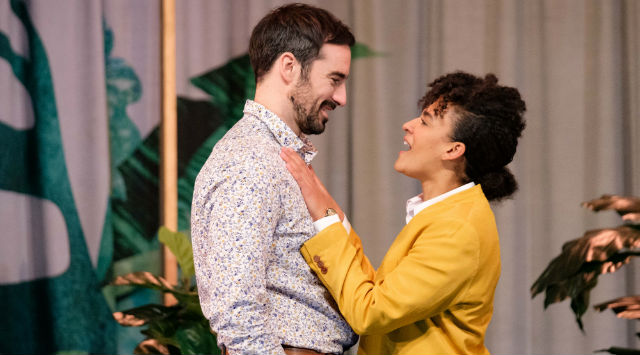
It is the classic story of misunderstandings, and the bumpy road that lovers must take, before arriving at happily ever after. Shakespeare’s Much Ado About Nothing features endless witty repartee, between idiosyncratic characters who seem to specialise only in matters of the heart. Romance takes centre stage, in an old-fashioned world that wants us to believe that nothing is more valuable than a monogamous heterosexual union.

Although rarely inventive, the production, directed by James Evans, is a joyful one, with a sense of playfulness that helps us get through the inevitable return of a perennial favourite. In the role of Benedick is an irrepressible Duncan Ragg, genuinely hilarious with his robust comedy, cleverly conceived and perfectly executed. Zindzi Okenyo plays a sophisticated Beatrice, memorable for an understated approach that works to reduce the cheese factor in Shakespeare’s play.

Hero is given emotional authenticity by Vivienne Awosoga whose efforts at instilling strength makes palatable the damsel in distress, and her gullible husband-to-be Claudio is depicted by a vibrant Will McDonald, who leaves a remarkable impression with his creative and energetic presence. Demonstrating that it is often Shakespeare’s male roles that truly shine, Mandy Bishop steals the limelight as Dogberry and Balthasar, incisive and effortlessly funny with all that she brings to the stage.

It is true, that we spend inordinate amounts of time and attention on romantic love. We seek a satisfaction unique to that experience, determined to find someone to fill an emptiness that cannot be otherwise occupied. There are things much more logical, and much more within an individual’s control, yet we stray from the possibilities of real achievement, to pursue that which is in many ways narrow and selfish. It seems that being human, we are capable of immense knowledge, but wisdom does not always mean that we act in the best interests of our species.

www.bellshakespeare.com.au

Review: Natives Go Wild (Sydney Opera House)

Venue: Sydney Opera House (Sydney NSW), Oct 22 – 27, 2019
Playwright: Rhoda Roberts
Music: Damian Robinson
Director: Chelsea McGuffin
Cast: Waangenga Blanco, Mika Haka, Beau James, Josephine Mailisi, ‘SistaNative’ Seini Taumoepeau, Samuela Taukave aka Skillz
Images by Anna Kucera

Theatre review
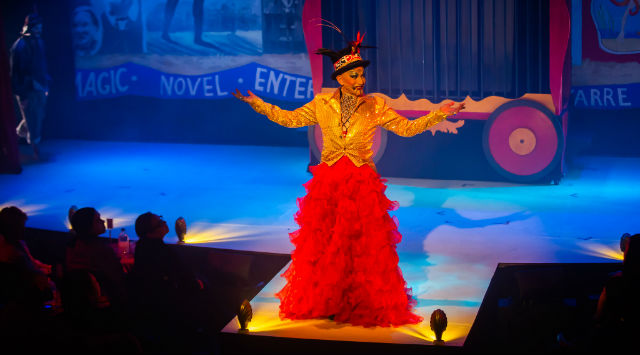
There is probably nothing more objectifying than being part of the display at a human zoo. To be placed in that position can of course be an entirely voluntary enterprise, but in the 19th century, it is likely that circumstances at fairs and carnivals were less than dignified, with the acquisition and misrepresentation of Indigenous peoples for the pleasure of gawking colonials, forming a crucial feature of the circus industry.

Rhoda Roberts’ Natives Go Wild is critical of that tradition of humiliation, of a West obsessed with exoticism, depriving people of colour their agency. In this show however, identities are reclaimed, and tables are turned, as Indigenous performers from various Antipodean regions, take charge of their narratives, telling us precisely what we need to know, about who they are and what they do.

It is a glamorous production, featuring excellent work by designers Mark Howett (set and lights) and Tim Chappel (costumes). Original songs and music by Damian Robinson are full of inspiration, contributing a sense of transcendental elevation to the staging, with singer Seini SistaNative Taumoepeau bringing remarkable soul to these refreshing compositions. Director Chelsea McGuffin is charged with the responsibility of assembling disparate elements into a cohesive whole, for a vaudeville style of presentation that asks all the right questions.

Ringmaster Mika Haka is high camp personified, but in an acerbic and confrontational style, never letting us easily off the hook. Waangenga Blanco and Samuela Skillz Taukave are mesmerising dancers, both portraying a series of legendary Indigenous figures from circus history. Aerial artist and contortionist Josephine Mailisi conveys true beauty with a physicality full of strength and discipline. The interminably charming clown Beau James delivers some of the funniest and most moving sequences, proving himself a real star we cannot get enough of.

Some might argue that colonisation has improved lives, but there is no question that the inherent cruelty of Western values, has had negative impacts on Indigenous communities that remain significant today. The persistent inability of white people to prioritise Indigenous voices have meant that their needs are consistently ignored, and their wisdom disregarded. Even as we watch the world crumble under instruments of white supremacy, it refuses to cede power, tenaciously holding on to reins that have failed economies and the environment. Unless the next stage of our collective evolution is to better incorporate those who have demonstrated actual skills of survival, the future can only be bleak.

www.sydneyoperahouse.com

Review: Hair (Sydney Opera House)

Venue: Sydney Opera House (Sydney NSW), Oct 3 – 6, 2019
Book & Lyrics: James Rado, Gerome Ragni
Music: Galt MacDermot
Director: Cameron Menzies
Cast: Stefanie Caccamo, Angelique Cassimatis, Emma Hawthorne, Luke Jarvis, Joe Kalou, Julian Kuo, Louis Lucente, Matthew Manahan, Sun Park, Paulini, Keshia Paulse, Callan Purcell, Monique Salle, Hugh Sheridan, Prinnie Stevens, Harris M. Turner,
Images by Daniel Boud

Theatre review
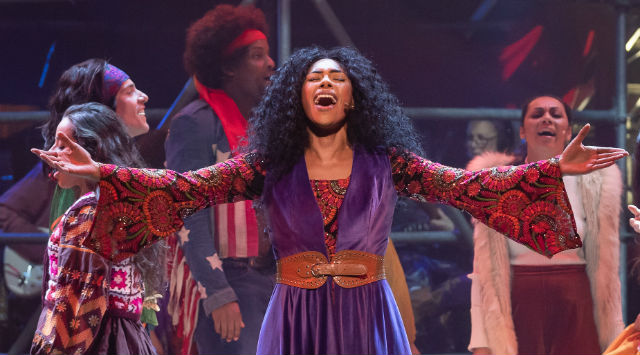
Hair debuted 1967, in the middle of the anti-Vietnam war movement. An icon of the peace-loving hippie counterculture era, the musical contains many anti-establishment elements that remain its defining feature, including the incorporation of profanity, illicit drugs, and nudity. It is the story of a New York City bohemian tribe, culminating in tensions that bring strain to the group when it is discovered that a member, Claude is being conscripted.

Act One is an exuberant cornucopia, of mischievously colourful expressions pertaining to ideals and identities of the flower power generation. Director Cameron Menzies and choreographer Amy Campbell manufacture a joyful visit to an optimistic past, enjoyable not only for its nostalgic value but also for an innocence, that proves so moving in the current bitter climate. Act Two turns serious, with the narrative shifting more firmly onto the Vietnam war, but sound engineering, although beautifully optimised for the cast’s vocalisations, does little to enhance diction in the reverb of the auditorium. Without clear enough access to dialogue and lyrics, the drama is unable to resonate. Lighting by Paul Lim on the other hand, is innovative and exciting, and together with James Browne’s spirited work on costumes, the production is a delight for the eyes.

A marvellous ensemble, full of conviction and vigour, gives us a cohesive gang of personalities, remarkably convincing in their depiction of an adopted family affair, powerful with the warmth they emanate. Matthew Manahan is a charming presence as Claude, commendable for the complexity he brings to the role. An imposing Harris M. Turner is the show’s unequivocal scene-stealer, equally impressive whether singing or dancing as Hud, the militant black rights activist. The astonishing Paulini sings some very big notes, reliably bringing the house down at each appearance. The group’s alpha male Berger is played by a tremendously likeable Hugh Sheridan, whose vivacity knows no bounds, even if completely unbelievable as a high school student.

When psychologist and LSD advocate Timothy Leary said half a century ago, to “turn on, tune in, drop out”, many were persuaded by his statement of subversion, and sought an alternative to socioeconomic and political systems that had revealed themselves to be oppressive and unjust. It seems all these years later, we are once again at a breaking point. A new generation, fuelled by the same disillusionment, is now trying to find new answers to old questions. Bell bottoms and patchouli may no longer be en vogue, but we still want peace, equity and a restorative love for mother earth, and with any luck, our efforts will have a permanent impact this time round.

www.sydneyoperahouse.com

Review: High Performance Packaging Tape (Sydney Opera House)

Venue: Sydney Opera House (Sydney NSW), Sep 18 – 22, 2019
Collaborating Artists: Phil Downing, Mickie Quick, Lee Wilson, Mirabelle Wouters
Cast: Lee Wilson
Images by Daniel Boud

Theatre review
The man assembles a whole lot of household and industrial items, including plastic chairs, oversized balloons, rubber bands, cardboard boxes, and an endless supply of packaging tape. Using them like big boys toys, he performs a series of daredevil type stunts, usually with gravity as his opposition, almost like a circus act. Except Lee Wilson is dealing entirely with physics in High Performance Packaging Tape, leaving nothing to chance, and therefore unlike the circus, we are not fearful of things going wrong. No one is at risk of plunging to their deaths, and certainly no lions are hanging around waiting to maul him to death.

In the absence of danger, our attention is then free to shift towards intellectual aspects of this physical work. We wonder what it is that compels man to place obstacles before himself, as Wilson does incessantly in his show. Questions about gender, ethnicity and therefore social advantages, begin to arise. We wonder if privilege means that a person would tend to create challenges for the self, if challenges are not already present. In 2019, if we are no longer interested in what a white man has to say about the way Australian life is experienced, it appears that we leave him to his own devices, and he goes to prove his worth by exploring his existence in spaces that seem devoid of politics, in cultural frameworks he is able to determine for himself, that can disregard all the urgent discussions being had in the real world.

It is arguable if audiences can be as easily persuaded. Some might be able to invest in the statements being made about the body, as entirely apolitical objects, scientific and subject only to natural laws of matter and energy. The rest of us will struggle to extricate our corporeality from the implications of daily stresses, unable to relate to this ethereal vacuum, where suffering and injustice are so conveniently shut out.

Within this world of childlike play, where the creators make up their own rules, the production is faultless, and very sleek, with what it sets out to achieve. The humour is sophisticated, and the stunts are original. Wilson’s nonchalant composure is a cool juxtaposition against the dramatic intensity of the visual presentations. Auditory effects are remarkably inventive, involving digital manipulations of live sounds that heighten tensions in the auditorium. High Performance Packaging Tape is quite unlike anything one has seen before, an escape from realities that not all can bear.

www.branchnebula.com

Review: The Irresistible (Sydney Opera House)

Venue: Sydney Opera House (Sydney NSW), Sep 11 – 15, 2019
Playwrights: Ariadne Daff, Zoe Pepper, Tim Watts
Director: Zoe Pepper
Cast: Ariadne Daff, Tim Watts
Images by Rémi Chauvin, Dan Grant

Theatre review
April wants to give her sister Bridget a break from motherhood, so little Cassie comes to stay. We soon discover that the child is not only a handful, she is in fact bizarre. The Irresistible too is often a strange exercise, with two actors playing a range of characters, behind translucent screens blurring our vision, and microphones altering their voices as if to say that it matters not, which actor is assuming which role.

The action is episodic, involving disparate narratives that our minds will insist on assembling a coherent picture out of, but the greatest pleasure in The Irresistible is to luxuriate in the extraordinarily imaginative approaches being applied to each theatrical moment. The magic is not in the stories themselves, but in how those stories are used to subvert our expectations, and therefore deal with what we consider to be normal in art and life. Director Zoe Pepper seems to imply that when we encounter the opposite of normal, an interrogation into who we truly are, comes to the fore. It is hard for humans to properly see ourselves, until a catalyst is introduced to turn us weird, and to force a deviation from the ordinary.

Performed by Ariadne Daff and Tim Watts, the simple text becomes springboard for experimentation, with their irrepressible desire to always manufacture something surprising, resulting in an experience that has us utterly mesmerised. The pair is outrageously inventive, both spirited in the kookiest way possible, and impossibly precise in their delivery of a technically demanding work. Sound by Phil Downing and music by Ash Gibson Greig are astonishing in their ambition and scope, daring to surpass other elements to become the most important and effective design aspects of the production. Jonathon Oxlade’s set and Richard Vabre’s lights manipulate our attention so that we cannot look away, keeping our sight intrigued and hopelessly engrossed for the entire duration.

The character Christian finds himself seduced by the performance of adult entertainer Neve, and responds by trying to dominate and consume her. At the theatre, we can never be sure how power dynamics can manifest themselves. Being capitalist, we enter with the subliminal notion that if someone is going to be the boss, the paying audience must surely be in charge. Art however, cannot let itself be subject only to market forces and the taste of the masses. It is responsible for moving discussions forward, to find advancements for our civilisation. For our society to progress, it seems artists are the only ones left willing to take the lead. We need the shock of the new, and The Irresistible is an excellent case in point.

www.sideponyproductions.com.au | www.thelastgreathunt.com