Review: The Real Thing (Sydney Theatre Company)

Venue: Sydney Opera House (Sydney NSW), Sep 9 – Oct 26, 2019
Playwright: Tom Stoppard
Director: Simon Phillips
Cast: Johnny Carr, Charlie Garber, Rachel Gordon, Geraldine Hakewill, Shiv Palekar, Julia Robertson, Dorje Swallow
Images by Lisa Tomasetti
Theatre review
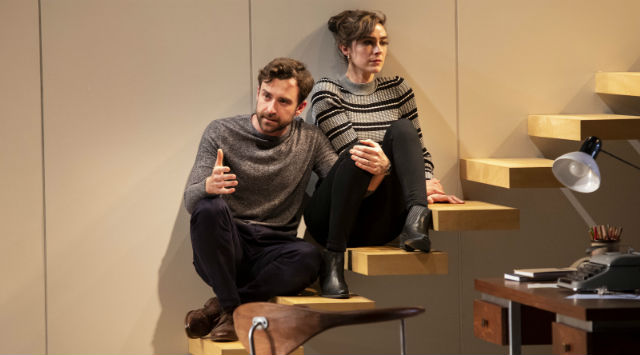
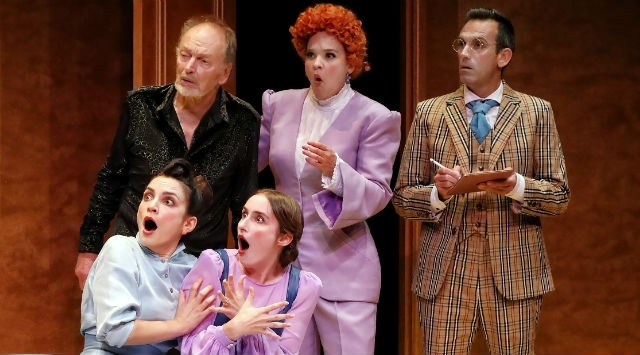
Henry has an excellent relationship with words and philosophy, which is just as well, being a successful playwright much like his creator Tom Stoppard. In The Real Thing however, we discover that his cerebral talents do not extend to matters of the heart. It is that very human conundrum we deal with in Stoppard’s extraordinarily rigorous piece of writing, that it is one thing to be able to know so deeply all that can be intellectualised, yet be unable to have much control over how one loves. People in the play are smart. Their understanding of the world is astute and penetrating, and their talk is very highbrow, but when we observe the way their feelings are being enacted, it seems there is no escaping the fools that we ultimately are.

Couples in The Real Thing wrestle with issues of fidelity. They cheat, they are suspicious, they are apologetic, and they fail repeatedly. They struggle with the need to be faithful, often engaging in discussions about the meaning of love and monogamy, but what they say have little bearing on how they feel. A constant discord exists between logic and emotions, prompting us to wonder if there can be more than one real thing in the human experience, if what we think and how we act are so often not in concurrence.

Director Simon Phillips brings remarkable clarity not only to these immediate themes, but also to the many tangential musings that make The Real Thing memorable. The density of the text is translated on stage by Phillips into a luxuriant tapestry of inspiring observations emerging from Stoppard’s brilliant mind. In the role of Henry is the sensational Johnny Carr, bringing a startling truthfulness to dialogue that could very easily be turned, under the wrong hands, highfalutin and empty. The actor’s presence and timing have us captivated, as we find ourselves enraptured, deeply invested in the many meaningful discussions that provide the foundation, for an admittedly bourgeois narrative. Geraldine Hakewill too, is engaging as Annie, a strong counterpoint in the story, effortlessly convincing with the complexity she portrays, whether playing subject or object in this tale about affection and attraction.

Production designer Charles Davis delivers a spectacular set, wonderfully imagined for the revolve stage, to facilitate poetic parallels between words and visions. His costumes are quiet but effective, able to bridge the time disparity inherent in reviving a 37-year-old work. Lights by Nick Schlieper are correspondingly sophisticated, always pleasing with the imagery he manufactures, and exacting in the way he shifts our impulsive responses from scene to scene.

It is likely that one can arrive at the conclusion that realities are multitudinous, yet there is something in our nature that cannot resist the idea that there could be a singular essence to things, that there is a fundamental truth in how we regard the world. It is as though a key exists, that life is only ever experienced as a sort of mystery that requires solving. Henry’s racing thoughts are incessant, and luckily for us, always beautifully articulated, yet we only ever see him carry on like a fool for love, as though knowledge can never live up to its promise of having the answer to everything.

www.sydneytheatre.com.au

5 Questions with Tariro Mavondo and Jayna Patel

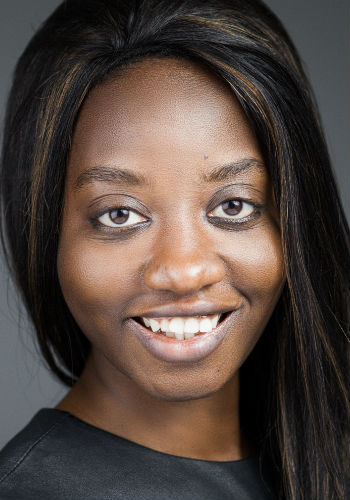
Tariro Mavondo

Jayna Patel: Do you have any pre-show rituals or routines?
Tariro Mavondo: Yes I do. My rituals usually differ depending on what the role I’m playing requires, for instance if it is a highly physical role I will do an intensive physical as well as vocal warm up. I always do a 15-30 min movement yogic sequence to get me into my body and out of my head as well as a set of personal affirmations and 10-15 min breathing meditation. A ritual for a while now has been to brush my teeth before every show to cleanse the day and enter the theatrical space of imagination, possibilities and wonder. I’m partial to candles, dim lights and soft music in my dressing room  and maybe one or two hard hitting tracks too.

If you were to recast the play with celebrities, who would you cast as who?
In line with Adena’s casting because I think she nailed it I would cast Frances McDormand in the principal role of Titus, Vanessa Williams as Tamora, Danai Gurira as Aaron, Peter Dinklage as Saturninus, Travis Fimmel as Bassianus/Marcus double, and I’d still cast Jayna, Tony and Grace because y’all stars in my eyes!

If you had the chance to have dinner with William Shakespeare, what would you ask him?
I’m interested in the theory of Emilia Bassano a black woman who was one of the first professional females writer’s in Elizabethan England having wrote his plays and the theory of her being the dark lady he refer to in his sonnets so I’d probably ask him about that. I’d also put on my best hip hop artists and ask him if he digs it because my guess is he’d be really into it!

Your purple hair for this show is so bold and beautiful! Is there anything you wouldn’t do to your hair for a show?
Thank you! Yeah I’m loving the vibrancy and vitality of wearing purple hair. I have done many things to my hair for the screen and stage there really isn’t anything I wouldn’t do I don’t think. Although my preference is keep it as natural looking as possible and not wear wigs that are closer to European hair if the character doesn’t require that. Black hair has a complete politic of its own and reclaiming the nappy kinky coil look when I can is important to me.

What’s your favourite kind of pie? (excluding Chiron & Demetrius flavour)
I don’t eat very much meat so I’d probably pick a sweet dessert pie – anything with apple. Apple and rhubarb or blueberry. Apple pie is probably my favourite winter dessert I’m also largely dairy free but cream on my apple pie is a must, haha definitely my guilty pleasure!

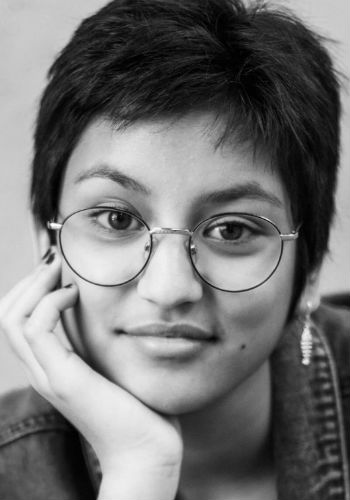
Jayna Patel

Tariro Mavondo: What has been your favourite part of making Titus Andronicus? And why? 
Jayna Patel: I love Adena’s style of theatre making because it is a collaborative process, and as a young person who often has no say in what goes on to the stage (and sometimes in life!) it’s really refreshing and empowering to have been able to contribute.

You often wear cool political t-shirts and musical theatre t-shirts, what’s your favourite? And why? 
My favourite t-shirt says ‘anti-colonial, anti- capitalist, for climate justice’ because I’m a climate activist who’s frankly quite scared for the future of the planet given the current environmental and political situation – I love being able to express my views & send an important message using what I wear! 

What drew you to wanting to work on Titus?
It’s a pretty funny story actually. Before I was sent this offer I had no idea what Titus Andronicus was, in fact I wasn’t too fond of any Shakespeare at the time! But my mum came to me and said “oh hey, there’s this Shakespeare play thing going on, and they want a 15 year old to audition, do you wanna give it a go?” and i said “sure why not!” So I hear that I actually got in and I’m stoked, and then my dad says “isn’t that Shakespeare’s most violent play?” and the excitement began there…

As your first main stage gig at the Opera House how are you feeling? And how are you managing the school load as well?
The first day we got into the venue, I was buzzing with excitement/nerves and I haven’t stopped! I cannot wait to hit the stage with this amazing team of artist and creatives. And as for school work… uh, let’s just say hopefully none of my teachers are reading this article!

Catch Tariro Mavondo and Jayna Patel in Titus Andronicus, by William Shakespeare.
Dates: 27 Aug – 22 Sep, 2019
Venue: Sydney Opera House

Review: Titus Andronicus (Bell Shakespeare)

Venue: Sydney Opera House (Sydney NSW), Aug 27 – Sep 27, 2019
Playwright: William Shakespeare
Director: Adena Jacobs
Cast: Melita Jurisic, Tariro Mavondo, Jane Montgomery Griffiths, Jayna Patel, Josh Price, Tony Ray Ray, Daniel Schlusser, Grace Truman, Catherine Văn-Davies
Images by Brett Boardman

Theatre review
War is said to have ended, but the violence of man bears a momentum that cannot be halted. Shakespeare’s Titus Andronicus involves bloody revenge between feuding parties, a cyclical phenomenon too powerful it seems, for any single human to defy. More than a fixation on murder, the play draws us into its morbid, almost fetishistic preoccupation with rape, amputation, infanticide and cannibalism. It is that pornographic quality that makes Titus Andronicus one of Shakespeare’s least celebrated work, but exploiting this weakness, it appears, can deliver surprising results.

Under Adena Jacobs’ direction, this ultramodern staging removes all the charade of having to relay a narrative, choosing instead to delve right into the dark obsessions that Shakespeare had rightly identified to be a seductive force behind his storytelling. A tale about kings and queens is constructed to mask the titillation derived from the representation of destruction, blood and gore. Jacobs’ show rids itself of pretence, in order that we may come in direct confrontation with some of our ugliest realities. We have to decide what is pleasurable and what is objectionable, acknowledge the disturbing overlaps, and perhaps most importantly, evaluate our peculiar attraction to horror. If we can understand the appeal of witnessing the grotesque in our art, there must surely be correlations with real world harm that can be identified and demystified.

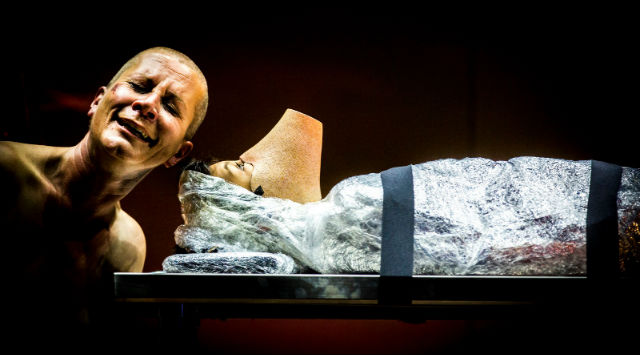
Flamboyantly macabre, Jacobs’ version of Titus Andronicus is avant-garde theatre at its most enthralling. Every scene a spectacle, as intriguing as they are outrageous. Shakespeare’s characters are portrayed to be as bizarre as they truly are, and in ridding the wolf of sheep’s clothing, we get closer to the essence of these people and of our shared inglorious humanity. Designer Eugyeene Teh does extraordinary work with sets, props and costumes, exhilarating with the freedom he expresses through the manifestation of some very wild visions. Video projections are a crucial element of the production, and Verity Hampson’s ability to seamlessly incorporate live and pre-recorded material with everything else that is demanded of our senses, makes for a series of multimedia juxtapositions that prove to be thoroughly, and unusually, satisfying. Sound design by Max Lyandvert forms a direct link with our nervous system, able to control our visceral responses with tremendous detail, in accordance with the shifting tensions being dramatically rendered.

An entirely splendid cast of performers, each one daring, inventive and spirited, present an experimental venture the degree of which is rarely seen on the big stages in Sydney. Playing Titus is Jane Montgomery Griffiths, whose unfailing emotional intensity provides a dependable anchor for us to navigate the feverishly chaotic action. The maternal quality she brings to the role prevents us from conveniently dismissing violence as par for the course in this story about warriors. Instead, we are compelled to connect with the moral dimensions that accompany each brutal thought and deed. Young actor Grace Truman leaves a marvellous impression with her conviction and focus, demonstrating herself to be an irresistible presence at the tender age of fifteen. Some of the show’s more extreme moments of performative transgression come from a radiant Catherine Văn-Davies, who uses her body to make statements about defilement in a way that is simultaneously vulnerable and defiant. In a piece that talks about people going too far, the inspired Văn-Davies certainly pushes the envelope in terms of what we have come to expect, of artistic establishments that tend to be obstinately conservative.

Amongst all the gruesome atrocities of Titus Andronicus, is something that feels like a transcendent beauty. It is clear that carnage has an alluring power; there is a part of us that loves the dark, that our capacity for cruelty, whether sadistic or masochistic, is undeniable. As audience, we are caught between knowing what is right, and wanting to see the worst. Artists are on hand to engage our imagination, sometimes for a discussion, and sometimes for catharsis. On this occasion, what we witness often seems strange, but its immense resonance demands that we look deeper, so that we find points of recognition within, that we come face to face with aspects of the self that are too hideous to address.

www.bellshakespeare.com.au

Review: West Side Story (Opera Australia)

Venue: Sydney Opera House (Sydney NSW), from Aug 16 – Oct 6, 2019
Book: Arthur Laurents
Music: Leonard Bernstein
Lyrics: Stephen Sondheim
Director: Jerome Robbins
Cast: Christian Ambesi, Matthew Antonucci, Daniel Assetta, Molly Bugeja, Olivia Carniato, Nicholas Collins, Nikki Croker, Paul Dawber, Angelica Di Clemente, Sarah Dimas, Amba Fewster, Anthony Garcia, Sebastien Golenko, Keanu Gonzalez, Paul Hanlon, Zoe Ioannou, Brady Kitchingham, Ariana Mazzeo, Noah Mullins, Natasha O’Hehir, Nathan Pavey, Sophie Salvesani, Berynn Schwerdt, Ritchie Singer, Taylah Small, Joshua Taylor, Blake Tuke, Dean Vince, Lyndon Watts, Daniel Wijngaarden, Jason Yang-Westland, Chloé Zuel
Images by Jeff Busby

Theatre review
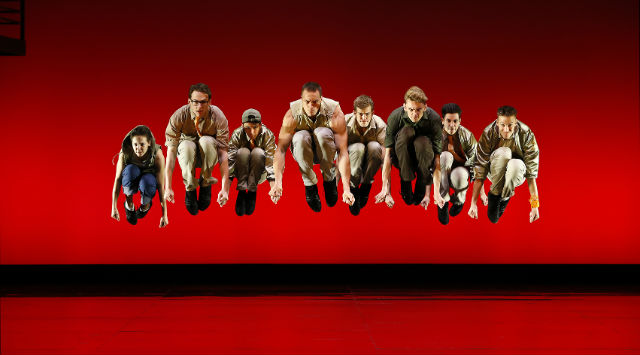
It is now 62 years, since the world was first introduced to the Jets and the Sharks, rival gangs from West Side Story, Bernstein and Sondheim’s landmark musical. Its relevance today is startling, as we find the United States in the throes of shocking immigration policies, determined to demonise those hailing from Latin America. The authentic darkness of the piece prevents it from dating, from its experimental musical styles to its thematic explorations into racial vilification, its resonances are timeless, even if the narrative seems to relate specifically to a distant time and space.

The production is highly polished, with director and choreographer Jerome Robbins’ original vision faithfully presented. Design elements no longer feel inventive by today’s standards, but the air of sophistication being conjured is unequivocal.

A tale about white supremacy, West Side Story features a group of white boys called the Jets, who spend their days taunting the Puerto Rican Sharks. Lyndon Watts is an imposing Bernardo, powerful and precise as leader of the Sharks. His nemesis Riff is played by Noah Mullins, a very peculiar casting choice given the performer’s glaringly bookish quality. Leading lady Sophie Salvesani is a suitably wholesome Maria, although rarely inspiring with her renditions of some extremely well-known songs. Daniel Assetta may not deliver a flawless Tony, but we are kept engaged by his likeable presence and surprisingly dulcet tones. The one real star on this stage is Chloé Zuel, whose Anita takes us through every gamut of emotion, impressive from beginning to end, as the proverbial triple threat.

Policing authorities in West Side Story fail to recognise the inherent power imbalance at play, as they attempt to handle the situation as though the feuding parties are equal in strength, unable to identify the victims they should protect. Minorities are routinely subjugated, when a level playing field exists only in our imagination. It is easy to place blame on the juvenile delinquents, who act out these objectionable impulses, but the problems are systemic, deeply entrenched in how we think and how we do things. The cure needs to target the root of the problem, and that will never be less than radical.

www.westsidestory.com.au

Review: Banging Denmark (Sydney Theatre Company)

Venue: Sydney Opera House (Sydney NSW), Jul 26 – Aug 24, 2019
Playwright: Van Badham
Director: Jessica Arthur
Cast: Michelle Lim Davidson, Patrick Jhanur, Amber McMahon, TJ Power, Megan Wilding
Images by Prudence Upton

Theatre review
It is very 2019 to have in a comedy, an online feminist warrior meet a leader of digital misogynistic communities, but as we see in Van Badham’s Banging Denmark, that is exactly the kind of story we need right now. Jake has run out of easy conquests, and is now setting his sights on a Danish librarian, a woman from an enlightened future impervious to his seedy charms. The quickest way to achieve cut-through, he figures, would be to enlist the help of Ishtar, whom he knows to be struggling with poverty, having just sued her through defamation law for every penny. If Ishtar is authority of all things feminist, she would clearly be the one to get Jake into a raging feminist’s pants.

Badham’s writing is keenly observed and very biting. It pours scorn on those who are deserving of insult, for an intensely contemporary experience that appeals to our very à la mode, adversarial tendencies. The work feels original in its scope and structure, a tremendously entertaining tale that proves unpredictable, rich with imagination yet entirely plausible. It bears all the characteristics of a romantic-comedy, only to subvert the narrative time and again, for a meaningful agitation of our nonsensical desires.

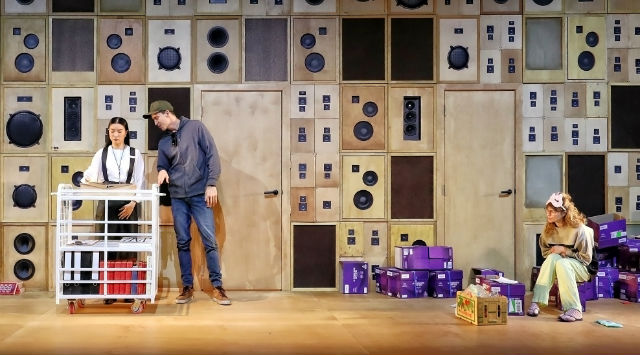
Designed by Renée Mulder, the backdrop is an imposing conglomeration of speakers, a visual delight that doubles perhaps, as a symbolic gesture pointing to our all talking, no listening culture. Director Jessica Arthur introduces just enough acerbity so that her show connects with an easy humour, whilst retaining the valuable intentions of the piece. Although consistently stimulating, the production never gets too intellectually demanding. There is a cheekiness to Banging Denmark that many will find entertaining, and with an emphasis on story over ideology, it demonstrates a prudent need to prevent itself from alienating any of its audience.

Actor Amber McMahon is full of exuberance as the irrepressible Ishtar, delivering a thoroughly enjoyable performance that is as funny as it is intelligent. In the role of Jake is TJ Power, deeply impressive with the dynamic range he brings to the staging, remarkably confident in presence, able to turn a hateful character into something believable, salvageable and human. Three supporting players, Michelle Lim Davidson, Patrick Jhanur and Megan Wilding, offer a variety of textures that make the experience a surprisingly expansive one, that urges us to think beyond the lazy binary.

If Banging Denmark‘s happy ending leaves one unsatisfied, one should probably reflect on their appetite for discord and destruction. We live in such disharmony, largely because of our own design. We have found ways to argue and fight, committed to making things better in accordance with personal perspectives, but we keep moving further and further away from all fabled notions of peace. Addiction to technology is real, and with that it seems, we have become addicted to disunity; happier to wrestle with aggression and rivalries, than to find ways for friendly co-existence. This is an age with unprecedented, and unlimited, capacity for speaking, but it can often look like no one is listening.

www.sydneytheatre.com.au

Review: The Torrents (Sydney Theatre Company)

Venue: Sydney Opera House (Sydney NSW), Jul 18 – Aug 24, 2019
Playwright: Oriel Gray
Director: Clare Watson
Cast: Emily Rose Brennan, Luke Carroll, Tony Cogin, Gareth Davies, Rob Johnson, Geoff Kelso, Sam Longley, Celia Pacquola, Steve Rodgers
Images by Philip Gostelow

Theatre review
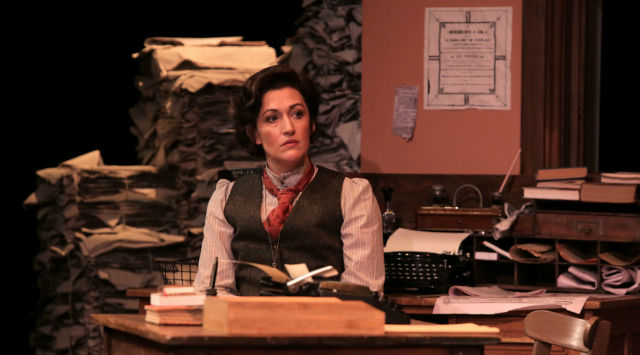
Jenny Milford has barely begun working in a news room, but is already being threatened with the sack. It is the end of the nineteenth century, and the old white men of Koolgalla’s local newspaper simply cannot imagine a woman working with them. In the meantime, agriculture in Koolgalla is at a crossroads, with old interests having to give way to advancements, or the population will have to face extinction. The Torrents was written by Oriel Gray around 1955, and although its themes are undoubtedly pertinent, it comes as no surprise that this is only the play’s second staging in over half a century. Its plot structure is awkward, its dialogue dry, and its narrative too simple.

Director Clare Watson adds to Gray’s work a lot of ornamentation, and the show becomes, fortunately, of satisfactory quality. It is an elegantly designed production, not particularly inventive with any of its renderings, but certainly accomplished with what it sets out to achieve.

Actor Celia Pacquola is spirited in the leading role, able to introduce a modern sense of sass for Jenny to remain likeable. Although crucial to the story, the character often feels insufficiently dominant in the scheme of things, with many sequences seeming to keep her excluded. The play’s title refers to Rufus Torrent, editor of the paper, and his son Ben. The former played by a sturdy, dignified Tony Cogin, and the latter, a kooky Gareth Davies, whose impulsive comedy adds a reliable and welcome invigoration to proceedings.

It is evident that all performers in The Torrents invest in an attempt to fortify their show. There is good effervescent energy, and an admirable precision to their rhythms as an ensemble, and although the staging is ultimately underwhelming, polish of this standard is always impressive.

Like the residents of Koolgalla, we need something radical to wake us up to our impending destruction. It may be narcissism, or simply fear, that keeps us from accepting the truth of ecological and technological disasters that are already in motion. It was not until the old boys club in The Torrents were able to let the first woman in, that significant change was able to begin.

The powerful is almost always conservative. Those at the top are habituated into thinking that they must protect the existing, and are thus unable to conceive of big transformations that would make things better. They keep doing things the old way, to try and reinforce the security they imagine themselves enjoying. They manufacture a supremacy, to be protected at all costs, unwilling to recognise that it is not mother nature who will be obedient, but us, who must abide by nature’s laws.

www.sydneytheatre.com.au | www.bsstc.com.au

Review: Playlist (PYT Fairfield)

Venue: Sydney Opera House (Sydney NSW), May 16 – 19, 2019
Director: Karen Therese
Cast: Mara Knezevic, Tasha O’Brien, Neda Taha, May Tran, Ebube Uba
Images by Daniel Boud

Theatre review
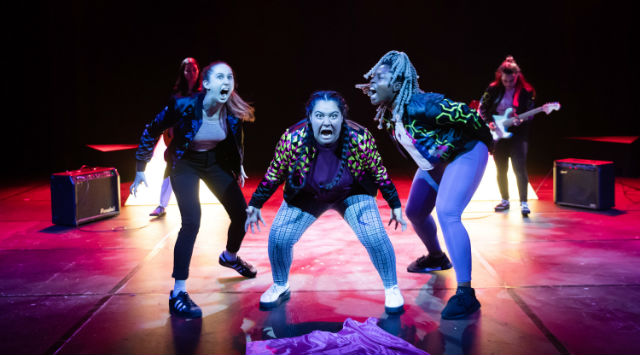
Five young women from Western Sydney take the stage, talking about themselves, driving home the point that their stories are not only valid, they are essential, should we wish to examine our lives as egalitarian Australians. For too long, these voices have been subsumed. Not white enough, not middle class enough, and not masculine enough, they have long been relegated to secondary importance in the way our national identity is construed and represented. This is not about a faded mythology; Ned Kelly, Don Bradman and Crocodile Dundee they are not. In Playlist, we encounter a devised work of theatre, that offers a refreshing and pertinent reflection of who we are, in the here and now. It is about creating a new vision of a future that addresses the social imbalances, and injustices, that have plagued us since European settlement. In Playlist, we see ourselves learning to become unapologetic women, more spice than sugar, able to occupy any space we deem appropriate.

The personalities bond through music and dance. It is a cultural discussion that requires each to talk about heritage. With roots in various continents, they gather to connect with traditions that are unfamiliar, and find commonality in popular music, alongside their shared experience of misogyny. Their bodies contain a multitude of meanings, and in Playlist, intersectionality is explicitly discussed, in words and in movement, to interrogate who we are as women, so that we may form progressive and propulsive intentions, to get us, collectively, somewhere better.

Larissa McGowan’s work as choreographer is invaluable in making the show dynamic and entertaining. She allows the expression of spirit to occur powerfully within structures that look disciplined but that feel simultaneously organic. Director Karen Therese does marvellously to bring cohesion to a diverse group of performers, with disparate styles and individual principles. An inspiring sisterhood is established through the harnessing of both similarity and difference, effective in conveying the possibilities that could arise from unions of this nature.

An extraordinarily well-rehearsed cast takes us through an entirely unpretentious theatrical exploration of a modern feminism, one that is useful today, for all Australians. They are humorous, but also disarmingly earnest with their propositions. There is great honesty on this stage, and as a consequence, we regard all they say with open hearts and minds. An immense energy pervades, physical and soulful, aided by a team of designers that join in on the conspiracy of a political presentation. Lights by Verity Hampson, and sound by Gail Priest and Jasmine Guffond ensure that Playlist makes its point every time, whether it chooses to hit us hard or to persuade gently. Also noteworthy are costumes and set by Zanny Berg, whose contemporary simplicity proves effective in helping us elicit a sense of visual resonance, to reach a deeper understanding of the nuances on display.

As migrant women of colour, we have learned to compromise our true essence, in efforts to survive a system that has us positioned low on its hierarchy of priorities. We have had to set aside our authenticity, in order that we can turn ourselves nonthreatening, and be deemed tolerable by the mainstream. In our maturity, we discover that these sacrifices have paid few dividends, so when Playlist stakes its claim on a self-determined womanhood, we can only respond with joy. These artists show us who they are, and in their revelations, we find answers to our own conundrums.

www.pyt.com.au

Review: Mosquitoes (Sydney Theatre Company)

Venue: Sydney Opera House (Sydney NSW), Apr 8 – May 18, 2019
Playwright: Lucy Kirkwood
Director: Jessica Arthur
Cast: Annie Byron, Jason Chong, Mandy McElhinney, Jacqueline McKenzie, Angela Nica Sullen, Louis Seguier, Nikita Waldron, Charles Wu
Images by Daniel Boud

Theatre review
The two sisters could not be more different. Alice is a high-achieving scientist, and Jenny is an anti-vaxxer; it would seem that all the brains had gone to one sibling, leaving the other quite the imbecile by comparison. Lucy Kirkwood’s Mosquitoes sets up a dynamic that tempts us to think in binary terms, but guides us away from forming false equivalences in our estimation of its characters. Although we see good and bad, smart and stupid, the play is able to convince us that people are people, that to determine some life as more valuable than others, would always be tenuous and quite indecent.

After one very big mistake, Jenny’s messy life appears to be going resolutely downhill. The reverberations of her self-destruction are felt by Alice, whose own existence begins to unravel, perhaps as a result of her sister’s chaotic proximity. Playwright Kirkwood sets the family drama against a backdrop of science and nature, with Alice’s career in physics providing context for us to ruminate on both the separateness and inseparable-ness of things. We isolate things to understand them, but forget their indissolubility in the bigger scheme. Our minds are able to conceive of distinct particles, but none exists in absolute detachment. Families are made of individuals, who are at once autonomous and conjoined.

Mosquitoes‘ small domestic scenes are not an easy fit on this vast stage, and although production designer Elizabeth Gadsby and lighting designer Nick Shlieper do not always succeed at containing and concentrating our vision, there is an alluring quality in the elegance that they do achieve. Some very big acting by Annie Byron, Louis Seguier and Charles Wu in supporting roles, are risky choices that prove helpful, and satisfying, in getting us involved. Director Jessica Arthur brings excellent amplification to personal emotions for the characters we meet, but her show is insufficiently provocative, able to communicate effectively only on surface levels. We want more insight into our contemporary times, and more philosophy in general, from a piece of writing that seems to promise so much intellectual rigour.

Jenny is played by Mandy McElhinney, whose humour is a striking feature, full of confidence and impressive verve. Jacqueline McKenzie’s Alice is appropriately high-strung, with an admirable intensity, although slightly one-note in her approach. Their work is assisted by James Brown’s music and sound design, who does marvellous work when tensions are rising, but is occasionally deflating, when in contradiction with the comedy being presented by the cast.

When we find Alice at the end of her tether, rationality turns her ironically monstrous, almost fascistic in attitude, as she tries to put order back into life. At that moment, the shiny appeal of her intelligence and sophistication, reveals something inhumane, and we begin to perceive Jenny’s prior weaknesses with disarming empathy. It is a magical instance of equalisation that transpires, if only in our irresistible urge to place judgement. At these times of extraordinary factiousness, there is perhaps no greater need than the urgency to look for similarities in between. In our efforts to make things better, we identify problems, and relegate them to imagined groups of others, and forget the ultimately inextricable culpability of the self. It is easy to think of the cosmos as one, but to prevent it from falling to pieces, in this day and age, looks to be impossible.

www.sydneytheatre.com.au

Review: The Miser (Bell Shakespeare)

Venue: Sydney Opera House (Sydney NSW), Mar 2 – Apr 6, 2019
Playwright: Molière (a new version by Justin Fleming)
Director: Peter Evans
Cast: John Bell, Michelle Doake, Harriet Gordon-Anderson, Elizabeth Nabben, Sean O’Shea, Jamie Oxenbould, Russell Smith, Damien Strouthos, Jessica Tovey
Images by Prudence Upton

Theatre review
Harpagon is the most miserly man you can imagine. He wants to marry off his daughter to a rich noble who has offered to waive the customary dowry, and is himself eager to marry a young woman who seems likely to be a frugal wife. Justin Fleming’s new version of Molière’s The Miser is a faithful adaptation that inflicts little disruption on the 350 year-old work, but the application of contemporary Australian lexicon refreshes it for a newly immediate experience. That we remain accustom to patriarchal structures, with mediocre men still ruling the roost in much of our daily lives, means that the very old play retains resonance. We relate to Molière’s iconoclastic spirit, but a sense of resignation pervades the play, for which our modern sensibilities should not be content with.

Designer Anna Tregloan offers a simple setting that conveys both Harpagon’s wealth and meanness, but it is her costumes that really impress. Flamboyant, colourful and unexpectedly trendy, every character is attired with an admirable level of taste and irony, perfectly coordinated to create a memorable visual vibrancy. Music by Max Lyandvert is charming, able to lure us into the story with a seductive power not unlike the irresistible magnetism of money. Peter Evans’ direction of the piece is less fanciful, with a straightforward approach that relies heavily on what each performer brings to the table.

John Bell is a convincing Harpagon, effortless in his portrayal of a very unlikable personality. More energetic members of cast leave a stronger impression, with Michelle Doake delivering the biggest laughs as Frosine, a matchmaker of sorts, demonstrating extraordinary aptitude for the classic farce genre. Damien Strouthos plays the son Cléante, deftly transforming the powerless offspring into a force of comedy, through bold physical explorations that delight, by virtue of their inventive quirkiness.

The problem with misers is that nobody seems to benefit from their obsession with hoarding. Those guilty are themselves constantly miserable, overwhelmed with an anxiety that accompanies the belief that nothing is ever enough. Everybody else is subsequently deprived of resources that are withdrawn from productivity, unable to gain necessary access for the general advancement of society. Harpagon puts his money in a cash box, allowing no one to do anything with it. What was once highly valued, is converted into dead objects. To have money means being able to do what the heart desires and what the brain can conceive. It can buy meaningless things, but it can also facilitate the betterment of countless lives. Misunderstanding the nature of money and the mismanagement of it, is responsible for so much of our ills and those who have lots of it have so much to answer for.

www.bellshakespeare.com.au

Review: How To Rule The World (Sydney Theatre Company)

Venue: Sydney Opera House (Sydney NSW), Feb 11 – Mar 30, 2019
Playwright: Nakkiah Lui
Director: Paige Rattray
Cast: Gareth Davies, Vanessa Downing, Michelle Lim Davidson, Nakkiah Lui, Hamish Michael, Rhys Muldoon, Anthony Taufa
Images by Prudence Upton

Theatre review
In Nakkiah Lui’s How To Rule The World, the government is trying to pass the Sovereign Territory Bill, a thinly-disguised piece of legislation that further advances the white supremacy cause that is already too much a part of our social fabric. Canberra insiders Vic, Zaza and Chris, are people of colour, all absolutely fed up with the state of affairs. They join forces to install a political puppet, by hiring a white male actor as a shoo-in for the senate, who will subsequently hold the balance of power required to kill off the offending bill.

It is a passionate work, piercingly funny, with an ambitious scope that even at over two-and-a-half hours, can at times feel hurried with its plot. As a result, we may not always understand with great detail, why the people do the things they do, but we nonetheless have an excellent time watching them being unequivocally hilarious. Directed by Paige Rattray, the show is exuberant, but laden with irony, and thoroughly modern in its dissection of power distribution in Australia, making no bones about the white patriarchy that corrupts our country from the inside out.

Lui herself plays Vic, a character central to the play’s advocating of a national treaty that will recognise and institute Indigenous rights, for the past and future. It is a performance memorable for its vulnerable authenticity, effortless at delivering a poignancy that stays with us, long after the laughter has subsided. Michelle Lim Davidson and Anthony Taufa are Zaza and Chris respectively, both endearing and vibrant personalities who ensure that we are always rooting for the right people. The three make a cohesive team, independently effective, but powerful as a singular entity.

The stooge is played by Hamish Michael, who breathes exciting life into an otherwise rudimentary character. His Tommy Ryan is a painfully accurate portrayal of the suits we see everyday on TV; vacuous, desperate and bizarrely comedic. The Prime Minister is a suitably deplorable man, as interpreted by Rhys Muldoon, who shines especially when his true colours are revealed in the latter half, as the going gets tough for the man on top. Gareth Davies appears in a very large assortment of roles, each of them wonderfully imagined and executed with stunning perfection, to earn the biggest laughs of the night. Also in multiple parts is Vanessa Downing, who although creates less of an impact, proves herself a dependable and unwavering source of support for the show’s louder types.

Set design is functional, and appropriately dreary in Marg Horwell’s depiction of our halls of parliament. The decision to do without set changes is a contentious one, considering the play’s frequent location changes, but to keep the action economically contained, encourages its scenes to flow quickly for the audience to remain exhilarated. Lights by Emma Valente are cleverly and efficiently rendered to shift time and space, with little noticeable fuss. Valente’s video projections include an instance of encircling sharks in the PM’s office that is particularly delightful. Paul Mac and Steve Francis provide sound and music, further perking up the proceedings, consistently reliable in their addition to the production’s humour.

We like thinking that the Western societies in which we dwell are democratic, but we also accept that there are people who want to rule the world, and we habitually acquiesce to those desires. At all our election days, each of us casts a vote, feeling as though we are an indispensable part of the most integral of processes, then we walk away letting the powerful carry on with business as usual. They climb their way up, as though determined to leave us behind. When we notice that the interests of those who have made it to the upper echelons are no longer in accordance with our concerns, we become exasperated. Injustices are felt only at the bottom, yet we wait for those on top to lead the change.

www.sydneytheatre.com.au