Review: Kindertransport (Darlinghurst Theatre Company)

Venue: Eternity Playhouse (Darlinghurst NSW), Jul 28 – Aug 20, 2017
Playwright: Diane Samuels
Director: Sandra Eldridge
Cast: Camilla Ah Kin, Annie Byron, Harriet Gordon-Anderson, Sarah Greenwood, Emma Palmer, Christopher Tomkinson
Image by Philip Erbacher

Theatre review
In 1938, an estimated ten thousand Jewish children from families in Germany, Austria and Czechoslovakia, were moved to safety in the United Kingdom, before the commencement of the second World War. Diane Samuels’ Kindertransport is the fictional story of one such child, nine-year-old Eva who finds herself sent away from Hamburg. She ends up in Manchester, north of England, eventually changing her name to Evelyn. Decades later, we discover that she has all but forgotten her life as a Jewish child. To leave the past behind, Evelyn’s survival instincts have created a kind of amnesia, in order that she may make the most out of her present circumstances. The play is about the relationship between yesteryear and today, and how our histories are constantly under threat of obliteration.

There are many theatrical works about Jewish experiences during the Nazi era, and Kindertransport can often feel generic in its approach to telling its story. It is a narrative that has to be reinforced, because there are wounds yet to be healed, and antisemitic threats have yet to disappear. There may be nothing particularly unpredictable about the show, but its capacity for the expression of genuine emotions, is nonetheless valuable, in the ongoing process of catharsis for many who continue to be affected by events of the war.

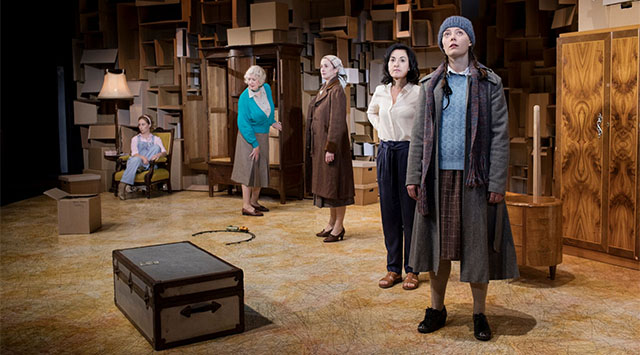
Sandra Eldridge’s direction introduces a gentle touch, working on the tenderness between characters rather than on exploiting the more sentimental elements of the play. Sections can feel underwhelming, with dramatic tensions kept subdued, but a highlight occurs in a fantasy sequence where Evelyn confronts her mother, both speaking as adults, putting to words their respective struggles. Actors Camilla Ah Kin and Emma Palmer find remarkable chemistry in this moment, and the stage becomes briefly incandescent. Also noteworthy is set design by Imogen Ross, with a backdrop composed of open cardboard boxes, symbolising the movement of peoples and cultures, as well as the human need to bring illumination to our darker inner selves.

There is much to be sad about what Evelyn has had to endure, but it is her ability to emerge strong and flourished that should be celebrated. None of us should hope to reach our graves unscathed by the ravages of mortality, if we are to seek a life well lived. It may be considered unfortunate that some of us have had to abandon religion, tradition and culture in order to find a way forward, but survival is key, and we must attain it however possible.
www.darlinghursttheatre.com

Review: Dry Land (Mad March Hare / Outhouse Theatre Co)

Venue: Kings Cross Theatre (Kings Cross NSW), Jul 28 – Aug 19, 2017
Playwright: Ruby Rae Spiegel
Director: Claudia Barrie
Cast: Sarah Meacham, Michelle Ny, Patricia Pemberton, Julian Ramundi, Charles Upton
Image by Marnya Rothe

Theatre review
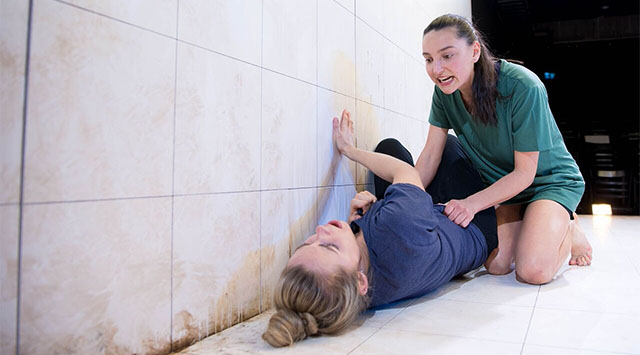
Teenage years are but a flash in any lifetime, yet they are the most formative, and in many cases, offer the most exciting of experiences and memories. Before we are tamed into adults, and before we understand the price to be paid for every decision, the teen is a new person unleashed from childhood, ready to explore all that had been previously prohibited. In Dry Land, Ruby Rae Spiegel writes about the locker room at a girls’ swim squad, except where we expect banter, we discover some very hard truths being learned. Amy and Ester are in the process of figuring out the women they want to be, and with the bravery and fortitude they had gained from training in elite sport, they put themselves through the most brutal loss of innocence.

These fearless characters see the immensity of the world and rush head-on to devour its every promise, limited only by that same flesh and blood that is determined to keep each of us contained. It is a story about the spirit of youth, and how every person has to come to terms with their own corporeal limitations, as well as those psychological and social. Ester is fighting tooth and nail to excel in her swimming, while Amy exploits every resource to obtain an abortion without parental consent. They know what is best for them, regardless of our judgements, and Spiegel’s ruthless need to put on display every explicit detail of their confronting endeavours, makes Dry Land an extremely edgy work of theatre that challenges our personal and collective values.

It interrogates notions of youth and gender, and seeks to dismantle bourgeois constructs that dominate discourse in Western art. Claudia Barrie, as director of the piece, demonstrates a real passion for those subversive and feminist ideals, in her creation of a work that is absolutely uncompromising and forceful with what it has to say about our realities, and their accompanying structures of artifice, pretence and hypocrisy. Collaborative outcomes with designers are perhaps slightly predictable, but their efforts are undeniably effective in the production’s ability to manufacture atmosphere and pace, keeping us completely engaged with its narrative.

Barrie’s strength as guiding light for actors, shines brilliantly in Dry Land. All performances, including Julian Ramundi’s very small part as the apathetic Janitor who has seen it all before, are deeply evocative and resonant. No stage moment is allowed to go to waste, and we are thus enthralled. Sarah Meacham’s explorations as the ambitious Ester are as exhaustive as they are delightful. A character study that feels utterly intelligent and inventive, Meacham elevates the show from one that can easily be monotonously dark and serious, to something that is unexpectedly very funny, and overwhelming with compassion. Her comedy sits mischievously under every expression of trauma, giving Dry Land a unique quality of tragicomedy that brings perverse joy to those who can stomach it. Amy is played by Patricia Pemberton, whose resolute refusal to portray a simplistic victimhood, compels us to interpret her grievous circumstances beyond its instance of desperation. It is an extraordinarily rich and defiant personality that Pemberton presents, one who demands admiration over pity, and who reinforces the female as gloriously sovereign and interminably powerful.

When we look back at the salad days of one’s youth, it is with contradictory feelings of pride and embarrassment, exhilaration and regret. No matter how we choose to regard the past, there is no denying that the tougher the lessons, the greater we are today in every aspect of being. We have to try always to protect our young, but allowing them to face difficulty in every mishap and blunder will, as they say, build character. The young women we encounter in Dry Land are caught in a snapshot of suffering and struggle, but their futures are not diminished, only emboldened and bright.

www.madmarchtheatreco.com | www.outhousetheatre.org

Review: The Verbatim Project (Canberra Youth Theatre)

Venue: ATYP (Walsh Bay NSW), Jul 19 – 22, 2017
Director: Katie Cawthorne
Cast: Jean Bennett, Jasper Kilby, Denise Druitt, Jack Hubner, Katie Hubner, Merilyn Jenkins, Carol Mackay, Charlotte Palmer, Sao Hom Palu, Yarno Rohling, Diana Sandeman, Kate Sherren, Elektra Spencer, Ted Stewart, David Turbayne, Quinten Van Rooy

Theatre review
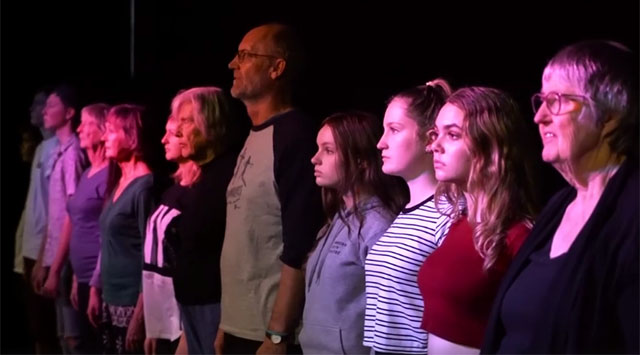
The cast is comprised of ten young Canberrans, from 14 to 16 of age, and six seniors, 65 to 80 years old. The Verbatim Project is a conversation across generations, offering an opportunity to look at how we contrast, and how we are consistent, within this unusual juxtaposition of peoples.

In their show, we hear thoughts about things that matter to Australians today, political, social and personal, through a wide variety of theatrical devices that help keep things interesting. Sound and video recordings, accompany the live physicality of its performers, consciously presented in movement and installation; using a multi-faceted approach to speak, without the use of a conventional narrative.

Director Katie Cawthorne and lighting designer Brynn Somerville, have structured a show that reveals the best of its cast. It is not a professional troupe, but all their strong suits are sensitively emphasised, with no distractions permitted to shift us away from a tightly assembled production. The text can sometimes be refreshing, but is generally predictable, with nothing controversial ever finding itself in the mix. It is a middle class look at middle class Australia, polite and well-meaning, and very civilised indeed.

There is a rigidity in The Verbatim Project that prevents anything from going wrong, but because nothing is left to chance, we are rarely able to discern the genuine connections between the personalities we meet. They are all too busy following instructions to let us in, on something more impulsive or spontaneous. Behind smoke and mirrors, we never really discover if the chasm of half a century can be bridged. Age can be made irrelevant, or it can mean everything.

www.cytc.net

Review: Under The Covers (Hayes Theatre)

Venue: Hayes Theatre Co (Potts Point NSW), Jul 19 – 23, 2017
Playwright: Matthew Mitcham
Director: Nigel Turner-Carroll
Cast: Matthew Mitcham, Rhys Morgan, Matthew Ogle

Theatre review
It has been 9 years since Matthew Mitcham won a gold medal at the Olympics for his diving. At 20 years old, he was on top of the world, having the time of his life, bathed in glory. Normalcy afterwards, has been understandably challenging. Under The Covers is a cabaret presentation in which Mitcham searches for something satisfying, in his current status as a retired athlete. It is an experience we rarely encounter, a young man having to come to terms with the idea that his best days are probably over. He names his state of anxiety, “midlife crisis”, which is outlandish for a person in his twenties, but Mitcham helps us understand his emotional struggles in this earnest, if slightly clumsy, string of autobiographical disclosures.

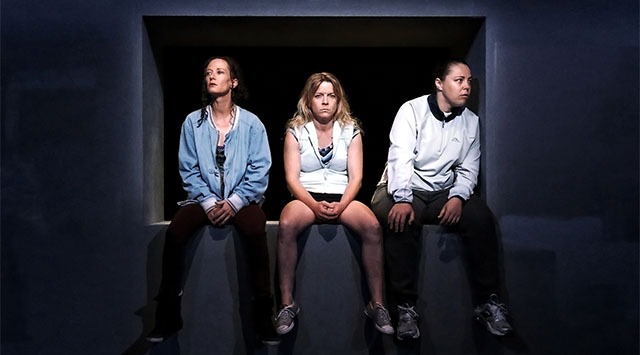
Linking episodic thoughts and recollections, mostly presented through a monologue style, are songs that Mitcham sings, sometimes with his ukulele as accompaniment, and sometimes with a pianist and a drag performer for added interest. It is a raw performance, relying on honesty and sincerity to capture our attention. Even though he seems less seasoned than most musical theatre artists who take centre stage, there is an undeniable charm in Mitcham’s childlike innocence (he compares himself to Peter Pan), and gifted with a warm timbre that he uses remarkably well for his penchant for pop, the hour long show is ultimately an entertaining sojourn, if oddly unaffecting.

There are clear parallels between sport and art, most obvious of which is the endeavour for triumph. To strive, is to have the capacity to fail. In Under The Covers, Matthew Mitcham is humbled, brought to his knees almost, having to admit that that defining moment of heroism, has to be left behind, if the rest of his days is going to be meaningful. On this stage, we watch him shine, and witness instances of floundering, but the champion’s spirit remains intact and resolute, showing us how he cannot help but put up the best fight, no matter the circumstances.

www.underthecoverslive.com

Review: Shit (Seymour Centre)

Venue: Seymour Centre (Chippendale NSW), Jul 18 – 29, 2017
Playwright: Patricia Cornelius
Director: Susie Dee
Cast: Peta Brady, Sarah Ward, Nicci Wilks
Image by Prudence Upton

Theatre review
It is the story of three wasted lives. Awful women whom we marginalise and detest, the ones we are contend to let rot. The question of course, is how they have come to be. In Patricia Cornelius’ Shit, Billy, Bobby and Sam never had a chance, abandoned as children, lost in a broken system of foster homes, they have grown up hopeless and beyond repair.

Cornelius’ writing is undeniably powerful, in terms of its social pertinence, as well as its extraordinary representation of language. For some, the work may be entertaining, but for many, it is a highly discomforting experience having to be in the presence of these monsters, although the moral that it carries is applicable to all.

Faultlessly executed, the production is directed with ingenuity and incisiveness by Susie Dee, who translates the uncompromising vision of the piece with remarkable potency. Marg Horwell’s set and Rachel Burke’s lights provide unexpected dimension within its sophisticated theatricality, allowing us to see deeper into the recesses of the difficult tale.

The actors are uniformly marvellous, creating a type of character rarely seen on Australian stages. Their voices are deeply familiar, so too are the physicalities they present, yet we are shocked by the incongruity of their appearance at the theatre, within our structure of bourgeois art. Peta Brady, Sarah Ward and Nicci Wilks form an ensemble precise and accurate with all of their depictions, aggressively challenging but shrewdly vulnerable, in a discussion about humanity at the fringes.

The boldness of Shit is provocative, but its ugliness is alienating. Tough art and tough issues bear that same pull-push quality. We understand that everything that is considered defective has to be mended, but it is easy to turn a blind eye. The neglected is given a voice in this play, but how we deal with the information being dispensed, is the crucial other half of the dialogue.

www.seymourcentre.com

Review: The Plant (Ensemble Theatre)

Venue: Ensemble Theatre (Kirribilli NSW), Jul 8 – Aug 5, 2017
Playwright: Kit Brookman
Director: Elsie Edgerton-Till
Cast: Briallen Clarke, Helen Dallimore, Sandy Gore, Garth Holcombe, Michelle Lim Davidson
Image by Prudence Upton

Theatre review
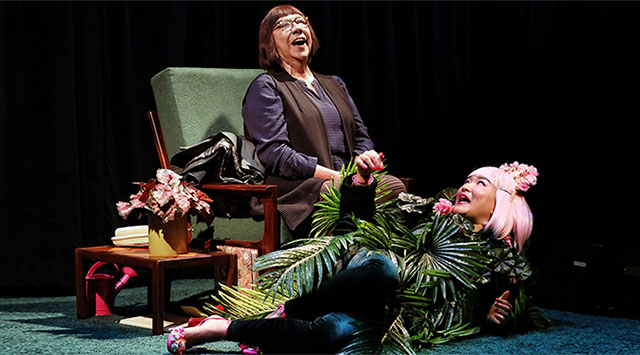
Suddenly widowed, Sue buys a Rex Begonia plant to keep her company. Her three children are grown-ups with other priorities, and even though they meet on weekends, Sue finds herself having to deal with bereavement and loneliness on her own. She names the plant Clare, and begins speaking with it, understandably, in the absence of human interaction.

Kit Brookman’s The Plant is a sweetly melancholic meditation on family and the mourning process. It offers an intimate look into life as an older person, and although its depiction of our middle-class existence contains more than a tinge of sadness, Brookman’s beautiful use of language makes his play an ultimately uplifting one.

The production is assembled with few bells and whistles, but director Elsie Edgerton-Till has us enthralled, with a wonderful ability that makes every word of dialogue sing with poignancy. It is a detailed and sensitive work, determined to reveal something truthful of the human experience, although its gentleness can feel slightly underwhelming, and perhaps evasive of some brutal realities that our old endure.

Sue is played by Sandy Gore, restrained but powerful in her portrayal of a neglected mother. Michelle Lim Davidson is delightful as the mysterious Clare, especially effective when playing up the ambiguity of her plant/human role. Briallen Clarke, Helen Dallimore and Garth Holcombe are the siblings, a proficient trio that tells us all we need to know, without too much fuss. A bigger dose of theatricality could make things more entertaining, but there is an elegance to The Plant that sets it apart.

We often hear about the fear of death, but it is really the ones left behind who have to go through immense hardship. Loss is inevitable, but the lucky ones will have companionship and love, to get them through tough times.

www.ensemble.com.au

Review: Front (Jackrabbit Theatre)

Venue: The Depot Theatre (Marrickville NSW), Jun 28 – Jul 15, 2017
Playwright: Michael Abercromby
Director: Michael Abercromby
Cast: Jack Angwin, Charlie Falkner, Elle Harris, Andreas Lohmeyer, Mary Soudi, Lincoln Vickery
Image by Tom Cramond

Theatre review
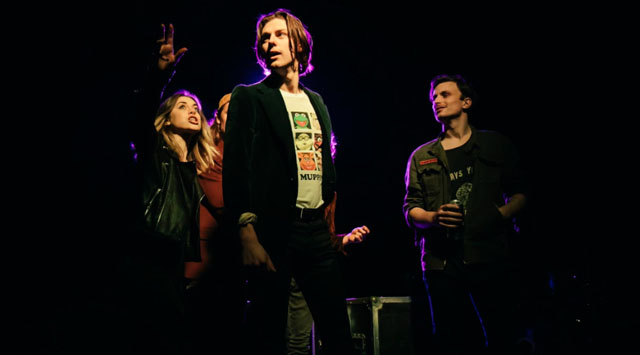
They are called Rough Cut Punt, a band that is going places, fuelled by big dreams, and even bigger egos. In Michael Abercromby’s Front, we meet four young men, talented but naive, trying to foster a career with only passion as guidance. Before too long, things begin to unravel, of course, in this age old tale of a partnership gone sour. Its narrative might be predictable, but the show is nonetheless enjoyable. Front is a story we have heard before, but its themes of betrayal and of innocence lost, will always retain their pertinence.

It is a tight and energetic production that Abercromby has directed. Scenes move past efficiently, with transitions, of time and space, handled remarkably well. The stage is effectively demarcated, by lighting designer Liam O’Keefe and set designer Shaynee Brayshaw, to offer a sense of vigour and action to keep us involved. Our frontman is played by Lincoln Vickery, whose vulnerability prevents us from being alienated by his poor behaviour. Vickery can seem a reluctant villain, but his charisma holds our attention even when the going gets tough. Charlie Falkner is relied upon to provide the comedy, as band guitarist and resident stoner, with his impeccable timing giving the production a much needed lustre. Also memorable is Mary Soudi as a recording executive, vicious and vile, accurately presented for some of the play’s more dramatic moments.

Like most people who fear being ordinary, artists are aghast by the thought of being generic. Rough Cut Punt wants to have a good time, but it knows that its survival depends on finding something original. Front may be an entertaining work, but we want it to say something new, so that its effects can last beyond the curtain call. Its prologue and epilogue are one and the same, both expressing the artist’s zeal for the vocation, but we see success eluding our protagonist, as he continues to ignore his craft.

www.jackrabbittheatre.com

Review: Mauritius (New Theatre / Sure Foot Productions)

Venue: New Theatre (Newtown NSW), Jul 12 – 29, 2017
Playwright: Theresa Rebeck
Director: Richard Cornally
Cast: Brett Heath, Kitty Hopwood, Peter-William Jamieson, Emma Louise, Andy Simpson
Image by Sundstrom Images

Theatre review
Jackie finds herself in possession of some highly collectable postage stamps after her mother’s death, and goes about trying to sell them for an enormous sum of money. The process is fraught with danger and dispute, as shady figures and family members get in her way. Theresa Rebeck’s Mauritius talks about greed, and the ugly behaviour that accompanies our thirst for personal gain. It is not a work with philosophical depth, but its effective take of a classic structure, provides ample opportunity for a gripping and entertaining thriller.

The production is well-rehearsed, with actors demonstrating excellent conviction. There is good energy on the stage, but a strange and awkward lack of humour tarnishes the show. Chemistry between players is present, although their focus on drama is often misplaced, during sections of the play that seem to offer favourable circumstances for comedy. Lighting and sound could help lift atmosphere, but both are severely neglected.

Kitty Hopwood is a very intense Jackie, always looking as if she is consumed by fear. Her steadfast approach reveals a part of the character that is anxious about her situation, but her scenes have a tendency to feel monotonous as a result of that unwavering artistic choice. More motivated by laughter is Peter-William Jamieson, who thankfully brings some joviality to the role of Dennis. A memorable performance is given by Brett Heath, who plays the villain of the piece Sterling, with a sense of creativity and playfulness that delivers theatricality, to this otherwise overly stiff and serious presentation.

www.surefootproductions.com

Review: Australian Graffiti (Sydney Theatre Company)

Venue: Wharf 2 Sydney Theatre Company (Walsh Bay NSW), Jul 7 – Aug 12, 2017
Playwright: Disapol Savetsila
Director: Paige Rattray
Cast: Gabrielle Chan, Airlie Dodds, Peter Kowitz, Kenneth Moraleda, Mason Phoumirath, Srisacd Sacdpraseuth, Monica Sayers
Image by Lisa Tomasetti

Theatre review
Asian restaurants are a familiar sight in Australian towns everywhere, but what we know is restricted only to their dining rooms and service areas. In Australian Graffiti, Disapol Savetsila presents a fantastical, but bleak, look at what happens behind the kitchen door of these inscrutable spaces.

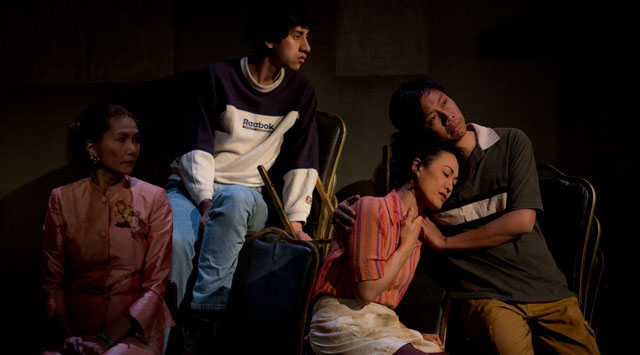
It is a story about Thai-Australians, both immigrants and native-born. Ben is a teenager, born in Sydney but who has since moved to an unnamed country town with his mother Baa, proprietor of the local Thai restaurant. Boi, Loong and Nam are employees stuck in the kitchen, with only work as salvation, completely cut off from mainstream society. When graffiti appears on one of the local churches, bearing Thai characters, the town takes the opportunity to carry out their racism, boycotting and harassing the group of five outsiders.

Savetsila’s seamless interweaving between surrealism and realism, creates his own universe of storytelling, where fact and fiction, tangibility and metaphysical, coexist to reveal truths of Australian life from the perspective of cultural minorities. Australian Graffiti is a play for the marginalised, speaking to and for communities with a voice rarely represented in our artistic landscape. It is a sign of the times, a valuable work that heralds the arrival of a new generation of creators that can only materialise with a certain level of social maturation.

The production is sensitively rendered by director Paige Rattray, whose gentle melancholy allows the play’s poignancy to sing through, with a deep and painful authenticity. Australian Graffiti is often darkly humorous, and Rattray’s depiction of its personalities is suitably nuanced, revealing both the good and the faults of the people we meet, even the ones who experience persecution.

Tenderly and imaginatively lit by Sian James-Holland, with music by Max Lyandvert and sound by Michael Toisuta that take us through subtle fluctuations of emotional states, the design creatives do an excellent job of turning a vast auditorium into a surprisingly suitable stage for Savetsila’s intimate writing.

Mason Phoumirath is impressive as Ben, passionate and convincing with what he presents as lead actor. His relation to place and people feels remarkably genuine, even though the circumstances are highly unusual. There is a psychological accuracy in his portrayal that gains our empathy, and the stories we hear become believable as a result. Gabrielle Chan and Kenneth Moraleda bring vulnerability and sentimentality to the show, with intensely moving expressions of the migrant experience, bringing attention to the play’s humanitarian concerns.

Underneath so many of our world’s surfaces, resides a threat of violence. Australia’s colonisation, our history of it and the continuing project of it, is rarely spoken of with sufficient honesty, and like any human defect that is left unattended, disease inevitably transpires. Ben’s family is of Thai origin, and their enemies are European. The lack of an Indigenous presence in their battle, is symptomatic of our inability to recognise what is fundamentally true of the land that we share, and whenever we are unable to acknowledge the root of our problems, they can only persist.

www.sydneytheatre.com.au

Review: Before Lysistrata (Kings Cross Theatre / Montague Basement)

Venue: Kings Cross Theatre (Kings Cross NSW), Jul 10 – 22, 2017
Playwright: Ellana Costa
Director: Saro Lusty-Cavallari
Cast: Ellana Costa, Alex Francis, Michaela Savina
Image by Zaina Ahmed

Theatre review
We know Lysistrata as the one who convinces the women of Greece to deprive themselves of sex, in order that their men would cease fighting each other in the Peloponnesian War. In Before Lysistrata, playwright Ellana Costa imagines a scenario that leads up to that audacious act. Lysistra and Lampito are the first ladies of Athens and Sparta, each representing a different side of politics.

It is the left and right wings of society, again at loggerheads. Whether 400 BC or 2017 AD it seems, we are determined to make enemies of one another, unable to be at peace with the idea of disagreement. The men go to war, determined to quash the other side, so that the world only needs contain one uniform ideology. With the death of sons that inevitably result, the ladyfolk band together, and hatch a plan to end the atrocities.

At points where the lines of good and evil are blurred, when us and them are disrupted, the show becomes refreshing. Its message can however, feel simplistic, as do its characters and dialogue. Wit and drama can be found in Costa’s well-meant text, but performances are unfledged, and the production never really builds enough tension that would allow sparks to fly. Few artistic risks are taken that will offer elements of surprise or intrigue. Its political interest holds court, central and singular.

Where there is solidarity, great things can be achieved. For each generation that experiences increasing social fragmentation, the idea of organised processes of action becomes correspondingly alien. That we can be unified, must not only be an abstraction, but how we get there, is more bewildering than ever before.

www.montaguebasement.com