Review: Smurf In Wanderland (National Theatre Of Parramatta / Griffin Theatre Company)

>Venue: SBW Stables Theatre (Kings Cross NSW), May 2 – 13, 2017
Playwright: David Williams
Director: Lee Lewis
Cast: David Williams
Image by Brett Boardman

Theatre review
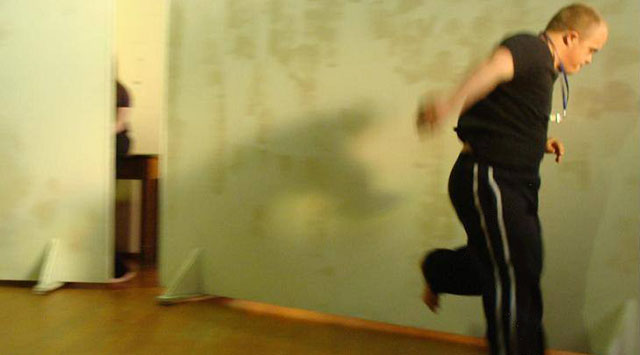
Life means little without passion. David Williams loves football, and he is here to tell us all about it, whether we like it or not. Smurf In Wanderland offers us more than a glimpse into the world of a football tragic, and while it may often be tedious for those of us who are sport-averse, Williams’ more general observations about Sydney life are truly valuable. He talks about modern city tribes, and all the silly things we do to feel belonged. There are attempts at explaining desire, the most potent yet bewildering of human qualities, looking at why we do the things we do, and the bizarreness of us all as a species.

There are moments of poignancy, fleeting yet memorable, including a sequence about the discontentment of those in Western Sydney, and our habitual postcode bias against those perceived to be less metropolitan. We delve into the fundamental masochism involved in rooting for teams when games will always insist on having losers. There is a lot to relish about Smurf In Wanderland, but it all lies beneath the surface. We are given an opportunity to understand our community better, but it is not always an enjoyable process. Sifting through Williams’ obsessive detailing of soccer fandom is fun for some, but exasperating for others. It is a story about us and them, told in a way that makes the ostracism it is concerned about, feel very genuine indeed.

As performer, Williams is charismatic and engaging., with a determination that forbids our attention from straying. His enthusiasm for the Sydney Football Club is a propulsive force that fills the stage with energy, and we must respond with anything but ambivalence. At the end of the piece, there will be individuals who experience fulfilment, and those who will feel worse for wear, but it is likely that all will share a fondness for the personality we had met.

The presentation breaks through the superficial walls we erect between one another. We imagine people to be different, as a way to validate our own existences, but we all exist in undeniable parallels. Our values may be different, but the lenses through which we view the world do not alter the world as it is. If art and sport are in opposition, then Smurf In Wanderland forces us out of our echo chambers and disrupts the silo effect, at least for one night. To love thy neighbour is easier said than done, but few things are as worthwhile an exercise.

www.riversideparramatta.com.au/NTofP | www.griffintheatre.com.au

Review: Big Fish (RPG Productions)

Venue: Hayes Theatre Co (Potts Point NSW), Apr 18 – May 14, 2017
Book: John August (based on the novel by Daniel Wallace and the screenplay by John August)
Music & Lyrics: Andrew Lippa
Director: Tyran Parke
Choreographer: Cameron Mitchell
Cast: Kirby Burgess, Seth Drury, Joel Granger, Brendan Godwin, Zoe Ioannou, Brenden Lovett, Phillip Lowe, Alessandra Merlo, Adam Rennie, Katrina Retallick, Brittanie Shipway, Aaron Tsindos, Zachary Webster
Image by Kate Williams

Theatre review
Edward Bloom spins yarns that only he can believe. He deals with reality using outrageous embellishment, but these tall tales have alienated his son Will, who struggles to connect with the man behind the illusions. Big Fish is about life and death, love and family, all the emotional stuff that make musicals work. A formula exists because it is effective, and here, we see all the obvious manipulations that get us to a predictable sentimental peak, yet we cannot help getting ourselves entangled in all of the Bloom family’s drama.

Dubbed the “12 Chairs Version”, this rendition may be streamlined, but director Tyran Parke brings a richness to the staging, with simple but exciting visuals that live up, surprisingly, to the story’s imaginative landscapes. The cast is buoyant and bubbly, determined to entertain. Leading man Phillip Lowe is fabulously charming, but problems with a throat infection seriously impair his ability to deliver the show’s many very grand showtunes. Instead, on hand to offer vocal magic is Adam Rennie in the role of Will, who is nothing less than sensational when the songs get chipper and stirring.

Women characters in Big Fish are often pathetically conceived, but the players do their best to bring life to their parts. Katrina Retallick takes the role of an embarrassingly docile mother, and turns her into a memorable figure; warm, generous and full of spirit. Her delivery of the heartbreaking “I Don’t Need A Roof” is a highlight, with Retallick’s performing talent proving to be the most captivating feature of the production. Also delightful is Brenden Lovett, simultaneously grotesque and adorable as circus ringmaster Calloway. The most over-the-top of Edward’s fantasies is also one of the most moving, when given the Lovett treatment.

We all know that our lives are finite, but we rarely think about how our deaths affect the way we live. We go about our daily business as though there is always tomorrow to worry about, but the unassailable truth is that death will come too soon. Edward was offered, as a child, a glimpse of his final moments, and what he saw was joyful. If we can all believe that what we eventually leave behind is going to be good, then our experience of today, must surely be replete with contentment.

www.bigfishaustralia.com.au

Review: Bengal Tiger At The Baghdad Zoo (Mad March Hare Theatre Company)

Venue: Old Fitzroy Theatre (Woolloomooloo NSW), Apr 12 – May 6, 2017
Playwright: Rajiv Joseph
Director: Claudia Barrie
Cast: Josh Anderson, Tyler De Nawi, Maggie Dence, Andrew Lindqvist, Stephen Multari, Megan Smart, Aanisa Vylet
Image by Kate Williams

Theatre review
It is a prayer of anguish and pain. In addressing God, Rajiv Joseph offers a meditation on the biggest challenges faced by humankind at this moment in time, from perspectives personal and global. Bengal Tiger At The Baghdad Zoo talks about the ceaseless wars that take place in the middle east, and the sacrifices made to all lives no matter which side of the battle they reside. It also deals heavily with guilt and regret, universal experiences that allow audiences to relate even closer to its characters and stories.

The writing is emotional and imaginative, with ghosts and paranoia haunting the living, and troubling philosophy interrogating the dead. Having Americans and Iraqis at the centre of the action might allow Australian viewers to distance ourselves from its very difficult themes, but the production’s extraordinary intensity is determined to have us embroiled. It is powerful work by director Claudia Barrie, who invests great detail and dynamism into all facets of her show.

An unrelenting atmosphere of tension akin to horror movies and war zones, is marvellously established by a bevy of design talents. Nate Edmondson’s music in particular, impresses with its exceptional precision in calibrating tonal shifts, allowing us to flow with the play’s many surprising and contrasting moods, with no apparent effort at all. Lights are appropriately colourful for a show that revels in its hallucinations, with Benjamin Brockman’s robust approach providing excellent visual variety to a small and restrictive stage. Stephanie Howe’s costumes and Isable Hudon’s set design are simple but always effective and convincing, especially admirable considering the economy at which they operate.

An ensemble of seven remarkable actors perform an unforgettable show, each one commanding, with strong interpretations of their individual parts but beautifully cohesive as a whole. Andrew Lindqvist is stunning as Musa, demonstrating a level of authenticity that makes theatre pure magic. The kinds of torment being described is, to most of us, quite unimaginable, but Musa’s story is laid bare in front of us, entirely convincing and heartbreaking. It is in the way Lindqvist brings meaning to his lines, and in the way his physicality manifests between those lines, that the essence of suffering can be so clearly observed. His work is dramatic and breathtaking, but also profound in its subtle assertions; the actor is fantastic. Josh Anderson and Stephen Multari play American soldiers, both engaging, and moving, with fascinating psychological complexities provides to what are usually reductive ways of portraying military personnel. The eponymous tiger is brought to life by Maggie Dence, who has a tendency to seem overly static, but the quality of omniscience she brings is invaluable. Tyler De Nawi, Megan Smart and Aanisa Vylet are all given scene-stealing opportunities, and although their appearances are relatively brief, they each leave an indelible mark on this stage.

Maybe God does exist out there in the ether, or maybe we are all gods in the here and now. We can crane our necks and ask for answers, but we will never be absolved from doing the best to make the world a better place. We must try to figure things out ourselves, for as we see here, divine intervention never did arrive. For good to happen, it is only up to us, but evil is real, and in Bengal Tiger, it does not know itself. In the play’s pessimism, our actions result in harm, and civilisation is on a downward spiral, but it is a work of fantasy, and how we respond, is another one of its mysteries.

www.madmarchtheatreco.com

Review: The Sylph (Harlos Productions / The Old 505 Theatre)

Venue: Old 505 Theatre (Newtown NSW), Apr 18 – 29, 2017
Playwright: Jodi Rose
Director: Colleen Cook
Cast: Gertraud Ingeborg

Theatre review
The legacy left behind by the celebrated 19th century ballerina Marie Taglioni, can be found in the world of dance, but in Jodi Rose’s The Sylph, we come to meet with her in a play. Stories from her life are relayed directly, to an audience curious about Taglioni’s biography. When we see dancers, they are picture perfect. What we see is effortless, often sublime, with all that happens behind the scenes kept tightly under wraps.

The monologue provides information about Taglioni’s history, but there is little in terms of drama that could be gleaned. There are no great eruptions of emotion, no spicy scandals, and few dark secrets. It is a meaningful existence from a distant past, discussed with a simplicity that is perhaps underwhelming for a generation accustom to much more outrageous tales of unrelenting impropriety by famous types.

Gertraud Ingeborg is in the starring role, impressive and convincing with her physical expressions as ballet expert. The graceful beauty she brings to the piece is commendable, along with an undeniable strength in her presence that keeps us engaged. It is a flattering image of both actor and character that the show presents, under the directorship of Colleen Cook, who demonstrates an elegant and effective use of space, but the plot structure would benefit from greater effort in manufacturing a sense of tension for The Sylph‘s storytelling.

Female geniuses are consistently obliterated from our history books and our consciousness. Works like The Sylph are important in finding redress to this injustice. To know that women have achieved as much as, or more than, our male counterparts, is crucial to how we see ourselves today and how future generations will be able to live out their potentials. For women who wish to be great mothers and wives, there are plenty of success stories, but for the rest of us who desire anything else, we need every opportunity to encounter our predecessors.

www.old505theatre.com

Review: Fallen (Sport For Jove Theatre)

Venue: Seymour Centre (Chippendale NSW), Apr 6 – 22, 2017
Playwright: Seanna van Helten
Director: Penny Harpham
Cast: Lucy Goleby, Megan Holloway, Chantelle Jamieson, Abbie-lee Lewis, Moreblessing Maturure, Rebecca Montalti, Eloise Winestock
Image by Marnya Rothe

Theatre review
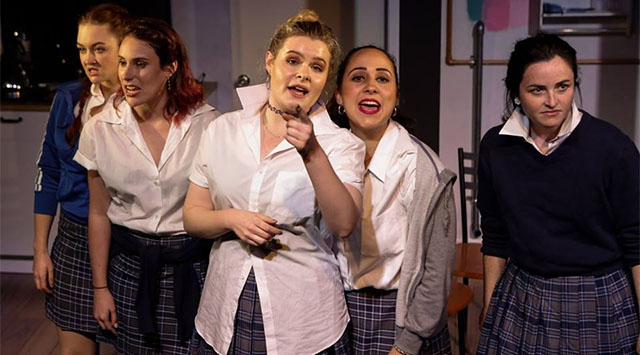
It is 19th century England, and the women in Seanna van Helten’s Fallen are told what to wear, how to act, and which to think. The story takes place in a kind of halfway house, where women who have transgressed morality are banished, to be put through a process of rehabilitation. There is a Victorian severity to these characters’ lives, but what the play demonstrates more relevantly, is how those archaic ways retain control over us today; we still insist on telling women how they should look and behave.

Van Helten’s writing is subtle, a quiet mystery with depths of emotion and meaning, discoverable under surfaces of restrained tumult. The six women of Fallen reveal little, but an authenticity is nonetheless present. The work is challenging to perform. Actors are required to imagine all that is hiding between the lines, and the bolder they are at manifesting the unsaid, the more effective their show becomes. It is a likeable ensemble, but not always powerful enough to overcome the cryptic nature of the writing. Lucy Goleby is matron of the house, a staunch, stern character who is depicted with a greater sense of definition than the rest. We rely on Goleby to bring the drama, which she does often, especially when she taps into the eerie, slightly gothic quality that the piece lends itself to.

The production has a mild temperament, almost timid in its expressions. At its best, Fallen is haunting and transcendent, but the show can quickly turn tepid and consequently lose connection with its audience. We wonder what the women had done to have them condemned, and who they truly are, but our interest seems to swell and wane, through different junctures of the plot. There are moments of design brilliance to relish; Raya Slavin’s music and Sian James-Holland’s lights are attractive, even though inconsistencies in atmosphere add to the show’s issues with dramatic tension. We see all the potential on this stage, and wish for greater impact, with more audacious approaches.

The women in Fallen have no choice but to be compliant. Our world today is significantly different, with much more liberated attitudes than before, yet we submit everyday, to fears of stepping out of line, whether or not repercussions are real. We alter our own behaviour to conform and to appease, and expect the same of other women. Well-behaved women seldom make history, but it is not only for the momentous that we should dare to be ourselves. It is what happens in our regular day-to-day that requires us to be vigilant over the power that we own and that we should never be fearful of.

www.sportforjove.com.au

Review: Hysteria (Darlinghurst Theatre Company)

Venue: Eternity Playhouse (Darlinghurst NSW), Mar 31 – Apr 30, 2017
Playwright: Terry Johnson
Director: Susanna Dowling
Cast: Miranda Daughtry, Michael McStay, Wendy Strehlow, Jo Turner
Image by Robert Catto

Theatre review
Sigmund Freud is near the end of his life, and the past returns to haunt him. We all change our minds, but writers have the burden of their work set in stone. In Terry Johnson’s 1993 play Hysteria, a fictive version of Freud is made to regret his declarations about women’s rape fantasies. It seems that the legendary psychoanalyst had misrepresented experiences of his patients, turning their reality into imagination, so that his work would be better received. Johnson’s piece about the need to redress denials of rape and molestation, is a timely discussion in the current climate of renewed interest in feminism, but Hysteria is a dry, and often inelegant, work that proves to be less than captivating.

The production looks smart enough, with Anna Gardiner’s set and costume design establishing a splendid first impression. Projections of Julian Tynan’s cinematography appear later in the piece, equally delightful with the imagery it presents. It is an accomplished group of actors, each one demonstrating a good sense of presence and conviction, but chemistry is lacking, and the stories they tell never seem to fortify. We are left feeling confused and detached, unable to adequately follow its narrative or to satisfactorily engage in any of its ideas. It is a laborious exercise for the audience, trying to work out the point of the exercise, and when we eventually gain clarity, Hysteria‘s concerns fail to resonate.

Individual elements of the show all look to be at least adequate, but they coalesce to form something that is altogether disappointing. Its characters are not lifeless; Salvador Dali is written in, presumably, to further enhance the quotient of eccentricity in Freud’s colourful world, but there is little in Hysteria that excites. Art does not owe us entertainment, nor does it promise to always be meaningful. In art, there is no right and wrong, but a work can certainly fall short of the standards it sets itself.

www.darlinghursttheatre.com

Review: White Rabbit Red Rabbit (Freefall Productions)

Venue: Kings Cross Theatre (Kings Cross NSW), Apr 4 – 15, 2017
Playwright: Nassim Soleimanpour
Cast: Ylaria Rogers
Image by

Theatre review
The play requires that its actor comes to the performance “blind”, not knowing anything about what lies on the pages of the playbook. It is a complete mystery to the person on stage, and also to those in the audience who are seeing Nassim Soleimanpour’s White Rabbit Red Rabbit for the first time. It is significant that the 2010 work was created when its 29-year-old author was forbidden from leaving his country Iran. The autocratic regime that he had to endure is not directly denounced in Soleimanpour’s writing, but its presence and influence on the piece, are clear.

We are made to consider how a police state operates, especially in terms of the complicity and compliance of citizens that allow inhumanity to thrive. The play shifts attention away from the way authorities intrude upon private lives, and looks instead at how the everyday person monitors and subjugates one another unconsciously, especially in cultures where freedoms are severely restricted. We are urged to think about the deficiencies in free will, and how easy it is for society to manipulate our empathy and deprive us of compassion. It wants us to see the tragedy that exists in our exploitable susceptibility to mistreating each other, and our readiness at forming habits of intolerance, hate and violence. It is to the writer’s credit that these grave and important issues are not only communicated powerfully in spite of its need to be cryptic, White Rabbit Red Rabbit is surprisingly humorous and entertaining.

Like Soleimanpour at the time of writing this script, actor Ylaria Rogers is in a position of vulnerability as she moves through the lines and instructions of every page. She submits to the text that she holds in her hands, but like those of us who have gathered to witness this unusual theatrical moment, our volition is constantly called to question. Ylaria’s obedience, and ours, come into examination, leading us to confront the nature of authority, and how it is constructed. Authority is often imagined, but even when it is real and life-threatening, the power of the masses can overthrow any dictator that sits atop. The conundrum is in our inability to perceive that collective force, and our failure to understand that the fear we experience is shared and can only manifest if we allow it to.

www.freefallproductions.com.au

Review: Consensual (New Theatre)

Venue: New Theatre (Newtown NSW), Mar 14 – Apr 15, 2017
Playwright: Evan Placey
Director: Johann Walraven
Cast: Callum Alexander, Michael Brindley, Claire Crighton, Rhys Johnson, Eloise Martin-Jones, Eliza Nicholls, Eamon O’Flynn, Celeste Reardon, Lauren Richardson, Natasha Rose, Anton Smilek, Nicole Toum,
Benjamin Vickers, Paul Whiddon, Emma Wright
Image © Bob Seary

Theatre review
Freddie was a 15 year-old schoolboy when a sexual tryst occurred between himself and his teacher, Diane. Seven years later, a confrontation takes place, with Freddie accusing Diane of rape. In Consensual, playwright Evan Placey poses a challenge to our ethics, not only in terms of what we consider to be sexual assault and what constitutes consent, but also how, as individuals and as society, we determine what is acceptable and what is abhorrent. The play is as much about where to draw the line, as it is about how we find consensus in the way that line should be drawn.

Placey’s gripping drama is often outrageous, but balance is offered by ethical and intellectual investigations that are as considered as they are controversial. Urging us to respond on levels that are both emotional and logical, the play leads us to experience states of struggle and confusion, while we attempt to negotiate right from wrong in all the grey areas of what we see on stage, and in those of our own real world experiences. Characters in Consensual are believable and quite frighteningly, we relate to all of them. Even when we wish to castigate certain behaviour, we understand the fallibility on display, and realise how easy it is to make those same mistakes.

Freddie is played by Paul Whiddon, perfectly cast as the male Lolita, vulnerable yet seductive, manipulative yet naive. We see a man domineering with his sexuality, as well as a lost boy not knowing what he is getting himself into. Whiddon brings a level of authenticity to the show that is quite arresting, allowing us to observe clearly, all the conflicting nuances that make his story so provocative.

Lauren Richardson takes on the highly complex role of Diane, portraying concurrent but contradictory layers of truth that has the audience squirming in nervousness. Some of her motivations could be played with greater conviction, so that the climactic moment can ring truer, but it is an accomplished performance that reveals the disconcerting depths of Diane’s story.

A strong ensemble of extraordinarily engaging young actors make up the high school classroom, typically rambunctious but surprisingly (and unnervingly) grown up in their exchanges about sex. Particularly impressive is Callum Alexander whose excellent focus and commitment, makes the supporting part of the very wise Nathan, especially memorable.

Production design is simple but effective. Renee Halse’s set and Liam O’Keefe’s lights are polished, efficient and unobtrusive, while music composer Nicky D’Silva’s exciting electronica in scene transitions, brings great vigour to the stage. Director Johann Walraven’s exhibits a valuable talent in making Consensual both intelligent and entertaining. More detailed work in dramaturgy would give greater finesse, but the show is nonetheless engrossing.

A child wants ice cream morning, noon and night. No amount of explanation could make the consequences more real than the yearning they experience. Likewise with teenagers and sex. Adults must protect the young, even when they appear headstrong with what they wish to explore. Sex and relationships are complicated, and we will continue to make mistakes no matter how grown up we feel, but as long as the more experienced can keep a watchful eye, the minimisation of harm must always be a priority.

www.newtheatre.org.au

Review: Two (Ensemble Theatre)

Venue: Ensemble Theatre (Kirribilli NSW), Mar 24 – May 6, 2017
Playwright: Jim Cartwright
Director: Mark Kilmurry
Cast: Brian Meegan, Kate Raison
Image by Clare Hawley

Theatre review
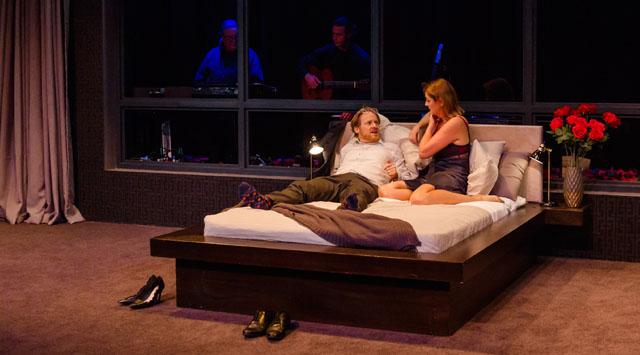
All kinds of things can happen in a pub, that old institution that uniquely combines commerce and community. It is wide open, with few restrictions on who and what are allowed to walk through its doors. Jim Cartwright’s Two first arrived at the very end of the 1980’s. Set in regional NSW, it paints a nostalgic picture of Australia before mobile phones, and before we began suspecting neighbours of wanting to bomb each other into pieces.

Men were masculine, women were feminine, and everyone was heterosexual. A comforting predictability existed, along with an indeterminate air of stifled constraint. The play features two actors in a series of roles that explore love and relationships, from an innocent time and space.

Kate Raison plays all the nice ladies with an admirable strength, bringing dimension to their predetermined passivity, and Brian Meegan keeps us entertained by introducing imaginative variation to his wide range of male characters. They make a confident and jubilant pair, adept at providing entertainment and pathos with each of Two‘s warmhearted vignettes. Director Mark Kilmurry stays out of the way of his actors’ talents, and leaves Cartwright’s vision intact, for a production that offers no surprises, but that communicates fluently with a remarkable simplicity.

For those of a certain age, there is no greater romance, than the romance one has with the past. We retain only the sweet, and those memories can make the living of today seem less dulcet. The Aussie pub is required to preserve tradition, but the financial imperative forces it to move along with the times. It is an allegory for us all. The past is often warm and comfy, but it is the essence of life that will insist we be taken in unexpected directions. The local watering hole may no longer know your name, but it still stands, awaiting new stories to be writ.

www.ensemble.com.au

Review: Richard III (Bell Shakespeare)

Venue: Sydney Opera House (Sydney NSW), Feb 25 – Apr 1, 2017
Playwright: William Shakespeare
Director: Peter Evans
Cast: Ivan Donato, James Evans, Sandy Gore, James Lugton, Kevin Maclsaac, Kate Mulvany, Meredith Penman, Gareth Reeves, Rose Riley, Sarah Woods
Image by Prudence Upton

Theatre review
Born ugly, Richard never understood what it is to be loved, and his story details the effect on a person when rejection is a constant and central defining experience. Coupled with what we now term privilege, his aristocratic life places him in a position of power in spite of that perpetual derision, and what results is a bitter thirst for the reciprocation of inhumanity, that knows no bounds.

It is possible to think of evil as a condition that is somehow innate, even natural to some, or as Shakespeare does in Richard III, we can conceive of evil as a manufactured and socialised phenomenon. In director Peter Evan’s rendition, the way brutality manifests, is an unambiguous process of retribution; Richard’s behaviour is depicted as being a direct consequence of the way he suffers under the mistreatment of a cruel world.

The production is adequately assembled, but there is no overstating its capacity as a showcase for the staggering talents of Kate Mulvany, who takes on the eponymous role with splendid aplomb. Mulvany’s unequivocal brilliance occupies centre stage, having us enthralled at every second, and casting a shadow over the rest of the show. All we want, is to absorb every meticulous minutiae that she serves up in each word and gesture.

It is pure genius at work, and to witness a virtuoso performance that is so exhaustively invested and incredibly rich with resonance, is the kind of theatre that broadens our understanding of what art is capable of doing. When Mulvany strips off at dramatic climax, to reveal her own scoliosis, we see the severely curved spine that she shares with Richard, and in that moment, performativity and reality conflate, for one of the most powerful visions ever brought to stage. Our reaction is appropriately visceral, but we are also made to consider how we attribute a person’s merits, or more accurately in this case, demerits, to their natural traits. If Richard is a villain because of his congenital physical condition, we must question how Mulvany’s and everybody else’s corporeality, is able to determine the people that we eventually become. We wonder about the finality of fate from the point of birth, and the extent to which our existence is written in the stars, and on the flesh.

There are other members of cast who impress, most notably Meredith Penman and Sarah Woods who deliver sensational scenes of heightened emotion, but the piece dulls significantly in the short moments when our star is offstage. Evans’ frequent use of his actors as a chorus is occasionally awkward, although the sense of vigour they create is valuable in ensuring that our attention is sustained. The set and costumes do not quite achieve the luxury and decadence that it aspires to, and the use of a small television set to convey the presence of a dumbwaiter is an inelegant solution and a continual distraction.

Visual aesthetics in this Richard III may not be a strength, but the character we have come to see, is marvellously presented. To live is to learn, and to be human, we need to understand humanity. Art shows us all the possibilities of being, so that we can find ways to negotiate better, both our environs and our selves. It is unlikely that Richard is a straightforward reflection of any one of us, but through this extraordinary rendering of a man who suffers and who retaliates, we gain insight into the nature of personal demons and recognise the way we co-exist in communities. Love can bring about things most beautiful, but its absence, is how we invite every ugliness.

www.bellshakespeare.com.au