Review: Australian Graffiti (Sydney Theatre Company)

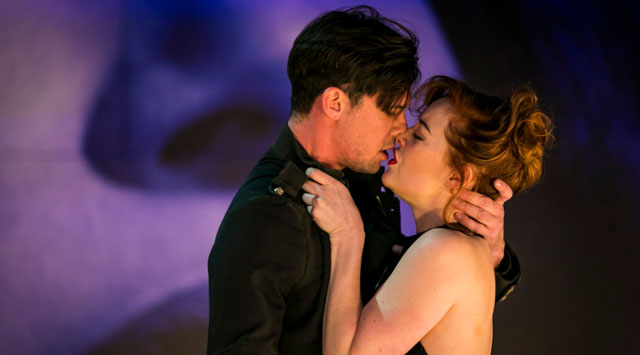
Venue: Wharf 2 Sydney Theatre Company (Walsh Bay NSW), Jul 7 – Aug 12, 2017
Playwright: Disapol Savetsila
Director: Paige Rattray
Cast: Gabrielle Chan, Airlie Dodds, Peter Kowitz, Kenneth Moraleda, Mason Phoumirath, Srisacd Sacdpraseuth, Monica Sayers
Image by Lisa Tomasetti

Theatre review
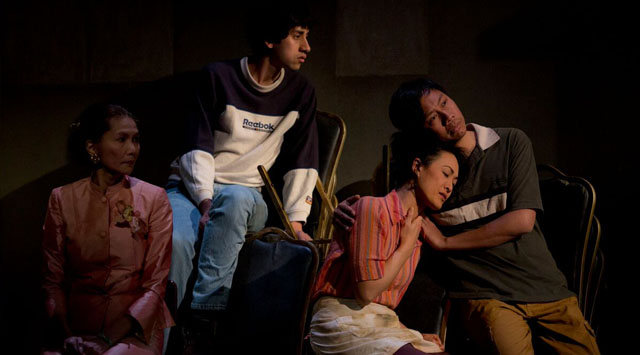
Asian restaurants are a familiar sight in Australian towns everywhere, but what we know is restricted only to their dining rooms and service areas. In Australian Graffiti, Disapol Savetsila presents a fantastical, but bleak, look at what happens behind the kitchen door of these inscrutable spaces.

It is a story about Thai-Australians, both immigrants and native-born. Ben is a teenager, born in Sydney but who has since moved to an unnamed country town with his mother Baa, proprietor of the local Thai restaurant. Boi, Loong and Nam are employees stuck in the kitchen, with only work as salvation, completely cut off from mainstream society. When graffiti appears on one of the local churches, bearing Thai characters, the town takes the opportunity to carry out their racism, boycotting and harassing the group of five outsiders.

Savetsila’s seamless interweaving between surrealism and realism, creates his own universe of storytelling, where fact and fiction, tangibility and metaphysical, coexist to reveal truths of Australian life from the perspective of cultural minorities. Australian Graffiti is a play for the marginalised, speaking to and for communities with a voice rarely represented in our artistic landscape. It is a sign of the times, a valuable work that heralds the arrival of a new generation of creators that can only materialise with a certain level of social maturation.

The production is sensitively rendered by director Paige Rattray, whose gentle melancholy allows the play’s poignancy to sing through, with a deep and painful authenticity. Australian Graffiti is often darkly humorous, and Rattray’s depiction of its personalities is suitably nuanced, revealing both the good and the faults of the people we meet, even the ones who experience persecution.

Tenderly and imaginatively lit by Sian James-Holland, with music by Max Lyandvert and sound by Michael Toisuta that take us through subtle fluctuations of emotional states, the design creatives do an excellent job of turning a vast auditorium into a surprisingly suitable stage for Savetsila’s intimate writing.

Mason Phoumirath is impressive as Ben, passionate and convincing with what he presents as lead actor. His relation to place and people feels remarkably genuine, even though the circumstances are highly unusual. There is a psychological accuracy in his portrayal that gains our empathy, and the stories we hear become believable as a result. Gabrielle Chan and Kenneth Moraleda bring vulnerability and sentimentality to the show, with intensely moving expressions of the migrant experience, bringing attention to the play’s humanitarian concerns.

Underneath so many of our world’s surfaces, resides a threat of violence. Australia’s colonisation, our history of it and the continuing project of it, is rarely spoken of with sufficient honesty, and like any human defect that is left unattended, disease inevitably transpires. Ben’s family is of Thai origin, and their enemies are European. The lack of an Indigenous presence in their battle, is symptomatic of our inability to recognise what is fundamentally true of the land that we share, and whenever we are unable to acknowledge the root of our problems, they can only persist.

www.sydneytheatre.com.au

Review: Before Lysistrata (Kings Cross Theatre / Montague Basement)

Venue: Kings Cross Theatre (Kings Cross NSW), Jul 10 – 22, 2017

Playwright: Ellana Costa
Director: Saro Lusty-Cavallari
Cast: Ellana Costa, Alex Francis, Michaela Savina
Image by Zaina Ahmed

Theatre review
We know Lysistrata as the one who convinces the women of Greece to deprive themselves of sex, in order that their men would cease fighting each other in the Peloponnesian War. In Before Lysistrata, playwright Ellana Costa imagines a scenario that leads up to that audacious act. Lysistra and Lampito are the first ladies of Athens and Sparta, each representing a different side of politics.

It is the left and right wings of society, again at loggerheads. Whether 400 BC or 2017 AD it seems, we are determined to make enemies of one another, unable to be at peace with the idea of disagreement. The men go to war, determined to quash the other side, so that the world only needs contain one uniform ideology. With the death of sons that inevitably result, the ladyfolk band together, and hatch a plan to end the atrocities.

At points where the lines of good and evil are blurred, when us and them are disrupted, the show becomes refreshing. Its message can however, feel simplistic, as do its characters and dialogue. Wit and drama can be found in Costa’s well-meant text, but performances are unfledged, and the production never really builds enough tension that would allow sparks to fly. Few artistic risks are taken that will offer elements of surprise or intrigue. Its political interest holds court, central and singular.

Where there is solidarity, great things can be achieved. For each generation that experiences increasing social fragmentation, the idea of organised processes of action becomes correspondingly alien. That we can be unified, must not only be an abstraction, but how we get there, is more bewildering than ever before.

www.montaguebasement.com

Review: Neville’s Island (Ensemble Theatre)

Venue: Ensemble Theatre (Kirribilli NSW), Jun 29 – Aug 12, 2017
Playwright: Tim Firth
Director: Mark Kilmurry
Cast: Andrew Hansen, David Lynch, Craig Reucassel, Chris Taylor
Image by Prudence Upton

Theatre review
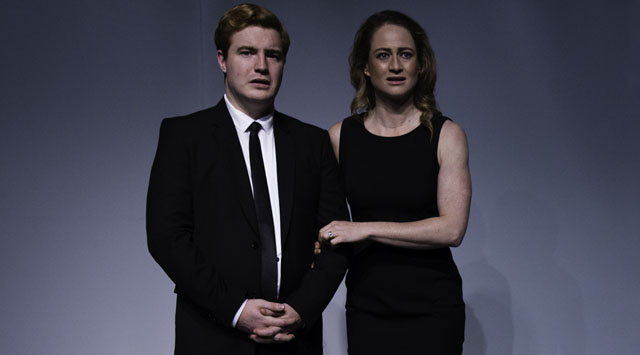
Four men are stranded on an island, after a corporate team building exercise takes a wrong turn. Neville is the senior of the group, who tries to keep things in order, while the other three middle aged men unravel, descending into various states of hysteria as the hours pass by.

Tim Firth’s 1992 comedy has at its centre, issues surrounding modern masculinity and the anxieties it triggers, but that important social concern only becomes a serious point of discussion, very late into the piece. For at least three quarters of the duration, its characters fumble around, struggling with having to deal with their sudden exposure to the wild. Their antics could mean hilarity to some, but depending on the sense of humour one possesses, the play could also be unbearably corny, tenaciously so, for many.

The actors are well rehearsed, each one demonstrating excellent conviction, but the writing offers little in terms of nuance that could allow any of them to truly impress. Quite remarkably, the cast succeeds at making individual characters believable, even though the play’s attempts at depth are precarious at best.

The stage is consistently lively, and when chemistry does take effect, their show can offer quite compelling entertainment. Neville’s Island is determined to amuse. Even if one is not tempted to laugh out loud, there is something satisfying in its earnest and enthusiastic tomfoolery, like every well-meaning dad joke that one would hate to miss.

www.ensemble.com.au

Review: Little Borders (Old 505 Theatre)

Venue: Old 505 Theatre (Newtown NSW), Jul 4 – 15, 2017
Playwright: Phillip Kavanagh
Director: Dominic Mercer
Cast: Lucy Goleby, Brandon McClelland
Image by Kate Williams

Theatre review
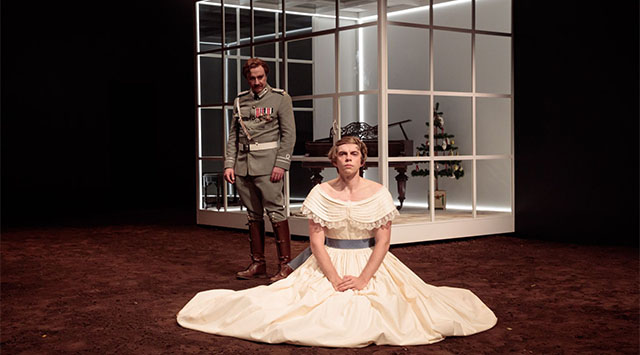
Elle and Steve are moving houses, because they have convinced themselves that their Middle Eastern neighbour is a terrorist. Little Borders by Phillip Kavanagh, is about the paranoid, fearful and narcissistic people that many of us have become, in a confused world that has us believe that things will go wrong in an instant, and that other people are to blame.

The young couple is bestowed every social and economic privilege that could give them the best opportunity at a comfortable existence, yet they are full of volatility and hostility, obsessed with the idea that their lives are going to fall apart at any given moment. Their self-destructive behaviour is depicted with biting astuteness by Kavanagh, who reveals the insidious nature of hate in our contemporary communities.

The production is suitably dark, if slightly too predictable in its despair. The important messages of Little Borders are given remarkable elucidation by director Dominic Mercer, and we leave shaken by our disastrous reflection, but the show has a tendency to feel too safe and slightly unambitious in its interpretations of Kavanagh’s bold writing. We sense that the words provide room for a greater theatricality, although its minimalism is nonetheless effective, and beautifully executed. Set design by Charlie Edward Davis and Jeremy Allen, is understated but charming, and undeniably memorable.

Actors Lucy Goleby and Brandon McClelland prove themselves to be highly accomplished in the piece. Goleby’s intensity, although quiet and contained, is a captivating study of Elle, a woman gripped by insecurity and irrational anxiety. She keeps us inquisitive, and terrified, by her authentic manifestation of a person that we sometimes find ourselves being. McClelland is a charismatic presence, with immaculate hair and perfect teeth providing disguise for a character that has no redeeming features. His juxtaposition of clean cut suburban wellness against the pure evil of Steve’s words and actions, is chilling, and perversely entertaining.

It is a frightening look at the psyche of our worst neighbours. The play resonates with an alarming accuracy, even though the events that unfold are very dramatic and extreme. It is truthful in what it says about modern life; the interminable feeling of inadequacy, and the need to infringe upon the lives of others, as we proceed to suppress everything that we have no understanding of. We are not told however, how it is that Elle and Steve have become such monsters; Kavanagh’s deliberate omission is provocative. We should really know those reasons for ourselves. These are our middle class lives, and we know these people. All the evidence that would explain their madness must already be in plain sight, if we choose to examine it.

www.old505theatre.com

Review: Cloud Nine (Sydney Theatre Company)

Venue: Wharf 1 Sydney Theatre Company (Walsh Bay NSW), Jul 1 – Aug 12, 2017
Playwright: Caryl Churchill
Director: Kip Williams
Cast: Matthew Backer, Kate Box, Harry Greenwood, Anita Hegh, Josh McConville, Heather Mitchell, Anthony Taufa
Images by Daniel Boud

Theatre review
Betty takes a long time to grow up. In fact, it is centuries before she becomes her own woman. In Act I, she lives in Victorian era Africa, having moved from Britain with her husband, a “colonial administrator”. In Act II, we find that not only has she advanced in age, time itself has moved abruptly to the current day.

Caryl Churchill’s Cloud Nine is about the way gender, with all its associated contrivances and constraints, is imposed upon individuals in Western societies, ruthlessly reinforced time and time again, in service of a white patriarchal project that seems to have no beginning and no end. It is a scheme that benefits few, and as we see in the play, no one is left unscathed by its oppressive nature.

The absurdities inherent in the practice of gender and whiteness, are shrewdly re-purposed for all of Cloud Nine‘s outrageous comedy, as well as its very scintillating drama. Churchill’s creation might be near on 40 years old, but its uncompromising boldness remains deeply affecting. Ensuring that the work’s confrontational qualities are retained, is director Kip Williams who pairs a flamboyant theatricality with a keen eye for detail, to deliver a show that is as entertaining as it is challenging, and quite surprisingly, profoundly moving.

Actor Heather Mitchell is phenomenal in the production. Playing Betty in Act II, and Betty’s young son in Act I, she works her magic to elicit our compassion, demanding that we respond with the best of our humanity, even when her characters are going through the most precarious of story lines. Whether playing a woman her own age, or a boy of nine, we believe all that she offers, and allow her to take our emotions on an intense but rewarding ride.

Also very memorable is Josh McConville, effortlessly but uproariously funny, again in dual roles of adult and child. As Betty’s husband Clive, he amuses us without giving access to any empathy for his despicable character, and as little Cathy, we fall for the wonderful innocence and irresistible cuteness he introduces, never mind that he looks nothing like a 5 year-old girl. The show is remarkably well-performed. Each member of the ensemble feels a star, and we connect with every personality being presented.

A pristine glass box sits upstage, tightly shut, desperately trying to enclose and protect itself. Representing a Western civilisation that insists on maintaining its incongruity with nature, Elizabeth Gadsby’s set design is a simple concept that speaks volumes. Times can change, and our societies have made progress, but that instrument of containment stays resolutely in place. As our efforts to erode structures of injustice and inhumanity continue, and as we observe transformations occur slowly, we can reach for ourselves, the experience of personal emancipation, so sweet, so wonderful, even if it is actually, no more than a state of mind.

www.sydneytheatre.com.au

Review: The Rover (Belvoir St Theatre)

Venue: Belvoir St Theatre (Surry Hills NSW), Jul 1 – Aug 6, 2017
Playwright: Aphra Behn
Director: Eamon Flack
Cast: Gareth Davies, Andre de Vanny, Taylor Ferguson, Leon Ford, Nathan Lovejoy, Elizabeth Nabben, Toby Schmitz, Nikki Shiels, Kiruna Stamell, Megan Wilding
Image by Anna Kucera

Theatre review
It is mid 17th century, and a bunch of rowdy English tourists descend upon Naples to partake in the masqueraded festivities of Carnival time. Aphra Behn’s depiction of wild revelry may be restricted by mores of the Restoration era, but its spiritedness is nonetheless unmistakable. In its atmosphere of debauchery, the characters talk of love and marriage, preoccupied with the sport of spouse hunting.

The play is conventional, but as the production’s prologue asserts, we cannot ignore Behn’s position as England’s first woman playwright, or the feminine perspective that her work brings to the stage. Although women are again, and literally, divided into virgins and whores in The Rover, they each act with agency, and their desires are provided due significance. Whether nuns or courtesans, we always know what it is that they want for themselves, and we watch them going about procuring what are essentially self-determined lives.

Director Eamon Flack delivers a thoroughly enjoyable work of high octane comedy, playfully inventive in approach, and unabashedly raucous with its expressions. Details can become confused, as the show’s humour takes first priority, but narratives are of slight importance in a show of this nature. It dazzles and it delights, with Mel Page’s brilliant work as set and costume designer scoring high; the imagery presented by The Rover is deliciously colourful and consistently alluring. Lights by Matt Scott are jaunty and energetic, with the inclusion of a “follow spot” enhancing the vaudeville quality of performances.

It is a remarkable cast, unrelenting with their extraordinary exuberance and skill. Flack showcases each of the player’s idiosyncratic sense of humour, while maintaining a cohesion to the comedy style of his creation. Megan Wilding is a standout in dual roles, seductive as the saucy temptress Lucetta, and delightfully foulmouthed as the maid Moretta, but always irresistibly funny and disarmingly magnetic, no matter the personality we encounter. As the charming cad Willmore, Toby Schmitz is a refreshing presence, theatrical but with a striking spontaneity that introduces a hint of danger, to the inevitable predictability of the story.

American comedian Beth Stelling says, “nothing makes a dick go softer than a funny woman.” The fallacious idea of women being less effective in comedy, still persists, but in The Rover, five comical women and five humorous men demonstrate that the funny bone recognises only talent, unconstrained by notions of gender. From Shakespeare to Gogol, and from Chaplin to Gervais, male geniuses have staked their dominance in the field. Spaces in art, like in commerce and politics, continue to be usurped by the masculine, but feminine retaliation is underway, as it has for generations, in this seemingly unending operation. After all, a woman’s work is never done.

www.belvoir.com.au

Review: Cyrano De Bergerac (Sport For Jove Theatre)

Venue: Seymour Centre (Chippendale NSW), Jun 15 – 24, 2017
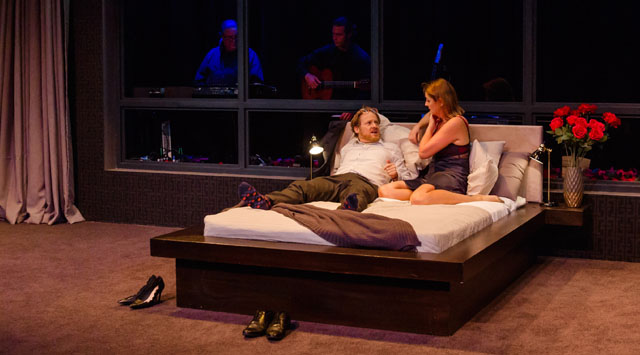
Playwright: Edmond Rostand (adaptation by Damien Ryan)
Director: Damien Ryan
Cast: Andrew Johnston, Barry French, Bernadette Ryan, Christopher Stalley, Christopher Tomkinson, Damien Ryan, Drew Livingston, Francesca Savige, James Lugton, John Turnbull, Julian Garner, Lizzie Schebesta, Madeleine Jones, Melanie Dobson, Thom Blake, Tim Walter, Wendy Strehlow
Image by Phil Erbacher

Theatre review
Women, no matter how intellectual or beautiful, are not to be trusted with their own decisions in Cyrano De Bergerac. Edward Rostand’s 120 year-old play is a romantic fantasy about an ugly man who successfully deceives and misleads the object of his desire, so that his feelings can be reciprocated. His nose, of legendary proportions, clearly does not stand in the way of human vanity.

Roxanne’s lust for the handsome Christian, is presented as foolish and absurd, hence illegitimate, in the old-fashioned play, because of course, the verbosely articulate Cyrano is the appropriate match, if a girl is to experience true love. Women are once again infantilised, and our sexuality subjugated, in order that patriarchal ideals can be presented as superior.

Tiresome ideologies of the original are retained in this recent adaptation, but there is no doubt that Damien Ryan’s remarkable wit and extraordinary talent with words, have polished up Cyrano De Bergerac, rolled it in glitter, and all but blinds us from its inferior politics. Ryan’s work is supremely clever, often very beautiful, and for the many who find enjoyment in its brand of outlandish romance, this is a play that will prove deeply satisfying.

Ryan’s work as actor too, is marvellous. Brilliantly funny, and irresistibly charming, he convinces us that sexual attractiveness is completely irrelevant, and that Cyrano is the only man for Roxanne. Lizzie Schebesta expends her efforts into the side of Roxanne that is repeatedly emphasised to be intellectual, and does all she can to elevate the role from the embarrassing gullibility that is Rostand’s creation. It is a very vivacious cast, relentlessly amusing, and audiences will be held captive for its entire 3.5 hour duration.

There are no big pertinent messages in Cyrano De Bergerac that need our urgent attention. We can certainly be entertained by other much more relevant stories, but this French play continues the perseverate tradition of European occupation of the arts in Australia. For over two centuries, we import these works, as though the purposes they serve are somehow irreplaceable or worse, more resonant than what we can find in the art of our own region. It offers an accurate reflection of the ongoing attitude of colonisation that persists (why else would all 18 actors on this stage be of Caucasian appearance?), even though we wish to think ourselves a modern, progressive and inclusive society.

www.sportforjove.com.au

Review: I Love You Now (Darlinghurst Theatre Company)

Venue: Eternity Playhouse (Darlinghurst NSW), Jun 9 – Jul 9, 2017

Playwright: Jeanette Cronin
Director: Kim Hardwick
Cast: Jeanette Cronin, Paul Gleeson
Image by Robert Catto

Theatre review
The stage is disguised as a hotel room, and two actors play out a series of infidelities in short episodes. The fragments are unified by the amorous theme, but how they fit together as a complete entity is the creative, and intriguing, challenge it presents to its audience. Jeanette Cronin’s I Love You Now takes conventional stories and puts them in a poetic structure, so that the telling of an ordinary tale, can lead to the discovery of greater meanings in everyday life.

Things happen, forming chaotic and arbitrary moments, but the human mind has an insatiable need for narratives. We make connections between incidents, and are determined to read into things, as though the urge to understand, is as basic and inexorable as breathing. While we attempt to make coherence of the scenes as they unfold in I Love You Now, we find ourselves beginning to fall in love instead, with transience. Sure, it is possible to formulate a whole of the parts, but it is really the fleeting moments of beauty and genius that gives us nourishment. Our impulse is to dedicate our attention to a big picture, but what is of greater satisfaction, are the minute occurrences that can so easily slip away, if we do not let go of the desire to be master of every situation.

Director Kim Hardwick’s task is to find balance and harmony in the storytelling, so that appropriate weight is assigned to each of the play’s divergent intentions and concerns. The writing presents many possibilities, and Hardwick demonstrates great sensitivity and fortitude, in her ability to mine for resonance in the many unexpected corners of I Love You Now, persuading our minds to find appreciation for the layer upon layer of ideas and observations, that constitute this deeply textured work of art.

A remarkably polished production, with Isabel Hudson’s set design creating a very solid first impression (the hotel room is glamorous and incredibly convincing), and Martin Kinnane’s lights speaking softly but intricately, the visuals are sumptuous but never obtrusive. As though providing accompaniment to singers centre stage, music is performed live, by Max Lambert and Roger Lock, whose instincts compel us to remain engaged with the play, even when it veers off to slightly obtuse places.

Cronin herself takes on the female roles, while Paul Gleeson is the masculine counterpart. Both are fabulously accomplished; impressive with the complexities and elegance they bring to the show, and as a couple, their infallible chemistry is the main drawcard. It is always what happens between them that is captivating, and important. We watch how they treat each other, listen to the way they speak to one another, inside this room of secrets, and through a range of characters and their clandestine intimacies, our own fires of curiosity and passion, are stoked back to life.

www.darlinghursttheatre.com

Review: Oedipus Doesn’t Live Here Anymore (ATYP)

Venue: ATYP (Walsh Bay NSW), Jun 7 – 24, 2017
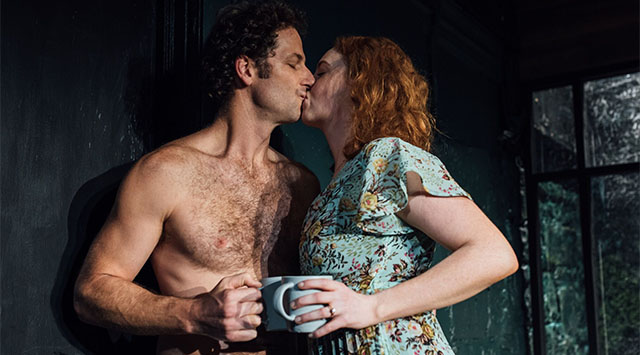
Playwright: Daniel Evan (after Sophocles)
Director: Fraser Corfield
Cast: Caitlin Burley, Jeremi Campese, Mia Evans Rorris, Joshua McElroy
Images by Tracey Schramm

Theatre review
The story of Oedipus and his mother/wife Jocasta has remained in our consciousness over the centuries. The resonance that it provides, whether emotional, moral or simply shocking, is unquestionably deep, but in Daniel Evan’s rendition, it is the tangents departing from the classic narrative that are its real concern. In Oedipus Doesn’t Live Here Anymore, the familiar tale of taboo and tragedy, provides the framework for a passionate and somewhat erratic theatrical experience. Less drama, more experimentation, Evan’s elaborate embellishments reflect a barrage of contemporary ideas that give an unmistakable impression of rejuvenation, although the sense of turmoil so characteristic of Sophocles’ creation is certainly missed.

Director Fraser Corfield uses the intricacies of the text, to formulate a dynamic staging memorable for its quick and vibrant episodes, featuring a host of colourful and surprising characters. The cast of four demonstrates extraordinary focus and conviction, along with an exciting inventiveness that gives their show texture, dimension and depth. Caitlin Burley and Jeremi Campese are confident players who connect effortlessly with the audience, both actors charming and entertaining with the diverse range of personality types they put forth. Mia Evans Rorris and Joshua McElroy provide stable grounding to the production, sensitive and considered in their approach to the many roles they inhabit.

The show is remarkably well designed. The formidable set, evocative of urban dilapidation is as dazzling as it is dangerous; Melanie Liertz’s transformation of the challenging space is quite an achievement. Emma Lockhart-Wilson’s lights address the play’s unrelenting movement of time and space, with excellent certitude and power. Sound by Steve Francis and Chrysoulla Markoulli’s music, give the show a splendid sophistication and cohesion.

It is not a particularly poignant retelling of Oedipus’ life, but we certainly come away gratified by the evidence of a successful collaboration, that showcases some very significant talent.

www.atyp.com.au

Review: The Village Bike (Cross Pollinate Productions)

Venue: Old Fitzroy Theatre (Woolloomooloo NSW), Jun 7 – Jul 8, 2017
Playwright: Penelope Skinner
Director: Rachel Chant
Cast: Kate Bookallil, Sophie Gregg, Jamie Oxenbould, Rupert Reid, Gabrielle Scawthorn, Benedict Wall
Image by Andre Vasquez

Theatre review
Becky is unable to get laid because her husband has irrational fears regarding the baby in her womb. Increasingly frustrated, she finds herself seeking gratification elsewhere. Penelope Skinner’s very riveting The Village Bike makes a powerful statement about marriage and monogamy, and the ways in which these age-old institutions and ideologies continue to form restraints, allowing society to control the lives of individuals, women especially, from the most intimate levels.

It plays almost like a revision of the Aga saga; that genre of slightly camp, English middle-class country life drama. The characters are familiar, and their stories are set, invariably, in an unassuming domesticity. Certainly, the work is critical of the way we conceive of a respectable woman. It challenges the unquestioned rules dictating what is acceptable, and objectionable, of a woman’s sexuality, and also the language we use that gives definition, and weight, to those restrictions.

In mocking that romantic and pedestrian style of storytelling, we see the wildness of Becky’s narrative resist the confines of form. Our protagonist is not playing by the rules, so the rules quickly become visible. In breaking the illusion of happily ever after, we are compelled to study her situation, and because we can relate to Becky’s desires so completely, we have to interrogate the systematic failures that we all have to operate under.

Although political and intellectual, the production is equally stimulating on other fronts. Rachel Chant’s direction ensures each personality we meet is distinct and vividly manifested, so we know exactly what it is that makes them tick (and how they contribute to the play’s tragic circumstances). Sequences oscillate between comedy and drama effortlessly, with moments of breathtaking sexual tension giving an excellent sense of texture and dimension to what we see, hear and feel. Persistent issues with spacial use however, detract from an otherwise polished and very well-rehearsed presentation that is as engaging as it is titillating.

Gabrielle Scawthorne stars as the woman who fucks up. Honest and vulnerable, she keeps us in love with Becky through every transgression. Scawthorne is sensational in the part, thoroughly psychological and physically detailed, turning a confronting role into a beautifully empathetic creature full of charm and disarming authenticity. Supporting actors too, are impressive, each one complex and humorous, all bringing a delicious, and rare, boldness to the telling of an uncompromisingly sexual tale.

By play’s end, Becky is rendered powerless. Entrapped by a world that permits only narrow definitions of motherhood and marriage, she has nowhere to go, but to accept her subjugation. Some have said that bicycling had contributed immensely to the emancipation of women in the 1890s, but today, calling a woman a bike, is to call a woman a harlot, whore, slut, skank; a common and convenient means of suppressing female sexuality, in order that the myth of the weaker sex is perpetuated. There is no greater threat to the patriarchy than a sovereign womanhood that rejects the Madonna/Whore dichotomy. When our sex is no longer tethered to imagined virtues in concordance with family, society and culture, is when a greater liberty can be found, for all the genders.

www.crosspollinate.com.au