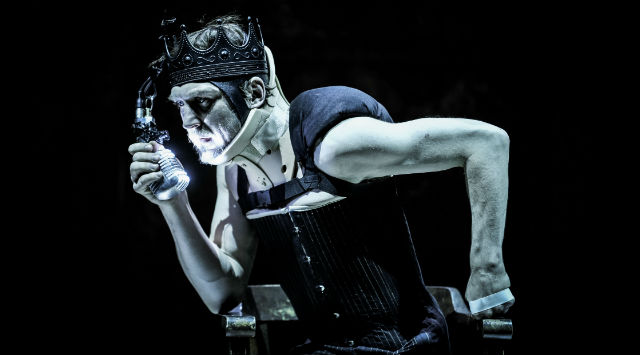
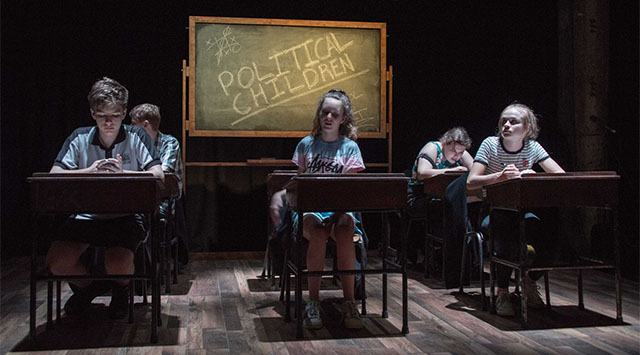
Review: The Judas Kiss (Old Fitz Theatre)

redlineVenue: Old Fitzroy Theatre (Woolloomooloo NSW), Feb 15 – Mar 11, 2017
Playwright: David Hare
Director: Iain Sinclair
Cast: Robert Alexander, Luke Fewster, Simon London, Hayden Maher, Hannah Raven, David Soncin, Josh Quong Tart
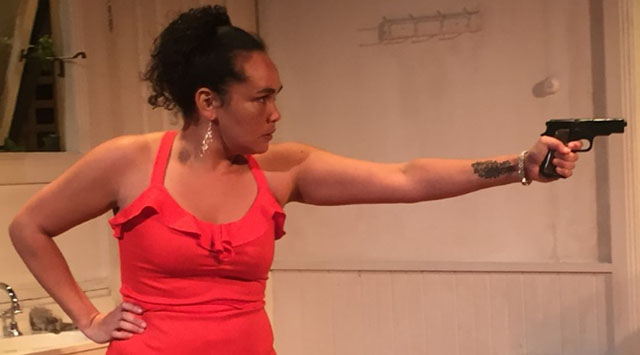
Image by John Marmaras

Theatre review
Oscar Wilde’s career was cut short, when in 1895, just several months after The Importance Of Being Earnest first opened, he was sentenced to two years’ imprisonment for homosexual behaviour. David Hare’s The Judas Kiss is a chronicle of Wilde’s downfall, with Act 1 detailing his last day of freedom, and Act 2 summing up his final years in exile and poverty.

Hare’s writing is nothing short of sublime. The beauty of his language lives up to our expectations of Wilde’s speech and milieu, along with gripping philosophy incorporated into its plot at every turn. It is a rewarding intellectual experience, but the play is also rich with romantic and emotional dimensions that have the ability to engage the more empathetic sides of our attention.

Under Iain Sinclair’s heavily melancholic direction, the show’s humorous Act 1 becomes more sombre than necessary. A dark cloud looms over all the brilliant wit and notorious flippancy associated with Wilde, taking away the laughs, and causing the gravity of the piece to appear too plain and obvious. Sinclair’s style is more effective in Act 2, where the serious tone provides good support to the dramatic unravelling of its main characters.

Playing Wilde is Josh Quong Tart, an actor capable of great intensity, excellent at portraying the role’s inner turmoil. We see him grapple with the writing’s complexity, slipping in and out of resonance, but Quong Tart proves himself to be always captivating even in momentary lapses of authenticity. The Judas in question is Wilde’s lover Alfred, performed by Hayden Maher who brings youth and energy to the stage, but his interpretation is a simplistic one that detracts from the story’s otherwise extraordinary depth. Simon London leaves a remarkable impression with his disciplined, understated approach as Robbie, a quiet personality given tremendous presence by the actor.

Kudos must also be given to Jonathan Hindmarsh’s extremely ambitious set design. Breathtakingly constructed by Colin Emmerton and Gautier Pavlovic-Hobba, one can hardly imagine the effort required for its daily assembly and dismantling.

The persecution of Oscar Wilde has made him an unwilling hero of our LGBT movement, one that is hungry for historical figures to help validate our existence, and to provide contexts for our narratives of struggle. People who had suffered before, tend to have their stories wiped away by the same dominant forces responsible for their mistreatment, so we cling on tightly to the tales that remain. Wilde is remembered not only for his legacy in writing, but also his part in helping us articulate, as a community to the wider world, the prejudice we face, and the value we bring to the world.

www.oldfitztheatre.com

Review: Making Love (King Street Theatre)

kstVenue: King Street Theatre (Newtown NSW), Feb 14 – 25, 2017
Playwright: Jess Scott Driksna
Director: Martin Ashley Jones
Cast: Philip D’Ambrosio, Jess Scott Driksna, Shannon Daniel Fallows, Eleanore Knox, Matthew Oberg

Theatre review
It might look like the 1990’s but the story takes place in a sci-fi future. Robots have become indistinguishable from humans, and are being sold to us as spouses and lovers. Jess Scott Driksna’s Making Love envisions a time when we finally give up on each other, and choose instead to live with compliant beings customised to fulfil our every desire.

It is a logical development of course, as technology continues to take over every function. We know that the events in the play are probably many lifetimes away, but Driksna’s predictions are entirely reasonable. Today, 50 million people are estimated to use the dating app Tinder, and many men in Japan have already declared themselves in serious relationships with virtual girlfriends who exist only on their computing devices and in the imagined ether. We might think of technology as synthetic, and hence contrary to the organic flesh and blood quality of how we conceive of relationships, but our behaviour demonstrates the readiness at which we meld the two.

Driksna’s writing inspires many fundamental and exciting questions about humanity at this advanced stage of civilisation, and even though his ideas are interesting, execution requires greater refinement. The play needs a trimmer plot, and characters would benefit from shorter, sharper dialogue. The script does offer some witty banter, but direction of the piece, which involves long sequences of actors sitting on a couch doing little more than reciting lines, and occasional corny physical humour, is less than exciting.

Acting is unfortunately stilted and under-rehearsed, although leading lady Eleanore Knox does leave a good impression with her concluding scene, in a soul-baring speech about loneliness in cutting edge times. As our consciousness shrinks into a size that fits into our smartphones, we become increasingly insular. People are distractions from an all-important self that exists only between one’s own body and a small magic screen. There is no need to understand others, there is no need to embrace other bodies. Everything can be made to fit one person’s vision of the world, and we think that each one of our tiny bubbles is good enough.

www.kingstreettheatre.com.au

Review: The Mystery Of Love & Sex (Darlinghurst Theatre Company)

darlotheatreVenue: Eternity Playhouse (Darlinghurst NSW), Feb 10 – Mar 12, 2017
Playwright: Bathsheba Doran
Director: Anthony Skuse
Cast: Deborah Galanos, Thuso Lekwape, Nicholas Papademetriou, Contessa Treffone
Image by Steven Siewert

Theatre review
We have told many “coming out” stories over the last several decades. The agonising process of revealing one’s own queerness to inevitably heterosexual parents and a correspondingly straight world, is a mainstay of queer art. In Bathsheba Doran’s The Mystery Of Love & Sex however, we are concerned with how individuals come out to themselves.

Charlotte’s parents are open-minded, savvy individuals who are relaxed about homosexuality, yet she finds herself in a state of crisis when discovering that she might be gay. Her closest confidante Jonny, too, is taken by surprise. Even with all the intimacies that they had shared through the years, the assumption of heterosexuality never goes away. Best friends can tell each other everything, but when it comes to any possible deviation of sexual preferences, those remain a deep, dark private secret.

The play is about society’s persistent inability to makes structural adjustments, that will allow our children to grow into adults with sexual idiosyncrasies, without fear of discrimination or persecution. Doran’s approach for this political issue is subtle, very cleverly handled. It is an intriguing plot, with dialogue that amuse, resonate and challenge. Its ideas are not new, but they are presented in a manner that makes us feel only their relevance and urgency.

Directed by Anthony Skuse, the show has an enchanting warmth that appeals to our sentimental selves. These may not be our families and friends who tell their stories on stage, but Skuse makes us feel as though they are part of our lives. The production has a tendency to be overly polite and placid, but all its messages are relayed with clarity and a beautiful deliberateness.

Charlotte is played by Contessa Treffone, effervescent in personality and comic timing, for a central character impossible to dislike. Best friend Jonny is sensitively crafted by Thuso Lekwape who brings wonderful depth and complexity to a young man trapped between tradition and modernity. Nicholas Papademetriou as Howard is a loving father, almost too sweet for several of his more combative scenes, but we believe all the relationships he fosters. The fiery Lucinda is a memorable presence in actor Deborah Galanos who contributes an excellent vitality, and whose artistic instincts are relied upon for much of the staging’s authentic sense of time and space.

It is a real privilege when the greatest obstacle for social acceptance comes from one’s self. Many of us who will see The Mystery Of Love & Sex, live in progressive communities who have learned about our LGBTQ neighbours, and the diverse expressions of love, sex and gender of all peoples, yet many of us struggle to face our personal desires and sexual experiences with honesty, and without shame. The things we are taught as children stick with us tenaciously. Values and beliefs that have long expired can retain their grip on how we think of ourselves. Each of us has to come to a full realisation that these old ideas have outstayed their welcome, and have them banished.

www.darlinghursttheatre.com

Review: Blink (Stories Like These)

storiesliketheseVenue: Kings Cross Theatre (Kings Cross NSW), Feb 9 – Mar 4, 2017
Playwright: Phil Porter
Director: Luke Rogers
Cast: James Raggatt, Charlotte Hazzard
Image by Robert Catto

Theatre review
It is a love story between a simple man and a complicated woman. Phil Porter’s Blink is a work of fantasy that magnifies the experience of infatuation, to sometimes inappropriate levels of obsession. We can choose to see Jonah as a creepy stalker, even though the play tries to show him only as naive and sweet. His actions are clearly harmless, but that of course, is what most men will say about their fixations. Sophie is made mastermind of Jonah’s actions, and although there is something gratifying in having a woman orchestrate her own experience of romance, the reprehensible fact that Jonah is a Peeping Tom who follows her everywhere, thinking that the object of his desire is completely oblivious, cannot be discounted.

Ultimately though, the characters do develop mutual feelings, and what the play does with their relationship is wistful, and very whimsical. Anna Gardiner’s set design corresponds with the quirkiness of the text, for a performance space imaginatively conceived to provide an enchanting sense of innocent wonder. Director Luke Rogers brings good coherence to a piece of unfettered mosaic-like writing, and his ability to balance upbeat energy with a daydream quality, gives the production its charming, and distinct style. In the role of Jonah is James Raggatt, awfully adorable and convincingly wide-eyed in his Tim Burton-esque interpretation of a young man smitten. His gentle but animated approach almost makes you believe his trespasses to be no more than a little innocuous skylarking. Sophie is a much more complex character, played by Charlotte Hazzard who portrays a woman’s need to be seen, with vital delicate care.

We all want to be acknowledged, for to be invisible is intolerable, but we are not always ready to pay the price for a bit of attention. Sophie wants to be on Jonah’s mind, but is unwilling to offer anything in return. Relationships do not always fit definitions or expectations. People can connect in unexpected ways, but convention can be agonising, and if we let it, can pull us apart. What a happy ending looks like, is familiar to everyone, but when destiny takes us in different directions, we may have to modify our beliefs, and see an alternate image of fulfilment.

www.storieslikethese.com

Review: The Little Dog Laughed (New Theatre)

newtheatreVenue: New Theatre (Newtown NSW), Feb 7 – Mar 4, 2017
Playwright: Douglas Carter Beane
Director: Alice Livingstone
Cast: Sarah Aubrey, Brett Rogers, Charles Upton, Madeline Beukers
Image © Bob Seary

Theatre review
It all feels a bit last century, with a movie star struggling to come out of the closet, and his agent seeming to model herself after the cutthroat antics of Wall Street corporate cannibal Gordon Gekko. Douglas Carter Beane’s The Little Dog Laughed is not the trendiest of plays, but its old fashioned structure delivers all we want from a good night out; lots of laughs and a few patronising observations about people we look down upon.

The story is not particularly interesting, but Beane’s dialogue is never short of wit. Diane (the aforementioned agent) is a manic personality with one-liners to die for. Performed by the show-stealing Sarah Aubrey, who ignites the stage with every entrance, the actor leaves a marvellous impression with an approach full of acerbic intensity and scintillating comic timing. Her chemistry with Brett Rogers, who plays Mitchell the movie star, produces extraordinarily precise and delicious scenes of comedy that ensure entertainment value for any viewer.

Alice Livingstone’s direction is trim and taut, for a fun show that asks questions about our values, even if its plastic Hollywoodness feels a world away (Tom Bannerman’s glamorous set design is quite remarkable). We all exist in a commercial reality where honesty and integrity are constantly tested in every social exchange. The Little Dog Laughed looks at the ease with which we make psychological and spiritual compromises for selfish gains, not only preying on others but also eating into our own sense of self-worth. Diane and Mitchell work hard to make their dreams come true, even when their lives turn miserable, they persist, blinded by an unexamined promise of something that cannot exist outside of their imagination.

www.newtheatre.org.au

Review: A Strategic Plan (Griffin Theatre Company)

griffinVenue: SBW Stables Theatre (Kings Cross NSW), Jan 27 – Mar 11, 2017
Playwright: Ross Mueller
Director: Chris Mead
Cast: Briallen Clark, Matt Day, Justin Smith, Emele Ugavule
Image by Brett Boardman

Theatre review
Andrew works at a nonprofit organisation that brings new music to the young. On the surface are noble intentions, but bureaucracy and ulterior motives threaten its existence every day. Andrew finds himself in a sink or swim position, trying to protect his job, along with his sanity. Ross Mueller’s A Strategic Plan is an angry play for our angry times, a diatribe that pits integrity against exploitation, art against money, with little nuance in between.

Its characters are familiar well-worn stereotypes, some with a heart of gold, and others simply despicable. We never warm up to any of them or to their stories, but the actors who play these roles are certainly dedicated. There is a lot of screaming and shouting, presumably to stop our attention straying away from the predictable and lacklustre plot. Justin Smith and Matt Day play their parts with a lot of conviction, and not much else, as the writing provides little that would allow their personalities any complexity. There is a good level of professionalism in all production aspects, that keeps us sticking around until the end, but the resulting aftertaste is regrettably bland.

There is much to hate in how our corporations operate, and in government bodies that disappoint us repeatedly. It is admirable that A Strategic Plan looks into these failings, but it has a hard time getting us to share in its anger. Malfeasance and injustice occur often, and we have become increasingly disillusioned. We should expect more of community, but the state of the world overwhelms us with all its deficiencies, and to resist a descent into bitter apathy is a challenge we have to face.

www.griffintheatre.com.au

Review: Intersection (ATYP)

atypVenue: ATYP (Walsh Bay NSW), Feb 1 – 18, 2017
Playwrights: Peter Beaglehole, Angela Collins, Thomas De Angelis, Isabella Jacob, Suzannah Kennett-Lister, Louis Klee, Laura Lethlean, Isabelle McDonald, Kevin Ngo, Charles O’Grady, Eliza Oliver, Farnoush Parsiavashi, Zoe Ridgway, Anita Sanders, Michelle Sewell, Jordan Shea, Brenden Snow, Lewis Treston, Mark Tripodi, Jackson Used, Honor Webster-Mannison
Director: Katrina Douglas
Cast: Tamara Bailey, Asha Boswarva, Alex Chalwell, Alex Chorley, Sonia Elliott, Elliott Falzon, Rebecca Gulia, Monica Kumar, Steffan Lazar, Ingrid Leighton, Hudson Musty, Kurt Pimblet, Esther Randles, Iris Simpson, Adam Stepfner, Ilai Swindells, May Tran, Darius Williams, Jackson Williams
Image by Tracey Schramm

Theatre review
Somewhere in the background there exists a high school formal, but what we see on stage are ten stories written and performed by young people, about young people who may or may not be connected with each other. Intersection is an earnest and wholesome collection of personalities, reflecting interests and concerns of today’s middle-class Australian youth.

Jordan Shea’s Little Differences is perhaps the most consciously political, in its passionate investigation of teenagers negotiating differences in religious and cultural backgrounds. Also significant is Charles O’Grady’s subtle depiction of queer identities in Pray 4 Mojo, whereby two lonely souls form a charming bond of friendship through their shared ostracism. Actors Kurt Pimblet and Adam Stepfner prove themselves sensitive and intelligent, offering up great insight into adolescence with their very charming tale.

Excellent performances can be found in Lewis Treston’s Starlight Plaza, in which romantic leads Ingrid Leighton and Steffan Lazar establish spectacular chemistry, transforming a sweet love story into the most engaging vignette of the production. Eminently memorable comedian Monica Kumar brings the laughs in Cassie And Saoirse by Suzannah Kennett Lister, a quirky piece involving an urn and the tricky business of mourning. Asha Boswarva is equally impressive with her delicately balanced portrayal of the recently bereaved.

There is an unmistakable warmth that comes through every one of the show’s segments. Director Katrina Douglas instils a soulful quality that translates as a sense of truth for the audience, even when the stories turn obscure. Creativity materialises in an infinite number of ways, and in Intersection we witness different dispositions and approaches, all finding their way to voice the things that matter. We may not always connect or indeed, agree on all of those things, but to be able to meet at a space of artistic expression, is a moment of harmony that is undeniably precious.

www.atyp.com.au

Review: Osama The Hero (Tooth And Sinew Theatre)

toothandsinewVenue: Kings Cross Theatre (Kings Cross NSW), Jan 21 – Feb 4, 2017
Playwright: Dennis Kelly
Director: Richard Hilliar
Cast: Tel Benjamin, Lynden Jones, Poppy Lynch, Joshua McElroy, Nicole Wineberg
Image by Ross Waldron

Theatre review
Just slightly beneath the skin of every human existence lies the barely contained need for violence, but like every propensity that we try to suppress, it finds expression in unexpected ways. Dennis Kelly’s Osama The Hero discusses our thirst for blood, looking at where that appetite comes from, and how it manifests. We find ourselves in an English housing estate, observing a group of neighbours inflicting cruel harm on one of their own.

It is a tale about scapegoating, and the habitual transference of our evil desires onto easy targets. In the case of Kelly’s play, young Gary, and his innocence, become the object of the group’s brutality, and in the process of his persecution, revelations are made about our oft-unexplained and neglected violent selves.

Director Richard Hilliar goes to great pains for every one of the play’s savage moments to occur with great power. The transgressions are hideous, and they are presented as such. A cultural gap exists between us and the working classes of England located at the centre of the drama, and it is arguable if the production’s interest in that specificity of experience has been made to translate effectively. As we are kept dazzled by the uniqueness of a cultural other, we often lose sight of the universality that can allow the work to resonate more intimately.

The ensemble of five is unquestionably energetic and committed, but the challenge posed by Kelly’s language and its accompanying encumbrance of dialects, can be a cause for distraction. Our attention alternates between hearing meanings, and observing the unsatisfying labour put into achieving what is ultimately a cosmetic accuracy. At their best however, the actors provide masochistic delight in an atmosphere of terrifying menace, the kind of which one would hope to encounter only at the theatre. Nicole Wineberg is particularly memorable in a scene involving her character Louise’s obsession over a video showing a man being killed. She brings the show to an intense peak, with the palpable depiction of a woman lost in evil and dread.

Bad people are almost always other people. If Osama The Hero succeeds, we should see ourselves in its characters, and gain a better understanding of the way we operate, as individuals and collectives, in these post-9/11 times of terror and fear. There is perhaps no solution to our unyielding need to make enemies out of fellow human beings, but knowing how that process works is essential if our evolution is to be progressive. When Osama bin Laden was executed, we never really expected the world to suddenly become a better place, but it certainly quenched the thirst of our carnivorous vengeance, if only for a moment.

www.toothandsinew.com

Review: Odd Man Out (Ensemble Theatre)

ensembleVenue: Ensemble Theatre (Kirribilli NSW), Jan 19 – March 18, 2017
Playwright: David Williamson
Director: Mark Kilmurry
Cast: Gael Ballantyne, Justin Stewart Cotta, Rachel Gordon, Lisa Gormley, Matt Minto, Bill Young
Image by Clare Hawley

Theatre review
Alice and Ryan meet on a bus, and are quickly drawn to each other. They have little in common, except for a shared desperation to become coupled up. Alice is sensitive about her biological clock running out of time, and Ryan is fearful of loneliness. They work hard to create a union, and in Odd Man Out, it seems tough grind is the key to success.

Marriage happens hastily for the pair. Ryan has never said “I love you” back to Alice, and proves himself embarrassing and humiliating in every social situation, but Alice decides to marry him anyway. No surprises then, that the husband turns out a disappointment. It is true, in David Williamson’s world of intractable heteronormativity, that women get into relationships to change men, while men hope for women in their lives to never grow.

We never really believe the Alice character. Maybe it is her severe lack of judgement that betrays the credibility of the narrative, or maybe, we are simply very tired of stupid girls in our stories. Turns out the “odd man out” here, could actually be a rather strange woman. Actor Lisa Gormley’s extraordinarily animated style may not have made things any better, but her conviction in spite of the playwright’s flawed imagination, is impressive. Her work is entertaining, and her aforementioned exuberance, does provide effective distraction from the play’s implausibilities.

Played by Justin Stewart Cotta, Ryan is a much more detailed and authentic personality who helps provide necessary grounding to Odd Man Out. Cotta turns in a spectacular performance, intelligent and thorough in his approach, for an interpretation that is immensely engaging and amusing, while retaining a solid amount of insightful nuance. Whether wildly rhapsodic or sensitive and quiet, Cotta provides the production with excellent layers of depth and clarity, giving the show a meaningful sense of purpose.

Mark Kilmurry’s direction of the piece is spirited and taut. The show has a vigorous energy aided by inventive use of a small chorus of actors, introduced into scenes of otherwise structurally simple dialogue. Sound design by Alistair Wallace is similarly effective in manufacturing a sense of motion and progression, for an urgency that helps us stay captivated.

The play ends abruptly, and awkwardly, with a fairy-tale conclusion that reveals a human need for hope, however misplaced it may be. Odd Man Out is fundamentally romantic, even if it is rarely sweet or poetic. Against all odds, we will dream up a way to make love happen, and that, is the essence of a life well lived.

www.ensemble.com.au

Review: Nosferatutu… Or Bleeding At The Ballet (Griffin Theatre Company)

griffinVenue: SBW Stables Theatre (Kings Cross NSW), Jan 7 – 21, 2017
Playwrights: Tommy Bradson
Director: Sheridan Harbridge
Cast: Tommy Bradson, Sheridan Harbridge, Brandyn Kaczmarczyk
Musicians: Steven Kreamer, Sally Schinckel-Brown, Olga Solar
Image by Lucy Parakhina

Theatre review
We find ourselves at a ballet performance, but a vampire hijacks the proceedings. What he offers is something entirely different from the Swan Lake that had been intended, but is no less beautiful and captivating. Tommy Bradson’s Nosferatutu… Or Bleeding At The Ballet is a tale of jealousy and unrealised ambition. It is about the manifestation of envy as a destructive force, alongside a subversive creativity that can result from the darkness of life as a struggling artist.

On stage, Bradson is an enchanting performer, a Frankenstein monster assembled from our memories of Rowan Atkinson and Marc Almond at their respective best. He wields a kind of magic that is bizarre and confusing, but mostly, it is transportative, taking us effortlessly away to, well, anywhere else but here. Bradson is no ballerina, but every gesture is seductive and powerful. His eyes are mesmerising, full of intense but unresolved emotion, and his voice, a stunning cacophony made of wild imagination and an unbridled passion for high drama.

Direction by Sheridan Harbridge is spirited and adventurous, charming in its embrace of a kind of theatrical madness that the protagonist inspires. The incorporation of live music, headed by Steven Kreamer, is highly effective, with a surprising sophistication in what it allows the production to convey. Also noteworthy are Alex Berlage’s lights and Ashisha Cunningham’s set, both impressive in their interpretation of space for this quirky but bold experiment of non-narrative storytelling.

When Nosferatutu attacks and murders his nemesis, the blood that splatters is a celebration of the avant-garde, and an expression of the innovation that all art requires. It is a messy affair, but anarchy is never convenient, and disruption is always necessary for greater meanings to be unearthed.

www.griffintheatre.com.au