
The Catastrophists (The Basement Productions)

catastrophists1Venue: Reginald Theatre, Seymour Centre (Sydney NSW), Sep 17 – 21, 2013
Playwright: Jordan King-Lacroix
Director: Jordan King-Lacroix
Choreographer: Naomi Hibberd
Actors: Jordan King-Lacroix, Eleanor Ryan, Edward Ransom
Dancers: Naomi Hibberd, Ken Ishii

Theatre review
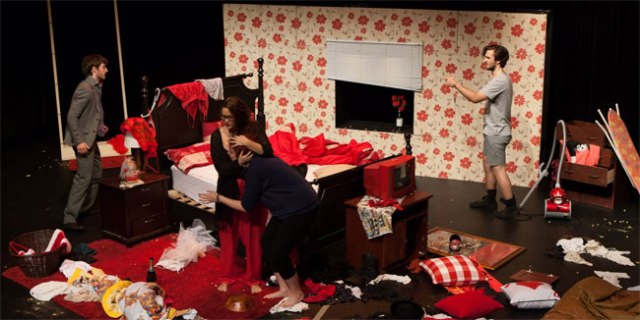
The Catastrophists is about very dramatic characters in three separate stories with slightly different styles of comedy. The three stories are linked with modern dance sequences, but are not obviously connected in any other way.

Eleanor Ryan’s playful performance as Desiree stands out as the most memorable. Her Bronx/Brooklyn accent tickles many funny bones, and the campiness of her character is a perfect fit for the high octane style of the show. Her other character Rachel is equally entertaining but less compelling, due to the complexity of the story that introduces a few too many surprising plot twists. Edward Ransom plays Jack, an awkwardly endearing I.T. professional. There is a lot of quirkiness in his portrayal, which gives his character a complexity and believability that could easily have been overly simple and undimensioned.

Naomi Hibberd’s choreography is charming and has many beautiful touches, but it struggles to find its place amongst the big comedic performances. Bryce Halliday’s music on the other hand, adds to the comedy, and his presence is incorporated well into the production’s staging. One can expect Fringe festivals to deliver the weird and the wonderful, and depending on your personal tastes and disposition, this could be just the production that gets you into fits of laughter.
www.facebook.com/…

Past Tense (Awkward Duck Theatre)

pasttense1Venue: Reginald Theatre, Seymour Centre (Sydney NSW), Sep 17 – 21, 2013
Playwright: Kara Eva Schlegl
Director: Kara Eva Schlegl
Actors: Joshua McInnes, Liz Jameson, Hanni Trewin, David Reynolds

Theatre review
There are two interesting throughlines in Past Tense. It is mainly concerned with Terry’s predicament as a young woman stuck in a rut, but it is also about her relationship with the narrator of her life story. The play therefore consists of a real life dimension as well as a metaphysical realm, but they are not kept distinct. The Narrator is allowed to interact with Terry and her friends, and through this anomaly, a lot of colour is added to the simple story. The show also attempts to introduce a sense of Brechtian distanciation with the idea of a materialised Narrator, although it is unclear whether creating that effect serves much purpose in this instance.

The players are encouraged to perform their comedy broadly, and their approach comes across more akin to the work of comedians rather than actors. Their main intention for the audience is one of effect, rather than empathy or affiliation. This means that the production is able to deliver lots of laughs, but we are unable to connect with the story’s central character satisfactorily. The biggest laughs are for David Reynolds who plays Rich. He has a keen sense of timing, and attacks his funny moments with gusto and conviction. He is there to deliver hilarity, and he is single-minded about it. Joshua McInnes as the Narrator is a good fit. The young actor has an innate sense of formality that is perfectly utilised. He portrays a character that is somberly rigid yet agile, and the show relies on his focus to keep the plot on track.

Along with the Narrator, a musician is on stage through the duration. Mark Conroy underscores the action and provides a few delightful incidental songs, which add to the joviality of the proceedings. Past Tense has a story to tell, and that story is used as a vehicle for entertainment and laughter. The show’s reverberations fade quickly after the performers have taken their bows, but it is great fun while it lasts.

www.pasttensefringe.com

Bushpig (Bagabus Inc.)

rsz_bushpig_seymour_event_build_hero_imageVenue: Sound Lounge, Seymour Centre (Sydney NSW), Sep 10 – 13, 2013
Playwright: Hannah Malarski
Director: Jack Richardson
Actor: Hannah Malarski

Theatre review
This is a one-woman show featuring a young actor who looks like she is having the time of her life, and that there is no other place she would rather be. Hannah Malarski plays Bushpig, an Australian girl who leaves the countryside for “the big smokes”. It is not clear if the story is auto-biographical in any way, but it is evident that both Malarski and Bushpig are destined to be great storytellers.

The play takes on a simple structure, with Malarski portraying the lead character, as well as multiple incidental characters who come into Bushpig’s story. There is a lot of mimicry and playful appropriation of voices and accents, which the audience thoroughly enjoys. Malarski excels at a comedy which is about characterisation, and thrills with every transformation and with every introduction of a new persona. She is an accomplished comedic actor, and one longs to see her in a bigger production, interacting with other performers.

Plot-wise, Bushpig does not offer very much. There are no big dramatic moments, or great spiritual messages, but it defiantly tells the story of an independent female from childhood to adulthood, without mention of romance, marriage or motherhood. Bushpig sprouts from a simple country town, but she stands gallantly on her own two feet.

bagabusinc.tumblr.com
www.seymourcentre.com

A Sign Of The Times (The Follies Company)

signofthetimesVenue: NIDA Parade Theatres (Kensington NSW), Sep 11 – 21, 2013
Playwright: Stephen Helper
Director: Stephen Helper
Actors: Scott Irwin

Theatre review (of preview performance, Sep 11)
One does not go to the theatre expecting the earth to move or a spiritual experience to take place, but a hope always exists in approaching the unknown darkness of a pre-show stage, that just maybe, tonight is going to be special. If once upon a time, you had seen an artist’s work that had overcome you and instilled a life long love for the arts, an unconscious yearning exists for that moment to recur. A Sign Of The Times is not perfect, but it is a play that can shake you to your core.

Like all great works of art, Stephen Helper’s script is about life. It is also about depression, and the obstacles we face that are so challenging that they stop us in our tracks and seem to be completely insurmountable. At these moments of stagnation, the mind goes into overdrive, and this is where the play starts. It features a lone character, performed by Scott Irwin , who delves into every cerebral space with themes like love, literature, poetry, mathematics, science, history, and a whole lot of philosophy. Irwin is perfectly cast as a man overflowing with palpable sadness. This is not a quality that he acts out explicitly but something that seems to manifest in his very being. Irwin’s performance is thoughtful and mature, and we benefit from him taking time with all his lines, many of which are dense and intellectual. He plays the character with tremendous, authentic and heavy emotion, but always careful to pay reverence to Helper’s words.

Helper’s direction is adventurous and dynamic. In contrast to the stasis of life in the play, Helper is effective at varying stage action to prevent anything from turning too severe or dull.  Lighting and sound together, play an important part of the story, and both are very accomplished indeed. Moments of silence are also introduced with powerful effect, and it is in those moments that the character is at his most vulnerable and the theatre feels most intimate.

A Sign Of The Times isn’t always an easy ride, but the journey into excavating the fundamental truths of life cannot be. There is a depth in Helper and Irwin’s work that is rare and incredibly moving. We understand that devastation and salvation make for good drama, but it is the way they portray these experiences, with dignity, bravery and truth, that has created something that shines bright, and eternal, like a diamond.

www.facebook.com/TheFolliesCompany

Miss Julie (Belvoir St Theatre)

757094-1f162f2e-1050-11e3-92bf-1ac22055d80e[1]Venue: Belvoir St Theatre (Surry Hills NSW), Aug 24 – Oct 6, 2013
Playwright: Simon Stone after August Strindberg
Director: Leticia Cáceres
Actors: Taylor Ferguson, Brendan Cowell, Blazey Best

Theatre review
Belvoir’s production of Miss Julie is a radical update of the Strindberg classic. It relocates the characters to modern day Australia, drastically changing its form, language, and ideology. Key plot developments are retained, ensuring that the excitement and drama of the original are utilised to their full potential. Importantly, the political unsavouriness inherent in Strindberg’s pre-feminist 1888 work undergoes thorough subversion, giving rise to a new creation that re-imagines a powerful story, and uses it to make a statement that is representative of our times. It is a feminist act to revamp the work, but the political message contained in this new production is thankfully more ambiguous and sophisticated.

Brendan Cowell does exceedingly well by quickly establishing the play in its time and space with a familiar Aussie bloke caricature from his very entrance. He performs the charming larrikin with gusto, and is immediately likable as well as extraordinarily funny. This man has charisma in spades and isn’t afraid to use it, which is appropriate for the role of a man who is caught between two women. Miss Julie traverses very dark territory, and Cowell’s comic presence serves well to keep the tone humorous, although there are a few points that could have been more impactful if things were allowed to go more serious and grave.

Taylor Ferguson plays the 16 year-old Julie with an enthralling character development that could surprise any seasoned theatre-goer. The role showcases her versatility and courage as a young actor, and the play relies solely on her strengths to introduce a sense of believability and empathy. While her Julie is not the most endearing character to behold, the effect she has on her audience is deep and enduring.

Director Leticia Cáceres and playwright Simon Stone have created this new Miss Julie with a young, revolutionary voice. Their work is fiercely contemporary and fearlessly dramatic. The politics of the story is not immediately evident, but it is the reconstruction of works in the “misogyny cannon” (Cáceres’ words) that is relevant, and one can only hope that they return to that cannon and disrupts it again one play at a time.

www.belvoir.com.au

Empire: Terror On The High Seas (Tamarama Rock Surfers)

1173881_628047743894506_803955022_n[1]Venue: Bondi Pavilion Theatre (Bondi NSW), Aug 29 – Sep 28, 2013
Playwright: Toby Schmitz
Director: Leland Kean
Actors: Anthony Gooley, Ella Scott Lynch, Billie Rose Prichard, Nathan Lovejoy, Anthony Gee

Theatre review
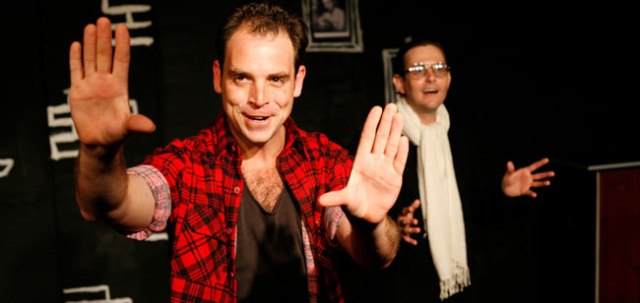
Empire: Terror On The High Seas is a murder mystery set on an ocean liner in the late 1920s, but it owes little to the world of Agatha Christie’s writing. Instead, Toby Schmitz’s script is evocative of improvisational jazz music and the work of William S. Burroughs, with a structure that lends itself to a plot that unfolds mesmerisingly, but also freely goes away on lyrical tangents as though the story takes a break to feed an opiate habit at suitable intervals.

This is a big cast, with the participation of just under 20 actors. Performances are consistently good, with even the smaller roles excelling at creating an impression. Leading man Anthony Gooley is spellbinding as an unorthodox writer of sorts, on a journey grappling with personal issues including his concept of setting poetry to the stage. Gooley skilfully creates an endearing character who surprises with dramatic turns that are deliciously outlandish. Nathan Lovejoy steals the first half of the show with an exquisite flamboyance. His stage presence is irrepressible and he rules the stage with perfect comic timing at the show’s lighter sections. Ella Scott Lynch’s creation of a wild, gutsy flapper provides some of the most entertaining moments, and her stage husband Anthony Gee is memorable with a high energy performance that is manic and menacingly intense.

Leland Kean’s direction is thorough and meticulous. His vision comes through distinctly from his players who obviously understand their captain’s destination and purposes. Kean does not shy away from shock value, but he is simultaneously elegant in his approach. There are explicit scenes of debauchery and murder but his show is an aesthetically stylish one. Costumes and set are cleverly and beautifully designed. Sound is outstanding by being omnipresent and crucial to the fluid machinations of the storytelling, but is never distracting.

This is an artistic work that takes many poetic licenses and while it does not always communicate clearly, it takes its audience on its trip and triumphantly weaves through styles and genres, ending up with a theatrical narrative that is gripping, fascinating, and utterly fabulous.

www.rocksurfers.org

Spring Comedy Double Bill (Blancmange Productions)

summerofbloodVenue: TAP Gallery (Darlinghurst NSW), Aug 27 – Sep 7, 2013

Brad Checks In
Playwright: Paula Noble
Director: Steven Tait
Actors: Chris Miller, Sam Smith, Katherine Shearer, Laura Holmes, Jim Gosden, Katrina Rautenberg

Summer Of Blood
Playwright: Robert Armstrong
Director: Stephen Carnell
Actors: Brennan Muhoberac, Chris Miller, Katherine Shearer, Laura Holmes, Jim Gosden

Theatre review
Two comedies that have very little in common thematically are staged successively over 3 hours. Both are structured almost like film scripts with numerous scene changes and emphasis on character development. Four of the actors appear in both shows, displaying range by taking on drastically different roles.

Brad Checks In deals with relationships in the modern era of online social networking. It is a familiar premise that many would easily relate to, but the play strangely features a central character entwined in a web with three women’s affections, without establishing or explaining his appeal. There are however, enjoyable performances, including Katherine Shearer’s Di who is dynamic and mischievous, and the only female character who was not entirely defined in terms of her relationship with the main character Brad. Sam Smith plays a womanising cad with charm and humour with a more naturalistic approach that contrasts well with the rest of the cast.

Summer Of Blood showcases a cast of manic characters, with frequently funny results. Laura Holmes delivers the biggest laughs with her confident comedic abilities. Chris Miller’s exhilarating performance is crucial to the liveliness of the play, setting the bar for his co-actors in terms of energy levels. Brennan Muhoberac is utterly convincing as an adult virgin who becomes increasingly tainted by greed. Director Stephen Carnell uses film effectively and relevantly, interplaying with live action in a memorable section of the play. Film geeks will relish in the facts and trivia introduced into the script, with references ranging from Alfred Hitchcock to Mary Harron. This is a satisfying, albeit messy romp about genre film, and the aspirations of people in the B-movie industry, but audiences will remember it for the schlocky blood letting, colourful characters and the many laughs it delivers.

www.facebook.com/…

Fred (Old 505 Theatre)

lisachappellVenue: Old 505 Theatre (Surry Hills NSW), Aug 28 – Sep 8, 2013
Playwright: Lisa Chappell
Director: Christopher Stollery
Actor: Lisa Chappell

Theatre review
One woman in an ugly costume, one chair, no set, no props, no “multimedia” elements. This is bare bones theatre that relies squarely on performance, writing and direction. The fact that Fred works so successfully is a real testament to the talent and hard work that Lisa Chappell and Christopher Stollery have put into their craft. This show is relentlessly dark, but also extremely funny. It strikes a balance between the horrific and the hilarious, creating an emotional effect that is painfully unsettling but entirely entrancing.

Chappell’s skill as an actor is exceptional. The thoroughness at which she maps out the frequent and dramatic changes in tone of performance and psychological states is the highlight of this production. Her ability to portray the insanity of being lost in an agonising and devastating memory in one second, and flicking back in an instant to frivolous silliness, is sublime. Also impressive, is that the audience is only ever allowed to see the character, Deidre on stage. The actor, Lisa, is perfectly hidden from view, even though she is right in front of your eyes, expertly casting her magic over a spellbound crowd. Her director Stollery provides a creative and critical “third eye”, and together, they have spawned a one-woman tour de force that is unmissable.

Equally noteworthy is Chappell’s script. Her work explores some of the most morbid crevices of the human imagination, but her storytelling stubbornly remains in the realm of jokes and laughter. This is a perfect (and intense) representation of trauma, mental illness and the human instinct for survival. While the play concludes abruptly, it does so with good reason. It might disrupt the audience’s sentimental response to the character in question, but it is in the awakening from the fantasy into stone cold sober reality that the truth hits home.

www.venue505.com/theatre

Murder On The Nile (The Genesian Theatre)

murderonthenileVenue: The Genesian Theatre (Sydney NSW), Aug 25 – Oct 5, 2013
Playwright: Agatha Christie
Director: Nanette Frew
Actors: Michael Barnacoat, Lilianna Komljenovic, Lachlan McNabb, Martin Estridge, Ros Richards
Image by Mark Banks

Theatre review
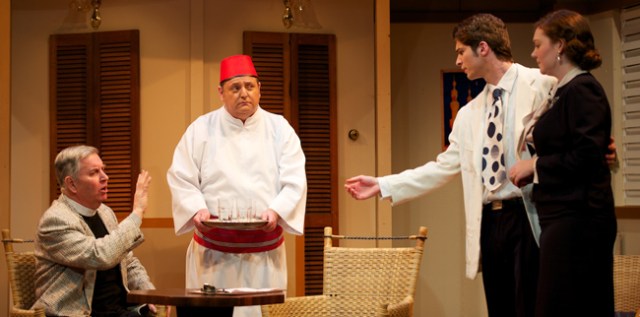
The power of an Agatha Christie work lies in its intrigue and suspense. The way her tales unfold is eminently captivating and beloved by audiences across generations and continents. The Genesian Theatre’s production of Murder On The Nile tells a witty and compelling story set on a cruise liner in Egypt, with colourful characters that retain their appeal 76 years after inception.

Design elements are basic but charming. The set is evocative of 1930s art deco, and effectively conveys a sense of languid luxury that is romantically nostalgic. Lighting is simple but elegant, never drawing attention upon itself, but efficient in its servitude to the play.

The director and players are mindful that clarity is key in the performance of Christie’s murder mystery. While some actors appear slightly miscast, they are all able to communicate the plot perfectly, so that the drama and tension inherent in the play are actualised on stage to great effect. Michael Barnacoat plays Canon Pennyfather with good commitment and excellent diction, giving crucial lengthy speeches in a manner that is highly engaging. Martin Estridge and Ros Richards are crowd favourites, playing eccentric characters with great aplomb, dominating the funniest moments in the show.

The Genesian has always been reliable in delivering great entertainment, and Murder On The Nile is no exception. Some things never change, and this much loved theatre company is thankfully one of them.

www.genesiantheatre.com.au

Jerusalem (New Theatre)

New TheatreVenue: New Theatre (Newtown NSW), Aug 21 – Sep 14, 2013
Playwright: Jez Butterworth
Director: Helen Tonkin
Actors: Nicholas Eadie, Jeremy Waters, Peter Nettell, Emma Louise, Peter McAllum
Image by Matthias Engesser

Theatre review
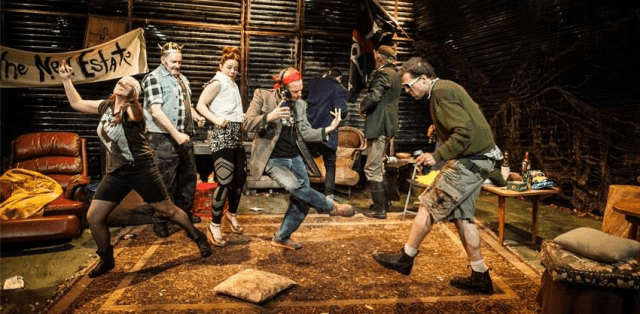
Upon entering the theatre, one is immediately struck by the power of the production design. Set design in particular is a highlight of this production. Tom Bannerman’s conversion of the stage into a dramatically evocative backdrop is absolutely essential to the storytelling. The creation of five different entrances is intelligent, and along with lighting, mood is established long before the first actor appears.

Nicholas Eadie is charismatic in the lead role. He brings variety to his performance, which provides entertainment and also creates a character that is multi-faceted and mysterious. He does however, have inconsistencies with the accent in his speech that could be distracting for some audiences. Jeremy Waters is a delightful actor, full of vigour and presence. He plays Ginger with great flair, equally confident with comic as well as dramatic moments. Peter Nettell is scarily convincing in his portrayal of Wesley. It is a very committed and genuine performance that leaves a lasting impression in spite of the part being a smaller one.

At the heart of Jerusalem is a tale about land rights and commercialism. It has interesting parallels with contemporary Australian issues involving our Aboriginal communities and how they are situated within the economy. This English play makes arguments about territorial ownership in relation to ancestry and money, and how these tensions manifest socially. If Butterworth’s ideas had been applied to a more localised context, their impact could have been even greater. Instead, the show is left intact and unmodified from its foreignness, which gives it an eccentric and exotic quality, but it demands more from the audience, as its cultural specificity is at times challenging and complicated.

www.newtheatre.org.au