Review: They Divided The Sky (Daniel Schlusser Ensemble)

Venue: Belvoir St Theatre (Surry Hills NSW), Jun 13 – 30, 2018
Playwright: Daniel Schlusser (from the Christa Wolf novel)
Director: Daniel Schlusser
Cast: Stephen Phillips, Nikki Shiels
Images by Patrick Boland

Theatre review
Adapted from Christa Wolf’s novel Der geteilte Himmel, Daniel Schlusser’s They Divided The Sky tells the story of Rita and Manfred, lovers in East Germany, just before the 1961 erection of the Berlin wall. Like pieces of demolished concrete scattered in the aftermath, romantic fragments constitute the play, as we wade through a recollection of events, trying to piece together truths of the past.

Politics of that era is central to the piece, but resonance is derived instead, from the personal relationship between its two characters. With mid-century German ideologies taking a backseat, we focus on the dynamics of the pair, examining the intricacies of love at a time of social unrest.

They Divided The Sky is challenging, but ultimately fulfilling, work. Schlusser’s writing and direction require of us, a deep concentration, in order that its transcendental beauty can take effect. Incisive lighting design by Amelia Lever-Davidson helps us tune in, with a degree of meditative attention, in order that we may approach the staging with a heightened sensitivity. James Paul’s sound design manipulates our emotions so that we respond accurately, on a visceral level, even when our minds are yet to figure out what it all means.

Stephen Phillips and Nikki Shiels are the wonderful actors charged with the responsibility of keeping us intrigued and invested. With an usual approach to plot structure, the play is slow to draw us in, but we are captivated from the start, by the strong presence of its cast. Individually, Phillips and Shiels are precise and cerebral with what they bring, and as a couple, their chemistry is unusually powerful. Whether subtle or intense, their energy is able to fill the stage, and in every shade of light and dark that they manufacture, we discover something special in their ephemeral theatricality.

A love is never more devastating than when it ends prematurely. In a week that has seen migrant children torn away mercilessly from their parents, we can easily imagine what it feels like to have a heart be broken, not by the object of desire, but by cruel external forces. In a world increasingly adversarial, the dreaded history of Germany in two halves serves as cautionary tale, for what could result from our appetite for strife and disunity. We can all have our own principles, but to let them get in the way of peace, is our biggest offence.

www.belvoir.com.au | www.danielschlusser.com

Review: Wyrd: The Season Of The Witch (Ninefold / PACT)

Venue: PACT Centre for Emerging Artists (Erskineville NSW), Jun 20 – 30, 2018
Playwright: adapted from William Shakespeare’s Macbeth
Director: Shy Magsalin
Cast: Aslam Abdus-samad, Erica J Brennan, Jessica Dalton, Victoria Greiner, Matthew Heys, Melissa Hume, Paul Musumeci, Gideon Payten-Griffiths, Shane Russon, Brigid Vidler, Tabitha Woo, Luke Yager, Stella Ye
Images by Liam O’Keefe

Theatre review
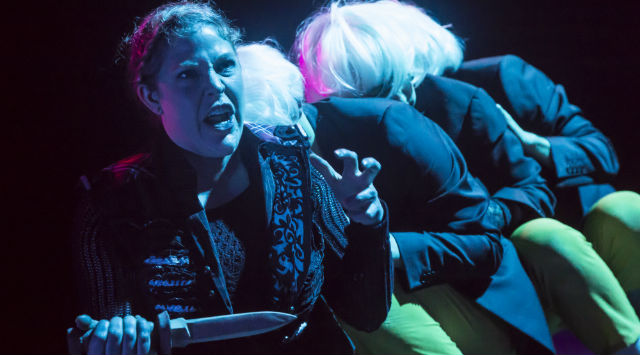
Wyrd is a reconstitution of Shakespeare’s Macbeth, in which the eponymous character is now a woman. Also, she no longer has a wife to blame her misdeeds on, only a coven of witches that proves to have a more intimate relationship with Macbeth than we had previously known. The conflation of dialogue originally held by the separate entities of Macbeth and Lady Macbeth, depicts a new personality that suddenly seems more believable than before. Her duplicitous nature now conveys an honesty that allows us to relate more closely with her circumstances; the ambition and guilt that define her story, increase in pertinence, since we are no longer able to perceive her sins as diffused and shared responsibility.

The production is wonderfully moody, with Liam O’Keefe’s lights and Melanie Herbert’s music providing a waking nightmare in which the action takes place. Director Shy Magsalin’s work with the ensemble is intricate and dynamic, not always elegant, but certainly very exciting at moments of high energy and sheer terror.

The trio of witches, performed by Aslam Abdus-samad, Erica J Brennan and Paul Musumeci, are thoroughly delightful, impressive with the taut cohesiveness of their offering. Gideon Payten-Griffiths appears late in the piece as Hecate to steal the show, completely mesmerising with the bold avant-garde sensibility that he brings to the stage. The inventiveness with his physicality and voice is quite extraordinary, and the show is elevated at a crucial moment, to give us some very special theatre. Macbeth, known only as Our Lady, is played by Victoria Greiner, not quite as flamboyant, but with more than enough conviction to make invigorating, this centuries-old story.

The Western patriarchal canon so powerfully instilled in us, refuses to be ignored. We can try to pretend to forget everything and foster some sort of replacement, or we can look for means of subversion that can assist with our progress. Reshaping Shakespeare to suit our times, will always contribute to the reaffirmation of his position of dominance, but when we are resolved to decipher the myriad problems of our indoctrination, we can begin to introduce meaningful transformation to how we see the world. Our master’s voice is hard to eliminate, but finding ways to expose his faults, can help set us free.

www.ninefoldensemble.com

Review: Dresden (Bakehouse Theatre Company)

Venue: Kings Cross Theatre (Kings Cross NSW), Jun 15 – 30, 2018
Playwright: Justin Fleming
Director: Suzanne Millar
Cast: Thomas Campbell, Renee Lim, Yalin Ozucelik, Dorje Swallow, Jeremy Waters, Ben Wood
Images by Clare Hawley

Theatre review
Wagner’s first success was Rienzi, an opera about the rise and fall of a medieval Italian populist leader. Hitler fell in love with the work, years after Wagner’s death, and in Justin Fleming Dresden we see the unexpected and formidable ways in which art can inspire behaviour, good and bad. It also looks at Hitler as a failed artist, and proffers a chicken and egg scenario; questioning the relationship between that infamous abominable nature and his own deficiencies at artistic creation. Even though information about contemporary fascistic regimes seem to remain prominent in our consciousness, the play does not feel immediately relevant, but Fleming’s writing exceeds the story he tells. Against a backdrop monumental and historic, his words sing with an enchanting beauty, imparting observations that are succinctly constructed and very wise indeed.

Opera and a world war, give the play a sensibility that is unavailingly grand, but the small auditorium is ambitiously converted by set designer Patrick Howe to convey the sophistication associated with Wagner’s discipline, as well as the aesthetic severity of Hitler’s Germany. Benjamin Brockman’s lights are relentlessly theatrical, with incessant transformations that move us through dimensions, from miscellaneous days of yore, to those that are even more ephemeral and fantastical. Director Suzanne Millar very deftly negotiates the weaving realms of the play, taking us from real to imaginary, across terrains and timelines, for an impressively lucid telling of tales.

Yalin Ozucelik and Jeremy Waters are the leading men, both enthralling with their respective stage presences, and splendid with the dialogue that they are master of. As Wagner, Waters is spirited yet delicate, and as Hitler, Ozucelik’s depiction of cruel imbecility strikes a perfectly balanced act of dramedy. Also memorable are Dorje Swallow and Thomas Campbell, each supporting player demonstrating excellent versatility, proving themselves to be eminently watchable in any guise.

We often hear, that all publicity is good publicity. If all Hitler had wanted from his extreme brutality, was to be remembered, then the confounding actions of people in power everywhere, can begin to make sense. Most of us wish to leave behind some semblance of a legacy, no matter how minute, so that our time on earth can be seen to be of some value. Some want their names to last, but others prefer that what they had tried to generate in their own lifetime, is able to make permanent improvements into the future. Bad people exist, and as we negotiate existence around them, we must try to stop ourselves from fighting fire with fire. Good can turn into evil in the blink of an eye, when we let our guard down and start to emulate those who wish to trespass against us.

www.bakehousetheatrecompany.com.au

Review: Marjorie Prime (Ensemble Theatre)

Venue: Ensemble Theatre (Kirribilli NSW), Jun 15 – Jul 21, 2018
Playwright: Jordan Harrison
Director: Mitchell Butel
Cast: Lucy Bell, Maggie Dence, Jake Speer, Richard Sydenham
Images by Lisa Tomasetti

Theatre review
Holograms are a reality, and so is artificial intelligence. Combining the two could garner extraordinary results, and in Jordan Harrison’s Marjorie Prime, we see what happens when the memory of lost loves are calibrated through technology, and people are able to re-materialise in three dimensional pixel form. A widow speaks to her late husband, who appears to exist right before her eyes, a digital simulacra assembled from information that she provides. This is science fiction that all can relate to. Universally intriguing notions around the extension of life, is a powerful subject, but the play’s sense of drama is subdued, and its intellect seems curiously restrained.

The production is elegantly assembled, on a very fabulous set, designed by Simon Greer. Director Mitchell Butel gives us only the essentials in a remarkably low-key approach, but the text seems to offer little that is exciting, besides its initially enticing conceit. Scenes become increasingly repetitive, and we find ourselves gradually alienated from a story that struggles to progress meaningfully. Its conclusion however, is once again provocative, as it takes the plot, finally, to somewhere surprising and quite fascinating.

The show might prove underwhelming but it is a polished and professional cast that takes the stage. In the role of Jon is Richard Sydenham, whose emotions are conveyed with an admirable precision that invites us at key points, to attain truthful connection with themes being discussed in Marjorie Prime. Maggie Dence is charming and humorous as Marjorie, cleverly introducing moments of levity to prevent the piece from turning monotonously serious. Lucy Bell and Jake Speer are competent and committed to their parts, although predictable with the interpretations that they bring.

There is a heavy scepticism in the play, that relates to the synthetic portions of our high tech existence, even though it does acquiesce to the inevitable development of civilisation down the futuristic path. Technophobia should never be the default position when talking about tomorrow. We should question everything, but whenever we submit to convenient attitudes of “natural is always better,” we deprive ourselves of empirical truths. It is tempting to want things to stay the same, but the only constant, as always, is change.

www.ensemble.com.au

Review: Saint Joan (Sydney Theatre Company)

Venue: Roslyn Packer Theatre at Walsh Bay (Sydney NSW), Jun 5 – 30, 2018
Playwright: George Bernard Shaw (additional text by Emme Hoy, Imara Savage)
Director: Imara Savage
Cast: Gareth Davies, John Gaden, Brandon McClelland, Sean O’Shea, Socratis Otto, Sarah Snook, Anthony Taufa, David Whitney, William Zappa
Images by Brett Boardman

Theatre review
Joan of Arc never even made it to her twenties. Executed at the age of nineteen, her story represents the worst of our misogyny, and in director Imara Savage’s version of George Bernard Shaw’s play, that absurd fear of powerful women is given elucidation, as we see state and religion go to great lengths to exterminate Joan, so that the threat that she poses to the patriarchy is banished. In Saint Joan, instead of the usual veneration and idolatry, a war hero is swiftly and mercilessly taken down, for the sole reason of her gender.

Men can have daring ambition and resolute faith, but in a girl, those qualities are turned into the charge of heresy. Shaw’s original vision proclaimed “no villains in the piece,” but Saint Joan is, on this occasion, thoroughly subverted, to expose the inhumanity of forces we hold in reverence, of those so much power is lavished upon. Church and government do not get off scot-free in this rendition of Joan’s legend. Their guilt in the historical episode, is brazenly exposed. Our father figures are rightfully condemned, made to own up to the brutal murder of an heroic warrior.

Full of passion, the work is powerful and gritty, made spectacularly riveting by the presence of its leading lady. Sarah Snook is an unequivocal sensation in the role, equally intense whether depicting vulnerability or majesty, marvellously incisive with the delivery of each line. She conveys meaning and emotion with admirable depth and a disarming authenticity, having us pining for her every artistic bestowment. Her interactions with the cast are replete with chemistry, and the men (all other players here are the culpable masculine) bring generous support, often brilliantly engaging in their own right.

David Fleischer’s set design is a restrained, highly sophisticated evocation of our traditional institutions, with a heavy curtain that encapsulates all that is required to express a simultaneous sense of awe and oppression. Lights by Nick Schlieper and sound by Max Lyandvert, take us through atmospheric and spatial transitions with admirable precision, manipulating our instinctual responses with great dexterity, so that our attention is focused always and only, on the exact resonating point.

Evil has a knack for hiding in plain sight. What was once a story about men being dutiful, is today revealed to be a site for the unravelling of abhorrent systems that thrive on ruthless subjugation. Where we were once entangled in the ambiguity of Joan’s assertions and behaviour, we can now depart from the doctrines that had given justification for the unforgivable persecution of a girl who had done nothing wrong. Corrupting forces will remain, but our ability to act virtuously with courage, truth and justice, is forever in ascension.

www.sydneytheatre.com.au

Review: August: Osage County (New Theatre)

Venue: New Theatre (Newtown NSW), Jun 6 – Jul 7, 2018
Playwright: Tracy Letts
Director: Louise Fischer
Cast: Adrian Adam, James Bean, Kirra Farquharson, Peter Flett, Jake Fryer-Hornsby, Brett Heath, Lynden Jones, Sonya Kerr, Alice Livingstone, Amy Scott-Smith, Helen Stuart, Emilia Stubbs Grigoriou, Emily Weare
Image by Bob Seary

Theatre review
The Westons are a dysfunctional family, of troubled individuals with a penchant for intoxication. There are no real problems that we can deduce, except that their home seems loveless, and each person bears, with great reluctance, a sense of onerous responsibility, where genuine care and affection are often conspicuously missing. There is also the issue of wealth in their story. Unlike the rest of us, these personalities seem to have no cares in the real world. Without any worries about putting food on tables, or securing roofs over heads, it begins to make sense that their anxieties are centred, and inflated, around their dissatisfaction with one another.

Tracy Letts’ August:Osage County is an entertaining work, that offers sadistic pleasures through its flamboyant portrayals, of women suffering emotional torment. Its low stakes give us permission to indulge in their dramatic exchanges, allowing us to watch gleefully, as rich white folk scream at each other, over not very much at all. While not altogether vapid, the play is ultimately lightweight, in spite of the incessant anguish that it endeavours to explore.

Directed by Louise Fischer, the production is appropriately extravagant with its histrionics, and memorable for the intensity it is able to manufacture, for the play’s unique brand of comic depressiveness. There is little in the Weston household that we can easily empathise with, but opportunities for derision abound. Actors Alice Livingstone and Helen Stuart play the bigger parts, both larger than life and very delightful, with the sensational hysteria that they bring to the stage. Also very charming is Kirra Farquharson whose refreshing naturalism introduces a quotient of valuable authenticity to proceedings, and Emily Weare whose nuances are as pertinent as they are captivating.

August:Osage County may not be an instalment of the Real Housewives franchise, but like the best in the tv genre of “scripted reality”, it delivers a series of spectacular conflict that undeniably amuses and enthrals. It may not be at its most satisfying when it attempts to offer depth and insight to the human condition, but the theatrical thrills that it provides, is quite remarkable.

www.newtheatre.org.au

Review: Snap*Click*Shot (Karul Projects)

Venue: PACT Centre for Emerging Artists (Erskineville NSW), May 25 – Jun 2, 2018
Choreographer and composer: Thomas E.S. Kelly
Cast: Jessica Holman, Thomas E.S. Kelly, Libby Montilla, Amalie Obitz, Taree Sansbury, Kassidy Waters

Theatre review
Accompanying the dance, is a recorded narration about ecology. It provides an Indigenous perspective on our relationship with the environment, particularly memorable for its musings about our responsibilities as custodians of the planet. The message in Thomas E.S. Kelly’s Snap*Click*Shot is sombre, but unifying.

The bodies in motion are simultaneously human and animal, soil and vegetation; the false points of demarcation that separate us are dissolved, for an expression of our existence that is all-encompassing. This is a summation of events that sounds excessively romantic, but when immersed, the show feels authentic, convincing in its depiction of nature as wholistic and incontrovertibly linked to the human experience.

Kelly’s work, as choreographer and composer, is sensitive yet disciplined, elegant yet dynamic. His ability to place in tandem opposing qualities, the hard with the soft, creates a sense of drama that keeps us engaged. It is a strong team of dancers, extraordinarily cohesive, and impressive in their familiarity with Kelly’s idiosyncratic physical language. Their presentation is confident, and very well-rehearsed, with an inexhaustible vigour that fills the auditorium. Costumes and lights are however, inadequately conceived, resulting in imagery that is needlessly monochromatic and repetitive.

At the production’s conclusion, we congregate in a circle, eyes closed, sharing in a moment of silent meditation. Our insecurities from being exposed thus, reach for reassurance, and we find camaraderie in that unusual instance of connection. We often think of independence as a virtue, but it is a falsehood to conceive of any life detached. It is vanity that separates, and narcissism that fuels oppression. The simple exercise of acknowledging others as equals will solve many problems, but we rarely rise to that challenge.

www.karulprojects.com

Review: Arthur & Marilyn (Dinosaurus Productions)

Venue: Blood Moon Theatre (Potts Point NSW), May 29 – Jun 2, 2018
Playwright: Jasper Lee-Lindsay
Director: Danen Young
Cast: Meg Hyeronimus, Alec Ebert

Theatre review
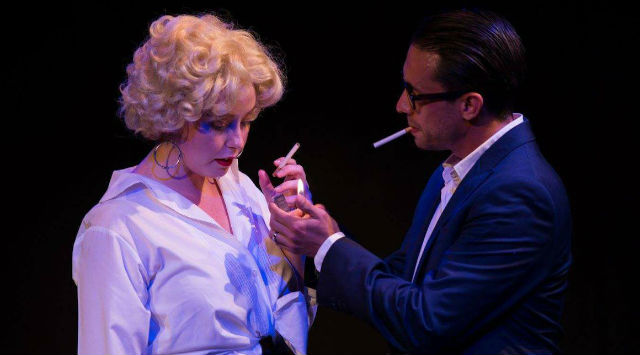
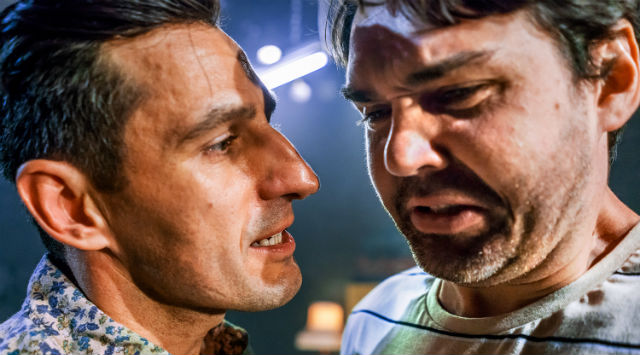
Marilyn Monroe and Arthur Miller, both legends in their own right, are significant not only for the work they had left behind, but as is typical of bona fide celebrities, their personal stories, whether real or fabricated, determine how we remember them generations on. The couple fell in and out of love, against the romantic backdrop of Hollywood in the 1950s. In Jasper Lee-Lindsay’s Arthur & Marilyn, each party is risen from the dead, and the consummate storytellers are called upon to give us their version of that famous love affair.

Dialogue is scintillating in the two-hander, with an admirable authenticity to its depiction of a lulling time and space that has us fascinated and seduced. Actors Meg Hyeronimus and Alec Ebert are an enchanting pair, accurate in voice and physicality for a convincing portrayal of mid-century America. Hyeronimus is wonderful as Marilyn, conveying not only the iconic vulnerable glamour that most of us are familiar with, but also adding a dimension of wilfulness and confidence that makes this iteration seem, perhaps strangely, even more genuine than the original.

The plot of Arthur & Marilyn is imperfect, unable to cultivate an emotional journey with enough potency that can live up to the sentimental value we hold for its subject matter, but levels of intensity for the production, is cleverly controlled by director Danen Young, and our attention is sustained to the end.

Relationships can be kept beautiful, if we are able to concede when their time is up. Longevity of marriages are venerated in polite society, but like so much of life, we learn ultimately that it is the quality, and not quantity, of things that should be valued. Monroe and Miller never had a “happily ever after”, but the many sweet moments that they did have together, represent their very best days on earth.

www.bloodmoontheatre.com | www.facebook.com/DinosaurusProd

Review: Stalking The Bogeyman (Old Fitz Theatre)

Venue: Old Fitzroy Theatre (Woolloomooloo NSW), May 23 – Jun 23, 2018
Playwrights: David Holthouse, Markus Potter (additional writing by Santino Fontana, Shane Stones, Shane Ziegler)
Director: Neil Gooding
Cast: Noel Hodda, Radek Jonak, Deborah Jones, Graeme McRae, Alexander Palacio, Anne Tenney
Images by John Marmaras

Theatre review
David was raped at the age of seven. The damage that follows is unimaginable, and the vigilante action he plans to carry out is understandable, even if some of us will no doubt have misgivings about his intentions to kill. In Stalking The Bogeyman, we are not asked to pass judgement on David’s decisions, but to witness the repercussions of sexual assault, especially as it pertains to the very young. Incidents that take place over several minutes, cause reverberations that last a lifetime. We meet David 25 years after the fateful night, and his struggles are unabated.

With these extraordinary stakes at hand, the play is appropriately enthralling; we are desperate to see how the story concludes. Not only do we want to know, how and if the characters find resolution, it is important that we discover what it is, that our societies would consider to be the right thing to do. In the creation of this play, our values are placed under magnification, and we hope for it to tell us more about ourselves that we may not already know.

It is an engaging production, with Neil Gooding’s restrained direction keeping things concise and clear. Ideas in Stalking The Bogeyman are simple, and powerfully conveyed on this stage. Leading man Graeme McRae’s vulnerability as David is a vital component, that preserves our empathy comprehensively, through every step of the proceedings. The eponymous bogeyman is played by Radek Jonak, whose portrayal of malevolence is as impressive as the electrifying energy he introduces with each appearance.

The play ends on an abrupt, and perhaps anticlimactic note. The drama fizzles out, but as it is “based on a true story” we appreciate the honesty of its divulgements. It is true, that when disaster strikes, we are rarely able to procure redress or compensation that is ever going to be satisfactory. That which cannot be undone, requires that victims find ways, often radical in nature, to make their daily existences bearable. Many even more unfortunate, have suffered annihilating consequences. Another day will dawn, if only for battling the lingering shadows of yesterday.

www.redlineproductions.com.au

Review: Obscene Madame D (Theatre Kantanka)

Venue: 107 (Redfern NSW), May 23 – 27, 2018
Novelist: Hilda Hilst
Director: Carlos Gomes
Cast: Katia Molino
Images by Heidrun Löhr

Theatre review
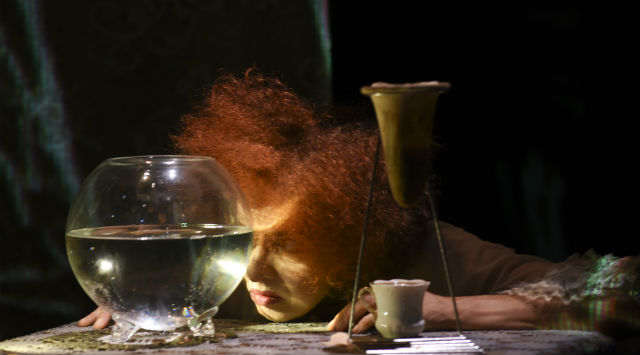
Surrounded by death and dereliction, Madame D is plunged into a deep isolation, where she finds herself examining the meaning of her existence, after suffering the recent bereavement of a longtime companion. Still shaken from the sudden loss, her thoughts are incoherent but belligerent, and her behaviour is increasingly erratic. Her neighbours are perturbed, and so are we. Obscene Madame D is unsettling, an avant-garde work that is unafraid of confusion, determined to embrace the strange and difficult, in its exploration of life at its outer peripheries.

The space is charged with a sense of wonderment, as though something esoteric has taken over Madame D’s depressed home and mind. Video projections by Sam James and lights by Fausto Brusamolino create a gloomy but seductive atmosphere; we never feel at ease, but this mysterious intrusion into Madame D’s sanctuary is a hauntingly beautiful experience. Gail Priest’s music and sound are heard through headphones, so that all the secrets are presented with immediacy, and intimacy, although what we are presented with, never seem to be more than clues or deflections.

Directed by Carlos Gomes, who orchestrates something enchantingly unique for his audience, often intriguing with its penchant for rousing curiosity, though its ability to hold our attention is inconsistent. In the absence of a strong narrative, we drift through dream states, not all of which pertain to the show in progress. Performer Katia Molino cuts a glamorous figure, mesmerising even in various states of dishevelment. In the middle of all the tangential statements, Molino’s unflappable presence provides a reliable centre, that our imaginations can retreat into, and interpretations can be formulated.

When we meet Madame D, it is as though she is encountering freedom for the first time. In pain from the shock of a new independence, she now has to define the world for herself. No longer the passive half of a partnership, Madame D must finally grow up, and as an older woman, the process is understandably excruciating. It is an inevitable metamorphosis, one that can only be unpredictable, but that will ultimately be rewarding, if only for the brutal authenticity that it delivers.

www.107.org.au | www.kantanka.com.au