Review: The Linden Solution (Kings Cross Theatre)

Venue: Kings Cross Theatre (Kings Cross NSW), May 26 – Jun 5, 2021
Playwright: Alexander Lee-Rekers
Director: Camilla Turnbull
Cast: Lib Campbell, Patrick Cullen, Laura Djanegara, Mason Phoumirath
Images by Clare Hawley

Theatre review
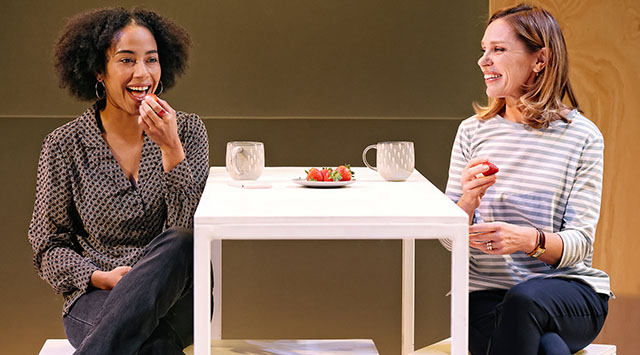
Hannah Marr is an ambitious local government staffer, in the fictitious Australian town of Linden. As residents prove themselves unwaveringly apathetic, worn down by decades of disappointment in rural politics, Hannah takes the opportunity to implement a host of initiatives, surreptitiously and perhaps not entirely by the book. Things seem to be working out according to plan, but as life begins to improve, white supremacist powermonger Aaron Boorman identifies in the amenable and acquiescent populace, an opportunity for his perilous narcissism to flourish.

The Linden Solution by Alexander Lee-Rekers is concerned with complacency, in the face of obvious and significant threats from nefarious forces. In this epoch of social media proliferation, with fascists always seeming to be at the ready to pounce, Lee-Rekers makes a strong argument for vigilance. The construction of his narrative however, is not entirely persuasive. The “slippery slope” scenario that he paints, does bear logic, but the story unfolds in a manner that feels exaggerated and abrupt. It is prudent to note that there is no denying its socio-political value, even if the work lacks an adequate sense of theatricality to instigate greater emotional investment.

Camilla Turnbull’s direction of the piece, although unvaried and overly naturalistic, conveys a gravity that is commensurate with the subject matter’s indubitable urgency. Set design by Tess Burg features a dominant but unnecessarily high platform that makes for inconvenient movement of performers, but lights by Sophie Pekblimli, along with Cameron Smith’s video projections, provide excellent texture to the imagery being depicted. Sound and music by Chrysoulla Markoulli are judiciously formulated, to help punctuate the experience with appropriate dramatic enhancements.

Actor Laura Djanegara impresses with her solid grasp of some very verbose text, but her Hannah is perhaps slightly deficient on vulnerability, thereby preventing the audience from connecting sufficiently with the story’s central character. Her friend and colleague Daniel Lemmey is played by Mason Phoumirath, who brings wonderful nuance and sensitivity to the show. The pair demonstrates good chemistry, prompting us to question the absence of dialogue about race between the two people of colour, in a play that attempts to provoke discussions about race in this country.

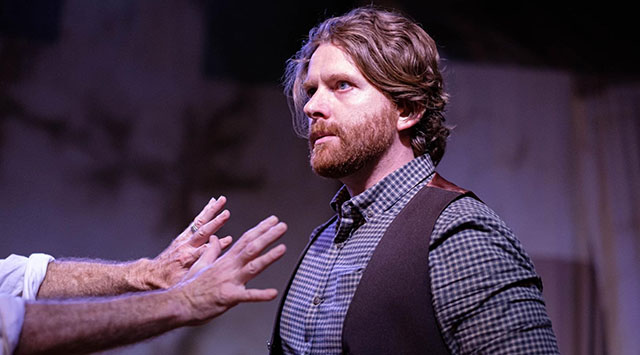
Patrick Cullen is very strong, and convincingly frightening, as the neo-Nazi antagonist, giving us the singular most spine-chilling moment towards the end of the show. Lib Campbell plays a range of whacky characters, all of whom are confidently rendered, and often genuinely funny.

There is something about The Linden Solution that is too black and white, in its analyses of right and wrong. It skates very close to making false equivalences between Hannah who tries to do good for her community, and Aaron who is only ever evil and destructive. We are made to look at the idea of democracy in absolute terms, when we know from lived experience and from history, that absolute democracy can itself deliver unfavourable results.

It is admittedly terrifying to dare think up alternatives to simple notions of democracy, but we have to be cautious of naivety and idealism, when dealing with situations that can be so immense in their complexity. There are times in the play when Hannah is being chastised, and it begins to feel as though we are urged to always play by the rules, even after the rules have failed us over and over again. Many minorities have learned, most notably from the work of poet Audre Lorde, that “the master’s tools will never dismantle the master’s house”. The challenge therefore, is to forge new systems, that aim to leave no one behind.
www.facebook.com/ratcatchtheatre

Review: The 7 Stages Of Grieving (Sydney Theatre Company)

Venue: Wharf 1 Sydney Theatre Company (Walsh Bay NSW), May 21 – Jun 19, 2021
Playwrights: Wesley Enoch, Deborah Mailman
Director: Shari Sebbens
Cast: Elaine Crombie
Images by Joseph Mayers

Theatre review
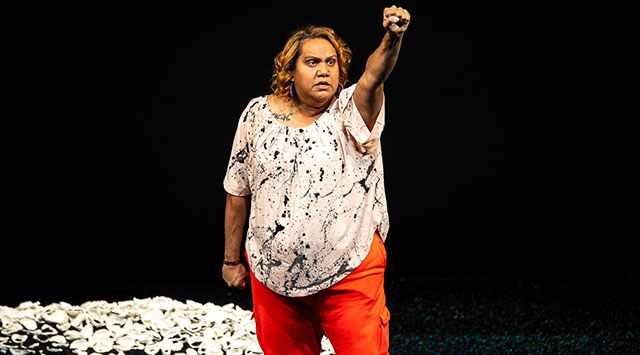
In popular understandings of psychological processes, there are well-known stages of grief, that relate to loss and anguish. Less commonly spoken of, are the sorrowful experiences of our Indigenous, that stem from over two centuries of colonisation. In The 7 Stages of Grieving by Wesley Enoch and Deborah Mailman, a veil is lifted with great generosity, on the burdens of Blackness in this country.

A one-woman play in which the soul of a people is laid bare, The 7 Stages of Grieving offers a valuable opportunity to obtain a condensed overview of challenges faced by our First Nations. Although living in divergent communities, these marginalised voices are given a unified focus, in order that we may cultivate an appropriate attitude and response, for the critical improvements needed for Black lives on this land.

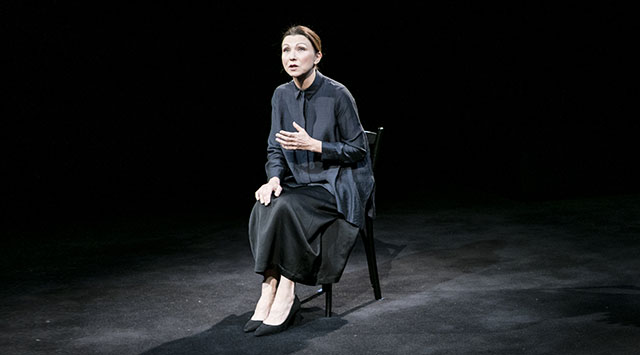
The storyteller takes us through seven phases of Aboriginal history, namely Dreaming, Invasion, Genocide, Protection, Assimilation, Self-Determination, and Reconciliation. Performed by Elaine Crombie who takes on the daunting challenge of representing an entire non-monolithic culture, we see her indomitable and joyful spirit shine through, even as she makes her way through one catastrophic anecdote after another. Crombie resists being defined by adversity; demonstrating that it is in fact a combination of defiance and resilience, that is truly formative.

Directed by Shari Sebbens, the show is memorable for both its gravity and its levity, juxtaposing hardship with humour, to deliver what are arguably the most important messages of our time. Set design by Elizabeth Gadsby (inspired by the work of Megan Cope) too, contrasts shimmering surfaces against earthy shrines, to communicate a sense of struggle in those who fight harder than most to survive. Verity Hampson’s lights and video projections, offer impressive visual variety, while Steve Francis’ work on music and sound, take our minds to ethereal places, as though creating a momentary paradigm shift, in this communal sharing of theatrical magic.

At the show’s conclusion, we are spared the indignity of walking away with little more than melancholy or worse, resignation. The artists urge us to take action, even prescribing “The 7 Actions of Healing” to assist in transforming what is normally a passive audience, into an activated one. Indeed, there is always a danger that the hard work of minority communities, is consumed as a kind of perverse entertainment, or a vehicle to raise awareness at best, but nothing besides.

The labour of presenting one’s trauma, to those directly and indirectly responsible, is rarely received with any comparable urgency. 26 years after the first staging of The 7 Stages of Grieving, we can now take this time to acknowledge the advancements that have and have not been made, since 1995. Whatever we decide is the current state of affairs, it is hard to deny that the room to improve, remains infinitely vast.

www.sydneytheatre.com.au

Review: Bigger and Blacker (Sydney Opera House)

Venue: Sydney Opera House (Sydney NSW), May 19 – 22, 2021
Music and Lyrics: Steven Oliver
Director: Isaac Drandic
Cast: Steven Oliver
Images by Daniel Boud

Theatre review
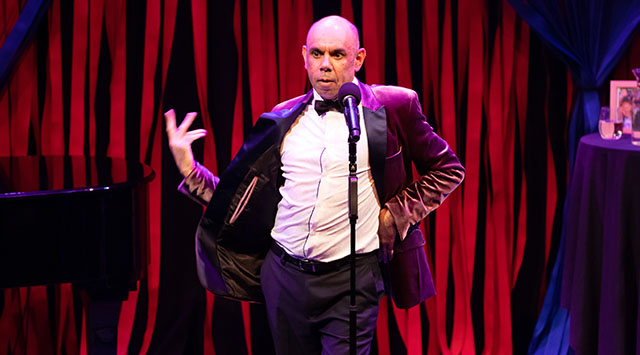
For just over an hour, a gay Black man reigns supreme, in Steven Oliver’s cabaret outing Bigger and Blacker. Entirely live and intimate, Oliver performs self-written songs accumulated over the years, a greatest hits compilation that spans everything from love to politics, that take us from hilarity to devastation.

Much of the presentation is concerned with being on the outside. Marginalised for both his racial and sexual identities, there is no wonder that Oliver is famously funny. Like many whose very existence poses a threat to the hegemony, being comical is a defence, a mode of self-preservation that becomes second nature. In Bigger and Blacker, the artist is characteristically flamboyant, but the underlying gravity of his raison d’etre is always apparent. Through the sensitive eye of director Isaac Drandic, we discover a duality of the persona, whimsical yet dark, and we respond accordingly, sometimes with joy, sometimes with sadness, but most often with a melancholic combination of both.

Oliver’s songs are cleverly written, all of them beautifully melodic and lyrically meaningful, made more poignant by the performer’s sincere introductions for every number. Accompanist Michael Griffiths is his spirited companion, whose inspired musical direction guides us through a multitude of stylistic genres, for a seriously engaging one-person variety extravaganza. From torch song to hip hop, Bigger and Blacker keeps itself fresh and surprising, not a single dull moment permitted.

Brady Watkins’ work on sound design transports us to a sensual world, distinctly lush and enchanting, and coupled with Chloe Ogilvie’s tender lighting, the audience finds itself effortlessly lulled into a temporary theatrical romance. Oliver is dressed by Kevin O’Brien, resplendent in a deep pink tuxedo jacket, determined to steal our hearts.

Identity labels are tiresome, for people who do not have to wrestle with oppression. Those of us who are systematically and habitually excluded, however, learn to embrace that which others have used to define us. What others try to shame us with, we grow to love, and we grow to understand the positively formative power, of everything that is meant to be inferior or contemptible. Oliver talks a lot about being a minority; he is Black, and he is gay, and as we come to realise, is therefore extraordinary.

www.sydneyoperahouse.com

Review: A Room Of One’s Own (Belvoir St Theatre)

Venue: Belvoir St Theatre (Surry Hills NSW), May 6 – 23, 2021
Playwright: Virginia Woolf (adapted by Carissa Licciardello, Tom Wright)
Director: Carissa Licciardello
Cast: Anita Hegh, Ella Prince
Images by Brett Boardman

Theatre review
It was almost a hundred years ago, when Virginia Woolf had given her lectures espousing the importance of championing women writers. Subsequently compiled and published in 1929 as an extended essay, A Room of One’s Own has since become a prominent work of twentieth-century feminist literature, providing language and concepts that have helped advance the cause.

Woolf’s meditations on liberation are, of course, much further-reaching than its immediate academic concerns. Finding ways to empower women writers, as we have discovered, involves an interrogation of how power is fundamentally distributed in our lives. These analyses about the people who do, and those who do not, have the space to think and write, generate a political discourse whereby women can contextualise their experience of freedom, or more likely lack thereof.

Adapted into a theatrical format by Carissa Licciardello and Tom Wright, we discover that Woolf’s words remain potent, even if her approach to these persistent issues can at times seem dated. We also observe that although much of how she had conveyed her thoughts, bear a passion that translates well to the stage, some of her writing is probably more effective when encountered in a book.

Performer Anita Hegh demonstrates a baffling super human memory, completely at ease with the enormous barrage of words she has to deliver. Her graceful gravitas creates for us, a version of Virginia Woolf who is engaging and persuasive, a formidable force of nature that lives up to our imagination, of what the legendary agitator could have been like in the flesh. Hegh’s work is extremely detailed, able to sustain our fascination with the intensity of her depictions, even in moments when one’s intellect falters at trying to keep up.

Licciardello’s direction of A Room of One’s Own introduces a substantial element of abstraction, to provide the show with a sense of elevation. In addition to what remains a lecture by Woolf, is a second performance space, a smaller cube in which a second actor Ella Prince is housed, as she manufactures physical augmentation to what is said and heard. These brief sequences are perfectly conceived, to add much needed theatricality, and to aide digestion of Woolf’s dense words.

David Fleischer’s work on set and costumes, are technically proficient but also surprisingly sensual. Lights by Kelsey Lee too, are soft and almost romantic in quality. The visuals offer a valuable counterpoint, to the understandably militant tone of the text. Music by Alice Chance is luscious, maybe even dreamlike, and along with Paul Charlier’s uplifting sound design, our mind is maintained in a mode of inspiration, as we welcome Woolf’s passionate call for progress.

“500 pounds a year” is the author’s unmissable refrain, reflecting a way of looking at equality that places emphasis on giving to women, what men possess. In the new century, we learn that what men possess, is no longer that which represents a better way of being. Woolf implies that to be rid of menial tasks, is the only way for women to think, but she was wrong. Many of modern feminism’s greatest thinkers were/are never able to leave the trenches of patriarchal oppression.

It is appropriate that both performers in the show are white women. Although much of what Woolf has written is valuable, it comes from a position of privilege that the author was evidently unwilling to confront. There is a deceptive simplicity to her message, and a strong tendency to preserve structures that should be called thoroughly into question. All she wants it seems, is to swap male for female, in these old ways of running things. What we need is to admit that these very systems of running things, are a problem, no matter who occupies positions within.

www.belvoir.com.au

Review: Dogged (Griffin Theatre Company)

Venue: SBW Stables Theatre (Darlinghurst NSW), Apr 30 – Jun 5, 2021
Playwrights: Andrea James, Catherine Ryan
Director: Declan Greene
Cast: Blazey Best, Sandy Greenwood, Anthony Yangoyan
Images by Brett Boardman

Theatre review
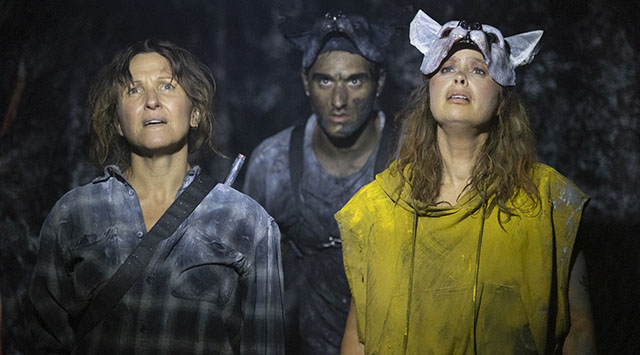
The story begins with a dingo in the lands of alpine Victoria, on Gunaikurnai country, looking for her babies. During her search, she encounters a dog and his human owner, a white woman hunter on the prowl for dogs in the wild, to collect their skin for profit. Dogged by Andrea James and Catherine Ryan, explores the broken relationship between modern humans and nature, as well as the difficult bonds between Indigenous Australians and their colonisers.

The 80-minute play is ambitious in scope, with a complex structure that reflects its creators’ desire to encapsulate many discussions being conducted by the wider community. In addition to topics pertaining to environmentalism and racism, Dogged touches on feminism and capitalism, for a work about injustice that cares to be vastly inclusive. Its approach however, is purely allegorical, sometimes obvious but mostly obtuse, which suggests that Dogged is likely to speak more intimately to those already invested in these ideas.

For those less initiated, the action-packed production incorporates energetic sequences, choreographed by Movement Director Kirk Page, that provide an exquisite dimension of visceral excitement to the narrative. Three extraordinary performers hold us captive, for this strange and sometimes bewildering tale of inter-species adventure. Sandy Greenwood is spectacular as Dingo, incredibly detailed with what she is able to convey between the lines, as a First Nations woman actor. We watch her as dingo and as human simultaneously, like a sort of transmorphic genius, illustrating the parallel plights of being Indigenous, of being female, and of being mother earth. Even though her main concern is the portrayal of desecration in its many forms, it is Greenwood’s defiant strength that really mesmerises. Also remarkable are the depths of emotion she summons at will, always replete with intensity, and flabbergasting in her authenticity.

Also impressive is Blazey Best who plays the unnamed human Woman, with a fierce mental concentration to accompany an excellent capacity for nuance, successfully preventing the hunter from devolving into a simple villain. Anthony Yangoyan does a marvellous impression of a dog, both physically and in attitude. The actor is completely believable playing canine in this fantastical thriller, with an endearing sprightliness that introduces a layer of tenderness to an often brutal landscape.

Director Declan Greene uses the writing’s complexity to deliver an exciting show, gripping on several levels. Dogged can be received as an intellectual piece, one that is highly critical of our reprehensible values, and confrontational in addressing our immorality. On the other hand, its dramatics are taut, with characters that interact deliciously, in the telling of a story whose stakes remain high from start to finish.

Design work on the production is inventively and skilfully implemented. An intricate set by Renée Mulder and Peter Waples-Crowe, guides our imagination into dark bushlands, mysterious and scary as though stepping into a living nightmare. Mulder’s costumes convince us of the roughness of these creatures’ existence, and the danger that constantly surrounds them. Lights by Verity Hampson meaningfully amplify every resonance of the text, bringing focus to all the profound messages that fundamentally anchor the show. Along with sound and music by Steve Toulmin, mood transformations in Dogged are accurately and intuitively accomplished, and the way Hampson and Toulmin collaborate to keep the staging unpredictable, is truly praiseworthy.

The colonisation of this land must not be seen as anything but cruel, unjust and inhumane. Commencing with European invasions in the 18th Century, to all the subsequent waves of migration, the incremental and devastating dispossession that our First Nations have had to suffer, is unforgivable. Like the destruction on nature, that modern technology, industrialism and commerce, have conspired to enact, we have arrived at a point of apocalyptic discombobulation, where we have no choice but to better understand the impact of many of those sins, past and ongoing.

Dingo tells Woman to “fuck off!” but one wonders if we are already in too deep, and if the idealistic wish for a simple reversion to a historic purity, can ever be possible. So much of the damage has been permanent. There needs to be a rebuild, as though from ashes, a rebirth that centres all the reparations that have to be made. If the moment of reckoning does not take place today, we are only waiting for things to get worse, before the dreaded inevitability happens.

www.griffintheatre.com.au | www.forcemajeure.com.au

Review: Fun Home (Sydney Theatre Company / Melbourne Theatre Company)

Venue: Roslyn Packer Theatre (Sydney NSW), Apr 27 – May 29, 2021
Book and Lyrics: Lisa Kron (based on the graphic novel by Alison Bechdel)
Music: Jeanine Tesori
Director: Dean Bryant
Cast: Gilbert Bradman, Ryan Gonzalez, Emily Havea, Mia Honeysett, Lucy Maunder, Jensen Mazza, Maggie McKenna, Adam Murphy, Marina Prior
Images by Prudence Upton

Theatre review
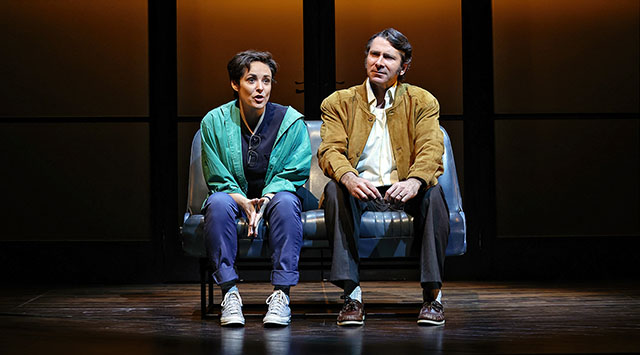
In the American musical Fun Home, based on the autobiographical graphic novel by Alison Bechdel, we observe the cartoonist hard at work on her drafting table, looking back at memories of her difficult father. Bruce was a baby boomer, and like many queer people of that generation, never came to terms with being gay. Even as Alison began to come out as lesbian, his personal anguish never diminished, struggling even to offer support to his own daughter at a time when she had needed him most.

Clearly intended to be an emotional theatrical experience, the show’s reliance on an unlikeable character is risky, and even though the music is predictably and relentlessly sentimental, it is doubtful if audiences could ever feel the full impact of the hardship that this family had gone through. Alison goes to considerable lengths to find forgiveness and understanding for her father, but it is arguable if the musical provides sufficiently for us to respond with deep compassion, or even to care enough for these characters, to be able to invest adequately into their story.

The staging is a polished one, with Alicia Clements’ design facilitating efficaciously, the need for frequent oscillations of time and space. Matt Scott’s lights are beautiful, especially when depicting illusory moments during which we see characters suspended in the undefined abyss of Alison’s imagination. Director Dean Bryant introduces an excellent sense of pizzazz to the production, making sure that we are entertained to the fullest of the show’s potential. He ensures that the story is told with clarity, including the unsavoury revelations relating to Bruce’s life.

We see Alison at three periods of maturity, from childhood and her college years, to the grown woman she is today. Child star Mia Honeysett is fantastic as Small Alison, wonderfully nuanced and authentic, in her portrayal of a child navigating complicated family dynamics, as well as her own blossoming homosexuality. Medium Alison is performed by Maggie McKenna whose singing voice proves a divine pleasure, and Lucy Maunder is captivating as Big Alison, bringing a palpable tenderness that underpins the show. The striking Adam Murphy does his best to honestly depict Bruce, warts and all, but it is Marina Prior who leaves a strong impression playing his wife Helen. When she finally breaks her silence and delivers a faultless solo number, Prior’s technical prowess brings momentary elevation to the production, inviting us to luxuriate in the sheer genius of her singing.

It should come as no surprise that humans are sometimes much more troubling, than a 100-minute Broadway musical can accommodate. The formulaic nature of these creations, requires a form of storytelling that follows many rules, and we discover that truth can sometimes become its nemesis. Bruce’s sexual encounters with underaged boys, is not forgivable, especially in this space of commercial theatre. Fun Home requires us to regard Bruce’s past sins with generosity, the way his daughter has to, in order that our emotions may become engaged in accordance with the traditional peaks and valleys of a conventional musical. Bruce’s transgressions however, are much too severe, at least for the old-fashion song-and-dance format.

www.sydneytheatre.com.au

Review: Honour (Ensemble Theatre)

Venue: Ensemble Theatre (Kirribilli NSW), Apr 23 – May 5, 2021
Playwright: Joanna Murray-Smith
Director: Kate Champion
Cast: Ayeesha Ash, Lucy Bell, Huw Higginson, Poppy Lynch
Images by Prudence Upton

Theatre review
After 32 years of marriage, George, a renowned writer, suddenly decides that he is no longer in love with Honour. To be more precise, he simply no longer wants a life with her. Unsurprisingly, this change of heart is precipitated by the appearance of a younger woman, Claudia, who had been assigned to interview George for a publication. In Joanna Murray-Smith’s wonderfully contentious play Honour, the meanings of love, marriage and fidelity, are brought under scrutiny.

Some of our most fundamental values come into scintillating question by the work, as good art is want to do. Four characters, with differing perspectives, challenge the way we think about something that seems so often, to be prescribed and immovable. Additionally, a modern approach to the depiction of female desire, encourages us to examine romantic partnerships in renewed ways. Issues around duty and responsibility, as they apply to womanhood (who we care for, and who to care for us) further broaden the scope of how we regard these long-established notions of matrimony and family.

Although never too radical in temperament, Murray-Smith’s work bears intellectual dimensions that are deeply compelling. She presents her ideas in a way that feels accessible, but encourages us to go further with how we consider repercussions (for her characters, and for ourselves) as they appear through her narrative. Directed by Kate Champion, there is no shortage of richness in how the production discusses these topics. In fact, it often appears that philosophy comes before drama, in Champion’s presentation of Honour. The result is a rewarding experience of theatre, even if its dialogue can sometimes move quicker than our minds can keep up with.

Actor Lucy Bell invests heavily into emotional authenticity for her portrayal of Honour, the jilted wife. The human complexities in Honour’s reactions to her predicament are rendered soundly by Bell, who makes believable the extraordinarily cerebral way that this wronged woman processes her trauma. The other woman Claudia is compassionately interpreted by Ayeesha Ash, who prevents the audience from too easily dismissing the role for her problematic actions. It is in our understanding of Claudia, that we can attain a more sophisticated appreciation of the play’s ideas. George is made surprisingly sympathetic by Huw Higginson, a sensitive performer unjudgmental of the celebrity writer’s dubious choices. Honour and George’s daughter Sophie is played by an energetic Poppy Lynch, who succeeds at making substantial, a comparatively small role.

Production design by Simone Romaniuk is elegant and evocative, with a simplicity that complements the show’s performance style, focussing our attention closely on the intricacy of dynamics between characters. Damien Cooper’s lights too, offer generous enhancement to the tone of each scene, gracefully moving us from one mood to another. Music by Nate Edmondson adds a sense of flamboyance to the story’s inherent dramatics, effective at turning every seemingly mundane circumstance into something unequivocally theatrical.

We put so much time and effort into this thing called love, but rarely do we interrogate the impulses that lead us to it. In the play Honour, we can recognise that the experience of love, is influenced so much by factors that relate to social conditioning, or “the way we are brought up”. What feels natural and organic, is so heavily informed by beliefs that have been unconsciously, but actively, cultivated, yet to dare shift parameters around what is and is not permitted in how one chooses to experience love, is often met with disapproval. When George declares that he is no longer in love, in the old-fashioned way, with Honour, the overwhelming pang of betrayal is obvious to all. To want him to stay because of guilt, debt and responsibility however, is not what Honour deserves.

www.ensemble.com.au

Review: Dead Skin (White Box Theatre)

Venue: Kings Cross Theatre (Kings Cross NSW), Apr 2 – 17, 2021
Playwright: Laneikka Denne
Director: Kim Hardwick
Cast: Ruby Maishman, Sarah Jane Kelly, Abe Mitchell, Laneikka Denne, Camila Ponti-Alvarez
Images by Jasmin Simmons

Theatre review
When high schooler Andie falls in love, it is not only her new girlfriend Maggie who occupies her mind. Visions of her mother Andrea come flooding relentlessly in. Laneikka Denne’s Dead Skin talks about teenage love, in tandem with the complications of a girl coming of age, without the presence of her mother. Young Andie needs to know what it is to become a woman, and in that transitionary process, the urge to understand a mother she never knew, becomes irresistible.

Much of the story is about the things we suppress, in order that we may survive, and the breaking points that occur, to open the gates for the confrontation of truth. As a child, Andie never received satisfactory information about Andrea’s disappearance, only knowing that life has to go on, imperfect as it may be. Things change however, when she is no longer able to experience the world as a child, and the truth of a woman’s being, must come to the fore.

Denne’s ideas are expressed meaningfully in her piece. Abstract concepts are juxtaposed comfortably against naturalistic scenes, using the theatrical form cleverly to explore curious facets of human psychology. The fragmented nature of the writing’s structure however, has a tendency to work against the audience’s capacity to sufficiently invest in its characters. Dialogue for Dead Skin whilst charming in its authentic representation of contemporary youth culture, can expose a superficiality in its efforts to capture painful aspects of emotional growth.

As performer, Denne is intense in the role of Andie. Very believable, if slightly monotonous, in her depiction of the awkward teenager; we never question the authentic voice she brings to the stage. Her new love is played by Ruby Maishman, charismatic and confident as the comical Maggie. Camila Ponti-Alvarez leaves a strong impression as Audrey, an unlikely maternal figure, especially captivating in moments of heightened drama. Sarah Jane Kelly and Abe Mitchell are mother Andrea and father Harry, respectively, both demonstrating excellent commitment, for somewhat perfunctorily conceived personalities.

Production design by Angus Consti offers clean lines on a very black stage, to denote a space that is about accuracy in the mind, rather than somewhere more tangibly material. Lights by Martin Kinnane provide much needed variation to atmosphere, but Chrysoulla Markoulli’s near constant drone for sound design, proves challenging.

Much of the show, directed by Kim Hardwick, feels like a dream state. We fluctuate between different levels of lucidity, with resonances that hit and miss. Dead Skin ebbs and flows, more interested in its own discoveries, than in driving home a point. Let artists do their art, and be grateful in our participation from the perimeters, as we observe and glean what we can. Together at the theatre, let us delight in curiosity, and hold each other safe, in an inevitable evolution of our species, whichever direction it may take us.

www.whiteboxtheatre.com.au

Review: Fuente Ovejuna (Flight Path Theatre)

Venue: Flight Path Theatre (Marrickville NSW), Mar 25 – Apr 11, 2021
Playwright: Lope de Vega (adaptation by Angus Evans)
Director: Angus Evans
Cast: James Bean, Tristan Black, Julia Christensen, Steve Corner, Shayne de Groot, Dominique de Marco, Lucinda Howes, Suzann James, Martin Quinn, Davey Seagle, Idam Sondhi, Madeleine Withington
Images by Clare Hawley

Theatre review
Originally published early seventeenth century, Lope de Vega’s Fuenteovejuna is based upon the true story of a bloody revolt that took place in 1476 Castile. After sustained mistreatment by authorities, residents of the town Fuente Obejuna banded together and decapitated their commander in a coup. When investigators took to torturing individuals, each victim would refuse to divulge information, and in solidarity answered only that “Fuenteovejuna did it.”

Adapted and directed by Angus Evans, this new version of Fuente Ovejuna takes the opportunity to express the discontentment of contemporary Australians with our own leaders. Evans’ approach demonstrates that themes of the play could easily be applied to any period of recent political memory, but of particular salience is the Prime Minister’s current inability to manage the upheaval brought upon by revelations of sexual assaults, committed by members of his own government. Their sustained and wilful insolence certainly does inspire fantasies of mutiny and murder.

Evans’ ideas are put forward passionately, if not always sufficiently coherent. It is a galvanised team under his guidance, with all aspects of the production demonstrating admirable levels of commitment and energy. Actor Steve Corner leaves a particularly strong impression in a variety of roles. A powerful and compelling presence, he introduces a delicious, and necessary, sense of heightened drama, especially when occupying centre stage. Lucinda Howes as Laurencia, fires up our emotions in a crucial scene that sees her stoke the flames of rebellion. The authenticity that Howes musters for that moment, is sheer theatrical joy. Tristan Black is charming and very funny as Mengo, and as puppeteer for the King. The performer’s comic timing is perfect, and a real highlight of the show.

Live music is provided by Edward Hampton and Liam Peat, both musicians attentive and inordinately sensitive, adding tremendously to our enjoyment of the staging. Lights by Jas Borsovsky are suitably ambitious, and clever in their seemingly intuitive manipulations of our emotional responses. Victor Kalka’s set and Lucy Ferris’ costumes evoke a time past, whilst maintaining relevance to the present, so that we understand the foreign places to be no different from here, and the historical personalities to be the same as us.

It is gruesome but undeniably joyful to witness the execution of a heinous autocrat. The truth however, is that our systems of power, can withstand the toppling of any one figure, no matter how eminent. We may feel empowered when daydreaming about Prime Ministers, movie moguls and press barons being cancelled or removed at will, but these positions undoubtedly will be swiftly replaced, by more of the same.

Fuente Ovejuna is a story about solidarity, and the power of the people. In places like Australia, the establishment only exists, because we the people, allow it to. The reason we authorise its powers, is that we believe them to be beneficial to our existence, but it seems that what we believe, is almost entirely controlled by those powers that be, in an ominous cycle of causality.

It is easy to acknowledge that parts of our minds can fathom a way of life devoid of corruption, that in our imagination, an idealistic utopia always seems just a hair’s breadth away. We want to think that as a united people, we can make decisions that are right, that those determined to be rapacious and unjust can be vanquished. In reality however, our way of life has long been predicated on inequity and greed. If our fundamental values require that there be losers as well as winners, then surely true unity will forever elude us. We may experience flashes of reckoning, in fact these moments of cultural awakening seem to occur increasingly frequently, but there is little proof that knowing what is right, is ever going to lead us to actually doing better.

www.flightpaththeatre.org

Review: Stop Girl (Belvoir St Theatre)

Venue: Belvoir St Theatre (Surry Hills NSW), Mar 20 – Apr 25, 2021
Playwright: Sally Sara
Director: Anne-Louise Sarks
Cast: Deborah Galanos, Sheridan Harbridge, Amber McMahon, Mansoor Noor, Toni Scanlan
Images by Brett Boardman

Theatre review
When Suzie returned from Kabul in 2011, it was the shock of the normal, that started her on an agonising downward spiral. In prominent Australian journalist Sally Sara’s semi-autobiographical playwrighting debut Stop Girl, Suzie is her doppelganger, through which stories of trauma and of healing, could be told. After years covering the war in Afghanistan, in addition to other disasters all over the world prior, Suzie intends to buy a home, ready to put down her roots in Sydney for a new phase in life. What greets her however, is a torrent of mental health disintegrations, preventing her from experiencing the comparative peace on this land, that the rest of us almost always takes for granted.

There is unequivocal passion and honesty in Sara’s writing, but an undue conventionality, in form and style, unfortunately delivers a show that can feel predictable and repetitive. Much has been written about post-traumatic stress disorder, often in more affecting ways, and although Sara’s critical need to share her story cannot be denied, Stop Girl sadly, brings nothing new to stories about the aftermath of war, that we have heard countless times before.

Directed by Anne-Louise Sarks, relationships between characters are conveyed with believability and warmth. There is a stilted quality to the delivery of dialogue, but each personality in the play is convincingly depicted, even though the production never quite attains the level of naturalism that it aspires. Stop Girl has a simple point to make, about the lack of care for those returning after having made unimaginable sacrifices, and Sarks leaves us fully persuaded.

In the lead role is actor Sheridan Harbridge, who comes to life when Suzie falls into a state of psychological torment, allowing us valuable insight into the workings of severe upheaval on the human mind and body. Best friend Bec is played by a spirited Amber McMahon, offering an effective point of reference and contrast, that demonstrates the degree to which our protagonist has deteriorated. Mansoor Noor is memorable as Suzie’s resilient fixer and producer Atal, an important embodiment of our responsibilities towards those in war-torn countries. Also very accomplished are Deborah Galanos and Toni Scanlan, both performers showing admirable commitment to their parts as psychologist and mother, respectively.

Intermittent video projections documenting Susie’s memories of Afghanistan, created by Jack Saltmiras and Susie Henderson, bring a sense of dynamism to the presentation. Music by Stefan Gregory and Hamed Sadeghi, are reliable in manufacturing swift transformations of atmosphere, and along with Paul Jackson’s lights, take us succinctly through each dramatic fluctuation of Susie’s emotional journey. Robert Cousin’s set design is elegant if slightly unambitious, and Mel Page’s costumes offer thoughtful solutions for a production that looks appropriately understated.

Keeping the Australian people ignorant, is advantageous for big business and career politicians. The less we know, the better. When we are in the dark, we can be sold anything they want. Journalists who go against all odds, risking life and limb, to bring us the whole and awful truth, are our unsung heroes. When they are no longer able to contribute, it appears that we discard them, on a metaphorical human trash heap, courtesy of our endlessly intensifying obsession with a capitalistic way of life. Even when we know that all humans have a use-by date under this system of running things, we do little to save ourselves from this inevitable consequence. All we have, is to prescribe to capitalistic principles of “every man for himself”, to be selfish and to hoard, should we hope to live with any dignity in our final days. For those who wish to do better, their concluding scenes, it seems, are likely to be grim.

www.belvoir.com.au