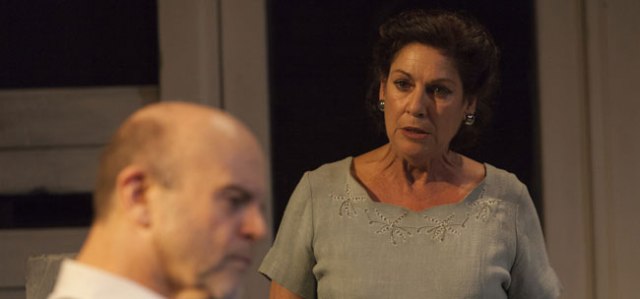
All My Sons (Darlinghurst Theatre Company)

allmysonsVenue: Eternity Playhouse (Darlinghurst NSW), Nov 1 – Dec 1, 2013
Playwright: Arthur Miller
Director: Iain Sinclair
Actors: Toni Scanlan, Marshall Napier, Andrew Henry, Anthony Gooley, Ann Deever
Image by Brett Boardman

Theatre review
All My Sons is a lesser known Arthur Miller work, but the decision to produce it today is entirely appropriate. One of its central themes is the relationship between war and commerce, which is a subject of interest for contemporary audiences in today’s socio-political climate. The idea of businesses profiteering from war deaths is a controversial one, and when intertwined with familial discord, the result is surprisingly explosive.

Certainly, Iain Sinclair’s direction is keen for the play to erupt at every available opportunity. Elements of Greek tragedy are characteristic of this work, and Sinclair boldly employs them to enthral and overcome his audience. His care in creating moments of silences before storms, makes for a plot that is seriously exciting. Even though the show is essentially a family drama, this is edge of the seat stuff. The nature of the story is dark and heavy, with deaths, lies and betrayals lurking at every corner, but Sinclair expertly balances the gravity inherent in Miller’s writing with great surges of energy, ensuring that emotional punches are all hits and no misses. It is noteworthy also that sound design by Nate Edmondson is subtle and indispensably effective.

Acting is excellent throughout. The sense of time and space (mid-west USA in the 1940s) is accurately and faithfully re-created by the entire cast. Andrew Henry’s high octane outbursts are crucial to the climax of the play and he delivers them with no reservation. Anthony Gooley plays a supporting role but his portrayal of a man bordering on insanity is fascinating. He brings a lot of colour and drama to the show, and the intensity in his work is truly remarkable. The production however, is dominated by Toni Scanlan who turns in an astounding performance as Kate Keller. The range of emotions she portrays is beyond impressive. This actor owns the show’s funniest and saddest moments, and her depiction of grief and disintegration is unforgettable. The psychological foundation in her characterisation is solid and crystal clear, and she defines the play’s other characters for the audience as much as she does her own.

Darlinghurst Theatre’s production of All My Sons validates the timelessness of Miller’s writing. Other recent examples have demonstrated that current interpretations do not always work, but under Sinclair’s directorship, we have a show that speaks to us deeply, perhaps even more so than most new works from the twenty-first century.
www.darlinghursttheatre.com

The Maintenance Room (King Street Theatre)

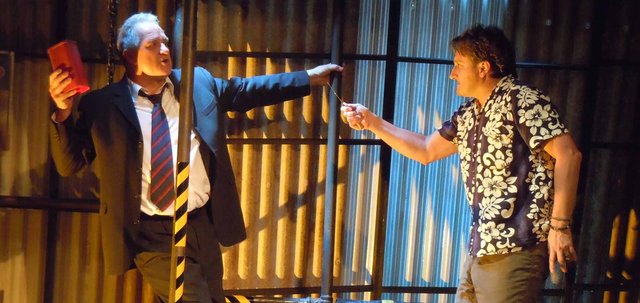
rsz_a_maint_room_gs_-_124_lowVenue: King Street Theatre (Newtown NSW), Nov 7 – 30, 2013
Playwright: Gerry Greenland
Director: Allan Walpole
Actors: Kim Knuckey, Lynden Jones
Image by Geoff Sirmai

Theatre review
Every show is a collaborative effort comprised of many disciplines and disparate elements, but in The Maintenance Room, the actors’ performances are so fine that it is hard for the audience to focus beyond their spectacular work. Gerry Greenland’s script has an excellent plot that never gives room for any predictability, and its every twist and turn keeps us engaged and fascinated. The story might not be particularly interesting, but Greenland’s storytelling is calculatedly clever. However, his depiction of the two women characters (who we hear a lot about but do not appear on stage) disappointingly utilises the madonna and whore dichotomy, which is convenient and somewhat regressive.

Allan Walpole is director and set designer, and he does both jobs marvelously. The set is complex, realistic and believable, providing a wide variation of levels and spaces for movement and activity during performance. Walpole’s work as director is much more subtle. He wields an invisible hand through the show, but we see extraordinary chemistry between the actors, and their many dialogues are timed to perfection. It is impossible to divorce the actors abilities from Walpole’s direction, but he must be given credit for the liveliness they bring from start to finish, even when the scenes are quiet and sorrowful.

The Maintenance Room is really about the actors, Kim Knuckey and Lynden Jones. Their portrayals of the complicated experience of human suffering, and the constant shifting of emotions in that space of grief and fear, are incredibly real and compelling. Jones masterfully manipulates physical performance and internal authenticity, accurately balancing emotional realism with theatricality. Knuckey’s work impresses with the remarkable believability of his character. The being he creates on stage is palpable, and the rawness of his crisis is felt as undeniable as the flesh and blood right before our eyes.

Theatre is about many things, but when it is about stunning performances, the experience is immensely rewarding. Most of us are likely to remember that when we fell in love with the stage, it was the work of actors who first drew us in. Great acting is divine, and The Maintenance Room is magnificent because of it.

www.kingstreettheatre.com.au

Cristina In The Cupboard (Subtlenuance)

cristinainthecupboard1Venue: TAP Gallery (Darlinghurst NSW), Jul 4 – 14, 2013
Playwright: Paul Gilchrist
Director: Paul Gilchrist
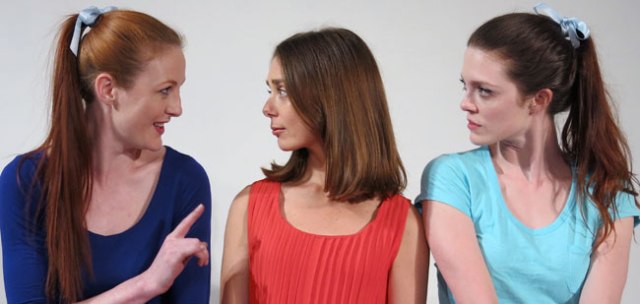
Actors: Sylvia Keays, Stephen Wilkinson, Alice Keohavong, Helen Tonkin, Peter McAllum, Kelly Robinson, Sonya Kerr, Sinead Curry

Theatre review
Cristina is spending time in her cupboard, and she invites us in to witness her thoughts as she searches for explanations and meanings of life. Surrounding her are a host of friends and family who live unexamined lives, and we see exactly what she is retreating from. Paul Gilchrist’s script is poignant and beautiful. Cristina’s philosophising is gentle but true, and the ideas being discussed delve deeply into crevices of our minds that we know exist but do not often acknowledge. Gilchrist’s excavation into the human psyche is a creative process but he is guided by honesty, which is the key to his writing being accessible to all.

Leading lady Sylvia Keays is earnest and full of conviction. She gives her character a childlike quality, and that innocence encourages her audience to listen with the same wide eyed wonder and openness. Helen Tonkin plays Cristina’s mother Gwen with soulfulness and warmth, and is memorable in several moving scenes that highlight family dynamics. Sinead Curry’s performance as the minxish Belinda gives the play a cheery vibrancy, and her comedic talents help a great deal with the entertainment value of the show.

In fact, all performances are strong and effective, but direction of the work tends to rely heavily on the words, with visual aspects sometimes left under-explored. There is a lot of space in the script for more imaginative expression and adventurous flights of fancy but instead the actors are often left in contexts of realistic dialogues, and their lines are sometimes drowned out by even more lines. On occasions where breathing space is provided, Gilchrist’s genius lines really do ring through the air with their strong resonances. Cristina In The Cupboard is a timeless work that speaks with intellectual and emotional clarity, and should be staged every place there is a thinking audience.

www.subtlenuance.com

Anaconda (Tamarama Rock Surfers)

rsz_1390679_658422944190319_399168425_nVenue: Bondi Pavilion Theatre (Bondi NSW), Oct 29 – Nov 23, 2013
Playwright: Sarah Doyle
Director: Sarah Doyle
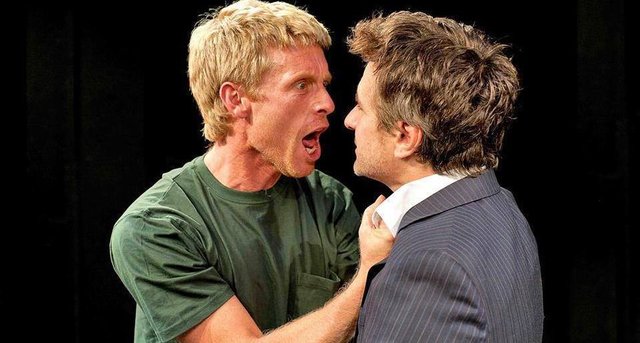
Actors: Damian de Montemas, Simon Lyndon, Leeanna Walsman, Martin Broome

Theatre review
There are stories that appear time and time again in our theatres because they contain evergreen ingredients, but once in a blue moon, a new story emerges that is poignant, interesting and representative of the times we live in. Anaconda is a tale that can only be told in civilisations that have achieved some level of gender and sexual liberation, and where religion is open to scrutiny. Taboos are omnipresent, but they evolve. What was once unspeakable is suddenly given release, and now is the time that themes of sexual abuse, and their many repercussions, are beginning to gain attention in public fora of certain societies.

Sarah Doyle’s script is an important one. It investigates the unraveling of sexual trauma in adult males from different perspectives, and we are provided valuable insight into hidden truths that are buried underneath the surfaces of our daily lives. Revelation is one of the most revered purposes of art. The play does not hold back at exposing gruesome details (although re-enactments are thankfully avoided), and descriptions of those details resonate powerfully with appalling terror.

Less successful however, is Doyle’s direction of her own writing. Characters do not develop as extensively as the story allows, and they come across overly simplified. The dynamics of the wife and husband relationship in particular, lack chemistry and credibility, even though performances are fairly strong. Actors are cast well, and all four bring conviction and gravitas to their roles, but the show requires greater “light and shade” for the dramatics of the script to work more effectively.

The greatest beauty in Anaconda is the way its plot unfolds. Full of intrigue and suspense, it provides great theatricality to what could have been a dreary, depressing experience. This show is a captivating one, and the air of mystery it creates ultimately finds gratification when it divulges its gritty and shocking secrets.

www.rocksurfers.org

An Ordinary Person (Sydney Independent Theatre Company)

anordinarypersonVenue: Old Fitzroy Theatre (Woolloomooloo NSW), Oct 22 – Nov 16, 2013
Playwright: Robert Allan
Director: Julie Baz
Actors: Cherilyn Price, Alexander Butt, Mel Dodge, Jai Higgs, David Jeffrey, Carla Nirella
Image by Katy Green Loughrey

Theatre review
At the heart of An Ordinary Person is an unusual relationship. It is an unconventional marriage not often represented on stage, but it is an entirely believable one. Robert Allan has written an interesting story, and he has crafted characters that are idiosyncratic, curious and memorable. The structure of the plot, however, is a challenging one. The show’s first half is full of intrigue, but not much else. It takes its time introducing the various characters in an air of mystery, but the audience needs a stronger sense of the impending drama for these characters to be compelling. Fortunately, the second half is much more satisfying, with drama bursting at all its seams.

Performing the piece is an ensemble of uniformly strong actors. Cherilyn Price is particularly impressive, playing her character Aggie at two different ages. She switches effectively between the portrayal of a middle-aged woman and her 14 year-old version, without the use of costumes or makeup, relying only on her acting. It is quite an experience to see Price’s method in her subtle but distinct transformations. Carla Nirella plays Fiona, and stands out with the effortless intensity and conviction she brings to the production. Her role is a simple one, but she attacks it with clarity and energy, giving very solid support to the key characters.

The play’s themes are dark and uncommon but Julie Baz’s direction does not exploit them gratuitously. She is careful to depict all characters with compassion, so that we leave the show thinking about our society’s issues in a mirror that reflects the social, rather than the personal. Although fundamentally a singular species, ordinary persons bear infinite differences between each and every separate entity. It is in the meeting of these individuals that extraordinary things happen, good or bad.

www.sitco.net.au

Love Field (Bakehouse Theatre Company)

lovefieldVenue: TAP Gallery (Surry Hills NSW), Oct 22 – Nov 2, 2013
Playwright: Ron Elisha
Director: Michael Dean
Actors: Lizzie Schebesta, Ben Wood
Image by Tessa Tran, Breathing Light Photography

Theatre review
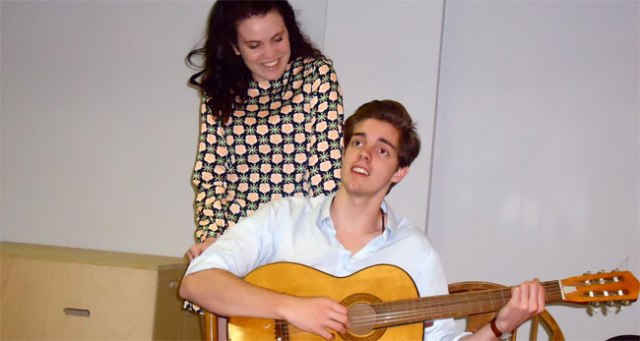
Jackie Kennedy and Lyndon Baines Johnson (the 36th President of USA) feature in this fictional story situated on a jet, immediately after the Kennedy assassination. Ron Elisha’s writing is imaginative and his thoughts are complex. There is a sense of something wild bubbling under his constructed universe, although the surface is deceptively restrained and conventional.

Direction of the production focuses on the creation of a naturalistic environment, and relies heavily on the actors’ lines to convey Elisha’s ideas. This is a tall order, as these concepts are deep and seem to demand more elaborate exploration. On the other hand, what results is an elegant work with a dignified simplicity.

Both actors are gifted with impressive but easy, stage presence. They are naturally fascinating creatures that absorb our attention effortlessly. Ben Wood plays Johnson, with a commanding speaking voice and great conviction. He instils clear character transitions throughout the play, and allows us to perceive several dimensions to his personality in a relatively short time (it runs for approx 75 mins). Lizzie Schebesta’s performance of the newly widowed Jackie Kennedy is beautifully melancholic, but she comes across slightly young for the role, and a little muted in her approach.

Although lacking in extravagant dramatics, Love Field is interesting and engaging. Its attempts at discussing issues of gender and social politics are well-meaning, and because modern times always seem to be in a state of “political turmoil”, the play is a timeless one.

www.bakehousetheatrecompany.com.au

Three Winters Green (Lambert House Enterprises)

threewintersgreenVenue: King Street Theatre (Newtown NSW), Oct 7 – Nov 3, 2013
Playwright: Campion Decent
Director: Les Solomon
Actors: Tom Sharah, Brett O’Neill, Gael Ballantyne, James Wright, Emily Kennedy, Matt Young, Diana Perini

Theatre review
First produced in 1993 (and again in 2003), Three Winters Green arrived at a time when the AIDS epidemic was still a crucial force in galvanising gay communities in the developed world. Campion Decent’s script is a beautiful representation of that generation’s experiences, and his depiction of their struggles is an important documentation that needs to be borne witness time and time again.

The emphasis on Les Solomon’s 2013 direction remains on the devastating effects of the AIDS virus, but other elements in Decent’s writing make the play more than a relic of recent lgbt history. It deals with uniquely queer experiences of family, the closet, and homophobic violence, all of which are hugely relevant themes that resonate strongly, even for the most jaded of contemporary Australians.

Tom Sharah is the lead, and his work is a major factor in the success of this production. Sharah has a thorough and sensitive understanding of the text, and his portrayal of Francis is deeply affecting. He plays the flamboyant character with great humour and delivers a lot of big laughs, but he also cuts through with beautiful, subtle moments that convey truthful character development and heartfelt emotion. It is a heartbreakingly sublime performance. Brett O’Neill is memorable in his supporting role as Andrew. He is naturally charismatic, and impresses with simplicity and authenticity. The restraint in his acting contrasts well with other cast members, and allows him to shine brightly through.

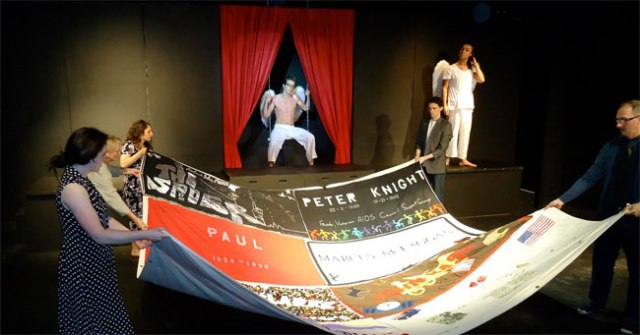
The play concludes with the unfurling of a quilt that was part of the Australian AIDS Memorial Quilt Project, that commemorates and honours those who have lost their lives to the disease. The poignancy of the quilt’s presence, along with the angels and the mourners they leave behind, cannot be understated. George Orwell said, “the most effective way to destroy people is to deny and obliterate their own understanding of their history.” May Three Winters Green return with greater emerald vibrancy at each passing season, and may we never forget the foundations of our shared histories, even if the communities we live in become increasingly fragmented.

www.kingstreettheatre.com.au

Butterflies Are Free (Lambert House Enterprises)

butterfilesVenue: King Street Theatre (Newtown NSW), Oct 7 – Nov 3, 2013
Playwright: Leonard Gershe
Director: Les Solomon
Actors: James Wright, Emily Kennedy, Cheryl Ward, Matt Young

Theatre review
Written by Leonard Gershe in 1969, Butterflies Are Free premiered at virtually the same time as the legendary Woodstock Festival. The work discusses notions of freedom at a time when America was in the depths of the Vietnam War, and when the hippie subculture was at its peak. 44 years on, the resonances in Gershe’s script remain strong, and its story still strikes a chord with contemporary audiences.

Les Solomon’s revival of the play is slightly referential of the 60s, but design elements do not explore the retro aspect too deeply. Instead, Solomon focuses our attention on character development and the themes inherent in the writing. His direction of the piece is confident and passionate. We are treated to perfectly paced comedy, as well as an earnest approach to the deeper and more philosophical sections of the text.

Quality of acting is consistently strong. Emily Kennedy’s portrayal of a free spirit is delightful, and she captivates by shading her character with glimpses of a sombre interior. Her balance of light and dark grounds the show in a space of warmth and truthfulness, and establishes an intimate sense of identification with the audience. Cheryl Ward plays Mrs Baker, the “mother”, bringing a comic quality that is enjoyable yet subtle. Ward’s performance is measured and sensitive, creating probably the most convincing character in the show. It is noteworthy however, that the final quarter of the play seems slightly rushed. The comedy eventually gives way to a fairly serious conclusion packed with meaning and pathos, but the actors seem to remain at the speed of the earlier scenes.

The theme of freedom is one that absolutely everyone can relate to. In Butterflies Are Free, we are presented with a beautiful story and sublime, deeply moving words. This production allows us to savour those words as delivered by a group of impassioned players, and provides an opportunity for its audience to reflect upon the freedoms that exist in our lives and also those that are sadly absent.

www.kingstreettheatre.com.au

Hamlet (Belvoir St Theatre)

hamletVenue: Belvoir St Theatre (Surry Hills NSW), Oct 12 – Dec 1, 2013
Playwright: William Shakespeare
Director: Simon Stone
Actors: Toby Schmitz, Emily Barclay, Luke Byrne, Thomas Campbell, John Gaden, Nathan Lovejoy, Robyn Nevin, Anthony Phelan, Maximilian Riebl, Greg Stone

Theatre review
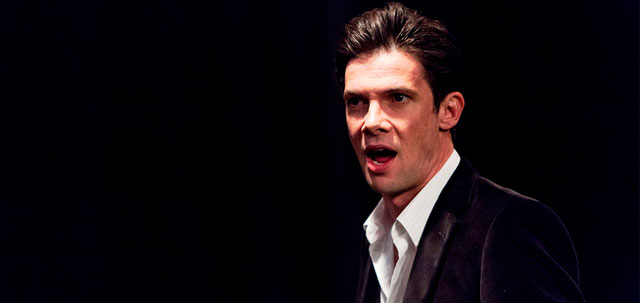
Shakespeare’s tragedies are vehicles for artists to express the extremities of human emotion and inconceivable psychological torment. When created well, a staging of plays like Hamlet will allow for the most outlandish and ostentatious of acting styles. In Belvoir’s production, Toby Schmitz pushes his portrayal of Hamlet over the edge of sanity, giving us one of the year’s most memorable theatrical performances.

Taking the brave decision to remove the ambiguity of the protagonist’s insanity, director Simon Stone’s version of events presents a Hamlet that is as much about mental disorders as it is about death and betrayal. Consequently, Schmitz’s choices are liberated, and he explores states of grief and madness with great intensity and high-octane drama. It is a delicious performance and the actor is magnetically powerful, while being controlled and considered. Schmitz is as intelligent as he is artistic, and the combination is lethal.

Greg Stone plays Polonius with great flair and confidence. This is an actor who loves Shakespeare’s words and knows how to use them. His performance is a real delight. Robyn Nevin’s role is less substantial, but she delivers what we have come to expect of her. Loads of gravitas and focus, and incredible elegance.

Many liberties are taken in Stone’s work, including a very clever take on the “play within a play” scene in which Lord Hamlet’s death is re-enacted, and some of the best use of incidental music in a long while. Stone displays not just originality and ingenuity, but also a keen sense of playfulness. His Hamlet is surprising, intriguing and taut. It runs slightly over two hours, and every moment is imbued with wonder and tension. This is exhilarating theatre. Stone’s show has a dangerous flirtation with abstraction which adds to its intrigue and seductive quality, but unfortunately becomes overwhelming in the final scenes. The play closes strongly but the journey at the end is slightly rocky. Nevertheless, this slightly abridged Hamlet is a courageous and accomplished work, one that showcases some of the best theatre practitioners and their dedication to, and faith in the art form.

www.belvoir.com.au

The Vehicle Failed To Stop (Version 1.0)

vehiclefailed1Venue: Carriageworks (Eveleigh NSW), Oct 15 – 26, 2013
Devisors: Sean Bacon, Irving Gregory, Jane Phegan, Paul Prestipino, Kym Vercoe, Olivia Stambouliah
Actors: Irving Gregory, Jane Phegan, Olivia Stambouliah

Theatre review
The subject is a heavy one, and the themes are serious. We are shown a side to the Iraq war that is little known, and the evidence provided is scandalous and outrageous. The tone of the production is suitably sombre, but it is a lively show that comprises quick and sharp scenes, holding its audience’s attention from start to end.

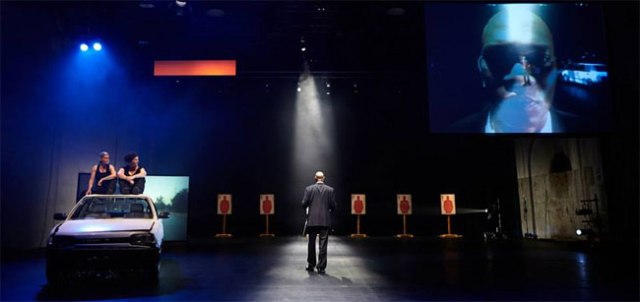
Exploration of theatrical techniques and devices are a key interest of this group (the exploding car is wonderful). Using the war story as a backdrop for a wide range of experimentation with sounds, visuals, and all the possibilities of an empty space, this is a highly creative work that is centred on form as much as it emphasises its content. Indeed, both form and content are interesting and thoroughly delved into, but on occasion, they seem to diverge and distract from one another. There are points in the performance where what is being shown on stage is so complex and enthralling, that the story seems to fall by the wayside. The originality of Version 1.0’s theatrical craft is accomplished and important, and so is the message of the story. Fortunately, both manage to get their days in the sun, although not always at the same time.

Aside from three actors, we see on side stage (in this multimedia production), a team of two musicians and a video artist. Their work alternates between providing background effects and featuring heavily at the foreground, but always married perfectly with the stage action. This genre of performance is still unconventional and not always practised successfully, but The Vehicle Failed To Stop is an example of how close collaborative efforts can give birth to something authentic and deliver theatre that is intriguing and unique.

www.versiononepointzero.com