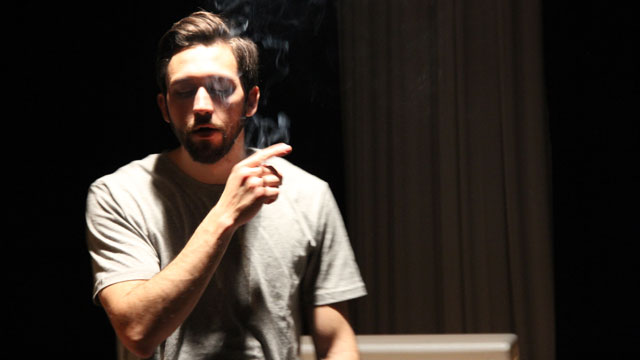
Review: Ghost Stories (Sydney Opera House)

ghoststories1Venue: Sydney Opera House (Sydney NSW), Jul 8 – Aug 15, 2015
Playwright: Jeremy Dyson, Andy Nyman
Director: Peter J. Snee
Cast: Tim Franklin, John Gregg, Lynden Jones, Aleks Mikić, Ben Wood

Theatre review
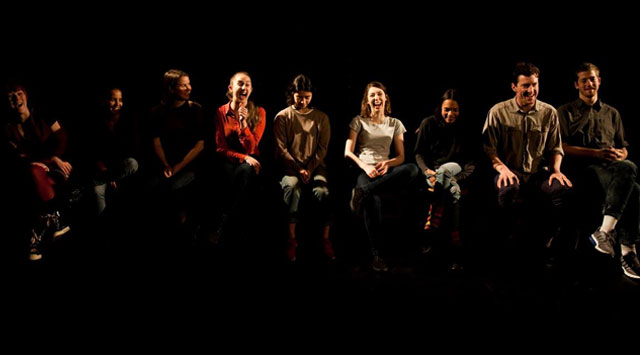
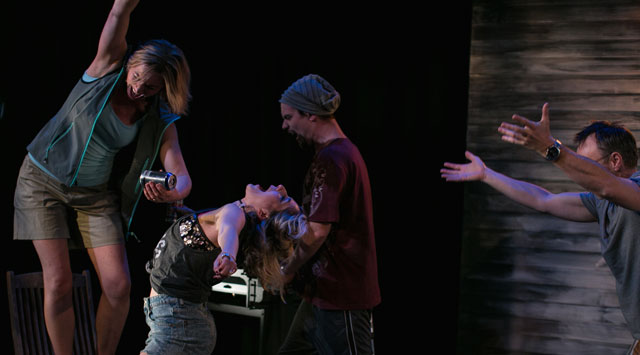
Horror movies have existed since the dawn of film technology in the 1890’s. It is a genre of storytelling that has always existed, and as such, should be thought of as integral to the way we communicate as a species, yet live theatre does not seem to have embraced that particular mode of presentation. Jeremy Dyson and Andy Nyman’s Ghost Stories adopts for an assembled crowd, the tradition of telling scary tales of the paranormal, with the intention of fascinating our senses and entertaining us. The work aims simply to frighten and thrill, so the script is tailored precisely for that purpose. It does not add much else to the experience, but its unpretentious simplicity helps it achieve an unusual show format that is refreshing and often very scary indeed.

Peter J. Snee’s direction cleverly manipulates all audio and visual cues in the venue to create the familiar sensations one derives from the horror genre. Unlike film though, we seem to require less extreme stimuli to respond with fear in live theatre. Thankfully, Snee does not push our limits too much, and the experience he provides never becomes unbearable. His design team (comprising Phil Shearer on production design, Christopher Page on lights, and Lana Kristensen on sound) does an excellent job of fulfilling its brief of creating a relentless air of skin-crawling foreboding that keeps tensions high, and when appropriate, shock us with powerful effects that literally make us jump.

There is a glaring lack of gender and ethnic diversity in the piece, but its all male cast is an accomplished one, with Lynden Jones’ performance as Professor Goodman providing the show with an inviting and dynamic energy. The actor is charmingly compelling, with an ability to turn the outlandish contexts believable, and a warmth that engages us for the entire duration, even when the plot starts to lose its resonance in its final moments.

Ghost Stories is a rare form of entertainment in the live arena, but it certainly does what it says on the bottle. The scares diminish with time, perhaps because of our acclimation to the production’s provocations, but on the occasions that it is effective, few things are quite as electrifying. There are many ways to have frivolous fun at the theatre, but choosing a night of horror over yet another musical is more than a novel option.

www.sydneyoperahouse.com

Review: Love And Information (Sydney Theatre Company / Malthouse Theatre)

Venue: Wharf 1 Sydney Theatre Company (Walsh Bay NSW), Jul 9 – Aug 15, 2015
Playwright: Caryl Churchill
Director: Kip Williams
Cast: Marco Chiappi, Glenn Hazeldine, Anita Hegh, Zahra Newman, Anthony Taufa, Ursula Yovich, Alison Whyte, Harry Greenwood
Images by Pia Johnson

Theatre review
Caryl Churchill’s Love And Information is a 90 minute play, composed entirely of very short sequences that look to be extracts from a wide range of stories running the gamut of genres in conventional theatre. Each independent bite-sized piece, not matter how small, provides enough for us to make sense of events taking place in the moment, but the scenes do no immediately relate to one another. Except, it is human nature to make meaning regardless of what is being scrutinised, and we form voluntary interpretations about the things we see. In the case of Churchill’s very fascinating work, we are seduced into intellectual overdrive, almost like reading a mystery, piecing together clues that may or may not be, to find a consolidation of significance. A great work of art is one that helps its viewer see a true picture of themselves, and their place within a social universe. The moral of Churchill’s stories is a fluid one, and we take from them what is intimate to us as individuals, and as such, it can be seen that the writer has used abstraction to successfully facilitate a kind of self-awareness in the viewer’s sense of being and identity.

The work makes a statement about contemporary times, and our environment of obsessive information technology. If modernity is sick, attention deficit disorder would be one of its chief ailments. We are incessantly seeking out information from all sources, like an addict with no ability of discernment. We find out small bits about everything, with no regard for relevance, and certainly no capacity for any depth. As our social and physical spaces become increasingly congested, our attention is compelled to be dispersed into a multitude of directions, all of the time, and this might be a case of “resistance is futile”, as we cannot be sure if we have any choice in the matter, or if indeed, we are able to withdraw into any alternatives. The play talks about choices, especially the lack thereof, and toys with the concept of hiding as a solution, but it is clear that we are what we are.

Director Kip Williams gives us all that we wish from a stage production, in spite of a missing story. The production is emotionally appealing, as it carefully emulates the sentimental journey of a narrative-driven plot, with all its intrigue, comedy, surprises and poignancies. Williams makes us respond accordingly even though there are no characters to follow. The thoroughly experimental nature of the work is no impediment at all to a satisfying experience for any audience with even just a minutiae of sophistication. Additionally, the work’s cerebral aspects might be unusually dynamic, but they are accessible to most. The production is an engaging one that inspires questions at every step of the way, and we read it at any level of competency that suits us personally.

Lighting designer Paul Jackson gives each distinct chapter and verse, a personality and beauty that captivate us, while assisting our subconscious to understand all that is being conveyed. Our visual attention is masterfully controlled so that we are kept firmly within the unusual plot trajectories that unfurl. Music and sound by The Sweats are a key feature that binds each aspect of the production to present a surprisingly coherent whole. The soundscape dictates the pace of the piece from beginning to end, and tells us quite directly how to respond at all times in our participation just outside the stage’s fourth wall. The technical proficiencies of Love And Information is extraordinary. There is nothing else that calls for as many scene and character changes, with what must be over one or two hundred entrances and exits, all flawlessly executed with an unbelievable fluency and grace. Stage Manager Lisa Osborn’s abilities are truly remarkable.

Also proficient is the diverse cast of eight, every one unique in appearance and style, yet tightly unified in the vision they aim to concoct and the energy they bring to the stage. The accuracy required of them both in terms of the technical and the artistic are simply unbelievable and they deliver with astounding dexterity. Predictably, the funnier actors leave a greater impression, and while Glenn Hazeldine’s comedy is only allowed flashes of brilliance in a play with lightning speed transitions, the actor never misses with any of his punchlines no matter how subtle. Anita Hegh too, is memorable for creating laughter at will, and her effortless charm is one that grabs hold of our attention and convinces us of everything being communicated. The play has philosophy seeping through every pore, and Ursula Yovich gives them a sublime gravity, whether the topic be death or infidelity.

A distillation of the theatregoing experience would probably reveal two fundamental elements; entertainment and meaning. When art is challenging, it helps us discover new things and prevents our existences from turning empty, but entertainment is always the easier ticket to purchase. While not mutually exclusive, they rarely meet as equals. In Love And Information, the two come as an explosive package. Philosophically and intellectually enthralling, it is similarly exciting and joyful from a perspective of pure amusement. There are better sources of fun and frivolity of course, but here is a rare and monumental leap in the evolution of the theatrical arts. If this is experimental, the real event that it paves way for, will be nothing less than revolutionary.

www.sydneytheatre.com.au | www.malthousetheatre.com.au

Review: Grace (Pulse Group Theatre)

GRACE 1Venue: Pulse Group Theatre (Redfern NSW), July 7 – 26, 2015
Playwright: Craig Wright
Director: Billy Milionis
Cast: Joseph Addabbo, Dudley Hogarth, Jeremy Shadlow, Nikki Waterhouse

Theatre review
Fanatically religious people are probably the most grating of all. Their narrow-mindedness and refusal to engage in intelligent conversation are frustrating, and their need to convert others’ beliefs to match their own is most infuriating, and sometimes dangerous. At the centre of Craig Wright’s Grace is Steve, an evangelical Christian man who relies on a blind faith that reveals itself to be nothing more than stupidity. Wright’s story is surprisingly textured, but much of the dialogue comes across cheesey and tends also, to be quite long-winded. His characters are initially interesting, but they prove to be too simple and obvious, and his humour lacks an acerbic bite that the themes require.

The production is not a sufficiently dynamic or imaginative one, but it is clear to see that focus is placed squarely on the craft of acting, and the cast is accomplished on many fronts. Dudley Hogarth appears in only two scenes but is memorable for the intense sentimentality that he moves us with. The performances are intent on finding authenticity, but guided by a need to establish a thorough naturalism, scenes can be uncommunicative even though an atmosphere of honesty is always present. Actors often look like they are performing at each other, and without a more presentational style, the audience is not consistently engaged. There is a lot of effort put into exploring emotions of characters, which often translates with too much self-indulgence. The cast seems to feel their stories powerfully, but they need to include us in those narratives, and not keep those ideas and poignancies to themselves. We might not be written into the text, but the audience is present, and we must be integrated further into the theatrical experience.

Like the “Christian Freaks” of the play, the production is lost in a single-mindedness that prevents us from getting closer. Like the zealots too, there is a passion on this stage that impresses. One of the messages in Grace is about diversity and plurality, and the importance of a generous spirit in our social lives. Congregating at the theatre remains an important element of any civilisation. For an hour or two, we are joined to find a moment of unity and peace, and hopefully leave with greater optimism about the world we temporarily occupy, but it is those on stage who have the greater responsibility of turning the mundane into magic, all in extraordinary style and exceptional grace.

www.facebook.com/PulseGroupTheatreCo

Review: The Typists (Company Of Rogues)

companyofroguesVenue: Exchange Hotel (Balmain NSW), July 8 – 24, 2015
Playwright: Murray Schisgal
Director: Hannah Strout
Cast: Jena Prince, Goldele Rayment
Image by Maylei Hunt

Theatre review
Work should not only be about survival and paying bills, but for those of us in the 9 to 5 lifestyle, being caught up in everything that is menial and petty, the meaning of life can become quite abysmal. No child grows up wishing for endless days of nothing but toil, yet the vast majority fall into all-consuming occupations that are neither enriching nor satisfying, beyond the monetary payments it offers. Murray Schisgal’s The Typists is a 1963 anthropological examination of modernity that more than stands the test of time. It might even be seen to have gained relevance over the years. The context of the writing is painfully realistic, but its approach is absurd, twisted, and ridiculously funny. Schisgal tells a lot of obvious truths, making us come face to face with the conundrum that hovers around us everyday.

Hannah Strout’s inspired direction of the piece is thoughtful, dynamic and wonderfully captivating. She finds impetus from the themes being discussed, and uses it to manufacture theatrical sequences that appeal to our minds and senses. Strout’s creation is an engrossing show that speaks intimately to each person’s lived experience. We are fascinated by the spectacles she builds on stage, but more than that, what seems bizarre on the surface resonates with a surprising depth. The marriage between the madness being presented and the irrationality of our daily truths, is a sensational meeting that is thoroughly exciting, while being undeniably and palpably dark.

Beautifully lit by Kevin Ng, the production is a resourceful one that creates atmosphere and punchy tonal variations with a minimal technical structure. Space is cleverly transformed to serve the purpose of the narrative and to establish a language of dramatic flamboyance. Kirby Medway’s music is often seamlessly introduced to evoke emotional responses, and to maintain the show’s comedic quality as well as its heightened style of expression. Also accomplished are performances by Jena Prince and Goldele Rayment, both artistic and earnest in their focus, even though early scenes are initiated with a stiffness that takes more time than necessary to warm up. Nevertheless, the duo make a very funny team, but it must be noted that their attention never strays away from the poignancies of the piece. Prince and Rayment’s passion for the work is genuine, infectious, and very engaging, making attendance of the play very pleasurable indeed.

People are never fully conscious of their actions and behaviour, and it takes artists to step on the brakes and bring to the fore, all that is left in oblivion. The Typists warns against wasting life and time. It is a wake up call that applies to everyone who forgets to examine choices made in the past and the present, and questions our failure to take charge of the future. In all its hilarious pessimism, the show makes the point that fate is in our hands if we decide to take its reins.

www.companyrogues.com

Review: Ladies In Lavender (Ensemble Theatre)

ensemble2Venue: Ensemble Theatre (Kirribilli NSW), Jul 3 – Aug 15, 2015
Playwright: Shaun McKenna
Director: Nicole Buffoni
Cast: Gael Ballantyne, Penny Cook, Sharon Flanagan, Lisa Gormley, Benjamin Hoetjes, Daniel Mitchell
Image by Clare Hawley

Theatre review
Shaun McKenna’s Ladies In Lavender is a 2012 stage adaptation of an original short story from 1908, and a more well-known 2004 film. It is a gentle story, with characters of an advanced age taking centre stage, allowing us to take a look at the experience of growing old and learning about a time in life that most of us will arrive at. Janet and Ursula are sisters in an English country town, lonely and isolated, but not without a zest for life and a sense of humour. We observe the nature of desire for the elderly, and consider the differences and similarities between young and old, when dealing with infatuations and relationships in general.

Direction of the piece by Nicole Buffoni is charming and lighthearted, with a respectful attitude towards its senior characters that encourages us to look at them with more complexity than we might usually do. The show is slightly low in energy, with a languid tone that can seem repetitive, but its personalities are endearing, and we follow their journeys with interest. Buffoni makes good use of the text to create a show that is entertaining at many points, although not all moments feel authentic within a presentation style that tends to be fairly surface. Both leading ladies display good commitment on stage, but we require greater dynamism and depth from their performances in order for the production to be more emotionally affecting.

Supporting actors Gael Ballantyne and Daniel Mitchell provide eccentric colour, and both deliver consistent waves of laughter with accomplished comedic skills, keeping us amused and delighted. Benjamin Hoetjes plays Andre, a young man who finds himself stranded and unwittingly, the instigator of some domestic destabilisation. Hoetjes has a convincing innocence that is crucial to the plot’s effectiveness, and his charismatic effervescence helps us understand the affections of the women around him. The actor’s abilities on the violin cannot go unremarked, as the kind of versatility he possesses as a multi-faceted performer is quite extraordinary.

There is something too quiet and mild about this production. We long to witness the passions inferred in the story, but they are portrayed too subdued. Life develops differently for each individual, and every person’s place in the world is never replicated, but one hopes that all who pass through this existence catches glimpses of the many highs it offers. At the theatre too, we want to come in contact with amplified realities and the feelings that come along with them. Ladies In Lavender is essentially about celebrating life and mortality, and we should remember to be overjoyed at being part of it all.

www.ensemble.com.au

5 Questions with Emily McGowan and Theo Kokkinidis

Emily McGowan

Emily McGowan

Theo Kokkinidis: What has been your most favorite on stage moment?
Emily McGowan: This would probably be from when I was studying at university. In the final year of my degree, each student got the chance to put on a 20 minute short play of our choosing. It could pretty much be anything under the sun. Now, I have an air about me that says young innocent girl, and I often get cast in roles in that category. I decided to put on an original work all about sex, and how the over sexualisation of society is ruining our ability to have proper functioning relationships, which was a little different from what people were used to seeing me do. Lot’s of strange physical stuff happened during the performance, and I even bit off my co-star’s ear. Which was awesome! I had fake blood oozing down my face for about 5 minutes during the show. I think my favorite on stage moment would be the silence from the audience (who were mostly close friends and family, my grandma too) where people didn’t know how to react.

Do you have a ‘guilty pleasure’ movie, tv show or song that most of your friends wouldn’t know you liked?
Ooh, this is a hard one. And not because I don’t have any guilty pleasure shows, but because I probably have too many to choose just one. I think that in an age where there are so many reality TV shows it’s hard to escape watching them. I used to be so vigilant in not watching them, as I feel it takes jobs away from hard working actors and isn’t exactly promoting engaging or thought provoking, new and exciting material. Instead it just replays the same format of material week after week. However, having said that, there is one reality TV show I have come to love in the past year and I don’t exactly know why. It’s… get ready for it… Dance Moms. There it is, massive cringe moment and you all now know my guilty pleasure.

What has been the best thing about working on The Cherry Orchard production so far?
There have been so many things. But the best part would be working with a group of people who work so hard and do it all for the love of the art. Rehearsing at The Depot Theatre and watching the theatre get built around us is so exciting. I feel like every time we arrive at rehearsal, David (who’s building it all) has made so much progress. It’s come together so quickly. These people love what they do, and do it because they love it. Who wouldn’t be inspired by that?

What do you feel is the most difficult part about working on the text of a Chekhov Play?
Chekhov writes in a very interesting way, where characters seem to repeat themselves quite a lot. Whether it be phrases, thoughts or even words, words are repeated, repeated again and again (see what I did there?). The challenges have ranged from simply learning the lines and remembering what order they come in, to finding the thought behind the line and why my character chooses to repeat some specific phrases.

How do you relax after a long day?
Getting into my pyjamas, making a delicious dinner, and sitting on the couch with my boyfriend.

Theo Kokkinidis

Theo Kokkinidis

Emily McGowan: What is your favorite post late night rehearsal snack?
Theo Kokkinidis: If I have any crackers in the pantry after getting home late, I am eating them without question. If not, then it’s a glass of red wine and a Woody Allen movie to make up for the snack.

What was it that first drew you to The Cherry Orchard and made you want to be involved in this project?
Chekhov’s plays have just attracted me ever since I first read them. There can be very little happening in the scene, but there’s so much going on within the characters and it’s fun to discover and work with that. Also, the fact that this is going to be a new venue is bloody exciting.

What is the thing that’s most similar between yourself and your character Peter Trofimov?
Oh boy, too much. He’s a man with a lot of passion and he sometimes doesn’t know what to do with it. Probably the most similar thing though is that he sometimes talks a lot longer than he should and as a lot of my friends know, that’s something I do often.

Being a Russian play, what do you find to be the hardest Russian word/name to pronounce? Please write it as it’s written and it’s spoken.
To be honest it’s my own name in the play, Peter Trofimov. I had an idea of what it sounded like when I read it before rehearsals started, but my emphasis was wrong. Peter is pronounced Pyeh-tyah and Trofimov is Troh-FEE-moff

What is the most embarrassing moment that you have ever had on stage?
My most embarrassing moment is actually also my most favorite moment on stage. I was a poor man about to give my huge speech to the villain which inevitably leads to his prosecution. It was about a page or two of dialogue, it started well of the first sentence or so, but then I just blanked. I improvised for a few seconds giving the general gist of what I was saying, until I just decided to yell out to my stage partner “What do you think of that!”. He caught on right away and continued on with his lines. The reason it’s also my favorite is because no one in the audience knew I screwed up and my partner was completely connected to me and knew what was going on.

Emily McGowan and Theo Kokkinidis will be appearing in The Cherry Orchard by Anton Chekhov.
Dates: 15 Jul – 1 Aug, 2015
Venue: The Depot Theatre

5 Questions with Marine Grangier and Jamie Collette

Marine Grangier

Marine Grangier

Jamie Collette: How did you become involved with this production?
Marine Grangier: I was checking australianstagejobs.com.au because I was about to finish working on my previous production and saw Tom’s audition ad for The Complete Works Of William Shakespeare (Abridged). I have read about that play before and was so grateful someone was staging it in Sydney that I just emailed Tom to say THANK YOU for doing it while letting him know that if he was looking for a stage manager I’d seriously be willing. Turned out he was and I got on board!

What’s it like stage managing 37 plays at once?
It’s like having severe ADD (attention deficit disorder). One moment I’m putting nail polish on severed (plastic) fingers and the next I’m building sock puppets. I must say I’m quite happy the original performers chose to cut down the number of actors from 1122 to 3 though.

What’s your favorite Shakespeare play and why?
I’d say As You Like It for its shocking modernity and Rosalind’s character. First time I heard her say things like “you may as soon make her that you love believe it, which I warrant she is apter to do than to confess she does” and “Sell when you can, you are not for all markets” I couldn’t believe this was written about 400 years ago. Shakespeare may not have had actresses to play his female roles but he created gold material for actresses nowadays.

What’s the best reason for people to come see The Complete Works Of William Shakespeare (Abridged)?
You’ll be able to brag about your extensive knowledge of the Bard afterwards and nobody will know you’ve only watched Baz Lurhman’s Romeo + Juliet. “Shakespeare? Yeah I’ve seen all his plays. My favourite? King John of course.”

What’s your favourite Shakespearean insult?
I immediately thought about “Thou art a villain” which cuts through BS and is uttered in our production, but after some research I must say “Thou art a general offence” and “my wife is a hobby horse” score quite high on both horrible and funny scales.

Jamie Collette

Jamie Collette

Marine Grangier: How did you first discover this show and what were your first impressions?
Jamie Collette: I first saw The Complete Works Of William Shakespeare (Abridged) at the opera house when I was 13, starring Darren Gilshenan, Erik Thompson and Damian Callinan, and I remember it being the most fun audience experience I had ever had. I knew then that I wanted to be in that show some day, and twelve years later here I am.

Which character, out of the 1122 in The Complete Works Of William Shakespeare (Abridged), do you enjoy playing most in the show and why?
I think my favorite character to play has to be Macbeth, in our authentically Scottish rendition of the Scottish Play. Without too many spoilers, let’s say it involves near indecipherable accents, men in skirts, and a fight scene involving clubs from everyone’s favorite Scottish sport!

Moment of truth, did you find Shakespeare boring at school?
I have to confess, I was a huge Shakespeare nerd from an incredibly young age. I had read almost all the plays before I turned 13, and after seeing the show in 2003, I quickly made sure I read all the rest, even King John and All’s Well That Ends Well (which holds a special place in my heart). One of my life missions is to make Shakespeare and all classical text more accessible and enjoyable for kids.

I’m magically turning into a philanthropic producer who asks you which show you’d like to put on, what do you chose and which role do you shotgun?
I have had a production of Antony And Cleopatra rattling around in my brain for a few years that I’d love to execute, but the role I’d most love to play currently is Edmund from King Lear (for whom my older brother is named.)

What do you think Willy would think if he sat in the Genesian Theatre on July the 11th?
“I can’t believe they brought me back for this /
I ne’er did think that I should be so mock’d /
This play’s my work, yet all is gone amiss /
I tell you now, these actors are all f***’d. /
For never better reason could be found /
T’ Return my rotting corpse unto the ground.”

Marine Grangier will be Stage Managing and Jamie Collette will be appearing in The Complete Works Of William Shakespeare (Abridged)
Dates: 11 July – 8 August, 2015
Venue: The Genesian Theatre

Review: Avenue Q (Enmore Theatre)

avenueqVenue: Enmore Theatre (Newtown NSW), from Jul 2 – 18, 2015
Music and lyrics: Robert Lopez, Jeff Marx
Book: Jeff Whitty
Director: Jo Turner
Cast: Shauntelle Benjamin, Julia Dray, Kimberley Hodgson, Madeleine Jones, Owen Little, Matthew Predny, Nicholas Richard, Justin Smith, Riley Sutton, Rowena Vilar

Theatre review
On Avenue Q, everyone is struggling with the challenges of life, and all have quirks that lead them to feeling marginalised by society at some point, but they are a community that provides support to each other, no matter their differences. They embrace the diversity of their street, and never fail to put judgements aside, for a song and a dance, and more than a few laughs. It has been 12 years since the show’s original première off-Broadway, and the bona fide hit is now a well-oiled machine, tuned to perfection. The script is clever and engaging, with punchlines that never fail, and the songs are all witty and extraordinarily catchy.

Jo Turner’s direction for this Sydney run, is lively, mischievous, and surprisingly moving. He is conscious of the brand’s gently subversive nature, and speaks politically at appropriate moments, but it is his emphasis on the show’s joyful comedy and its sentimental poignancies that cuts through strongest. Every moment seems meaningful, and while not always deep, Turner consistently draws from us powerful emotional responses, both light and dark. The stage is kept active and busy, so that our senses are keenly enthralled, but our attention is focused on a tightly woven plot, relayed with crystal clarity, as is its range of characters.

A strong Australian cast is at the production’s helm, with Matthew Predny’s work as vocalist, puppeteer and actor leaving the greatest impression for his two roles, Princeton and Rod. Charming, effervescent and impossibly sweet, we devour everything that he offers up, and are amazed by all that he is capable of. Also compelling is Madeleine Jones as Kate Monster, whose big dreams remind us of forgotten idealism and who touches us with her tender youth and innocence. Jones’ portrayal is passionate, with thrilling vocals that gain control of our emotions with ease. It is a very warm presence that the team brings to the stage, making us all feel like everything’s A-OK, and we want to know how to get to Avenue Q… how to get to Avenue Q.

www.facebook.com/AvenueQSydney

Review: The Dapto Chaser (Apocalypse Theatre Company / Griffin Theatre Company)

apocalypseVenue: SBW Stables Theatre (Kings Cross NSW), Jul 1 – 25, 2015
Playwright: Mary Rachel Brown
Director: Glynn Nicholas
Cast: Danny Adcock, Noel Hodda, Jamie Oxenbould, Richard Sydenham
Image by Robert Catto

Theatre review
Stories can have universal appeal, or they can be culturally specific. The two are not mutually exclusive, but it is a tall order to expect any work of the theatre to be able to explore unusual themes and contexts at great depth, while still being able to speak to everyone. Mary Rachel Brown’s The Dapto Chaser is not a work that can enthral every kind of audience, but it certainly represents a segment of society that is rarely seen on our stages, even if their existence in real life is ubiquitous and undeniable. Four men entrenched in the world of greyhound racing, staking their lives on the ambiguous divide between skill and chance. At its core, the work is about poverty and kinship, and although it can be seen as being critical of gambling, and does portray its addictive qualities as such, great care is taken to provide a sense of accuracy to the lives it depicts. The experiences resonate with a documentary-like truth, but without a watered down presentation, the play is not palatable to all.

Human resilience and the popular notion of the Aussie battler doing it tough, are expressed thoroughly and fluently by director Glynn Nicholas, who brings to the stage a microcosm of a disadvantaged family that is rarely revealed at such powerful and intimate detail. An invisible fifth character, the dog at the symbolic centre of its entire narrative, is given presence by a hint of deftly generated magical realism, but it is the hyper realistic delivery of very domestic scenarios that impress.

Four actors, all perfectly cast, each giving spectacular performances that leave no imaginable room for improvement. Richard Sydenham is flamboyant and wild as Cess Sinclair. He plays the role big and broad, but his comedy is cunningly subtle and genuinely funny. With a less than attractive character at hand, Sydenham brings to the fore unexpected tenderness and humanity at every opportunity, and we cannot help but surrender our empathy to his marvellous work. Jimmy is the younger Sinclair, more vulnerable and much less boisterous. Played by Jamie Oxenbould, whose authenticity on every level is disarmingly incredible. Oxenbould seems to refuse any glimpse of the actor, allowing us only to see the character he embodies. The show is unquestionably heightened in its naturalism, and the actor makes good dramatic use of his lines to highlight the story’s poignancies, but his creation is entirely believable, and at many points, captivating in its emotional sensitivity.

We all know the pain that comes with blood that flows thicker than water, and most of us understand the struggles of falling short at life’s promises, but our stories are not all the same. Diversity in media and the arts is a serious concern, and we must guard against the conformism that comes from a twisted misunderstanding of democracy that is determined to produce a universal blandness. On one hand, our tall poppy mindset persists, and on the other, our middle class aspirations keep our cultural cringes in check. What is generally acceptable, becomes narrower by the minute. Small stories are necessary, because it is in the deep excavation of a singular site, that the most meaningful inspirations can surface, even if they are not immediately accessible to every Tom, Dick and Harry.

www.apocalypsetheatrecompany.com | www.griffintheatre.com.au

5 Questions with Charles Allen and Anna Houston

Anna Houston

Anna Houston

Charles Allen: How do you prepare to play a character that isn’t even given a name in the play, you are only referred to as Curley’s Wife?
Anna Houston: I work like a script detective … what clues are in Steinbeck’s script, his novel? Then I broaden the scope to look at the time period she came from. That helps with filling in the gaps about domestic life, socio economics, education, and so on. The rest is imagination and intuition. So much of what you bring to a role is intuitive, emotional. That’s the fun stuff. I also found a beautiful letter that Steinbeck wrote to Claire Luce, the first actress to play Curley’s Wife on Broadway in 1937. In it, he discusses her background, her motivations and desires. That letter does a lot to restore her dignity and humanity.

Curley’s Wife wants to be a star in the movies… which would you choose, being a star on stage or in the movies?
Can I do both, please? I think I’ll go with being a star on stage, paid movie star money.

5 words you’d use to describe working with a cast of 10 actors.
A noisy explosion of creativity.

Favourite down time activity on your days off from acting?
Sleeping.

Why should people see Of Mice And Men?
Because it’s Steinbeck! It’s gritty, heart breaking and timeless. It’s epic on the most intimate and vulnerable scale. And the artists at the helm of this production are at the top of their game. Excellent direction, design and performances. It deserves a damn big audience!

Charles Allen

Charles Allen

Anna Houston: Of Mice And Men is controversial for its language and the social environment surrounding its only African American character Crooks, how do you feel playing a role like that?
Charles Allen: Well, that comes down to separating the ego of the actor from the behavior of the character. I feel fine especially considering playing such a character requires me to stretch as an actor.

Crooks likes to read a lot of books, which book have you read recently that you really enjoyed?
I’m into Memoirs Of A Dutiful Daughter right now and I am really enjoying that.

Which actors inspire you?
My friend and fellow actor Mark Nassar. He isn’t well known but I’d put him in the ring with any actor past or present.

You are currently based in Brisbane… what is the first touristy thing you’ve done in Sydney?
Take a picture of the Opera House.

Why should people see Of Mice And Men?
Because it’s an atypical love story that is destined for tragedy. It uses simple characters to tell a complex story. It’s beautiful.

Anna Houston and Charles Allen will be appearing in Spot For Jove Theatre’s Of Mice And Men/em> by John Steinbeck.
Dates: 9 – 25 July, 2015
Venue: Seymour Centre