Review: King Charles III (Almeida Theatre)

stcVenue: Roslyn Packer Theatre at Walsh Bay (Sydney NSW), Mar 31 – Apr 30, 2016
Playwright: Mike Bartlett
Director: Rupert Goold, Whitney Mosery
Cast: Jennifer Bryden, Richard Glaves, Dominic Jephcott, Geoffrey Lumb, Lucy Phelps, Carolyn Pickles, Robert Powell, Ben Righton, Giles Taylor, Tim Treloar, Beatrice Walker, Paul Westwood, Emily Swain, Emily-Celine Thomson, Ryan Whittle, Karl Wilson
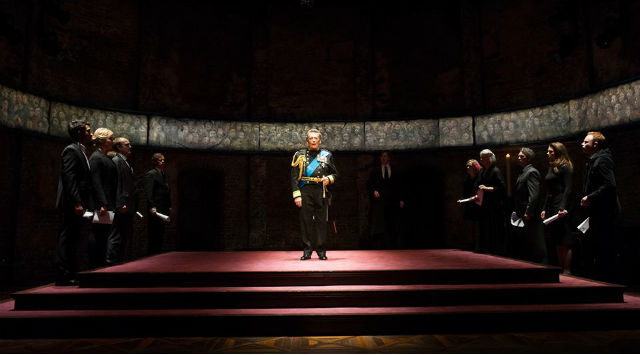
Image by Richard Hubert-Smith

Theatre review
Many consider the monarchy to be an archaic and irrelevant institution. It is constantly under scrutiny and criticism, mostly for the notion that it bleeds the economy of money without seeming to contribute anything concrete. In Mike Bartlett’s imagined near future, Prince Charles finally ascends the throne, and we are presented with the astonishing circumstance of the new king exerting his right to influence governance of the United Kingdom. The silent figurehead decides to act according to his conscience, and opposes the passage of a new law by parliament, which results in unadulterated pandemonium and excellent drama. Bartlett’s story about the most famous family in the world is part Shakespearean, part tabloid influenced. The high and low brow concoction speaks to our perceptions about the royals; we think of them as enigmatic, grand and otherworldly, but also as gossip fodder, with petty concerns that our curiosity feels entitled to.

The show begins with exquisite humour, then develops increasingly heavy, ultimately ending in great pessimism similar to many cautioning fables about governments and democracy. Even though energy levels drop significantly as the plot turns serious, both its comedic and dramatic aspects are effectively conveyed. We are gripped by its fast moving scenes, each one short and scintillating, as though on steroids courtesy of prime-time TV. Its familiar personalities are seen just the way we expect them to be, but with additional dimensions that provide surprises to the startling narratives that unfold. Bartlett’s dialogue is endlessly amusing in its juxtaposition of contemporary speech with Shakespearean conventions, which the cast delivers with impressive skill and fluency.

Richard Glaves is a memorable Prince Harry, endearing and vulnerable just the way many would wish him to be. Humour in the production is extremely contained, but Glaves is able to find a sense of mischief within the restraints, consistently depicting emotional authenticity while asserting the entertaining qualities of his role. Charles is played by Robert Powell, imposing and noble, utterly believable as King. His portrayal bears little cosmetic resemblance to the character we see regularly on the news, but is full of nuance and texture. Even though appropriately stoic and stiff upper lipped, Powell brings complexity and psychological accuracy to the piece, replete with humane ambiguities that challenge our moralistic judgements. We find our opinions about Charles constantly shifting as we gain an increasingly deeper understanding of his nature and intentions.

We look for bad guys in the play, but there are no convenient answers. Democracy is what we value most in the collective entity we term society, and its machinations are evaluated in King Charles III in a theatrical but honest way. There are many Australians passionate about turning our country into a republic, and the play certainly pleads a strong argument for that case. Our democracy may be flawed but it is what we hold dear. In the play, Charles is a good man, and could well be a great leader, but he is not appointed by the people and further, unprotected by our legal and political processes. Civilisations need to work towards greater transparency, so that our progress may reach closer to democratic ideals, but the monarchy, by definition, contravenes those principles we revere in the highest regard. This story seems a wild one, but it resonates strongly and we believe its outrageous scenarios to be plausible, implying that there are dangers in our current systems, which although underestimated and overlooked, are in fact gravely threatening.

www.almeida.co.uk

Review: Golem (1927 Productions)

Venue: Roslyn Packer Theatre at Walsh Bay (Sydney NSW), Mar 16 – 26, 2016
Playwright: Suzanne Andrade
Director: Suzanne Andrade
Film, Animation & Design: Paul Barritt
Music: Lillian Henley
Cast: Esme Appleton, Will Close, Lillian Henley, Rose Robinson, Shamira Turner
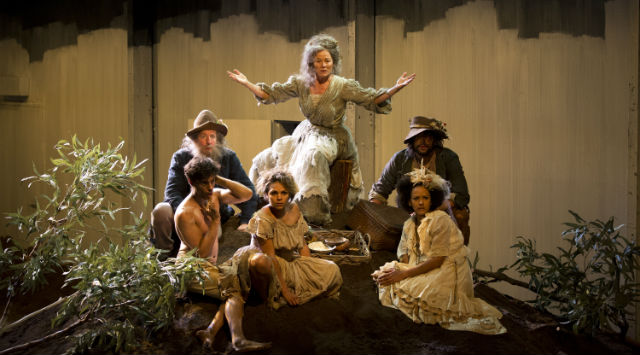
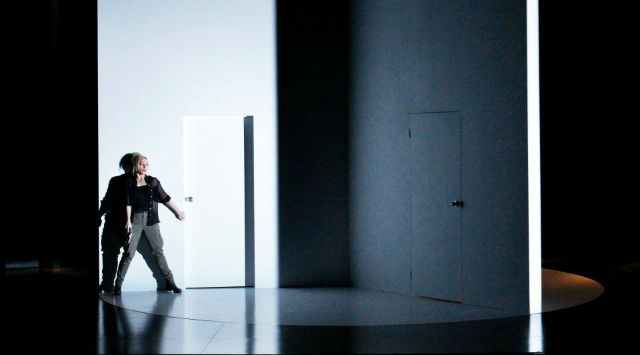
Images by Bernhard Müller

Theatre review
It is in the nature of cities around the world to be obsessed with progress. Some economies are determined to find opportunities in international markets to bring communities out of poverty, while others are simply caught up in capitalism’s readiness to encourage and facilitate greed. Whether intentions are noble or otherwise, all of us in developing and industrialised countries are on a fast train to a future shaped almost exclusively by concepts of financial and technological advancement. Suzanne Andrade’s Golem is not only about the fear of being left behind, it is also interested in the involuntary embroilment that we often find ourselves, fuelled by the voracious appetite of today’s way of the world, with its monetisation of virtually everything and the impossibility of detaching oneself from these increasingly sinister systems of economy. Andrade’s work leaves no room for doubt about damage that results from the insatiable process of consumption. Disguised as machines of betterment, we participate and contribute to a never-ending order of perpetual buying, one with increasingly bigger promises at every step of the way.

The show combines the projection of an animated film, with live actors and musicians. It is a unique aesthetic, thoroughly idiosyncratic with a wide appeal that many would find delightful. The performance involves a high level of precision and technical sophistication (ironic considering its critique of technology), for a captivating experience that is as satisfying as its themes are troubling. A sense of wonder pervades the production, with a child-like tone that would speak to audiences young and old. Its message is grave, but also simple. It spells out what we secretly know to be true, but prefer to leave uncovered for we fear its inevitability and know not to act against it. Reality does not allow us to turn back the hands of time, but on stage, Golem is able to do just that. With brilliant imagination and refined wizardry, the show takes us to an earlier period of our industrialisation, and charts the path of our irreversible progress. We recognise all its allegories, and respond with appreciation, to the way it voices our apprehensions about modern life.

No one truly knows how to tame that monster within. We see it do its dirty work, and acknowledge our complicities. Some of us remain aware of its every pitfall, while others choose to turn a blind eye. Golem offers no alternatives or solutions to the civilisation it disparages, and its nostalgic longing for an innocent past seems futile. The result is either a melancholy that finds no emancipation, or the embrace of a certainty that is not all light. Tales of pessimism do their part in reminding us of the oft forgotten dark sides of being, if only to turn us into more compassionate people, but we have to make the best of what we do have, and even though far from perfect, it is easy to recognise the elements that are good in the way we live today.

www.19-27.co.uk

Review: Machu Picchu (Sydney Theatre Company / State Theatre Company Of South Australia)

STCVenue: Wharf 1 Sydney Theatre Company (Walsh Bay NSW), Mar 3 – Apr 9, 2016
Playwright: Sue Smith
Director: Geordie Brookman
Cast: Elena Carapetis, Darren Gilshenan, Luke Joslin, Annabel Matheson, Lisa McCune, Renato Musolino
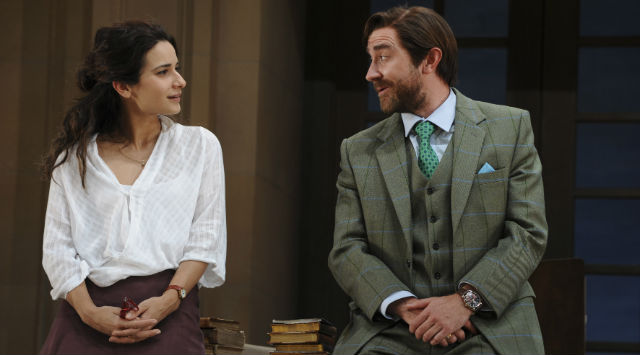
Image by Brett Boardman

Theatre review
What we understand mid-life crises to be, seems relevant only to the privileged. Gabby and Paul are a middle class couple, both independently established and intelligent, reaching a point in time where their mortality suddenly comes into focus. Machu Picchu is about their reassessment of priorities and values, and although the threat of death is thankfully more than an abstract construct in Sue Smith’s play, the problems they face can often feel hyperbolic. Their struggles are honest, but also indulgent. Where others have had to just keep calm and carry on, Smith’s characters have the luxury of excessive rumination, which in turns disallows much drama or comedy to transpire. There are opportunities for philosophy, but those tend to be subsumed by domestic situations that prevent intriguing ideas from developing with satisfactory depth. Although emotionally distancing, the text has an enjoyable and innovative plot structure that reveals flair in the way its non-chronological timeline is formed. Scenes unfold unpredictably to keep us attentive, with surprising elements appearing at regular intervals for added variety.

We never quite warm to the characters in Machu Picchu. Director Geordie Brookman maintains an understated tone to proceedings, which gives an air of sophistication but also detracts from the story’s gravity. Gabby and Paul’s catastrophic state is comprehensible, but only intellectually so. The fears and trauma that they experience do not connect beyond the cerebral, and the work’s inability to encourage greater empathy gives the impression that its concerns are probably less meaningful than it wishes to be. Dramatic tension never becomes taut enough for us to feel strongly about the characters’ woes, and themes surrounding relationships and ageing, although earnestly portrayed, are not presented with sufficient ingenuity. The only people who are surprised by the effects of time seem to be on stage, and they add little to our own understanding of those ravages.

Lisa McCune’s performance as Gabby is focused and intense. There are many moments of authenticity in her depictions of disappointment, frustration and anguish, and her energetic approach helps sustain interest in her narrative, which can at times be lacklustre. The role of Paul is tackled by Darren Gilshenan who introduces an instinctive levity to the production. Gilshenan is a charming actor with tongue always firmly in cheek, but who proves capable of more serious material with this character’s adversity. It is not an entirely convincing coupling of actors, but the pair finds good rhythm with dialogue and together create imagery evocative of a bourgeois Australian identity that many will find familiar.

Clichés persist for their truth. Life is about the journey, not the destination. The Machu Picchu in Peru represents an ideal that exists in Gabby and Paul’s imagination, a place they have never experienced but that they believe to be special. In our lives, we often long for what we have yet to encounter, thinking that salvation lies therein. It is human to dream, but how much of dreams we allow to interfere with reality, is deeply personal, and determines the shape of each individual’s existence. It is ultimately inconsequential whether the protagonists get themselves to the location of their aspirations. What they are able to create and discover in their time before that fateful day is of great value, if they choose to recognise it as such.

www.sydneytheatre.com.au | www.statetheatrecompany.com.au

Review: Arcadia (Sydney Theatre Company)

stcVenue: Sydney Opera House (Sydney NSW), Feb 8 – Apr 2, 2016
Playwright: Tom Stoppard
Director: Richard Cottrell
Cast: Blazey Best, Ryan Corr, Honey Debelle, Andrea Demetriades, Jonathan Elsom, Georgia Flood, Julian Garner, Glenn Hazeldine, Josh McConville, Will McDonald, Michael Sheasby, Justin Smith
Image by Heidrun Löhr

Theatre review
Strong societies encourage each of their individuals to reach the greatest of their potential. Geniuses do not exist in vacuums; even though the uniqueness of their abilities easily becomes a source of isolation or detachment, they are part of communities that need to recognise the exceptional advantages they bring to the progress of our civilisations. In theatre, a conundrum exists with writers like Tom Stoppard. To produce a play such as his Arcadia, a team of highly accomplished talents must be employed in order that the density of his writing gets the best chance of finding elucidation, but that would necessitate considerable box office takings (at a time when government funding for the arts continues to plummet). Bringing Arcadia to the masses is a strange proposition. We are used to mindless sentimental tosh drawing in the crowds, but getting throngs into the Sydney Opera House for a night of intense intellectual exchange is, to put it mildly, ambitious.

Many will appreciate director Richard Cottrell’s sophisticated and vibrant take on the text, but there will be no shortage of viewers finding themselves entirely befuddled for its three-hour duration. The play is about mathematics, chaos theory, the second law of thermodynamics and English landscape gardens in the early 19th century, quite a different set of interests from what we encounter in Australia’s everyday media. Perhaps this is an indication that the public is actually capable of ingesting more than sporting scandals and partisan politics, but more realistically, this is a case of either seriously overestimating our cultural climate, or a very daring effort at lifting our game.

Art must challenge, but when it does, it often alienates. Cottrell’s show is energetic and seductive. Its jaunty rhythm and charismatic personalities are engaging but whether they make Stoppard’s subject matter enticing, is debatable. We are impressed by the passion depicted on stage. Some audiences might be able to get involved with the idiosyncratic obsessions of Arcadia‘s characters, but more are likely to be swept along by the cast’s incontrovertible thespian devotion.

Key roles are marvellously performed with an infectious glee that for the most part, keep us within the action of the play. Andrea Demetriades is sensational as Hannah Jarvis, completely convincing and natural in her approach, and irresistibly compelling. What she presents is a model for the kind of acting that forbids the detection of any divergence between actor and character. Her conflation of the two seems effortless, yet there is no denying the theatricality that allows her to communicate intentions and emotions with brilliant clarity. Similarly delightful is Josh McConville as Bernard Nightingale, deliciously pompous and shrewdly sardonic, playing the role as an effective archetype but with a solid authenticity to keep us convinced and endeared.

Stoppard and his characters strive for a mastery of their domains. They locate and identify pieces to puzzles that will form a finished and satisfying picture to intellectual pursuits that inevitably become more complex as processes develop. Watching Arcadia asks of us that same commitment of attention and effort. It is not easy-going for the vast majority, but we can certainly jump back into the action whenever we find ourselves in moments of confusion, to continue on that chase for meaning. As a contender in the popularity contest that is the live theatre industry, this show is unlikely to be a crowd favourite, but as inhabitants of this city, we must hold deep gratitude that programming of this calibre exists, and is available to more than the privileged few.

www.sydneytheatre.com.au

Review: The Secret River (Sydney Theatre Company)

Venue: Roslyn Packer Theatre at Walsh Bay (Sydney NSW), Feb 1 – 20, 2016
Playwright: Kate Grenville (based on the novel by Andrew Bovell)
Director: Neil Armfield
Cast: Georgia Adamson, Joshua Brennan, Toby Challenor, Shaka Cook, Nathaniel Dean, Frances Djulibing, Jennifer Hagan, Isaac Hayward, Trevor Jamieson, Heath Jelovic, Ningali Lawford-Wolf, Madeleine Madden, Colin Moody, Jeremiah Mundine, Wesley Patten, Kelton Pell, Richard Piper, Rory Potter, James Slee, Bruce Spence, Matthew Sunderland
Images by Heidrun Löhr

Theatre review
It is one thing to know about the usurpation of Australian land by the British two centuries ago, but quite another to see it happen before one’s own eyes. Brutal and tragic events register in our minds only as deeply as human sensitivity can allow. Our natural tendency to evade pain also means an involuntary ability to shelter our frail sentiments from the true depth of atrocities that we become aware of. We can think of this inadequacy in our comprehension as an explanation for the deficiency of empathy relating to the plight of Aboriginal Australia, and it is also the ease at which our minds can resort to delusion that their suffering can so often be hidden from us in plain sight.

Kate Grenville’s The Secret River is a story all Australians know. It is about early British settlement and the swift displacement of Aboriginal communities as a result of our convict history. What is valuable in Grenville’s vision, is the depth and detail of personal experiences from those old chronicles that we find difficult to face. Her play is a confrontation that insists we witness in vividness, the misjustice, betrayal and horrific bloodshed that had befallen our Aboriginal peoples, on which many of our lives today are built upon. Through her marvellous storytelling and palpable characters, concepts are turned into reality and pain is shared.

The show is heavy and heartbreaking, but also remarkably compelling. At no point is the audience in doubt about the end that is to come, but we are nonetheless captivated by the story that unfolds. Director Neil Armfield sets a reverent tone and at a deliberate pace, embarks upon a presentation that takes its responsibilities in education and activism seriously. The Secret River is exemplary as an exercise of using theatre for social progress, through the art of gentle persuasion so that its message can be accepted by many. Armfield strikes a fine balance of portraying the barbarism inflicted upon the nation’s First Peoples while relaying a dramatic narrative with great warmth and credibility, so that even the most misanthropic of us will remain engaged.

Nathaniel Dean and Georgia Adamson play the Thornhills, who begin their frontier lives on the Hawkesbury River in 1813 as farmers claiming land without authorisation by its rightful owners. The actors are vibrant, charismatic and precise in their approach, with a fierce honesty that keeps us simultaneously endeared and repelled. It is tricky business creating villainous protagonists, but the duo’s very fine work shines light on their flawed humanity with a complexity that disallows us from writing them off too conveniently. A cast of Indigenous performers brilliantly depicts the local community that falls victim to the Thornhills’ rapacious enterprise. They do not speak English, but all that they feel and desire is conveyed with clarity and enthralling charm. Ningali Lawford-Wolf provides with great beauty, an important matriarchal omnipresence that represents the origins of our land, and a compassion that informs the way we respond to the events that unfold before her, and our, eyes. The role of Ngalamalum is played by Trevor Jamieson, whose humour and capacity for powerful emotion leaves an indelible impression. His work in the epilogue especially, is quite a thing to behold, and certainly one of the most moving moments to be seen on any stage.

There is a simplicity to the production, crucial and closely linked to its essential gravity, with design elements thoroughly refined in order to maintain a sense of directness in its depictions. The show seems understated, but there is no denying the sophistication and thoughtfulness involved in creating its very specific aesthetic of earthiness and urgency. Musical Director Isaac Hayward is positioned downstage left providing accompaniment for the entire duration, orchestrating the way we feel in each scene and meticulously controlling atmosphere along with the very involved lighting design of Mark Howett. Stephen Curtis’ elegant set is a basic and unchanging one, so Howett’s lights are called upon to establish the play’s many transitions of time and space, which he manages with unassailable flair.

At its most extreme and idealistic, political theatre wishes to create uprisings and revolutions. It is arguable if any work had ever achieved that purpose, but what we can hope for, is for individuals to find inspiration, and for our culture to move towards something better, as a result of a collective awakening brought on by a show like The Secret River. When we sit in an auditorium and feel the same passions, we must realise the strength of our will and what it is capable of. We may not know what the next step should be, but the common trajectory of our feelings is undeniable, and we must hold on to the belief that justice, truth and democracy will eventually prevail.

www.sydneytheatre.com.au

Review: The Golden Age (Sydney Theatre Company)

stcVenue: Wharf 1 Sydney Theatre Company (Walsh Bay NSW), Jan 14 – Feb 20, 2016
Playwright: Louis Nowra
Director: Kip Williams
Cast: Rarriwuy Hick, Remy Hii, Brandon McClelland, Robert Menzies, Liam Nunan, Zindzi Okenyo, Sarah Peirse, Anthony Taufa, Ursula Yovich
Image by Lisa Tomasetti

Theatre review
At the time of The Golden Age‘s original première in 1985, we talked about multiculturalism. 31 years on, that buzzword has evolved into the contemporary concern for diversity, and a real need for societies to address pervasive inequities, whether they be surreptitious or conspicuous. Since the middle of the previous century, we have seen the rise of political agitation, most significantly in the realms of race, gender and sexuality, that attempt to remedy the injustices of the world, to varying degrees of success.

In Louis Nowra’s play, two cultures collide, with one being an overwhelming and dominating force that instinctively requires anything contradictory to surrender, assimilate and conform. The other is a community of six people, a lost tribe descended from outcasts in the Tasmanian wilderness, admittedly rustic but undeniably peaceful. The idea of an Australian mainstream is explored bitingly by Nowra, who juxtaposes what we have come to think of as normal, against something quite literally extraordinary, to expose the systemic failings of the way we organise life, in the belief that our idea of civilisation is the only one legitimate and proper. The Golden Age reveals how we fight tooth and nail to hold up an ideal that is ultimately of service to no one, and that has an appetite for destruction so voracious that it causes devastation even unto itself.

We can interpret Nowra’s writing in a myriad ways, and apply his parable to any context of power imbalance, but its relevance to the immediate and pressing matter of Aboriginal lives in colonial Australia cannot be ignored. The subjugation of The Golden Age‘s lost tribe, in the name of protecting them, is a painful parallel to the many governmental initiatives that have transpired and continue to be devised, claiming to be in the best interest of our First Peoples. The way power disguises its self-serving objectives behind façades of charity and convenient slogans like “the greater good”, is scathingly deconstructed and laid bare in this production by director Kip Williams. This is highly complex theatre, yet Williams delivers nuance, clarity and power while retaining the poetic, and challenging, spirit of Nowra’s writing.

Williams’s show is profoundly hypnotic, coalesced with brilliant dramatic chemistry and an air of intriguing mystery so fierce that we are left still wanting more after its generous three-hour duration. The Golden Age works on all levels; entertaining, emotional, spiritual, intelligent and meaningful, it fulfils everything the theatregoer wishes to experience, and leaves an impressive political message that implicates every one of us. David Fleischer’s design brings beauty, both raw and refined, to the stage, along with surprisingly flexible spacial configurations that provide excellent variety for the many scene transitions. Sound and music by Max Lyandvert is the clandestine master manipulator of atmosphere and the author of the show’s sublime mythical dimension. He works with our imagination to take us to wondrous spaces never before encountered, but are viscerally familiar. The aesthetics of the production is dreamlike, simultaneously splendid and cruel, almost quintessentially Australian, but completely enchanting.

The cast is ethnically diverse, with several actors playing parts that are of different races to their own (an oddity for Australian theatre even though we are well into the 21st century). Ursula Yovich as Elizabeth Archer in particular, performs with great acerbity, her character’s increasingly oppressive European presence in the play. Yovich’s utterances of prejudicial statements resonate with startling potency, perhaps informed by the actor’s personal experiences as an Indigenous woman. The heart wrenching lead role Betsheb is played by Rarriwuy Hick, who provides a focused and strong centre to the piece. She balances Betsheb’s wildness with a natural warmth to deliver an endearing personality responsible for the show’s many poignant moments. Brandon McClelland is similarly likeable, creating a Francis that is agile and vibrant, with an emotional depth that makes relationships believable. He figures between both sides of the story’s cultural divide, and is convincing throughout.

The flaws in dominant ideologies stare at us straight in the face every day, but most of us accept them as par for the course. Along with that sense of resignation, many underprivileged lives are allowed to remain in disadvantage, injustice, and hardship. In The Golden Age, the powerful are with the assumption that alternatives will be detrimental to their personal lives, and the powerless suffer the consequences of being outsmarted and outnumbered. There are many occasions in Australia today that we think of the need for a revolution, but our majority is crippled with fear, and the minorities are left in sacrifice. Things can change, and they do change, but with each appearance of sensational work like this, our minds are enlightened and refreshed, and a new sense of urgency can be ignited.

www.sydneytheatre.com.au

Review: King Lear (Sydney Theatre Company)

Venue: Roslyn Packer Theatre at Walsh Bay (Sydney NSW), Nov 24, 2015 – Jan 9, 2016
Playwright: William Shakespeare
Director: Neil Armfield
Cast: Simon Barker, Wade Briggs, Helen Buday, Max Cullen, Alan Dukes, Eugene Gilfedder, Jacek Koman, Nick Masters, Colin Moody, Robyn Nevin, Eryn Jean Norvill, Geoffrey Rush, Phillip Slater, Helen Thomson, Mark Leonard Winter, Meyne Wyatt
Images by Heidrun Löhr

Theatre review
Lear finds himself rejected by all his daughters, and loses his mind. Redemption is eventually found, when he discovers grace and purity, but what remains of interest, is the rationale behind his torment. In King Lear, we look at issues surrounding mortality, kinship and honour, and examine how it is that good people can turn bad. The provocative difference between the elder “vicious sisters” Goneril and Regan, and the youngest Cordelia with a heart of gold, along with our observations of the king’s narcissism reflected in his immoral daughters’ greed, are pertinent to this discussion of evil and its roots. In the glaring absence of a maternal figure, a direct correlation can be made between Lear’s downfall and the depravity he had encouraged in his children. The tragedy is karmic, and Shakespeare’s morality play warns of the consequences one has to to reap from the seeds that are sowed.

The play is long and complex, with characters and narratives that can be explored endlessly. Finding a focus for a production of King Lear is crucial, and although Neil Armfield’s rendition is not short of drama and energy, its scope seems to be too wide, with too ambitious an approach. In its earnest efforts at unearthing nuance, it loses sight of elements that deliver poignancy, and the show is only able to resonate sporadically. Armfield’s trust in actors is evident. Personalities on stage are idiosyncratic, and the formidable lead players are certainly vibrant and appealing, but their work would benefit from greater manipulation by their director.

Geoffrey Rush’s vulnerability takes centre stage in his portrayal of Lear. His descent into madness is not particularly startling, but we are drawn into the authentic humanity that Rush reveals in states of devastation. He puts on a spirited performance, but bodily positions are often overly crouched, obscuring facial and physical expressions from view of the very large auditorium, making audience connection challenging at many points. Lear’s most theatrical scenes are interpreted with insufficient power, including an underwhelming death, but Rush’s way with words remains unquestionable and a real highlight of the production.

Stealing the show is Mark Leonard Winter who spends a majority of his stage time as Edgar completely naked. Nudity is difficult for any actor (and audience), but Winter overcomes the issue beautifully by arresting our attention, away from his body, onto a captivating performance that is dynamically varied and emotionally compelling. The actor displays a tenacious and magnetic conviction, as well as a commanding presence, balanced by extraordinary sensitivity, all outstanding qualities conspiring to create the most memorable supporting role of the play.

Also impressive are Robert Cousin’s sets and Nick Schlieper’s lights. The visions they create are breathtaking, and truly fascinating. Act Two in particular, begins with actors seemingly floating in a vast white of nothingness, where for a few seconds, no end and no beginning to space can be perceived. The manufacture of a storm, complete with an oversized wind machine and water falling incessantly from above, provide a sensational spectacle and additional dimension to what the actors work hard to achieve. The aesthetic is best described as minimal. We can sense the purposeful subtraction that has taken place to leave the various empty spaces for activity to occur, but the effectiveness of this bareness is clearly debatable. The production proves that King Lear‘s story can be told with few objects and visual symbols, but it will never be known if all that has been taken away is indeed redundant.

We hurt the ones we love most, and family is where the thin line between love and hate is most pronounced. It is because the people are important, that our emotions cannot disengage. Betrayal can only come from trust, and it is both sides of that same coin that Lear’s story addresses. The end is deeply pessimistic, but all tragedies leave behind a future, and the audience is an unequivocal part of it. How we move away from each tragic ending matters, but not every ending will bring elevation to life. Cordelia dies in her father’s arms after a period of sorrowful estrangement. Her demise is bittersweet, but for those who witness it, time is on our side, and we hold on to the belief that better is always possible.

www.sydneytheatre.com.au

Review: Orlando (Sydney Theatre Company)

Venue: Sydney Opera House (Sydney NSW), Nov 9 – Dec 19, 2015
Playwright: Sarah Ruhl (based on the novel by Virginia Woolf)
Director: Sarah Goodes
Cast: Matthew Backer, Luisa Hastings Edge, Garth Holcombe, John Gaden, Jacqueline McKenzie, Anthony Taufa
Images by Prudence Upton

Theatre review
Virginia Woolf’s novel Orlando: A Biography was published in 1928, when discussion of sexuality was made in hushed tones, and inseparable from notions of gender identity. If a person loved a woman, they had to take the form of the masculine, and the reverse was true. The centrepiece of Orlando‘s story is a man’s magical transformation into a woman, wistfully described but scarcely explained, though by simple deduction, one could perceive more than an indication of sexual fluidity, and a desire to explore what is now known as sexual orientation. It would be remiss however, to reduce the work to be simply about sex, for its interest in fluidity extends to the whole of a person’s identity, or how one sees themselves, along with how society conceives of that individual.

Sarah Ruhl’s 2010 stage adaptation can be understood as a feminist piece. Orlando’s life as a man is depicted with an extroversion that is concerned with the character’s appetite and discovery of the world around him, but as a woman, she turns introspective and we are presented with constant interrogations about her place in relation to things as the fairer sex. In other words, maleness is seen as an unquestionable natural state, while the feminine requires persistent justification. In dramatic terms, Ruhl’s work is poetic, sublime theatre that uses all the capacities of language to excite, provoke and enchant, and to tell a fascinating story that is strangely engaging in spite of its contextual distance.

It is a humorous text, gentle in its approach, but always charming and amusing with its renderings. Director Sarah Goodes executes that subtle comedic tone with great sophistication, and although the production is seldom laugh-out-loud funny, her brilliant wit is deeply endearing. There is clever use of space, with a relatively small ensemble establishing an active and visually dynamic stage. Comprising two flights of mobile staircases and concentric revolving platforms, our eyes are kept busy and no time is wasted on scene changes, but the production is not strikingly lavish. It makes occasional reference to the well-known Sally Potter film of 1992, but that extravagant beauty, still fresh in many of our memories, is absent from this staging.

Our focus is placed squarely, and appropriately, on the title role’s narrative, but the show features a charismatic four-man chorus that helps with a lot of heavy lifting. Matthew Backer, John Gaden, Garth Holcombe and Anthony Taufa play a wide range of roles in all gender states, and provide commentary in song and narration that moves the plot along in spirited, gay fashion. Backer in particular, is impressive with his fervent embrace of the show’s vaudeville style of presentation, taking the opportunity to showcase delightful comic timing and a flair for exquisite camp.

In the role of Orlando is Jacqueline McKenzie, keeping us spellbound with a delivery that will be remembered for its intelligence, precision and unrelenting effervescence. It is noteworthy that the actor’s interpretation of Orlando’s personality does not alter significantly with the sensational gender transformation. Whether in male or female costume, McKenzie maintains a singular essence, reflecting a modern and enlightened attitude toward the construction of gendered identities. Her unfaltering energy gives life to two solid hours of stage time, every minute compelling and whimsical, keeping us engrossed in the development of Orlando’s extraordinary narrative with her captivating confidence.

The word “transgender” was recently announced as one of Collins’ dictionary’s “Words of the Year”. As Western societies begin to better understand the way we live out our gendered lives, we can recognise that a new dawn in civilisation is imminent, where people will no longer be persecuted for the way they express their gender, and individuals are free to adopt any form of gender identity they wish to inhabit. Hardly anyone bats an eyelid when Orlando emerges as a woman after living thirty years as the opposite sex. We may not share her aristocracy, wealth and power, but we can appreciate the nonchalance surrounding her transformation, and indeed realise the curious irrelevance of something that convention considers so crucial to how we understand life. Feminism is about achieving equality, and in equality, all that we think separates us, can be vanquished.

www.sydneytheatre.com.au

Review: Death And The Maiden (Sydney Theatre Company / Melbourne Theatre Company)

sydneytheatrecoVenue: Wharf 1 Sydney Theatre Company (Walsh Bay NSW), Aug 28 – Oct 17, 2015
Playwright: Ariel Dorfman
Director: Leticia Cáceres
Cast: Eugene Gilfedder, Steve Mouzakis, Susie Porter
Image by Jeff Busby

Theatre review
Paulina resides in the space of terror. Captured, tortured, and raped; not only have the fractures in her world endured 15 years since the devastating event, her thirst for revenge is becoming an increasingly uncontrollable force that drives her to the extremities of Ariel Dorfman’s Death And The Maiden. Paulina was blindfolded during her ordeal but remembers the voice of her rapist, and during a chance encounter one night, she identifies a kindly, mild-mannered man Roberto to be the perpetrator, and proceeds to keep him captive in her home. Stripped and tied to a chair, Roberto is threatened by Paulina’s revolver and her accusations, but maintains his innocence. Paulina fluctuates between demanding a confession and wanting his life, but we are never sure if Roberto is in fact the right man. Dorfman’s work is dramatic and tense, with an undeniable political emphasis. Inspired by Chile’s progression from totalitarianism to democracy in the 1980’s, difficult questions about finding justice for victims of the state are explored. In an Australian context, the most direct association one could make would involve the continuing mistreatment of our Indigenous communities, but there are no obvious adaptations in the production that attempt to find a more specific point of relevance for its audience.

Scenic and lighting design by Nick Schilieper reduces the space and concentrates the action efficiently onto a small stage, so that nothing distracts us from the show’s intimate sequences. The leanness of its appearance however, conveys only a monotonously cold atmosphere. Correspondingly, Leticia Cáceres’ work as director seems to pay fastidious attention only to performances by its three players. The production feels insufficiently ambitious in scope, eschewing a bolder use of space that could have assisted us in relating to the unfolding plot better, by depicting either the oppressiveness of Paulina’s home and mental state, or a wider and more identifiable political and social environment. Composer and sound designer The Sweats excels in his control over atmosphere and scene transitions. He introduces a sophistication, along with a sense of drama to a staging that is often too minimalist in its overall style.

Leading lady Susie Porter presents a likeable and convincing Paulina. Porter’s cerebral portrayal gives integrity to the story being told, and her gracious presence keeps us firmly on her character’s side, but her performance is ultimately a tepid one that lacks a certain operatic quality required for the production to engage more powerfully. Porter’s interpretation is one steeped in depression, where a more dynamic madness would allow the narrative’s controversial aspects greater potency, and therefore elicit a more robust response from its audience. The actor’s work comes across psychologically accurate and very thoughtful, but the Latin American text asks for a fire that may only exist beyond rationality, which itself (being rational or not) is after all, one of its chief concerns. In the role of Paulina’s husband Gerardo, is Steve Mouzakis, who takes every opportunity to raise temperatures in the theatre. It is a smaller part but one that moves through different emotional phases, and the performer brings a spirited passion to each of them, reflecting an impressive conviction that viewers can no doubt appreciate. Eugene Gilfedder makes an interesting villain of Roberto. Probably not quite as charismatic as Porter, and therefore tilting the adversarial balance slightly off between duelling characters, but nonetheless an intriguing personality. He keeps us guessing, which is central to the play’s effectiveness, and provides fine tension at its concluding moments.

Death And The Maiden contains poignant moments of philosophy and drama, but at 25 years old, its resonances require translation. We are certainly no strangers to concepts of political upheaval, war and terror, but what we view to be tangible threats have changed. In spite of the production’s success at achieving a good level of believability, the play feels distant. We are reminded that our concerns have evolved, and although we often consider our civilisations to have improved, the fact remains that the things that haunt us never go away; they only take the form of something else. The fears in the play are different from ours today, but the vulnerabilities we share are interminable, and it is that darkness that Paulina needs to release with indomitable fury.

www.sydneytheatre.com.au | www.mtc.com.au/

Review: The Present (Sydney Theatre Company)

Venue: Roslyn Packer Theatre at Walsh Bay (Sydney NSW), Aug 4 – Sep 19, 2015
Playwright: Andrew Upton (after Anton Chekhov’s Platonov)
Director: John Crowley
Cast: Anna Bamford, Cate Blanchett, Andrew Buchanan, David Downer, Eamon Farren, Martin Jacobs, Jacqueline McKenzie, Brandon McClelland, Marshall Napier, Susan Prior, Richard Roxburgh, Chris Ryan, Toby Schmitz
Images by Lisa Tomasetti

Theatre review
What is now known to be Anton Chekhov’s Platonov, was an unpublished manuscript discovered a decade after the playwright’s 1904 death. His sister had called it “a long play without a title”, and it remains an obscure component of the master’s oeuvre. Andrew Upton’s The Present is an adaptation of the aforementioned work by the young Chekhov, and is significantly transformed from its original manifestation. The play is now updated, with events moved to the mid 1990’s, and its structure and language thoroughly altered to address our sensibilities in the early twenty-first century.

The play reads like a tribute to Chekhov, with his distinctively dry sense of humour and his legacy in Russian realism featuring prominently in its style and tone, but The Present is much more powerful and immediately provocative than its predecessor. Act One begins with Anna Petrovna firing a pistol into the audience, an act of aggression that warns us of the exhilarating ride that is to follow. Scenes are short and sharp, with vibrant characters full of intriguing quirk engaging in intense dialogue. Even in its early moments before “shit went down” (Upton’s words), tension is palpable and we always sense that an eruption is imminent. In fact, the play is repeatedly explosive, and at three hours, its ability to keep us on the edge of our seats is a remarkable achievement.

Directing the production is John Crowley, who introduces a wild and ferocious energy to the typically Chekhovian setting of gentries, then enforcing an air of restraint over its characters to create a sense of agonising oppression, that threatens to burst at the seams with every hint of conflict and confrontation. Crowley’s astounding ability to sustain the very satisfying comedy of the production throughout its increasingly disastrous and painful chain of revelations, creates a rare viewing response that is strangely potent. The tragicomedy manages to elicit feelings that alternate between mirthfulness and dread, almost to reflect the complexity of lived experience, and surprises us with the unexpected sensation of having these seemingly incompatible emotions co-exist singularly.

The philosophical aspects of The Present are undeniable, but they are presented with subtlety and benevolence, frequently through metaphor and symbolism not unlike Chekhov’s preferred mode of expression. Often with a playful, but ultimately poignant approach, we are urged to consider its universal themes from a personal perspective. Love and loss, honesty and delusion, hope and despair, all become resonant dichotomies, no matter our distance from the Russian summer of 1993. Design elements of the show are elegant and fairly minimal, but space is dutifully manipulated to frame performance and to aide the projection of its actors’ work, so that our attention falls squarely on their unbelievably nuanced portrayals. There are no distractions from what the play wishes to convey, but its central construct of materialism versus truth, might be a bitter pill for some regardless of the clarity at which the message is laid on stage.

Cate Blanchett attacks her role, and the tenets of the text, with a forceful conviction that can only emerge from the extremely talented. The star’s undisguisable passion for her craft is a coherent match for the determination and fortitude of Anna, a woman coming very close to the end of her tether. Her portrayal of drunken and unhinged abandonment in Act Two is sheer theatrical delight, and a beautiful blend of studied precision with courageous impulse. Blanchett’s incredible allure keeps us spellbound, and she uses it to deliver the many thoughtful intentions of the play, which we absorb with enthusiastic acquiescence. Mikhail, the self-loathing cad brimming with regret, is played by the equally stellar Richard Roxburgh, with magnificent comedic aplomb. His flawless timing and uncanny capacity to intuit his audience’s temperament at all times, ensures that we are fascinated, entertained, shocked and moved, at his will. Roxburgh amuses us with outrageous frivolity, while lucidly communicating his character’s experiences and troubles at impressive depth. We identify intimately with Mikhail’s destruction, and the actor’s work leaves us wanting for nothing.

Questioning life, is not a daily preoccupation for many, but it is the business of artists to investigate and challenge the way we view our world, and then present to us, all that they discover. Andrew Upton’s The Present is concerned with contemporary life, and the choices we make as individuals. It is interested in the definitions of fulfilment, success and happiness, and Upton gifts us with the urgent encouragement for the pursuit of enlightenment while time rushes past. Life is meaningless without death, and while the end is always nigh, it is the now that must be cherished, and it is in the now that we must find redemption.

www.sydneytheatre.com.au