Review: Lies, Love And Hitler (CADA Studio Productions / Sydney Independent Theatre Company)

rsz_photo_by_katy_green_loughrey___llh8___james_scott__langley___doug_chapman__bonhoeffer____flickr___photo_sharing_Venue: Old Fitzroy Theatre (Woolloomooloo NSW), Apr 15 – May 3, 2014
Playwright: Elizabeth Avery Scott
Director: Rochelle Whyte
Actors: James Scott, Doug Chapman, Ylaria Rogers
Image by Katy Green Loughrey

Theatre review
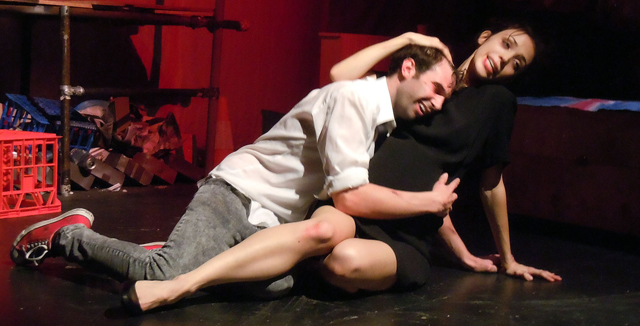
Romance and art are not usually complementary; theirs is a fraught relationship. Art conventions are concerned with all that is deep in the human experience, and romance pursues something that is often inane and fleeting. Elizabeth Avery Scott’s script however, manages to place romance in its centre, and through themes of ethics, politics, history and religion, tells a story that is engaging and intelligent.

Scott’s structure for Love, Lies And Hitler discusses the nature of ethics, and unpacks perennial questions that we face in every ethical dilemma. A parallel is drawn across time and space, between a university lecturer’s love affair with a student, and a German theologian’s involvement in the plot to assassinate Adolf Hitler. The stakes are different, but our thought processes are intriguingly similar when determining right from wrong.

With topics like capital punishment, sexual harassment and Nazism put in focus, the play’s solemnity is inescapable. Director Rochelle Whyte handles the play’s dark sides with sensitivity and reverence, and her skill in introducing seamlessly, the apparition of Dietrich Bonhoeffer from 1945, into scenes at a university in modern day Australia is commendable. Less effective are her interpretation of the script’s moments of levity. These are frequently hurried through, and jokes are neglected, resulting in a show that feels heavier than necessary.

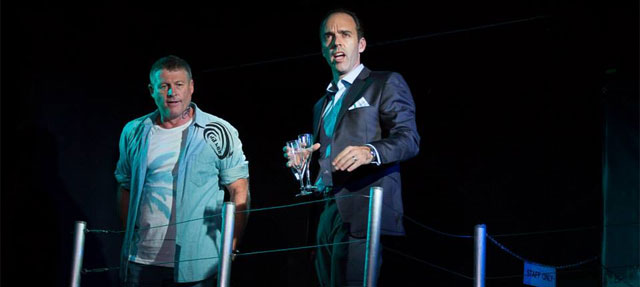
Ylaria Rogers plays Hannah and Hermione, displaying great efficiency and simplicity with both characters. Rogers places emphasis on moving the plot along swiftly, and telling her parts of the story clearly, but her portrayals would benefit from greater complexity and presence. James Scott is a very dynamic Paul Langley. His charisma quickly connects him with the audience, and we enjoy the tenacity in his performance, which is confident and thoroughly considered. There is however, a deliberateness to his style that can at times make his character seem less than authentic. Bonhoeffer is played by Doug Chapman, who has a subtle and naturalist approach that contrasts strongly with the other actors, and consequently, and ironically, helps him leave the greatest impression. Chapman provides a healthy counterbalance to the production with his restraint, which is also a quality that keeps us engrossed.

Stories about genocidal persecution and Hitler never dry up. They also never fail to fascinate. Love, Lies And Hitler is a show that entertains and enlightens. We think about our individual ethical boundaries and moral structures, while it seduces us with love stories past and present, and a surprising brand of romance that does not patronise.

www.cada.net.au

Review: The Jungle Book (Emu Productions / King St Theatre)

rsz_1620714_737788869599707_8034336185139306069_nVenue: King Street Theatre (Newtown NSW), Apr 14 – 26, 2014
Book and Lyrics: Markus Weber (based on the original by Rudyard Kipling)
Composer: Michael Summ
Director: Markus Weber
Actors: Maria De Marco, Badaidilaga Maftuh-Flynn, Mark Power, Mandy Fung, Bernard Wheatley, Brett O’Neill, Kyle Stephens
Image by Lorina Stacey Schwenke

Theatre review
Markus Weber and Michael Summ’s version of The Jungle Book is a beautifully-written musical derived from Rudyard Kipling’s famed writings. Familiar characters are retained, and even though these songs are less well-known, they are delightfully catchy and pleasantly melodic.

Markus Weber’s current production is fairly minimal, and relies on the strength of the songs and text to carry the show. Musical arrangements are joyful and effective for most of the material, but several numbers need an update from an unfortunate and uncomfortable 1990s pop/rock sound. Weber’s use of space is thoughtfully varied. The multi-tiered stage is designed well, and used cleverly to keep the attention of the audience. It is noteworthy that although a vast majority of the crowd is very young, the musical has enough content to entertain any adult companion.

There are moments however, where performances falter, and confusion emerges. Even though performances are spirited, calibre of players vary dramatically. The show is designed for children, but the roles are not simple, and it relies heavily on what the actors can bring to the production.

Maria De Marco’s singing voice is strongest in the cast, using it wonderfully to convey the story wonderfully despite not having assistance from microphones. She plays Bagheera, the black leopard who delivers several poignant moments that give the production a necessary shade of gravity. Badaidilaga Maftuh-Flynn plays Mowgli, the only human character. Maftuh-Flynn performs with conviction, and has the gift of being able to portray emotion with great clarity without appearing to be doing very much at all. Brett O’Neill is a vibrant King Louie, the amusingly deluded monkey who never fails to entertain. O’Neill’s energy is big and focused, and his keen sense of comic timing shows him to be the most polished actor on this stage, leaving an excellent impression, notwithstanding the brevity of his appearance.

The Jungle Book‘s message of ecological awareness is a critical one. The anthropomorphism of wildlife imparts to younger generations, values of conservationism that are noble and necessary. Providing children with an understanding that animals are not our slaves or property is a responsibility we must take, if only for our own survival.

www.kingstreettheatre.com.au

Review: Machine (Eclective Productions)

rsz_10245432_622290321179288_1955330957718505088_nVenue: Old 505 Theatre (Surry Hills NSW), Apr 16 – 20, 2014
Playwright: Melissa Lee Speyer
Director: Rachel Chant
Actors: Lucy Heffernan, David Jackson

Theatre review
Suicide often finds its way into art. It is the most direct contemplation on the value and meaning of life, when questioning “to be or not to be”. Melissa Lee Speyer’s Machine is a pessimistic appraisal of life, and a work that embodies great sensitivity and beauty in its melancholy.

Rachel Scane channels that sense of resignation into her set design.It is basic and cold, but elegantly executed. Together with lighting designer Benjamin Brockman’s work, the space is cleverly transformed into a purgatory of sorts, with a sense of ethereality and impending doom.

Machine‘s story of suicide features Lucy Heffernan as Christine, and David Jackson as her guardian angel. The structure of the play interestingly places focus on the angel who takes us through events in Christine’s life, and her subsequent decision to end it. He also gives the impression from early on, that she is safe in his hands, even in the midst of her depression. As a result, the stakes are never high in the show. The assurance he provides, detaches us from Christine’s predicament, and even though Heffernan’s performance is committed and strong, we do not connect with her suffering. We know that Christine is being watched over, regardless of how things may end. Jackson has conviction in his acting, but the lack of experience and confidence is evident. It is noteworthy however, that Jackson’s smaller subsidiary roles are performed well when he takes the form of Christine’s encounters.

The Angel seems to be the problem. If it is the intention of the artists to create a work that is emotionally involving, we need more access to Christine. Her pain is universal, but we need to feel closer for the drama to work. She has much to divulge, but her Angel shields too much for her, and from us. The girl needs to stand alone.

www.facebook.com/EclectiveProductions

Review: Construction Of The Human Heart (Apocalypse Theatre Company)

rsz_cothh_170Venue: TAP Gallery (Darlinghurst NSW), Apr 16 – May 3, 2014
Playwright: Ross Mueller
Director: Dino Dimitriadis
Actors: Cat Martin, Michael Cullen
Image by Matthew Duchesne

Theatre review
We live much of our selves through relationships. Meanings are derived through the way we interact with people who surround us. In these interactions, we create stories through creative processes that require collusion from different kinds of intimacies and relations. In Construction Of The Human Heart, life, theatre and words are at war with stories.The characters Him and Her are in the depths of tragedy, and we see their struggle to connect, to move forward, to remain stagnant, and to be.

Sheets of paper with words are everywhere on the stage. The characters attempt to create narratives with the lines they have written, but coherence is beyond reach and connection is impossible. They fail to find meaning. In their desperation, they devise a myriad scenarios, and forge divergent possibilities, but all lead to disintegration and sorrow.

Ross Mueller’s script is intriguing, seductive, and powerful. Its structure is sophisticated and intelligent, but the emotions it conveys is familiar and immediate. It pleasures the mind with challenging elements, and a whole lot of wit, but it devastates the heart with the truths and emotions it portrays.

Direction in this production is provided by Dino Dimitriadis whose excellent work establishes clarity out of abstraction, and externalises for the audience what is really a deeply introspective exploration. It is strange to term this an entertaining show, but the many gear changes it makes with emotions, keeps us thoroughly engaged and fascinated. Dimitradis’ ability in communicating the script’s many subtle nuances is impressive, but it is doubtless that the strength of his cast assists greatly with the play’s success.

Played by Cat Martin, Her is memorable for the strength she displays. Martin’s portrayal of suffering is cleverly obscured, and her creative decisions never aim for the obvious. The universality of the characters’ experience calls for a depiction of agony that is unexpected, and Martin’s use of humour and stoicism gives her work a beautiful complexity. Michael Cullen is a dynamic Him. Cullen is an energetic performer, with an inviting warmth that quickly endears him to the audience. His performance feels authentic and we cannot help but feel moved by it.

We use words to understand our selves, to connect, and to project our futures. We may also use them to re-write histories, to live in pretense and denial, and to lie. In Construction Of The Human Heart, words show us a truth that is rarely articulated; they are the mirror that reveals the way we operate in the throes of darkness.

www.apocalypsetheatrecompany.com

Review: Dancing Naked In The Backyard (Brave New Word)

bravenewwordVenue: TAP Gallery (Darlinghurst NSW), Apr 15 – 26, 2014
Playwright: C.J. Naylor
Director: Travis Kecek
Actors: Matt Hopkins, Zasu Towle, Estelle Healey, Alan Long, Sam Smith, Sascha Hall, Kara Stewart

Theatre review
Contentious issues in our daily lives can make for great theatre. Dancing Naked In The Backyard explores over-development in suburbia, and attempts to make an argument for population growth control in residential areas. A shady character Reland, spearheads the Sylvan Towers project that will see construction of six-storey apartment blocks on quiet Hinton Street. In opposition is the clean cut Derwent who makes it his mission to stop the project from being approved by local government.

The premise is simple, and the production is plain. The script and direction are straightforward in what they wish to say, but what results is a show that feels overly didactic, and the lack of complexity in their argument makes for scenes that feel repetitive. The themes being discussed are not uninteresting, but the characterisation of Derwent representing good and Reland bad, is too obviously unbalanced and consequently, unconvincing.

Derwent is played by Matt Hopkins who does his best at channelling his character’s conviction into his own performance. The material he works with is not always strong, but he is believable and charming in the role. Hopkins has great presence, and his eagerness in connecting with co-actors gives him a sense of polish, and conveys confidence. Estelle Healey is memorable as the highly idiosyncratic Nancy. At times funny, and at others awkward, she might not always hit her marks but she is definitely a magnetic personality that adds exuberance to the stage.

The play clearly has a point to make, but its one-sided approach can cause its audience to question the validity of the debate at hand. Lamenting the introduction of low rise apartments into an idyllic suburb is romantic, but our daily lives point to a realistic perspective that is not sufficiently represented in the work. Backyards with unobstructed views are very nice to have, and almost everyone dreams of owning one, but when that privilege runs out, and we seek to mourn its disappearance, it is important to first scrutinise the rights we claim to have over this piece of earth we inhabit.

www.bnwtheatre.com.au

Review: Strictly Ballroom (Lyric Theatre)

Venue: Lyric Theatre (Sydney NSW), from Mar 25, 2014
Book: Baz Luhrmann, Craig Pearce
Original Score: Elliot Wheeler
Director: Baz Luhrmann
Choreographer: John O’Connell
Performers: Thomas Lacey, Phoebe Panaretos, Bob Baines, Drew Forsythe, Natalie Gamsu, Robert Grubb, Fernando Mira, Heather Mitchell, Mark Owen-Taylor, Sophia Katos

Theatre review (originally published at auditoriummag.com)
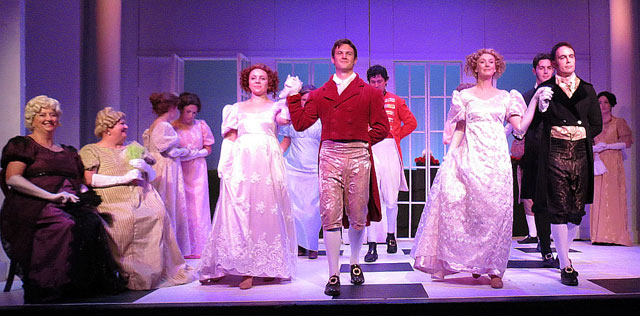
The transformation of Strictly Ballroom into a work for the musical stage is a logical progression. The themes and structure of the film obviously lend themselves to a rendering that would fit readily into the popular genre, and Baz Luhrmann’s penchant for ostentation, flamboyance, and musical numbers in his films makes him a marketer’s dream in this lucrative market.

As an internationally lauded luminary of film imagery, our expectations of production and costume design in his show are understandably high. Fresh from receiving her third and fourth Academy Awards just a month prior to opening night, long-time collaborator Catherine Martin’s work as set and costume designer is irrefutably stunning. Working with already outlandish costumes from the world of ballroom dancing, Martin’s creations take a giant leap forward, into a realm of fairy tales and pure fantasy. There is no requirement for restraint on this stage, and we are treated to the most gloriously colourful and glitzy wigs and costumes that had previously existed only in our dreams.

Martin’s sets are effective and dynamic. The scenes are not located anywhere exotic, but the several suburban venues depicted are created with flair and great imagination. There is very efficient use of space with mobile pieces that work independently, but are also combined for different perspectives. It is not a story that features pyramids, castles or helicopters, but this is a visually arresting stage, which exploits every depth and height that the space can afford, and which sparkles at every corner. There are sequins, paillettes, beads and crystals shimmering at all times, helping to establish an aesthetic that fits in perfectly with this fantastical realm.

Strictly Ballroom embraces wholeheartedly the kitsch value of musicals, and its visual elements are only the beginning. Although it does carefully cater to middle class family audiences, every aspect is expressed through a rejection of banal refinement and conventional good taste. Its story is highly romanticised, the emotions it portrays are brash, the songs are oversweet and obvious, and all performers approach their roles with a sense of unbridled and confident exaggeration. If there is ever a moment for a concoction with this much cheese to work, this would be it, but very unfortunately, the show misses its mark on several levels.

Humour is appropriately peppered throughout the plot. There is much to make fun of, with ridiculous characters and contexts all clearly bearing the promise to deliver laughs, but many of the jokes fall flat. Luhrmann’s direction seems to lack an emphasis on the comedy. Punchlines often do not work, and the atmosphere struggles to keep buoyant. An exception is the role of Liz, played by Sophia Katos, who is memorable as the most consistently funny member of the cast. A number of roles have been created chiefly for comic relief, and Katos’ execution is clearly the strongest.

Leading the cast is Thomas Lacey, an attractive man and a strong dancer, both qualities shared by his character Scott Hastings. Lacey is also an adequate singer, but the scale of the production requires a much more experienced voice that will stand its own amongst all the frenetic activity on stage. Weaker still is Lacey’s acting, which fails to connect him with his love interest, and renders their relationship completely uninteresting and unconvincing. Equally responsible is Phoebe Panaretos, who is admittedly more evenly skilled in the various disciplines of musical theatre, but her lack of charisma in the very central role of Fran is a key disappointment. Panaretos is not a weak performer, but it is evident that she is simply too inexperienced for the challenge bestowed upon her.

Better performances come from the likes of Heather Mitchell, who is endearing as Shirley Hastings, the male protagonist’s mother. Mitchell’s characterisation is vibrant and believable, and although not the strongest of singers, she brings a warmth to the production despite playing someone fairly unpleasant. Also in parental roles are Natalie Gamsu and Fernando Mira, who both impress as characters of Spanish heritage. Gamsu’s distinctive voice is outstanding in a production that seems to have cast performers according to dance ability and appearance, and Mira is a charismatic actor, whose talents as a flamenco dancer are showcased brilliantly, but needs to find greater confidence in his singing.

One of the themes in Strictly Ballroom is the tension between ethnic groups in Australia. This is expressed in the romantic relationship between Fran and Scott, and also in their dance. Their families are depicted in wildly different lights, but both are spirited, joyful and moving. Regretfully, this meaningful and dramatic subject matter is not explored in sufficient depth. The young leads seem too easily accepted by each others’ families, and the penultimate obstacle to their love takes form instead, in the young man’s dilemma about competition dance partners. The opportunity for a more emotive conclusion is sacrificed for one that is more vivacious, but also needlessly frivolous. Ultimately it is the production’s marvelous visual beauty that triumphs, but a three hour show requires more than pleasure for the eyes. It needs to do something for the soul, which discerns the difference between style and substance, and recognises all that glitters is not gold.

www.strictlyballroomthemusical.com

Review: Cough (Unhappen)

rsz_unhappenVenue: 107 Projects (Redfern NSW), Apr 10 – 20, 2014
Playwright: Emily Calder
Director: James Dalton
Actors: Melissa Brownlow, Vanessa Cole, Tim Reuben, Tom Christophersen
Image by Lucy Parakhina

Theatre review
Cough is a work about children and parenting. Through its story, we find a palpable and critical investigation into our middle classes. Emily Calder’s vibrant script examines our beliefs, values, and behaviour by placing us in a child care centre, where toddlers are the currency for adult social interaction. We are presented three characters, each a familiar type, with ordinary foibles, all trying hard to be the best parent they could imagine. Complications arise when they move focus away from their individual familial relationships, and become embroiled as a collective of anxious parents, every one “infecting” their counterparts with imagined and paranoiac fears, like a cough that seems to emerge from nowhere, only to overwhelm the masses.

James Dalton’s direction is thoughtful and inventive. The story and its moral are kept central to the production, but an extravagant theatricality is built upon the script’s theme of childhood imagination and fantasy. The stage (designed by Becky-Dee Trevenen) is raised high above the ground even though we are seated close, making us crane up our necks, to watch everything happen like small children caught in the middle of an adult argument. Dalton’s talent at creating atmosphere gives the play a sense of wonderment that evokes not just of innocence, but also the concurrent terror that underlies childhood experiences. Lighting designer Benjamin Brockman and sound designer Tom Hogan both show great sensitivity and ingenuity, achieving fabulous effects with minimal facilities.

Actor Vanessa Cole plays the highly unlikable Isabella but wins us over with a dynamic performance that is varied in style, and astutely measured. She develops her character fascinatingly, from a painful parochial stereotype to a heightened state of dramatic derangement. Assisted by a versatile and powerful voice, Cole provides the clearest guide for our navigation through the plot and its ideas. Tom Christophersen is a very tall man playing a three-year-old. His character Frank is created with a brand of outlandish mimicry that is highly entertaining, but also menacing in its surrealism. He is the boy we try hard to forget, but who leaves a lasting impression. Frank is untrustworthy yet seductive, and appropriately, Christophersen captivates us while keeping us quite nervous in his presence.

Growth happens quickly, especially when we are not paying attention. We scuffle with silliness, over details that are inconsequential and petty, to over protect our loved ones, and to feed our egos. In the meantime, life had already happened, and opportunities are missed. The here and now exists, but we sometimes come to it a little late.

www.unhappen.org

Review: The Government Inspector (Belvoir St Theatre / Malthouse Theatre)

rsz_12941006184_c9638e943c_bVenue: Belvoir St Theatre (Surry Hills NSW), Mar 27 – May 18, 2014
Playwrights: Simon Stone, Emily Barclay (inspired by Nikolai Gogol)
Songs: Stefan Gregory
Director: Simon Stone
Actors: Fayssal Bazzi, Mitchell Butel, Gareth Davies, Robert Menzies, Zahra Newman, Eryn Jean Norvill, Greg Stone
Images by Lisa Tomasetti

Theatre review (originally published at auditoriummag.com)
First published in 1836, Nikolai Gogol’s The Government Inspector has long been considered a masterpiece in comedy, farce, and political criticism. This co-production by Sydney’s Belvoir St Theatre and Melbourne’s Malthouse Theatre takes inspiration from Gogol’s work, but strays as far as is imaginable with drastically transformed contexts and characters, while retaining certain thematic and structural features of the original.

Simon Stone writes and directs this new version, continuing his passion for adapting and modernising eminent classics of the stage. Fresh from last year’s successful, and bloody, re-telling of August Strindberg’s Miss Julie, he once again presents an interpretation that is radical and completely surprising. This production is a “last minute” replacement for The Philadelphia Story by Philip Barry and Ellen Barry, which had been removed from its programmed slot due to unforeseen copyright issues. It is unclear how much time was available for Stone and his team to rehearse and workshop their take on The Government Inspector, but the volume of ideas and creativity it contains, more than lives up to the famed hilarity of its inceptive roots.

Adding to the theme of mistaken identities, Stone’s show takes on a layer of complexity by embracing and incorporating the experience of losing one script and gaining another. The actors play out a farce that represents their predicament, and uses the opportunity to create a work about the artistic process. Their creation comes out of their anxiety, and a need to satisfy the paying audience, so what results is a piece of theatre that is thoroughly crowd pleasing, and relentless in its pursuit of laughter.

Stone’s courage and edginess as an artist translates curiously well in this madcap comedy format. Popular culture and theatre references are utilised to great effect, but it is Stone’s liberal amount of sarcasm and irony that gives the production an air of intelligence and pointed sophistication. It is a very fine line between silliness and stupidity, but we are never lured into any realm of coarseness or vulgarity. The show plays for laughs but it doggedly rejects cheap ones.

Performances are excellent. The cast of seven might not be uniform in ability and experience, but the ensemble they have created is impressively even. The chemistry between all is stunning, and a tremendous highlight. Eryn Jean Norvill delights with a subtle approach that demonstrates preparedness and confidence. The character she creates is a familiar one, but instead of placing too much emphasis on becoming convincing, Norvill brings with her a sense of knowing, always applying a level of commentary to her actor and character selves. Her attempted defiance against a moment of sexism in the “play within a play”, is poignant and pitch perfect. Zahra Newman is the only actor with two roles, including Dolores de la Cruz, a janitor who delivers some of the biggest laughs by lampooning the thespians. In one of the show’s few political moments, the actors discuss Newman’s ethnicity being an element that provides unfair advantage in the casting process, and it is a pleasure watching her turn an uncomfortable taboo subject into something quite memorable and meaningful.

Gareth Davies is a show-stealer for the duration in which he plays a version of the misidentified inspector. More than any other in the cast, Davies’ execution of the production’s improvisational tone is most credible and exciting. The frantic energy is particularly raw and unhinged when Davies takes focus of the plot. Greg Stone’s exuberant charisma and zeal for self-deprecation quickly endears him to the crowd. His thorough grasp of the material at hand is reflected in his outstanding comic timing. A simple throwaway line about obtaining a job in an office is transformed into a biting joke about the state of the arts in Australia.

Design aspects are fairly basic, but the introduction of a revolving stage that essentially removes the need for extra time to facilitate set changes, and speeds up entrances and exits, makes for a very fast paced, dynamic affair that keeps the audience attentive, and the atmosphere persistently buoyant. No time is wasted between scenes, and we are kept laughing from beginning to end.

There is an extended musical portion in the show that could have felt extraneous, but its insertion is handled with great wit, and we not only forgive its inclusion, we actually find ourselves at new dizzying heights of outrageous comedy. The Government Inspector by Simon Stone and co-writer Emily Barclay, is an exceptionally funny show, but it cannot be denied that the political resonances in Gogol’s writing have all but disappeared. Of course, theatre does not have to be political in order to be valid or indeed meritorious, but radical adaptations of classics will always be controversial, especially when a key feature that has made something legendary is left behind.

www.belvoir.com.au

www.malthousetheatre.com.au

Review: Manon (The Australian Ballet)

ausballetVenue: Sydney Opera House (Sydney NSW), Apr 3 – 23, 2014
Choreographer: Sir Kenneth MacMillan
Dancers: Madeleine Eastoe, Wim Vanlessen, Matthew Donnelly, Brett, Chynoweth, Dana Stephensen

Theatre review
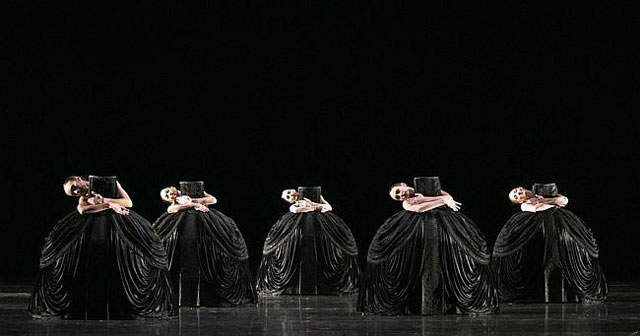
With its extravagant production of Manon, The Australian Ballet once again brings ethereal beauty to life. Originally a novel from the 18th century, Sir Kenneth MacMillan’s work from 1974 is revived for contemporary audiences with generous measures of drama and humour that ensure broad appeal. The story interweaves romance with deception, murder and debauchery, resulting in a show that is full of entertainment, while providing extraordinary aesthetic pleasure.

Madeleine Eastoe is a delicate Manon. She anchors the show with a charming confidence, and her energetic execution of choreography delivers a characterisation that is endearing and precise. Eastoe’s captivating depiction of Manon’s journey is crystal clear, and her final moments are moving in their palpability.

Dana Stephensen is memorable as Lescaut’s mistress, with a striking vivacity that connects well with the audience. She plays up the comical elements of her role with subtlety, and attacks her dance with an alluring dynamism that is often breathtaking. Brett Chynoweth as Lescaut impresses and steals the show in Act 2 with sequences portraying his drunkenness. Chynoweth’s performance of the stunning choreography is highly amusing, but also technically powerful.

Manon‘s design elements are magnificent. Peter Farmer’s costume and set design are lavish and imaginative. It is an immense treat to have a fantasy world materialise before one’s eyes. Farmer’s six different sets are not just heavenly backdrops, and his costumes are not merely pretty adornment. We marvel at his genius, and lose ourselves in the sublime world he has created.

On display in Manon are artists of supreme talent and ability, almost not of this world. Their work lifts us out of our mundane realities, and takes us to a place far, far away.

www.australianballet.com.au

Review: The Gigli Concert (O’Punksky’s Theatre / Darlinghurst Theatre Company)

opunkskysVenue: Eternity Playhouse (Darlinghurst NSW), Apr 4 – May 4, 2014
Playwright: Tom Murphy
Director: John O’Hare
Actors: Patrick Dickson, Kim Lewis, Maeliosa Stafford
Image by Wendy McDougall

Theatre review
O’Punksky’s Theatre’s current production of The Gigli Concert at the Eternity Playhouse is the company’s fourth staging of the Tom Murphy work. Over the course of 16 years, their relationship with the play has developed into something remarkably complex and outstanding in its sophistication. This is a story about the madness that we encounter in our lives, its varying manifestations, and the degrees at which it rears its head. It is also about opera.

Expression through music is used in the production in a fascinating and original way. Director John O’Hare plays with the relationship between music and personal spirituality, and works with it as an instrument of salvation for the play’s characters, and in his staging, a mechanism for storytelling. O’Hare explores bravely, the effects of and experiential reactions to operatic music, almost as an antithesis of the spoken word. Psychoanalysis is a central theme in The Gigli Concert, but it experiments with a departure from incessant talking, and creates a space of meaning with music that reaches beyond everyday language.

O’Hare’s creation is multi-layered, and thick with ideas and intelligence. The show runs the risk of being too intellectually dense in parts, but it is a show that is careful to hold its connection with its audience. It goes on various imaginative flights of fancies, but O’Hare always intends on bringing us along. Along with his actors, he has created a show that is keen to challenge and also to entertain.

Maeliosa Stafford brings with him extraordinary presence, and a brilliant sense of theatricality. We almost expect him to break into arias at each appearance, with a fascinating and dominant energy, keeping us on the edge of our seats for what he wishes to unleash in every scene. His characterisation is consistently strong but also unpredictable, resulting in a portrayal that is full of colour and charm.

JPW King is played by Patrick Dickson whose work is detailed and solid. There is a thoroughness that can only come from extensive study and deep understanding, and Dickson’s performance is infallible. When an actor is in complete control, we get swept away in his confidence, open to all that he wishes to share. There is also an air of whimsy to the leading man that keeps us endeared, and keeps the play effervescent in spite of its frequent darkness.

The Gigli Concert shows us two men and their individual madness. We see them dealing with issues from different perspectives, but the universality of their stories keeps us engaged, and we understand them through the knowledge of our selves, and through the prism of our own madnesses. We achieve a greater understanding of life, and of the nature of human navigation through this incredible and absurd landscape.

www.darlinghursttheatre.com

www.opunkskystheatre.com