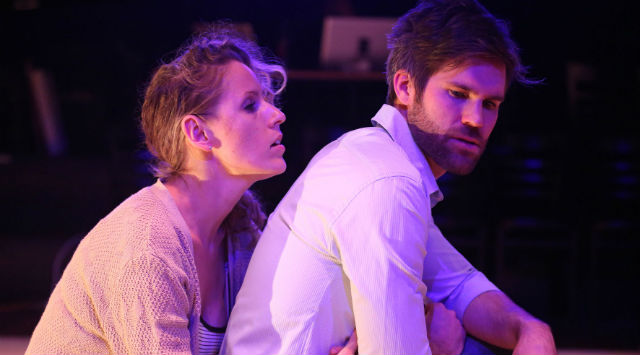
Review: Smudge (The Kings Fools)

thekingsfoolsVenue: Kings Cross Theatre (Kings Cross NSW), May 27 – Jun 11, 2016
Playwright: Rachel Axler
Director: Stephen Lloyd-Coombs
Cast: Danielle Connor, Kieran Foster, Nick Hunter
Image by Liam O’Keefe

Theatre review
The curve balls that we encounter make life frustrating, and sometimes unbearable. We cannot exist without envisioning the future, but nature insists on disrupting our plans to make destiny something that we can never truly be masters of. In Rachel Axler’s Smudge, Colby and Nick give birth to a severely disabled baby. As the young couple tries to come to terms with the unexpected turn of events, we witness their struggles and disappointment, and measure them against a new life that we have little understanding of but whose rights are unequivocal. It is a brutal set of circumstances, but the play takes a less than obvious approach, avoiding melodrama at all costs in its exploration of relevant issues and of human behaviour.

The play is quirky and often comedic, with director Stephen Lloyd-Coombs maintaining a sensitive, delicate tone over proceedings, but the show is most effective at its darkest moments when characters are intense and irrational. Danielle Connor and Kieran Foster work well at creating believable presences and convincing emotion, but the production’s mildness of demeanour restricts how much it is able to convey on a visceral level. It is a story of considerable gravity, and although powerful in parts, Smudge can seem slightly detached from its own sorrow.

Accomplished work by Liam O’Keefe on lights and sound by Michael Toisuta give tension to the piece, and both conspire to add a dimension of supernaturality and of horror when appropriate. Theatrical pleasure is derived from a quality of surrealness created by O’Keefe and Toisuta’s atmospheric manipulations, and along with Elia Bosshard’s set, leave a strong impression with the show’s aesthetic and technical proficiencies.

We do not talk enough about disability. There is little understanding in mainstream communities about what people’s needs may be, when living with unique challenges. Colby and Nick are isolated, left to nurture a baby that is of them but also radically different from their realm of reality. Their story is an allegory about every person’s conflict with the unpredictability of life, but the specific experience of disabilities, physical and otherwise, must not be overlooked. Conversations needs to be had in order that societies can work towards becoming more inclusive, and we must learn about disadvantages that exist in our communities to bring about equity for all. The new family in Smudge are unable to cope on their own, but with our support, things can only get better.
www.facebook.com/…

Review: Is It Time (King Street Theatre)

emuprodVenue: King Street Theatre (Newtown NSW), May 25 – Jun 5, 2016
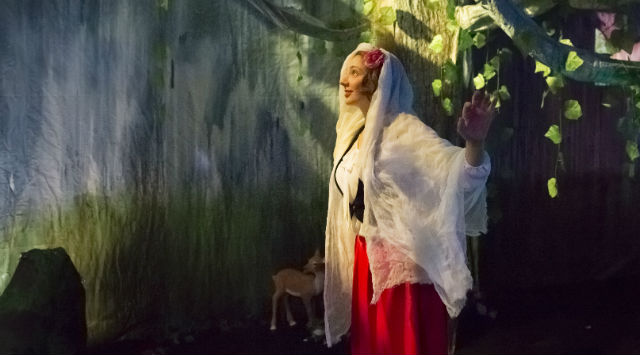
Playwright: Martin Ashley Jones
Director: Barry Walsh
Cast: Lauren J. Jones, Denise Kitching, David Luke, Sarah Plummer, Ross Scott, Sylvia White
Image by Thomas Adams

Theatre review
Discussions about end-of-life decisions are invariably dynamic. Each of us has a stake in the topic, and our points of view tend to be fiercely adversarial, even though the matter is contentious precisely for its manifold ambiguities. Martin Ashley Jones’ Is It Time makes a courageous proposition about the way we should be allowed to be in control of our own deaths. It makes a pro-euthanasia argument, but avoids cliché with some of its more radical ideas that are rarely presented in public discourse. Jones’ story is confronting and controversial, with well-crafted characters and vibrant dialogue that will facilitate healthy debate on the subject. The script can be further finessed, especially in passages where diatribes become too obvious, but it is a passionate work that will encourage thoughtful and spirited interaction in its audience.

Direction by Barry Walsh brings excellent lucidity, in emotional and logical terms, to the play’s ideas. There is little doubt as to what Is It Time wishes to say, but the show can often lack nuance in its representations. The issue is a complex one, but we jump to its conclusions almost too easily. Walsh’s pace is admittedly enjoyable, but it also feels rushed at points, and important details become lost in the process. Performances are characterised by clarity and enthusiasm, and even though a greater sense of moral struggle would add drama to the piece, the production succeeds in engaging us by asking important, burning questions. Sylvia White and Ross Scott lead the cast with heartbreaking honesty and beautiful chemistry. Their control over poignant sections of the play is considerably stronger than in moments of comedy, and we do take time to warm up to their personalities, but they get us to an ending that is ultimately very satisfying.

Fighting over the right for a dignified death is problematic for many reasons, including the fact that many who argue against euthanasia have not encountered terminal illness at close proximity. For those who only see death as a distant and abstract concept, taking away a suffering individual’s final cardinal choice is a not a difficult task. Is It Time demonstrates that art has the unique capacity to provide space for the issue to be explored, in a way that is humane and sentimental, but simultaneously objective and pragmatic. There are few opportunities for us to come face to face with our mortality, but at the theatre, where it is secure and sacred, we can interrogate the inevitability to reach a deeper understanding of that sunset we will all see one fateful day.

www.kingstreettheatre.com.au

Review: The Forest Unyielding (Self Help Arts)

selfhelpartVenue: 107 Projects (Redfern NSW), May 24 – 28, 2016
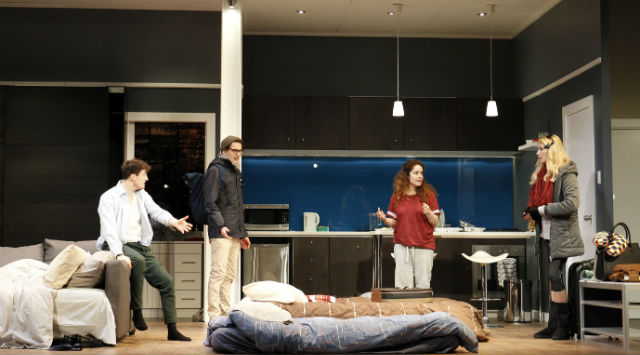
Director: Margot Politis
Cast: Taryn Brine, Grace Partridge, Margot Politis, Lauren Scott-Young, Claire Stjepanovic, Lucy Watson
Image by Sarah Emery

Theatre review
The Forest Unyielding is a dynamic new study of mental health, set in a dark forest space representing the inside of a brain.” It might be considered a performance art piece, comprising six actors each demonstrating her own isolated corner of dysfunction. Some are in perpetual motion, and others are caught in modes of stasis. No words are spoken, but there is a potency of intent and presence that is inescapable.

Dylan Tonkin’s sensational set design keeps our eyes fascinated with a enigmatic blend of colours (with Emma Lockhart-Wilson’s lights) and textured surfaces providing an affecting approximation of a mystical fairyland, in which we roam and explore. Sound is thoughtfully orchestrated to provide tension to the ethereal environment, with a mixture of drone and spiritual elements by Thomas Smith controlling our visceral responses to the work.

Without the use of a narrative, The Forest Unyielding requires that we interact with its abstract displays instinctively. Each of the women are trapped in a repetitious cycle of activity and emotion. We observe them from a state of initial curiosity to varying degrees of understanding or perplexity, with director Margot Politis’ use of time requiring of us reflection and perseverance before we are able to encounter the depth of what is being represented. The space moves, but is non-changing for its 50 minutes, and it is the audience that experiences a transformation within.

The show is not always an easy journey, and its ending could be executed with greater flair, but the experience it delivers is unexpectedly satisfying. It relies on our selves to make the most of what envelopes us, and it is that investment of personal energy and thought that leads to an appreciation of the work. Passivity will not get one very far in this forest. We are used to being told what to think at the theatre, but on this occasion, our own devices are put to the test.

www.facebook.com/SelfHelpArts

Review: Bad Jews (Vass Theatre Group)

badjewsVenue: Seymour Centre (Chippendale NSW), May 18 – Jun 4, 2016
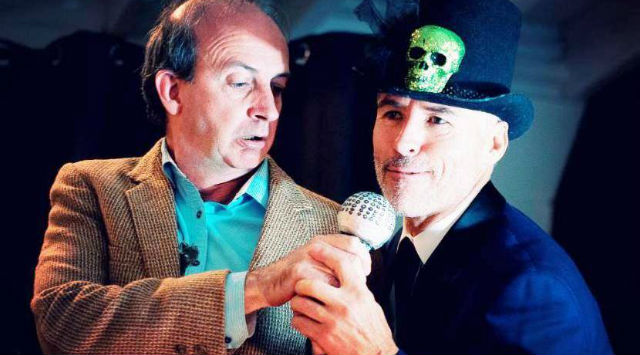
Playwright: Joshua Harmon
Director: Gary Abrahams
Cast: Maria Angelico, Simon Corfield, Anna Burgess, Matt Whitty

Theatre review
Joshua Harmon’s Bad Jews explores authenticity of the self in relation to religion, ethnicity and history. At opposite ends of a spectrum are the religiously observant Daphna and her atheist cousin Liam, both Jewish by genealogy but each relating to their backgrounds in vastly different ways. They fight over what constitutes right and wrong, constantly and fervently berating each other for their conflicting life choices. At its best, Harmon’s writing is deliciously cutting, with characters verbally attacking each other at the most vicious degrees imaginable. The words are brutal, but they ring true, even as they emerge in contradiction from opposing sides of the argument.

The play’s comedy is not always refined but director Gary Abrahams injects a confident energy into the production to ensure that chutzpah makes up for the occasional shortcomings of the text. Abrahams’ eye for detail delivers a very tight production that insists on being compelling at every moment, and rich with thrilling resonance whenever it delves into more meaningful proclamations.

Excellent performances by the cast of four make Bad Jews a memorable night at the theatre. Daphna is played by Maria Angelico with extraordinary gusto. Dangerous, funny and vulnerable, she goes through the gamut of human emotions for a portrayal of what seems an oddity but in fact translates with intimate accuracy. We may not be able to identify with her world of religious righteousness but her very human expressions of desperation are universally accessible. In the role of Liam is Simon Corfied, animated and passionate with great conviction, giving life to an uptight scholarly type who although represents the voice of reason, is comically unable to quell his shortness of temper for his adversary. Supporting actors Anna Burgess and Matt Whitty are both accomplished and precise with their depictions. Burgess in particular, impresses with her capacity to turn every brief opportunity in the limelight into a delightful showcase for her comedic genius.

For all its talk about religion, and the varying extents to which its individuals practise the beliefs that they inherit, Bad Jews makes a convincing point about love being the overriding factor that helps determine how we live. We cannot decide who we truly fall in love with, much like we do not choose who we are born to. Liam is accused of sacrilegious desecration by the pious Daphna, but the play makes us understand that anything that would come between real love to be erroneous. Liam revels in the purity of his romantic relationship, while Daphna experiences purity in her religious orthodoxy. They are concurrently right, even if in a state of war.

www.badjewstheplay.com

Review: 7 Days In The Life Of Simon Labrosse (Théâtre Excentrique)

theatrerexcentriqueVenue: Creative Space 99 (Darlinghurst NSW), May 18 – 29, 2016
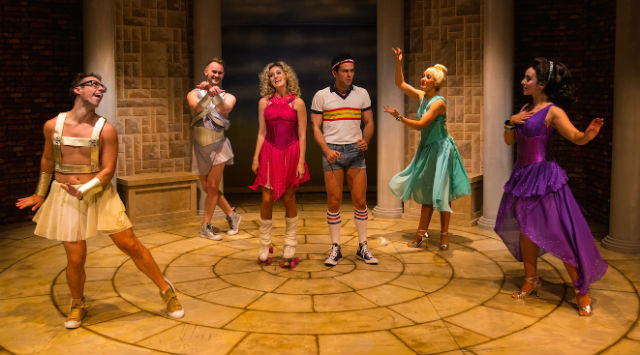
Playwright: Carole Fréchette (translated by Kris Shalvey)
Director: Anna Jahjah
Cast: Cassady Maddox, Steve McGrath, Gerry Sont
Image by Emma Lois

Theatre review
Simon Labrosse is a talented man, but he has trouble making a living out of his many skills. He tries hard to market himself, giving out samples of the services he can provide, and although he convinces everyone of his abilities, none are willing to pay for his expertise. Labrosse is an artist of sorts; what he does is not strictly scientific, mathematical or easily commodifiable, but he has much to contribute to society. The economy, however, does not recognise his unquantifiable efforts and rejects him, judging him worthless and a burden. Carole Fréchette’s play is about the problems we face as communities of modern capitalism, unable to embrace parts of our humanity that cannot be monetised.

The production is beautifully designed, with the audience situated inside Labrosse’s home. His bed is in the middle of the space, and action takes place all around us. Our view can get obstructed at times, but the constant relocation of activity is exciting and an effective mechanism for maintaining high energy levels. Anna Jahjah’s direction is free and humorous, delivering a work that feels unrestrained and exhilarating. The short scenes are punchy and surprising, full of whimsy with lively characters each appealing in their own way. It is a tightly rehearsed cast, cohesive in style and delightfully engaging. Gerry Sont plays Labrosse, wistful but optimistic, with a pleasing vibrancy that elicits our curiosity and empathy. A greater dose of melancholy would probably give the show a little necessary gravity to have its themes resonate stronger, and for its ideas to stay in our minds longer. Supporting players Cassady Maddox and Steve McGrath create a range of eccentric personalities that make the show unpredictable and give it a consistent buoyancy, while in the process leaving excellent impressions for their versatility and comic timing.

7 Days In The Life Of Simon Labrosse is a light-hearted take of a sad situation. The privatisation of everything in Australia seems boundless, with every annual budget revealing less and less support for those of us whose talents are incongruous with the reductive demands of capitalism. Simon Labrosse shows us all that he is capable of, but he is situated inside an economy that wants him to be simpler and more ordinary so that they can provide a place for him just like everybody else’s. It is the job of capitalism to turn everything and every person into a measurable and sellable unit, and in the process, risk the removal of everything that we know to be the best of human nature. In the seven days that we meet our protagonist, he keeps on trying but does not give up his true essence; we see him fail repeatedly and wonder how he can make things work. We have a collective part to play in allowing his potentials to blossom, but we wonder if what he can give in return will cost too much.

www.theatrexcentrique.com

Review: Xanadu (Matthew Management / Hayes Theatre)

xanaduVenue: Hayes Theatre Co (Potts Point NSW), May 12 – Jun 12, 2016
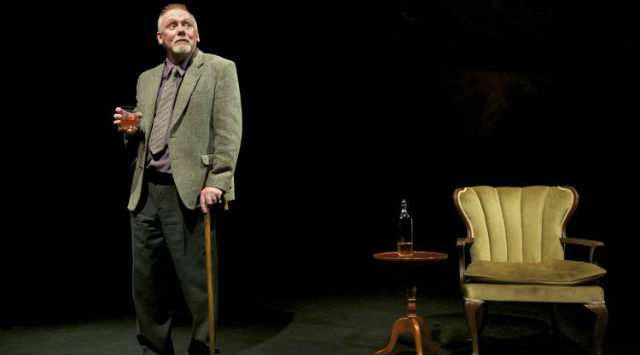
Book: Douglas Carter Beane
Music & Lyrics: John Farrar, Jeff Lynne
Director: Nathan M. Wright
Choreography: Leah Howard, Nathan M. Wright
Musical Direction: Andrew Bevis
Cast: Dion Bilios, Francine Cain, Catty Hamilton, Kat Hoyos, Jaime Hadwen, James Maxfield, Ainsley Melham, Josh Quong Tart, Jayde Westaby
Image by Frank Farrugia

Theatre review
1980 is not exactly a great many lifetimes ago, but we have certainly lost a considerable measure of innocence since then. The Xanadu stage musical is a recent incarnation of the now cult classic film that materialised at the very dawn of the 80’s, and judging by the thoroughly farcical approach now taken, twenty-first century life seems to be very cynical indeed. Gone are all the naive idealism and whimsical romance that had accompanied Electric Light Orchestra’s bubblegum pop for the original, replaced by post-modern campery so sardonic, Liberace and Mae West are blushing in their respective graves (maybe with jealousy, but hard to know for sure).

The Xanadu film was never well regarded by critics, and its box office takings were disappointing, but it retains a significant place in pop culture history chiefly for the hugely successful music that it features. It makes sense that Douglas Carter Beane would re-write the piece exposing all the silliness of the story so that we can laugh with his version, instead of laughing at it as was often the case with its predecessor, but there is a compromise to the substantial presence of the original songs that does not always find harmony. Beane can subvert everything in the book, but shoehorning his comedy into the perfectly constructed pop masterpieces often feels antipodal and frankly, a waste of opportunity. Instead of improving the storytelling around the euphoric compositions of passion, he tries to re-engineer them for his comedic purposes with mixed results. Nonetheless, the show is by and large, a very funny one, in the style of a “children’s show for 40 year-old gay people” as one of its character states.

Director Nathan M. Wright rises to the challenge of bringing a tenacious and flamboyant vibrancy to the work, never missing a beat with his show’s unrelenting hammy humour. Always engaging and always in jest, every weakness of the 1980 film is turned into a knowing joke, as are the few effective poignancies from the original. The love story takes a back seat, making way for amusing and frivolous characterisations taking centre stage, performed almost vaudevillian in style, by an impressive cast that seems to have no limits to their abilities. It is not every day that we see people singing, dancing, acting and making us laugh, all at once, and on roller-skates no less. Jaime Hadwen is perfect for the role of Kira, sent from the heavens to raise Xanadu from its ashes. Hadwen’s comedic skills win us over from her first appearance, and while the tender warmth that she is able to inject surreptitiously, is easily overlooked in a mélange of frenzy, it is that quality of sweetness that keeps us endeared and quite miraculously, invested in. Her singing is exuberant and accomplished, but more creative sound design is required to live up to Olivia Newton-John’s legendary recordings. Xanadu may not be perfectly conceived, but its execution is top-notch, especially by the performers who give it their all on stage.

Kira discovers that the reason for humans striving hard for art, is linked inextricably to our mortality. As daughter of Zeus, her life is eternal, but the only way for us to live beyond the last breath is to establish legacy. The fact that Xanadu has endured against all odds through the decades, serves as inspiration to all of us who suffer from lapses of confidence in our work and indeed, other parts of life. We may not always receive affirmation and recognition for the things we do, but it is important to realise the ripple effect of even the smallest of our efforts. We cannot see every tomorrow, but the ones we touch will carry something of us into the days ahead, like “where Alph, the sacred river, ran / Through caverns measureless to man /
Down to a sunless sea.” (Kubla Khan by Samuel Taylor Coleridge)

www.hayestheatre.com.au

Review: As We Forgive (Griffin Theatre Company / Tasmania Performs)

griffinVenue: SBW Stables Theatre (Kings Cross NSW), May 11 – 21, 2016
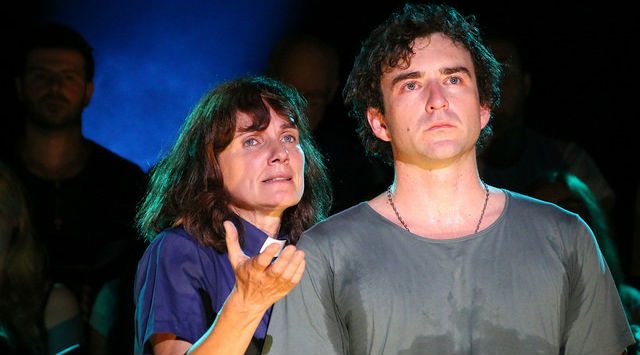
Playwright: Tom Holloway
Director: Julian Meyrick
Cast: Robert Jarman

Theatre review
Forgiveness is complicated and unstable, and where it is most needed, its difficulty is at its greatest. In Tom Holloway’s As We Forgive, three monologues featuring an older man demonstrate the purpose of forgiveness, as it relates to a self that needs to find emancipation that can only be derived from an act of absolution. When we realise that life is short, the urgency for deliverance becomes even more pronounced, and Holloway uses the mechanism of age in his storytelling to amplify the poignancy of his message.

The writing is sublime, with evocative and powerful imagery that connect on levels of emotion, spirituality and intellect. Actor Robert Jarman does an exquisite job of the words, sensitively articulating each sentence so that the text communicates with richness and lucidity. Although quiet in presence and at times too gentle with his approach, Jarman is a charismatic personality effective at conveying profound sentimentality. There is an elegance to his work that is memorable for its simplicity, as well as an inner authenticity that contributes to the cogency of the play’s concepts.

The production is melancholic, beautifully so, but a more dynamic atmosphere would perhaps provide an experience that is more engrossing. Lisa Garland’s photo projections and Raffaele Marcellino’s music add tender dimensions to an already delicate staging for an overall effect that is undoubtedly appealing, but for its eighty-minute duration, greater fluctuations in energy levels is required.

The men in As We Forgive are consumed by vengeance, hatred and remorse. Their stories are dramatised but we perceive their feelings to be familiar and true. All our lives parallel, and no matter the obstacles we face, our humanity binds us, allowing us to recognise each other’s wounds and suffering. We may not all be lonely people, but finding forgiveness is a solitary task, and those who succeed are the luckier ones.

www.griffintheatre.com.au | www.tasperforms.com

Review: The Events (Belvoir St Theatre)

belvoirstVenue: Belvoir St Theatre (Surry Hills NSW), May 12 – Jun 12, 2016
Playwright: David Greig
Director: Clare Watson
Cast: Johnny Carr, Catherine McClements, Pitt Street Singers, Wycliffe Singers
Image by Luke Cowling

Theatre review
There are probably no issues more pressing than those pertaining to immigration, terrorism and mass shootings. Trying to make sense of these realities has become an everyday fixation in many of our lives, and David Greig’s The Events is a timely and sensitive expression of those concerns. Claire is a priest and choir leader whose life and faith is shattered by a traumatic incident that transforms the complexion of all that she knows. Fractured and struggling to find coherence, Greg’s writing is a reflection of the protagonist’s state of being. The play is not an easy ride, but it provides valuable insight for all of us who are part of this contemporary and complicated discussion on nationhood and security.

The play’s structure lends itself to intrigue and tension, which director Clare Watson manufactures well, but its restrained emotional dimension prevents the show from creating the same resonances that we have come to expect when dealing with its themes. There is no shortage of television coverage on these matters, and they are almost without exception, full of cheap sentimentality and irrational fear, which The Events does not replicate, but what it delivers instead can feel underwhelming and uncomfortably tepid. Perhaps its intention is to guide viewership to a more cognitive response for its deliberations, which is a challenging task that it accomplishes at varying degrees.

Catherine McClements is impressive with the thorough authenticity she introduces to the stage, and the ease with which she is able to convey the magnitude and intricacy of Claire’s psychological condition. The aforementioned disinclination for melodrama is disappointing, but understandable. The actor tells the story well, and we learn all there is to know about her character and the circumstances, even if we are not engaged on a more emotive level. Johnny Carr plays a variety of roles opposite the leading lady, engrossing but not always distinct (probably a comment on Claire’s disillusionment with the world), with an energetic approach that we rely on for a propulsive sense of momentum.

Claire has the strength to move forward but she needs time. When disasters strike, we can try to forge ahead in blindness but the scars and stains they leave behind do not disappear without effort. In The Events, we are urged, in times of trouble, to humanise individuals when all our instincts want is for perpetrators of violence to become demonised. It is a story about forgiveness, the truth of its emancipatory effects and the difficulty of its embrace. The problems we face are hard, they may even be thought of as insurmountable, but life persists in spite of it all and we must negotiate its good and its evil the best we know how.

www.belvoir.com.au

Review: Telescope (Montague Basement)

montageubasementVenue: Leichhardt Town Hall (Leichhardt NSW), May 12 – 21, 2016
Playwright: Charles O’Grady
Director: Charles O’Grady
Cast: Shevvi Barret-Brown, Caillin McKay
Image by Omnes Photography

Theatre review
Experimentation often happens behind the scenes. A wealth of weird and wonderful things must happen in rehearsals before an audience is introduced to the mix. For Telescope, the experiment happens before our eyes but without us knowing. Each night, actors in the two-hander swap roles, which means that most would only ever see half of the picture. Charles O’Grady’s script is interested in the meanings of gender as experienced at home, and the surprising extent to which it pervades every corner of family life, insidious but unintended. Joss and Vic have a child going through early stages of gender transition. We do not meet Jem, but his presence is felt through the play, like a dark cloud that hangs over the living room in which all action is set. Sequences of mundanity and theatricality combine to form a plot that attempts to demonstrate the turbulent effect of gender coming into consciousness, and to explore the subtleties of how gender informs our relationships.

In between engaging scenes of argument and conflict, the production’s efforts at representing the banal can be overly indulgent. It takes a lot of time to cut to the chase, but while the audience desires drama, Telescope is interested in what happens in quiet moments. Joss and Vic are a very regular couple, but we are not allowed to disregard the minute conventionalities that inform us of their identities. We look for signs and gestures, usually hidden and ignored but sonorous on this stage, to come to an understanding of their relationship. We need to know who is the wife, who is the husband, but in that process of misgendering and determination, question the necessity of that very information. With our discovery of their respective genders, we consider its relevance to the story that unfolds, and indeed its machinations in real life outside of the auditorium.

Performances by Shevvi Barret-Brown and Caillin McKay are uneven, but effective when they find passion and when they are able to demonstrate hints of connection. There is a sense of detachment on the stage that, although challenging for a two-hour show, helps us observe human intimacy from an unusually critical standpoint.

Joss and Vic are unable to live and let live. They struggle to come to terms with Jem’s deviation, and are tormented by his self-determination. Their emotions are true, but also absurd. Vic and Jem are in a tug-of-war at opposite ends of the gender conceit, both insistent on what they deem irrefutable and real. Telescope not only makes us examine that binary, it leads us to its dissolution. The characters in the play speak only in terms of female and male, but what O’Grady puts on stage is a disruption of those simplistic and myopic ways of approaching life. Like feminism that works for the elimination of patriarchal systems, a revision to how we understand, practise and enforce gender in society would lead to greater equity, but that revision is of immense complexity, and we are only at the dawn of that political movement.

www.montaguebasement.com

Review: My Name Is Asher Lev (Eternity Playhouse)

asherlev1Venue: Eternity Playhouse (Darlinghurst NSW), May 8 – 29, 2016
Playright: Aaron Posner (from the novel by Chaim Potok)
Director: Moira Blumenthal
Cast: Annie Byron, Tim McGarry, John O’Hare
Image by Blumenthal Photography

Theatre review
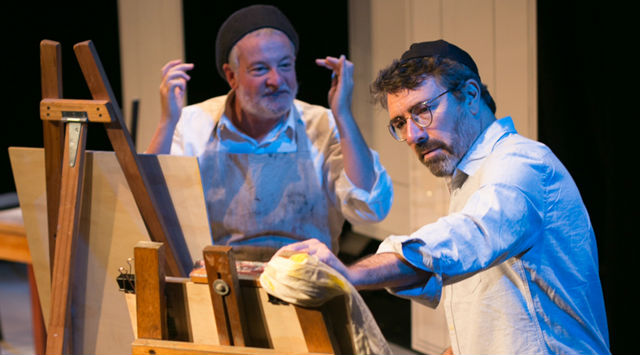
We meet Asher Lev from the time he discovers a talent for drawing, and follow his journey from prodigy to established artist. It is a short time getting to success, but the lessons he learns are profound, and writers Aaron Posner and Chaim Potok do an excellent job of sharing those wisdoms in the story. The theme is one that we all have to grapple with, some more often than others, but it is nonetheless universal; we must identify a true and authentic self, and live accordingly. Young Lev’s sense of authenticity is frequently at odds with the life his parents had envisioned for him, but it is that negotiation between forces that allows him to thrive as an artist and more significantly, develop into an independent autonomous being.

Direction by Moira Blumenthal is tender and melancholic, with detailed attention placed on family dynamics that are central to Lev’s experience of the world. The characters are believable and we relate to their psyches easily, but the production needs greater dynamism with its rhythm, and a more pronounced sense of humour to achieve variances in mood and tone between scenes. The role of the young artist is played by John O’Hare who although lacks the adolescent energy required, depicts acute emotional accuracy in order that we understand all the nuances of his conflicts and challenges. More compelling is Tim McGarry in a range of paternalistic parts who brings colour and surprising vibrancy to the show. Annie Byron is convincing as Lev’s mother, and chemistry between all three is beautifully forged for a show that makes a poignant statement about the complexities of family, history and individual fulfilment.

Whether we grow up to be copies of our parents, or turn out to only be partially similar to family members, there is no doubt that blood ties have a deep influence on the people that we become. As a child turns into an adult, they should be given choices and importantly, the strength to make them. We wish the best for our offspring, but they must become their own persons, and there comes a time when father no longer knows best. The world evolves, and it develops in directions that may not always be pleasing. When things become unbearable, we can call upon faith, and trust that something bigger than our own minds has great designs in mysterious ways, beyond our ability to currently comprehend.

www.encounters.edu.au