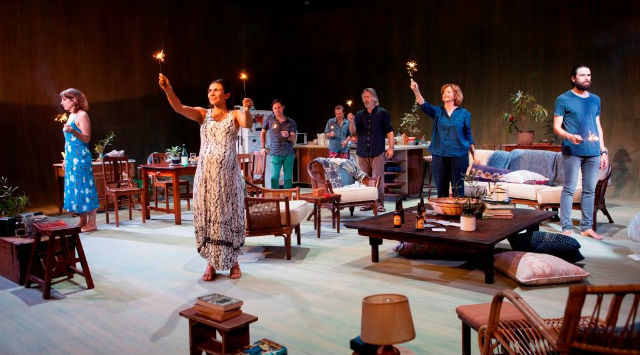
Review: The Great Fire (Belvoir St Theatre)

belvoirVenue: Belvoir St Theatre (Surry Hills NSW), Apr 2 – May 8, 2016
Playwright: Kit Brookman
Director: Eamon Flack
Cast: Sarah Armanious, Peter Carroll, Lynette Curran, Eden Falk, Sandy Gore, Shelly Lauman, Marcus McKenzie, Geoff Morrell, Yalin Ozucelik, Genevieve Picot
Image by Brett Boardman

Theatre review
For many people, having children is considered natural and something that does not require questioning. In Kit Brookman’s The Great Fire, we see the complications that arise, not when toddlers are misbehaving, but when children become adults and their struggles can no longer be quelled by their parents. Judith and Patrick are affluent Australians of the baby boomer generation, with a strong marriage and three grown children. The couple is in their 60s and is beginning to contemplate their autumn years. Unlike their own parents, Judith and Patrick do not have the luxury of only considering their own needs. Their children might be adults, but they are not yet financially independent.

The Great Fire is about one family’s woes, but also an experience shared by many. For what seems to be the first time in human history, apron strings have become hard to sever. With the aggressive growth of capitalism occurring at the same time as baby boomers having children, much of the world has now evolved into a new economy where the chasm between the haves and have-nots is larger than ever. Judith and Patrick never foresaw that their offspring would find it hard to make a living, and certainly never expected their retirement plans to include their children’s well-being, but the current state of the world is no longer offering the same opportunities. The younger generation is brought up in the image of their parents, and they find themselves lost in this new social system, where no one is guaranteed an income, and where building careers is a privilege increasingly out of reach.

The story is not an easy one to articulate. We are perhaps too close and too new to its concepts, and unable to see the forest for the trees. Brookman’s script contains many ideas, observations and philosophies, all relevant to contemporary life, and even though it is admirable that the work feels uncompromised, it is not always focused enough for dramatics to work effectively. The plot is long and meandering, often with enjoyable moments but also overly complicated and overladen by details. Nevertheless, characters and their narratives are authentic, and we recognise their individual challenges easily and intimately. Direction by Eamon Flack brings attention to the wider social aspects of the family drama. We are not left indulging in bourgeois pettiness, but are asked to consider the play’s bigger contexts, which affect us all. The Great Fire takes its time to get to the point, but the poignancy at its end is deeply satisfying.

Production design is accomplished with quiet elegance, and Michael Hankin’s set is undeniably beautiful. Sound and lights are gently executed, making their presence felt without drawing undue attention. There is excellent chemistry in performances that makes us believe in the play’s complex family dynamics. Genevieve Picot brings a warm and organic instinct to her portrayal of Judith, while Peter Carroll and Yalin Ozucelik leave strong impressions in their powerful and prominent stage moments. It is not a simple piece to communicate, but the actors convince us of its core messages.

The characters in The Great Fire do not live in poverty, but their struggles are real. Like most of us, they have obligations that need to be met, but resources always seem to lag behind. We may have learned life lessons from our parents, but we do not always realise that the skills they had acquired for their lives may no longer be sufficient for dealing with ours. When we bring children into the world, optimism can overwhelm and blind us from the cold face of reality, and how much protection a parent can afford seems always to be a difficult question. The pursuit of prosperity is linked to what our planet can give. There is no end to how much we want, but the planet is finite, and we feel very close to that limit.
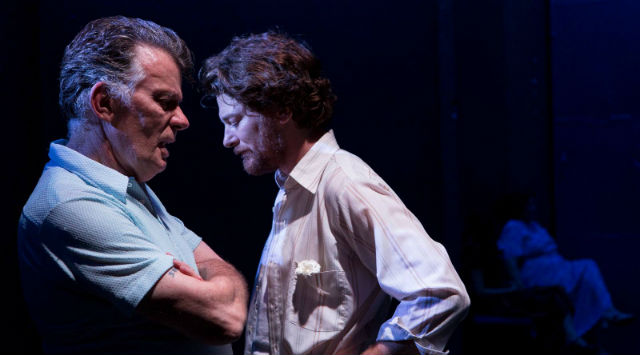
www.belvoir.com.au

Review: The Blind Giant Is Dancing (Belvoir St Theatre)

belvoirVenue: Belvoir St Theatre (Surry Hills NSW), Feb 13 – Mar 20, 2016
Playwright: Stephen Sewell
Director: Eamon Flack
Cast: Michael Denkha, Ivan Donato, Andrew Henry, Emma Jackson, Russell Kiefel, Genevieve Lemon, Geoff Morrell, Zahra Newman, Dan Spielman, Yael Stone, Ben Wood
Image by Brett Boardman

Theatre review
Stephen Sewell’s The Blind Giant Is Dancing premièred in 1983, long before the internet and social media had become a central part of how we understand and engage in politics. Armchair activism had yet to be discovered, and participation in our country’s big issues required more than clicks on neglected polls and petitions, or furious rants of 140 characters. If any action was to be taken, we had to put money where our mouths were, and the stakes were much higher than risking the closure of troll accounts on Twitter.

The play looks at how the working class was embroiled with trade unions and other organisations in a fight for protecting their rights, at a watershed period where capitalism’s subsumption of the economy was fiercely under way. We watch the moral descent of an idealist in Allen Fitzgerald as he climbs the ladders of power, observing the seemingly inevitable corruption that occurs as an individual finds their way into positions of power. It is a deeply pessimistic and cynical statement about the world that director Eamon Flack has successfully transposed to twenty-first century Australia. Industrial relations continue to be a key issue, and we are probably more aware than ever before, about the vulnerabilities of our democracy. The details in The Blind Giant Is Dancing might be outdated, but its concepts are resolutely relevant, and its ideology remains powerful.

With its zealous political dissections, aficionados would probably find the work irresistible, but there is much in the production that appeals to the layperson. Its central concern regarding tensions between the personal and the political, are fluently expressed, especially in scenes that move the plot into realms of the domestic. Allen’s personal life allows us to relate to his story more intimately, as he negotiates abstract principles and beliefs, against the real matter of daily life. The conflicts that arise from trying to put into being, imagined and utopian ideals for larger social contexts, prove to be problematic as we witness those precepts failing in the Fitzgerald household. It is his broken relationships with family and lovers that we empathise with, and the meanings behind that destruction, which are most poignant.

Dan Spielman is convincing as Allen, with a commanding stage presence that places him comfortably at the centre of all our attention. He connects well with the audience from the start, and we stay compelled until the bitter end. His portrayal of the complex role is intelligent, confident, and quite affecting. Although disappointing, we see his flaws and misjudgements as human, and Spielman’s honesty as a performer helps us realise the accuracy of the grim situation in which we find his character. The role of Louise is played by Yael Stone, sensitive and intricate, with excellent conviction behind the fiery personality being depicted. Louise is perhaps not as well-written a character as her male counterparts, but Stone’s ability to locate emotional authenticity assists with our all-important suspension of disbelief to make her narrative work.

This is a production of high quality, polished and consistently thoughtful. The cast does a marvellous job in creating a succession of explosive scenes that grips us for its entirety (the three-hour duration whizzes past), and the designers impress with adventurous and effective work. Sound design by Steve Toulmin in particular, provides an epic grandeur, recalling period drama pieces of a similar ilk that trace the familiarly ominous ascension of political figures.

The Blind Giant Is Dancing warns us of many things, but provides no solutions. The darkness of its revelations feel real and in spite of their grave severity, we are offered no recourse. What happens after the curtain call is anybody’s guess, and also a crucial estimation about the utility of theatre. The show interrogates all our personal lives, and after receiving its indictments, the process will continue in each individual beyond that evening of attendance. If an artist is unable to produce the answers, the best they can do is to ask the questions, boldly and fervently. What we wish to happen thereafter can only then be, a question of hope.

www.belvoir.com.au

Review: Perch (The Leaps / Belvoir St Theatre)

perchVenue: Belvoir St Theatre (Surry Hills NSW), Feb 9 – 21, 2016
Playwrights: Brian Carbee, Sarah Carradine
Director: Sarah Carradine
Cast: Brian Carbee
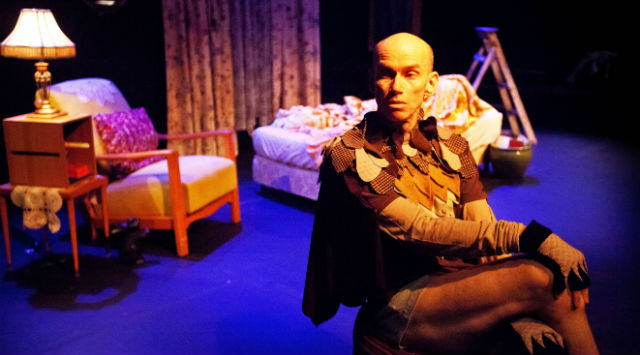
Image by Phyllis Photography

Theatre review
Brian Carbee plays two characters in Perch; an owl and a human. Their relationship is strange to say the least, and even though the poetic script does not engage in a conventional sense, it provides impetus for a show that utilises the considerable talents of its performer, revealing not only the wealth of experience Carbee possesses as a dancer, but also the eccentric and idiosyncratic qualities he bears as an artist accomplished in the realm of movement based art.

It feels as though the roles he inhabits are but conduit for an expression of self. We might not achieve a great understanding of what is being created on stage, there is certainly no doubt as to the kind of person involved in the creative process before our eyes. The work is about the artist’s presence, and it is his skill, flair and fluency that captivates. It is Carbee’s very own humanness that is the object of our appreciation, and the surreality of all the action he manufactures is the looking glass through which we are able to read, and feel, the existence of a living, breathing sentient being exposed to our audienceship.

Perch is a work about the camp sensibility and its manifestations in physical and verbal forms. Carbee portrays an overt flamboyance that simultaneously obfuscates and indicates the truths that are at play on his stage. Identity is explored through the creation of false otherness, almost as though reaching for exaggerated and illusory entities is key to the discovery of authenticity. When we define our alter egos, we give shape and meaning to ourselves, and because facing the self is exasperating, we luxuriate in something else, something seemingly separate that can tell us everything that we need to know about the universe that lies within.

www.theleaps.org | www.belvoir.com.au

Review: Jasper Jones (Belvoir St Theatre)

belvoirVenue: Belvoir St Theatre (Surry Hills NSW), Jan 2 – Feb 7, 2016
Playwright: Kate Mulvany (based on the novel by Craig Silvey)
Director: Anne-Louise Sarks
Cast: Tom Conroy, Kate Mulvany, Matilda Ridgway, Steve Rodgers, Guy Simon, Charles Wu
Image by Lisa Tomasetti

Theatre review
Laura is found dead, and although not wrapped in plastic, the stories in her town of Corrigan bear many similarities to those at David Lynch’s Twin Peaks. Burgeoning adolescence, secret lovers, hidden sanctuaries, sexual abuse and a creepy man that holds the key to mysteries. Jasper Jones acknowledges the debt it owes to Harper Lee’s To Kill A Mockingbird and Truman Capote’s In Cold Blood, and there is certainly more than a sense of familiarity in the way Laura’s murder is explored, but the play provides a fresh look at Australia’s own troubled experience of race relations, which remains under-represented in our artistic landscape. Unlike the Americans for example, we have shied away from the truths of our racism, both historical and current, so works such as Jasper Jones that place attention on our indigenous and immigrant cultures are deeply important, not only for the development of our theatrical heritage, but also for a wider benefit to society in general. Healing can only come from understanding, and the ugly sides of our histories must be recognised if we are to find meaningful progress as a unified nation.

Kate Mulvany’s witty and highly amusing script portrays a small rural community that is familiar on the surface, but surprising and dark underneath. It is concerned with the duality of the Australian memory of a friendly, unpretentious past, and the cruel prejudice suffered by refugees and Aboriginal peoples through the years. Under Anne-Louise Sarks’ direction, characters in the show are idiosyncratically palpable, and every scene is replete with dramatic and comedic tension. Sarks’ show excels in keeping us engaged and emotionally invested, but the central issue of its title role’s adversities seem underwhelming. Jasper is an Aboriginal teenager accused of Laura’s murder, but his struggles do not provide the strongest resonances in the piece. We are distracted by other more pleasurable details in the plot, and like in real life, tend to overlook the serious plight of our country’s first peoples. Jasper Jones is entertaining, dynamic and extremely likeable, but its gravity is not sufficiently manifested, resulting in a production that is not as thought-provoking as it should be.

Playing 14-year-old Charlie is (adult actor) Tom Conroy, who depicts purity with incredible accuracy and charm. His performance is entirely believable, and we follow his coming-of-age journey with tremendous interest. Conroy provides the anchor on this stage, with an endearing nature that ensures that we care for his town and all that happens in it. Equally captivating is Charles Wu as Jeffrey, a young son of Vietnamese immigrants and Charlie’s best friend. The actor displays splendid humour, and a natural exuberance that injects energy with every entrance. His irresistible comedy ranges from subtle to slapstick, but no matter his approach, we greet it with uncurbed laughter.

There is much to love in Jasper Jones (including Michael Hankin’s versatile set and Matt Scott’s tender lighting design), but it involves subject matter that requires greater impact. We talk about social injustices frequently, and we become blasé about them, if only as a defence mechanism against issues that seem insurmountable, so stories need to pack considerable punch to have real effect. Jasper’s suffering in 1965 cannot be divorced from his ethnicity, and fifty years on, we have to examine the nature of that prejudice and continue to seek a solution to that preposterous violation of Aboriginal communities that refuses to go away. No single play can bring about a complete revolution, but every attempt should bring us closer.

www.belvoir.com.au

Review: They’ve Already Won (Belvoir St Theatre)

theyvealreadywonVenue: Belvoir St Theatre (Surry Hills NSW), Dec 8 – 20, 2015
Playwrights: Harriet Gillies, Pierce Wilcox
Directors: Harriet Gillies, Pierce Wilcox
Cast: Harriet Gillies, Pierce Wilcox
Image by Mitch Lee

Theatre review
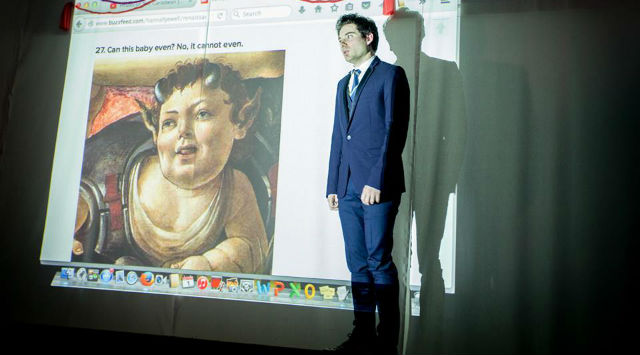
Art can find a way to represent the state of our collective consciousness as it stands, so that we may achieve an understanding of life, while remaining embroiled within. They’ve Already Won is about the now, and how individuals in societies such as ours, deal with the new face of media and its pervasiveness. It explores the interactivity of technology, and exposes the nature of our participation in the digital world, with all its anxieties and intellectual challenges.

As barriers to information and truth begin to crumble, we are forced to encounter pessimism like never before. Harriet Gillies and Pierce Wilcox’s play is about the way we respond to this incessant profusion of bad news arriving through all our screens, and how it dominates and shapes our culture as it stands today. The show addresses us directly, beginning almost like a lecture with Gillies orchestrating visual projections and sound cues, and Wilcox gesturing to illustrate their assertions, but thankfully, things turns increasingly fluid in style as they proceed. The work is beautifully considered and idiosyncratic, with rich content that will ring true and provoke. There are unusual and refreshing modes of expression in its staging, with a string of amusing scenes and surprising concepts. Execution of ideas could be more polished, but the production is ultimately an impressive one that offers a generous serving of food for thought.

They’ve Already Won can be seen as a political work, but it also allows us to be apathetic. It accurately reflects the confusion of modern life, revealing to us that the more we know, the less we know what to do. It is a feeling of helplessness that co-exists with a passion for betterment, an everyday duality that pulls in different directions. We can leave the show determined to be unfazed, but reality is tumultuous and we will be moved regardless.

www.belvoir.com.au

Review: Mortido (Belvoir St Theatre)

belvoirVenue: Belvoir St Theatre (Surry Hills NSW), Nov 7 – Dec 23, 2015
Playwright: Angela Betzien
Director: Leticia Cáceres
Cast: Toby Challenor, Tom Conroy, Colin Friels, Louisa Mignone, Renato Musolino, David Valencia
Image by Brett Boardman

Theatre review
At the centre of Angela Betzien’s Mortido, is a wretched life. Jimmy is a soft and kind soul, misguided by family and exploited by every person he trusts. Emerging into adulthood from a background of poverty and addiction, the only barometer he possesses for a better life is a need for acceptance, along with our definitive measure of success, money. Without the support of anyone who has Jimmy’s own interests at heart, and with no education to speak of, his fate is sealed, and doomed. The story is a dark one about the underbelly of Sydney, and how our affluence is built upon the perpetuation of an underclass, kept aspirational and concurrently ignorant.

Betzien’s script is highly ambitious and vast in scope. It encompasses themes of family, money and addiction, set against historical contexts, to explore attitudes and machinations of our current sociopolitical environment. The play looks at our problems with narcotics and poverty from micro and macro perspectives, refusing to diminish their complex enormity for convenient storytelling. What results is a piece of writing that is detailed and intricate, but also challenging, for audiences and theatre makers alike.

Director Leticia Cáceres does well at providing the production with tension and intrigue, but the plot’s clarity suffers from that tautness of pace. In its second half especially, too much is revealed too quickly, and our minds struggle to process every poignancy. Each revelation is an important one that contributes, not only to our appreciation of each character’s circumstances, but also to our understanding of the real world. Many of the story’s elements will resonate deeply if given the chance, but the show seems to rush quickly past and we are left wondering if we had learned everything that is worth knowing.

Nevertheless, Mortido is gripping, and very exciting, with each scene holding surprises, frequently overwhelming with its keen portrayal of brutality, both physical and psychological. Composer The Sweats and Sound Designer Nate Edmondson do exceptional work with their manipulations of atmosphere. The production relies heavily on its sounds to control our responses, and the precision at which it guides our emotions through every sequence and transition is remarkable. A disappointing contrast does occasionally occur however, when it takes a back seat, leaving the actors to their own devices, and we begin to feel the emptiness of space.

There is plenty of impressive acting to be found, including the very young but very compelling Toby Challenor, whose immovable focus on each task in every appearance, belies his tender age. Colin Friels plays several disparate characters, displaying a good level of versatility and enthusiasm, but is probably most effective as Detective Grubbe and El Carnicero. The star’s presence is undeniable and the intensity he brings to the stage has an effortless drama that is absolutely captivating. The central character Jimmy is performed by Tom Conroy with a faultless vulnerability. For all of Jimmy’s regrettable mistakes, we are always on his side, hurting for his every adversity and hoping that a twist of fate appears. Conroy excels in the role, successfully depicting Jimmy’s personal difficulties as well as the social connotations of a problematic life. We understand the responsibilities that are due young people like Jimmy, and realise how we have failed those who share his disadvantage. Also noteworthy is David Valencia as the enigmatic Spanish-speaking El Gallito, memorable for his simultaneous delivery of danger and ethereality, and an aggressive sex appeal that electrifies the stage.

The title of the work refers to our human tendencies toward self-destruction. It is a discussion about weakness, and along with that, we encounter ideas surrounding ethics, responsibility and social harmony. Mortido is a cautionary tale about the seduction of death, and the perils involved when allowing lives to be less than honourable. It confronts the inequity that exists in our wealthy cities, and our complicity in maintaining that damaging status quo. We can always identify good from bad, but we do not always make the right decisions.

www.belvoir.com.au

Review: Ivanov (Belvoir St Theatre)

Venue: Belvoir St Theatre (Surry Hills NSW), Sep 19 – Nov 1, 2015
Playwright: Anton Chekhov (adaptation by Eamon Flack)
Director: Eamon Flack
Cast: Fayssal Bazzi, John Bell, Blazey Best, Airlie Dodds, John Howard, Ewen Leslie, Zahra Newman, Yalin Ozucelik, Helen Thomson
Images by Brett Boardman

Theatre review
The word is not explicitly mentioned in Eamon Flack’s adaptation, but his Ivanov shows all the signs of a modern man deeply depressed. He is unable to work, and everything seems to be a source of anxiety. As an educated man of some social standing, Nikolai Ivanov is expected to do better, and everyone waits for him to get his act together. Nikolai himself blames no one else for his predicament, although it is clear that his disdain for things are beyond the personal.

We think about depression today increasingly as a medical condition pertaining to the individual. Circumstances and environment are diminished in importance, and one is required simply to find ways and means to weather the harsh realities surrounding themselves, or to accept the inherent deficiencies of one’s constitution. We no longer talk about the problems of society and their effect on persons. In Flack’s Ivanov, we are encouraged to examine the world in which Nikolai lives, and in our impatience for him to buck up, to also consider if there is anything indeed that would make his life truly worthwhile. Flack’s version is authentically pessimistic, but full of comedic power. Its laughter comes from the sad and absurd elements of life, with attention paid closely to the elements that control us. It discusses government and the economy, money and property, marriage and family, and the strain of masculinity, all troubling aspects that Nikolai has to deal with, and that are perversely familiar to us.

The show’s tone is surprisingly farcical, with a unique sensibility that straddles both Australia and Russia. It is a make believe time and space, with language that freely traverses geography and genre, but it rings true at all points. The places might be strange and the characters equally foreign, but we know the themes, and the play speaks sensitively and coherently through Chekhov’s now antiquated scenarios. The production is designed with intelligence, sophistication and flair. Michael Hankin’s set is immediately evocative, but also cheeky with symbols that add significantly to its overall and ubiquitous social commentary. As director, Flack’s ability to make every scene come to life ensures that the show is as emotionally engaging as it is thoughtful. Each character is exuberant and distinctive, and their exchanges are frenzied with fire and chemistry. Their stage is a thoroughly playful one, and we cannot resist pouring ourselves into their carousal, even if it is mad and miserable. Music and songs by Steve Toulmin and Francis Merson are party to much of that delirious energy.

It is a formidable cast, with memorable performances from all nine actors. The title role by Ewen Leslie is suitably angsty and frustrating, and he rumbles with extravagant drama at each of his key revelatory moments. The actor is also able to tame his darkness for many of the show’s amusing sequences, for a finely balanced portrayal of a man disintegrating in the middle of a riotous comedy. Blazey Best and Helen Thomson play obnoxious women of means, taking the opportunity to present offensively loud personalities in brilliant displays of sublime but exaggerated humour (wonderfully supported by Mel Page’s outrageous costuming). John Bell and John Howard turn up the charm with characters that are as flawed as they are endearing, transforming significant imperfections into figures of palpable humanity. The superb quality of acting in Ivanov is theatrical magic. Inspiring, uplifting and poignant, it takes Chekhov from history to tangible, and in this rare episode, provides an interpretation that exceeds our expectations of the master’s bequeathed words.

Chekhov had a definite interest in firearms and suicide. In any reflection of life, its opposite will always be implicated. In thinking about death, especially suicide, we are made to consider the decisions to remain alive. If that discovery of life’s meaning is elusive, then the mystery of how we stop from killing ourselves becomes potent. Nikolai reads a lot, and the more that he knows, the closer his gun is held. In Ivanov‘s world, ignorance is bliss, and pessimism struggles to find relief. Fortunately, hope is independent of reason, and we persist albeit devoid of certainty and replete with insecurity.

www.belvoir.com.au

Review: La Traviata (Belvoir St Theatre / Sisters Grimm)

Venue: Belvoir St Theatre (Surry Hills NSW), Aug 27 – Sep 20, 2015
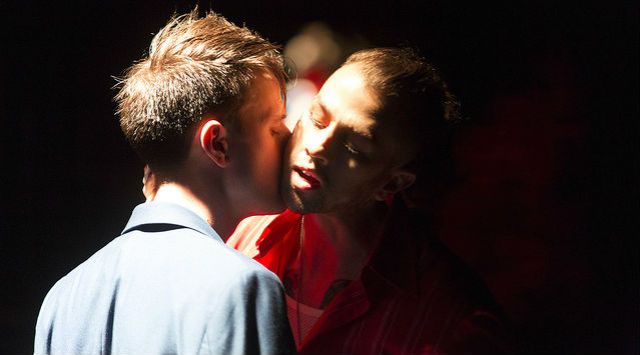
Creators: Ash Flanders, Declan Greene
Director: Declan Greene
Cast: Ash Flanders, Emma Maye Gibson, Michael Lewis, Zindzi Okenyo
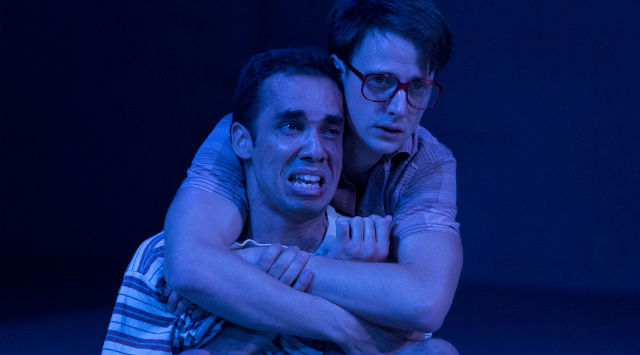
Images by Patrick Boland

Theatre review
Giuseppe Verdi’s opera La Traviata is about love and money. In Ash Flanders and Declan Greene’s radical re-imagination, a third theme of art is added to create a work of theatre that moves emphasis away from sentimental indulgence, to something that is altogether more contemporary, and intellectual. The exploration of ideas becomes an explicit one. Through five separate sequences, we are encouraged to think about our economy and consider the extent to which our lives are required to be commodified in order to survive, or at least to be able to find justification for our social existences.

Flanders and Greene are interested in the problems of thinking about art as product, and in their attempt to determine what it is that gives art a sense of value, a series of funny but thoughtful scenes are created. Each one a different genre, their presentation also addresses the clichés of art reflecting upon itself, and the difficulties in producing anything original, especially within this contemporary and introspective concept. The same operas are staged every year, yet artists are pressured to be innovative, and in our current political climate, the capitalistic ideal of “excellence” is applied to art in an attempt to understand and indeed, control how artists do their work. These absurdities are effectively, and entertainingly, encapsulated in Flanders and Greene’s show. Each section is executed with charm and sharp humour, but the transitions between them are not always managed with the same amount of flair. One also questions the straightforward division of scenes, which comes across too simple and convenient. The fourth sequence involves a question and answer format that aims to perform a sort of “reality” genre that accurately depicts the state of communications today, but the discussions demystify the abstractions that had come before, and the transformation of what was ephemerally beautiful into plainer terms is unfortunate. Perhaps a statement is made about the diminishment of romance and mystery in our lives, but it is an ironic and disappointing loss.

Greene’s talent with aesthetic and atmosphere is a drawcard of the production. Along with designers Marg Horwell (set and costumes), Matthew Marshall (lighting) and Steve Toulmin (music and sound), this overhaul of La Traviata is a consistently fascinating one, particularly at its more classically operatic moments. There is a strong desire for the work to connect, which often results in an appealing brashness that matches its quite madcap humour. It takes every opportunity to express itself with flamboyance and extravagance, but unlike the lavish operas at bigger venues, its sensibility is firmly anti-establishment. Quirky and queer, the world it creates is adventurous, dynamic and consistently idiosyncratic, with compelling symbols that interrogate our imagination and delight our eyes and ears. Performers Emma Maye Gibson and Michael Lewis leave an impression with their accomplished voices late in the piece, surprising us with morsels of operatic singing that we had all but given up expecting. It is a strong cast, each with solid presences and a confidence in their material that helps us appreciate the topics being dissected. In the absence of narrative, their cohesion in energy and comedy styles gives the show its compelling driving force.

Our hero Violetta chooses love over money at every stage of her life story. There is never a hint that money could ever mean more than her one true love. The sacrifices she makes for Alfredo eventually destroys her, and although we observe in sadness her tragic death, the profound meanings of integrity and truth emerge clearer than ever. Death pales in comparison to passion. When one is able to identify the greatest love of all, life is worth living.

www.belvoir.com.au | www.sistersgrimm.com.au

Review: Seventeen (Belvoir St Theatre)

Venue: Belvoir St Theatre (Surry Hills NSW), Aug 1 – Sep 13, 2015
Playwright: Matthew Whittet
Director: Anne-Louise Sarks
Cast: Peter Carroll, Maggie Dence, John Gaden, Genevieve Lemon, Barry Otto, Anna Volska
Images by Brett Boardman

Theatre review
It is the last day of school, and five seventeen year-olds are celebrating the milestone with great happiness and too much booze. Performed by actors in their seventies, the play promises to offer refreshing perspectives of a rite of passage that most of us are familiar with. Matthew Whittet’s script for Seventeen explores teenage life at its later stages, when adolescents begin to think about the future, and the choices they inevitably have to make. The writing’s approach is a gentle one that shows a mainstream idea of youth that does not use its characters to shock or sensationalize. The group seems thoroughly regular, and it is worthwhile giving them a voice, without requiring them to be controversial or achieving anything particularly extraordinary or dramatic. Their concerns and interests are revealed with honesty, and the play derives its dynamism from the colourful optimism of its teenage personalities, but challenges exist in dealing with what is essentially quite pedestrian experiences. The text has enough vibrancy and surprises peppered through its plot, but if it is to be performed by age appropriate actors, one can imagine the work to lack a sense of theatricality, and come across too ordinary. If casting much older players is the only way the play gains its edge, it can be interpreted that the manoeuvre is somewhat gimmicky, but the production does manage to use the age discrepancy in fascinating ways at many points.

The comedic components of the show are effective and very memorable. Watching these seniors mimic the physical and verbal expressions of persons much younger is a joy, and we never tire of the immediate and awkward juxtaposition of behaviour against body, young against old. Director Anne-Louise Sarks introduces that humorous sense of contemporariness into much of the piece, and the cast executes them with triumphant results, no matter how juvenile or, at times, embarrassing. Less successful however, are the many scenes of quite serious conversations in the latter half, where its characters indulge in romantic squabbles, and the performances loses its ironic charm. The tone of the show turns earnest, and as it moves away from comedy, it simultaneously loses energy and tension, and the strong focus placed on puppy love shifts the production from a thoroughly amusing one, to something altogether less involving.

At the centre of Seventeen is a meditation on how we conceive of the future, at different stages of life. A particularly moving scene involves Tom declaring his feelings about leaving his town and his friends, at the conclusion of his high school education. Actor Peter Carroll performs the scene with outstanding sensitivity and intuition, communicating the duality of his character’s sadness, and the undeniable poignancy of an older man saying goodbye to the mortal world. Carroll’s power on stage comes not only from his ability to tug at our heartstrings but also from his amazing agility that defies our beliefs about ageing. Equally magnetic is Barry Otto as the kooky and childlike Ronny, a character on the periphery, unpopular but undefeated, always exuberant and full of kindness. The role needs better integration into the play’s main narratives, but his presence is a touch of innocent tenderness that provides a balance to the boisterous and libidinous goings on that gives cohesion to the stories. Genevieve Lemon plays the very cheeky and adorable fifteen year-old Lizzy with expert comic timing and a very pronounced stage presence. We welcome each of her entrances and anticipate every one of her hilarious punchlines.

Time may not always be linear, but in Seventeen, we are reminded that turning back the clock is impossible, and that the desire to do so, is misguided. The elderly are able to contribute so much to society that cannot be matched by the young. Of course, the reverse is also true, but wisdom that comes from age and experience cannot be replaced or surpassed. What we witness in the show are stories about the very immature of our communities, presented by a group with centuries worth of combined insight and intelligence. They do not say very much more than what is asked of them, but we are glad to have them in our midst, putting on display their talent and skill, all for our benefit.

www.belvoir.com.au

Review: Mother Courage And Her Children (Belvoir St Theatre)

Venue: Belvoir St Theatre (Surry Hills NSW), Jun 6 – Jul 26, 2015
Playwright: Bertolt Brecht (translated by Michael Gow)
Director: Eamon Flack
Cast: Paula Arundell, Tom Conroy, Lena Cruz, Michael McStay, Alex Menglet, Arky Michael, Robyn Nevin, Anthony Phelan, Richard Pyros, Hazem Shammas, Emele Ugavule
Images by Heidrun Lohr

Theatre review
It cannot be denied that war is a part of human nature. We can certainly imagine a world with no battles, but history proves that it is in fact inevitable, that people will fight, over religion, money and land, no matter how catastrophic the results may be. We are however, resilient and optimistic, with a survival instinct that does not easily give in to threats and destruction. Bertolt Brecht made the association between capitalism and war, in his seminal work Mother Courage And Her Children, first staged in 1941, during the Second World War. It is concerned with decisions made by individuals in the face of social upheaval at wartime, and characteristically, Brecht had aimed to encourage a specific way of thinking through the play.

Politics is always crucial to discussions and renderings of Brecht’s legacy. He made theatre with the intention of influencing his public about contemporary issues, and whenever productions are materialised today, it is still imperative that a political message is at the core of whatever transpires. Story and politics are intimately bound, and for Brecht’s writing, separation is quite impossible. Michael Gow’s translation provides a newer cadence to the text, but the poetic style of language requires a delivery that is sensitive to the ears of its audience, and the production fails to find a way to connect with our sensibilities and emotions.

Eamon Flack’s direction leaves us confused for long stretches of the show, with unclear depictions of characters, timelines and narratival details. There is a good focus on theatrics, which provides an energetic and colourful atmosphere, but we are never quite certain what the plot is trying to reveal. The iconic use of Brechtian placards are sorely missed in our periods of perplexity. The players engage confidently with each other, and their presences feel authentic, but not enough effort is put into including us in their interactions, which means that we are never able to gain insight into how and why things are happening. The experience is frustrating as events on stage often seem interesting, but we only have access to surfaces. The lack of depth in our understanding, coupled with an emotional detachment makes it increasingly challenging to pay attention as time passes. At 150 minutes, our commitment to participate as an engrossed crowd is thoroughly tested.

Performances in the piece have a quality of confidence and gravity that give the production an unmissable polish. The cast, including leading lady Robyn Nevin, seems well-rehearsed and they rise to the challenge of a show with complex transformations and frequent scene changes that can be wildly different in tone from one another. For the entire duration, the actors are in powerful command of all that happens on stage, even though they rarely create significant impact beyond that periphery. Speech is presented in a naturalistic manner, which is inappropriate for a script that is quite dense and florid. Without sufficient assistance with nuances of the writing, the lines seem to hurry past our consciousness, and characters begin to sound as though mumbling throughout their lives. Paula Arundell leaves the strongest impression in her role of Yvette, with an appealing vivacity that communicates more than the others. Arundell seems to project her portrayal with greater specificity to allow for audience connection, resulting in one of the more successful elements of the production.

It is an expertly designed show, with Benjamin Cisterne’s lights and Robert Cousins’ set creating both an air of theatrical fantasy and wartime grittiness via a surprising minimal approach. That sophistication extends to Stefan Gregory’s delightfully intricate music compositions, which are probably the greatest achievement of this staging. Evocative of Brecht and Kurt Weill’s distinctive style, each interlude provides an opportunity for us to focus on the state of minds and affairs being explored, as they find articulation at a more lyrical pace.

We are in the midst of war when our governments and communities identify explicit enemies, whether asylum seekers, terrorists, paedophiles or drug dealers. As individuals in democracies, our ethical standpoints must always be examined. Bad things happen when good people do nothing, or if they submit to dominant ideologies that are unconscionable. We live in a time where dubious ethics are encouraged, in the name of things like nationalism, or the profit motive. Capitalism can provide an excuse for unjust behaviour, and fabricate permission for bad things to happen. Mother Courage should not be a divisive personality, but on this occasion, we cannot be sure that the right message is consistently delivered, or whether the spectators can even be concerned at all for the moral of her story.

www.belvoir.com.au