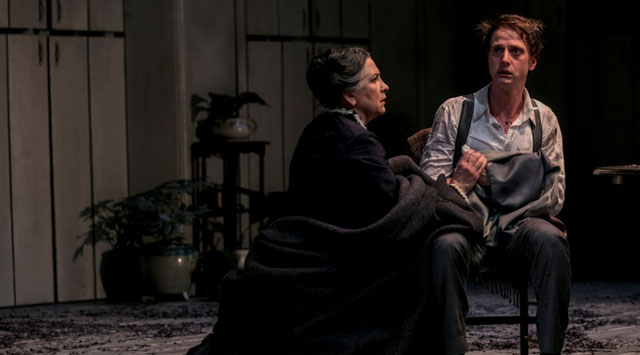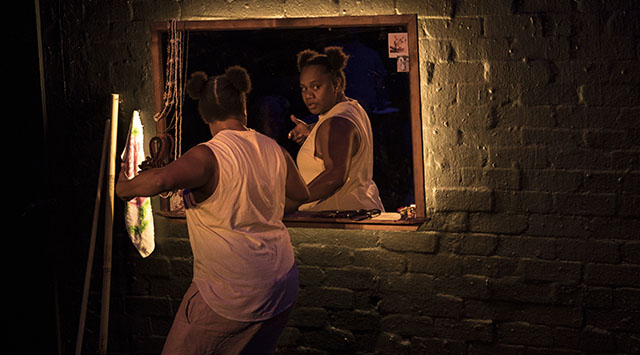
Review: My Urrwai (Belvoir St Theatre / Performing Lines)

Venue: Belvoir St Theatre (Surry Hills NSW), Jan 19 – Feb 4, 2018
Playwright: Ghenoa Gela
Director: Rachael Maza
Cast: Ghenoa Gela
Image by David Charles Collins

Theatre review
Ghenoa Gela is a Torres Strait Islander born in Rockhampton. Efforts to keep culture in her veins have always been deliberate and laborious; it is a constant battle for Indigenous Australians to resist colonisation and to retain their own identities. In My Urrwai, Gela shows us what it is like to be a woman of native heritage living in modern Australia, bringing particular focus to the unjust burden that black people have to bear, whilst existing on their own rightful lands, that white people had forcefully usurped.

Part of the tale involves a significant first visit to Gela’s extended family in the Torres Strait Islands, where she finds herself in moments of alienation, as well as extraordinary connection. My Urrwai is, among many things, a deep meditation about the need to belong, and with it, we examine the hugely important themes of displacement and repudiation as experienced by our First Nations peoples for 230 years and counting.

Formative and crucial fragments of Gela’s life are compiled intelligently, for an autobiography that feels impressively comprehensive in its scope. Even though My Urrwai does contain colourful idiosyncrasies, the earnest care with which it discusses issues of race is unmistakable, as it is probably inevitable that this one-woman show would be called upon to represent entire communities. The need for more productions featuring Torres Strait Islander voices, simply cannot be overstated.

As performer, Gela is an outstanding talent, combining years of training in stage disciplines, with an enviable presence, to produce the consummate storyteller. Her remarkably exacting and agile physicality, plus an uncanny ability to speak with great resonance, sonorous and philosophical, are the key ingredients in this wonderfully moving piece of theatre. Proving himself to be equally accomplished, is lighting designer Niklas Pajanti, whose work accurately prompts a wide range of emotional responses, from transcendent beauty to chilling terror. Director Rachael Maza’s sensitive manipulations of space, ensures that each scene is received crystal clear, whether in their inception, intent or purpose.

Unlike most plays we see on the Australian stage, My Urrwai is conscientious about acknowledging the multicultural aspect of our audiences. It understands that we do not all come from the same place, even if we do wish to identify as one. It is welcoming of all peoples, but it certainly does not subordinate those whose culture is on display. The ease with which it addresses Torres Strait Islander viewers, and its ability to establish a theatrical language that rejects white experience as the centre of all our orbits, is admirable. The process of decolonisation in how we do and think about art in Australia is a massively difficult one, but Ghenoa Gela and My Urrwai are jubilant rays of hope, undeniable in their brilliance.

www.performinglines.org.au | www.ilbijerri.com.au | www.belvoir.com.au
Review: My Name Is Jimi (Belvoir St Theatre / Queensland Theatre)

Venue: Belvoir St Theatre (Surry Hills NSW), Jan 5 – 21, 2018
Playwrights: Jimi Bani, Jason Klarwein
Director: Jason Klarwein
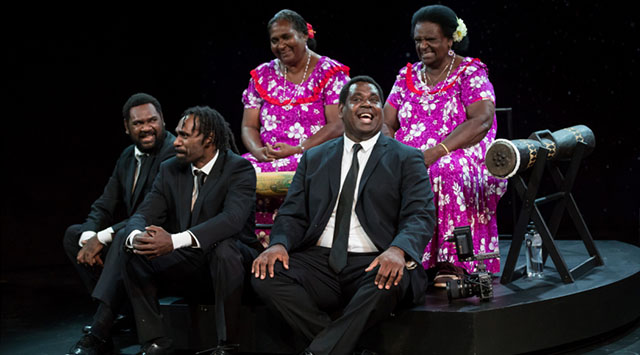
Cast: Dmitri Ahwang-Bani, Agnes Bani, Conwell Bani, Jimi Bani, Petharie Bani, Richard Bani
Image by Daniel Boud

Theatre review
Jimi Bani hails from Mabuiag Island, in the near Western part of Torres Strait. His show My Name Is Jimi, is about culture and tradition, and the resolve to keep the uniqueness of his Wagadagam tribe alive and thriving in the modern age. True to form, the production features performers from his own family, across four generations, illustrating the essence and the importance of what is being relayed.

Small communities are always at risk of losing their identity. The young is seduced by external forces, through cultures of technology and consumption determined to establish a conformity, as required and dictated by Western capitalism. We see Jimi’s son Dimitri devouring the smartphone like any other youth, gradually losing touch with the real kinship that surrounds him.

Ambitiously directed by Jason Klarwein, the work is complex and detailed with its depictions. We learn not only what it is, that Jimi is keen to preserve, but also why and how these traditions have come to be of such value. Folklore and dance feature prominently, to inform and to entertain, but perhaps most importantly, as a demonstration of ancestral pride. There is exquisite humour in the piece, alongside its inherent warmth and poignancy.

Jimi Bani’s naturally commanding presence wins us over from the get-go, allowing us to empathise with his story effortlessly, even though his circumstances are admittedly far removed from many of our daily realities. Dimitri shares his father’s humour, delivering memorable moments of comedy. Agnes and Petharie are the senior women providing music, in ethereal, glamorous and dignified fashion. Conwell and Richard are Jimi’s brothers, appropriately sharing the weight of the show, as nimble sidekicks, particularly effective with their live camera work for filmic projections called upon to represent legends of the land. Especially noteworthy is Justin Harrison’s work as sound and projection designer, beautifully transcendent and crucial to the success of My Name Is Jimi.

Family can mean different things to people, but there is no denying the emotional hold it can have over each of us. Watching Jimi and his loved ones cultivate their extraordinary closeness, is reassuring, but also challenging to those who seek a radical independence in today’s climate of rationalism. It is now normal in many societies, to find definition for the self as an entity distinct from practices of the past, especially when one identifies weaknesses and problems associated with those customs. Jimi’s emphasis on language however, is noble and inspiring. Words contain so much, and they allow us to connect with histories when we choose to. Times will change, but forgetting the past, will only hamper any effort to progress. As we seek to become better, a link with earlier experiences is invaluable. Talking with those who had come before necessitates a bridge, and understanding cultures, especially one’s own, is often more rewarding than we can imagine.

www.queenslandtheatre.com.au | www.belvoir.com.au

Review: Barbara And The Camp Dogs (Belvoir St Theatre)

Venue: Belvoir St Theatre (Surry Hills NSW), Dec 2 – 23, 2017
Playwrights: Alana Valentine, Ursula Yovich
Director: Leticia Cáceres
Cast: Troy Brady, Elaine Crombie, Jessica Dunn, Michelle Vincent, Debbie Yap, Ursula Yovich
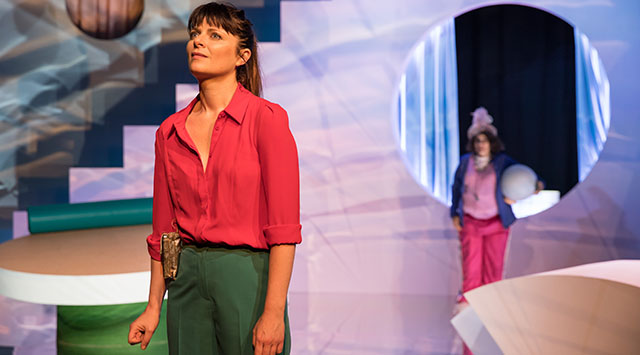
Image by Brett Boardman

Theatre review
Barbara has a lot of fun in the city, singing at bars and events, being independent and vivacious. She is a mischievous character, and together with her cousin René, they paint the town red on the regular, determined to devour all that life has to offer, and to escape the troubling roots of their outback origins. Barbara And The Camp Dogs by Alana Valentine and Ursula Yovich, falls into categories of the musical and the epic journey, but it is a consistently surprising ride that defies all manner of expectations.

Barbara does well in life, but as an Aboriginal woman, the scars that she carries are deep, agonising and easier left ignored. When she finds herself having to return home to fulfil her filial obligations, all that she tries to deny, come flooding back to taunt her. The play expresses the nature of that immense suffering, with extraordinary acuity. Barbara and René sing, because so much of Indigenous experience is beyond our usual capacities of speech. In Barbara And The Camp Dogs, we are able to connect with the injustice and pain that have become entrenched in Black Australia. It divulges with power and wit, through its songs and storytelling, the darkest, most hidden of many Indigenous women’s lives.

It is impossible to overstate Jessica Dunn’s achievements as musical director. Barbara’s secret inner world turns intimately palpable, via influences of rock and soul, for a mode of communication sublime in its startling veracity. The songs move us as though a spiritual entity has taken hold. We are guided from scene to scene, with emotional intensity, precise and lush at every juncture.

Director Leticia Cáceres imbues the show with a warm glow, enchanting and irresistibly alluring. Everything about Barbara And The Camp Dogs is designed to have us fall in love with its characters and their narratives, and we endear to it all, readily and completely. There are occasional instances of abruptness in the transition of scenes, that can be slightly disorienting, but the raw aesthetic of the production is a forgiving one. Moreover, any blemishes would be easily shielded by the show’s incredibly charismatic stars.

The sensational voices and effervescent personalities of Ursula Yovich and Elaine Crombie win us over effortlessly, from the very beginning. The harmony forged between the two is a delight to our ears and to our hearts; what they present is wonderfully tender and exceptionally real. Yovich in particular, moves us in the most profound but unexpected ways. Telling us Barbara’s story of intolerable suffering, is not for a moment of catharsis, but a lasting gift of inspiration. We observe and learn, and promise to do better, to do more.

Barbara is not a social justice warrior. She is not a conscious activist, but she has to fight every day of her life, to defend herself against structural forces determined to keep her down. Australia’s shameful history of genocide, originating from the illegitimate claim of terra nullius in 1788, has reverberations that remain cruel and potent in the twenty-first century. A semblance of equality is not sufficient to heal these dreadfully severe wounds. Meaningful reparations will cost, but they must be made.

www.belvoir.com.au

Review: Atlantis (Belvoir St Theatre)

Venue: Belvoir St Theatre (Surry Hills NSW), Oct 28 – Nov 26, 2017
Playwright: Lally Katz
Director: Rosemary Myers
Cast: Paula Arundell, Lucia Mastrantone, Amber McMahon, Hazem Shammas, Matthew Whittet
Images by Daniel Boud

Theatre review
Lally Katz’s Atlantis is an autobiographical fantasy. It sprouts from the personal and authentic, then leads to something entirely imaginary. Lally, the protagonist, is consumed by anxiety, when at 35, she finds herself single and childless. We follow her on an odyssey that takes her from Sydney, to the USA’s east coast; an eventful, wacky journey that comprises a string of amusing characters and incidents. Lally goes through many discoveries, fuelled by a desperate search for love, or at least a husband and a baby.

It is not a quest that all will find persuasive. The deliberately silly scenes in Atlantis are certainly a lot of whimsical fun, but the central disquiet that motivates all the action seems too trivial, perhaps even narcissistic, to allow us to invest in a meaningful way. Through the plot, Lally comes in contact with more worthy concepts, of climate change, of poverty and of mortality, but they affect her only momentarily. We can all see that her problems diminish in significance as time passes, but nonetheless, Lally persists. She must find a man to fall pregnant with, or she simply cannot go on.

Amber McMahon plays a juvenile, although very likeable, version of the playwright. As though in a pantomime, McMahon’s exaggerated effervescence proves to be captivating, as she keeps us attentive through the highs and lows of Lally’s stories. The production is unquestionably humorous, directed by Rosemary Myers with a relentless sprightliness that offers entertainment and laughter, even when the narrative turns tiresome. Four other actors are called upon to perform a big roster of small roles, and they are all remarkable. The infinite versatility of the ensemble astounds us, with what they are able to achieve through sheer inventiveness. Also noteworthy are Damien Cooper’s lights and Jonathan Oxlade’s set, creating exciting images full of colour and movement, increasingly mesmerising as the show turns hopelessly hallucinatory.

Like in all our lives, the promise of a utopia propels the action in Atlantis. We need to believe in something, like that pot of gold at the end of a rainbow, in order that we can set ourselves in motion, so that we can fill time with meaning. Lally Katz does so much in the play, through all its scenes of mischievous adventure, but we see her being neglectful of each moment, keeping her mind focused instead on a puerile objective. When there is joy surrounding us, we must take notice and take pleasure in it. Better days will come, but understanding that they have a propensity to surprise us, and learning to see the signs that wish to evolve us, is how we can experience the magical unpredictability of this existence.

www.belvoir.com.au

Review: Ghosts (Belvoir St Theatre)

Venue: Belvoir St Theatre (Surry Hills NSW), Sep 16 – Oct 22, 2017
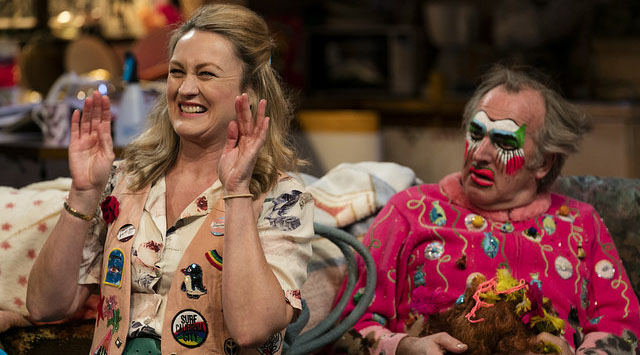
Playwright: Henrik Ibsen (adapted by Eamon Flack)
Director: Eamon Flack
Cast: Tom Conroy, Taylor Ferguson, Robert Menzies, Colin Moody, Pamela Rabe
Image by Brett Boardman

Theatre review
It is late 19th century, and the widowed Mrs Alving is building an orphanage so that her dead husband’s money can be released from her conscience. She is still unable to find peace, even though her poisonous marriage is now over, after having suffered in silence for decades. Ibsen’s Ghosts is about the incontrovertible links between past and present. It looks at how we are controlled by beliefs, events and decisions of days gone by, and the unconscious ways in which we keep ourselves and one another bound to societal rules and conventions.

Mrs Alving understands that a better life is possible, yet she persists with misery. Director Eamon Flack prompts us to question the nature of our protagonist’s volition, whilst simultaneously placing emphasis on external forces that insist on her compliance. From all our personal experiences, we know the tension that lies inevitably between others and the will of the self. The concept of a self-determined existence is an attractive one, even though none of us can lay claim to have fashioned an entirely independent state of being.

Ghosts is an inherently challenging work, and with the passage of time, its narrative has turned predictably archaic, leaving only its central philosophies to speak with pertinence. Tradition and religion no longer hold the same power, so the Alving family’s story is in many ways only a relic, but Flack’s ability to turn the essence of Ibsen’s writing into a resonating force for his show, is certainly admirable.

Pamela Rabe’s performance as Mrs Alving has an understated charm, that shifts the play’s old melodramatic quality to something that is altogether more elegant and naturalistic. It is quite extraordinary, the way Rabe sublimates obsolete details into her very convincing storytelling. All the actors are worth their salt, successful in bringing invigoration and surprising nuance, to some very dry material. Equally remarkable are Nick Schlieper’s lights, especially noteworthy in the final act, when imagery turns breathlessly sublime, and we see baroque paintings come to life.

Artists need knowledge of the past, in order that they may forge new ground, but like characters in Ghosts, their work is constantly under threat of being undermined by the reverence we so often attribute to the historical. The continual resurrection of dead white males like Ibsen can be considered necessary, but it can also be thought symptomatic of problems that the Australian artistic landscape faces. Our art means little if it hinges so strongly on traditions of olden Europe. The Alving patriarch might be dead and buried, but those he had left behind are doomed to perpetuate his agony. We want them to renounce those burdens and henceforth, prosper with the current of their own autonomy, but it seems easier said that done.

www.belvoir.com.au

Review: Hir (Belvoir St Theatre)

Venue: Belvoir St Theatre (Surry Hills NSW), Aug 12 – Sep 10, 2017
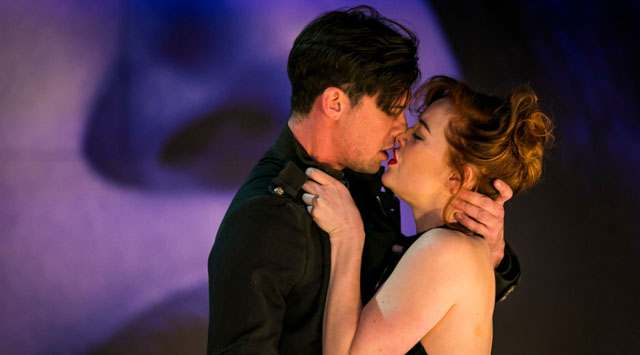
Playwright: Taylor Mac
Director: Anthea Williams
Cast: Kurt Pimblett, Greg Stone, Helen Thomson, Michael Whalley
Image by Brett Boardman

Theatre review
Paige is suddenly emancipated. By a stroke of luck, her abusive husband Arnold has turned invalid, revealing a fortuitous way out of misery. She revels in her new freedom with a maniacal glee, and together with her now transgender son Max, their household is transformed to radically embrace every concept of anti-patriarchy that they come across. Taylor Mac’s Hir is a revenge story, centring on a protagonist who tries to find independence and a better life by subverting prevailing notions of gender, the very thing she identifies to have been responsible for her adversities.

The play is uproarious, with Paige in various states of hysteria, desperately seeking redefinition for her existence. The action begins when her elder son Isaac, having been dishonourably discharged from war, returns to the deliberate chaos at home (set design by Michael Hankin is remarkably mirthful). Unable to come to terms with the shock of the new, Isaac attempts to restore the old order, and things quickly escalate. We watch Paige being confronted by her position as mother and wife, as she persists with the project of queering everything, and are enthralled by the brutal tenacity at which she sticks to her guns, in a face off with a past she is determined to be rid of. It is a wild premise that the playwright establishes, and the ride that we get taken on, is as emotionally powerful as it is entertaining, all the while maintaining a level of intellect that many will find irresistible.

It is a spectacular production, painstaking in the way its progressive, and sometimes obscure, ideas are interpreted with brilliant lucidity, to be presented alongside some thoroughly enjoyable comedy. Director Anthea Williams brings to the piece, a boldness of spirit, that allows its controversial qualities to speak poignantly and persuasively. Hir is political theatre, unapologetic in its desire to make an impact on the way we think.

Playing Paige is the absolutely scintillating Helen Thomson. The actor is gloriously funny, with perfect timing and faultless instincts that have us hopelessly captivated. A portrayal of a woman reclaiming space, strength and sovereignty, Thomson is commanding and, when required, vulnerable. She is called upon to make some very extreme statements about womanhood, and although not to everyone’s tastes, the way she delivers each audacious proclamation, is beyond gratifying.

If Paige finds the answers she wants, she will discover that it is not necessarily happiness, but a heavy burden that she will encounter, when living a life of integrity and enlightenment. When we reject conventions and systems that are unfairly stacked against us, we are guaranteed only honesty and liberation. To not expect hardship is foolish. In the struggle against deceit and inequity, fulfilment when derived, is often more painful than joyous. It is how the bastards keep us dishonest, by issuing modicums of petty bribery that offer an illusory sense of security and comfort, so that we maintain the eternally exploitative status quo. In cases when a straw does break the camel’s back however, a woman scorned will unleash a fury of mythical proportions, to seek redress and to aggravate for a revolution.

www.belvoir.com.au

Review: The Rover (Belvoir St Theatre)

Venue: Belvoir St Theatre (Surry Hills NSW), Jul 1 – Aug 6, 2017
Playwright: Aphra Behn
Director: Eamon Flack
Cast: Gareth Davies, Andre de Vanny, Taylor Ferguson, Leon Ford, Nathan Lovejoy, Elizabeth Nabben, Toby Schmitz, Nikki Shiels, Kiruna Stamell, Megan Wilding
Image by Anna Kucera

Theatre review
It is mid 17th century, and a bunch of rowdy English tourists descend upon Naples to partake in the masqueraded festivities of Carnival time. Aphra Behn’s depiction of wild revelry may be restricted by mores of the Restoration era, but its spiritedness is nonetheless unmistakable. In its atmosphere of debauchery, the characters talk of love and marriage, preoccupied with the sport of spouse hunting.

The play is conventional, but as the production’s prologue asserts, we cannot ignore Behn’s position as England’s first woman playwright, or the feminine perspective that her work brings to the stage. Although women are again, and literally, divided into virgins and whores in The Rover, they each act with agency, and their desires are provided due significance. Whether nuns or courtesans, we always know what it is that they want for themselves, and we watch them going about procuring what are essentially self-determined lives.

Director Eamon Flack delivers a thoroughly enjoyable work of high octane comedy, playfully inventive in approach, and unabashedly raucous with its expressions. Details can become confused, as the show’s humour takes first priority, but narratives are of slight importance in a show of this nature. It dazzles and it delights, with Mel Page’s brilliant work as set and costume designer scoring high; the imagery presented by The Rover is deliciously colourful and consistently alluring. Lights by Matt Scott are jaunty and energetic, with the inclusion of a “follow spot” enhancing the vaudeville quality of performances.

It is a remarkable cast, unrelenting with their extraordinary exuberance and skill. Flack showcases each of the player’s idiosyncratic sense of humour, while maintaining a cohesion to the comedy style of his creation. Megan Wilding is a standout in dual roles, seductive as the saucy temptress Lucetta, and delightfully foulmouthed as the maid Moretta, but always irresistibly funny and disarmingly magnetic, no matter the personality we encounter. As the charming cad Willmore, Toby Schmitz is a refreshing presence, theatrical but with a striking spontaneity that introduces a hint of danger, to the inevitable predictability of the story.

American comedian Beth Stelling says, “nothing makes a dick go softer than a funny woman.” The fallacious idea of women being less effective in comedy, still persists, but in The Rover, five comical women and five humorous men demonstrate that the funny bone recognises only talent, unconstrained by notions of gender. From Shakespeare to Gogol, and from Chaplin to Gervais, male geniuses have staked their dominance in the field. Spaces in art, like in commerce and politics, continue to be usurped by the masculine, but feminine retaliation is underway, as it has for generations, in this seemingly unending operation. After all, a woman’s work is never done.

www.belvoir.com.au

5 Questions with Thomas Campbell and Jane Phegan

Thomas Campbell


Jane Phegan: What attracts you to Enda Walsh’s writing? Misterman is the second play of his that you have performed.
I love Enda Walsh’s plays and characters because I pick up a script of his and have no idea where to start and that excites me. There’s a consistent theme through most of his plays where his characters are searching for love so there’s a deep truth to them. Added to that, he uses extraordinary language and word play so it’s a delight and a challenge to speak his words. He’s effing brilliant.

Why do you want to take this work or work in general to the Edinburgh stage?
Edinburgh Fringe has always been a bit of a bucket list thing for me but it’s a very expensive exercise so seemed like a bit of an impossibility. When we took Misterman to Hobart last year and had a mini tour experience, Hartley, our lighting designer, suggested we look at going to Edinburgh so we started to put the wheels in motion. Also, Misterman is just a great showy piece for all of us and then I thought I should take my comedy piece, One Hander, as well. Why not?

What inspired you to write and perform One Hander?
I was living in London, having my UK ‘experience’, pretty depressed and artistically deprived. I’ve always had these stories about people’s reactions to my hand, or lack thereof, which have been great dinner party fodder. So at about 3am one morning, after my 10th episode of Real Housewives of Beverly Hills, I decided to get off my arse and face a fear and do a stand up comedy open mic night. I started writing, did the open mic night, and a month later I did a full hour show at the Battersea Barge in London. That’s where it began.

Like myself, you have worked with Kate Gaul several times – what keeps you coming back for more?
Kate Gaul is a genius. She’s unbelievably hard working and has such rigour to her work. She’s constantly asking questions of herself and her creatives right up until the show closes. She always asks ‘what is the story we are telling?’ which seems like basic question but it’s the most important and tends to get forgotten in a lot of productions I see. She’s also not afraid to be ‘direct’ as opposed to ‘polite’ in a rehearsal room which I respond well to and believe it’s a short cut to the best work.

What’s your favourite musical?
I love musicals but my favourite changes daily depending on the mood I’m in. Today it’s probably my old favourite, Into The Woods, because I remember getting a VHS copy of the OBC production with Bernadette Peters, when I was about 13 and watching it 4 times back to back in the one day. It was the first musical I saw that showed they didn’t have to just be frothy and shiny but could have cracking acting as well. I’m also a little bit obsessed with Dear Evan Hansen at the moment- I have a dodgy bootleg copy- but I’m yet to work out if it’s just Ben Platt’s performance that is the extraordinary thing or the show or both.

Jane Phegan


Thomas Campbell: Tell me about the play and your role?
It is a beautiful piece by Noelle Janaczewska that takes the audience on a wild adventure down the Amazon, a long dreamed of destination, and through the history of that part of the world. At the same time the character is coming to terms with her father’s illness and exploring their relationship which centres around a shared love of literature. They are both venturing into other worlds and the unknown. It is in turn a poetic, funny and, as Ben Neutze described, “ultimately heartbreaking piece of theatre”.

What’s it been like to revisit a role for the second time?
I am just beginning to revisit the role and Noelle has made some minor edits – that is one of the brilliant aspects of being able to do a piece more than once – the ability to refine and go further. I hope to do the same with the performance! I’m looking forward to going back into the world of the show and finding new gems with a sense of knowing.

Are you nervous about taking your work to the Edinburgh Fringe Festival?
Of course!! What a loony thing to do! It’s bad enough taking to the stage on your own in Sydney let alone in front of an international audience. But that is what we do, is it not? Move toward that which scares us the most. Now I’m really nervous – thanks Tom!

What’s Kate Gaul like as a director?
I have worked with Kate a number of times now and that is because I trust her 100%.That trust extends to both the bigger picture and also my performance. Because of that I can push the boundaries of what I think is possible (and be pushed!) and know that she will never let me (or her) look foolish or the show be under par. She is imaginative, forthright, assured, switched on and fun. I admire her drive and Kate is such an intelligent director, in tune with the work and only taking on what she is truly inspired to bring to life.

How are you travelling with a group of misfits like myself?
Actually travelling? By plane. Maybe a train here and there. And I hope we can walk to the venue! How am “dealing” with the group of misfits? I am one! We’re going to have a ball and we get to showcase some Australian work on the international stage. Super excited.

Tom Campbell and Jane Phegan are in Siren Theatre Company’s Edinburgh Program season of Misterman, Good With Maps and One Hander.
Dates: 14 – 18 June, 2017
Venue: Belvoir St Theatre

Review: Mr Burns (Belvoir St Theatre)

Venue: Belvoir St Theatre (Surry Hills NSW), May 19 – Jun 25, 2017
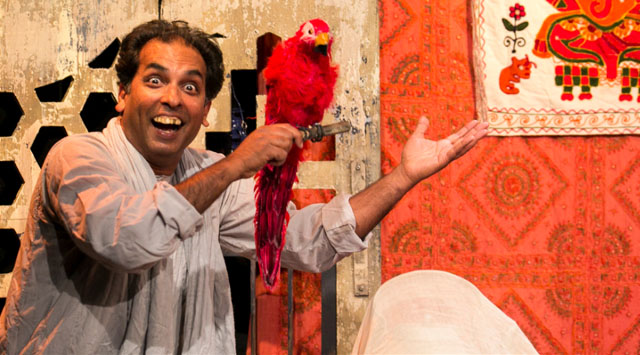
Playwright: Anne Washburn
Music: Michael Friedman
Lyrics: Anne Washburn
Director: Imara Savage
Cast: Paula Arundell, Mitchell Butel, Esther Hannaford, Jude Henshall, Brent Hill, Ezra Juanta, Jacqy Phillips
Image by Brett Boardman

Theatre review
There are three distinct acts in Mr Burns: A Post-Electric Play. First, we discover that the world has gone to hell in a handbasket; it is the apocalypse, and we have run out of electricity. A small group of survivors huddle together, trying to keep themselves sane by retelling episodes of The Simpsons. They each contribute fragments, but memory, like all human ability, proves to be considerably less than infallible.

Over the next decades, this compulsion to hark back to when things were better, grows in magnitude. The act of storytelling becomes grander, so do the increasingly fabricated remembrances of how things had been, back in the day. Eventually, we see that The Simpsons is turned into a kind of origin story that no longer accurately recreates the real thing.

Anne Washburn’s play is wildly imagined, but not always successful in its ability to aid our suspension of disbelief, as is necessary for all styles of science fiction. At each step of the narrative, we are bothered by questions left unanswered, that create an expanding sense of implausibility to the narrative. It is appropriate then, that the show turns progressively extravagant, until in Act Three, where we are presented with something that looks no different from standard Broadway musical fare.

The production begins dour, perhaps understandably so, but its long and enduring dullness marks a disappointing start for a crowd that has clearly amassed for that very particular Simpsons sense of humour. Satisfaction eventually arrives with Act Two, as the tone turns quirky and playful, and stimulating philosophy is introduced to its existentialist explorations.

The first musical number appears, quite unexpectedly, weaving American pop references into a kind of campy postmodern mash-up, to excellent effect. We see the characters desperately trying to hold on to all things bright and shiny from the past, much like the conservatives in our real life, unable to come to terms with their new circumstances. Entertainment continues to be dispensed henceforth, but we discover that the show had reached its peaked too soon. It all comes to a somewhat underwhelming conclusion.

It is a proficiently designed production. Mr Burns’ black sequinned catsuit by Jonathon Oxlade is very fabulous indeed, an unforgettable vision for the theatrical annals. Oxlade’s sets are appropriate to each sequence, but the show offers only a few surprises with its imagery, presumably restrained by its context of resource depletion.

Mitchell Butel leads an endearing cast of enthusiastic and colourful performers. As Mr Burns, Butel’s gangly limbs attempt to steal the show with their incredible animated dexterity, but the actor’s comedic capacities are impressive, and a real asset to this tenaciously serious creation.

It really is no joke, that we refuse to adequately address our energy crisis. Those with a stake in industries that are bringing devastation to the environment, like the villainous Mr Burns, continue to be allowed to plunder and destroy. We have to keep optimistic in order to be of any effect as opposition to their corruption, but the prevailing state of confused democracy seems to be getting us nowhere. Knowing right from wrong, is no longer sufficient in mobilising power and generating action, in our current climate of fake news, alternative facts, and insatiable greed. If history teaches us anything, it is revolution that will shift paradigm, but there is no hint even of burgeoning insurgency, in this age of despondent complacency.

www.belvoir.com.au

Review: Guru Of Chai (Indian Ink / Belvoir St Theatre)

Venue: Belvoir St Theatre (Surry Hills NSW), May 16 – Jun 4, 2017
Playwright: Justin Lewis, Jacob Rajan
Director: Justin Lewis
Cast: Jacob Rajan
Image by Brett Boardman

Theatre review
The story begins at the Bangalore City railway station. We meet Kutisa at a street stall selling chai, a vivacious man who cannot help but tell us a wondrous story about himself, a parrot, and a family of orphaned sisters whom he adopts into his care. Supernatural beings and high drama ensue, accompanied by extravagant emotions surrounding birth, death and betrayal. Guru Of Chai is gripping, made even more compelling by the work of a masterful performer full of drive, and magnificently skilled.

Jacob Rajan is scintillating in this one-man show. Almost like magic, his presence takes over the theatre, and we fall under his spell. Playing what seems to be an endless number of characters, Rajan is crystal clear with each manifestation, weaving the most vivid of narratives through his immense talent and artistry. It is a real pleasure to be able to submit to an expert guiding hand, and perceive the confidence in the actor and in ourselves, that the play can only progress flawlessly.

Direction by Justin Lewis ensures that the story is told at great detail and precision, with great care put into showcasing the best of his actor’s abilities. Gentle assistance from Cathy Knowsley’s lights and David Ward’s music, provide us with deeply evocative suggestions that transform a black box into the busy, sweltering streets of India. It is a small production that unfolds before us, but what we are made to see in our minds, is infinitely bigger.

There is something about Guru Of Chai that feels like a fairy tale, even though its characters encounter only the brutal realities of hardship and poverty. By removing us from the here and now, into a space far away, experiencing Kutisa’s world is as though we have stepped into a dream. When art meets us in reverie, the capacity of our minds turn boundless, and we can learn great things about the universe that are unimaginable in our insular everyday. We connect with other lives, no matter how dissimilar from what we are used to, and discover that which is unambiguously human, or perhaps something like a soul, that keeps us from feeling isolated, that gives us a glimpse of the eternal.

www.belvoir.com.au