5 Questions with Kate Champion and Steve Rodgers

Kate Champion

Steve Rodgers: What’s the first memory you have of seeing live theatre?
Kate Champion: I was lucky enough to see Lindsey Kemp, the mime artist who taught Bowie, when I was pretty young. I remember there was nudity and men wearing frocks with powdered faces – they were moving but it wasn’t like any dance I’d ever seen and they were acting but it certainly wasn’t naturalism. It was exciting because it was outrageous and risky and different.

What works by others over the years have inspired you?
Hmmm – I always find this question difficult to answer because there are so many and afterwards I’ll end up thinking more about the ones I’ve left out. I find that work from genres other than the ones I work in have probably influenced me more. Music, film, comedy, visual arts, architecture, books…

You’ve been directing a heap of shows lately, Evie May a musical at Hayes Theatre, you’ve got Arthur Miller’s A View From A Bridge coming up at SASTC, what’s special about Every Brilliant Thing?
I am enjoying how different the shows I’ve been working on are – it really tests my skill set as a director. Every Brilliant Thing – as we wrote in the program notes – is almost not a play. It practically creates its own form which I love. Its form has come about as an honest and appropriate response to its subject matter. I come from a history of devising work from scratch. I recognise the skill with which Every Brilliant Thing has been devised and therefore appreciate its distilled and deceptive simplicity. To achieve what it does without the usual bells and whistles is its triumph.

What are the ingredients for a ‘brilliant’ rehearsal room?
I think having mutual respect in the room is vital. Giving everyone the ability to contribute their opinion yet at the same time asserting the necessary leadership that you, as directors, will make the final call. Talking about personal experiences around the subject matter of the play is vital. We’ve been writing our own list of Every Brilliant Thing every morning of rehearsal. Everyone who is in the room writes down ten brilliant things and then we read them out aloud. I think we’ve learnt more nuanced information about each other this way than we would have found out otherwise. It’s a ‘brilliant’ way to start the day. It’s also vital that everyone knows that they can be vulnerable in the room and will be supported. A combination of discipline and playfulness is imperative.

Why should people come to this play, now?
There seems to be a strong disconnect these days between a surface way of sharing and deep social isolation. Every Brilliant Thing brings us together as an audience literally face to face to share the personal account of a struggle with unstable mental health. This difficult subject matter is handled in a down to earth, tender, even lighthearted way which is ultimately beautifully life affirming. I think there’s a good chance it will still be relevant long into the future.

Steve Rodgers

Kate Champion: You’re both a writer and an actor – how do you think your acting experience influences your writing and visa versa?
Steve Rodgers: I think writing and acting inform each other in the sense that they’re both about making words live off the page. I guess obviously acting is more about playing the words, where as with playwriting you get the chance to create the words for someone else to play. But they talk to each other because they’re both beautiful imaginative leaps that require discipline.

How does Every Brilliant Thing differ from how you might approach other roles?
Every role I’ve ever done is about examining what I think I understand and know about the character in relation to my own experience, and what I don’t know or understand, and need to find out. This role is all about shedding your skin, without layering something else on top.

What’s it like going from the co-directing to the acting ‘head space’?
I understand the director has the final call, so as the co-director I think my job is to be a part of the discussion as another observer, offer another perspective, and in a small tight room like ours, try and make a few jokes. As an actor I’m also doing the same. It’s a discussion about personalising the work. I must admit watching Mulvers get up and do it each day is easier than getting up and doing it your self. I’m reminded how much acting personally costs.

Do you enjoy learning lines?
No… But when they’re learnt, I’m anyone’s.

What part of the process of creating/getting a show to the stage do you enjoy the most?
Rehearsals for me are sacred, where I’m always reminded I’m not alone in the world. People and stories… what else is there?

Kate Champion and Steve Rodgers are co-directing Every Brilliant Thing by Duncan Macmillan.
Dates: 8 – 31 Mar, 2019
Venue: Belvoir St Theatre
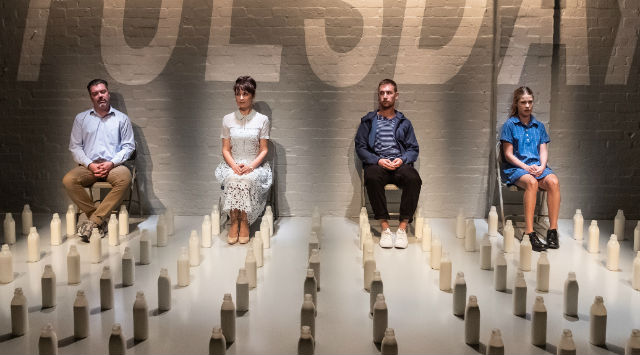
Review: Tuesday (Sign Of The Acorn / 25A Belvoir)

Venue: Belvoir St Theatre (Surry Hills NSW), Feb 6 – 23, 2019
Playwright: Louris van de Geer
Director: Nell Ranney
Cast: Frances Duca, Duncan Fellows, Tom Anson Mesker, Bridie McKim
Images by Clare Hawley

Theatre review
Four people in a supermarket, isolated in their own lanes, doing what are probably the most banal of activities, in the most mundane of places. In Louris van de Gerr’s Tuesday, we see ourselves on the most prosaic day of the week, caught up in private thoughts that reveal our truest, most unflattering selves. Structured as four interwoven monologues, these Australians do not interact with each other, but they exhibit common characteristics that serve to represent our identity. They may be of different genders and generations, but what we see in Tuesday are scared white people, filled with anxiety and aggression, completely self-obsessed even at a moment of catastrophe.

Van de Gerr’s writing is astonishingly detailed in its observations, thus able to connect in a way that feels intimate and authentic. Its disarming sarcasm makes for scintillating humour, and along with a subtle but cleverly structured narrative drive, Tuesday proves to be terrifically satisfying. Director Nell Ranney’s emphasis on tension and gravity from the get go, creates a powerful work of theatre that delivers incessant ironic laughter, as well as an undeniable sense of poignancy in its microscopic scrutiny into the everyday.

The production is designed exceedingly well. Isabel Hudson’s precarious placement of full uncapped bottles of milk, in perfect straight rows, insists that our bodies seize up in their presence, in fear of any accidents that might happen. Martin Kinnane’s quiet rendering of lights gives support to that mood of ubiquitous and impending horror, without ever drawing attention to itself. Sound design by Clare Hennessy is a marvellous achievement, heavily relied upon to convey every fluctuating degree of funny and frightening, for a highly sophisticated blend of comedy, drama and thriller.

A splendid ensemble comprising impressive measures of intelligence and creativity, takes us on an exercise in intuitive storytelling, riveting from beginning to end. Frances Duca fascinates us by combining poetic gestures with incisive speech, to emulate and comment on the sad housewife archetype. Equally memorable is Duncan Fellows’ interpretation of the pathetic but still respectable low-rung shop manager, hilarious in his naive perception of the world. Bridie McKim plays a mischievous schoolgirl, painfully accurate and unfettered in her spirited depiction of mindless rebelliousness. Tom Anson Mesker’s controlled and complex portrayal of masculinity at its puerile best and toxic worst, encourages us to examine the little irritations and provocations that can pervade our lives, pretending to be normalised, only to explode spectacularly when you least expect it.

The characters in Tuesday are consumed by annoyance, yet there is no evidence of anything serious actually happening within their personal realms. They are people who have no concerns about food and shelter, but are far away from any semblance of peace or contentment. In Australia, we have everything, in fact we have a great deal more than we need, yet we are endlessly restless, and increasingly selfish, always obsessing over issues like border defence and protectionism, without ever intending to be properly informed about the world beyond our shores. It is easy to see the crazy in others, but to understand one’s own madness is quite another thing.

www.facebook.com/SignoftheAcorn | www.belvoir.com.au

Review: The Iliad Out Loud (Sport For Jove Theatre)

Venue: Belvoir St Theatre (Surry Hills NSW), Jan 23 – 27, 2019
Playwright: William Zappa
Director: William Zappa
Cast: Blazey Best, Heather Mitchell, Socratis Otto, William Zappa
Images by Lisa Tomasetti, Jamie Williams

Theatre review
Homer’s ancient poem is adapted and abridged in William Zappa’s The Iliad Out Loud, first for radio, and now for the stage. This iteration of the epic stretches across three parts, each three hours long, presented by four actors and two musicians, in the form of a staged reading. It takes after what is believed to have happened in 8th century BC, when the original was performed, to be heard and not read. Zappa’s text can easily be repackaged as a novel, and often we wonder if that would have been a better format, especially during the very many drawn out battling sequences, which require only visualisation and no analysis on our part.

This condensation of events would likely be more rewarding for those who are already fans of the story. A thrilling ride for some can prove an ordeal for others, as the production routinely rushes past character development to cover significant occurrences. Without sufficient background understanding of personalities, we struggle to resonate with their trials and tribulations in all the warfare, that Zappa so exhaustively conveys.

Michael Askill and Hamed Sadehi are musicians and stars of the show, a two-man band that makes a real art form of their accompaniment. In the absence of more conventional theatrical imagery, Askill and Sadehi pull out all the stops to stoke our imagination, adding infinite colour to the pages of words being dispensed. Lighting by Matt Cox too, is inspired, with a series of elegant transformations to illumination, helping guide us through states of emotion.

Zappa is an outstanding reader, full of dynamism on his stage, holding our attention with extraordinary ease, effortless in sharing his immense enthusiasm for a seminal work of his heritage. It is a confident cast that travels with us on this journey, impressive in their detailed familiarity with every twist and turn of the 9 hours.

The warring men blame their behaviour alternately, on one woman Helen, or on the gods Zeus and his ilk. Their inability to face their own culpability in all the conflict, feels an accurate reflection of every war in every era. It may not be true that women are never in favour of such brutality, but it is certain that none of these atrocities can ever be perpetrated without men. All the war heroes in Iliad can be thought of as good guys, and our continual inclination to excuse them of the horrors that they choose to enact, reveals, at least in part, why we remain in a perpetual cycle of bloodshed.

www.sportforjove.com.au

Review: Counting & Cracking (Belvoir St Theatre)

Venue: Sydney Town Hall (Sydney NSW), Jan 11 – Feb 2, 2019 | Ridley Centre (Adelaide Showgrounds, South Australia) Mar 2 – 9, 2019
Playwright: S. Shakthidharan
Director: Eamon Flack
Cast: Prakash Belawadi, Nicholas Brown, Jay Emmanuel, Rarriwuy Hick, Antonythasan Jesuthasan, Nadie Kammallaweera, Ahi Karunaharan, Monica Kumar, Gandhi MacIntyre, Shiv Palekar, Monroe Reimers, Hazem Shammas, Nipuni Sharada, Vaishnavi Suryaprakash, Rajan Velu, Sukania Venugopal
Images by Brett Boardman

Theatre review ⭐️⭐️⭐️⭐️⭐️
It was 1983 when Radha first came to Australia, escaping persecution in Sri Lanka during the racial riots of Black July. With her husband killed in the midst of unrest, Radha was left with no choice but to flee alone and pregnant, arriving in Sydney to put down new roots in a foreign land. S. Shakthidharan’s Counting & Cracking is a very big play, ambitious and benevolent, rhapsodic in its attempts to uncover the whole truth about a woman, observed as a maternal figure from the playwright’s vantage point. Shakthidharan’s work is warm and witty, generous in its seismic attempts to explain everything, taking us through half a century of untold stories to reach an understanding about the people we are today.

It is often a gripping production, directed by Eamon Flack who renders marvellously the play’s more domestic and romantic scenes. Relationships are beautifully cultivated, between powerful characters, with a convincing sentimentality that encourages the audience to invest deeply, our attention and our emotions, right from the very beginning. Political dimensions are communicated less lucidly, but we are able to gather sufficient information for the narrative drive to maintain interest.

Designer Dale Ferguson’s transformation of Sydney Town Hall’s colonial interior, into a festively radiant Sri Lankan space of congregation and celebration, is a sight to behold. Majestic and monumental, it embraces our bodies and psyches, holding us firmly inside its milieu, to have us luxuriate in all its extravagant expressions. Contrastingly, acoustics are a sore point for the production, with sound engineering unable to overcome the echoey vastness of the old building, thus resulting in occasional dissipation of dialogue. There are however auditory delights to be had, in the form of Stefan Gregory’s score, performed live by a trio of musicians (Kranthi Kiran Mudigonda, Janakan Raj and Venkhatesh Sritharan) whose expert accompaniment provides us with unparalleled sensuality and soulfulness.

Actors Nadie Kammallaweera and Vaishnavi Suryaprakash share the lead role, both captivating and extremely likeable, allowing us to fall under Radha’s spell for the show’s entire duration. Their combined dynamism gives Counting & Cracking complexity and authenticity, and we find ourselves moved by a tale that is at once unique, yet spiritually universal. Sukania Venugopal is memorable as Aacha, the vivacious matriarch who brings colour and effervescence to the stage with every exhilarating entrance. Radha’s son Siddhartha provides the cultural anchor for this Australian story, performed by a very compelling Shiv Palekar, whose luminous confidence proves to be as impressive as it is alluring.

It is always demanded of migrants that we prove our worth. Counting & Cracking is in some ways an exercise in showing the establishment that we contribute at least as much as the others; it makes a statement about our Australianness, arguing against incessant lies about immigration being nothing but a burden on this society. More valuable is the play’s reclamation of identity, in its insistence that the portrayal of Australian lives must include histories and origins that are routinely excluded and denied. As humans, we must always strive for unity, but cohesion must bear the unequivocal acceptance of difference, hard as it may be.

www.belvoir.com.au | www.co-curious.com

Review: The Club (Belvoir St Theatre)

Venue: Belvoir St Theatre (Surry Hills NSW), Dec 7 – 22, 2018
Playwright: David Williamson
Director: Tessa Leong
Cast: Jude Henshall, Louisa Mignone, Ellen Steele
Images by Marnya Rothe

Theatre review
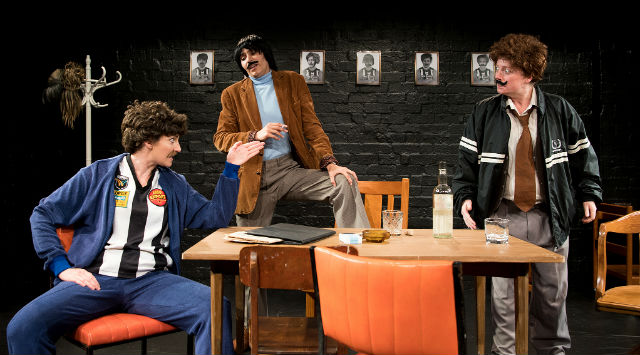
Hundreds of millions of dollars go through Australia’s sporting organisations, and to view the industry as wholesome and virtuous is, to put it mildly, naive. Yet, we routinely attribute our sports stars and their colleagues, with a glow of reverence, and they in turn, present an image of habitual sanctimony. The men in David Williamson’s The Club are exposed of these hypocrisies. It is a story about white boys spoilt by their talent with an olive-shaped ball, who grow into stunted adulthood, and we watch their clumsy attempts at extending the glory days beyond bygone moments on the football field.

The corrupt and inane behaviour of these self-aggrandising men provide a platform for director Tessa Leong’s discussion of sexism and toxic masculinity, within an archetypal setting of a sporting arena, that conveniently encapsulates our nation’s sense of self-image. Three female performers take on all the roles, playing exaggerated versions of maleness, for a subversive exercise that makes statements about gender, and especially about the misguided adoration of what might be termed traditional masculinity. First half of the production is surprisingly conventional, a one-trick pony with a simple concept that quickly loses steam, but the show picks up furiously after interval, and what had felt gimmicky, turns into something far more complex and provocative.

The production is full of grandiose gesturing, not always powerful, but certainly delivered with extraordinary conviction. Actor Ellen Steele is particularly robust with her comedy, extremely cheeky and acerbic, a consistent delight in this portrait of ugliness. Jude Henshall and Louisa Mignone too, are exuberant performers who bring admirable rigour into their farce, for a rewarding study on the machinations of privilege and ignorance, frequently found in some segments of Australian society.

In sport, we celebrate high achievers not only for their accomplishments, but also for the whole of their persons. We want our heroes to be godlike, and imagine them to be infallible, consequently giving them powers, in the form of money and status, that they often exploit to the detriment of our collective good. It is no coincidence that these powerful are predominantly straight white men. Our institutions are structured to benefit a certain idea of supremacy, one that repeatedly exerts its imperialism over all others, and any action designed to take them down is met with disdain and even violence. Oppression requires concession, with the oppressed made to concede to notions of objectivity and meritocracy, that are demonstrably unjust. It is a survival strategy, to play to these rules, but only those willing to sacrifice can hope to foster a change.

www.belvoir.com.au | www.isthisyours.com.au

Review: The Overcoat (Belvoir St Theatre)

Venue: Belvoir St Theatre (Surry Hills NSW), Nov 15 – Dec 1, 2018
Book & Lyrics: Michael Costi (based on the short story by Nikolai Gogol)
Music: Rosemarie Costi
Director: Constantine Costi
Cast: Laura Bunting, Kate Cheel, Aaron Tsindos, Charles Wu
Images by Clare Hawley

Theatre review
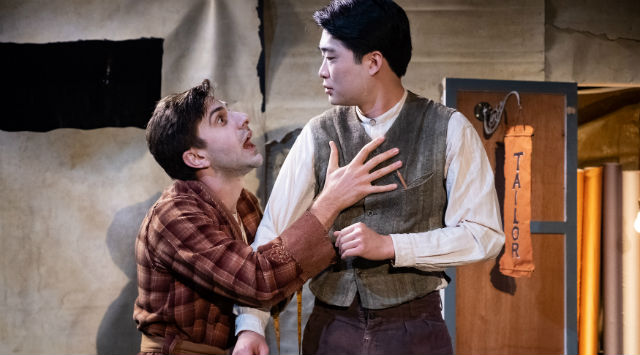
Nikolai is an unremarkable man, an ordinary citizen of Russia, who lives and works in St Petersburg, not unlike the faceless millions in any of the world’s cities. He is unambitious, able to be content with a simple life, but the most basic of human requirements, dignity, eludes him. He is sold a luxurious coat, one he is unable to afford, with the promise that the new garment would finally help him gain the respect of people he sees every day at work. Based on Nikolai Gogol’s short novel of the same name, The Overcoat is about injustice, and the sacrifices some have to make, just to attain a level of subsistence.

Adapted by Michael Costi, whose book and lyrics retain the poignancy of the original, this musical version is an understated but thoroughly moving work of theatre. Rosemarie Costi’s music is consistently gripping, and delightfully idiosyncratic, incorporating shades of Kurt Weill and Stephen Sondheim to find exquisite balance in this sophisticated take on the genre. Director Constantine Costi exhibits great style, alongside a sensitive understanding of drama, for a production that lulls us gently to some very deep places in our hearts and minds.

Performer Charles Wu is an enchanting presence, vulnerable yet confident as Nikolai. Not only does he earn our empathy for the pitiful character, Wu elevates our experience of the sad story with his capacity to inspire our intellect. Aaron Tsindos’ booming voice thrills and satisfies, as do his extravagant depictions of several unforgettable supporting roles. Laura Bunting and Kate Cheel create a range of ebullient personalities, both actors proving themselves to be as commanding as they are charming.

Our protagonist procures his coat, with money that should have gone to food and rent. Before society can provide him with a feeling of belonging, Nikolai must give up more than all he has; we come to the cruel realisation that the real world does not offer unconditional love. When we participate in the labour force, we go to work for survival and for salvation, but there is never any guarantee that the exchange can be a fair one. In fact, we see in The Overcoat, that when the marketplace is left to its own devices, many of us are put in positions where we have to give more than we can ever receive in return. The unfairness is ubiquitous, and without intervention, disparities can only widen.

www.belvoir.com.au

Review: The Dance Of Death (Belvoir St Theatre)

Venue: Belvoir St Theatre (Surry Hills NSW), Nov 10 – Dec 23, 2018
Playwright: August Strindberg (literal translation, May-Brit Akerholt)
Director: Judy Davis
Cast: Giorgia Avery, Colin Friels, Pamela Rabe, Toby Schmitz
Images by Lisa Tomasetti

Theatre review
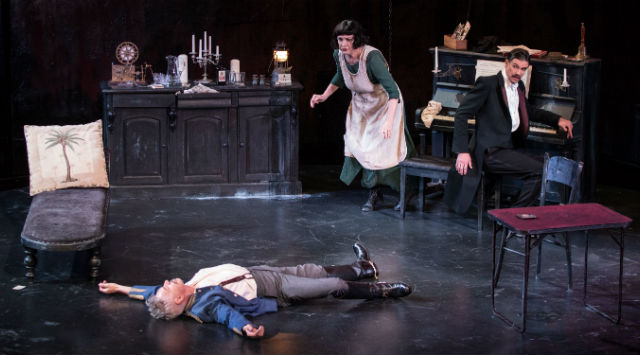
Alice and Edgar live secluded on an island, married to each other but full of hate, in a state of constant exhaustion from having spent every waking moment bitter, and berating all that they come in contact with. When relative Kurt arrives for a brief visit, the antagonism escalates, as we observe the vitriol begin to infect their unsuspecting guest. From 1900, August Strindberg’s The Dance Of Death is characteristically expressionist, with the writer’s socialist attitudes perceptible in the play, although its criticisms of class are somewhat benign by today’s standards.

Its comedy is dark and caustic, and Judy Davis’ direction certainly conveys that subversive quality well, for a show that is consistently amusing, if not quite laugh out loud funny. Strindberg’s absurd and surreal dimensions are embraced by designers, who deliver a production many will find stimulating with its declarative flamboyance. Paul Charlier’s music is libidinous but disturbing, and extraordinarily theatrical in its effect. The stage floats on a pool of blood, with a backdrop proclaiming “hell on earth”; Brian Thomson’s set design and Matthew Scott’s lights conspire in a visual tango that intrigues and mystifies. Costumes and wigs by Judy Tanner are wonderfully evocative, with an exquisite red gown late in the piece, proving to be particularly memorable.

Pamela Rabe cuts a striking figure as the decadent former actress Alice, operatic in style and thoroughly entertaining, if slightly deficient with her character’s emotional authenticity. Edgar is played by Colin Friels, similarly heightened in his approach, for a beguiling study of narcissistic machismo at its ugliest. Cousin Kurt is taken through drastic transformations by Toby Schmitz, whose cheeky humour reinvigorates the action with each of his entrances.

The Dance Of Death succeeds at keeping us engaged, but we wait for poignancy that never arrives. It inspires us to think about marriage, about the way we deal with this thing called love, and how hate only exists in response to something unequivocally cherished, but the show keeps distant, as though aloof, unwilling to be touched, unable to move. Emotions can be frightening, so we go to art to better witness its machinations. Alice and Edgar share a love, but their vulnerabilities are all but calloused by the time we meet them at their twenty-fifth year of entanglement, and it is as though they no longer feel anything. They know only to make demands, and are incapable of giving anything, yet this dynamic is set on a perpetual loop, sustained by the ever surprising human capacity to withstand debasement. From the outside however, it is always easier to perceive with clarity, and we know that walking away from someone who has overstayed their welcome, is the simplest solution.

www.belvoir.com.au

Review: random (Belvoir St Theatre)

Venue: Belvoir St Theatre (Surry Hills NSW), Oct 18 – Nov 11, 2018
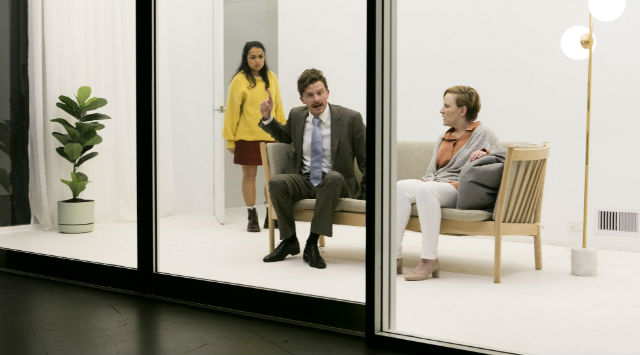
Playwright: debbie tucker green
Director: Leticia Cáceres
Cast: Zahra Newman

Theatre review
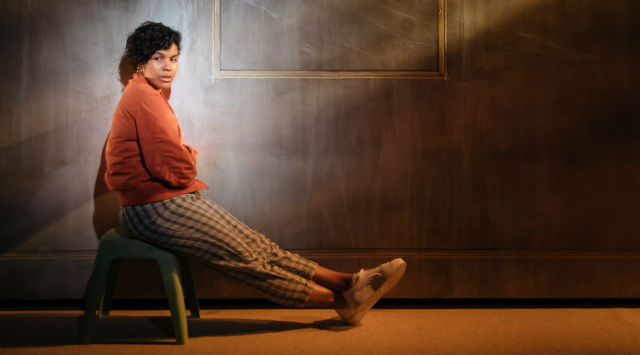
A regular family wakes up to another ordinary day, getting ready for their midweek routine. We soon discover that things do not go as planned, when the police appear on their doorstep, delivering news of catastrophic proportions. debbie tucker green’s random is about youth violence in metropolitan cities, a consequence of our incompetence as communities to provide adequate care and guidance. The playwright’s unique combination of slang, patois and poetry, represents a sublime reshaping of the English language, that emerges from the Caribbean migrant experience in England. Keen observations of contemporary life, are positioned alongside nuanced social critique, giving palpable voice to the black working class.

Actor Zahra Newman plays all the characters in this one-woman show, proving herself a force of nature, and a legitimate superstar of the Australian stage. With extraordinary talent and skill, Newman tells the story of random with exceptional dynamism, taking us from jubilation to the extremes of tragedy, for an experience full of complexity and sentimental enthralment. The multitude of voices, emotions and gestures that the actor is able to portray for each and every personality, are administered with an astounding fluency, as we watch her switch flawlessly between states of mind, whether these people appear for a breathtaking split-second or for several bewitching minutes. Newman is an unequivocal genius, and the theatrical magic she dispenses here, is simply divine.

Directed by Leticia Cáceres, the production is sharp, powerful, often awe-inspiring. Hilarious at the start, and later on, turned harrowing, every moment is captivating, fuelled by an urgent confidence, a vehement need to present the play, with all its sociological pertinence and aesthetic glory. Designed with commendable sophistication, the staging features lights by Rachel Burke and music by The Sweats, both restrained in approach but marvellously efficacious, for this brazenly empty space.

There will be some who wish to call the phenomenon universal, but to neglect the racial dimension of violence in random would be callous. We are all capable of heinous acts, but the circumstances around racial inequity must always be taken into account when trying to understand the social ills of any community. Poor outcomes should never be considered random or accidental, when it is clear that the cards are clearly stacked against some. To be blind to the colour of our neighbours, is to be wilfully ignorant of the challenges that they face. We all deserve the same rights and privileges, but to imagine that things are already equal, and to behave as though nobody is ever in need of additional support, is to perpetuate and fortify the devil’s work.

www.belvoir.com.au

Review: An Enemy Of The People (Belvoir St Theatre)

Venue: Belvoir St Theatre (Surry Hills NSW), Oct 7 – Nov 4, 2018
Playwright: Melissa Reeves (after Henrik Ibsen)
Director: Anne-Louise Sarks
Cast: Peter Carroll, Catherine Davies, Leon Ford, Steve Le Marquand, Kenneth Moraleda, Kate Mulvany, Nikita Waldron, Charles Wu
Images by Brett Boardman

Theatre review
Dr Stockman is wellness consultant at the local spa resort, where business is booming, resulting in great prosperity for the township. When contamination is discovered in the water and patients are developing diseases as a consequence, she proceeds to reveal all in order that harm can be minimised, and that the town can find the right way forward. Her good intentions however, are met with opposition by men in power, who are motivated only by self-interest, refusing to let emerge, the truth that will cost them severely. In Melissa Reeves’ version of Henrik Ibsen’s An Enemy Of The People, there is the added dimension of Dr Stockman’s gender, that fuels the actions of these deplorable men.

This revision of the 1882 classic arrives at a time of heightened consciousness, in matters relating to the deep-rooted, long-established and systematic deprivation of power as experienced by women everywhere. There is no explicit naming of misogyny in Reeves’ reinvention, but director Anne-Louise Sarks makes it abundantly clear, that what we are talking about here is not only Ibsen’s concerns over democracy and corruption, but also the currently pertinent topic, on the pervasive abuse of women, in this undeniably and resolutely patriarchal world. The show suffers a slow start, with tentative humour and uncomfortable chemistry between personalities, but things escalate for a spectacular second half, enthralling and powerful in its exposition of political ills and challenges that we face as a community.

The addition of a scene involving Stockman’s cleaning lady, Randine chastising the middle classes, along with the theatre-going bourgeoisie, expands our understanding of the body politic. In efforts to make our nations great again, it seems we inevitably become embroiled in discussions that turn increasingly petty in their scope; as we drill down deeper and get closer to the bone of what we think our problems are, we habitually turn exclusionary, always putting ourselves first and forgetting the rest. Intersectionality is not yet the custom, and in Reeves’ An Enemy Of The People, we watch it explained with agonising clarity.

Actor Kate Mulvany is strong as Dr Stockman, particularly persuasive when the role gets emotionally intense. There is an infallible sense of confidence in Mulvany that allows her audience to engage deeply in the arguments being made, and we find our philosophical and ideological selves gratifyingly enriched by the experience. The aforementioned Randine is played by Catherine Davies, who impresses with exquisite nuance and a robust presence. Also memorable is Kenneth Moraleda as the obnoxious Aslaksen, delightfully comical in his animated depiction of a crooked, repugnant undesirable.

2018 could be remembered for the unprecedented number of elected women officials quitting Australian politics, with names like Julia Banks, Emma Husar and Ann Sudmalis making the news, telling stories about bullying and intimidation taking place in quarters where we should be demanding the highest of integrity. The numbers reveal, plain and simple, that women are being deliberately shut out from positions of power, but myths around notions of biology and meritocracy have formed narratives that prevent us from carrying out justice, whether or not we are personally invested. Dr Stockman says she will fight to the bitter end, but our reality demonstrates that her solitary perseverance is no match for the glass ceiling.

www.belvoir.com.au

Review: The Maids (Glitterbomb / 25A Belvoir)

Venue: Belvoir St Theatre (Surry Hills NSW), Aug 25 – Sep 15, 2018
Playwright: Jean Genet (translated by Bernard Frechtmann)
Director: Carissa Licciardello
Cast: Alexandra Aldrich, Skyler Ellis, Amanda McGregor
Images by Jasmin Simmons

Theatre review
Jean Genet’s The Maids is based on a 1933 murder in France. A pair of sisters work as maids in a rich man’s house, isolated from the rest of the world. Their shared oppression turns them monstrous, as they gradually bring to fruition, the heinous contents of their imagination. We may no longer, in the West, have servants of that kind, but it is a story that draws parallels with the many inequalities that persist, or are in fact escalating, in these supposedly modern times. We look at the birth of evil, from evil, and are made to consider the repercussions of a society determined to maintain its hierarchies.

Carissa Licciardello directs an extraordinarily intense and flamboyant production, using Genet’s macabre poetry to inspire a marvellous sense of heightened drama. Three wonderful actors work in perfect tandem, delivering a sensational piece of grotesque theatre, intriguing and powerful with what they bring to the stage. Alexandra Aldrich and Amanda McGregor play the sisters, both commanding in presence, as Claire and Solange, compelling from beginning to end, even when Genet’s writing turns impenetrable and obtuse. Male actor Skyler Ellis takes on the role of Madame with aplomb, demonstrating excellent nuance alongside the role’s predictable extravagance. Watching the maids feud with a man, creates a fresh intellectual dimension, helping the old play speak with more pertinence than it would otherwise have.

Humans have an insatiable desire to control one another. Our thirst for power, when untamed, has the ability to blind us to the fact that people’s freedoms are always essential. Compromises can be reached in all our interactions, of course, but it is clear that transgressions occur frequently, with or without our acknowledgement. The servants have no choice but to submit to the consequences of their poverty, but when people are subjected to conditions unnatural and perverse, it is certain that morbidity will result.

www.dasglitterbomb.com | www.belvoir.com.au