Review: Henry V (Bell Shakespeare)

bellshakespeareVenue: Sydney Opera House (Sydney NSW), Oct 21 – Nov 15, 2014
Playwright: William Shakespeare
Director: Damien Ryan
Cast: Michael Sheasby, Matthew Backer, Drew Livingston, Damien Strouthos, Gabriel Fancourt, Eloise Winestock, Danielle King, Darcy Brown, Keith Agius, Ildiko Susany
Images by Michele Mossop

Theatre review
As the years pass, we become increasingly accustom to war being a fact of life. Wartime is no longer a set of specific and exceptional circumstances, especially with the proliferation of mass media and the normalisation of conflict as a topic of daily interest. Shakespeare’s Henry V includes the ambiguities and tensions between tragedy and heroism, but four centuries on, we seem no longer able to tell a story like this without letting casualties take centre stage.

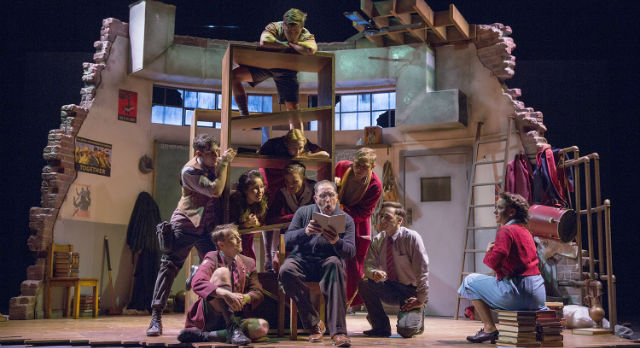
Damien Ryan’s vision certainly reflects contemporary attitudes on the essential destructiveness of war. The injured and the dead are not obliterated from our sight, but are left critically present on stage to abate any hint of glory that might surface. The use of symbols and the visual lavishness of Ryan’s work is fiercely thoughtful, almost omnipresent. Space is explored to its creative limits, with the astonishingly dynamic use of bodies, sets and props to convey emotions and concepts. Ryan’s brand of theatre is captivating and exhilarating, but also undeniably sensitive and intelligent. His Henry V is complex but accessible, innovative but unpretentious. It aims to be a theatre for all, catering to aficionados, students and everyone else, encompassing every age and background. Shakespeare’s language is challenging for many, and the director works thoroughly to bring elucidation, although detractors are unlikely to have a change of heart with this text, which is probably one of Shakespeare’s more obscure pieces.

The production is visually beautiful, with accomplished and adventurous work from designers on all fronts. Anna Gardiner’s intricate set gives the stage an intimacy and provides performers with extensive possibilities for inventiveness. Gardiner’s costumes are not extravagant but accurately and astutely conceived, consistently effective in each character transformation and evolution. Sian James-Holland’s lighting design is one of the show’s main features. Her work is ambitious and powerful, at times conveying the plot more completely than other more tangible elements can manage. Also outstanding are music and sound designer Steve Francis’ achievements in his very specific control over atmospherics, and vocal composer Drew Livingston’s many charming and surprising songs accompanying the script.

Clearly, the performances are not the only stars of the show, but this is an undeniably excellent ensemble of actors. The chemistry they have found with each other, and in every scene, is exemplary. There is an athleticism to their creation, assisted by movement director Scott Witt, that is often breathtaking and marvelous to behold. The constant variation in tone and mood that they manufacture gives the production an extraordinarily textured feel. Keith Agius plays the more mature roles and is memorable for the depth of meaning he is able to bring to his lines. It is the gravity and an intensity that he puts into speeches that sets him apart. Matthew Backer shines with a distinct sense of humour that follows his assured presence, and his singing voice is quite sublime. The most vibrant actor will always leave an impression, and on this occasion, it is Damien Strouthos who wins us over with his agile, flamboyant and impossibly energetic approach.

It is clear that Shakespeare is revered internationally, but the universality of his writing is arguable. As societies become more aware of ethnic, gender and other differences in experience and background, it becomes less likely that any artist can claim to be relevant to everyone, but theatre is in a unique position of sheer proximity where it has the potential to move and touch, in a visceral manner. Shakespeare’s words might not always make sense, but what it gives birth to, is often blisteringly remarkable.
www.bellshakespeare.com.au

Review: Tartuffe (Bell Shakespeare)

bellshakespeareVenue: Sydney Opera House (Sydney NSW), Jul 26 – Aug 23, 2014
Playwright: Justin Fleming (after Molière)
Director: Peter Evans
Cast: Leon Ford, Sean O’Shea, Helen Dallimore, Geraldine Hakewill, Kate Mulvany, Charlie Garber, Tom Hobbs, Jennifer Hagan, Robert Jago, Russell Smith, Scott Witt
Images by Lisa Tomasetti

Theatre review (originally published at Auditorium Magazine)

Stories that stand the test of time contain truths that resonate across generations. They bear a universality that seems to derive from the very essence of being human, and a good retelling of those tales will always reveal to us, the nature of our being, and perhaps more importantly, the morals we should live by, however we choose to respond. Tartuffe has a central theme that does not age. Our relationship with religion as individuals and as collectives come into scathing scrutiny, and the way this resonance persists is a potent indication of the concerns we live with, and sadly, how little some things evolve. Molière’s play is now 350 years old, and what was controversial then, can still be used for contentious discussion today.

Justin Fleming’s exciting new script shows great talent and flair. It is an adaptation that feels updated and immediate, yet it preserves a classic sensibility, most notably through his use of rhymes. The original featured rhyming couplets, and Fleming’s decision not to deviate too far from it is felicitous, especially with new rhyme structures that are more varied and surprising. The play’s religious complexion is faithfully retained, but Fleming’s writing reconditions its gender dynamics to reflect modern day conventions. From this perspective, it is pleasing to observe the diminishment of sexism, even if religion’s place in the world seems to have obstinately endured over these centuries. By far the most drastic flourish is found in the overhauled ending of the piece. The change is a brave one, but its effectiveness is debatable. While it displays a quirky humour that can fit quite well with the style of Molière, the production falters at this point of “supernaturality”, not quite able to execute a vision with sufficient aplomb.

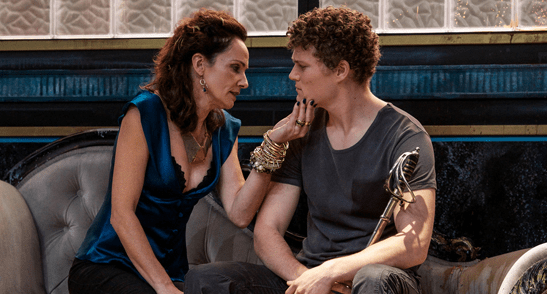
The venue is a large one, with a stage size that is challenging for any play featuring only a handful of performers in each scene. Director Peter Evans’ emphasis on authenticity in dialogue delivery is admirable, but memorable moments of the production come from performances that are more about flamboyance than nuance, and the frequently realistic level of interpretation seems to waste not just the vastness of the auditorium, but also the wildness of Molière’s concepts. As a result, performers like Scott Witt who have a greater command of physical capacities capture more of our attention (Witt also serves as Movement Director). Theatre is as much about space as it is about words. There are texts difficult to master, and likewise, there are stages that are harder to conquer. Not all characters are externalised enough, whether due to ability or creative choices, and the comedy is consequently uneven. Leon Ford as Tartuffe is neither majestic nor repulsive. The actor does have a captivating presence, but the role calls for more extravagant malevolence and a certain enigma that is never achieved. The play provides for his entrance tremendous build-up, but when he finally materialises, the Tartuffe we see does not live up to our imagined personality who is more evil and animated, and definitely less attractive.

The script is outlandish and titillating, always with an air of controversy, but what Evans puts on stage is safe by comparison. There is irreverence in content but not in its form. Bell Shakespeare is a professional theatre company doing theatre properly, and their Tartuffe is charming and polished. Expectations of a more anarchic rendering may be unrealistic, but Molière’s themes evoke heresy and inspire mischief, and without some quality of impoliteness, the play is reduced to something quite frivolous. There is social significance to this story, and due attention needs to be placed on its relevance to the community it plays for. We are after all, in the age of the Mad Monk (one of our Prime Minister’s nicknames), and we have political leaders who advocate the replacement of secular social workers in schools with chaplains. There is clearly fertile ground that can be penetrated, in order that a stronger social criticism can be made from taking on this platform.

The character of Orgon is played by Sean O’Shea, who becomes increasingly delightful as the hysteria escalates. Like many of the cast, his early scenes seem oddly subdued, but greater exuberance appears further into the piece. O’Shea has a playfulness that connects well with his audience, and establishes a good level of believability as both the master of the house and the fool. However, the mockery out of Orgon is not made strongly enough. It can be argued that the gravity of the play lies in Orgon and his mother’s irrational trust in Tartuffe, and the devastating effects that follow. The pertinence of their blind faith cannot be understated, and not giving it greater prominence seems to be missing the point altogether.

Stand out performances include Kate Mulvany’s Dorine, who is easily the most colourful and confident on stage. Mulvany’s remarkable wit is clearly a highlight, and her enthusiasm for creating theatrical magic out of every sentence is a marvel to watch. Charlier Garber’s comedy style is an excellent match for the frenetic energy of Molière’s crazed world. Garber capitalises on his extraordinary lankiness and idiosyncratic hairstyle, manufacturing an almost cartoonish character that never fails to amuse.

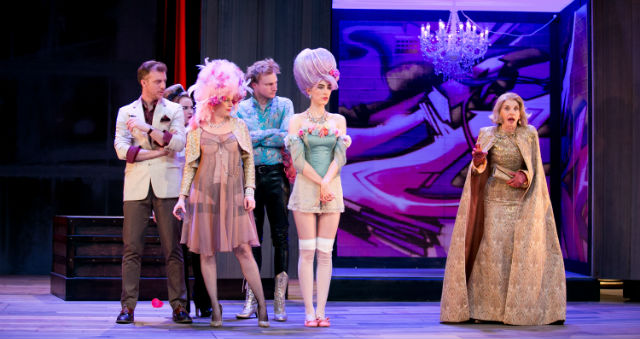
Also commendable are the production’s visual design aspects, especially Anna Cordingley’s work on costumes and sets. The script self-consciously mentions “Dolce, Galliano and McQueen”, indicating the family’s affluence and interest in style, and Cordingley certainly manages to impress upon us, a world of some extravagance and luxury, including an unforgettably exquisite costume for Madame Pernelle. Over-sized set pieces add a sense of wonder, and help with segmenting and shrinking stage spaces, but the unruly wheels on a very dominant chesterfield sofa need to be tamed to prevent its repeated, unintended and distracting slipping and sliding.

Bell Shakespeare’s Tartuffe is an entertaining work with committed performances and slick production values. Its level of professionalism is exceptional in an artistic landscape that tends to reserve our biggest talents for commercial musical theatre, and for productions overseas. Great stories however, are not only about entertainment and refinement. They are defined by the depth at which they move us, and as Molière’s immortality has shown, it is always the moral of the story that truly counts.

www.bellshakespeare.com.au

2014 Season Programs In Sydney

What to go see? Here’s a handy guide to who’s doing what in 2014.

If you’re reading this in 2013 or early 2014, now is a good time to book your generously discounted season tickets and subscriptions! If you’re accessing this page overseas, here’s a good list for planning your theatre experiences in Sydney in 2014.

The Australian Ballet

The Australian Ballet

Bell Shakespeare

Bell Shakespeare

Belvoir St Theatre

Belvoir St Theatre

Carriageworks

Carriageworks

Darlinghurst Theatre Co

Darlinghurst Theatre Co

Ensemble Theatre

Ensemble Theatre

The Genesian Theatre

The Genesian Theatre

Griffin Theatre Co

Griffin Theatre Co

King Street Theatre

King Street Theatre

New Theatre

New Theatre

The Old 505 Theatre

The Old 505 Theatre

Opera Australia

Opera Australia

Reginald Seymour Centre

Reginald Seymour Centre

Riverside Theatres

Riverside Theatres

2014-rocksurfers

Rock Surfers Theatre Co

Sydney Dance Co

Sydney Dance Co

Sydney Theatre Co

Sydney Theatre Co

Sydney Independent Theatre Co

Sydney Independent Theatre Co

Phèdre (Bell Shakespeare)

phaedreVenue: Sydney Opera House (Sydney NSW), Jun 6 – 29, 2013
Playwright: Jean Racine (translated by Ted Hughes)
Director: Peter Evans
Actors: Catherine McClements, Julie Forsyth, Marco Chiappi, Edmund Lembke-Hogan

Theatre review
Not very much happens in this story, but the enjoyment of Greek tragedies like Phèdre is in their heightened sense of drama, and the creative choices made by contemporary theatre practitioners in their interpretation of texts centuries old.

Lead actor Catherine McClements is best in sections where her character’s emotions are overflowing. She portrays pain and guilt with a delicious darkness, and her strength in guiding her audience through the plot with very clear story-telling in terms of her intentions and transitions are remarkable. Even though she lacks a sense of majesty and physical agility that this level of drama seems to require, McClements compensates with her impressive charisma and presence.

Also remarkable is Julie Forsyth who plays Phèdre’s nurse. Even though the role is comparatively small, her grasp of the genre is completely arresting.  The other actors are less appealing, especially Lembke-Hogan who seems to have walked right off a budget soap set, completely out of his depth. One leaves the theatre wondering if actor training caters now only to television work, with emphasis on voice and face, but everything from the neck down is neglected.

Set, lighting and sound design are subtle and sophisticated, with a murky sexiness permeating the theatre even before the play commences. This serves the themes of illicit desire and spousal betrayal well, but comes in conflict with small sections of the play where the mood is lighter and both audience and players obviously need a dose of comedy and quick reprieve from the intensity of the story. Costume design is overly minimal, detracting from the depiction of a “royal story”, although keeping in line with the overall visual style of the production.

For those of us who love dramatic tragedies, it is always about going on that emotional journey which appeals the most. When this is achieved with a classic play that has stood the test of time and does not rely on fads and gimmicks, the experience is particularly satisfying.

www.bellshakespeare.com.au