Review: The Rolling Stone (Outhouse Theatre)

Venue: Seymour Centre (Chippendale NSW), Jul 5 – 21, 2018
Playwright: Chris Urch
Director: Adam Cook
Cast: Henrietta Amevor, Nancy Denis, Zufi Emerson, Damon Manns, Mandela Mathia, Elijah Williams
Images by Clare Hawley

Theatre review
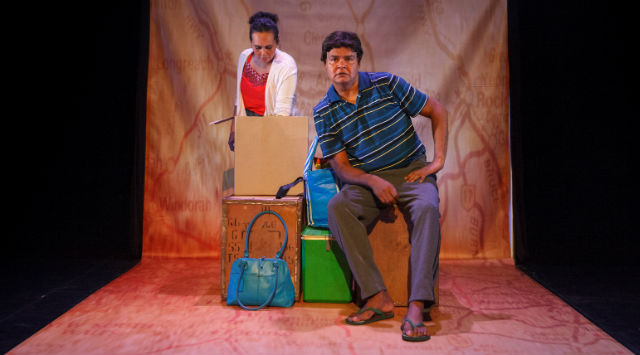
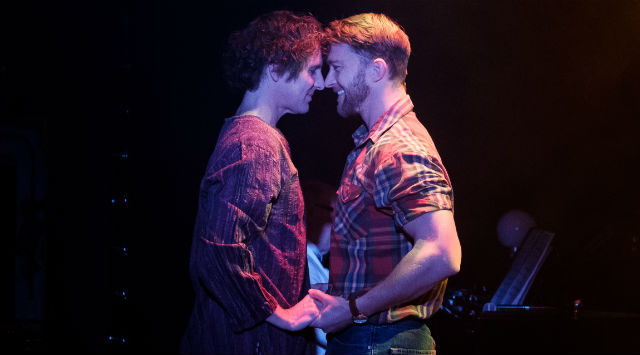
Dembe is an 18 year-old gay man living in Uganda. His family thinks of themselves as being exemplary Christians, but for many in their culture, the killing of homosexuals is not only a permissible deed, it is often exhorted to be a godly act. When Dembe falls in love, the personal and the social can no longer be reconciled. The persecutions illustrated in Chris Urch’s The Rolling Stone, are extremely cruel, but we know them to be factual. Urch pulls no punches in his storytelling; the passions are wild, whether evil or virtuous, and we are not spared the worst of human nature, even as we delve into the purest of our emotions.

Much of the play is horrifying and depressing, but an overt theatricality in the production’s tone chooses our minds over hearts, in how it wishes to keep us engaged. Adam Cook’s direction requires of us, a cerebral approach in our appreciation of his show, so that we may come to a greater understanding, of the colossal stakes at play, and of the mechanisms that drive the barbarism being depicted. The Rolling Stone steers clear of ever turning itself into torture porn, ensuring that Dembe’s conflicts and suffering are used, not for masochistic indulgence, but for a greater sociopolitical purpose.

Elijah Williams is a powerhouse leading man, completely captivating with a larger than life presence, and disarming with the extraordinary degree of vulnerability he is able to convey. Dembe’s love interest Sam, of Northern Irish and Ugandan descent, is played by Damon Manns, deeply impressive with the nuance he puts into the portrayal, of a man unable to escape the oppression he has to endure for his sexuality, in both Europe and Africa. The actor delivers remarkable dynamism and complexity, for a role that he makes wonderfully convincing.

Also very endearing is Henrietta Amevor as Naome, the young woman who has lost her voice to trauma. Amevor’s performance speaks louder than words, perfectly calibrated to tell us all we need to know of her secret story. Zufi Emerson proves herself very likeable, pairing an effortless warmth with technical precision, for a surprisingly memorable turn as Dembe’s sister Wummie. Nancy Denis and Mandela Mathia are splendid in more dramatic scenes, both bringing chilling power to the formidable malice they represent in this painful tale.

There are noteworthy technical elements in the production, including Isabel Hudson’s sophisticated take on scenic design that adopts traditional style wings to complement the show’s classic acting traits. Lights by Sian James-Holland give the stage an astonishing beauty, even when the action turns daunting. Ryan Devlin and Nate Edmondson keep music and sound design understated, but there is no denying the efficacy, and elegance, of what they accomplish.

The Rolling Stone is an important story for people of colour everywhere. LGBT activism has achieved exceptional advancements in many white communities, but whether in developing or industrialised nations, there is no question that gay liberation has thus far failed many queer people of colour. The abuse and murder of gay and trans people that occur every day, no longer make the Australian news. With the passage of marriage equality, we have convinced ourselves that the work is complete. Even if we do not wish to spare a thought for atrocities overseas, what happens in the neglected enclaves of black and brown Australia must not be ignored.

www.outhousetheatre.org

Review: Away (Bondi Pavilion Theatre)

Venue: Bondi Pavilion (Bondi NSW), Jul 4 – 7, 2018
Playwright: Michael Gow
Director: Nicholas Christo
Cast: Beth Daly, Meg Clarke, Norah George, Veronica Lang, Berynn Schwerdt, David Simes, Will Usic, Elliott Weston, James Wright
Images by Lynn Quiroz

Theatre review
Tom and his family are new immigrants to 1960’s Australia. Unlike many of their aspirational neighbours, they are content with a new residence offering a sense of freedom and egalitarianism, after having worked hard to escape the stifling mores of England. Michael Gow’s Away may not be set in 1788, but it is in some ways a story about white settlement, as we watch three white families trying to make sense of their place on this strange colonised land. They never feel completely at home, and the play urges that we attempt to find ways to explain their unrelenting anxieties and throbbing disquiet.

It is a kind of rootless existence that we witness in Away, about those who have only short histories as inhabitants of this young nation. The play opens and closes with quotations from the works of Shakespeare, as though inspiration can only be derived from old Europe; that inability and aversion to connecting with the authentic here and now, is more than a little revealing. The production however, uses A Midsummer Night’s Dream well, with the presence of Puck and other fairies underscoring much of the action, in costumes by Emma Clark that are very delightful indeed.

Director Nicholas Christo does well to introduce a dimension of ethereality whenever possible, for a magical quality that brings additional drama to the production. Not all actors are obviously suited to their roles, but it is an adequate cast that presents the show, with David Simes proving to be most endearing as both Tom and Puck. The performer is sprightly, with a charming earnestness that accompanies an admirable level of dedication he displays for the stage.

Not every work of art can stand the test of time, but there is no stopping us from new interpretations when we find them starting to wither. There is little joy in reading the same texts, in the same way, year in year out. With every revisit, tiny shifts in our culture allow us to see old things in new light. That which had been written might be characterised by a certain immovability, but the eyes that read them, can never defy the ravages of time.

http://www.waverley.nsw.gov.au/recreation/places_of_interest/bondi_pavilion

Review: Speaking In Tongues (Chippen Street Theatre)

Venue: Chippen Street Theatre (Chippendale NSW), Jun 29 – Jul 7, 2018
Playwright: Andrew Bovell
Director: Jake Ludlow
Cast: Elsa Cherlin, Dale William Morgan, Simon Thomson, Josie Waller

Theatre review
A woman disappears in Andrew Bovell’s Speaking In Tongues, but it is the relationships surrounding the incident that are its focus. It is an unconventionally structured play about ordinary heterosexual people, and through Bovell’s contorting lens, our every day is made strange to reveal the inconspicuous nature of what takes place beneath the surface. Our dysfunctions as individuals and as couples, are brought to light, refreshing but bleak in their honesty.

A team of young actors play the middle age characters of Speaking In Tongues. A noticeable deficiency in maturity is thus inevitable, but there is certainly no shortage of conviction in what they deliver. Act Two commences with the cast performing a series of monologues, proving themselves particularly engaging when working autonomously. Director Jake Ludlow’s attempts at theatrical embellishment are well-intentioned, but his strengths reside more persuasively in the production’s plainer sequences. It is a raw presentation, with a healthy quotient of promise put on clear display.

There are things we pay little attention to, that quietly engineer the way we experience the world. The personalities in Speaking In Tongues are absorbed in all their immediate concerns, but it is us, watching from the sidelines who are able to decipher the deeper implications of their entanglements. There is a missing person in the play who works as a consolidating device, but in this not unappealing piece of drama about the bourgeois, we see that everyone is lost inside their own discontentment, and come to an understanding of the triviality inherent in so much of our own suffering.

www.chippenstreet.com | www.gradco.studio

Review: Toby Schmitz Live (Old Fitz Theatre)

Venue: Old Fitzroy Theatre (Woolloomooloo NSW), Jun 26 – 29, 2018
Playwright: Toby Schmitz
Cast: Toby Schmitz

Theatre review
It is a convention in autobiographies that they involve vignettes of major significance, with important occurrences that have shaped a person’s being, occupying centre stage. Typically, one gives a recount in chronology, from a childhood that reveals background and ancestry, through to career highlights and personal triumphs, always with a healthy dose of trauma placed strategically, to elicit some sort of poignancy from its audience. In Toby Schmitz Live, an actor-slash-playwright talks about himself in a disarmingly casual manner, rejecting the obvious constraints of aforementioned assumptions, to paint a self-portrait using rules of his own determination. We obtain an impression of the artist, entirely accurate and immediate, but secrets remain undisclosed.

There might be no dirty laundry to speak of, but Schmitz’s presentation is not devoid of vulnerability. The complete absence of a fourth wall exposes the performer to intense scrutiny. We watch him manifest a mode of presentation extraordinary with its degree of naturalism; as actor, Schmitz’s ability to render invisible the devices of theatre is deeply fascinating. Early sequences seek to explore the unpredictable nature of the live form. We are reminded of its title Toby Schmitz Live, and the show seems intent on delivering just that; Toby Schmitz is live, and anything can happen. There is a degree of daring and confidence that will no doubt impress, even if Australian audiences are guaranteed to always be excessively polite.

Much of the piece feels no different to genres of stand up comedy, but Schmitz’s penchant for theatricality often rears its head. It is an effective technique, to have us let down our guard in the presence of his spontaneity, then be met subsequently, with a more dramatic approach that he so cunningly, and effortlessly, weaves through unsuspectingly. The yarns that our star spins, are thoroughly amusing, although largely inconsequential. It is his charisma, and undeniable skill, that has us invested in the storytelling, but it is unclear if many of us will find lasting relevance in what he has to share. Ultimately, it is a personal, albeit slightly surface, representation of Schmitz’s life as he knows it. We are invited to come in contact with his world for a confined moment, and we go on our separate ways, none of us transformed.

www.redlineproductions.com.au/underground

Review: Unqualified (Ensemble Theatre)

Venue: Ensemble Theatre (Kirribilli NSW), Jun 22 – Jul 21, 2018
Playwrights: Genevieve Hegney, Catherine Moore
Director: Janine Watson
Cast: Genevieve Hegney, Catherine Moore
Images by Phil Erbacher

Theatre review
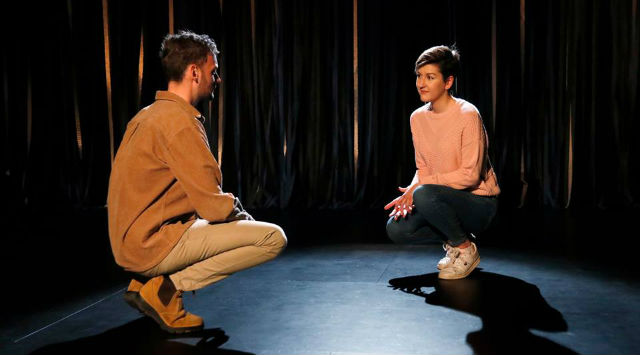
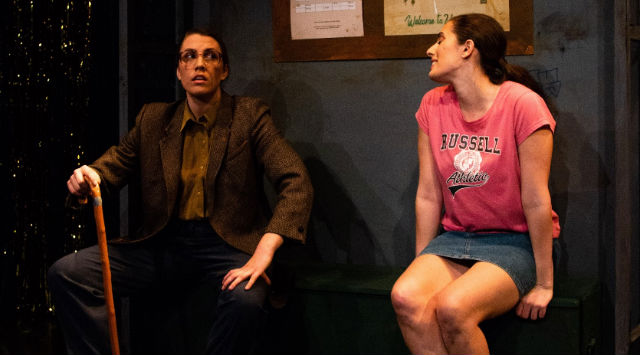
Centrelink offices are not generally considered places of serendipity, but when Felicity and Joanne meet, an unlikely and fortuitous union occurs. They join forces to set up a temping agency, creating opportunities for themselves, to leave the past behind and to become gainfully employed in a manner that gives them a new independence. Finding your own feet, however, is never an easy task. The women fly before they walk, and with a hilarity derived from their naivety, we watch them in Unqualified, fumbling and learning to come into their own.

Genevieve Hegney and Catherine Moore’s play contains a suite of excellent jokes, all stemming from a meaningful concept, involving women resisting their societal obligations as wives and daughters. Its general plot is insufficiently taut, but the show is a successful expansion of the skit format, with speedy exchanges between the two designed to provide what seems an endless amount of very clever punchlines.

The writers present their own creation, both impressive with the detail that they bring on stage, along with a sensational display of chemistry determined to hold us captive. Moore is particularly delightful as the jovial Felicity, delivering a comic performance astonishing in its efficacy, precision and inventiveness. Director Janine Watson orchestrates the action so that there is plenty of colour and movement to occupy our attention. Even when the story stagnates, we find ourselves luxuriating in the laughs that come through incessantly, and effortlessly.

Few people seem to be able go through life never having to make any sacrifices; many of us look as though we are never capable of putting ourselves first. Unqualified is a work celebrating the discovery, when it finally dawns upon us, that there is a finite amount to what we can owe, and that true fulfilment requires an individual to understand what it is that will realise their true potential. Felicity and Joanne spent many years cultivating a sense of worth, by following prescribed rules. It is satisfying to witness their moment of self-determination, as they make the decision to break free. Humour can help us through anything, but emancipation is ultimately the biggest reward.

www.ensemble.com.au

Review: They Divided The Sky (Daniel Schlusser Ensemble)

Venue: Belvoir St Theatre (Surry Hills NSW), Jun 13 – 30, 2018
Playwright: Daniel Schlusser (from the Christa Wolf novel)
Director: Daniel Schlusser
Cast: Stephen Phillips, Nikki Shiels
Images by Patrick Boland

Theatre review
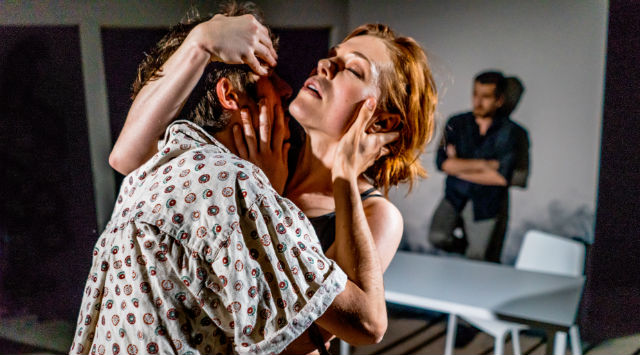
Adapted from Christa Wolf’s novel Der geteilte Himmel, Daniel Schlusser’s They Divided The Sky tells the story of Rita and Manfred, lovers in East Germany, just before the 1961 erection of the Berlin wall. Like pieces of demolished concrete scattered in the aftermath, romantic fragments constitute the play, as we wade through a recollection of events, trying to piece together truths of the past.

Politics of that era is central to the piece, but resonance is derived instead, from the personal relationship between its two characters. With mid-century German ideologies taking a backseat, we focus on the dynamics of the pair, examining the intricacies of love at a time of social unrest.

They Divided The Sky is challenging, but ultimately fulfilling, work. Schlusser’s writing and direction require of us, a deep concentration, in order that its transcendental beauty can take effect. Incisive lighting design by Amelia Lever-Davidson helps us tune in, with a degree of meditative attention, in order that we may approach the staging with a heightened sensitivity. James Paul’s sound design manipulates our emotions so that we respond accurately, on a visceral level, even when our minds are yet to figure out what it all means.

Stephen Phillips and Nikki Shiels are the wonderful actors charged with the responsibility of keeping us intrigued and invested. With an usual approach to plot structure, the play is slow to draw us in, but we are captivated from the start, by the strong presence of its cast. Individually, Phillips and Shiels are precise and cerebral with what they bring, and as a couple, their chemistry is unusually powerful. Whether subtle or intense, their energy is able to fill the stage, and in every shade of light and dark that they manufacture, we discover something special in their ephemeral theatricality.

A love is never more devastating than when it ends prematurely. In a week that has seen migrant children torn away mercilessly from their parents, we can easily imagine what it feels like to have a heart be broken, not by the object of desire, but by cruel external forces. In a world increasingly adversarial, the dreaded history of Germany in two halves serves as cautionary tale, for what could result from our appetite for strife and disunity. We can all have our own principles, but to let them get in the way of peace, is our biggest offence.

www.belvoir.com.au | www.danielschlusser.com

Review: Wyrd: The Season Of The Witch (Ninefold / PACT)

Venue: PACT Centre for Emerging Artists (Erskineville NSW), Jun 20 – 30, 2018
Playwright: adapted from William Shakespeare’s Macbeth
Director: Shy Magsalin
Cast: Aslam Abdus-samad, Erica J Brennan, Jessica Dalton, Victoria Greiner, Matthew Heys, Melissa Hume, Paul Musumeci, Gideon Payten-Griffiths, Shane Russon, Brigid Vidler, Tabitha Woo, Luke Yager, Stella Ye
Images by Liam O’Keefe

Theatre review
Wyrd is a reconstitution of Shakespeare’s Macbeth, in which the eponymous character is now a woman. Also, she no longer has a wife to blame her misdeeds on, only a coven of witches that proves to have a more intimate relationship with Macbeth than we had previously known. The conflation of dialogue originally held by the separate entities of Macbeth and Lady Macbeth, depicts a new personality that suddenly seems more believable than before. Her duplicitous nature now conveys an honesty that allows us to relate more closely with her circumstances; the ambition and guilt that define her story, increase in pertinence, since we are no longer able to perceive her sins as diffused and shared responsibility.

The production is wonderfully moody, with Liam O’Keefe’s lights and Melanie Herbert’s music providing a waking nightmare in which the action takes place. Director Shy Magsalin’s work with the ensemble is intricate and dynamic, not always elegant, but certainly very exciting at moments of high energy and sheer terror.

The trio of witches, performed by Aslam Abdus-samad, Erica J Brennan and Paul Musumeci, are thoroughly delightful, impressive with the taut cohesiveness of their offering. Gideon Payten-Griffiths appears late in the piece as Hecate to steal the show, completely mesmerising with the bold avant-garde sensibility that he brings to the stage. The inventiveness with his physicality and voice is quite extraordinary, and the show is elevated at a crucial moment, to give us some very special theatre. Macbeth, known only as Our Lady, is played by Victoria Greiner, not quite as flamboyant, but with more than enough conviction to make invigorating, this centuries-old story.

The Western patriarchal canon so powerfully instilled in us, refuses to be ignored. We can try to pretend to forget everything and foster some sort of replacement, or we can look for means of subversion that can assist with our progress. Reshaping Shakespeare to suit our times, will always contribute to the reaffirmation of his position of dominance, but when we are resolved to decipher the myriad problems of our indoctrination, we can begin to introduce meaningful transformation to how we see the world. Our master’s voice is hard to eliminate, but finding ways to expose his faults, can help set us free.

www.ninefoldensemble.com

Review: Dresden (Bakehouse Theatre Company)

Venue: Kings Cross Theatre (Kings Cross NSW), Jun 15 – 30, 2018
Playwright: Justin Fleming
Director: Suzanne Millar
Cast: Thomas Campbell, Renee Lim, Yalin Ozucelik, Dorje Swallow, Jeremy Waters, Ben Wood
Images by Clare Hawley

Theatre review
Wagner’s first success was Rienzi, an opera about the rise and fall of a medieval Italian populist leader. Hitler fell in love with the work, years after Wagner’s death, and in Justin Fleming Dresden we see the unexpected and formidable ways in which art can inspire behaviour, good and bad. It also looks at Hitler as a failed artist, and proffers a chicken and egg scenario; questioning the relationship between that infamous abominable nature and his own deficiencies at artistic creation. Even though information about contemporary fascistic regimes seem to remain prominent in our consciousness, the play does not feel immediately relevant, but Fleming’s writing exceeds the story he tells. Against a backdrop monumental and historic, his words sing with an enchanting beauty, imparting observations that are succinctly constructed and very wise indeed.

Opera and a world war, give the play a sensibility that is unavailingly grand, but the small auditorium is ambitiously converted by set designer Patrick Howe to convey the sophistication associated with Wagner’s discipline, as well as the aesthetic severity of Hitler’s Germany. Benjamin Brockman’s lights are relentlessly theatrical, with incessant transformations that move us through dimensions, from miscellaneous days of yore, to those that are even more ephemeral and fantastical. Director Suzanne Millar very deftly negotiates the weaving realms of the play, taking us from real to imaginary, across terrains and timelines, for an impressively lucid telling of tales.

Yalin Ozucelik and Jeremy Waters are the leading men, both enthralling with their respective stage presences, and splendid with the dialogue that they are master of. As Wagner, Waters is spirited yet delicate, and as Hitler, Ozucelik’s depiction of cruel imbecility strikes a perfectly balanced act of dramedy. Also memorable are Dorje Swallow and Thomas Campbell, each supporting player demonstrating excellent versatility, proving themselves to be eminently watchable in any guise.

We often hear, that all publicity is good publicity. If all Hitler had wanted from his extreme brutality, was to be remembered, then the confounding actions of people in power everywhere, can begin to make sense. Most of us wish to leave behind some semblance of a legacy, no matter how minute, so that our time on earth can be seen to be of some value. Some want their names to last, but others prefer that what they had tried to generate in their own lifetime, is able to make permanent improvements into the future. Bad people exist, and as we negotiate existence around them, we must try to stop ourselves from fighting fire with fire. Good can turn into evil in the blink of an eye, when we let our guard down and start to emulate those who wish to trespass against us.

www.bakehousetheatrecompany.com.au

Review: Marjorie Prime (Ensemble Theatre)

Venue: Ensemble Theatre (Kirribilli NSW), Jun 15 – Jul 21, 2018
Playwright: Jordan Harrison
Director: Mitchell Butel
Cast: Lucy Bell, Maggie Dence, Jake Speer, Richard Sydenham
Images by Lisa Tomasetti

Theatre review
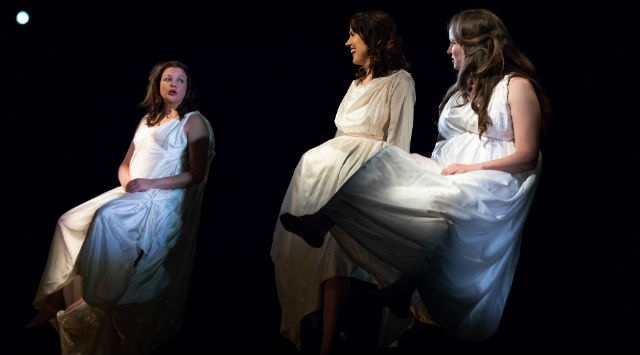
Holograms are a reality, and so is artificial intelligence. Combining the two could garner extraordinary results, and in Jordan Harrison’s Marjorie Prime, we see what happens when the memory of lost loves are calibrated through technology, and people are able to re-materialise in three dimensional pixel form. A widow speaks to her late husband, who appears to exist right before her eyes, a digital simulacra assembled from information that she provides. This is science fiction that all can relate to. Universally intriguing notions around the extension of life, is a powerful subject, but the play’s sense of drama is subdued, and its intellect seems curiously restrained.

The production is elegantly assembled, on a very fabulous set, designed by Simon Greer. Director Mitchell Butel gives us only the essentials in a remarkably low-key approach, but the text seems to offer little that is exciting, besides its initially enticing conceit. Scenes become increasingly repetitive, and we find ourselves gradually alienated from a story that struggles to progress meaningfully. Its conclusion however, is once again provocative, as it takes the plot, finally, to somewhere surprising and quite fascinating.

The show might prove underwhelming but it is a polished and professional cast that takes the stage. In the role of Jon is Richard Sydenham, whose emotions are conveyed with an admirable precision that invites us at key points, to attain truthful connection with themes being discussed in Marjorie Prime. Maggie Dence is charming and humorous as Marjorie, cleverly introducing moments of levity to prevent the piece from turning monotonously serious. Lucy Bell and Jake Speer are competent and committed to their parts, although predictable with the interpretations that they bring.

There is a heavy scepticism in the play, that relates to the synthetic portions of our high tech existence, even though it does acquiesce to the inevitable development of civilisation down the futuristic path. Technophobia should never be the default position when talking about tomorrow. We should question everything, but whenever we submit to convenient attitudes of “natural is always better,” we deprive ourselves of empirical truths. It is tempting to want things to stay the same, but the only constant, as always, is change.

www.ensemble.com.au

Review: Estelle Astaire’s Woes & Wares (Blood Moon Theatre)

Venue: Blood Moon Theatre (Potts Point NSW), Jun 13 – 16, 2018
Playwright: Bianca Seminara
Director: Bianca Seminara
Cast: Bianca Seminara

Theatre review
It is a Tupperware party, and our host is doing her best to keep us entertained. Estelle Astaire’s Woes & Wares is a one-woman show, in which a recent immigrant from New York relays the journey that had got her here. The challenges of a child living with a difficult mother, and failed love affairs of an ingenue, form an amusing biography of someone trying to come into her own. Estelle is great company, and her mother is a splendidly colourful creature, both witty and spirited, in this uncomplicated but cleverly written play, by Bianca Seminara.

For the production, Seminara serves also as actor and director, for which her abilities are evidently less accomplished. There is a charm and attractive quirkiness to the presence she brings on stage, but the lack of dynamism and drama in the performance, makes for a monotonous experience, albeit a tenaciously endearing one. Nevertheless, the hour-long show is fairly rewarding, made memorably novel by the circulation of a large number of fascinating plastic containers among the audience.

Estelle has a horrible husband, whom she tolerates in a way similar to how she had dealt with her mother. The big difference of course, is that Estelle is no longer a child, and can leave her appalling circumstances at will. Independence is essential, but to acquire the skills that will help one attain it, is always a tricky ordeal. When mothers are unable to fulfil their duty as role models, daughters often have to learn things the hard way. Estelle has yet to find her path, but we are glad to see that she is on the right track.

www.bloodmoontheatre.com