Review: The Hypochondriac (Darlinghurst Theatre Company)

Venue: Eternity Playhouse (Darlinghurst NSW), Jun 9 – Jul 1, 2018
Playwright: Molière (a new version by Hilary Bell)
Director: Jo Turner
Cast: Gabriel Fancourt, Darren Gilshenan, Sophie Gregg, Emma Harvie, Lucia Mastrantone, Jamie Oxenbould, Monica Sayers
Images by Robert Catto

Theatre review
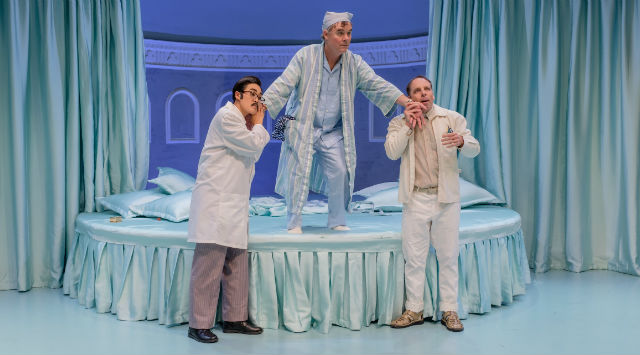
Argan is convinced that he is riddled with disease. His wife Beline, has heard it all before, and tired of waiting for his death, is now plotting to steal his entire estate without the help of sickness to deliver the goods. Molière’s The Hypochondriac is given new interpretation by Hilary Bell, who makes adjustments to the language and story for yet another generation. The essence of Molière’s farce is retained, and it proves still to be effective and very enjoyable, but a more modern sensibility is introduced, most notably in terms of its women characters, who are now full of nerve and agency.

First glimpse of the production is impressive. Designer Michael Hankin’s set is an opulent creation, gloriously lit by Verity Hampson to convey both the wealth at the centre of Argan’s story, and the traditions from which it is derived. The show however, is slow to start. Energies are subdued, and a misplaced hush pervades much of the action, even if the cast looks to be raring to go. Things do fall into place however, when an air of chaotic ruckus that so defines the genre, eventually kicks in, to replace the strange tentativeness of its beginnings.

Performer Darren Gilshenan’s marvellous comedic presence makes him the perfect candidate for Argan; he brings to the role a rare combination of precision and raw impulse, keeping us firmly on track with the plot, but always feeling as though anything could happen, as is crucial in this style of live comedy. It is a thoroughly accomplished ensemble that takes the stage, and although chemistry in-between is not yet at perfection on opening night, each player is as enthused and skilled as the next, and we find ourselves fawning over all of their colourful characterisations.

Marriage is increasingly strange a phenomenon. As we move towards ever more rational forms of existence, the fact that people hold on to that ancient practice, is quite curious. Young ones in The Hypochondriac wish to have marriage legitimise their love, whilst their older counterparts think of marriage in direct accordance with the possession of property. Love and property can exist today independent of that institution, but we cannot help returning to it, maybe for its symbolism, or maybe we are simply always in search of something to make ourselves feel better.

www.darlinghursttheatre.com

Review: Bliss (Belvoir St Theatre)

Venue: Belvoir St Theatre (Surry Hills NSW), Jun 9 – Jul 15, 2018
Playwright: Peter Carey (adapted for the stage by Tom Wright)
Director: Matthew Lutton
Cast: Marco Chiappi, Mark Coles Smith, Will McDonald, Amber McMahon, Charlotte Nicdao, Susan Prior, Anna Samson, Toby Truslove
Images by Pia Johnson

Theatre review
Harry Joy escapes a narrow death, but in the return to consciousness, he is no longer the same. Peter Carey’s 1981 novel Bliss is the story of an archetypal ad man, exemplary only in the mediocrity that he embodies, coming to the realisation that the hell he endures is in fact present in the here and now, and not a figment about a foreboded afterlife. Tom Wright’s adaptation for the stage is appropriately surreal, as Joy begins to see the absurdity of the world that he inhabits. Scenes are whimsically comedic, with a flamboyant sense of neurosis that makes for amusing theatre, but its tale of redemption feels surprisingly distant. The central concerns in Bliss remain relevant, but 37 years is a long while for us to retain meaningful identification with its plot and people.

Although little of the content has been updated for our times, director Matthew Lutton’s stylistic choices are undeniably au courant, inventive and imaginative. Sprightly, with a little acerbity, it is an energetic production, spouting clever ideas at every turn. The moral of its story can seem too basic, and obvious, but the show’s structural complexities keep us attentive. Marg Horwell’s set is a simple concept that proves highly effective in shifting dimensions, thereby conveying time and space in a dynamic manner. Paul Jackson’s big, blunt lighting transformations give us lots of delicious drama, and Stefan Gregory’s music has a quirky edge that is delightfully unpredictable.

Actor Toby Truslove is a credible leading man, especially persuasive in moments of melancholy. His quiet but confident interpretation of the play’s humour, brings a subtlety that offers refreshing juxtaposition against a lot of theatrical commotion. As Bettina Joy, Amber McMahon’s rigorous elucidations are as illuminating as they are entertaining. The performer is to be admired for the integrity she is able to introduce, to a character who is destroyed for daring to follow her bliss. Marco Chiappi and Susan Prior are memorable for the boldness of their satire, both personalities radiant and irresistibly funny on this stage.

There can never be enough stories warning us about the single-minded pursuit of money. The seductive powers of materialism seem to grow ever so exponentially, no matter how much we are told of its dangers. The all-or-nothing propositions of Bliss however, give it a quality of the parable, the kind that conclude with unrealistic resolutions that will struggle to deliver inspiration. It is easy to say that the root of all evil is money, but much harder to find an alternate undertaking, when one is deeply entrenched in the deceptive glory of gold.

www.belvoir.com.au | www.malthousetheatre.com.au

Review: Saint Joan (Sydney Theatre Company)

Venue: Roslyn Packer Theatre at Walsh Bay (Sydney NSW), Jun 5 – 30, 2018
Playwright: George Bernard Shaw (additional text by Emme Hoy, Imara Savage)
Director: Imara Savage
Cast: Gareth Davies, John Gaden, Brandon McClelland, Sean O’Shea, Socratis Otto, Sarah Snook, Anthony Taufa, David Whitney, William Zappa
Images by Brett Boardman

Theatre review
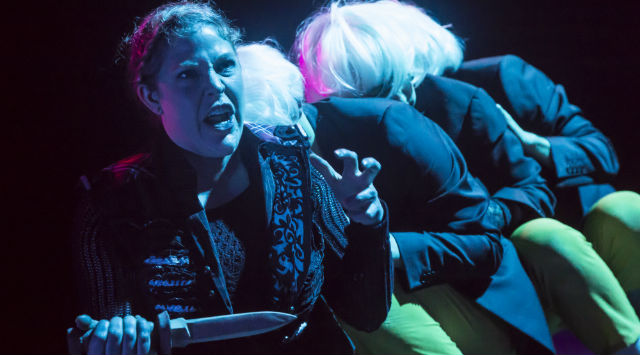
Joan of Arc never even made it to her twenties. Executed at the age of nineteen, her story represents the worst of our misogyny, and in director Imara Savage’s version of George Bernard Shaw’s play, that absurd fear of powerful women is given elucidation, as we see state and religion go to great lengths to exterminate Joan, so that the threat that she poses to the patriarchy is banished. In Saint Joan, instead of the usual veneration and idolatry, a war hero is swiftly and mercilessly taken down, for the sole reason of her gender.

Men can have daring ambition and resolute faith, but in a girl, those qualities are turned into the charge of heresy. Shaw’s original vision proclaimed “no villains in the piece,” but Saint Joan is, on this occasion, thoroughly subverted, to expose the inhumanity of forces we hold in reverence, of those so much power is lavished upon. Church and government do not get off scot-free in this rendition of Joan’s legend. Their guilt in the historical episode, is brazenly exposed. Our father figures are rightfully condemned, made to own up to the brutal murder of an heroic warrior.

Full of passion, the work is powerful and gritty, made spectacularly riveting by the presence of its leading lady. Sarah Snook is an unequivocal sensation in the role, equally intense whether depicting vulnerability or majesty, marvellously incisive with the delivery of each line. She conveys meaning and emotion with admirable depth and a disarming authenticity, having us pining for her every artistic bestowment. Her interactions with the cast are replete with chemistry, and the men (all other players here are the culpable masculine) bring generous support, often brilliantly engaging in their own right.

David Fleischer’s set design is a restrained, highly sophisticated evocation of our traditional institutions, with a heavy curtain that encapsulates all that is required to express a simultaneous sense of awe and oppression. Lights by Nick Schlieper and sound by Max Lyandvert, take us through atmospheric and spatial transitions with admirable precision, manipulating our instinctual responses with great dexterity, so that our attention is focused always and only, on the exact resonating point.

Evil has a knack for hiding in plain sight. What was once a story about men being dutiful, is today revealed to be a site for the unravelling of abhorrent systems that thrive on ruthless subjugation. Where we were once entangled in the ambiguity of Joan’s assertions and behaviour, we can now depart from the doctrines that had given justification for the unforgivable persecution of a girl who had done nothing wrong. Corrupting forces will remain, but our ability to act virtuously with courage, truth and justice, is forever in ascension.

www.sydneytheatre.com.au

Review: Snap*Click*Shot (Karul Projects)

Venue: PACT Centre for Emerging Artists (Erskineville NSW), May 25 – Jun 2, 2018
Choreographer and composer: Thomas E.S. Kelly
Cast: Jessica Holman, Thomas E.S. Kelly, Libby Montilla, Amalie Obitz, Taree Sansbury, Kassidy Waters

Theatre review
Accompanying the dance, is a recorded narration about ecology. It provides an Indigenous perspective on our relationship with the environment, particularly memorable for its musings about our responsibilities as custodians of the planet. The message in Thomas E.S. Kelly’s Snap*Click*Shot is sombre, but unifying.

The bodies in motion are simultaneously human and animal, soil and vegetation; the false points of demarcation that separate us are dissolved, for an expression of our existence that is all-encompassing. This is a summation of events that sounds excessively romantic, but when immersed, the show feels authentic, convincing in its depiction of nature as wholistic and incontrovertibly linked to the human experience.

Kelly’s work, as choreographer and composer, is sensitive yet disciplined, elegant yet dynamic. His ability to place in tandem opposing qualities, the hard with the soft, creates a sense of drama that keeps us engaged. It is a strong team of dancers, extraordinarily cohesive, and impressive in their familiarity with Kelly’s idiosyncratic physical language. Their presentation is confident, and very well-rehearsed, with an inexhaustible vigour that fills the auditorium. Costumes and lights are however, inadequately conceived, resulting in imagery that is needlessly monochromatic and repetitive.

At the production’s conclusion, we congregate in a circle, eyes closed, sharing in a moment of silent meditation. Our insecurities from being exposed thus, reach for reassurance, and we find camaraderie in that unusual instance of connection. We often think of independence as a virtue, but it is a falsehood to conceive of any life detached. It is vanity that separates, and narcissism that fuels oppression. The simple exercise of acknowledging others as equals will solve many problems, but we rarely rise to that challenge.

www.karulprojects.com

Review: Arthur & Marilyn (Dinosaurus Productions)

Venue: Blood Moon Theatre (Potts Point NSW), May 29 – Jun 2, 2018
Playwright: Jasper Lee-Lindsay
Director: Danen Young
Cast: Meg Hyeronimus, Alec Ebert

Theatre review
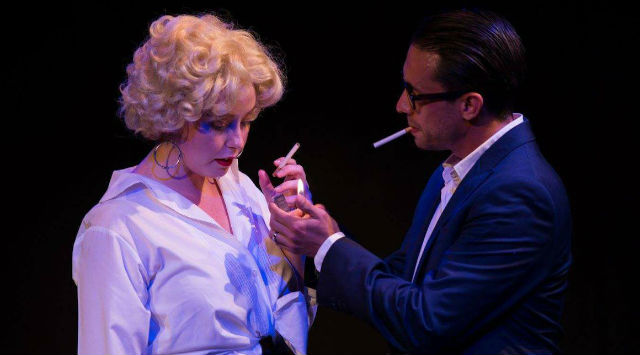
Marilyn Monroe and Arthur Miller, both legends in their own right, are significant not only for the work they had left behind, but as is typical of bona fide celebrities, their personal stories, whether real or fabricated, determine how we remember them generations on. The couple fell in and out of love, against the romantic backdrop of Hollywood in the 1950s. In Jasper Lee-Lindsay’s Arthur & Marilyn, each party is risen from the dead, and the consummate storytellers are called upon to give us their version of that famous love affair.

Dialogue is scintillating in the two-hander, with an admirable authenticity to its depiction of a lulling time and space that has us fascinated and seduced. Actors Meg Hyeronimus and Alec Ebert are an enchanting pair, accurate in voice and physicality for a convincing portrayal of mid-century America. Hyeronimus is wonderful as Marilyn, conveying not only the iconic vulnerable glamour that most of us are familiar with, but also adding a dimension of wilfulness and confidence that makes this iteration seem, perhaps strangely, even more genuine than the original.

The plot of Arthur & Marilyn is imperfect, unable to cultivate an emotional journey with enough potency that can live up to the sentimental value we hold for its subject matter, but levels of intensity for the production, is cleverly controlled by director Danen Young, and our attention is sustained to the end.

Relationships can be kept beautiful, if we are able to concede when their time is up. Longevity of marriages are venerated in polite society, but like so much of life, we learn ultimately that it is the quality, and not quantity, of things that should be valued. Monroe and Miller never had a “happily ever after”, but the many sweet moments that they did have together, represent their very best days on earth.

www.bloodmoontheatre.com | www.facebook.com/DinosaurusProd

Review: Stalking The Bogeyman (Old Fitz Theatre)

Venue: Old Fitzroy Theatre (Woolloomooloo NSW), May 23 – Jun 23, 2018
Playwrights: David Holthouse, Markus Potter (additional writing by Santino Fontana, Shane Stones, Shane Ziegler)
Director: Neil Gooding
Cast: Noel Hodda, Radek Jonak, Deborah Jones, Graeme McRae, Alexander Palacio, Anne Tenney
Images by John Marmaras

Theatre review
David was raped at the age of seven. The damage that follows is unimaginable, and the vigilante action he plans to carry out is understandable, even if some of us will no doubt have misgivings about his intentions to kill. In Stalking The Bogeyman, we are not asked to pass judgement on David’s decisions, but to witness the repercussions of sexual assault, especially as it pertains to the very young. Incidents that take place over several minutes, cause reverberations that last a lifetime. We meet David 25 years after the fateful night, and his struggles are unabated.

With these extraordinary stakes at hand, the play is appropriately enthralling; we are desperate to see how the story concludes. Not only do we want to know, how and if the characters find resolution, it is important that we discover what it is, that our societies would consider to be the right thing to do. In the creation of this play, our values are placed under magnification, and we hope for it to tell us more about ourselves that we may not already know.

It is an engaging production, with Neil Gooding’s restrained direction keeping things concise and clear. Ideas in Stalking The Bogeyman are simple, and powerfully conveyed on this stage. Leading man Graeme McRae’s vulnerability as David is a vital component, that preserves our empathy comprehensively, through every step of the proceedings. The eponymous bogeyman is played by Radek Jonak, whose portrayal of malevolence is as impressive as the electrifying energy he introduces with each appearance.

The play ends on an abrupt, and perhaps anticlimactic note. The drama fizzles out, but as it is “based on a true story” we appreciate the honesty of its divulgements. It is true, that when disaster strikes, we are rarely able to procure redress or compensation that is ever going to be satisfactory. That which cannot be undone, requires that victims find ways, often radical in nature, to make their daily existences bearable. Many even more unfortunate, have suffered annihilating consequences. Another day will dawn, if only for battling the lingering shadows of yesterday.

www.redlineproductions.com.au

Review: Obscene Madame D (Theatre Kantanka)

Venue: 107 (Redfern NSW), May 23 – 27, 2018
Novelist: Hilda Hilst
Director: Carlos Gomes
Cast: Katia Molino
Images by Heidrun Löhr

Theatre review
Surrounded by death and dereliction, Madame D is plunged into a deep isolation, where she finds herself examining the meaning of her existence, after suffering the recent bereavement of a longtime companion. Still shaken from the sudden loss, her thoughts are incoherent but belligerent, and her behaviour is increasingly erratic. Her neighbours are perturbed, and so are we. Obscene Madame D is unsettling, an avant-garde work that is unafraid of confusion, determined to embrace the strange and difficult, in its exploration of life at its outer peripheries.

The space is charged with a sense of wonderment, as though something esoteric has taken over Madame D’s depressed home and mind. Video projections by Sam James and lights by Fausto Brusamolino create a gloomy but seductive atmosphere; we never feel at ease, but this mysterious intrusion into Madame D’s sanctuary is a hauntingly beautiful experience. Gail Priest’s music and sound are heard through headphones, so that all the secrets are presented with immediacy, and intimacy, although what we are presented with, never seem to be more than clues or deflections.

Directed by Carlos Gomes, who orchestrates something enchantingly unique for his audience, often intriguing with its penchant for rousing curiosity, though its ability to hold our attention is inconsistent. In the absence of a strong narrative, we drift through dream states, not all of which pertain to the show in progress. Performer Katia Molino cuts a glamorous figure, mesmerising even in various states of dishevelment. In the middle of all the tangential statements, Molino’s unflappable presence provides a reliable centre, that our imaginations can retreat into, and interpretations can be formulated.

When we meet Madame D, it is as though she is encountering freedom for the first time. In pain from the shock of a new independence, she now has to define the world for herself. No longer the passive half of a partnership, Madame D must finally grow up, and as an older woman, the process is understandably excruciating. It is an inevitable metamorphosis, one that can only be unpredictable, but that will ultimately be rewarding, if only for the brutal authenticity that it delivers.

www.107.org.au | www.kantanka.com.au

Review: The Walworth Farce (Workhorse Theatre Company)

Venue: Kings Cross Theatre (Kings Cross NSW), May 18 – Jun 9, 2018
Playwright: Enda Walsh
Director: Kim Hardwick
Cast: Rachel Alexander, Laurence Coy, Robin Goldsworthy, Troy Harrison
Images by Clare Hawley

Theatre review
Inside a small London apartment, Dinny and his adult sons spend every day acting out a complicated farce, so that the best performer may win a trophy, and that Blake and Sean may remember their early days in Ireland, but only in a way that Dinny permits. It is an account of events that is absurd and dense, designed so that his sons’ memory of their collective biography, is doctored and confused.

Dinny has a lot to hide, and because Blake and Sean are a part of his confections, they are kept under strict control, even if both have well and truly arrived at adulthood. This is a story about parenting, and about the diaspora of cultures that every city experiences. It is about the relationships between countries, and the way individuals are affected by the boundaries we draw in the demarcation of national differences. Enda Walsh’s The Walworth Farce is unquestionably meaningful, but some of the play’s more culturally specific aspects, can prove impenetrable and tedious.

It is a tenaciously exuberant production, directed by Kim Hardwick who leaves no stone unturned in this complex work. There is a lot that goes on in every moment, and Hardwick’s eye for detail demands that we engage with her show in a way that is complex and nuanced. The very lively cast gives a generous performance, energetic and rich with spirit and inventiveness. Troy Harrison is particularly wonderful as Sean, the older brother on the precipice of discovering a new life. It is a plethora of emotions that emerge from the actor, conflicting yet distinct, allowing us to decipher the fundamental underlying truths that are in operation, amidst the constant vociferous hullabaloo.

As immigrants, we often find ourselves having to create narratives when required to explain how we have come to be. The tales that we weave are seldom the complete story, because the action of moving from one’s hometown, to somewhere entirely new, will always involve layers of intricacies that seem impossible to encapsulate in a convenient way. How we think of the past, is key to how the future looks. When we are unable to be honest about the journey before today, what happens hereafter, can only be fraudulent.

www.workhorsetheatreco.com

Review: Blackie Blackie Brown: The Traditional Owner Of Death (Sydney Theatre Company)

Venue: Wharf 2 Sydney Theatre Company (Walsh Bay NSW), May 12 – Jun 30, 2018
Playwright: Nakkiah Lui
Director: Declan Greene
Cast: Ash Flanders, Megan Wilding
Images by Daniel Boud

Theatre review
Dr Jacqueline Brown is a mild-mannered archaeologist, who spends her days looking for evidence of the Australian past. Aboriginal histories are often kept buried, so it only makes sense that she should take matters into her own hands, in order that the primal urges to connect with her cultural heritage could find gratification. Learning that some of one’s family had been subject to genocide however, will have quite extreme effects on any person’s psyche. Nakkiah Lui’s Blackie Blackie Brown: The Traditional Owner Of Death charts the rise of a new superhero. A parody of blaxpolitation and Hollywood superhero films, the play depicts the underdog’s ascent and revenge, in a wildly fantastical setting typical of those genres.

Inspired by 70s blaxploitation tropes, antagonists in Blackie Blackie Brown are characterised as the white establishment, but more radical is its requirement that we see regular white folk, those we are conditioned to think of as “ordinary Australians”, as the enemy. In our heroine’s audacious mission to kill 400 white people, each individual’s sins and transgressions fade into irrelevance, and we have to confront instead, the legacy of illegitimate occupation, and the ongoing usurping of space and privilege, by the ruthless project of white supremacy, to which this nation has fallen prey over the last two-and-a-half centuries.

The message is a hard one to swallow, for the predominantly white audiences who will find themselves directly and personally castigated, but as with all good works of comedy, it is the humour that provides magical mollification, as though its sense of absurdity provides relief from the harsh truth. The laughter that Blackie Blackie Brown delivers, is relentless and uproarious. Lui’s very astringent jokes are cutting, sometimes controversially so, offering its players plentiful opportunity to raise temperatures in the auditorium.

Megan Wilding is a mesmerising leading lady, effortlessly alternating between the earnest vulnerability of Dr Brown and her alter ego Blackie Blackie Brown’s extravagant vivacity. The character’s barbarous adventures could easily have us turning against her, but Wilding is impossible to dislike. Full of charm, and with a striking presence, we devour all that she brings, whether madcap, or profoundly authentic. In accompaniment is the high camp stylings of Ash Flanders, equally endearing in a range of screwball guises, each one hilarious and wonderfully inventive.

The pair is well-rehearsed, for an intricate production that involves extensive use of visual projections (animated by Oh Yeah Wow, designed by Verity Hampson), allowing the show to leap across spaces, geographical and metaphysical, with great efficiency. Filmic influences, particularly in relation to the cartoonish violence being portrayed, are cleverly incorporated in this live meets video amalgamation, by director Declan Greene, whose vision seems boundless in its daring and grandness. Also marvellous is the work on sound by Nate Edmondson and Steve Toulmin, who keep adrenaline pumping for the duration of the piece, having us under control with an exquisite blend of sounds that seems to have direct authority over our viscera. Technical aspects although not entirely flawless, are complex and precise, and there is no denying the scale of ambition necessary for this show to come together; the stage management team is worthy of commendation.

There are few places where minorities can speak freely about their own oppression. The nature of the beast determines that those under the thumb, are well-behaved and polite in the presence of their oppressor, or risk having to suffer even greater abuse. Art has the ability to let all voices be heard. A society that believes in art, will allow a space for a kind of honesty that other spheres are unable to withstand. Art encourages communication in ways that are truthful, and compensate where regular language proves deficient. To kill 400 innocent white people is a ridiculous proposition that anyone would disregard, but to be able to understand the idea beyond the literal, would bring us deep into a discussion that Australians need to have.

www.sydneytheatre.com.au

Review: Priscilla Queen Of The Desert (Capitol Theatre)

Venue: Capitol Theatre (Sydney NSW), May 13 – Jul 19, 2018
Book: Stephan Elliott, Allan Scott
Director: Simon Phillips
Cast: Lena Cruz, Euan Doidge, Robert Grubb, George Holahan-Cantwell, David Harris, Adèle Parkinson, Emma Powell, Tony Sheldon
Images by Ben Symons

Theatre review
Priscilla Queen Of The Desert is an iconic work about homophobia, or more accurately, the resilience of LGBT people in Australia, who have managed to grow from strength to strength against all odds, in the face of pervasive, persistent and severe prejudice. The bus takes our three protagonists across the breadth of half the continent, encountering abuse and humiliation at every stop. To watch spirited people triumph over obstacles and injustice, is always gratifying, but to see it all happen in a musical with shiny twentieth-century pop tunes, is quite the sensation.

There is much to love about the show. Brian Thomson’s production design, Tim Chappel and Lizzy Gardiner’s costumes and Ben Moir’s wigs, are all spectacular and unabashedly flamboyant, a real feast for the eyes, in a theatrical moment that provides an escape from our beige humdrum. The central story that reunites a gay man with his young son, is thoroughly moving, a soulful addition to the already poignant and universal narrative, of having to live out one’s own truth. The original film, on which the musical is based, is however, well over two decades old, and the baggage of its sexist and racist dimensions have only become more pronounced with time. Theatre, unlike the format of the motion picture, is capable of endless evolution. It is understandable that the biggest gags of the film have to be retained, but their political incorrectness require a degree of modulation or better yet, radical revisions, which the production conveniently disregards.

One can think of many women, bankable stars of the stage, who would be perfect for the role of Bernadette, but Tony Sheldon is once again cast as the Sydney local trans legend. He is precise and polished, an incandescent presence, but we are now in a new age of trans identities, and misgendering of this nature, is distracting, and certainly no longer acceptable. Euan Doidge is interminably effervescent, and breathtakingly beautiful, as Felicia the younger drag queen who learns things the hard way. His abilities as singer and dancer are thrilling to witness, and there is no denying the relief in seeing a person of colour as a lead, in a show known for its history of excruciating ethnic representations. The infamous ping pong scene is kept intact, but Lena Cruz’s feisty performance as Cynthia has us cheering for the character’s sense of liberated and vibrant autonomy.

David Harris cuts through the noisy glitz as Tick, impressive in his ability to convey emotional intensity, for several scenes that help prevent the show from disintegrating into meaningless froth. The father-son chemistry in later sequences are unforgettable, with fabulous child performer George Holahan-Cantwell offering the perfect balance, especially moving in the “Always On My Mind / I Say A Little Prayer” number, delivering a genuine instance of delicacy, in the midst of all things bold and brassy.

The show opens in Sydney officially, and auspiciously, on May 17, International Day Against Homophobia, Transphobia and Biphobia 2018. This year, same-sex couples in Australia are finally able to marry, and the gay rights movement finds itself approaching the culmination of its objectives. In Priscilla, the prejudices on display that are most agonising, are no longer about gay men. It is time to look at the behaviour on the Australian stage, towards trans people and ethnic minorities. These may just be unintended sub-plots of a show that bears our national pride, but the passage of time can turn things from well-meaning to wilful neglect. We all wish to belong, and those who are no longer the pariah, should know to work for a bigger expanse of inclusivity and unity.

www.priscillathemusical.com.au