Review: Travelling North (Sydney Theatre Company)

rsz_398087-6086798c-83c3-11e3-b691-c4bd5b62f2b6Venue: Wharf 1 Sydney Theatre Company (Walsh Bay NSW), Jan 10 – Mar 22, 2014
Playwright: David Williamson
Director: Andrew Upton
Actors: Alison Whyte, Bryan Brown, Harriet Dyer, Russell Kiefel, Emily Russell, Andrew Tighe, Sara West

Theatre review
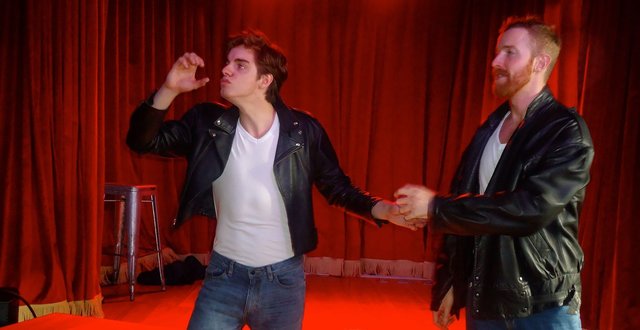
David Williamson’s 1979 play about a Melbourne couple moving up north, finds new life with the Sydney Theatre Company. Andrew Upton once again focuses attention on people and stories, and keeps visual design to a minimum. Set and props are rendered virtually invisible, except for an effective three tiered curved stage reminiscent of Australian landscapes. Upton’s direction brings out the realism of relationships and characters, creating everyday personalities that we are able to identify and relate to easily. There is a tendency for Williamson’s concepts to appear overly mundane as a result of Upton’s minimalist vision, but the production is kept buoyant by a healthy dose of humour that thrives in the midst of its pervasive simplicity.

Bryan Brown is miscast as the elderly Frank. Brown is charming, handsome and carries an air of magnificence that is completely at odds with the story about a sick man at the end of his days. We love his performance, which is always funny and sometimes poignant, and we understand everything his character goes through, but ultimately Brown’s celebrity gets in the way of the depiction of a regular old “cobber” we should feel sorry for.

Alison Whyte plays Frances with a lovely balance of strength and gentility, and while her role makes life choices that might not be entirely clear, the actor manages enough conviction and solidness to sell us her story. Noteworthy in the support cast include Harriet Dyer who does not miss any opportunity for comedy, and Andrew Tighe who makes good use of his physicality and costumes to carve out a very memorable character. Tighe brings authenticity and lightness to the production, and we anticipate his every appearance.

The relevance of Travelling North‘s staging today is not immediately relevant. Its themes of family, marriage, ageing, and seachanges unify many of our lives, but this 35 year-old play struggles to make a fresh statement about the Australian experience. It does, however, showcase some of our idiosyncrasies as a people, and is an occasion for us to excel at quite a bit of self-deprecating humour.

www.sydneytheatre.com.au

Review: Noises Off (Sydney Theatre Company)

noisesoffVenue: Sydney Opera House (Sydney NSW), Feb 17 – Apr 5, 2014
Playwright: Michael Frayn
Director: Jonathan Biggins
Actors: Alan Dukes, Lindsay Farris, Marcus Graham, Ron Haddrick, Danielle King, Genevieve Lemon, Tracy Mann, Josh McConville, Ash Ricardo

Theatre review
Sydney Theatre Company’s new production of the now classic farce, Noises Off, is comedy at its broadest. This comedy of errors is not sophisticated in concept but its execution under the directorship of Jonathan Biggins is highly accomplished and outlandishly dynamic. From men falling off staircases to women sitting on sardines, and girls in gartered lingerie to boys in bell bottoms and mullet hair cuts, Biggins approaches Frayn’s 1982 work with the most basic of motivations. He wants to make us laugh, and he is determined to pull out all the stops to make it happen.

The cast Biggins has assembled shares his vision. They show no qualms in playing for laughs at every available opportunity, which means that not all characters are clearly defined, and some plot lines get lost in all the mayhem, but the entertainment value of their show is guaranteed. Josh McConville as Roger/Garry impresses with his athletic agility and the most exaggerated physical gags in the production. The volume of his performance sets the standard for how extravagant the actors can go on that stage.

Tracy Mann plays Flavia/Belinda with more subtlety, but her use of voice is strongest in the cast. The excessively, and comically, stagey English accent from the era not only assists with a more distinct characterisation, its overt articulation actually provides clarity to the many twists and turns that occur in the busy story. Ash Ricardo as the Vicki/Brooke “bimbo” characters triumphs in spite of the restrictive and narrow scope given. Her energetic interpretation brings a fresh edginess, and the running joke about her contact lens is a big crowd pleaser. Marcus Graham, usually known for dramatically serious roles, is surprisingly effective as Lloyd. Like the rest of the cast, his enjoyment of the show is genuine, and infectious.

Laughter is the best medicine. Theatre goers can often be an uptight bunch. Jonathan Biggins’ Noises Off forces us to open up and it speaks to a different part of our minds. Like the brilliant extended section in Act 2 where virtually no words are spoken, but the biggest laughs are heard, our senses are kept busy. We work overtime to keep up, not with lines and ideas, but by observing all the funny unfold and responding with the thoroughly visceral, and biological, guttural guffaws from deep within… that space which is too often hidden away from the light of day.

www.sydneytheatre.com.au

Review: Everything I Know I Learnt From Madonna (Tunks Productions / Sydney Independent Theatre Company)

rsz_1899685_623939144321658_1856255859_oVenue: Old Fitzroy Theatre (Woolloomooloo NSW), Feb 18 – 22, 2014
Playwright: Wayne Tunks
Director: Fiona Hallenan-Barker
Actor: Wayne Tunks
Image by Katy Green Loughrey

Theatre review
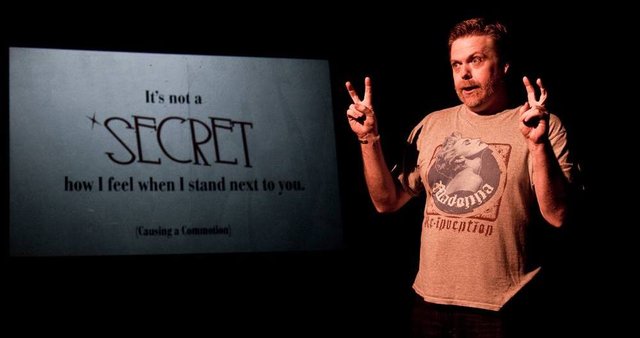
Madonna, the pop star, means many things to many people. Like many brassy women in the public eye, she is regarded by gay communities as an icon. An outspoken proponent of the gay movement since the early 1990s, it is understandable that her place with LGBT people has endured the years. In this one-man play by Wayne Tunks, he talks about his obsession with Madonna in the introduction, then goes on to share with us his stories of coming out and relationships with various men, liberally quoting lyrics by his hero at every available opportunity. His script is an interesting one. It is almost as if Tunks is unable to verbalise his thoughts and feelings without the aide of Madonna songs, so her words keep appearing in his monologue, sometimes seamlessly, sometimes a little forced, but it is no doubt that his admiration is beyond skin deep, and that her work actually provides a space of solace. It looks a lot like religion.

Tunks is an actor full of vigour. He appears on stage and is determined to seize your attention, and for the entirey of his performance, we pay close attention to his stories. It helps that Tunks’ voice is commanding and versatile. It is naturalistic acting but there is definitely not a hint of mumbling, everything is said loud and clear, which is fortunate as the bareness of the staging and minimal direction of the near two hour work, leave nothing else for Tunks and his audience to hold on to.

The show overflows with earnestness. For a seemingly shallow premise of pop star fandom, it contains no irony and very little frivolity. We are presented love stories with a string of men, Sean, Warren, Guy, Jesus, and (presumably) Brahim. They are not particularly colourful events, in fact, slightly mundane. There isn’t really a set up of context, just a man keen to share with a captive crowd, and we are inspired by his fighting spirit that never gets dampened by failed relationships. He keeps getting back in business as though nothing’s better than more because ultimately, what can you lose?

“You’re never gonna see me standin’ still, I’m never gonna stop ’till I get my fill” (Over And Over, Madonna 1984).

www.tunks.com.au

Review: The Night Larry Kramer Kissed Me (Lambert House Enterprises)

rsz_1796028_10202558976807602_539984011_oVenue: Ginger’s Oxford Hotel (Darlinghurst NSW), Feb 19 – 27, 2014
Playwright: David Drake
Director: Kynan Francis
Actors: Ben Hudson, James Wright

Theatre review
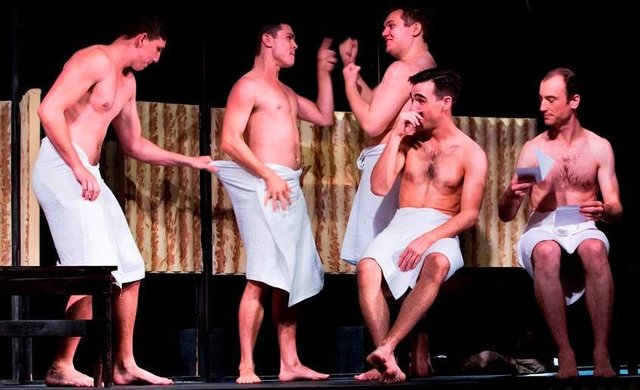
American playwright and actor David Drake’s 1994 one-man play is revived to coincide with the Sydney Gay & Lesbian Mardi Gras 2014 season. This time, Australian director Kynan Francis casts two actors, makes several updates to the script, and chooses a cabaret style venue to stage a radical re-telling of a piece of radical writing. Drake’s work from the post-ACT UP era was fresh and optimistic, arriving at a time when the shock of the AIDS epidemic had begun to subside, and communities were galvanised and empowered. A new gay identity had emerged, characterised by a buoyancy that had previously remained elusive. The Night Larry Kramer Kissed Me is an important work that represents this transformation. It remembers the horrors of a time of closeted secrecy and overt persecution, but articulates a vision of the future of equality and emancipation.

Ben Hudson is the more sure footed of both actors. He exhibits a close affiliation with the themes of the work, with a performance that is stirringly passionate and authentic. There is no question that Hudson would have been able to carry the show on his own, but Francis’ decision to partner him up is not an unwise one. While James Wright is less experienced, he holds his own. Like a young brother following closely behind, he completes the picture, and adds more to the production that is immediately evident. Both are brave yet vulnerable, and both understand the weightiness of the material they have taken on. There is a lot of careful reverence and sensitivity in this production, giving it an uplifting and beautiful spirituality.

Francis’ direction is deep and meaningful. His thorough familiarity with the script and its contexts ensures that every scene, moment and nuance is depicted with emotional accuracy and poignancy, and with political impact. The use of two actors effectively portrays the bonds between gay men, as brothers, lovers and compatriots. Some of this work is very moving. There is also technical brilliance on show, particularly with the performance of an extended section set against music. For a production of such small scale, it is surprisingly, and impressively, well rehearsed.

In 1994, the idea that all adults will one day be able to marry equally in the eyes of the law was hard to imagine. Our battles today might feel arduous and frustrating, but The Night Larry Kramer Kissed Me shows just how far our society has progressed. The play ends in the year 2020, when Oklahoma becomes the final USA state to legalise same-sex marriage. We are now 6 years away from that fictitious moment, and things seem altogether more hopeful and brighter than ever before.

www.facebook.com/…

Review: Once In Royal David’s City (Belvoir St Theatre)

rsz_auditorium-onceinroyaldavidscityThis review first published in Auditorium Magazine (Spring 2014)

Venue: Belvoir St Theatre (Surry Hills NSW), Feb 8 – March 23, 2014
Playwright: Michael Gow
Director: Eamon Flack
Actors: Helen Buday, Brendan Cowell, Maggie Dence, Harry Greenwood, Lech Mackiewicz, Tara Morice, Helen Morse, Anthony Phelan

Theatre review
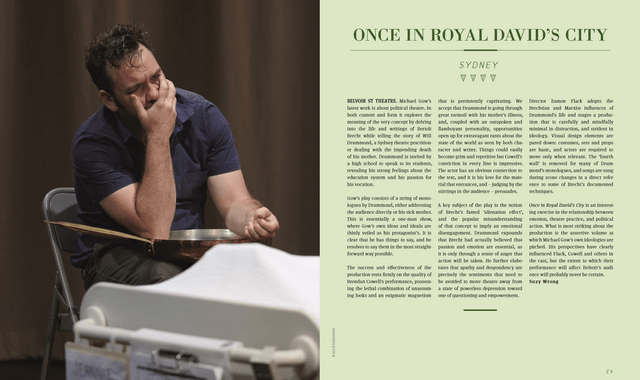
Michael Gow’s latest work is about political theatre. In both content and form, it explores the meaning of the very concept by delving into the life and writings of Bertolt Brecht, and by telling the story of Will Drummond, a Sydney theatre practitioner dealing with the impending death of his mother. Drummond is invited by a high school to speak to its students on the very topic of political theatre, revealing to us Drummond’s strong feelings about the education system and his passion for his vocation.

Gow’s play consists of a string of monologues by Drummond, either addressing the audience directly, or his sick mother who sleeps through his speeches. Minor characters appear sporadically to assist with plot trajectories, but they exist mostly to illustrate Drummond’s points of discussion. This is essentially a one-man show, where Gow’s own ideas and ideals are thinly veiled as his protagonist’s. It is clear that he has things to say, and he resolves to say them in the most straightforward way possible.

Brendan Cowell is the leading man, and the success and effectiveness of the production rests firmly on the quality of his performance. Cowell possesses the lethal, and contradictory, combination of unassuming looks and enigmatic magnetism. He plays the down-to-earth regular guy with ease, but has a star quality that is persistently captivating.

Cowell plays up his character’s theatricality. We accept that Drummond is going through great turmoil with his mother’s illness, and coupled with an outspoken and flamboyant personality, opportunities open up for impassioned and extravagant rants about the state of the world as seen by both character and writer. Things could easily become grim and repetitive but Cowell’s conviction in every line is impressive, and believable. The actor has an obvious connection to the text, and it is his love for the material that makes us listen, and judging by some of the stirrings in the audience, possibly even persuasive.

A key subject of the play, is the notion of Brecht’s famed “alienation effect” from the original “verfremdungseffekt”, and the popular misunderstanding of that concept to imply an emotional disengagement. Drummond, in his school lecture, expounds that Brecht had actually believed that passion and emotion are in fact important, as it is only through a sense of anger that action will be taken. He further elaborates that apathy and despondency are precisely the sentiments that need to be avoided, and that theatre needs to move away from a state of powerless depression, toward one of questioning and empowerment.

Director Eamon Flack adopts the Brechtian and Marxist influences of Drummond’s life, and stages a production that is carefully and self-awaredly minimal in distraction, and strident with its ideology. Visual design elements are pared down. Lighting is fairly sophisticated, but costumes, sets and props are basic, and only engaged when necessary. Actors are required to be still, only moving when relevant. The “fourth wall” is removed for many of Drummond’s monologues, and songs are sung during scene changes as direct reference to some of Brecht’s documented techniques.

Once In Royal David’s City is an interesting exercise in the relationship between emotion, theatre practice, and political action. We see a theatre director gradually becoming more socially active through his work, as his personal circumstances turn increasingly emotional. This is not entirely convincing as a storyline, but what is most striking about the production is the assertive volume at which Michael Gow’s own ideologies are pitched. His perspectives have clearly influenced Flack, Cowell and others in the cast, but the extent to which their performance will affect Belvoir’s audience can probably never be certain.

www.belvoir.com.au

Review: Privates On Parade (New Theatre)

rsz_1069838_594783037267230_490878940_nVenue: New Theatre (Newtown NSW), Feb 11 – Mar 8, 2014
Playwright: Peter Nichols
Music: Denis King
Director: Alice Livingstone
Choreographer: Trent Kidd
Actors: Matt Butcher, Jamie Collette, Peter Eyers, David Hooley, Morgan Junor-Larwood, James Lee, Henry Moss, David Ouch, Diana Perini, Martin Searles, Gerwin Widjaja
Image by Bob Seary

Theatre review
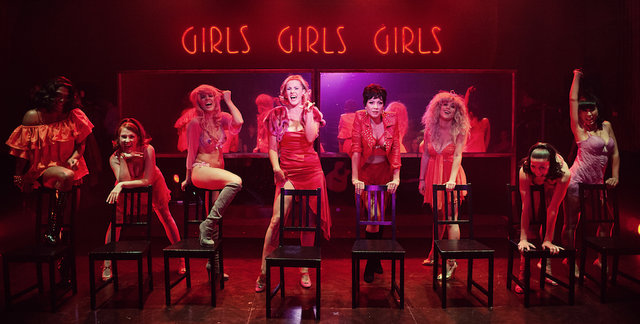
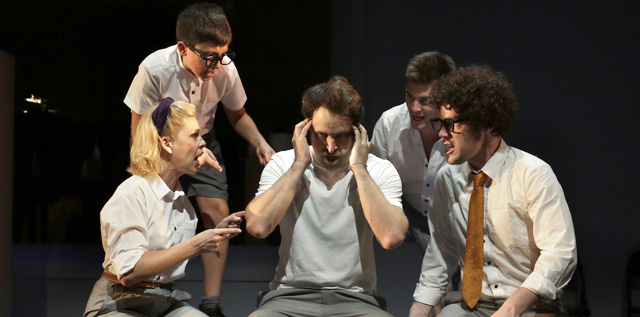
Written in 1977, this “play with music” appeared just two years before the inaugural Sydney Gay & Lesbian Mardi Gras parade. It contains some of the earliest progressive depictions of same sex relationships, and is an excellent choice for the New Theatre to present it in conjunction with the Mardi Gras festival this year. The work comes from a time before political correctness, and includes many references to ethnicity, gender and sexual preference that could make contemporary audiences cringe, but director Alice Livingstone is mindful of the change in context and deals with those awkward moments shrewdly and with sensitivity.

Livingstone’s decision to add a prologue featuring the “Boogie Woogie Bugle Boys” is a stroke of genius. Gerwin Widjaja, Henry Moss and David Ouch play a trio of drag queens in cheongsams inviting the audience to 1948 Singapore, and providing a side of the fictitious SADUSEA (Song And Dance Unit South East Asia) that is missing from Peter Nichols’ show. More importantly, it showcases the talents of Widjaja and Ouch, who would otherwise have been completely mute as the multiple “oriental men” in the original work.

The greatest strength of this production is its cast. Diana Perini in particular rises to the challenge, and does almost everything one could possibly ask of a performer. She plays comedy and tragedy, sings in ensemble and solo, dances en pointe and on tap heels, gets her top off, and does a mean Indian accent. Her role is not terribly interesting, but she sure makes a jaw-dropping one-woman tour de force out of it. James Lee plays Terri Dennis, the most flamboyant character imaginable. He masters all his song and dance routines, and endears himself as a crowd favourite from his very first appearance. Lee is also very effective in creating chemistry, always bringing out the best in his co-actors when appearing together. There is an effortless warmth to this man that most performers can only dream of. David Hooley is polished and disciplined as Steven Flowers. He seems slight in stature but his singing is big and confident, and his tap dancing is thoroughly impressive. His dreamy “Fred and Ginger” style sequence with Perini is most memorable.

Politics shift constantly, and ideologies evolve. Old works of art can be left behind and buried, but creativity can unearth and shine new light on them. We need not be afraid of mistakes past, if we learn to deal with them at every developed age. A 1977 comedy about British forces in 1948 Singapore, has crossed many borders, time and geographical, to reach this point. It is with refreshed enlightenment and a sense of progressiveness that should mark our approach to it today.

www.newtheatre.org.au

Review: Sweet Charity (Luckiest Productions / Neil Gooding Productions)

rsz_sc_0005_bps4219Venue: Hayes Theatre Co (Potts Point NSW), Feb 7 – Mar 9, 2014
Book: Neil Simon
Music: Cy Coleman
Lyrics: Dorothy Fields
Director: Dean Bryant
Choreography: Andrew Hallsworth
Musical Direction: Andrew Worboys
Actors: Verity Hunt-Ballard, Martin Crewes, Debora Krizak, Lisa Sontag

Theatre review
Bob Fosse directed and choreographed the iconic Sweet Charity, on stage and on film, in the late 1960s. The dance sequences are some of the most striking moving images ever seen, so one of the main challenges in staging the work today would be the treatment given to the re-creation of those scenes.

The current production at Hayes Theatre Co, helmed by director Dean Bryant and choreographer Andrew Hallsworth straddles between faithfulness and innovation. There is an acknowledgment that times and audiences have changed, but also an awareness that the immortal is a hard act to follow. Bryant’s adaptation uses the theatre’s spacial limitations to his advantage, and turns the work into an intimate and emotionally rich experience. There is a sense of things being scaled down, but for the most part, he achieves a good intensity on stage that results from the distillation of something conceptually grander. Hallsworth’s thankless task of re-interpreting Fosse’s choreography is surprisingly effective, even if the numbers “Hey Big Spender” and “Rich Man’s Frug” do leave us pining desperately for the film.

Visual elements are especially noteworthy. Ross Graham’s lighting is varied, dynamic and sensually appealing, providing the minimal set an aura of tragic beauty. It also gives logic to time and place, making the innumerable scene transitions happen flawlessly. Tim Chappel’s costumes and Ben Moir’s wigs are thoughtful and impactful without being overwhelming. They tell the story of the characters even before they begin to speak.

Martin Crewes plays a trio of Charity’s men, and delights with every role. The energy he brings to the stage is staggering, and he possesses a headstrong determination that is seductive and commanding. Crewes impresses with his powerful and creative song interpretations, and is responsible for both the funniest and saddest moments of the show in his role of Oscar. Debora Krizak shines as Nickie, one of the more jaded dance hall hostesses, and is easily the raunchiest and most colourful of characters. Krizak’s ability to portray earthiness and pathos is a real highlight. Verity Hunt-Ballard is the star of the show, with a vocal talent that makes Charity’s songs more meaningful than ever. The comic elements of the role are difficult (it’s not the funniest of scripts), but Hunt-Ballard is deeply moving at every tragic turn.

Sweet Charity can be thought of as pre-feminist. It constantly defines its women in terms of their relationships with men, and depicts their work in the adult industry as unquestionably pessimistic. All efforts are made for them to appear vivacious and intelligent, but their desires are left unexamined and unevolved. Unlike Fosse’s film, this production does not leave you with thoughts of glitz, glamour and glossy dance routines. Instead, it makes you ponder the big questions in our lives… and the meaning of love.

www.hayestheatre.com.au


www.facebook.com/luckiestproductions


www.goodingproductions.com

Review: Falsettos (Darlinghurst Theatre Company)

falsettos1Venue: Eternity Playhouse (Darlinghurst NSW), Feb 7 – Mar 16, 2014
Book by William Finn, James Lapine
Music and lyrics: William Finn
Director: Stephen Colyer
Co-musical directors: Nigel Ubrihien, Chris King
Actors: Stephen Anderson, Margi de Ferranti, Ben Hall, Tamlyn Henderson, Elise McCann, Katrina Retallick, Isaac Shaw
Image by Helen White

Theatre review
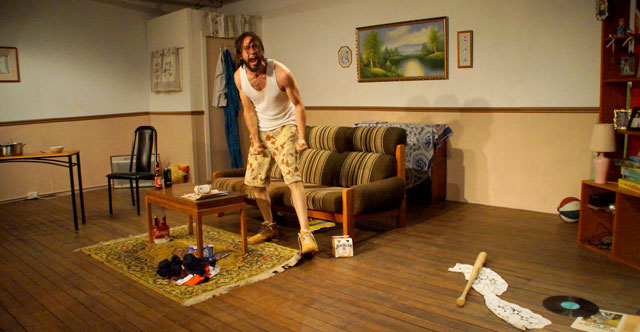
Falsettos is a musical that has everything. More than that, Darlinghurst Theatre’s latest production achieves excellence on many different levels, and provides a theatrical experience that exceeds many shows in Sydney of much grander scales (with far heftier price tags). This is a modest and intimate interpretation of an off-Broadway musical that first took form in 1981, but it surprises with the emotional punch it delivers, and the incredibly impressive standard of choreography, direction and performance.

When an actor is allowed to showcase the clichéd triple-threat in demanding roles, results can be breathtaking, and in the case of lead man Tamlyn Henderson, it is definitely so. Henderson’s performance is skilful and complex. He draws laughter and tears, all the while being Mr Showbiz, all booming singing voice and nifty footwork, but simultaneously completely believable and tender in his characterisation. Henderson is in a word, fantastic.

Katrina Retallick brings an extraordinary warmth to her Trina, and performs the single most memorable number of the night, based entirely on a step aerobics routine. Young actor Isaac Shaw steals hearts in the role of the irresistibly cute Jason, displaying talent and ability that matches up confidently to his adult counterparts.

In spite of his ugly wig and spectacles, Stephen Anderson’s natural charisma is clearly evident. His comic ability is well utilised in the show, and his singing voice is delightfully versatile and reliably resonant. Ben Hall provides the story’s eye candy, and certainly lives up to that challenge. Thankfully, Hall imbues his role with a healthy sense of humour, and is a strong enough singer to hold his own (but does suffer a little from the lack of microphones). It must be noted that Nigel Ubrihien’s solo piano accompaniment is outstanding, and does what a full orchestra sometimes fails to do. The feel and accuracy he contributes to the sonic landscape of the production is absolutely crucial and perfectly executed.

Visual design elements are effective but understated. Ingenuity is shown in the use of seven coffin-like structures that are incorporated elegantly into stage design and choreography, but could probably benefit from a little sprucing up. Our eyes focus on characters, while set, props, costumes and lighting take a back seat in this musical.

Director Stephen Colyer’s extensive background in dance shines through brilliantly. His use of movement and the physical form is intricate, deeply considered, and beautiful. The lines between choreography and direction are entirely blurred. Characters never dance for the sake of dancing alone. Every move is for character development and storytelling. Colyer obviously knows all there is to know about entertainment and show pacing, but he is also careful to handle the material with sensitivity and spirituality, which in turn produces a good level of depth that accompanies the sentimentalities that pervade the writing. The show he has created is artistically inventive and technically accomplished. It is also highly entertaining, thought provoking and full of humanity. This is the musical format thoroughly evolved.

www.darlinghursttheatre.com

Review: We’re Bastards (Two Peas)

bastards1Venue: Old 505 Theatre (Surry Hills NSW), Feb 6 – 23, 2014
Playwright: Oleg Pupovac
Director: Glen Hamilton
Actors: Tara Clark, Oleg Pupovac
Image by Anna Chase

Theatre review
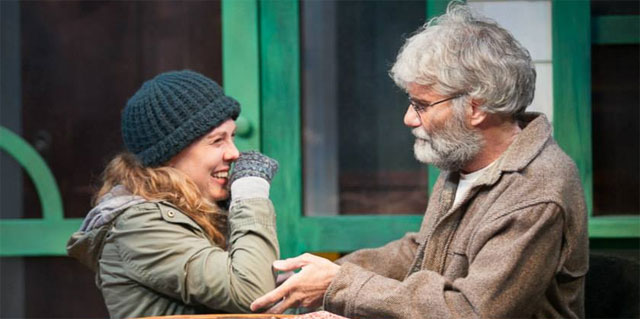
We’re Bastards is a play that doesn’t go anywhere, about people who don’t go anywhere. Everything seems congested, but within the stagnation, an abundance of characterisation is explored in its main characters. Darling and Joe are siblings living in the disenfranchised lower classes of the United States of America. Their concerns are a world away from our middle class Australian theatre audiences, but they are a pair of oddities that instantly spark our interest. It is a bit of a freak show that unfolds, but care is taken to attempt an explanation for the damage they display.

Oleg Pupovac’s script might be too simple for some tastes, but his strength as an actor shines through within the straightforward context. Pupovac achieves a level of realism with his speech and movement that gives the production a feel of authenticity. His chemistry with Tara Clark, who plays his sister, is a highlight of the show. There is a level of intimacy between the actors that comes across, and adds complexity and mystery to their relationship.

Glen Hamilton’s direction is colourful and energetic, but his style is gentle, which sometimes comes into conflict with the script that resides in a space simultaneously cold and brutal. We’re Bastards is a brave work that takes on a time and place that is ignored but intriguing. It is about the third world that is sprouting in our own backyards in this age of increasingly severe class divisions. We all have a stake in this bastardry/illegitimacy, but it is too easy to turn a blind eye, and it is the job of art to impose these stories of injustices upon us.

www.venue505.com/theatre

Review: Proof (Ensemble Theatre)

proofVenue: Ensemble Theatre (Kirribilli NSW), Jan 31 – Mar 8, 2014
Playwright: David Auburn
Director: Sandra Bates
Actors: Matilda Ridgway, Catherine McGraffin, Adriano Cappelletta, Michael Ross

Theatre review
There seems a fine line between genius and madness. Both are by nature alienating, and people who present these qualities frequently feel misunderstood or isolated. In our age of overdiagnosis and hypervigilance, mental conditions seem to be everywhere, presenting to society innumerable challenges relating to the way we manage them in daily lives. As we continue to obsessively pathologise every less than common behaviour including the display of extraordinary talents, so do our tendencies to impose conformity throughout our communities. Proof is a story about a woman’s gift in mathematical ability, and the pressures she faces from living a less than conventional life.

Sandra Bates’ direction relays the story clearly, and pays close attention to dynamics between characters. We have a good sense of who these people are, and the world in which they live is portrayed vividly. Tragic elements of the play are fleshed out particularly well, with themes of death, illness, betrayal and jealousy providing tension and gravitas. The production is however, less effective in its lighter moments, where some of the comedy can be stiff and muted. Bates’s work might not be consistently strong through every scene, but where the drama does work, things get fabulously explosive.

The four actor ensemble is tight and even. These are generous performers who have opened up to their audience and to each other. The frisson between characters is a highlight of the show, and their interchanges are thoroughly enjoyable. Michael Ross plays Robert with ardour and depth. He delves into a realism that appeals to our empathy, but also performs the character’s madness with a fiery gusto that keeps us engrossed. Lead actor Matilda Ridgway is committed and present. She has a warmth that allows us to identify readily with Catherine’s ordeal, but her emotional range requires further expansion in order to hit all the right notes required by the emotionally complex script.

David Auburn’s writing delivers a story that is intriguing and passionate. It is also deceptively simple, and only with protracted excavation can all its subtleties be brought to light in the theatre. In this new production by Ensemble Theatre, we are treated to a fascinating story, told with an authenticity and a gentleness that will resonate with anyone who has ever wondered about the insanity and ingenuity that resides in every person.

www.ensemble.com.au