Review: Every Second (Michael Sieders Presents / Darlinghurst Theatre Company)

ensembletheatreVenue: Eternity Playhouse (Darlinghurst NSW), Jun 27 – Jul 27, 2014
Playwright: Vanessa Bates
Director: Shannon Murphy
Actors: Simon Corfield, Glenn Hazeldine, Julia Ohannessian, Georgia Symes
Image by Louis Dillon-Savage

Theatre review
Art emerges from all walks of life in Australia. The egalitarian nature of our society means that diverse voices are heard in theatres that reflect the many facets and classes that co-exist on this land. Correspondingly, stories are told that do not necessarily speak to all audiences across all spectrums of communities. Vanessa Bates’ Every Second is a well structured script with thoroughly explored characters, but their concerns are specific, and probably not as universal as initially hoped for; or perhaps, it is not always an artist’s priority and indeed responsibility, to consider how a work might be read and received. Bates’ expression of upper-middle class worries is valid, but finding the empathy from audiences might prove to be a challenge.

The story involves two married couples, both desperate to conceive. Through their crusade to fall pregnant, we observe the mechanics of the wife-husband relationship, discovering its resilience and points of weaknesses, its evolution, and struggle for longevity. Child-bearing and marriages can be alienating concepts for many, but the play does explore more general themes of love and self-fulfillment, although to a lesser extent. Shannon Murphy’s direction is careful to keep all her characters appealing in spite of their individual faults and annoyances. The people on stage, and their relationships, all feel genuine, and the pain they experience does manage to resonate even if contexts fail to connect. Indeed, Murphy’s strength is in creating vulnerability and palpable emotions that are immediate and powerful.

Andy McDonnell’s set is a visual representation of the quagmire being played out. The circular structure, reminiscent of a whirlpool or tornado, is a constant reminder of the pressure and volatility that overcomes the characters. The greatest effect of McDonnell’s design is the focus it puts on the actors by shrinking the stage, and literally containing them within the structure itself. With the assistance of lighting by Verity Hampson, the vast venue becomes intimate, thereby enhancing intensity of the dialogue and amplifying energy of performances.

Julia Ohannessian as Meg is powerful and exuberant. The woman she portrays is at time exasperating, but Ohannessian works hard to provide dignity, and manages to elevate her role from mere baby-making machine. She wins our understanding and affections, transforming a neurotic housewife into an authentic persona. Meg’s husband is played by Simon Corfield who bravely embodies a man buckling under the stress of a fractured home life. We catch Tim at a time when he can do no right, but Corfield’s portrayal is full of humanity and compassion that allows us to see him in the same forgiving light. Glenn Hazeldine delivers many surprising moments of laughter. His comic abilities are impeccable, and he keeps the show buoyant as Bill. Hazeldine’s chemistry with stage wife Jen (played by Georgia Symes) is touchingly tender, and a scene that sees their declaration of love for each other leaves a beautiful impression.

Every Second is compelling entertainment, performed by a skilled and thoughtful cast. Their story does not cater to a very wide audience, which depending on your perspective, could be a good or bad thing. Art should have no rules about social acceptability and conventions. Theatre should exist for all, even for the bourgeoisie.

www.darlinghursttheatre.com | www.michaelsiederspresents.com
Review: The Mercy Seat (Gentle Banana People / Sydney Independent Theatre Company)

gentlebananaVenue: Old Fitzroy Theatre (Woolloomooloo NSW), Jun 24 – Jul 5, 2014
Playwright: Neil LaBute
Collaborating directors: Samantha Young, Andrew Wilson, Peter Mountlord, Alistair Wallace
Cast: Rebecca Martin, Patrick Magee
Image by Katy Green Loughrey

Theatre review
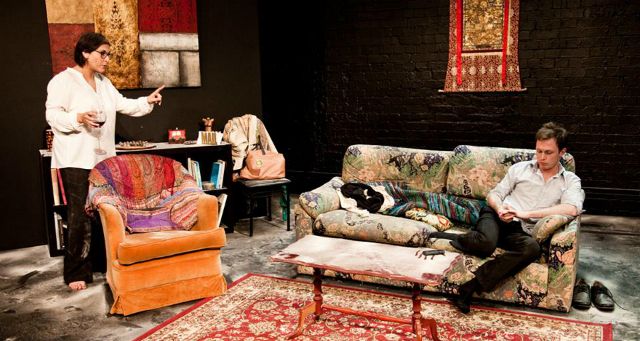
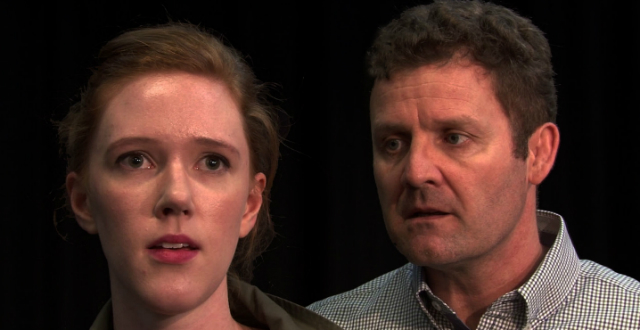
This is a love story that is not particularly romantic. It is however, written with a great sense of truth, and is reflective of real experiences in our love lives. Yes, there is some sweetness, but, like in life, the relationship being explored is fraught with issues. We are refused the clichéd and comforting notion of a love that fixes everything. Instead, what Neil LaBute discusses is the inherent difficulties, and there are many of them, when two people get together. The themes in The Mercy Seat are innumerable. Through Abby and Ben, we observe the often ugly complexities of love, relationships and human nature. Theatre does something noble, when it provides difficult revelations.

The production is directed well. Emphasis is placed on the narrative, and it is clear that work has been put into bringing nuances to light. The writing’s intrigue and its structural quirks are materialised beautifully. The unorthodox characters are allowed to be challenging, always fluctuating between  likeable and objectionable. The story is told without convenient heroes and villains, but it communicates successfully, probably because of the way its honesty speaks closely to our deepest feelings. We understand Abby and Ben because their fears are so fundamental and intimate, they leave us nowhere to hide.

Rebecca Martin as Abby is spirited and flashy. The actor is a determined entertainer, and never fails to grab our attention. There is considerable bravery in her work. We feel Martin’s heart on her sleeve, and she portrays a character with very clear intentions and emotions, conveying an internal journey that is complicated, yet coherent and recognisable. The role of Ben is played by Patrick Magee, whose comic timing is impeccable. He delivers the subtle and dark comedy with a gentle assuredness, careful to prevent funny moments from obfuscating his impressively earnest characterisation. Magee is a dynamic performer, and the enthusiasm at which he oscillates light and shade is thoroughly enjoyable. Both actors are able to deliver a wide range of tone and emotion, but both share a common lack in authenticity when playing sadness.  A reason could be the speed and energy at which their performance is pitched. The characters go through very drastic alterations in mood, which is terribly exciting to watch, but evidently difficult to embody. Even though the actors have excellent chemistry throughout the piece, they do not muster up a convincing sexual energy which is important to their tale.

We sometimes cry at the theatre, but those tears are usually shed for the people on stage or for the scenarios that we witness. Seldom do we react emotionally for our own circumstances that a work recalls. The Mercy Seat strikes a chord when you least expect it. The show ends with a little pessimism, along with some idealism. How we choose to proceed is incumbent upon ourselves.

www.sitco.net.au | www.pantsguys.com

Review: Oleanna (Sydney Theatre School / Actors Not Feelers)

Oleanna 4 MEDVenue: Sydney Theatre School (Chippendale NSW), Jun 25 – Jul 6, 2014
Writer: David Mamet
Director: Jerome Pride
Cast: Grace O’Connell, Jerome Pride

Theatre review
David Mamet’s script is powerful, complex and intellectual. It is an anarchic work about anarchy. It makes its point by shattering conventional paradigms of discourse, and uses theatre to discuss politics in a way that would be challenging for any audience. There are many ways that texts can be interpreted, but Mamet’s Oleanna is resilient, with a message that is unyielding. There might be room for some ambivalence in the plot, but what it wishes to say is clear. Anyone taking it on must capitulate to its structure in order for the characters to make sense, and for dramatics to take effect, or risk a show that is unconvincing and nonsensical.

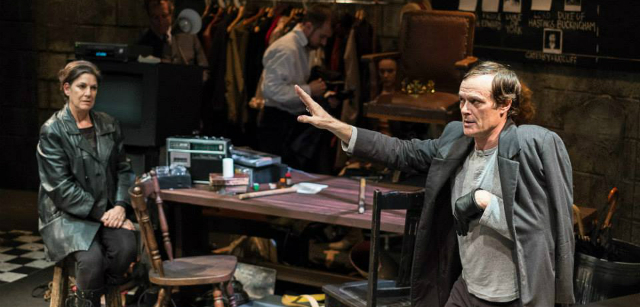
Jerome Pride’s direction handles the play’s concepts carefully. Reverence is paid to the writing, and the results are manifestly impressive. Controversial and sophisticated ideas are expressed with surprising clarity. Daring propositions avoid the curse of sounding like highfalutin abstraction, and are made credible and real. Both actors enthrall with interesting and dimensioned portrayals. The pace and tone of dialogue are perfectly tuned, so that we are gripped from beginning to end. Design elements however, are neglected. There is no need for very much embellishment but the set and costumes are overly basic. The actors’ work would benefit with a more defined sense of space, especially with the cast’s eagerness for movement.

John is played by Pride, who invests in his role, an appealing coupling of impulsiveness and thoughtfulness. We can see him thinking, but we also feel the instinctual timing that he trusts to rely on. The story’s characters are flawed, and we need to be repulsed by them as much as we relate to them but Pride’s creation is endearing, which poses a problem for the production. Perhaps better wardrobe choices could play a part in helping to create a less affable impression.

John’s adversary is Carol, whose development over the course of the play is startling. Grace O’Connell’s performance is not entirely convincing. Some of her creative choices lack authenticity, and we come away slightly confused with the character’s evolution. Nevertheless, O’Connell comes to life after the first act. Her energy and conviction is spellbinding. There is a lot to enjoy in this actor’s work, which is robust yet heavily nuanced.

Mamet’s story gives us important and difficult questions, but it is debatable whether answers are to be found therein. Oleanna deals with the injustices in our lives. It talks about systematic oppression and victimhood, but more significantly it talks about the prospect of dismantling those systems and imagines its alternative. The show’s title refers to a failed utopian state. We always want something better, and in some cases, we know exactly what needs to be improved but the question must always be asked about how we get there. Removing the status quo requires a replacement, but it is human nature that seduces and shapes every new status quo into tomorrow’s conundrum.

www.sydneytheatreschool.com

Review: Richard III (Ensemble Theatre)

ensembletheatreVenue: Ensemble Theatre (Kirribilli NSW), Jun 24 – Jul 19, 2014.
Also playing at Riverside Theatres (Parramatta NSW). 22 July – 26 July.
Playwright: William Shakespeare
Director: Mark Kilmurry
Actors: Danielle Carter, Patrick Dickson, Matt Edgerton, Mark Kilmurry, Amy Mathews, Toni Scanlan

Theatre review
Tales about Machiavellian ambition are timeless. The darkest parts of human nature often relate to our ability to compromise morality in order to satisfy the urges of greed and vanity. Political climates seem to evolve, but shades of betrayal and deceit are persistent. As long as the need for kings and leaders remain, the threat of malice at the highest rungs will always be present.

Mark Kilmurry’s direction of Richard III is colourfully creative, but faithful. His playful style ensures that we are consistently involved with his stage (even when the Shakespearean language becomes challenging) but his artistic liberties are careful to keep original intentions intact. Kilmurry’s creation is a rich theatrical experience that explores the collaborative nature of the art form thoroughly. Cast and creatives are allowed freedom of expression, which in turn encourages a level of audience engagement that is sophisticated, intelligent and surprisingly enjoyable. As leading man, Kilmurry is mesmerising, delightful and appropriately repulsive. He invites us to share his love of the text, and everything within it that is genius and delicious. It is a supremely confident performance by a skilled showman who knows how to steer a vehicle, and we are his trusting happy passengers.

Danielle Carter’s portrayal of Queen Elizabeth is enigmatic and very strong. Her impressive presence is utilised effectively, and the solid stillness in her performance contrasts and stands out from a busy production. Carter’s scenes of confrontation with Kilmurry are especially dynamic. The chemistry and timing between both actors are phenomenal, forging moments of gold for fans of high drama. Matt Edgerton plays a total of five characters. This is a tall order, and one of the show’s few misjudged decisions, but Edgerton’s energy and focus are entrancing. This is an adventurous cast with a passion for their work that has elevated a classic play into an event brimming with charm, wit and poignancy. Amy Mathews closes the show with a soliloquy that is heartfelt and starkly genuine, reminding us of the gravity in Richard III‘s story and evils that prevail in our world.

The production’s design and technical aspects are equally accomplished. Set, props and costumes are subtle but evocative, all contributing to the small space an aesthetic that is beautifully au courant. Nicholas Higgins’ lighting and Daryl Wallis’ sound design are sensitively considered, never drawing undue attention to themselves, but consistently adding to the action on stage. Stage manager Rebecca Poulter should also take a bow for the incredibly smooth running of what must be a complicated backstage and control booth, to which we are completely impervious.

Kilmurry is a leader of fabulous talent. His show is brilliantly put together, and everyone he enlists is showcased marvelously. Shakespeare’s work is probably not very much about democracy, but drawing parallels with our own governmental structures is irresistible. It provokes questions about secrecy in high offices, and the trust we lay upon the people we elect. It prompts us to remember the value of irreverence that is so much a part of our national identity, and to cherish our ability in this country to question authority. We must not forget that the bastards do need to be kept honest.

www.ensemble.com.au

Review: My Name Is Truda Vitz (Somersault Theatre Company)

TRUDA13Venue: TAP Gallery (Darlinghurst NSW), Jun 25 – Jul 6, 2014

Writer: Olivia Satchell
Director: Pierce Wilcox
Cast: Olivia Satchell
Image by Julia Robertson

Theatre review (of preview performance)
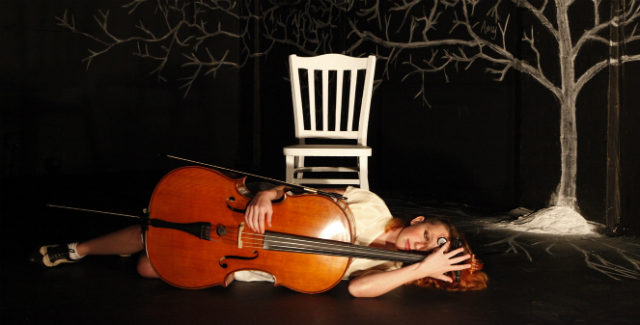
Olivia Satchell’s work is a personal journey of discovery and invention. It is concerned with family history and Satchell’s link with her ancestral past. Truda Vitz is Satchell’s grandmother, and this show obsessively explores her life from memory, investigation, and rigorous fantasy. It becomes clear that lives today can be hollow without acknowledgment of what had come before. Satchell finds meaning and establishes her own identity by thinking about blood relations. She tries to see what her grandmother might have seen, and feel what would have been felt. From an unexplained longing, she makes a connection with the dead in her writing, acting, and through the music of her cello.

Satchell’s performance is quiet but it contains passion. There is not great sadness or elation, but we see the manifestations of a meditative process that is deeply truthful even though a sense of fiction is always present. As an actor, Satchell’s strongest quality is her presence and confident engagement with her audience. The weakest quality of the production is the overly languid tone that persists from beginning to end. Although it only goes for an hour, one cannot help but wish for greater fluctuations in mood and emotion. The show is sincere and thoroughly authentic, but it grows cool where more power could be fabricated.

The sound of Satchell’s cello is sublime. In the small venue, subtleties are easily magnified, and the musical instrument’s every nuance becomes sensationally beautiful. Widely described as being able to produce sounds that are closest to the human voice, it adds a dimension of dialogue to the one woman play. At certain times, it allows us to feel like Satchell is speaking with herself, and at others it represents a voice from the afterworld. The cello’s resonances are mighty, and its incorporation into the fabric of the work shows good creativity and impressive sensitivity.

Life without romance can prove fruitless, but romance itself often seems absurd. My Name Is Truda Vitz is more sweet than bitter; it is lighter than it is dark. Its melancholy is gentle and mild, perhaps an accurate reflection of the artist’s inspiration and inner world. This is theatre that embraces simplicity, in a time when simplicity might be at its loneliest.

www.somersaulttheatre.com

Review: Trafficked (Darling Quarter Theatre)

traffickedVenue: Darling Quarter Theatre (Darling Harbour NSW), Jun 13 – 15, 2014
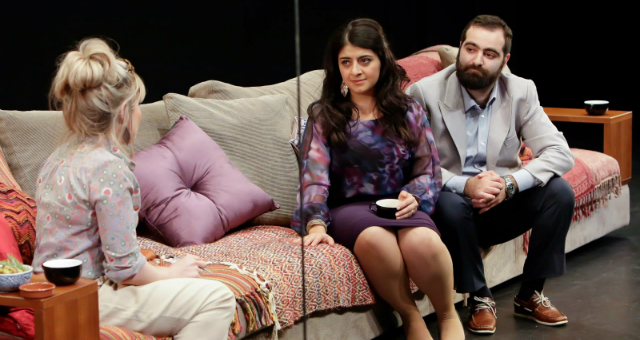
Playwright: Carli Carey
Director: Carli Carey
Cast: Sorcha Harrop, Amy Fisher, Michael Smith, Jace Pickard, Isaac Reefman

Theatre review
The play begins with television news reports from a commercial station about the subject of human trafficking and modern slavery. As is often the case with commercial news, the stories are sensationalist, and the network’s watermarked logo exists almost as a reminder to take everything we see with a grain of salt. Of course, its themes are genuine, but we have learned as a society to remain sceptical about the things we are told, and we demand concrete evidence before outrageous claims can be believed.

Trafficked tells horrific tales of young Australians in captivity and enslaved. They look and sound like any young adult we know, and are even of Caucasian appearance. The play subjects them to incredible cruelty, and tells their stories with earnest fervour. The characters are intertwined and build relationships with each other, but everything they say is addressed directly to the audience. It feels like documentary, but there is absolutely no indication that their words are not entirely fiction. Their stories are unbelievable, and we struggle to be convinced by anyone.

Performances are uneven, but Michael Smith and Sorcha Harrop work hard to make their parts meaningful. They have good focus, and show excellent commitment in tricky moments of melodrama. Smith has a good presence that makes him the most memorable element of the production. Harrop succeeds in encouraging some empathy, and impresses with the stamina she displays for her arduous role.

Technical aspects are very lacking. Light and sound design are poorly judged, and execution seems to go awry from start to end. It is obvious that there is a serious lack of experience in the crew, and it is unfortunate that a more accomplished production manager had not been assigned to assist and nourish this young crew.

Every project in the arts is an opportunity to grow. Director Carli Carey and her team have not created a masterpiece on this occasion, but they have succeeded in turning talk into action. They have put money where their mouths are, and are therefore one step ahead of those who dream but do nothing.

www.traffickedproject.com

Review: The Boat People (Rock Surfers Theatre Company / The Hayloft Project)

hayloftVenue: Bondi Pavilion Theatre (Bondi NSW), May 29 – Jun 21, 2014
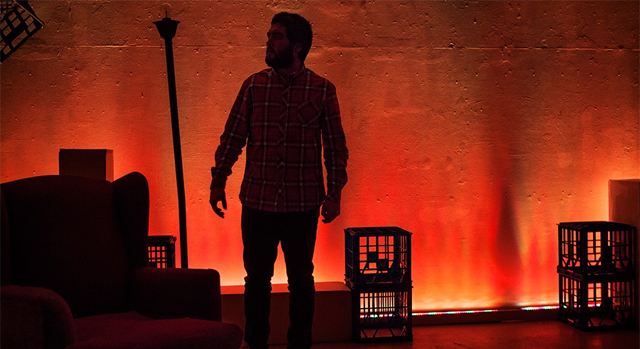
Playwright: Benedict Hardie
Director: Benedict Hardie
Actors: Susie Youssef / William Erimya / Emily Rose Brennan / Luke Joseph Ryan
Image by Zakarij Kaczmarek

Theatre review
One of the exciting facets of theatre is the way it is able to deal with social issues. The stage provides a membrane of safety, where artists can venture into dangerous territory, and say things that are controversial, or even, fictional. In this unique space of expression, the audience is able to examine ideas with their own free will, and perhaps have opinions swayed, or maybe come to new realisations about the world.

Benedict Hardie’s The Boat People is a script that we desperately need. It tackles subjects that are prominent in news and politics, but approaches it from an artistic perspective. What results is a discussion about themes that we care passionately about, but unpacked in an unconventional way. Its story and characters present to us a refreshing way at looking at Australia’s obsession with asylum seekers and our ever-changing stance on immigration policies. It is neither journalistic reportage nor realistic documentary. It is imaginative, and in its “what ifs”, we are able to observe and judge our personal responses to some of the ideas brought up by the work. Hardie’s writing is sardonic and sophisticated. There are surprises everywhere, and its characters connect deeply with the way we look at ourselves today. Hardie’s direction however, is slightly lacking. The pace of the piece misses a certain fluidity. There are many gear changes that occur from constant shifts in comic tone, which is conceptually exciting, but experientially, a little awkward. Our emotions and attention are prevented from becoming more deeply invested, which might be intellectually interesting, but in reality, quite frustrating. We like the characters and want to feel more for them.

Susie Youssef’s performance as Sarah is extraordinarily centred and strong. Playing a character that is unable to anchor herself morally, Youssef is surprisingly authentic. She presents a truth that we relate to, one that appeals to our humanity; the part of us that lives in shades of grey, and where life forces us to move within these shades, refusing to let us hold on to black or white regardless of our desire for certainty and convenient truths. The level of conviction in Youssef’s work is impressive. The confidence she brings to a role that is characterised by its power and wealth is very persuasive indeed.

Karl is played by William Erimya, who is memorable for his immense affability. Karl is absolutely adorable, and Erimya’s performance is hilarious, but his final scene attempts to shock, only to leave us bewildered and unconvinced. Melanie is another role who goes through a confusing transition, but Emily Rose Brennan’s performance is engaging and enjoyable. Brennan’s work is precise, with an exquisite polish, and she brings an intense energy that is deceptively subtle. Luke Joseph Ryan is the live wire of the group. He is outlandish, buoyant and effervescent, giving us a lot of silliness that contrasts effectively with the gravity of the work. He does seem to be slightly detached from the ensemble who are comparatively subdued, but we do catch glimpses of great chemistry when situations are conducive.

The production is designed intelligently and efficiently. Michael Hankin’s set is simple but arresting. His construction of “windows” is a stroke of genius. Sound designer and composer Benny Davis makes us laugh with pop music made “ethnic”. Costumes by Elizabeth Gadsby helps tell the story well, and her work for Karl and Melanie are particularly attractive but Sarah’s stature requires further finesse.

The complexity of The Boat People is unapologetic and essential. Hardie’s writing resists simplification, so we are forced to grapple with the difficulty of issues at hand. Art is not always about truths, but this show hits the nail on the head. The accuracy at which it portrays contemporary Australian beliefs is staggering, and the results are not always easy to digest. Theatre must not always be a walk in the park, and on this occasion, the ride is bumpy, for good and bad.

www.rocksurfers.org | www.hayloftproject.com

Review: Love Song (Gamut Theatre Co)

gamut1Venue: TAP Gallery (Darlinghurst NSW), Jun 11 – 22, 2014
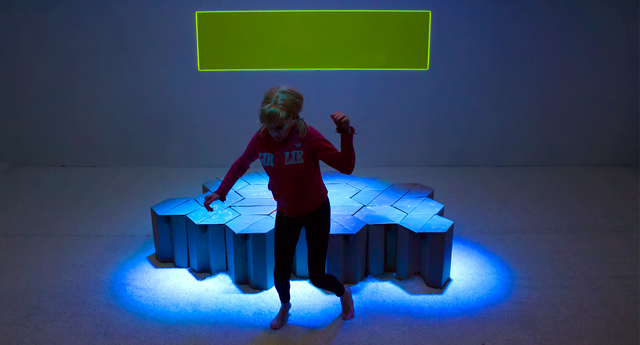
Writer: John Kolvenbach
Director: Glen Hamilton
Cast: Melinda Hyde, Ford Sarhan, Ben Scales, Romney Stanton
Image by Farland Photography

Theatre review
John Kolvenbach’s Love Song is beautifully written. Witty and thoughtful lines, colourful characters, imaginative scenarios with humour and poignancy, and surprising plot trajectories, all make for a play that is irresistibly charming, and rich with potential for creative interpretation. Kolvenbach’s script about relationships and eccentricity is crafted with intelligence. It has a refreshing originality, but it also bears a universality that ensures a wide appeal.

Direction by Glen Hamilton is elegant but fairly subdued. There is some attention placed on lighting effects, especially during scene transitions, but Hamilton focuses almost entirely on working with his actors to form interesting and dynamic personalities. The four main characters are distinct and memorable, each with their own rhythms and quirks. Ford Sarhan plays Beane, the young protagonist, and he is completely delightful. Sarhan is charismatic, understated, and tremendously funny. His comic timing is a highlight of the production, often delivering big gleeful laughs at unsuspecting moments. Ben Scales’ work as Harry is sensitively considered yet playful. He has a thorough connection with the text, and his articulation of the writer’s ideas is clear and powerful. This is a cast with good presence and buoyant energy, and their performances have created a show that is entertaining and consistently engaging.

Love Song does talk a little about romance, but that is not the whole of its message. It is interested in the way people’s lives are nourished through relationships, and through love. The concept of love is explored at depth. We watch how it affects us comprehensively, and how we transform in its presence. Most significantly, we learn how it (love) is essential for life to flourish, no matter what form it may take, and no matter how much effort is required for it to materialise.

gamuttheatreco.wordpress.com

Review: Winter (Persophia / The Old 505 Theatre)

winter2Venue: Old 505 Theatre (Surry Hills NSW), Jun 7 – 22, 2014
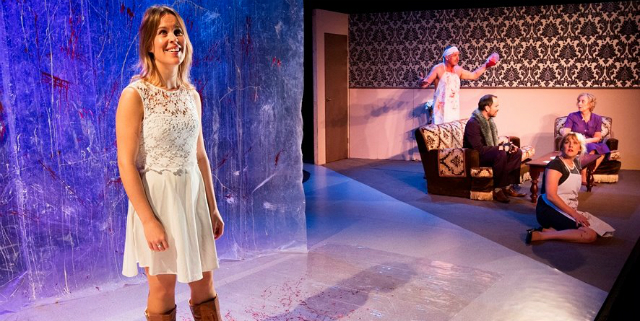
Playwright: Jon Fosse
Director: Jonathan Wald
Cast: Susie Lindeman, Berynn Schwerdt

Theatre review
Extramarital affairs remain a taboo subject in the twenty-first century. Marriage is still considered sanctimonious, and of course betrayal in any relationship will never be greeted with nonchalance. Taboos are by nature difficult to discuss, and language often escapes those who transgress. When one is acting against better judgement, explanations struggle to find logic, and words fail. In the space of impulse and emotion, expression is not always best achieved through speech.

Jon Fosse’s Winter demonstrates those inadequacies in the theatre, with a script that uses words to propel action, and to evoke sentiments, but not to describe motives or to divulge feelings. The nameless characters, a woman and a man, speak in incomplete sentences, and with repetitive words that reveal little. Under Jonathan Wald’s direction, the play is surprisingly digestible. A clear sense of narrative is achieved in spite of the text’s poetic style. Assisted by Stephen Colyer’s expertise as a movement choreographer and an accomplished design team, the dynamic and inventive use of space creates an experience that is visually exciting and charged with sensuality.

Susie Lindeman’s performance is suitably quirky, creating a refreshing character with an intriguing allure. Qualities of desperation and desire are beautifully conveyed. Lindeman introduces a vulnerability that gives the story complexity, and keeps us engaged. Berynn Schwerdt’s presence is genuine and weighty. His style is minimal but effective, which adds an air of sophistication to the production. The actor seeks to build meaning into his character’s silences, with quite powerful results.

Winter makes us see and hear from an alternate perspective. It experiments with the way meanings are formed from all that occurs on stage. It is concerned with convention, and the lack of it, in relation to how our senses and minds function. This is not an emotional work, but it does not leave you cold. It is more about the nature of art than it is about relationships and illicit affairs, and fortunately, art can sometimes be more seductive than the prospect of a secret rendezvous in a fancy hotel room.

www.venue505.com/theatre

Review: Why Torture Is Wrong, And The People Who Love Them (New Theatre)

newtheatreVenue: New Theatre (Newtown NSW), Jun 3 – 28, 2014
Playwright: Christopher Durang
Director: Melita Rowston
Actors: Peter Astridge, Romy Bartz, Ryan Gibson, Terry Karabelas, Alice Livingstone, Ainslie McGlynn, Annie Schofield
Photograph © Bob Seary

Theatre review
With a title as provocative and powerful as this, the play’s central concept hangs over everything that unfolds. We evaluate every situation, trying to decide what our personal definitions of “torture” might be, in relation to the statements that the writer makes. It is not a passive experience, sitting in the darkness of this theatre. The script seeks to involve and implicate us in its world. We look at its characters and wonder how we fit in, or indeed how the stories fit into our lives.

The production however, struggles to connect with us. The players are in their own world, always at a distance, and while there is a consistent semblance of poignancy and performances are all polished and precise, there is an uncomfortable inaccessibility that makes engagement difficult. Melita Rowston’s direction is wonderfully heightened and outlandish, but its strict structure seems to restrict her actors from playing with audience reactions and from using our presence as extensively as a comedy of this nature should. Nevertheless, Rowston’s work is suitably subversive in vision, and the courage at which she tackles the play’s difficult subjects is noteworthy.

Set design by Sasha Perri and Clarisse Ambroselli is imaginative and efficient. The action takes place in almost ten different places, and great lengths are taken to make every setting convincing and evocative. The play goes through many scene changes, and each transition is managed with elegance. From a production values perspective, the show scores very well.

Standouts in the cast include Peter Astridge, who plays Leonard, an extreme right winger of the nutty and violent variety. Astridge’s confident absurdity is refreshing and seductive. The caricatured roles are not written with much range or variance, but Astridge manages to find nuances to create a sense of dimension and unpredictability. Romy Bartz as Hildegarde plays up to the wildness in Christopher Durang’s comedy and delivers several big laughs. There are no weak performances in the show, and all roles are cast well. The script seems to require its players to portray the duality of character and actor, and although some effort is put into creating a sense of “metatheatricality”, a more conventional approach is usually chosen. Immersed within their roles, they miss opportunities for a more post-modern style of commentary on the situations being depicted.

A play that examines our moral compasses with torture and terror, should never leave us cool, or cosy. Its elements of controversy and iconoclasm should take precedence, and their disruptive nature should spawn discomfort, or disquiet. The play shows itself thinking things through; it is concerned with the use of intelligence, and it wishes to be challenging. The edge of the envelope can be pushed further.

www.newtheatre.org.au