Review: Love And Information (Sydney Theatre Company / Malthouse Theatre)

Venue: Wharf 1 Sydney Theatre Company (Walsh Bay NSW), Jul 9 – Aug 15, 2015
Playwright: Caryl Churchill
Director: Kip Williams
Cast: Marco Chiappi, Glenn Hazeldine, Anita Hegh, Zahra Newman, Anthony Taufa, Ursula Yovich, Alison Whyte, Harry Greenwood
Images by Pia Johnson

Theatre review
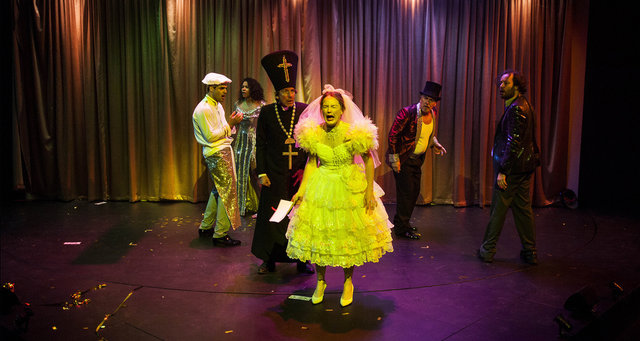
Caryl Churchill’s Love And Information is a 90 minute play, composed entirely of very short sequences that look to be extracts from a wide range of stories running the gamut of genres in conventional theatre. Each independent bite-sized piece, not matter how small, provides enough for us to make sense of events taking place in the moment, but the scenes do no immediately relate to one another. Except, it is human nature to make meaning regardless of what is being scrutinised, and we form voluntary interpretations about the things we see. In the case of Churchill’s very fascinating work, we are seduced into intellectual overdrive, almost like reading a mystery, piecing together clues that may or may not be, to find a consolidation of significance. A great work of art is one that helps its viewer see a true picture of themselves, and their place within a social universe. The moral of Churchill’s stories is a fluid one, and we take from them what is intimate to us as individuals, and as such, it can be seen that the writer has used abstraction to successfully facilitate a kind of self-awareness in the viewer’s sense of being and identity.

The work makes a statement about contemporary times, and our environment of obsessive information technology. If modernity is sick, attention deficit disorder would be one of its chief ailments. We are incessantly seeking out information from all sources, like an addict with no ability of discernment. We find out small bits about everything, with no regard for relevance, and certainly no capacity for any depth. As our social and physical spaces become increasingly congested, our attention is compelled to be dispersed into a multitude of directions, all of the time, and this might be a case of “resistance is futile”, as we cannot be sure if we have any choice in the matter, or if indeed, we are able to withdraw into any alternatives. The play talks about choices, especially the lack thereof, and toys with the concept of hiding as a solution, but it is clear that we are what we are.

Director Kip Williams gives us all that we wish from a stage production, in spite of a missing story. The production is emotionally appealing, as it carefully emulates the sentimental journey of a narrative-driven plot, with all its intrigue, comedy, surprises and poignancies. Williams makes us respond accordingly even though there are no characters to follow. The thoroughly experimental nature of the work is no impediment at all to a satisfying experience for any audience with even just a minutiae of sophistication. Additionally, the work’s cerebral aspects might be unusually dynamic, but they are accessible to most. The production is an engaging one that inspires questions at every step of the way, and we read it at any level of competency that suits us personally.

Lighting designer Paul Jackson gives each distinct chapter and verse, a personality and beauty that captivate us, while assisting our subconscious to understand all that is being conveyed. Our visual attention is masterfully controlled so that we are kept firmly within the unusual plot trajectories that unfurl. Music and sound by The Sweats are a key feature that binds each aspect of the production to present a surprisingly coherent whole. The soundscape dictates the pace of the piece from beginning to end, and tells us quite directly how to respond at all times in our participation just outside the stage’s fourth wall. The technical proficiencies of Love And Information is extraordinary. There is nothing else that calls for as many scene and character changes, with what must be over one or two hundred entrances and exits, all flawlessly executed with an unbelievable fluency and grace. Stage Manager Lisa Osborn’s abilities are truly remarkable.

Also proficient is the diverse cast of eight, every one unique in appearance and style, yet tightly unified in the vision they aim to concoct and the energy they bring to the stage. The accuracy required of them both in terms of the technical and the artistic are simply unbelievable and they deliver with astounding dexterity. Predictably, the funnier actors leave a greater impression, and while Glenn Hazeldine’s comedy is only allowed flashes of brilliance in a play with lightning speed transitions, the actor never misses with any of his punchlines no matter how subtle. Anita Hegh too, is memorable for creating laughter at will, and her effortless charm is one that grabs hold of our attention and convinces us of everything being communicated. The play has philosophy seeping through every pore, and Ursula Yovich gives them a sublime gravity, whether the topic be death or infidelity.

A distillation of the theatregoing experience would probably reveal two fundamental elements; entertainment and meaning. When art is challenging, it helps us discover new things and prevents our existences from turning empty, but entertainment is always the easier ticket to purchase. While not mutually exclusive, they rarely meet as equals. In Love And Information, the two come as an explosive package. Philosophically and intellectually enthralling, it is similarly exciting and joyful from a perspective of pure amusement. There are better sources of fun and frivolity of course, but here is a rare and monumental leap in the evolution of the theatrical arts. If this is experimental, the real event that it paves way for, will be nothing less than revolutionary.

www.sydneytheatre.com.au | www.malthousetheatre.com.au

Review: The Government Inspector (Belvoir St Theatre / Malthouse Theatre)

rsz_12941006184_c9638e943c_bVenue: Belvoir St Theatre (Surry Hills NSW), Mar 27 – May 18, 2014
Playwrights: Simon Stone, Emily Barclay (inspired by Nikolai Gogol)
Songs: Stefan Gregory
Director: Simon Stone
Actors: Fayssal Bazzi, Mitchell Butel, Gareth Davies, Robert Menzies, Zahra Newman, Eryn Jean Norvill, Greg Stone
Images by Lisa Tomasetti

Theatre review (originally published at auditoriummag.com)
First published in 1836, Nikolai Gogol’s The Government Inspector has long been considered a masterpiece in comedy, farce, and political criticism. This co-production by Sydney’s Belvoir St Theatre and Melbourne’s Malthouse Theatre takes inspiration from Gogol’s work, but strays as far as is imaginable with drastically transformed contexts and characters, while retaining certain thematic and structural features of the original.

Simon Stone writes and directs this new version, continuing his passion for adapting and modernising eminent classics of the stage. Fresh from last year’s successful, and bloody, re-telling of August Strindberg’s Miss Julie, he once again presents an interpretation that is radical and completely surprising. This production is a “last minute” replacement for The Philadelphia Story by Philip Barry and Ellen Barry, which had been removed from its programmed slot due to unforeseen copyright issues. It is unclear how much time was available for Stone and his team to rehearse and workshop their take on The Government Inspector, but the volume of ideas and creativity it contains, more than lives up to the famed hilarity of its inceptive roots.

Adding to the theme of mistaken identities, Stone’s show takes on a layer of complexity by embracing and incorporating the experience of losing one script and gaining another. The actors play out a farce that represents their predicament, and uses the opportunity to create a work about the artistic process. Their creation comes out of their anxiety, and a need to satisfy the paying audience, so what results is a piece of theatre that is thoroughly crowd pleasing, and relentless in its pursuit of laughter.

Stone’s courage and edginess as an artist translates curiously well in this madcap comedy format. Popular culture and theatre references are utilised to great effect, but it is Stone’s liberal amount of sarcasm and irony that gives the production an air of intelligence and pointed sophistication. It is a very fine line between silliness and stupidity, but we are never lured into any realm of coarseness or vulgarity. The show plays for laughs but it doggedly rejects cheap ones.

Performances are excellent. The cast of seven might not be uniform in ability and experience, but the ensemble they have created is impressively even. The chemistry between all is stunning, and a tremendous highlight. Eryn Jean Norvill delights with a subtle approach that demonstrates preparedness and confidence. The character she creates is a familiar one, but instead of placing too much emphasis on becoming convincing, Norvill brings with her a sense of knowing, always applying a level of commentary to her actor and character selves. Her attempted defiance against a moment of sexism in the “play within a play”, is poignant and pitch perfect. Zahra Newman is the only actor with two roles, including Dolores de la Cruz, a janitor who delivers some of the biggest laughs by lampooning the thespians. In one of the show’s few political moments, the actors discuss Newman’s ethnicity being an element that provides unfair advantage in the casting process, and it is a pleasure watching her turn an uncomfortable taboo subject into something quite memorable and meaningful.

Gareth Davies is a show-stealer for the duration in which he plays a version of the misidentified inspector. More than any other in the cast, Davies’ execution of the production’s improvisational tone is most credible and exciting. The frantic energy is particularly raw and unhinged when Davies takes focus of the plot. Greg Stone’s exuberant charisma and zeal for self-deprecation quickly endears him to the crowd. His thorough grasp of the material at hand is reflected in his outstanding comic timing. A simple throwaway line about obtaining a job in an office is transformed into a biting joke about the state of the arts in Australia.

Design aspects are fairly basic, but the introduction of a revolving stage that essentially removes the need for extra time to facilitate set changes, and speeds up entrances and exits, makes for a very fast paced, dynamic affair that keeps the audience attentive, and the atmosphere persistently buoyant. No time is wasted between scenes, and we are kept laughing from beginning to end.

There is an extended musical portion in the show that could have felt extraneous, but its insertion is handled with great wit, and we not only forgive its inclusion, we actually find ourselves at new dizzying heights of outrageous comedy. The Government Inspector by Simon Stone and co-writer Emily Barclay, is an exceptionally funny show, but it cannot be denied that the political resonances in Gogol’s writing have all but disappeared. Of course, theatre does not have to be political in order to be valid or indeed meritorious, but radical adaptations of classics will always be controversial, especially when a key feature that has made something legendary is left behind.

www.belvoir.com.au

www.malthousetheatre.com.au

This Is Beautiful (The Public Studio)

The Public StudioVenue: Tower Theatre at Malthouse (Southbank VIC), Jul 19 – Aug 3, 2013
Playwright: Ming-Zhu Hii
Director: Ming-Zhu Hii
Actors: Jing-Xuan Chan, Pier Carthew, Terry Yeboah

Theatre review
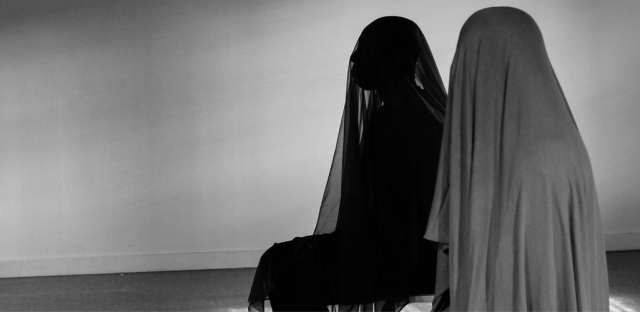
Expecting experimental work in any art form to entertain is usually a lost cause, and performance art pieces are rarely crowd-pleasers. This Is Beautiful is composed of three performers spouting endless existentialist questions about the arbitrariness of life’s big meanings. There is no obvious context, and clearly no narrative for which to situate these characters and their constant inquisitions. The small amount of movement and facial expressions they produce seem to be guided by those big questions, giving the impression that the entire 50-minute piece is about one idea.

These questions are not frivolous ones, in fact, one could argue that they are fundamental and relevant to all lives. Only problem is, you would either have already thought about them a thousand times and are quite happy to leave them behind, or they are simply of no interest to you and a night at the theatre would take a lot more than three strangers’ declarations to change your mind.

A big element of this production is the video that plays throughout, which adds dimension to the activity in the space. They provide an interesting abstraction to the repetitive themes, and are visually captivating in their own right, providing variation and colour to the austerity of what is unfolding in the flesh.

It is interesting to note that the three performers are of different ethnicities, and that it takes an experimental work of this nature for this multi-cultural amalgamation to materialise onstage. They make a beautiful picture together, creating a landscape of purity and unison. It also conjures up the notion that this combination of skin colours seems to face constant resistance in mainstream Australian narrative-based storytelling, in theatre or otherwise.

www.thepublicstudio.net

Dance Of Death (Malthouse Theatre)

Venue: Beckett Theatre at Malthouse (Southbank VIC), Apr 18 – May 19, 2013
Playwright: Friedrich Dürrenmatt, English text by Tom Holloway
Director: Matthew Lutton
Actors: Jacek Koman, Belinda McClory, David Paterson

Theatre review
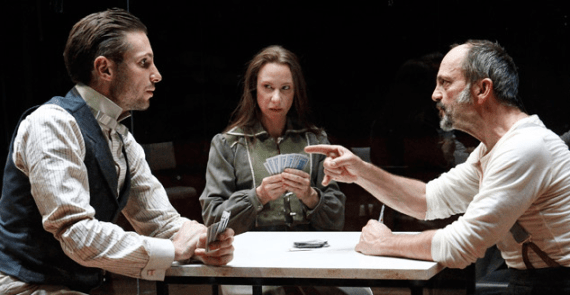
The players are brilliant. They are charismatic, humorous, agile and precise. From the very start, the audience is eating out of the palm of their hand, keen to see what unfolds. Their depiction of a dysfunctional marriage (to put it mildly) is fascinating and thrilling, but it is a struggle to find more than great entertainment value from this production, which is curious as the play does go into very dark places. Its last third turns more serious, but this is where the show loses focus, and the crowd is left bewildered as to what is being conveyed.

Production values are wonderful. Sound and music, set and props, and lighting all felt flawlessly executed and artfully created. This is a loud and dynamic, yet elegant production, which theatre-goers will enjoy even if its ending fails to match u up to its astounding start.

www.malthousetheatre.com.au