Review: Ghosts Of Glebe (Jetpack Theatre Collective)

Venue: Streets of Glebe (Glebe NSW), Oct 31 – Nov 11, 2017
Curators: Emilia Higgs, Kirsty McGuire
Cast: Gabby Florek, Nicole Archer, Chloe Leathlan-Higson, Kipp Carina, Tim McNaught and Elliot Ulm

Theatre review
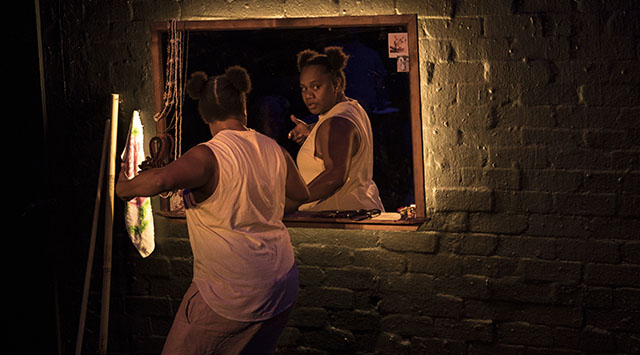
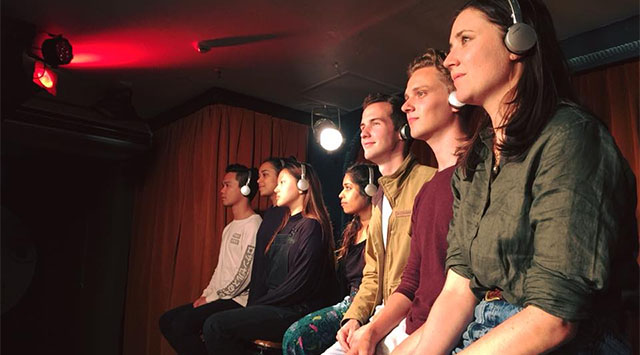
The entire experience is disguised as a “ghost tour”, and we quickly forget that our tickets had originally been acquired, for a theatre production. Ghosts Of Glebe works best when we submit to the fantasy, and actively participate in the creation of its narrative. The more we are able to behave and react like tourists, the greater its results.

We walk the streets of Glebe, rich with a history of murders, accidental deaths, and spooky stories. The spine tingles, in spite of our better judgement. Things get eerie, when our minds fail to decipher fiction from reality, but we relieve the tension when the inevitable sense of awkwardness starts to make us giggle.

It is a well-conceived production, although less eventful sections of the plot do feel lacking in imagination. There is wondrous use of space; Glebe at night is beautiful, and the theatricality that is wrapped around its topography, is highly enjoyable, if unconventionally brief.

Theatre is group activity, but in the West, we are used to it being the most passive of adventures. Ghosts Of Glebe offers an opportunity for our involvement to go slightly beyond the usual “sit back and wait”, and like in the rest of life, it is when we are willing to put in the effort, that the rewards become even more gratifying.

www.jetpacktheatre.com

Review: Give Me Your Love (Seymour Centre)

Venue: Seymour Centre (Chippendale NSW), Oct 31 – Nov 4, 2017
Playwright: Jon Haynes, David Woods
Director: Jon Haynes, David Woods
Cast: Jon Haynes, David Woods

Theatre review
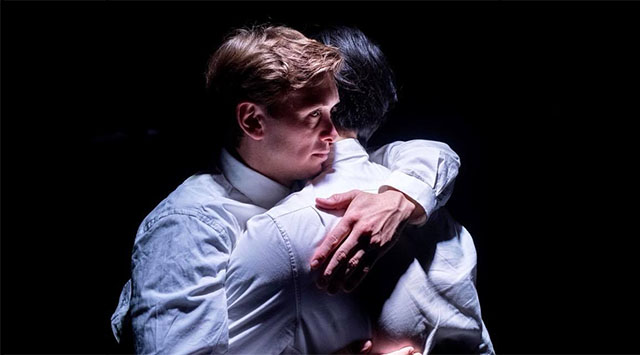
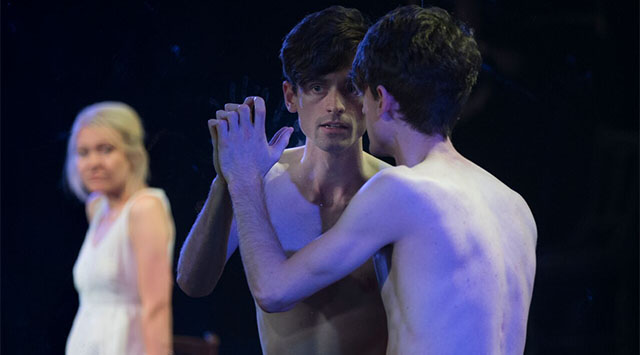
Not only is Zach trapped in his room, he has resolved to stay inside a cardboard box, never to emerge. Jon Haynes and David Woods’ Give Me Your Love portrays life after war, for a Welsh soldier suffering from Post Traumatic Stress Disorder. Although wildly imagined, the work never deviates from a sense of authenticity in the way it discusses mental illness. The comedy is clearly outlandish in style, but the scope of its concerns remains faithful to a sense of accuracy, and urgency, in its depiction of a veiled but serious social problem.

It is an enormously witty show, and fantastically inventive, not only with its clever dialogue, but also in the sheer theatricality of what it presents. Jacob Williams’ set design is viscerally affecting, powerfully evocative of spaces in and around our protagonist. Zach’s tattered box is wielded masterfully by Woods, like an oversized mask. In his best moments, we connect in a profound way to the agony being explored, and reach a decent understanding of the difficult psychology and emotions, as experienced by those who live with PTSD. We can see that Zach is being ridiculous, but in quite an inexplicable way, we know what it feels like, to persist with behaviour that makes no sense.

Give Me Your Love relies on our universal need for empathy. The audience is introduced to an extraordinary set of circumstances, but the storytelling touches us intimately, and we recognise Zach’s dysfunction to be fundamentally human. It is also about sacrifice, personal and communal, inevitable and unfortunate. Life does not permit anyone to go through it unscathed. Damage will be done, but it is when we learn to heal the wounded, that we can begin to regain some control.

www.ridiculusmus.com

Review: A Westerner’s Guide To The Opium Wars (Thirty Five Square Theatre)

Venue: M2 Gallery (Surry Hills NSW), Oct 25 – 30, 2017
Playwright: Tabitha Woo
Director: Kevin Ng
Cast: Tabitha Woo

Theatre review
In Tabitha Woo’s mostly autobiographical work A Westerner’s Guide To The Opium Wars, it is not the historical event in China mid-1800’s that takes our focus. The conflict between East and West that Woo is concerned with, is a personal one. Being of both Asian and European heritage, Woo’s understanding of her own Australian identity can be a complicated one, shaped by our society’s persistent rejection of affiliations with neighbouring cultures.

As Woo traces her lineal descent, through Tasmania, Malaysia and China, we begin to gain a greater understanding of our collective character as a singular yet diverse nation. We think about the meanings of migration, and the tension between having to leave behind that which is unsatisfactory, and the need to remember where we come from. In the construction of new identities as we flee from one place to another, a deliberate renunciation occurs, of things and memories best left behind, but the nature of time requires that we return eventually, usually momentarily, for a more honest evaluation of states of being.

The show is often fascinating in the way it uncovers decades and centuries of information behind Woo’s smiling exterior. Its juxtapositions of cultural influences from all over the world makes for a rich experience, although transitions between the theatrical forms it explores, could be handled more imaginatively. As performer, Woo makes up for her reticent presence with clarity of thought and intention, always ensuring that our understanding of her work is accurate and comprehensive.

Each person carries with them, ghosts from generations past, yet we can only regard our acquaintances with a sense of egalitarian homogeneity. We have no choice but to make assumptions of uniformity in how we deal with the world, but in relation to the self, a thorough authenticity is necessary or existence can turn unbearable. How a person wakes up every morning, depends on how much they respect the mind and body that is being nourished. The better we know ourselves, whether as individuals or as communities, the better a life we can create.

www.thirtyfivesquare.com

Review: The Merchant Of Venice (Bell Shakespeare)

Venue: Sydney Opera House (Sydney NSW), Feb 25 – Apr 1, 2017
Playwright: William Shakespeare
Director: Anne-Louise Sarks
Cast: Mitchell Butel, Catherine Davies, Eugene Glifedder, Felicity McKay, Shiv Palekar, Damien Strouthos, Anthony Taufa, Jessica Tovey, Jo Turner, Jacob Warner
Image by Prudence Upton

Theatre review
It is clear that Shakespeare wrote The Merchant Of Venice for an antisemitic audience. When we revisit the play today, there are choices to be made in its interpretation, to appropriately address its inherent prejudices. If it was indeed Shakespeare’s intention to shame and vilify Jewish people, contemporary productions must take the radical decision of going against the playwright’s will, or risk making statements that are completely unacceptable in our modern day.

Director Anne-Louise Sarks shifts the discussion from being an indictment on Jews, to one that chastises both Christianity and Judaism, effectively turning all the characters in The Merchant Of Venice uniformly into villains, and deftly solving the problem of Shakespeare’s racism. It is a thoroughly enjoyable staging, with commendable proficiency in all aspects, but it is the dialogue between Sarks and Shakespeare that is most engaging.

In imposing contemporary sensibilities onto the piece, Sarks lets us observe an evolution that has taken place over four centuries, and gives us the opportunity for repudiation and rectification. There is no better reason to remount classics, than using them to distance ourselves from the traditions and cultures they represent.

In acts of subversion, symbols of power, along with their gatekeepers and revered masters, are often implicated in the creation of something progressive and new. If we are to do Shakespeare endlessly, we must not permit the repetition of mistakes, even if it means changing the very essence of what is being said.

The role of Antonio the pious Christian, is carefully modified in this iteration to provide new meaning. Actor Jo Turner plays him unforgivable and contemptible, so that we too, want his pound of flesh. Shylock is performed by Mitchell Butel with excellent nuance, providing an image of vulnerable humanity, coupled with a vengeful ferocity, to make comprehensible the character’s temperament and intentions. It is an excellent cast, inventive and entertaining in all their contributions, for a show as amusing as it is intelligent.

In 2017, it is no longer tolerable to express any form of racial discrimination, but religion has itself become susceptible to scrutiny. In our refusal to abide by Shakespeare’s sanctimonious depiction of Christianity through the denigration of Jews, how we think about The Merchant Of Venice must go through transformation. What our gods represent must be allowed to move with the times, even if it means to disregard those who insist on adhering to unreasoning traditions.

www.bellshakespeare.com.au

Review: A View From The Bridge (Old Fitz Theatre)

Venue: Old Fitzroy Theatre (Woolloomooloo NSW), Oct 18 – Nov 25, 2017
Playwright: Arthur Miller
Director: Iain Sinclair
Cast: Ivan Donato, Giles Gartrell-Mills, David Lynch, David Soncin, Zoe Terakes, Janine Watson, Lincoln Younes

Theatre review
It is always good to see the bad guy fall. In Arthur Miller’s A View From The Bridge, Eddie is the patriarch who gets torn down fantastically by his own moral infractions. The dramatic tension is derived however, not from the pleasure of witnessing his ruin, but from the delusions that he suffers, in his inability to see the damage he causes, as he goes about doing what he incorrectly perceives to be good and right.

The work is an indictment of the archaic and unjust systems of social control we continue to endure, but its poignancy lies in the portrayal of fragility and discontentment in those who are thought to benefit most from those infringements. A View From The Bridge is about toxic masculinity, and the destruction that men bring upon themselves by perpetuating traditional notions of gender. Instead of fulfilling their promise of order and prosperity, Eddie discovers that the power he so stubbornly clings to, reveals itself to be of service to none of the people or ideals he holds dear.

The greatest success of this tremendously gripping production, is director Iain Sinclair’s rendering of Eddie as a tragic but unsympathetic character, made to be held accountable for his actions. We see his immense vulnerabilities but are dissuaded from making concessions on his behalf. Miller’s text is romantic in its depictions of the working man, but this is a production that emphasises, appropriately, his culpability and faults.

Actor Ivan Donato is spectacular in the role, simultaneously savage and sensitive, allowing us to view Eddie from the psychological personal and more importantly, as the indefensible villain of the piece, even if Miller’s narrative has a precarious tendency to position him as victim of circumstances. It is important that although we understand the character intimately, we are prevented from ever letting him off the hook. Donato provides all that we require to judge as harshly as he deserves.

The 1950s American melodrama of the piece, is deliciously executed by all the cast, each one intense and exacting in their contributions. It is an incontrovertibly powerful show, magnificently operatic with its exhibition of emotions, forged through meticulous and nuanced deliberation. As individual performers, all are captivating, and as an ensemble, their collective chemistry is quite explosive.

Sinclair’s inventive use of space, across two planes, cross-shaped in its “theatre in the round” format, keeps us thrilled and engaged. Defenceless against the huge personalities and their extravagant exchanges, in these very close quarters, we get involved, in the most meaningful way, studying closely as each scene unfolds, shifting our moral compasses as the plot moves us purposefully through violations and conundrums. There is incredible sophistication in the director’s approach; our hearts and minds are told a story with astonishing expertise. Also remarkable is Clemence Williams’ work on sound design, with its ebbs and flows manipulating at will, every transformation of atmosphere, whether lavish or minute.

Eddie makes repeated demands about being given respect and honour, but does not offer the same to others. His narcissism expects that he alone wears the pants in the house, and everything else falls into place accordingly, as a matter of course. Even when his preposterous behaviour lands him in hot water, he thinks that the world has wronged him. We can tell the misogynists and homophobes that their actions and attitudes need fixing, but like Eddie, most will not acknowledge the evil that they produce. Waiting for broken systems to mend themselves is futile. In a way, A View From The Bridge suggests that radical force is inevitable in real progress, but violence must never be considered the only means to an end, even if it is excellent entertainment, witnessing brutal torture of our enemies.

www.redlineproductions.com.au

Review: The Big Meal (The Depot Theatre)

Venue: The Depot Theatre (Marrickville NSW), Oct 18 – Nov 4, 2017
Playwright: Dan LeFranc
Director: Julie Baz
Cast: Cormac Costello, Emily Dreyer, Angus Evans, Suzann James, David Jeffrey, Tasha O’Brien, Brendan Paul, Kaitlyn Thor
Image by Katy Green Loughey

Theatre review
Things happen very quickly in Dan LeFranc’s The Big Meal. Nicole and Sam meet at a restaurant, and their lives flash before our eyes, from courtship and marriage, through to childbirth, sickness and death. The play is not about the peculiarities of any of the characters we meet. In some ways, it is about the insignificance of the individual existences we believe ourselves to inhabit. Taking the “circle of life” approach, LeFranc attempts to chart the journey of a human being, from beginning to inevitable end.

It is the idea of a “typical” person that The Big Meal is concerned with, but it cannot go unnoticed, that it is strictly an American middle class heterosexual paradigm that it is interested in depicting. In the play, the people do little but give birth, raise children, and repeat. It is not the intention of the work to include a wider scope of what these characters are capable of, or indeed the other responsibilities that they doubtless will have. We see only one facet of their worlds.

The Big Meal means to speak universally, but the experiences therein are, to many, exclusionary. Nonetheless, it is a dynamic piece of writing that will facilitate very vibrant stage activity, and director Julie Baz makes sure that her show is an exuberant one. Scenes unfold before us, fast and furious, in a race to the end. We think about mortality, as though a delicious meal that must only be finite. It is noteworthy that Mehran Mortezaei’s lights take us efficiently through each of the play’s dramatic leaps across time, with minimal hassle in the transitions between.

Performances are generally strong, by a crew of actors clearly delighted by the wide range of personalities that each is called upon to undertake. Their transformations are a joy to watch. Cormac Costello and Suzann James are particularly memorable in the final moments, with a tenderness and an emotional authenticity that has us captivated, and touched. Also impressive is Brendan Paul, who plays innumerable boys and men over the course of 100 minutes, proving himself to be an engaging, disciplined and passionate presence.

Talking about death is important. The acceptance and awareness that our lives come to an end, extends our consciousness beyond the self. It frees us to be better people, kinder and more generous in all our dealings. To understand that we are all transient in the bigger scheme of things, could wake us to our duties as custodians of the planet, or at least remind us of the inconsequential nature of all the things we may struggle with, in our day to day. One should be moved to think about legacy, and find inspiration to leave behind something wonderful, or simply to depart having caused no harm.

www.thedepottheatre.com

Review: No End Of Blame (Sport For Jove Theatre)

Venue: Seymour Centre (Chippendale NSW), Oct 12 – 28, 2017
Playwright: Howard Barker
Director: Damien Ryan
Cast: Akos Armont, Angela Bauer, Danielle King, Sam O’Sullivan, Monroe Reimers, Lizzie Schebesta, Amy Usherwood, Bryce Youngman
Image by Kate Williams

Theatre review
In No End Of Blame, Howard Barker creates a hero out of political cartoonist Bela Veracek, who begins his life in Hungary at the end of the 19th century, and ends up in England decades later, after a stint in Lenin’s Russia. It is a man’s search for truth, through decades of war and social unrest, and an artist going against every grain to make sense of the world.

First published in 1981, the piece is stylistically representative of English male playwrights of the time, angsty and very wordy. Thatcher had become Prime Minister, and the righteous had much to fight for; Barker is certainly argumentative in No End Of Blame. Damien Ryan’s production updates the work from the punk era to something altogether more earnest and refined.

Projected on a large, white backdrop, are drawings by Nicholas Harding, David Pope and Cathy Wilcox, who bring an extraordinary dimension of artistry, constantly pulling our attention back to the actual medium being celebrated. Also remarkable is Alistair Wallace’s sound design, utilising a meticulous selection of music that takes us to places far away and sublime.

There is a lot of excellent acting to be enjoyed. Akos Armont is the charismatic and passionate lead, dependably convincing even though Bela’s emotions seem always to be operatic in scale. Supporting roles are all vibrantly rendered, with Danielle King especially memorable in a range of small parts, and highly effective as newspaper editor Stringer, delivering a tremendous sense of poignancy at show’s end.

As commentators of our world, cartoonists have the noble responsibility of pointing their finger at all that is wrong. This usually means that it is the powerful that come under the pencil’s attack, and it is necessary for us all to be cognisant of how those powers will try to quash their naysayers. Bela’s story came before the internet age, but even though we no longer have the same reliance on the print industry to provide a battle ground for democracy, those same dynamics exist today in how we use our phones and computers. The bad guys are able to control our freedoms, in some ways easier than before, and our resistance must remain vigilant and tenacious.

www.sportforjove.com.au

Review: Birdland (New Theatre)

Venue: New Theatre (Newtown NSW), Oct 3 – Nov 4, 2017
Playwright: Simon Stephens
Director: Anthony Skuse
Cast: Jack Angwin, Graeme McRae, Charmaine Bingwa, Leilani Loau, Louise Harding, Airlie Dodds, Matthew Cheetham
Image by Chris Lundie

Theatre review
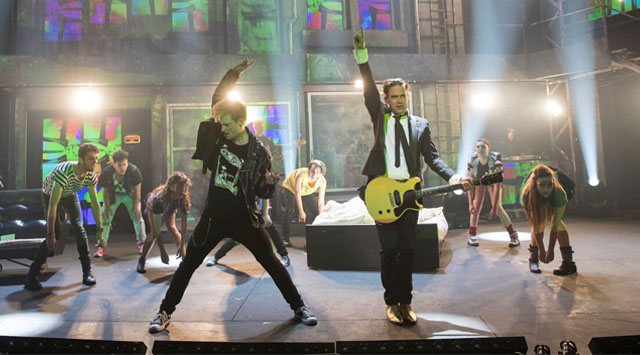
Paul is a rock star who plays to crowds of 100,000 people. That scale of extraordinary fame and fortune, is an existence beyond the comprehension of us mere mortals. In Simon Stephens’ Birdland, we see a kind of dehumanised individual struggling to find a sense of normalcy in a world where everything is permissible and accessible, and where everything is eventually reduced to meaninglessness.

The play lifts the lid on the lustrous personalities who entertain us. We fall in love with these strangers, and envy their lifestyle, thinking that theirs is the ultimate freedom, to have every request and desire met. It is fascinating to imagine what it must be like, to not be able to want, after having consumed everything. The human compulsion to pursue that which remains unsated, is crucial in how we are able to operate from day to day. The depressed cannot get out of bed, because nothing is worthwhile. The superstar experiences something similar, when all appetite is quelled even before they appear.

Paul becomes increasingly anaesthetised, resulting in a frantic escalation of indulgence and excess. Graeme McRae is strong in the lead role, offering an interpretation that is detailed and intelligent. It is extremely demanding work, and while our compassion for Paul is carefully sustained for the entire two hours, McRae’s stamina seems to wane in the later stages. The production is quiet and sensitive, with director Anthony Skuse’s remarkable ability to provide a sense of fragility keeping us engaged, but the bareness of the stage, although visually appealing, can at times feel overly taxing on the actors, who have nothing but themselves to make each moment spark.

It is less daunting for the rest of the cast, who play a series of supporting characters orbiting Paul. Charmaine Bingwa is outstanding in Birdland. As an African escort, she is dangerously alluring, and as an English policewoman, she is deliciously unkind, but it is in the scene where she plays Paul’s father that Bingwa is most memorable. We are suddenly overwhelmed with emotion, when we see the only thing of genuine value to Paul, falling to pieces along with every other aspect of his being. It is a beautifully performed show, with each actor captivating in their passionate commitment to the craft.

It is healthy to want better for ourselves, and dreaming big is a way for us to find impetus to live with excitement and joy. A state of contentment however, must never be absent. The tension between needing more, and feeling satisfied, might seem a contradiction, but it is in finding a way to negotiate their co-existence that we can perhaps achieve emotional and psychological stability. Nobody rejects Paul, so it can only be up to him to say no.

www.newtheatre.org.au

Review: Hypnagogism (Balter Theatre Co)

Venue: The Factory Theatre (Marrickville NSW), Oct 4 – 14, 2017
Playwright: Frankie
Directors: Luke Beattie, Frankie
Cast: Kate Allison, Bretany Amber, Daniel d’Amico, Brielle Flynn, Lachlan Mcnab, Vonne Patiag, Ash Sakha, Tivy Siripanich
Image by Margaret Grove

Theatre review
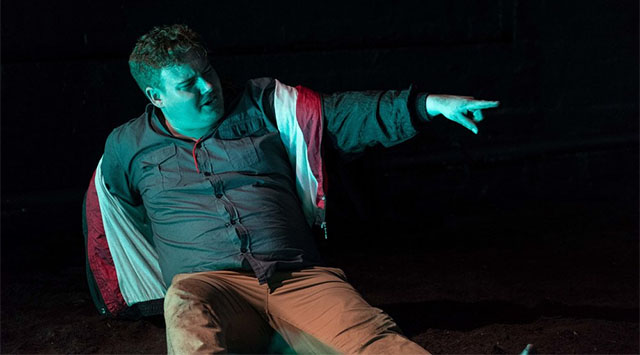
Michelle goes to acting school everyday, where teachers tell her to dig deep for emotions worthy of display. Trauma is fetishised, but little care is given to the young adults who find themselves in a constant state of vulnerability, with open wounds that are left to their own often inadequate devices. Michelle suffers from a history of sexual assault and finds herself encouraged to exploit those very painful memories.

Frankie’s Hypnagogism portrays with striking persuasiveness, the neglect of mental health in some of our less proficient institutions. Although lacking in polish and maturity, the play makes salient points about how we train our actors, by drawing attention to problematic practises that are usually hidden from the public eye.

It is essentially a work of dark comedy, with a strong tendency to turn very melodramatic in its efforts to maintain emphasis on Michelle’s struggles. Directors Luke Beattie and Frankie herself, use the stage with commendable imagination, but edits could be made at more than a few junctures, to achieve a considerably crisper result. Playing Michelle is the confident Bretany Amber, one of an impressively well-rehearsed and cohesive team of young talents. Flamboyant actors Brielle Flynn and Daniel d’Amico are memorable in comedic roles, both bringing exuberance and excellent entertainment value.

The infinitely multi-faceted nature of art, allows for participation by artists of all kinds. It is easy to identify the ones who go to extremes, but more than a few level-headed individuals have found success on their own terms. In the process of art however, the extant discovery of self and environment is fundamental, meaning that limits and boundaries must always be explored. Where and when one chooses to transgress, is perhaps how art is best able to get involved, in the creation of meaning.

www.baltertheatre.com

Review: Home (Tantrum Youth Arts)

Venue: PACT Centre for Emerging Artists (Erskineville NSW), Oct 4 – 7, 2017
Director: Janie Gibson
Cast: Sara Barlow, Thomas Lonsdale, Roger Ly, Alexandra Mangano, Meghan Mills, Meg O’Hara, Taylor Reece, Stephanie Rochet, Rosie Scanlan, Clare Todorovitch, Phoebe Turnbull
Image by Eryn Leggatt

Theatre review
The point of departure is a meditation on home, a concept that we associate with all things secure, warm and familiar, but the 11 artists delve deep within, to unearth instead, many unexpected and troubling aspects of living in Australia today.

The piece begins predictably, perhaps too innocently, about the planet and its natural environment, with seen-it-all-before physical configurations, typical of theatre featuring ensembles of young people. After some warming up, director Janie Gibson takes us to the deep end, where pretence gives way to raw honesty, and the real drama happens.

Home‘s collation of words by various entities (with dramaturgy by Lucy Shepherd), is a remarkable achievement, showcasing a valuable range of perspectives that form a truthful and timely representation of where we are today, as a society and a collective consciousness.

Alexandra Rose talks poetically about the idea of body as home, Phoebe Turnbull speaks boldly for new feminists everywhere, Roger Ly articulates with great humour, the historical experience of our many marginalised ethnic minorities, and Meg O’Hara is blinding with her infectious passion as a queer activist. There is a lot of power in Home, derived from very serious and exquisite thought.

Art scintillates when brave and authentic, and there is much to be excited about here. Also very noteworthy is the live music accompaniment by Huw Jones, whose electronica underscores the entire show with intelligence, and beautiful sensitivity. Quality of acting in the group is inconsistent, but Stephanie Rochet-Cuevas’ brilliance as performer is unequivocal, presenting a “star is born” moment on the Sydney stage, having recently arrived from Chile, via Newcastle. She is formidable, a force to be reckoned with, and a personality one sincerely hopes to see grace our theatres again soon, and often.

Home is where we should be able to find comfort. It is also where we are safest and most able to confront the darkest of our beings. In bringing their audience their most authentic vulnerabilities, the artists compel us to connect, with the work and with each other. Enclosed and tethered, we think about the spaces we share, and the inevitability of our dependence on each other, and the care, that increasingly, we forget to take.

www.tantrum.org.au