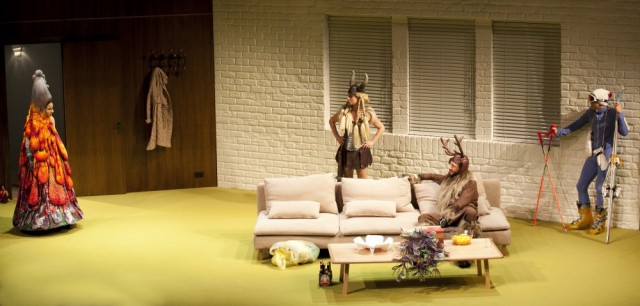
Review: Proof (Ensemble Theatre)

proofVenue: Ensemble Theatre (Kirribilli NSW), Jan 31 – Mar 8, 2014
Playwright: David Auburn
Director: Sandra Bates
Actors: Matilda Ridgway, Catherine McGraffin, Adriano Cappelletta, Michael Ross

Theatre review
There seems a fine line between genius and madness. Both are by nature alienating, and people who present these qualities frequently feel misunderstood or isolated. In our age of overdiagnosis and hypervigilance, mental conditions seem to be everywhere, presenting to society innumerable challenges relating to the way we manage them in daily lives. As we continue to obsessively pathologise every less than common behaviour including the display of extraordinary talents, so do our tendencies to impose conformity throughout our communities. Proof is a story about a woman’s gift in mathematical ability, and the pressures she faces from living a less than conventional life.

Sandra Bates’ direction relays the story clearly, and pays close attention to dynamics between characters. We have a good sense of who these people are, and the world in which they live is portrayed vividly. Tragic elements of the play are fleshed out particularly well, with themes of death, illness, betrayal and jealousy providing tension and gravitas. The production is however, less effective in its lighter moments, where some of the comedy can be stiff and muted. Bates’s work might not be consistently strong through every scene, but where the drama does work, things get fabulously explosive.

The four actor ensemble is tight and even. These are generous performers who have opened up to their audience and to each other. The frisson between characters is a highlight of the show, and their interchanges are thoroughly enjoyable. Michael Ross plays Robert with ardour and depth. He delves into a realism that appeals to our empathy, but also performs the character’s madness with a fiery gusto that keeps us engrossed. Lead actor Matilda Ridgway is committed and present. She has a warmth that allows us to identify readily with Catherine’s ordeal, but her emotional range requires further expansion in order to hit all the right notes required by the emotionally complex script.

David Auburn’s writing delivers a story that is intriguing and passionate. It is also deceptively simple, and only with protracted excavation can all its subtleties be brought to light in the theatre. In this new production by Ensemble Theatre, we are treated to a fascinating story, told with an authenticity and a gentleness that will resonate with anyone who has ever wondered about the insanity and ingenuity that resides in every person.

www.ensemble.com.au

Review: Legend! (Decorum / Sydney Independent Theatre Company)

legend1Venue: Old Fitzroy Theatre (Woolloomooloo NSW), Jan 28 – Feb 15, 2014
Playwright: Pat Sheil
Director: Lex Marinos
Actor: John Derum
Image by Katy Green Loughrey

Theatre review
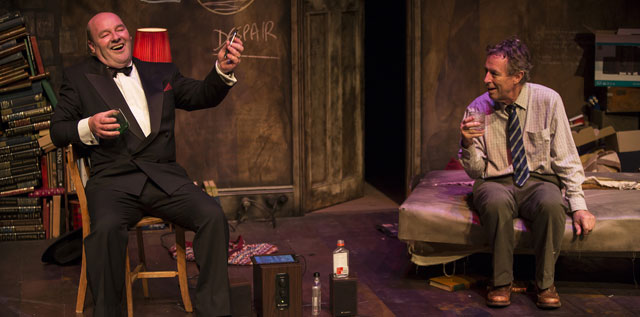
‘Slips’ Cordon is in his home, reminiscing. We don’t know why, or who it is he speaks to, but there is certainly no shortage of tall tales to share. Pat Sheil toys with our “European history” in his script, re-writing events involving our iconic war heroes, legendary sporting personalities, celebrated performers, and various significant political figures of times past. These revisions are amusing, and depending on your level of affinity with the “source material”, possibly even hilarious.

Cordon is played by the effortlessly charming John Derum, who carves out a character that is immediately endearing. This is an actor who revels in spinning yarns, and his enjoyment of the limelight is infectious. We are drawn in and are glad to be his captive audience. Derum is excellent at punchlines. Indeed, the show does at times, feel like a stand up comedy routine, where a comedian simply tells jokes, without much concern for context or character development. We do not learn very much about Cordon, but he does make us laugh.

This is a clever script that could work well in the form of a novella, but Derum’s interpretation adds a dimension of time and place that is strangely (and ironically) authentic, even though we are free to imagine where and when the action before our eyes actually takes place. Legend! is only mildly iconoclastic. In fact there is an air of reverence for these legends that hangs heavily over the production. Rest assured that our sacred cows are left unscathed.

www.sitco.net.au

Neighbourhood Watch (Ensemble Theatre)

rsz_watchoneVenue: Ensemble Theatre (Kirribilli NSW), Dec 12, 2013 – Jan 25, 2014
Playwright: Alan Ayckbourn
Director: Anna Crawford
Actors: Brian Meegan, Fiona Press, Gillian Axtell, Douglas Hansell, Lizzie Mitchell, Jamie Oxenbould, Olivia Pigeot, Bill Young

Theatre review
Alan Ayckbourn’s brilliant script is a work about the anxieties of middle classes in English suburbia. Its comedy is flamboyantly unhinged, and bears the strong flavour of absurdist British humour that is loved on stages and television the world over. His characters are quirky and colourful, yet complex enough to prevent them from becoming mere caricatures. Ayckbourn’s construction of “the frightening other” is masterful. We watch the onstage characters imagine a threat without actually seeing any substantiation for their terror. Audiences are implicated into the farce being performed, because we share in the imagery of the imagined enemy, but the play constantly reminds us of the stupidity in the scenarios being presented and indeed, the irrationality of those fears.

Brian Meegan is an effective leading man, playing the neighbourhood watch group leader Martin Massie with charm and energetic ardor. All the action is structured around him, and he displays great commitment and gravitas that holds the plot together. Jamie Oxenbould plays the cuckolded Gareth. His characterisation is idiosyncratic and subtle, turning a smaller part into a memorable, and very odd, stand out role.

Direction of the play focuses on plot trajectories, resulting in very clear storytelling, and amusing discourse on themes and concepts. However, interpretation of the play’s comedy elements falls short. There is an emphasis on realism in performances while the text seems to require a much broader comic style. Potential for laughter resides in virtually every line of Ayckbourn’s sharp writing, but his wit is not always strongly delivered.

Neighbourhood Watch deals with issues of class and hypocrisy in our societies. It exposes what we all know to be true, but in a way that surprises and fascinates. Its characters are simultaneously familiar and unpredictable, and they present a story that we can all relate to, regardless of which side of the fence we imagine ourselves to be situated.

www.ensemble.com.au

The Dreamer Examines His Pillow (Unpathed Theatre Company)

dreamerexaminesVenue: TAP Gallery (Darlinghurst NSW), Dec 10 – 21, 2013
Playwright: John Patrick Shanley
Director: Vashti Pontaks
Actors: Ainslie Clouston, Scott Lee, Peter McAllum
Image by Tom Bannerman

Theatre review (of preview performance, Dec 11)
The best stories in theatre and film contain messages and morals that are applicable to lives everywhere. The Dreamer Examines His Pillow seeks to unpack profound truths of our shared experiences, and present on stage an enlightened point of view that can enrich and inspire everyone. John Patrick Shanley’s script was written early on in his career, but is masterful in the way it expresses its philosophies, mainly from the perspective of a middle-aged character.

Peter McAllum plays Dad, the aforementioned role, with powerful conviction and exquisite relish. It is evident that McAllum has a good affiliation with the material, and many of the play’s complex ideas are articulated effortlessly and clearly through his portrayal. McAllum is thoroughly enjoyable to watch. He dominates in his scenes, and is quite obviously having the time of his life in this unique gem of an opportunity.

Direction by Vashti Pontaks relies heavily on performances from her three actors, who are all keenly energetic, but who also vary in experience and ability. While they are all focussed and charismatic, the depth of some sections do not always translate well when in the hands of the younger performers. Chemistry is also lacking between the young leads, and humorous moments are sometimes missed. Pontaks’ strength lies in the more serious aspects of the play, but the length of the work requires that its lighter sections deliver the laughs, in order that interest is more effectively sustained.

A lot of Dreamer is about courage, and Pontaks drives that message through beautifully. She also constructs a world where the concept of fear is palpably believable. The courage we need for living full lives, and the courage artists need for bringing their work to fruition, are explored and on display in this earnest and dynamic production. It is up to us to rise from our slumber, and to decide for ourselves whether an unexamined life is worth living.

www.unpathed.com.au

Decadence (Apriori Projects)

decadence1Venue: Old 505 Theatre (Surry Hills NSW), Dec 4 – 7, 2013
Playwright: Steven Berkoff
Director: Serhat Caradee
Actors: Katherine Shearer, Rowan McDonald

Theatre review
Steven Berkoff’s script Decadence is essentially about morality, and it displays thoroughly and explicitly, the manifestations of immorality within the context of 1980s Thatcherite Britain. It is bold writing in verse form, with emphasis on language and character dynamics, and minimal reliance on conventional narrative structures. Berkoff’s characters are cold and obnoxious. This is not the kind of play that inspires empathy or identification, but it is persistently fascinating.

Serhat Caradee’s direction focuses squarely on the performances of his two leads, and his efforts pay off with excellent work from the actors. Caradee is particularly strong in sustaining the high energy, almost chaotic tone of the show, while giving texture and layers to what is basically a play based on a singular idea. There are a few moments, however, where one could imagine a greater user of space. Whether it be additional performers, multimedia elements, or set and props, various supplementary components could have been introduced to magnify some of the dramatics, even though the relatively bare staging does have its charms.

Katherine Shearer’s infectious playfulness endears her instantly to the audience. There is an old-fashioned sensibility to her mode of performance which is full of allure, and perfectly suited to the era in which the action is set. She brings a joy to the stage, providing a welcome counterbalance to the dark cynicism of the writing. Rowan McDonald is a highly animated actor, who obviously enjoys the absurdity and biting social criticism of the play. The range of physical, vocal and facial expressions he introduces into his work is truly breathtaking. There is a dogged tenacity to McDonald’s stagecraft that is magnetic, and he holds our attention to present concepts that are sometimes subversive, and always entertaining.

Indeed, Berkoff’s subversive spirit is represented with great success in this production. The energetic and entertaining performers prevent things from being too alienating, but the work’s political edge is thankfully not lost. The message might be a difficult one to take in, but the thrills and spills of the ride are certainly rewarding.

www.venue505.com/theatre

On/Off (Bordello Theatre)

onoff2Venue: Bordello Theatre (Potts Point NSW), Nov 30 – Dec 15, 2013
Playwright: Lisa Chappell
Director: Scott Witt
Actors: Lisa Chappell, Marissa Dikkenberg
Image by Simon Dikkenberg

Theatre review
When an actor and a singer come together to create a work in the cabaret space, it is a sure sign that they are on a mission to break theatrical rules in order to create something unique and fresh. On/Off certainly gives us something new and innovative, but more than that, this is a work that entertains, fascinates, and connects on many levels. It takes its audience on an emotional roller coaster ride, well aware that it is the contrast of funny and sad that makes each reaction more powerful. We laugh and cry, and laugh again. With its unusual structure and excellent performances, the show forces us to let down our guard, and takes control of all our sentiments.

Scott Witt’s direction is superb. He constantly plays with juxtapositions, making use of the wildly different characteristics of the two actors, and the spacial concepts of on stage and off stage, and crafts a work that is as emotionally volatile as it is confident in its structure and plot. The journey is incredibly bumpy, but the destination is crystal clear. The experience of witnessing one actor on stage, and the other off, while listening to a familiar cabaret standard, is a pleasure that has to be seen to be believed.

Marissa Dikkenberg’s depiction of her character’s disintegration is marvellous. Her singing voice is strong, but she uses her skills carefully to maintain the believability of her character. Sara is a bland “Stepford housewife” type, who goes through a thorough and clamorous break down, progressing from a chirpy and sober state of delusion into a complete drunken mess. Lisa Chappell’s presence in the tiny Bordello Theatre is colossal, and her acting is faultless. Her drama and comedy are both high octane, but the gory authenticity she puts into her work makes every moment convincing. Chappell’s performance is determined to hit her audience like a ton of bricks. It is unabashed, unapologetic theatricality at its most flamboyant and audacious, and completely delicious.

This is alternative art, but formulated with the intention to communicate to wide audiences. It is a story about life’s disappointments, human resilience, and the value of friendship. These themes are universal, and also passionate. The words to one of the songs in the show sum things up best, “you’ve got to laugh a little, cry a little… and when the world is through with us, we’ve got each other’s arms.” Many things happen in On/Off, but what endures is The Glory Of Love.

www.facebook.com/lisachappellonoff

Theatresports Cranston Cup Grand Final 2013 (Impro Australia)

rsz_113-12-01cranston_cup1052_winners_hans_and_ottoVenue: Enmore Theatre (Enmore NSW), Nov 30, 2013
MC: Jim Fishwick
Director / Referee: Marko Mustac
Judges: Michael Gregory, John Knowles, Susie Youssef, Ewan Campbell, Lyn Pierse
Participating teams: Yay! It’s Pat Magee and Friends, Middle Rage, Bridie of Frankensteen, Hans and Otto, The Browntown Three, Kavalier
Image by Stephen Reinhardt

Theatre review
The annual Cranston Cup sees teams compete through several rounds to reach the grand final, a night that celebrates the best of improvisation and unscripted comedy. Theatresports has thrived for nearly thirty years, and judging from the turn out and response at the Enmore Theatre, it is a part of Sydney culture that has a particularly loyal and colourful following. In fact, the crowd is an important element to the night’s proceedings, and they are a group who are up for a big laugh and know how to get it.

Early rounds see two teams, The Browntown Three and Kavalier, battle it out for the Fresh Cranston Cup, which rewards the best of young and emerging improvisers. All players presented no hint of green, and performed as well as their more seasoned counterparts. As a result, both groups tied for the fresh cup, although an all girl three-way affair depicted by Kavalier remains particularly memorable.

For the main event, a pair of “German gargoyles” Hans and Otto took out not just the Cranston Cup of 2013, but an additional Clem’s Chicken Award was also awarded to one of the duo Edan Lacey for most consistent performance throughout the various stages of competition. Although not always the clear winner, they demonstrated many moments of genius and were a definite crowd-pleaser. Bridie of Frankensteen were first runner-up in spite of a particularly powerful performance in their final challenge, showcasing a vicious tuck shop conflict. Third place went to Yay! It’s Pat Magee and Friends, who are made up of four members of varying abilities, and Middle Rage came in fourth even though their onstage bravado was most impressive.

It is unclear what the winners receive in prizes on top of the flamboyant trophy and prestige, but all performers were certainly fighting hard to put forward their very best. Each segment might be short and sweet, but the participants work hard at delivering incessant waves of laughter, and this tremendous collection of comedic talents undoubtedly found our funny bones and tickled us pink on their night of nights.

www.cranstoncup.com.au

The Star Child (The Genesian Theatre)

rsz_starchildVenue: The Genesian Theatre (Sydney NSW), Nov 23 – Dec 14, 2013
Book & Lyrics: Roger Gimblett (based on story by Oscar Wilde)
Music: Nicholas Edwards
Director: Roger Gimblett and Stephen Lloyd Coombs
Actors: Ben Bennett, Elizabeth MacGregor, Robert Green, Martin Searles, Amber Wilcox, Michael Jones, Dominic Scarf, Timothy Bennett
Image by Mark Banks

Theatre review
Based on a children’s story from Oscar Wilde, The Star Child is a new family musical about a boy acquiring the virtues of humility and generosity. It is a moral tale told through humour and fun, and would appeal to audiences across different religious backgrounds. Most of the songs are well-written, with several memorable jazz tunes standing out. Choreography is careful to accommodate the various skill levels in the cast, who all appear to be comfortable with their moves.

Ben Bennett plays the Star Child, with impressive vocal range and power. He is a confident performer and has a youthful vigour that is perfect for the role. Bennett’s keenness for the comedic elements in the story helps with keeping the show buoyant, and his chemistry with co-performers is a joy to watch. Dominic Scarf’s scene as the Rabbit is cheeky and delightful. His performance adds colour and pizzazz to the proceedings, and delivers some of the funniest moments in the show. Timothy Bennett and Daniel Hitchings play multiple roles and although they do not have solo numbers in the show, both shine with the comedy they introduce throughout the course of the production.

Children are impressionable. It is important they hear stories that feature worthy role models and extoll true virtues. The Star Child is a show that will hold every child’s attention, entertain them and most importantly, inspire them.

www.genesiantheatre.com.au

Vere (Faith) (Sydney Theatre Company)

Photo by Matt NettheimVenue: Sydney Opera House (Sydney NSW), Nov 6 – Dec 7, 2013
Playwright: John Doyle
Director: Sarah Goodes
Actors: Paul Blackwell, Matilda Bailey, Matthew Gregan, Ksenja Logos, Rebecca Massey, Geoff Morrell, Yalin Ozucelik

Theatre review
This is a story about a highly regarded physicist, Vere, who falls victim to Parkinson’s disease. Vere has built a life based on science and intellect, but is now faced with the cruel obliteration of his mental capacities by dementia. John Doyle’s play explores the remains of a life, as its subject goes through a metamorphosis so exhaustive and fundamental. In Vere’s disintegration, we see the curious way in which memory functions, and from it, we gain an appreciation of what is immortal and invaluable. Themes of love, relationships, religion, work, mortality, and the transience of life itself, are meaningfully woven along with humour and pathos to create a show that is simultaneously entertaining and profound.

The first half is set in a university before Vere’s disorder takes effect, and the second, at his home when it is in full swing. The show speaks at first to our minds, with exuberant and witty repartee among cerebral academics, then to our hearts, as family dynamics come into play with decidedly greater sentimentality. It is as though Vere’s illness can wipe out the contents and function of the brain, but the soul is unbreakable and eternal. Director Sarah Goode’s work is quiet, and not particularly showy, but her hand is a confident one. She understands the strengths of the script, and ensures those strengths shine through with minimal intrusion.

Design elements are excellent, if a little conservative. The production is demanding of the actors, who (aside from the lead) each play two sets of characters, and they rise to the challenge beautifully. Geoff Morrell’s flamboyant style ensures that his characters are memorable, and his vivacity is a welcome addition to any event. Rebecca Massey portrays an unintelligent character with brilliant irony and meticulous timing. She delivers many laughs with a camp sensibility but is careful to retain a level of realism and believability.

Paul Blackwell’s performance is sublime. His presence is remarkable and the audience falls for his Vere from the very first words. He fascinates us, and we are completely enthralled, like putty in his hands. Blackwell’s biggest success is the ability to elicit great empathy while depicting a very sick man with utmost dignity. Through him, we see the humour in our fragility, but that frailty he depicts is also deeply touching. Blackwell, and Vere, guide us through a poignant meditation on growing old, on lost love, and on death, and we conclude at a place that is, surprisingly, not very frightening at all.

www.sydneytheatre.com.au

Dying For It (New Theatre)

dyingforit1Venue: New Theatre (Newtown NSW), Nov 19 – Dec 21, 2013
Playwright: Moira Buffini (from Nikolai Erdman’s The Suicide)
Director: Peter Talmacs
Actors: Johann Walraven, Jodine Muir, Jeannie Gee, Joel Spreadborough, Peter Adams
Image by Bob Seary

Theatre review
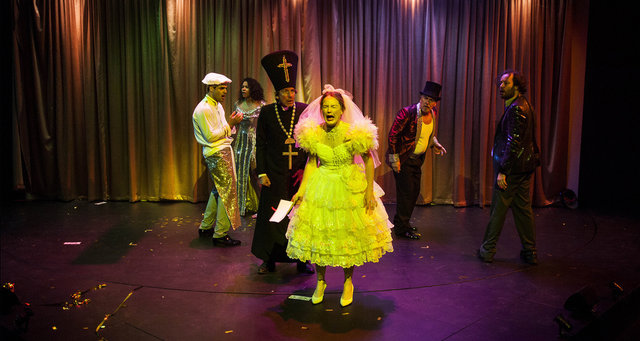
This story comes out of 1920s Russia, and includes some very subversive dark humour, dealing with death, marriage, religion and politics. Moira Buffini’s 2007 script is an adaptation that retains the original’s time and place, foregrounding the political climate of the time. Almost a hundred years on, Russia is no longer thought of in the same light, but social dynamics do not seem to change and we recognise the mechanics at work in the narrative.

Dying For It is a very funny show. While not every moment is laugh-out-loud hilarious, each line is witty and comedic. The context is dark and twisted, but the writing is purposefully light and humorous. Buffini’s characters are irresistibly amusing, and her farce cuts to the bone. Director Peter Talmacs creates a show that is entertaining and energetic, extracting from his cast a performance style that is wild and extravagant. Talmacs is relentless at keeping things lively, and he makes full use of the abundant absurdity inherent in the play.

The cast is a strong (and big) one, with leading man Johann Walraven taking the opportunity to show off his formidable talent. Walraven plays Semyon Semyonovich Podsekalnikov with a calculated silliness, and portrays a character that the audience finds simultaneously endearing and appalling. His work is precise, in terms of his physicality as well as diction, and is an absolute joy to watch. His wife Masha is played by Jodine Muir, who excels at the kind of frantic, rambunctious performance that characterises this production, and offers an important counterbalance of rationality to the mad goings-on of the other roles. Jeannie Gee’s mother-in-law character escapes generic stereotyping, with a depiction that is charming and whimsical. She clearly has a keen sense of comedy and draws many of the biggest laughs.

Tom Bannerman’s design shows a deep understanding of the New Theatre stage capabilities, and his ambitious set is crucial to the effectiveness of this production. Tony Youlden’s lighting is subtle but thorough, and operated flawlessly by the crew. This is a demanding show for its operating crew, who rise up to its challenge with fabulously sleek work.

Dying For It travels through bleakness, but its dark murmurs resonate silently. It expresses a poignancy that is omnipresent but gentle, even though its themes are heavy. This is a work of comedy that is reminiscent of the art that laughs in the face of adversity.

www.newtheatre.org.au