Review: Othello (Bell Shakespeare)

bellshakespeareVenue: Sydney Opera House (Sydney NSW), Oct 25 – Dec 4, 2016
Playwright: William Shakespeare
Director: Peter Evans
Cast: Ray Chong Nee, Joanna Downing, Alice Keohavong, Edmund Lembke-Hogan, James Lugton, Huw McKinnon, Elizabeth Nabben, Yalin Ozucelik, Michael Wahr
Image by Daniel Boud

Theatre review
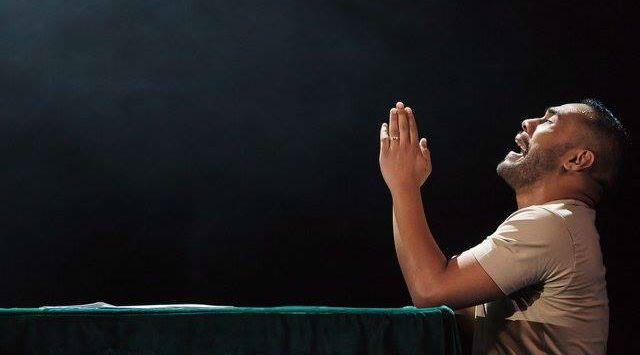
As the saying goes, “well behaved women seldom make history”. Desdemona and Emilia are slaughtered by their respective husbands after displaying only wifely devotion, as well as prudent decorum to all and sundry in Othello. It is not a battle of the sexes in the play, for there is nothing that resembles a level playing field, but an examination of tyrannical brutality against women, and the treatment of women, in art and in society, as mere objects and possessions. Toxic masculinity is the villain, and it resides in every one of the play’s male characters. Jealousy and egotism are their driving force, and great drama certainly does ensue, along with observations on some of our ugliest traits as human beings.

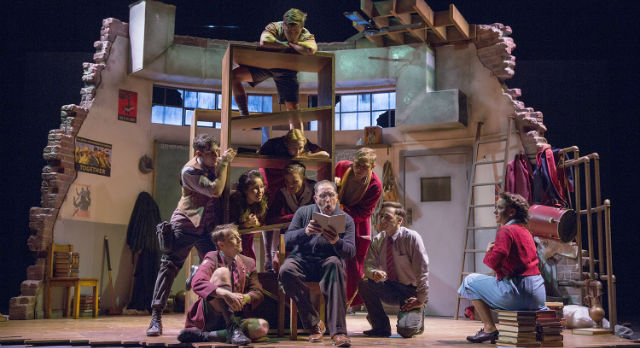
It is a remarkably well-rehearsed production, with director Peter Evans’ innovative ideas keeping things fresh and relevant for contemporary audiences. Imagery is often beautifully manufactured; Evans’ efforts at adding visual resonance to Shakespeare’s text is admirable, especially noteworthy in Cassio’s “party scene”, involving strobe lights and levitating cask wine bladders. Lighting design by Paul Jackson is thoroughly adventurous, and relied upon heavily for scene transitions and atmospheric transformations, in the presence of a very minimal set, consisting little more than a big wheely table that is manoeuvred around the stage for a large portion of the show, breathtaking when effective, but unbelievably jarring when at its worst.

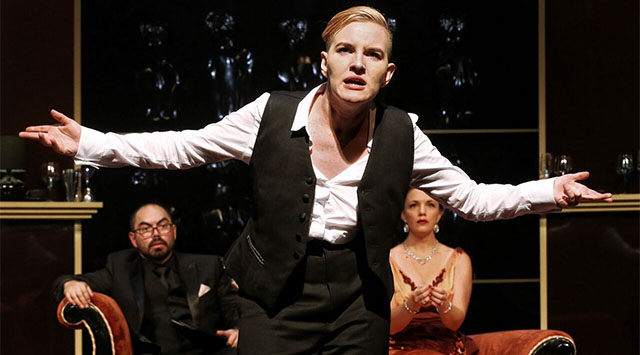
The cast is polished and energetic, but the show suffers from portrayals of very big emotions that are not necessarily persuasive. Ray Chong Nee is a stately and handsome Othello, perfect in his depiction of the character’s noble qualities, and enthralling as a romantic figure in the early sequences, but Othello’s descent into darker barbaric emotions is significantly less convincing. Bad guy Iago is powerfully performed by Yalin Ozucelik, charismatic and full of conviction, in a role that gives the plot its strongest propulsive vigour. Although slightly lacking in texture, the actor’s work remains captivating, with a delicious Machiavellianism that makes for excellent entertainment.

It is reported that one woman is killed by her partner every week in Australia. When the women are slain at the bitter end, our attention is drawn squarely onto the behaviour of the perpetrators. We begin to wonder if much has changed over the last four centuries, and are disturbed by the thought that the lowest of our nature continues to persist through aeons of civilisation. Shakespeare’s Othello, is a man’s story for men. It is a tragedy with logic and consequences, where a black man is used, in a highly prejudiced manner, to demonstrate that primordial impulses can lead to catastrophe. Our salvation can lie only in the understanding of our destructive nature, and in every effort to restrain and reshape those instincts. If we choose to improve, life becomes better, but where we take the cowardly alternative, there can only be loss.

www.bellshakespeare.com.au

Review: The Literati (Bell Shakespeare / Griffin Theatre Company)

griffinVenue: SBW Stables Theatre (Kings Cross NSW), May 27 – Jul 16, 2016
Playwright: Justin Fleming (after Molière)
Director: Lee Lewis
Cast: Caroline Brazier, Gareth Davies, Jamie Oxenbould, Kate Mulvany, Miranda Tapsell
Image by Daniel Boud

Theatre review
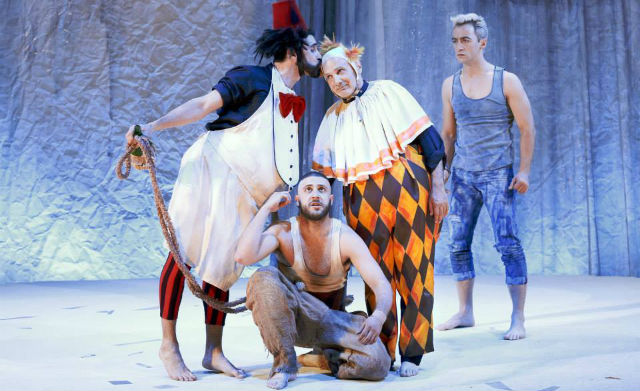
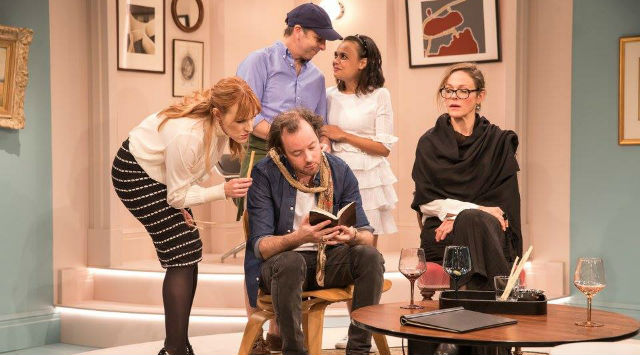
There are two halves to the family in Justin Fleming’s The Literati. Philomena and her elder daughter Amanda have aspirations for a sophisticated existence, both enamoured with books and language, while Christopher and younger daughter Juliet are of a simpler ilk, down-to-earth like true blue Aussies never to be caught dead with tickets on themselves. The play is about pretension, and the meaning of knowledge. We explore what it is to be good people, in a world where values are easily misplaced and ideas about virtue are unstable and skewed. Its message is uncomplicated, with a plot that proves to be entirely predictable, but The Literati is gorgeously written, with inexhaustible wit permeating every rhyming couplet in this thoughtful adaptation of Les Femmes Savantes by Molière. The jokes come fast and furious, along with inspired ruminations about diverse subjects including romance, intellectualism, purity and class.

Characters in The Literati are archetypal, but convenient moralistic jabs at “the bad guys” are thankfully few. The play wrestles with the problematic duo of Philomena and Amanda, shallow on one hand, but admirably ambitious on the other. Their desires are noble, but their mode of pursuance is misguided. The play sets up an old-fashioned dichotomy of pure and impure, but allows itself to negotiate between the two, so that we achieve a more textured understanding of good and bad within the story. Director Lee Lewis makes the appropriate decision of placing effect before depth, for a work that has nothing unusual to say but has very impressive ways of expressing its beliefs. The comedy is often flamboyant, but Fleming’s exquisite words are always in the spotlight, full of evocative power and mischievous vigour. The production is buoyant from start to finish, and although occasionally repetitious with its methods of eliciting laughter, we are kept engrossed in its electrifying showmanship.

Playing Christopher and Clinton is the one endearing Jamie Oxenbould, convincing and dynamic in his diverse roles. A memorable sequence features the actor alone on a revolving stage performing with meticulous clarity, and an exuberant sense of absurdity, both his characters in passionate dialogue with each other, completely absorbent of our attention, astonishment and adoration. Gareth Davies and Kate Mulvany offer up very broad humour with outlandish interpretations of their caricatures, finding every opportunity to perform their unrestrained comedy to a very appreciative and delighted crowd.

People in The Literati fight over the redundancy of words and culture, when notions of style are not validated by substance. The moral of Molière’s story is neither controversial nor surprising, but we are captivated by the production’s theatricality and the resonance of its language. In some ways, the show defeats its own argument, for what keeps us enthralled is not its idealistic core, but the talent that emanates from it. We fall in love with its gestures and articulations, but pay little heed to its very point of contention. We can look at art without the need for a presumed frame of reference or an indication of something behind, something deeper. Art is not a means to an end, but a sacred entity meaningful on its own terms. “If you want to know all about Andy Warhol, just look at the surface of my paintings and films and me, and there I am. There’s nothing behind it.”

www.bellshakespeare.com.auwww.griffintheatre.com.au

Review: Romeo And Juliet (Bell Shakespeare)

bellshakespeareVenue: Sydney Opera House (Sydney NSW), Feb 20 – Mar 27, 2016
Playwright: William Shakespeare
Director: Peter Evans
Cast: Cramer Cain, Justin Stewart Cotta, Michelle Doake, Michael Gupta, Angie Milliken, Kelly Paterniti, Hazem Shammas, Tom Stokes, Damien Strouthos, Jacob Warner, Alex Williams
Image by Daniel Boud

Theatre review
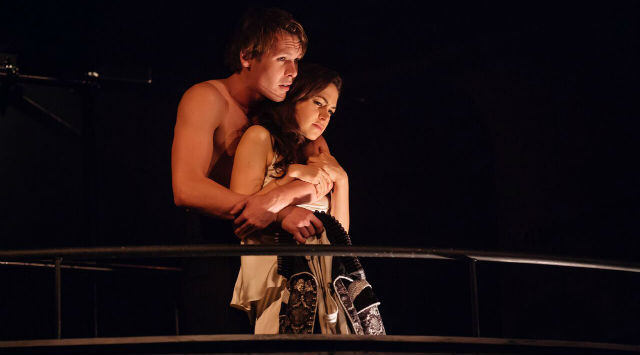
Youth is wasted on the young, but romance is best experienced at a tender age. Shakespeare’s Romeo And Juliet is the most romantic of stories, which by the same token, would mean that it is a play that can seem completely ludicrous to some. A pair of teenagers meet at a party, decide to get married hours later and over the next few days go through hell and high water to stop their families from prying them apart. Human attraction and the sexual impulse are often mysterious, but instantly recognisable when present. In Peter Evans’ iteration, we see an abundance of sophistication and polish, but chemistry is in scarcity.

The production’s first half sees several energetic performers providing effective comedy and lively interaction. Notable supporting players include Michelle Doake and Damien Strouthos who delight with flamboyant theatrics that help us engage with nuances of the plot, while delivering surprising swells of laughter. Stars of the show Kelly Paterniti and Alex Williams bring passion to the narrative, but we are never quite convinced enough about the relationship to invest our emotion into their dilemma. In the tragic second half, an unravelling seems to occur, and we become even less involved in the lovers’ plight despite their catastrophic fate. Kelly Ryall does marvellous work with music, and even though wonderfully executed throughout, does not help the concluding melodrama take flight, and the greatest of love stories leaves us cold.

Juliet and Romeo are in love with strangers. Like many things in life, their connection defies logic but are indisputably real. Something magical happens between the two, but we are not privy to it. They are overwhelmed and moved to extremes, while we observe with slight curiosity, wondering how it is that innocent love can fade without warning. Time does strange things to people, but we must be there to witness its power. Our protagonists have seen little, but we can find solace in the fact that they had only ever experienced purity, if nothing much else.

www.bellshakespeare.com.au

Review: Hamlet (Bell Shakespeare)

Venue: Sydney Opera House (Sydney NSW), Oct 27 – Dec 6, 2015
Playwright: William Shakespeare
Director: Damien Ryan
Cast: Philip Dodd, Ivan Donato, Robin Goldsworthy, Josh McConville, Julia Ohannessian, Sean O’Shea, Matilda Ridgway, Catherine Terracini, Michael Wahr, Doris Younane
Images by Daniel Boud

Theatre review
Director Damien Ryan’s rendition of Hamlet takes place in mid-20th century Denmark, with surveillance technology, airport last call announcements, and broadcasts of royal weddings. The prince is deeply upset by the death of his father, and by his mother’s very quick remarriage, but within this modern context, his very well known nervous breakdown seems to also involve the pressures of nobility as we understand them today. Our memory of Diana, Princess of Wales persevere, and the way she had been spoken off as having gone out of control, serves as a parallel to this Hamlet.

Ryan’s ideas are refreshing and plentiful. They can be meaningful, or merely ornamental, but his work is invariably engaging. In our age of collective attention deficit disorder, the production’s ability to retain our interest for over 3 hours is remarkable. Every scene is energetic, whether poignant, comedic, or transitory, Ryan finds a way to deliver entertainment and a quality of intrigue regardless of the text’s intentions. This is excellent directing, that has given rise to a show that can captivate even the most cursory of Shakespeare’s fans. Visual design contributes significantly to its pleasures. Alicia Clements’ versatile set produces dimensions on the stage with minimal fuss, and lighting designer Matt Cox’s nightmarish atmosphere administers a mesmerising effect that takes charge of our gaze.

In its efforts at bringing a newness to Hamlet, it might be argued that some dramatic tensions are unfortunately lost from the plot. The significant subdual of King Claudius’ villainy, along with the decision to play Queen Gertrude as an innocent, might be politically correct moves, but they take away from the power struggles that provide a certain spiciness to the admittedly clichéd foundations, especially in its first half. Nevertheless, the sophisticated and measured performances of the entire cast are enjoyable, and thankfully, easy to follow.

Josh McConville’s interpretation of the title role is a dynamically ranging one that exhibits a daring freedom eager to explore and experiment. McConville is powerful with all that he presents, playing comedy and tragedy equally well, but the distinction between both can appear too drastic. We understand the subject of madness involved, but it is debatable whether consistency of character can be improved in his expression of Hamlet’s state of mind. Ophelia is played by Matilda Ridgway, who shakes off the personality’s obligatory tweeness over the course of the play and puts on an impressive display of sorrow and rage in her concluding moments, for some of the most passionate and compelling scenes of the production. Philip Dodd is memorable and disarmingly funny in his parts as Polonius and Gravedigger. The actor’s confident and nuanced comic timing is a necessary element that helps with the show’s buoyancy, effectively preventing any monotony from setting in.

Revenge speaks to our base desires. A hallmark of advanced societies is the rejection of capital punishment, yet stories about vengeance resonate with no trouble at all. In Hamlet, revenge is a cancer that destroys from within. Its effects are contrary to the emotions that guide it. When enacted, the only ones who win are those from the outside, uninvolved in the eye for eye narrative. It is a profound lesson, one that is deeply, and appropriately for this text, Christian. To forgive and forget is an ideal that is unthinkable for many, but probably the only alternative to our prince’s tragic demise.

www.bellshakespeare.com.au

Review: The Tempest (Bell Shakespeare)

bellshakespeare
Venue: Sydney Opera House (Sydney NSW), Aug 19 – Sep 18, 2015
Playwright: William Shakespeare
Director: John Bell
Cast: Robert Alexander, Matthew Backer, Felix Gentle, Brian Lipson, Arky Michael, Hazem Shammas, Maeliosa Stafford, Damien Strouthos, Eloise Winestock
Image by Prudence Upton

Theatre review
Shakespeare’s fantastical masterpiece The Tempest, with all its mystique and magic, is almost an allegory for the transportative and imaginary qualities of the world of theatre. On Prospero’s island, anything can happen, and on the stage, it is precisely that boundless unpredictability that makes it a special, and for many, sacred space. Whether it is the stories of everyday that are being presented, or manifesting scenarios beyond the wildest of dreams, theatre has the ability to provide something extraordinary to all its participants.

Like Prospero abandoning the magical arts at the play’s end, John Bell directs his last production with this rendition of The Tempest. The cast he has amassed is an impressive one, and Bell’s extensive acting background is clear to see, in the fascinating and intricate characters being brought to life. Every player is detailed, energetic and palpably present, yet the resultant show is oddly placid. Themes of the text fail to resonate. Ideas such as the distinctions we draw between nations, between nature and civilisation, between freedom and confinement, struggle to find illumination, even though their presences in modern life remain relevant. Exoticism is explored well in the show, but its sense of adventurous fantasy is not always established with sufficient dynamism. Music by Alan John and sound design by Nate Edmondson are outstanding features; helping to drive the production through atmospheric transformations and exquisite moments of ethereality. Less successful are its visual elements that seem to lack whimsy and ambition. The story being told is celestial and outlandish, but what we see is staid and dated. Even exits and entrances are awkwardly managed to accommodate the inconvenient access to stage wings of the uninspired set.

Prospero is played by Brian Lipson, whose nuanced and vibrant performance provides sustenance for the entire plot, and whose sharp focus keeps us compelled. The production suffers from an overall lack of poignancy, but Lipson depicts emotions with gravitas and complexity that assist with some level of audience identification. Arky Michael and Hazem Shammas are a show-stealing couple whose mischievous antics are a persistent source of amusement. They create some of the most memorable sequences with brilliantly broad comedic interpretations of their dual roles (Michael plays Sebastian and Trinculo, and Shammas is Antonio and Stephano), captivating us with what looks to be an updated, and improved, Laurel and Hardy act.

The story is about kingdoms, sorcery, and heavenly creatures, but the show does not bear the majesty of the famed text. With its delicate and sincere approach, it is easy to be disappointed by the production’s simplicity, even though the thoroughness of its thespian executions are evident. William Shakespeare’s imagination is a genius that is unparalleled, and it seems that our meagre capacities in the dark auditorium requires greater facilitation, in order to achieve the same vision he had intended.

www.bellshakespeare.com.au

Review: As You Like It (Bell Shakespeare)

Venue: Sydney Opera House (Sydney NSW), Feb 21 – Mar 28, 2015
Playwright: William Shakespeare
Director: Peter Evans
Cast: George Banders, John Bell, Gareth Davies, Alan Dukes, Emily Eskell, Charlie Garber, Zahra Newman, Kelly Paterniti, Dorje Swallow, Tony Taylor, Abi Tucker
Images by Rush

Theatre review
As You Like It is not one of Shakespeare’s phenomenally poignant stories, nor is it an exceptional work of fantastical exuberance. It offers interesting personalities and amusing situations, but lacks a sense of grandeur and elements of surprise. Shakespeare might be idolised in all the right quarters, but his writing is certainly not without its detractors. His use of language especially, can be alienating for twenty-first century audiences, and when handled with less than expert proficiency, productions rarely deliver good results. Peter Evans’ direction never quite takes flight. There is plenty of investment into characters who seem to be dynamic and colourful, but we struggle to relate to anyone. Action on stage is lively and confident, but nobody connects with authenticity.

It is never certain where the centre of the play lies. The obvious focus would be on the love story between Rosalind and Orlando, but the remarkably poor chemistry between the two leads leave us searching for something more meaningful, or at least with some level of appeal. Zahra Newman as Rosalind is effervescent and a joy to watch when given the opportunity to take centre stage, but the important quality of romance in her narrative does not convince. Playing Orlando is the regrettably miscast Charlie Garber, whose charming presence and considerable comedic talents prove not to be sufficient for the role to take shape in our imagination. He does his best to exhibit commitment to the more dramatic sequences, but his efforts pale in comparison to when he gets to play the fool.

The stars of the show are its designers. Michael Hankin’s set brings to the stage a glorious interpretation of a Shakespearean forest, with floral garlands cascading from above, adding beautiful dimension and breathtaking hues to the performance space. Lighting by Paul Jackson is sensual but also varied, effectively depicting the movement of time and transformation of space. Kate Aubrey’s costumes are subtle and elegant, with just enough theatrical flourish to help actors establish mood and traits of individuality. Music and sound are utilised with great impact to influence atmosphere and to provide a sense of unpredictability. Kelly Ryall’s songs are pure entertainment, and an excellent touch that helps enrich an otherwise unexciting plot structure.

John Bell plays Jacques, and late in the second act, delivers the famous “all the world’s a stage” monologue. For a moment, the theatre turns electric, and descends into an attentive hush. The magic is real, and there is no mistaking its existence when it does take over. It takes a village to raise a child, and it takes a very big team of talents to put on a show of Bell Shakespeare’s usual ambitious scale, but on this occasion, it seems that the sum of its parts has not resulted in a collaboration greater than the whole.

www.bellshakespeare.com.au

5 Questions with Dorje Swallow

dorjeswallowWhat is your favourite swear word?
I actually don’t mind the odd egad! And a simple bollocks goes a long way, I find.

What are you wearing?
Right now I’m favouring the blue shorts, white linen shirt, indoor soccer shoes ensemble. I’m trying to make it a thing. I’ve been sporting it for a whole summer now, and I’m still yet to have the satisfaction of seeing a single other person walking the streets with it. Having said that, if it ever did catch on, I’d stop wearing it. I’d hate for it to become like handball and 80’s music and suddenly ironic and cool for the kids. Actually that’s it. I’m done with this whole soccer/prep/Havana Night’s theme. It’s not me anyway – who am I kidding?

What is love?
Love is a wave of euphoric bliss, between two people who brighten and lighten each other’s days, and perhaps even add a little steam to the kitchen of life. Over time, it solidifies into the closest of friendships, and the feelings of joy and support one can appreciate when two people have shared so much together, and still have so much to look forward to. In effect, it moves from the kitchen to the living area. If you ever find yourself in the lavatory, or the rumpus, you’re in trouble. And we all know what happened to the Flowers in the Attic, and Colonel Mustard in the Conservatory with the Lead Piping, so let that be a lesson to you, ye students of love!

What was the last show you saw, and how many stars do you give it?
Masterclass. Charlie Garber and Gareth Davies. Old Fitzroy. 4 and a half stars out of 5. It features a brilliant revival of the montage sequence, which I would like to see more of in the theatre, please. A very funny show. Funny ha-ha, AND funny weird, which is, in my mind, the best combination.

Is your new show going to be any good?
Three weeks into rehearsal I can safely say that I think it’s going to be rather good, to say the least. Or, to quote a few people in the rehearsal room yesterday “This isn’t shit at all!” It’s a great play, that Shakespeare chap did seem to have a vague idea what he was doing, and in the hands of my talented cohorts I think we are building quite the theatrical, sumptuous feast! Come grab a seat in a few weeks and chow-down!

Dorje Swallow can be seen in As You Like It, by Bell Shakespeare.
Show dates: 21 Feb – 28 Mar, 2015 (the show then heads to Canberra and Melbourne)
Show venue: Sydney Opera House

Suzy Goes See’s Best Of 2014

sgs-best2014

2014 has been a busy year. Choosing memorable moments from the 194 shows I had reviewed in these 12 months is a mind-bending exercise, but a wonderful opportunity that shows just how amazing and vibrant, theatre people are in Sydney. Thank you to artists, companies, publicists and punters who continue to support Suzy Goes See. Have a lovely holiday season and a happy new year! Now on to the Best Of 2014 list (all in random order)…

Suzy x

 Avant Garde Angels
The bravest and most creatively experimental works in 2014.

 Quirky Questers
The most unusual and colourful characters to appear on our stages in 2014.

♥ Design Doyennes
Outstanding visual design in 2014. Fabulous lights, sets and costumes.

♥ Darlings Of Dance
Breathtaking brilliance in the dance space of 2014.

♥ Musical Marvels
Outstanding performers in cabaret and musicals in 2014.

♥ Second Fiddle Superstars
Scene-stealers of 2014 in supporting roles.

♥ Ensemble Excellence
Casts in 2014 rich with chemistry and talent.

♥ Champs Of Comedy
Best comedic performances of 2014.

♥ Daredevils Of Drama
Best actors in dramatic roles in 2014.

♥ Wise With Words
Best new scripts of 2014.

 Directorial Dominance
Best direction in 2014.

♥ Shows Of The Year
The mighty Top 10.

♥ Suzy’s Special Soft Spot
A special mention for the diversity of cultures that have featured in its programming this year.

  • ATYP

End

sgs-best2014a

Photography by Roderick Ng, Dec 2014

End

Best of 2018 | Best of 2017 | Best of 2016Best of 2015Best Of 2013

Review: Henry V (Bell Shakespeare)

bellshakespeareVenue: Sydney Opera House (Sydney NSW), Oct 21 – Nov 15, 2014
Playwright: William Shakespeare
Director: Damien Ryan
Cast: Michael Sheasby, Matthew Backer, Drew Livingston, Damien Strouthos, Gabriel Fancourt, Eloise Winestock, Danielle King, Darcy Brown, Keith Agius, Ildiko Susany
Images by Michele Mossop

Theatre review
As the years pass, we become increasingly accustom to war being a fact of life. Wartime is no longer a set of specific and exceptional circumstances, especially with the proliferation of mass media and the normalisation of conflict as a topic of daily interest. Shakespeare’s Henry V includes the ambiguities and tensions between tragedy and heroism, but four centuries on, we seem no longer able to tell a story like this without letting casualties take centre stage.

Damien Ryan’s vision certainly reflects contemporary attitudes on the essential destructiveness of war. The injured and the dead are not obliterated from our sight, but are left critically present on stage to abate any hint of glory that might surface. The use of symbols and the visual lavishness of Ryan’s work is fiercely thoughtful, almost omnipresent. Space is explored to its creative limits, with the astonishingly dynamic use of bodies, sets and props to convey emotions and concepts. Ryan’s brand of theatre is captivating and exhilarating, but also undeniably sensitive and intelligent. His Henry V is complex but accessible, innovative but unpretentious. It aims to be a theatre for all, catering to aficionados, students and everyone else, encompassing every age and background. Shakespeare’s language is challenging for many, and the director works thoroughly to bring elucidation, although detractors are unlikely to have a change of heart with this text, which is probably one of Shakespeare’s more obscure pieces.

The production is visually beautiful, with accomplished and adventurous work from designers on all fronts. Anna Gardiner’s intricate set gives the stage an intimacy and provides performers with extensive possibilities for inventiveness. Gardiner’s costumes are not extravagant but accurately and astutely conceived, consistently effective in each character transformation and evolution. Sian James-Holland’s lighting design is one of the show’s main features. Her work is ambitious and powerful, at times conveying the plot more completely than other more tangible elements can manage. Also outstanding are music and sound designer Steve Francis’ achievements in his very specific control over atmospherics, and vocal composer Drew Livingston’s many charming and surprising songs accompanying the script.

Clearly, the performances are not the only stars of the show, but this is an undeniably excellent ensemble of actors. The chemistry they have found with each other, and in every scene, is exemplary. There is an athleticism to their creation, assisted by movement director Scott Witt, that is often breathtaking and marvelous to behold. The constant variation in tone and mood that they manufacture gives the production an extraordinarily textured feel. Keith Agius plays the more mature roles and is memorable for the depth of meaning he is able to bring to his lines. It is the gravity and an intensity that he puts into speeches that sets him apart. Matthew Backer shines with a distinct sense of humour that follows his assured presence, and his singing voice is quite sublime. The most vibrant actor will always leave an impression, and on this occasion, it is Damien Strouthos who wins us over with his agile, flamboyant and impossibly energetic approach.

It is clear that Shakespeare is revered internationally, but the universality of his writing is arguable. As societies become more aware of ethnic, gender and other differences in experience and background, it becomes less likely that any artist can claim to be relevant to everyone, but theatre is in a unique position of sheer proximity where it has the potential to move and touch, in a visceral manner. Shakespeare’s words might not always make sense, but what it gives birth to, is often blisteringly remarkable.

www.bellshakespeare.com.au

Review: Tartuffe (Bell Shakespeare)

bellshakespeareVenue: Sydney Opera House (Sydney NSW), Jul 26 – Aug 23, 2014
Playwright: Justin Fleming (after Molière)
Director: Peter Evans
Cast: Leon Ford, Sean O’Shea, Helen Dallimore, Geraldine Hakewill, Kate Mulvany, Charlie Garber, Tom Hobbs, Jennifer Hagan, Robert Jago, Russell Smith, Scott Witt
Images by Lisa Tomasetti

Theatre review (originally published at Auditorium Magazine)

Stories that stand the test of time contain truths that resonate across generations. They bear a universality that seems to derive from the very essence of being human, and a good retelling of those tales will always reveal to us, the nature of our being, and perhaps more importantly, the morals we should live by, however we choose to respond. Tartuffe has a central theme that does not age. Our relationship with religion as individuals and as collectives come into scathing scrutiny, and the way this resonance persists is a potent indication of the concerns we live with, and sadly, how little some things evolve. Molière’s play is now 350 years old, and what was controversial then, can still be used for contentious discussion today.

Justin Fleming’s exciting new script shows great talent and flair. It is an adaptation that feels updated and immediate, yet it preserves a classic sensibility, most notably through his use of rhymes. The original featured rhyming couplets, and Fleming’s decision not to deviate too far from it is felicitous, especially with new rhyme structures that are more varied and surprising. The play’s religious complexion is faithfully retained, but Fleming’s writing reconditions its gender dynamics to reflect modern day conventions. From this perspective, it is pleasing to observe the diminishment of sexism, even if religion’s place in the world seems to have obstinately endured over these centuries. By far the most drastic flourish is found in the overhauled ending of the piece. The change is a brave one, but its effectiveness is debatable. While it displays a quirky humour that can fit quite well with the style of Molière, the production falters at this point of “supernaturality”, not quite able to execute a vision with sufficient aplomb.

The venue is a large one, with a stage size that is challenging for any play featuring only a handful of performers in each scene. Director Peter Evans’ emphasis on authenticity in dialogue delivery is admirable, but memorable moments of the production come from performances that are more about flamboyance than nuance, and the frequently realistic level of interpretation seems to waste not just the vastness of the auditorium, but also the wildness of Molière’s concepts. As a result, performers like Scott Witt who have a greater command of physical capacities capture more of our attention (Witt also serves as Movement Director). Theatre is as much about space as it is about words. There are texts difficult to master, and likewise, there are stages that are harder to conquer. Not all characters are externalised enough, whether due to ability or creative choices, and the comedy is consequently uneven. Leon Ford as Tartuffe is neither majestic nor repulsive. The actor does have a captivating presence, but the role calls for more extravagant malevolence and a certain enigma that is never achieved. The play provides for his entrance tremendous build-up, but when he finally materialises, the Tartuffe we see does not live up to our imagined personality who is more evil and animated, and definitely less attractive.

The script is outlandish and titillating, always with an air of controversy, but what Evans puts on stage is safe by comparison. There is irreverence in content but not in its form. Bell Shakespeare is a professional theatre company doing theatre properly, and their Tartuffe is charming and polished. Expectations of a more anarchic rendering may be unrealistic, but Molière’s themes evoke heresy and inspire mischief, and without some quality of impoliteness, the play is reduced to something quite frivolous. There is social significance to this story, and due attention needs to be placed on its relevance to the community it plays for. We are after all, in the age of the Mad Monk (one of our Prime Minister’s nicknames), and we have political leaders who advocate the replacement of secular social workers in schools with chaplains. There is clearly fertile ground that can be penetrated, in order that a stronger social criticism can be made from taking on this platform.

The character of Orgon is played by Sean O’Shea, who becomes increasingly delightful as the hysteria escalates. Like many of the cast, his early scenes seem oddly subdued, but greater exuberance appears further into the piece. O’Shea has a playfulness that connects well with his audience, and establishes a good level of believability as both the master of the house and the fool. However, the mockery out of Orgon is not made strongly enough. It can be argued that the gravity of the play lies in Orgon and his mother’s irrational trust in Tartuffe, and the devastating effects that follow. The pertinence of their blind faith cannot be understated, and not giving it greater prominence seems to be missing the point altogether.

Stand out performances include Kate Mulvany’s Dorine, who is easily the most colourful and confident on stage. Mulvany’s remarkable wit is clearly a highlight, and her enthusiasm for creating theatrical magic out of every sentence is a marvel to watch. Charlier Garber’s comedy style is an excellent match for the frenetic energy of Molière’s crazed world. Garber capitalises on his extraordinary lankiness and idiosyncratic hairstyle, manufacturing an almost cartoonish character that never fails to amuse.

Also commendable are the production’s visual design aspects, especially Anna Cordingley’s work on costumes and sets. The script self-consciously mentions “Dolce, Galliano and McQueen”, indicating the family’s affluence and interest in style, and Cordingley certainly manages to impress upon us, a world of some extravagance and luxury, including an unforgettably exquisite costume for Madame Pernelle. Over-sized set pieces add a sense of wonder, and help with segmenting and shrinking stage spaces, but the unruly wheels on a very dominant chesterfield sofa need to be tamed to prevent its repeated, unintended and distracting slipping and sliding.

Bell Shakespeare’s Tartuffe is an entertaining work with committed performances and slick production values. Its level of professionalism is exceptional in an artistic landscape that tends to reserve our biggest talents for commercial musical theatre, and for productions overseas. Great stories however, are not only about entertainment and refinement. They are defined by the depth at which they move us, and as Molière’s immortality has shown, it is always the moral of the story that truly counts.

www.bellshakespeare.com.au