Review: Monopoly (Hot Room Theatre Group)

Venue: Petersham Bowling Club (Petersham NSW), Oct 13 – 14, 2017 with performances at other venues thereafter
Playwright: Steven Hopley
Director: Steven Hopley
Cast: Jasper Garner Gore, Benjamin Kuryo, Diego AR Melo, Alison Lee Rubie, Emilia Stubbs Grigoriou

Theatre review
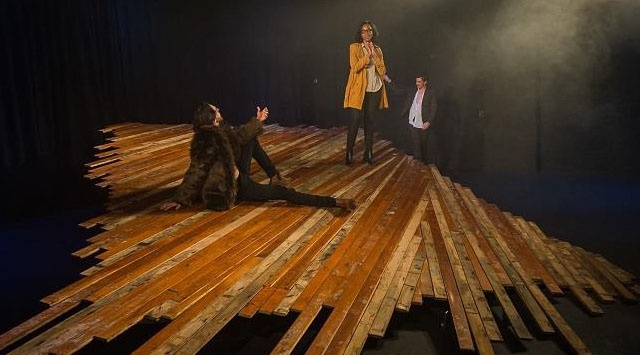
It makes sense to write a play about Sydney people playing Monopoly. We are obsessed with property prices, and cannot stop talking about it. Living in a metropolis requires that each of us has a certain level of aspiration, even just to survive this dog-eat-dog world. The characters in Steven Hopley’s Monopoly are competitive, though to varying degrees. Aside from one white cishet male, born with a silver spoon in the mouth, the other board game participants have limitations, in their race to the top.

At its best, the piece discusses the idea of privilege and by the same token, systematic disadvantage, as we understand them to exist in Australia today. Arguments are made about the kinds of people who benefit most from the way our society is structured, while others are regularly left behind. It is noteworthy that issues of poverty and sexism are given some focus, while other aspects of our inequity, such as sexuality and race, are left conspicuously neglected.

An exuberant ensemble drives the piece, with each actor demonstrating a good grasp of the material. There are portions that become convoluted, when they become deeply involved in a game that the audience can only ever have a peripheral appreciation for, but Hopley’s direction is always careful to provide a sense of urgency to sustain our attention. It is a well-rehearsed show, entertaining, if slightly hesitant in its efforts to provoke thought.

The Monopoly game requires that competitors amass houses, or face decimation. It is not quite the same in real life. The need to own property is rarely questioned, an archetypal Australian dream that is ubiquitous yet only vaguely justified. The characters in Monopoly are a true reflection of the Sydneysider. We all want to possess a piece of this land, when all we should ever be content with, is having the right to live here.

www.facebook.com/…

Review: Buyer And Cellar (Ensemble Theatre)

Venue: Ensemble Theatre (Kirribilli NSW), Oct 6 – Nov 12, 2017
Playwright: Jonathan Tolins
Director: Susanna Dowling
Cast: Ben Gerrard
Image by Prudence Upton

Theatre review
In her book My Passion For Design, Barbra Streisand reveals a private shopping mall in the basement of her property in Malibu, California. Playwright Jonathan Tolins imagines what it must be like to find yourself the sole employee of that strange place, in his 2013 one-man play Buyer And Cellar.

Unsurprisingly, the work overflows with camp and frivolity, but Tolins anchors the fun with a genuine interest in human nature, building his narrative around our fascination with the rich and famous, and taking a look into the limitlessness of ambition, and our insatiable need for affirmation.

In Buyer And Cellar, we are presented a version of Streisand, semi-fictional, who thinks herself never beautiful enough, successful enough, or admired enough. Alex, the aforementioned shop boy, is the everyday person, positioned in close proximity, to make us examine the different lives, and to consider our own values as they relate to the meanings of accomplishment, happiness and love.

The play is witty, very creatively conceived. It will appeal to much more than fans of Streisand, but a passing familiarity with the entertainment icon, and with American pop culture, is required. A specific kind of gay sensibility, of the family-friendly flavour (more “Just Jack” than John Waters), determines the comedy style, and actor Ben Gerrard is sensational in the show.

For 90 minutes, he is bewitching, so precise and energetic, that we all find ourselves hopelessly immersed in the story, whether or not we give two hoots about Streisand and her ridiculous closets. There is a tendency for Gerrard to outshine the actual material being shown, but it is for certain that we emerge thoroughly, and fabulously, entertained. His partnership with director Susanna Dowling, is clearly a match made in heaven.

Appropriately, design is marvellous in this production of Buyer And Cellar. Alexander Berlage’s lights and Marty Jamieson’s sounds are particularly effective, as we find ourselves transported to a Hollywood dreamland. Both artists are adventurous and meticulous in what they bring to the stage. Charles Davis’ set is simple, in the most elegant way, but probably slightly understated for the Streisand brand.

It is not fair that some people should have so much, while the rest of us are deprived of ever experiencing that level of wealth, but if we believe that everything comes at a cost, it might be some consolation thinking about the things that have to be given up in order to arrive at that state of abundance. There is no such thing as a free lunch, and although Streisand has traded in huge talent and hard work, we also see the emotional deficiencies she suffers, that form the propulsive force resulting in her eminent glory. The woman we see in Buyer And Cellar is dissatisfied and often unhappy, but as the playwright keeps reminding us, this is a work of pure fantasy.

www.ensemble.com.au

5 Questions with Brielle Flynn and Frankie

Brielle Flynn

Frankie: Why do you act?
Brielle Flynn: I ask myself all the time haha….I act because it was the first and only thing I felt alive doing and that felt right- like “yeh, this is what I want to do.” I love having the opportunity to delve into the life of a character and explore the complexity of humans. If it speaks to an audience, whether it’s personal or about an issue affecting us socially, I think theatre can really have the power to create discussion and thought. So not only do you get to play dress ups, you can cause a stir or realisation in someone else- that’s pretty cool.

Exactly how many heightened characters are you playing and… how?
Well, I’m playing 5 characters! I think the best thing for me through this process was finding a physical idea of them, and letting that affect the rest. I went with what traits I thought they might possess, the way they look at the context/people around them, and played around with vocal range. I don’t know where the Scottish ninja came from, but hey! Mainly, I just have fun within each one.

Which of your characters do you enjoy the most and why?
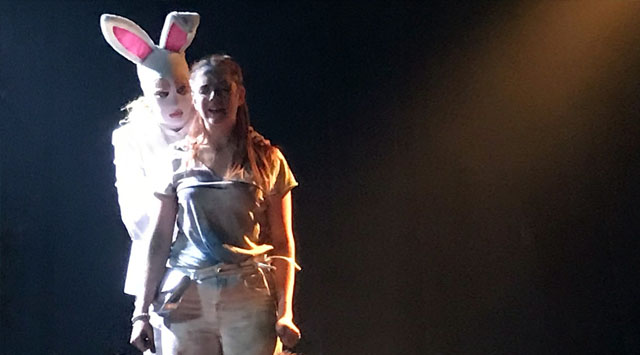
I actually really enjoy playing the rabbit- I think she has a very intimidating energy but at the same time is so unsure of what she is saying. She sort of talks her way through hidden insecurity. 101 gets an honourable mention too- she’s wacky and I have lots of fun playing with that role.

What does the theme of the play mean to you?
To me, it explores the blur between reality and imaginary- that as actors we try to push for realism, but puts a question on how much this can affect your mental health, and how it’s dealt with by those around you.

When you are not acting, you are… ?
Working in retail, writing, and more often than not, daydreaming.
Frankie

Brielle Flynn: Tell us about Frankie?
Frankie: I’m going to go literal here. After a series of terrible events, I needed a fresh start, and so I had my name legally changed to Frankie.

What was the process for the idea of this play?
I began to write draft one of Hypnagogism using nothing but a blank Word document and a psychology textbook. Twenty pages in, I went to a psychiatric hospital. While I was in there, they wouldn’t let me near a computer. I had to rely on messy scribblings in a journal. For me, idea formation is violent and uncontrollable. Ideas assault me- one after the other- it happens fast. The ideas replay over and over until they’ve safely landed on a page. The moment I write one down, another one pops up and they’re all connected in complex ways. I look at them, up there, in my prefrontal cortex (which at this point has stealthily extended itself way out past my forehead), and watch the threads link each idea together in a specific order, an order I must memorise. My fingers are not fast enough. My working memory hits limiter. I chunk each thought as quickly as I can. More space. More room. More ideas are coming. My shorthand gets shorter and my notes become more abstract but they’re there- they’re all there and when I look down at my notes I see my ideas once more, up there, in my invisible brain. It’s exhausting. It’s exhilarating. By the time I was discharged from the hospital, I had a collection of memory jogs. I pieced them together like a three-dimensional puzzle, and then, manically, I typed up the rest of draft one in four days. This was in 2015. I spent a couple of years obsessively learning how to write good. Then I fixed everything up, got it down to 90 pages, and Hypnagogism became an actual, real play.

Why did you want to write it?
My original plan did not involve a play. After I was psychologically injured at drama school, I realised that what happened to me was common, and so I set out to fix the problem. It was Dr Mark Seton, co-author of the Australian Actors Wellbeing Study, who suggested that I write a play. So I did.

How does it feel seeing it come to life?
Sometimes in the rehearsal room it was like watching a memory, which is tough, because trauma symptoms. Luckily the cast, lighting designer, and my co-director have brought more to it than I ever could. Seeing the finished product, I’m bewildered. It’s something else.

Who are your inspirations?
I identify quite a bit with the guy who did Tokyo Story, Yasujiro Ozu. I kinda just do my own thing. But there’s a catch: convergent evolution of ideas. It’s impossible to be original. I seem to be a weird mix of Tom Stoppard, Samuel Beckett, and Sarah Kane (so I’ve been told). It’s also impossible not to be influenced by things you’ve been exposed to. This particular play seems to draw inspiration from Alice In Wonderland, The Wizard Of Oz, and old school South Park. It was more that I wrote a bunch of things, then noticed what influenced the things that I wrote. Douglas Adams probably influences my writing a great deal too. I’d say though, and this has nothing to do with writing, that Jane Goodall inspires me the most.

Brielle Fiynn is appearing in Frankie’s Hypnagogism.
Dates: 4 – 14 October, 2017
Venue: The Factory Theatre

Review: Birdland (New Theatre)

Venue: New Theatre (Newtown NSW), Oct 3 – Nov 4, 2017
Playwright: Simon Stephens
Director: Anthony Skuse
Cast: Jack Angwin, Graeme McRae, Charmaine Bingwa, Leilani Loau, Louise Harding, Airlie Dodds, Matthew Cheetham
Image by Chris Lundie

Theatre review
Paul is a rock star who plays to crowds of 100,000 people. That scale of extraordinary fame and fortune, is an existence beyond the comprehension of us mere mortals. In Simon Stephens’ Birdland, we see a kind of dehumanised individual struggling to find a sense of normalcy in a world where everything is permissible and accessible, and where everything is eventually reduced to meaninglessness.

The play lifts the lid on the lustrous personalities who entertain us. We fall in love with these strangers, and envy their lifestyle, thinking that theirs is the ultimate freedom, to have every request and desire met. It is fascinating to imagine what it must be like, to not be able to want, after having consumed everything. The human compulsion to pursue that which remains unsated, is crucial in how we are able to operate from day to day. The depressed cannot get out of bed, because nothing is worthwhile. The superstar experiences something similar, when all appetite is quelled even before they appear.

Paul becomes increasingly anaesthetised, resulting in a frantic escalation of indulgence and excess. Graeme McRae is strong in the lead role, offering an interpretation that is detailed and intelligent. It is extremely demanding work, and while our compassion for Paul is carefully sustained for the entire two hours, McRae’s stamina seems to wane in the later stages. The production is quiet and sensitive, with director Anthony Skuse’s remarkable ability to provide a sense of fragility keeping us engaged, but the bareness of the stage, although visually appealing, can at times feel overly taxing on the actors, who have nothing but themselves to make each moment spark.

It is less daunting for the rest of the cast, who play a series of supporting characters orbiting Paul. Charmaine Bingwa is outstanding in Birdland. As an African escort, she is dangerously alluring, and as an English policewoman, she is deliciously unkind, but it is in the scene where she plays Paul’s father that Bingwa is most memorable. We are suddenly overwhelmed with emotion, when we see the only thing of genuine value to Paul, falling to pieces along with every other aspect of his being. It is a beautifully performed show, with each actor captivating in their passionate commitment to the craft.

It is healthy to want better for ourselves, and dreaming big is a way for us to find impetus to live with excitement and joy. A state of contentment however, must never be absent. The tension between needing more, and feeling satisfied, might seem a contradiction, but it is in finding a way to negotiate their co-existence that we can perhaps achieve emotional and psychological stability. Nobody rejects Paul, so it can only be up to him to say no.

www.newtheatre.org.au

Review: Hypnagogism (Balter Theatre Co)

Venue: The Factory Theatre (Marrickville NSW), Oct 4 – 14, 2017
Playwright: Frankie
Directors: Luke Beattie, Frankie
Cast: Kate Allison, Bretany Amber, Daniel d’Amico, Brielle Flynn, Lachlan Mcnab, Vonne Patiag, Ash Sakha, Tivy Siripanich
Image by Margaret Grove

Theatre review
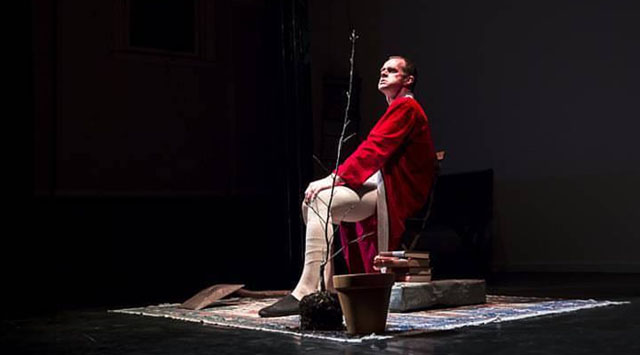
Michelle goes to acting school everyday, where teachers tell her to dig deep for emotions worthy of display. Trauma is fetishised, but little care is given to the young adults who find themselves in a constant state of vulnerability, with open wounds that are left to their own often inadequate devices. Michelle suffers from a history of sexual assault and finds herself encouraged to exploit those very painful memories.

Frankie’s Hypnagogism portrays with striking persuasiveness, the neglect of mental health in some of our less proficient institutions. Although lacking in polish and maturity, the play makes salient points about how we train our actors, by drawing attention to problematic practises that are usually hidden from the public eye.

It is essentially a work of dark comedy, with a strong tendency to turn very melodramatic in its efforts to maintain emphasis on Michelle’s struggles. Directors Luke Beattie and Frankie herself, use the stage with commendable imagination, but edits could be made at more than a few junctures, to achieve a considerably crisper result. Playing Michelle is the confident Bretany Amber, one of an impressively well-rehearsed and cohesive team of young talents. Flamboyant actors Brielle Flynn and Daniel d’Amico are memorable in comedic roles, both bringing exuberance and excellent entertainment value.

The infinitely multi-faceted nature of art, allows for participation by artists of all kinds. It is easy to identify the ones who go to extremes, but more than a few level-headed individuals have found success on their own terms. In the process of art however, the extant discovery of self and environment is fundamental, meaning that limits and boundaries must always be explored. Where and when one chooses to transgress, is perhaps how art is best able to get involved, in the creation of meaning.

www.baltertheatre.com

Review: The Natural Conservatorium For Wise Women (Clockfire Theatre)

Venue: Old 505 Theatre (Newtown NSW), Oct 3 – 21, 2017
Director: Emily Ayoub
Cast: Alicia Gonzalez, Sam Newing-Stern, Catherine Parle, Laura Turner, Tony Weir
Image by Geoff Magee

Theatre review
The patriarchy is constantly at war. In a system that benefits few, it has to protect itself from many enemies, especially those who have awoken from its deceptive manipulations, and are now aware of the injustices it generates. The Natural Conservatorium For Wise Women is an allegorical expression of the nature of patriarchy, in which we meet a man sitting atop a lonely throne, inside the strict boundaries of his miserable home, whilst others are outside engaged in blood-drenched combat on his behalf.

A highly imaginative work with only a slight reliance on dialogue, it is the sheer theatricality we encounter that truly excites. The characters tell a meaningful story, but it is the craft being put on display that is most captivating. There is much to admire, in the very specific discipline cultivated by this team of artists, with its strong emphasis on human physicality, rather than a more conventional use of emotional and verbal capacities as devices of communication. Informed by traditions of dance and mime, it is a style of performance that we rarely see in the landscapes of Australian art and is hence, an immediately refreshing experience for our audiences.

It is a very accomplished cast, with Tony Weir sensational as the decaying patriarch. Mesmerised, we watch closely as he mobilises every fibre of his being to turn the stage into a living, breathing thing that insists on our undivided attention. Weir’s commanding presence, and his powerfully seductive eyes, guide us through each moment with commendable precision and an inspiring sense of wonder. Alicia Gonzalez and Catherine Parle too, are terrific with their eccentric concoction of personalities, and the beautiful simplicity built into their unique language, is quite sublime. Space and atmosphere are finely tuned by director Emily Ayoub, who delivers a creation elegantly minimal in its aesthetic, but rich in resonance.

There is no end to the things we can talk about in the theatre, and there is no end to the different ways in which we can have those conversations, yet we seem to go about things in predictable fashion, choosing to persist with refining usual modes of presentation, instead of investing in the new. Our conservative art is symptomatic of the conservative times in which we live, and one might begin to interpret this unmistakable apathy as though there is nothing left to fight for. The opposite is true of course, but until we wake from the dulled and disillusioned dormancy of an existence that has resigned itself to the parochial, events like The Natural Conservatorium For Wise Women can only be an exception and not the norm.

www.clockfiretheatre.com

Review: Home (Tantrum Youth Arts)

Venue: PACT Centre for Emerging Artists (Erskineville NSW), Oct 4 – 7, 2017
Director: Janie Gibson
Cast: Sara Barlow, Thomas Lonsdale, Roger Ly, Alexandra Mangano, Meghan Mills, Meg O’Hara, Taylor Reece, Stephanie Rochet, Rosie Scanlan, Clare Todorovitch, Phoebe Turnbull
Image by Eryn Leggatt

Theatre review
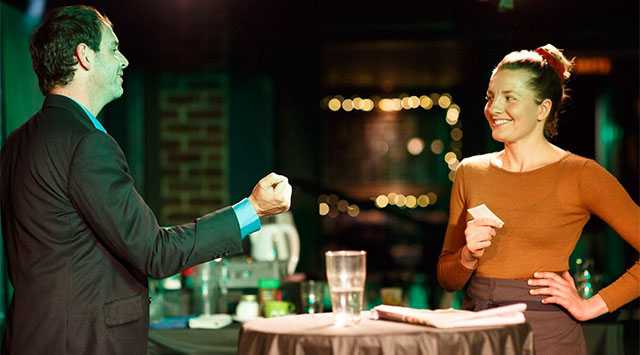
The point of departure is a meditation on home, a concept that we associate with all things secure, warm and familiar, but the 11 artists delve deep within, to unearth instead, many unexpected and troubling aspects of living in Australia today.

The piece begins predictably, perhaps too innocently, about the planet and its natural environment, with seen-it-all-before physical configurations, typical of theatre featuring ensembles of young people. After some warming up, director Janie Gibson takes us to the deep end, where pretence gives way to raw honesty, and the real drama happens.

Home‘s collation of words by various entities (with dramaturgy by Lucy Shepherd), is a remarkable achievement, showcasing a valuable range of perspectives that form a truthful and timely representation of where we are today, as a society and a collective consciousness.

Alexandra Rose talks poetically about the idea of body as home, Phoebe Turnbull speaks boldly for new feminists everywhere, Roger Ly articulates with great humour, the historical experience of our many marginalised ethnic minorities, and Meg O’Hara is blinding with her infectious passion as a queer activist. There is a lot of power in Home, derived from very serious and exquisite thought.

Art scintillates when brave and authentic, and there is much to be excited about here. Also very noteworthy is the live music accompaniment by Huw Jones, whose electronica underscores the entire show with intelligence, and beautiful sensitivity. Quality of acting in the group is inconsistent, but Stephanie Rochet-Cuevas’ brilliance as performer is unequivocal, presenting a “star is born” moment on the Sydney stage, having recently arrived from Chile, via Newcastle. She is formidable, a force to be reckoned with, and a personality one sincerely hopes to see grace our theatres again soon, and often.

Home is where we should be able to find comfort. It is also where we are safest and most able to confront the darkest of our beings. In bringing their audience their most authentic vulnerabilities, the artists compel us to connect, with the work and with each other. Enclosed and tethered, we think about the spaces we share, and the inevitability of our dependence on each other, and the care, that increasingly, we forget to take.

www.tantrum.org.au

Review: The Gloveman (Blood Moon Theatre)

Venue: Blood Moon Theatre (Potts Point NSW), Oct 4 – 14, 2017
Playwright: C.J. Naylor
Director: Michael Block
Cast: Chris Argirousis, Brinley Meyer, Chris Miller, Matt Blake, Janine Penfold, Ben Dewstow
Image by Hayden Brotchie

Theatre review
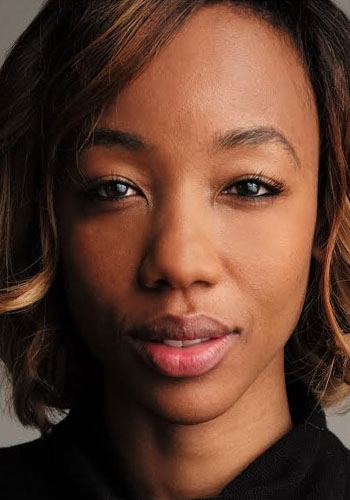
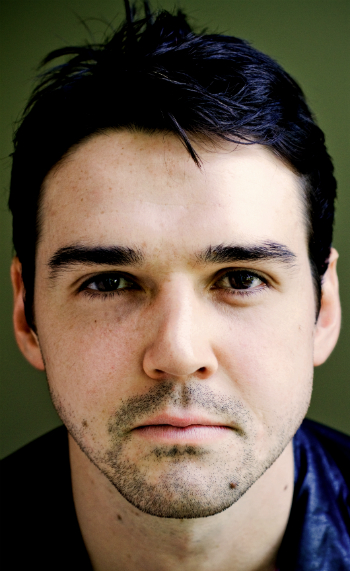
Edith has an unfulfilling life, working in a small town pub in Leeds, England. Restricted by a minor disability, she had all but resigned herself to a life of discontentment, until a pivotal encounter with Hugh, a shady figure in the local football circuit. C.J. Naylor’s story involves corruption and ambition, but for all its enthusiasm, The Gloveman serves up little drama. The stakes never seem to feel high enough, and the various divergent narratives contributed by each of its characters, add up to a plot that is consequently haphazard. Naylor’s approach to dialogue however, is often delightful, with colourful and lively exchanges that some will find amusing.

It is an energetic show, featuring an exaggerated tone to acting styles that can be charming at times, and comical at others. The decision to use Australian accents instead of a very specific Northern England one is understandable, but the effect is disorienting. The role of Edith is played by Brinley Meyer, whose warm and confident presence keeps us endeared. Personalities in The Gloveman are portrayed with little complexity, but director Michael Block provides a sense of familiarity akin to everyday television presentations that helps us relate. Supporting actor Janine Penfold is particularly memorable, for her interpretation of journalist Gabe as a woman of substance and grit.

When Edith goes missing, presumed abducted by baddies, the menfolk she takes care of at home, preoccupy themselves with arguments about who amongst them is the best goalkeeper in town. It is not uncommon that the woman imagines herself indispensable, persisting with her servitude convinced that the greater good justifies her personal suffering. Meanwhile, all the glory and dirty money that circulates within her community, bypasses Edith, as her elbow grease continues to be called upon to support their sporting economy.

www.bloodmoontheatre.com

5 Questions with Charmaine Bingwa and Graeme McRae

Charmaine Bingwa

Graeme McRae: Who’s your favourite character of the play and why?
Charmaine Bingwa: Alistair, the protagonist Paul’s father; though I’m being slightly biased as I play him. There is a simplicity to him that is so compelling. I love him as he is so representative of the generational disconnection that all too familiar in families. He also serves to remind no matter how hard we try to avoid being like our parents, elements of it are usually inescapable.

What is it like working with our director Anthony Skuse?
Firstly he is an amazing human being. He works very intuitively, has a sense of openness, yet implores exactitude and specificity as God in the detail. He is so widely read too, he’s pretty darn phenomenal.

You had a completely different career before pursuing acting. What caused this change?
I used to work in banking believe it or not! Living in Sydney, I had to balance my creative dreams with the expensive reality of this city. Slowly but surely I was guided towards acting, it almost felt like I could no longer hold my creativity in. I don’t regret it though, I learned loads and made heaps of friends! Plus, I am one of the few actors who is also a numbers girl!

If Skuse gave you a point in the show to come on and play a song on your electric guitar and sing, what would it be? I’ll do harmonies from the wings if you need.
“Paranoid Android” by Radiohead. It’s gloriously anthemic! I feel like Paul and Johnny would play Radiohead-esque music. I love how eclectic the song is, it feels like Alt Rock’s “Bohemian Rhapsody” and I think the lyrics “When I am King, you will be first against the wall” strikes at the heart of the play. Gratuitous solos and definitely room for your BV’s, Graeme!

Have you ever had an experience with a personality like Paul? If so, what happened? If not, make it up.
Unfortunately, yes. My ex was a narcissist and it was the pits. They can’t see beyond themselves, lack empathy and just take and take and take. My least favourite type of humans. But you can’t take it personally as their destructive personalities are usually just mirrors to their own internal brokenness.

Graeme McRae

Charmaine Bingwa: This is the third Simon Stephens play you have worked on, what do you love about him as a writer?
Graeme McRae: It is! I love the way his plays open up as you work on them. A scene can seem pretty basic on first read because of the conversational quality of his writing but once pulled apart becomes profound. As a writer Stephens doesn’t spoon feed you, he makes you work. He asks you to find the clues in the text as to what is happening in the scene. I think this occurs because the writing is succinct, nothing is over written, the character never goes on & on about how they’re feeling. You’ll only get a fragment in what might seem a throw away line. As you can see, I’m not as succinct.

What is it like working with our director Anthony Skuse?
Skuse will always be a pleasure to work with. He has the ability to make the rehearsal room feel like home. His knowledge of art, in its many forms, is inspiring and can at times make you feel a little ignorant but is only used to allow you to see the work through a different lens. Ultimately you end up looking at a lot of art and watching a lot of art films. He’s the first to admit he doesn’t know what’s happening in a scene and so any thought or idea had in the room is allowed to be expressed and played with making the piece a true collaboration.

Birdland has many musical musings; what is your favourite song and why? And do you use music in relation to your acting craft?
I’ve been stuck on Hozier for a good while. He’s got a song called “It Will Come Back” that I think is lyrically spot on for the subject matter. I don’t think I consciously delve into other music when working on a project but it does happen. I remember working on Three Sisters last year and found myself listening to a lot of Tchaikovsky and for this it seems The Doors and Radiohead have been on constant loop in my car.

In many ways Birdland is a dissertation on money, fame and in the impact on people and society at large. What are your thoughts on that and how is it relevant today?
Ooooooo, good one. Feels like an essay question. I think the play does a great job at looking at both sides of the transaction. What happens when you start to believe in your own fame? Why do we as consumers want to own a part of a person’s life? Essentially money is just a number and fame is just a word and you need to be careful about how much you buy into any of it. Told you, far from succinct.

You play Paul, the ultimate rock god. Tell us the ways you are a rock god in your own life.
Ha! Thinking about how to answer this just makes me feel mediocre. The closest I get is busting out to Smooth 95.3 in my car. I know, I’m the coooooolest.

Charmaine Bingwa and Graeme McRae can be seen in Birdland by Simon Stephens.
Dates: 3 Oct – 4 Nov, 2017
Venue: New Theatre

5 Questions with Grace Lauer and Tobias Manderson-Galvin

Grace Lauer

Tobias Manderson-Galvin: You’ve come all the way from Dresden, Germany (via L.A) to be in Puntila/Matti and I wonder as it is the structure of a classic joke: did anything funny happen to you on the way to the theatre? PS it doesn’t have to be funny haha.
Grace Lauer: I had a crazy experience/crazy apparition while driving. 10.30pm so it’s dark. I’m on a part of the autobahn that has no speed limit so I am going quite fast, there is nothing around, no infrastructure, nothing, just road and all of a sudden lit by my headlights I see these white legs in massive heels flash up on the side of the road really close to me like right there .. and then they are gone just as quickly. Or I passed. I’m not sure. I was so perplexed.. and creeped out somehow. A prostitute? The ghost of a prostitute, the legs of a ghost of a prostitute, my imagination? I drove even faster hoping it, they wouldn’t follow me, the ghost legs of the autobahn prostitute, yes that they wouldn’t follow me or it wouldn’t follow me, my imagination – yes that my imagination wouldn’t follow me, leaving it in the dust or better on the tarmac of the autobahn near the spot of the legs of the prostitute the autobahn legs. When I spoke to my brother he offered up the information that street prostitution is very illegal in Germany so neither she nor her legs should have been there really. I didn’t succeed. My imagination is right here with me.

Driving… you play Matti the chauffeur, in Puntila/Matti, so you, I didn’t know this but so you have a licence to drive?
Only a German one. I’ve only driven in Australia a couple of times, I don’t think I’m allowed to. Somehow I got pulled over one of these times and I was so nervous, and I gave him – the policeman – the German licence and he wanted to do the test- the alcohol test. I was giggling uncontrollably and he said ‘Have you been drinking m’am’; and I was really really nervous so I wasn’t blowing properly and then I said, ‘I think I ate an orange yesterday maybe it fermented in my stomach’. And then my mother – who was in Australia, she was in the passenger seat – said “it’s my daughter’s first breathalyser can we take a photo please,” I failed three more times to do the breathalyser test and my mother wouldn’t stop taking photos so the policeman let us go.

The ghost on the street is that the only ghost you’ve ever seen?
One other time. I was running a race in year four. And I got teamed up with a guy. And the guy- so the girl were running the race. And the guys were side lined supporting you as cheer squad. So I got teamed up with this guy I was MASSIVELY in love with. And I remember running and being in front but Deborah K. was running next to me and she was much taller and had longer legs than me and so like I recall running and then the gym teacher was like ‘come on guys support your girl’ and this guy was cheering so loud and I was like ‘I NEED TO WIN THIS’ and then it wasn’t like a prayer or something but in my head I was like ‘please please run faster’ and I just shot off and won this race by like metres and metres and so that was my first encounter with a ghost. Or even the ghost.

Did you win your sweetheart’s affection?
Not until years later and we went out for quite a while. We ‘dated’. I never told the boy about the ghost though and it didn’t last. The crazy thing and I was talking about this to some filmmakers in a sauna in LA. At least they said they were filmmakers. And also it seemed like everyone has their own radio station or podcast in L.A. So anyway they seemed to subscribe to this proto-Freudian, cult-like concept that everyone has an experience between the ages of like 5 to 8 years old that defines your whole life. For me it was winning that race.

But you became an actor not a runner. So how is this your defining moment?
It was a moment of realisation- no believing, let’s say, that there is this potential for a greater benevolent force. So I’m not sure I’m totally 100 percent comfortable with Matti killing Puntila at the end. We can give spoilers here right?

Tobias Manderson-Galvin

Grace Lauer: Have you ever seen ghosts?
You know we’re in Puntila/Matti, not Ghosts at Belvoir right?

I’m asking the questions. So have you?
Once I saw a dragon. I was visited by the Patron Saint of Telemarketing. I’ve communed with angels. I can travel my soul into other people’s bodies and control them like puppets. I can manifest balls of pure energy and all four elements. I can know anyone’s deepest desires by hearing only their cough. There is a spirit panther that follows me sometimes. But no I’ve never seen a ghost.

Speaking of Freud, have you ever seen a psychologist?
A psychiatrist/therapist actually; I went for 12 weeks. Each week she (the doctor) would say ‘I’m really sorry my office is being used by a colleague so we need to use this other room today I normally use for children. So we’d meet in this room full of stuffed toys. She said get comfortable so I arranged all the toys on the couch with me; with a fluffy anaconda around my neck as a scarf. She’d ask questions and sometimes the toys would answer. At the end of the twelve weeks I said to her: ‘So what’s wrong with me doc?’ She said nothing but I was very entertaining and she felt guilty that she’d been the one getting paid for the time. I never returned.

We had 14 walk outs on the second preview; does that bother you?
Once I did a show with an audience of 5. I didn’t like the attitude of three of them so I kicked them out. The show is not for everyone. Tolerance has its limits. I bumped into the three on the street later that night and they said ‘you’re the worst comedian we’ve ever seen’. I said ‘You didn’t see me.’ Turned out one of the two people that I left in the audience was a reviewer. Five stars.

There’s a fair bit of play between yourself and the audience that you didn’t tell me about in rehearsal. Does that happen when you go to other people’s shows?
Only if it feels appropriate. I once threw a show at punk hardcore luminary Henry Rollins’ spoken word concert (at Rollins himself), and he seemed pretty chill with it, but then beat me up in the carpark afterwards while his manager shouted ‘take a photo and post it on the internet, punk, no-one will ever believe you’. So I pick my battles now. But still- F*** you, Rollins.

Grace Lauer and Tobias Manderson-Galvin are performing in Puntila/Matti, part of Sydney Fringe 2017.
Dates: 25 Sep – 14 Oct, 2017
Venue: Kings Cross Theatre