Review: On The Shore Of The Wide World (Pantsguys / Griffin Theatre Company)

pantsguysVenue: SBW Stables Theatre (Kings Cross NSW), Jan 8 – Feb 1, 2014
Playwright: Simon Stephens
Director: Anthony Skuse
Actors: Alex Beauman, Paul Bertram, Kate Fitzpatrick, Huw Higginson, Graeme McRae, Lily Newbury-Freeman, Emma Palmer, Amanda Stephens-Lee, Alistair Wallace, Jacob Warner

Theatre review
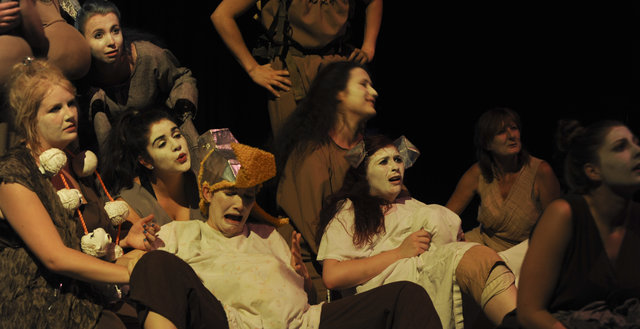
Conventions of drama seek to draw in audiences, to create a kind of psychological and emotional engagement that other art forms do not offer quite as readily. Plays about family dynamics in particular tend to provide an experience that is about sentimentality, whether melancholic or uplifting. On The Shore Of The Wide World however, keeps viewers at arms length, encouraging an objective perspective and intelligent discourse about contemporary middle class family lives. This does not mean that the audience is alienated to an extent that we do not care about its characters. Conversely in fact, Anthony Skuse’s direction appeals to our humanity and allows us to empathise with each diverse personality, while engaging deeply with their challenges and circumstances.

One of the main techniques employed to place the material in an intellectual framework is the positioning of actors on stage even when the scene unfolding does not involve them. We see these “extraneous” characters watching and thinking about what is being played out, and try to scrutinise their responses. This causes a constant tension that adds dimension to every plot development, for we are always reminded of repercussions and contrasting points of view.

The ensemble is marvellous. Characterisations are convincing and intentions are clear. We know who these people are, what they think, and how they feel about each other. Kate Fitzpatrick plays the role of grandmother Ellen with restraint and a whole lot of authenticity. It is a minimal performance that works splendidly within the confines of the intimate theatre, and we never question the validity of the actor’s choices. Fitzpatrick’s work is wonderfully elegant, telling her story very persuasively, while being very still. The most memorable performance in the production belongs to Huw Higginson. The role of Pete is written with a lot of thoroughness, and Higginson’s interpretation is equally exacting. His portrayal is subtle and vulnerable, but the actor is unafraid of dramatics when they are required. His chemistry with all co-players are palpable, creating an on stage family that is entirely believable.

This is an unusual theatrical experience, one that talks to its audience with intelligence about themes that are universal. It addresses our concerns with honesty, but does not provide convenient resolutions. Like a good parent, this is a show that tells you what you need to hear, not what you want to hear.

www.griffintheatre.com.au

Review: Wittenberg (Brevity Theatre / Sydney Independent Theatre Company)

rsz_wittenbergVenue: Old Fitzroy Theatre (Woolloomooloo NSW), Jan 7 – 25, 2014
Playwright: David Davalos
Director: Richard Hilliar
Actors: David Woodland, Alexander Butt, Nick Curnow, Lana Kershaw

Theatre review
Wittenberg is a play that examines the struggle between theology and philosophy. We are positioned along with Hamlet (in his younger years) in the centre of the action, caught between reason and religion. David Davalos’ text is a dense one. Western literature is referenced relentlessly, creating a post-modern structure based on citations of classical concepts, characters and quotations.

Richard Hilliar’s direction is confident and precise. He places equal emphasis on dramatics and content, ensuring a show that appeals intellectually and is also fabulously entertaining. Hilliar does his best to make sense of the lines, which are frequently academic and cerebral, and while some of us might find it challenging to absorb everything, the direction succeeds in keeping us engaged at all times.

Design elements of the production are simple, elegant and effective. The set in particular, works well with the space and the performers. Lighting is creative but also unintrusive. It is a pleasure to see the Old Fitzroy stage given some three-dimensionality and lightness.

Performances are consistently strong, and all actors seem to be very thoroughly rehearsed. Intentions are clear, and their control over their tricky lines are very accomplished. David Woodland’s performance however, is completely show stealing. His portrayal of John Faustus is charismatic, committed and irresistibly convincing. He has a fearless approach that effervesces unceasingly, and he resonates strongly at every turn. We hear his points of view clearly, and we empathise with his vulnerabilities. His co-actors are not weak by any stretch of the imagination, but the show becomes unintentionally asymmetrical in its intellectual arguments due to the overwhelming persuasiveness of one side.

Ultimately, this is not a play that seeks to change anyone’s core beliefs, but it reminds us of the other, and the values it holds close. Wittenberg is about the plurality of our existences, and the constant negotiations we endure in making sense of our daily lives.

www.facebook.com/BrevityTheatreCo

Review: An Enemy Of The People (Nine Years Theatre)

rsz_1522124_273651802782255_1915973110_nVenue: National Museum of Singapore (Singapore), Jan 8 – 11, 2014
Playwright: Henrik Ibsen (Mandarin translation by Nelson Chia)
Director: Nelson Chia
Actors: Rei Poh, Mia Chee, Hang Qian Chou, Neo Hai Bin, Jean Toh

Theatre review
This is a story about truth, greed, and democracy. Originally published in 1882, its central themes remain relevant and powerful. The play capitalises on our fundamental need to seek not only for truths, but also for personal materialistic gain, and of course the struggle between the two. Nelson Chia’s translation is faithful to the original, and his direction of the text is a straightforward one. There is an emphasis on giving Ibsen’s work and ideas absolute focus, with no obvious liberties taken for updates or reinterpretations. What results is a kind of language and “period” tonality that is fascinatingly quirky. It is simultaneously realistic yet unusual, which gives the production a sense of wonder and theatricality. Visual design elements should also be noted for their effectiveness and refinement.

Performances are committed and disciplined. A sense of polish and measuredness permeates the proceedings, and the precision at which the story is told gives the show not only an air of professionalism but also a rare beauty. Lead man Rei Poh steals the show with moments of flamboyance and pomposity. His portrayal of the hero invites doubt, and disallows convenient certainty, giving the play a complexity that necessitates thought and discussion. The cast of five is a young one, but there is no question that they take this work seriously. This however, comes at the cost of the depiction of sarcasm and delivery of humour, which are evident in Ibsen’s writing. The ensemble’s attention on plot and realism does make the story crystal clear, but some of the comedy seems to have been sacrificed in the process. Perhaps a slightly exaggerated sense of performance could be introduced, so that the play’s farcical nature can be elevated.

An Enemy Of The People is a political story, but the production does not use it to push forth with a simple reading of social mechanics. Indeed, it portrays politics and economies as being problematic by nature, and hence, ambiguities lay central to our existences. It is to the company’s credit that these complex ideas are presented with simplicity, succinctness and a lot of elegance.

www.nineyearstheatre.com

Review: Notre Dame De Paris (Base Entertainment)

14247-140-7[1]Venue: Marina Bay Sands (Singapore), Dec 17, 2013 – Jan 11, 2014
Book: Victor Hugo
Music: Riccardo Cocciante
Lyrics: Luc Plamondom (English translation by Will Jennings)
Director: Giles Maheu
Actors: Alessandra Ferrari, Matt Laurent, Robert Marien, Richard Charest, Alberto Mangia Vinci, Ian Carlyle, Elicia MacKenzie

Theatre review
The story unfolds with a lack of clarity, and the English lyrics are less than elegant, but this “Musical Spectacular” features a cast of astounding talent (largely Canadian), and their work makes for an evening of inspiration and fantastic entertainment.

Robert Marien is outstanding as Frollo, with a magnificent voice that is world class. The songs he performs showcase his talents well, and allow for the performer to steal the show effortlessly. Alessandra Ferrari plays Esmeralda, impressing her audience with a vocal range that will remain unforgettable. Even though her role is spectacularly anti-feminist, Ferrari is able to charm her way and make her audience fall into endearment.

Choreography is relatively conventional, but the team of dancers and acrobats perform at a level that can only be described as stellar. We are treated to an incredibly high energy and accomplished presentation, with influences from jazz, modern and break dance, along with shades of Cirque du Soleil and the Eurovision Song Contest. Yes, things do get kitschy, but they are irresistibly so.

The theatre seats 2,155 but today’s session probably was less than a quarter filled. The performers were entirely unperturbed and gave their all, and the audience was obviously swept away. The standing ovation at the end of the evening was genuine, and well deserved.

www.baseentertainmentasia.com

Neighbourhood Watch (Ensemble Theatre)

rsz_watchoneVenue: Ensemble Theatre (Kirribilli NSW), Dec 12, 2013 – Jan 25, 2014
Playwright: Alan Ayckbourn
Director: Anna Crawford
Actors: Brian Meegan, Fiona Press, Gillian Axtell, Douglas Hansell, Lizzie Mitchell, Jamie Oxenbould, Olivia Pigeot, Bill Young

Theatre review
Alan Ayckbourn’s brilliant script is a work about the anxieties of middle classes in English suburbia. Its comedy is flamboyantly unhinged, and bears the strong flavour of absurdist British humour that is loved on stages and television the world over. His characters are quirky and colourful, yet complex enough to prevent them from becoming mere caricatures. Ayckbourn’s construction of “the frightening other” is masterful. We watch the onstage characters imagine a threat without actually seeing any substantiation for their terror. Audiences are implicated into the farce being performed, because we share in the imagery of the imagined enemy, but the play constantly reminds us of the stupidity in the scenarios being presented and indeed, the irrationality of those fears.

Brian Meegan is an effective leading man, playing the neighbourhood watch group leader Martin Massie with charm and energetic ardor. All the action is structured around him, and he displays great commitment and gravitas that holds the plot together. Jamie Oxenbould plays the cuckolded Gareth. His characterisation is idiosyncratic and subtle, turning a smaller part into a memorable, and very odd, stand out role.

Direction of the play focuses on plot trajectories, resulting in very clear storytelling, and amusing discourse on themes and concepts. However, interpretation of the play’s comedy elements falls short. There is an emphasis on realism in performances while the text seems to require a much broader comic style. Potential for laughter resides in virtually every line of Ayckbourn’s sharp writing, but his wit is not always strongly delivered.

Neighbourhood Watch deals with issues of class and hypocrisy in our societies. It exposes what we all know to be true, but in a way that surprises and fascinates. Its characters are simultaneously familiar and unpredictable, and they present a story that we can all relate to, regardless of which side of the fence we imagine ourselves to be situated.

www.ensemble.com.au

The Dreamer Examines His Pillow (Unpathed Theatre Company)

dreamerexaminesVenue: TAP Gallery (Darlinghurst NSW), Dec 10 – 21, 2013
Playwright: John Patrick Shanley
Director: Vashti Pontaks
Actors: Ainslie Clouston, Scott Lee, Peter McAllum
Image by Tom Bannerman

Theatre review (of preview performance, Dec 11)
The best stories in theatre and film contain messages and morals that are applicable to lives everywhere. The Dreamer Examines His Pillow seeks to unpack profound truths of our shared experiences, and present on stage an enlightened point of view that can enrich and inspire everyone. John Patrick Shanley’s script was written early on in his career, but is masterful in the way it expresses its philosophies, mainly from the perspective of a middle-aged character.

Peter McAllum plays Dad, the aforementioned role, with powerful conviction and exquisite relish. It is evident that McAllum has a good affiliation with the material, and many of the play’s complex ideas are articulated effortlessly and clearly through his portrayal. McAllum is thoroughly enjoyable to watch. He dominates in his scenes, and is quite obviously having the time of his life in this unique gem of an opportunity.

Direction by Vashti Pontaks relies heavily on performances from her three actors, who are all keenly energetic, but who also vary in experience and ability. While they are all focussed and charismatic, the depth of some sections do not always translate well when in the hands of the younger performers. Chemistry is also lacking between the young leads, and humorous moments are sometimes missed. Pontaks’ strength lies in the more serious aspects of the play, but the length of the work requires that its lighter sections deliver the laughs, in order that interest is more effectively sustained.

A lot of Dreamer is about courage, and Pontaks drives that message through beautifully. She also constructs a world where the concept of fear is palpably believable. The courage we need for living full lives, and the courage artists need for bringing their work to fruition, are explored and on display in this earnest and dynamic production. It is up to us to rise from our slumber, and to decide for ourselves whether an unexamined life is worth living.

www.unpathed.com.au

Cowboy Mouth (Such&Such Productions)

rsz_img_8354Venue: TAP Gallery (Darlinghurst NSW), Dec 4 – 7, 2013
Playwrights: Sam Shepard & Patti Smith
Director: Kate Wadey
Actors: Bianca London, Jake Lyall

Theatre review
The script is a challenging one. It is full of incoherence, and has consistent stylistic allusions to intoxication. Abstraction is its addiction, and effort is required of both artist and audience to embrace and appreciate it. Words on stage function differently from when they are in a book. We listen to them at a speed dictated by actors, and do not have the luxury to ruminate on complex sections at our own leisure. Fortunately, Kate Wadey’s direction is careful to tell the story visually and through music, creating a show that relies on more than the delivery of lines to connect.

Wadey’s creative decisions are interesting and well thought through. She utilises her actors’ skills well, showing them off in the best light possible, thus drawing us into their bizarre love story. Wadey has chosen to play the characters’ conversation relatively straightforward, which helps with grounding the abstract nature of the writing, but sacrifices the opportunity for more outlandish theatrical expression. There is a sense of restraint that makes for an elegant interpretation, but could at times come across slightly conservative.

Jake Lyall plays Slim with great conviction and power. Within the confines of script and direction, he does a beautiful job of bringing to life a character that we do not necessarily understand a great deal of. He portrays a wide range of emotion with authenticity and clarity, and it is his emotional journey that forms the main plot trajectory on which we travel. Lyall is a charismatic performer who commands attention easily, and shows intelligence in the measured way he tackles the role.

Bianca London’s portrayal of Cavale highlights the innocence of the couple. London has the valuable quality of affability, and the wide-eyed wonder she brings to the piece lightens the work, making it more palatable, although the bleak inebriation that characterises the writers’ legacy from the period is missed. Nostalgia and reminiscence is not a major driving force in this production of Cowboy Mouth, but as an exploration of intimate theatre, it succeeds in creating something unconventional, landing at a space that is certainly off the beaten track.

www.facebook.com/SuchandSuchproductions

Decadence (Apriori Projects)

decadence1Venue: Old 505 Theatre (Surry Hills NSW), Dec 4 – 7, 2013
Playwright: Steven Berkoff
Director: Serhat Caradee
Actors: Katherine Shearer, Rowan McDonald

Theatre review
Steven Berkoff’s script Decadence is essentially about morality, and it displays thoroughly and explicitly, the manifestations of immorality within the context of 1980s Thatcherite Britain. It is bold writing in verse form, with emphasis on language and character dynamics, and minimal reliance on conventional narrative structures. Berkoff’s characters are cold and obnoxious. This is not the kind of play that inspires empathy or identification, but it is persistently fascinating.

Serhat Caradee’s direction focuses squarely on the performances of his two leads, and his efforts pay off with excellent work from the actors. Caradee is particularly strong in sustaining the high energy, almost chaotic tone of the show, while giving texture and layers to what is basically a play based on a singular idea. There are a few moments, however, where one could imagine a greater user of space. Whether it be additional performers, multimedia elements, or set and props, various supplementary components could have been introduced to magnify some of the dramatics, even though the relatively bare staging does have its charms.

Katherine Shearer’s infectious playfulness endears her instantly to the audience. There is an old-fashioned sensibility to her mode of performance which is full of allure, and perfectly suited to the era in which the action is set. She brings a joy to the stage, providing a welcome counterbalance to the dark cynicism of the writing. Rowan McDonald is a highly animated actor, who obviously enjoys the absurdity and biting social criticism of the play. The range of physical, vocal and facial expressions he introduces into his work is truly breathtaking. There is a dogged tenacity to McDonald’s stagecraft that is magnetic, and he holds our attention to present concepts that are sometimes subversive, and always entertaining.

Indeed, Berkoff’s subversive spirit is represented with great success in this production. The energetic and entertaining performers prevent things from being too alienating, but the work’s political edge is thankfully not lost. The message might be a difficult one to take in, but the thrills and spills of the ride are certainly rewarding.

www.venue505.com/theatre

On/Off (Bordello Theatre)

onoff2Venue: Bordello Theatre (Potts Point NSW), Nov 30 – Dec 15, 2013
Playwright: Lisa Chappell
Director: Scott Witt
Actors: Lisa Chappell, Marissa Dikkenberg
Image by Simon Dikkenberg

Theatre review
When an actor and a singer come together to create a work in the cabaret space, it is a sure sign that they are on a mission to break theatrical rules in order to create something unique and fresh. On/Off certainly gives us something new and innovative, but more than that, this is a work that entertains, fascinates, and connects on many levels. It takes its audience on an emotional roller coaster ride, well aware that it is the contrast of funny and sad that makes each reaction more powerful. We laugh and cry, and laugh again. With its unusual structure and excellent performances, the show forces us to let down our guard, and takes control of all our sentiments.

Scott Witt’s direction is superb. He constantly plays with juxtapositions, making use of the wildly different characteristics of the two actors, and the spacial concepts of on stage and off stage, and crafts a work that is as emotionally volatile as it is confident in its structure and plot. The journey is incredibly bumpy, but the destination is crystal clear. The experience of witnessing one actor on stage, and the other off, while listening to a familiar cabaret standard, is a pleasure that has to be seen to be believed.

Marissa Dikkenberg’s depiction of her character’s disintegration is marvellous. Her singing voice is strong, but she uses her skills carefully to maintain the believability of her character. Sara is a bland “Stepford housewife” type, who goes through a thorough and clamorous break down, progressing from a chirpy and sober state of delusion into a complete drunken mess. Lisa Chappell’s presence in the tiny Bordello Theatre is colossal, and her acting is faultless. Her drama and comedy are both high octane, but the gory authenticity she puts into her work makes every moment convincing. Chappell’s performance is determined to hit her audience like a ton of bricks. It is unabashed, unapologetic theatricality at its most flamboyant and audacious, and completely delicious.

This is alternative art, but formulated with the intention to communicate to wide audiences. It is a story about life’s disappointments, human resilience, and the value of friendship. These themes are universal, and also passionate. The words to one of the songs in the show sum things up best, “you’ve got to laugh a little, cry a little… and when the world is through with us, we’ve got each other’s arms.” Many things happen in On/Off, but what endures is The Glory Of Love.

www.facebook.com/lisachappellonoff

The Star Child (The Genesian Theatre)

rsz_starchildVenue: The Genesian Theatre (Sydney NSW), Nov 23 – Dec 14, 2013
Book & Lyrics: Roger Gimblett (based on story by Oscar Wilde)
Music: Nicholas Edwards
Director: Roger Gimblett and Stephen Lloyd Coombs
Actors: Ben Bennett, Elizabeth MacGregor, Robert Green, Martin Searles, Amber Wilcox, Michael Jones, Dominic Scarf, Timothy Bennett
Image by Mark Banks

Theatre review
Based on a children’s story from Oscar Wilde, The Star Child is a new family musical about a boy acquiring the virtues of humility and generosity. It is a moral tale told through humour and fun, and would appeal to audiences across different religious backgrounds. Most of the songs are well-written, with several memorable jazz tunes standing out. Choreography is careful to accommodate the various skill levels in the cast, who all appear to be comfortable with their moves.

Ben Bennett plays the Star Child, with impressive vocal range and power. He is a confident performer and has a youthful vigour that is perfect for the role. Bennett’s keenness for the comedic elements in the story helps with keeping the show buoyant, and his chemistry with co-performers is a joy to watch. Dominic Scarf’s scene as the Rabbit is cheeky and delightful. His performance adds colour and pizzazz to the proceedings, and delivers some of the funniest moments in the show. Timothy Bennett and Daniel Hitchings play multiple roles and although they do not have solo numbers in the show, both shine with the comedy they introduce throughout the course of the production.

Children are impressionable. It is important they hear stories that feature worthy role models and extoll true virtues. The Star Child is a show that will hold every child’s attention, entertain them and most importantly, inspire them.

www.genesiantheatre.com.au