Review: The Dog, The Night And The Knife (The Other Theatre)

Playwright: Marius von Mayenburg (translated by Maja Zade)
Director: Eugene Lynch
Cast: Thomas G Burt, Tom Crotty, Samantha Lambert
Images by Shayan Askari

Theatre review
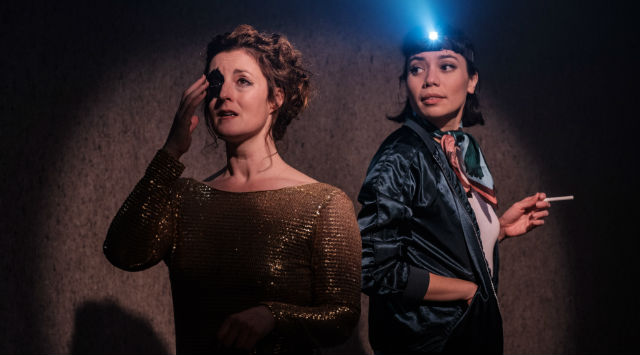
It is always 5:05 o’clock, in Marius von Mayenburg’s nightmarish The Dog, The Night And The Knife. A man is trapped inside a surreal landscape, encountering strange people who all seem to have nefarious intentions, it seems, of wanting to eat him up. The anxiety-riddled work takes us on a bizarre trip, into a space that feels like the semiconscious, where reality exists only in states of compromise. Paranoia is about things that hide beneath the surface, and in von Mayenburg’s play, things are certainly never quite what they seem.

Actor Tom Crotty demonstrates good focus as the protagonist, full of mental concentration, but lacking in physical agility. The production is staid, probably overly serious in its interpretation of von Mayenburg’s writing. Director Eugene Lynch is able to create a sense of macabre for the piece, but the show proves less funny than it could be.

In a variety of roles are Thomas G Burt and Samantha Lambert, both performers introducing an enjoyable theatricality with the ghostly quality they bring to their characters. Burt is particularly delightful with the dynamism he is able to bring to the stage. Also noteworthy is music composer Kailesh Reitmans, who delivers clever atmospheric enhancements for the production, especially effective with the suspense he is able to convey.

There is no denying that art can help deal with psychological and emotional baggage of which no one is excepted. At the theatre, whether we come in contact with cannibals or with the average Joe, there is always opportunity to know ourselves better, and in that process, find a more expansive view of existence that will keep our disquiet in check. In The Dog, The Night And The Knife, von Mayenburg comes to terms with the idea that people are not always kind to one another. It might be a pessimistic realisation, but an acceptance of reality is always a necessary start, before attaining greater epiphanies.

www.facebook.com/theothertheatre

Review: Leopardskin (Jackrabbit Theatre)

Venue: Kings Cross Theatre (Kings Cross NSW), Mar 26 – Apr 6, 2019
Playwright: Michael McStay
Director: Samantha Young
Cast: Nick Gell, Travis Jeffery, Zoe Jensen, Emma Kew, Guy O’Grady, Ella Watson-Russell
Images by Clare Hawley

Theatre review
Luka and Val are petty thieves trying to make the big leagues. They hear of an Italian billionaire philanthropist giving away his priceless antique clock, and make a beeline for an opportunity to nab the prize. Michael McStay’s play is a farce in the classic vein, reminiscent of Molière, Fo and Brecht, complete with bumbling cops, mixed identities and love triangles. Witty and wild, extremely quirky and downright silly, the work is almost astonishing in its ability to steer clear of anything that could be classed deep and meaningful. Amusement is of course, one of the main reasons we go to the theatre, and Leopardskin delivers it in spades.

Samantha Young directs a wonderfully flamboyant show, very loud and very mad, quite the counter-cultural statement in what feels to be a terribly conservative milieu. With just enough attention placed on making sense of the frankly perfunctory narrative, Young puts her energy into making every second count, so that the audience’s synapses are firing, all of us tickled and fascinated, from beginning to end. When not laughing out loud, we find ourselves grinning from ear to ear, in deep enjoyment of this peculiar beast of an unapologetic, outlandish comedy.

Six very excitable performers can be seen luxuriating on stage, in full throttle madcap mode. Luka is played by Guy O’Grady, sarcastic in his unexpectedly pompous rendition of the small-time crook. Zoe Jensen is vibrant as Val, the rookie pickpocket who defies underestimation. The idiosyncratic tycoon Giuseppe Monterverdi is made an effervescent joy by Travis Jeffery, who brings surprising texture to his performance. Nick Gell takes all four of his characters to high camp territory, unforgettably gregarious with his vaudeville style. Also very effective in multiple roles is Emma Kew, whose timing is surpassed only by her effortless comedic presence. Senator Olive Darling is depicted with precision and a lot of exaggeration, by Ella Watson-Russell who contributes to the exceptional mischievousness of the production.

In accordance with its title, the show features costume pieces in all manner of leopard spots, that perennial symbol of bad taste in Anglo-Saxon societies. Indeed, in Leopardskin‘s embrace of all things brash and obnoxious, we encounter an anti-conformist aesthetic that tells so much about what constitutes normal and respectable, in our art and in our lives. When we scrutinise each other, to police an idea of tastefulness in the way we look and behave, we reveal a set of values determined to separate people into classes. When we dare to disrupt those codes, bad traditions can begin to be dispelled, and more than that, a shitload of fun will be had.

www.jackrabbittheatre.com

Review: The Appleton Ladies’ Potato Race (Ensemble Theatre)

Venue: Ensemble Theatre (Kirribilli NSW), Mar 22 – Apr 27, 2019
Playwright: Melanie Tait
Director: Priscilla Jackman
Cast: Valerie Bader, Merridy Eastman, Sapidah Kian, Amber McMahon, Sharon Millerchip
Images by Phil Erbacher

Theatre review
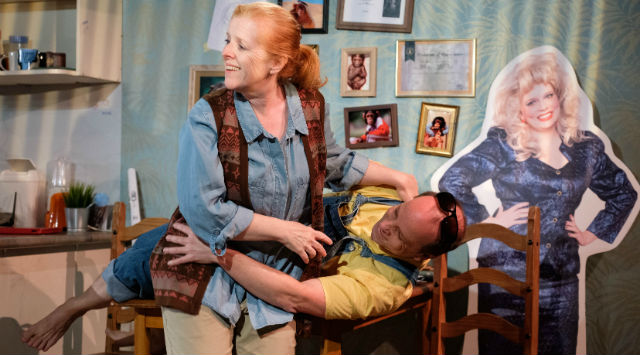
Like many of our little country towns, the fictional Appleton struggles with the idea that women should be able to enjoy the same privileges as men. They fool themselves into thinking that the genders simply belong in different domains, rather than admitting that people are being unjustly deprived of spaces and experiences. Worse, they habitually overlook power imbalances, allowing inequalities to exist, under the guise of having to keep the peace. In Melanie Tait’s The Appleton Ladies’ Potato Race, Penny moves home from the city, to a township busying itself with having to gear up for show day. When she discovers that the day’s highlight, the potato race (involving people running with sacks of potatoes on their backs) awards the winner in the women’s category only $200, or $800 less than the men’s, she decides to take action.

It is not an easy task of course, to find backing for her cause, in this conservative community where it can feel as though tradition is all they have. As is crucial in any feminist story, persistence is the key, and in Tait’s play, that persistence is embodied by a mild-mannered protagonist, who instead of going into her project all guns blazing and feisty, takes it upon herself to do all the hard work with inconceivable politeness. Her only true ally is a Syrian sidekick, Rania, who provides moral support, and little else besides. Penny is a GP, and Rania an unemployed refugee; they both wish to affect the same change, but Australian currency clearly has its biases. Nevertheless, The Appleton Ladies’ Potato Race is funny, passionate and rousing, an uplifting romp that many will find irresistibly delightful.

Director Priscilla Jackman imbues the show with extraordinary warmth. A palpable sentimentality colours this sojourn into mystical rural Australia, where people with good hearts never fail to charm our pants off, even if they are a little ignorant. Jackman’s representation of modern sisterhood is edifying, thoughtfully nuanced in all the complexities it is able to convey in regards the always painful job of galvanising people against the patriarchy. Actor Sharon Millerchip leads the charge as Dr Penny Anderson, perhaps a trifle too sweet in approach, but a persuasive presence who disallows us from ever questioning her intentions.

Rania is played by an understated Sapidah Kian, who introduces a distinct quotient of realism to the otherwise stridently fairy-tale quality of the production. Excellent narrative tension is created by Valerie Bader, august and compelling as Bev, a marvellous boss about town, unofficially in charge of everything. Splendid humour is brought by Merridy Eastman and Amber McMahon, both fabulously imaginative, and faultless with their comic timing. It is an impressively well-rehearsed presentation, featuring five actors in a cohesive and joyful collaboration that perfectly illustrates the point of the whole exercise.

The men carry 50kg sacks but the women carry 20kg. In real life, men do carry heavier loads than women in some places, and the reverse is also true. We hear of young men killing themselves in the bush, but rarely connect these dots. There is no need for any of our burdens to be allocated unevenly. In The Appleton Ladies’ Potato Race, women are fighting not only for equal prize money, but also for the opportunity to let every person have equal footing in their society. The consequences to disadvantage are obvious, but in our neo-liberal world, we neglect to recognise the problems that arise within loci that are concentrated with power. If we can orchestrate a dispersion of power, money, privilege and advantage, hardship at the bottom and at the top, must surely begin to evaporate. If this sounds an unconvincing argument, we can understand why arms have to be twisted in order to make things better.

www.ensemble.com.au

Review: Fierce (Old Fitz Theatre)

Venue: Old Fitzroy Theatre (Woolloomooloo NSW), Mar 20 – Apr 13, 2019
Playwright: Jane E.Thompson
Director: Janine Watson
Cast: Lauren Richardson, Zelman Cressey-Gladwin, Stacey Duckworth, Martin Jacobs, Chantelle Jamieson, Felix Johnson, Andrew Shaw
Images by Clare Hawley

Theatre review
Suzie Flack is the first woman to play Australian Rules football in a professional men’s team. This is of course, a fictional premise that Jane E. Thompson uses to construct her play, Fierce. Our trailblazing protagonist may have broken through the glass ceiling, but her challenges do not end at that point of disruption. The weight of having to single-handedly redefine an entire industry, sits on her shoulders. This is a story about women who have had to walk into men’s spaces all alone, against all odds, to overcome unjust systems of exclusion. Thompson’s writing is passionately feminist, and although ultimately a predictable narrative, its magnanimous spirit proves affecting.

Directed by Janine Watson, the production is often powerful, and memorable for creative risks that help elevate its overall sense of artistry. Music by Ben Pierpoint contributes vigour at key moments, crucial in helping us identify the high stakes that Suzie’s experiences represent. Kelsey Lee’s lighting design has a dynamism that works well at conveying a turbulent volatility for the storytelling, and Melanie Liertz’s set and costumes offer just enough visual stimulation, to keep us attentive to both surface and deeper implications of Fierce.

Actor Lauren Richardson’s scorching intensity ensures that the play’s social pertinence is never neglected. Her display of vulnerability can at times seem excessive for a personality who has to remain unyielding with her strength and resilience, but it is a captivating performance that puts the audience firmly on her side. The ensemble cast is uniformly wonderful, every actor full of sincere conviction. In the role of Melanie is Chantelle Jamieson, who offers a deeply fascinating portrayal of a football WAG struggling to find happiness, beyond the obvious perks of her unsubstantial job title. Never able to make explicit her desires, we observe her desperation in various states of physical manifestation, which Jamieson renders with impressive power and accuracy. Felix Johnson too is memorable as Nate, the escort who shares more than sexual intimacy with Suzie, in a performance that is as convincing as it is moving.

It is a daunting prospect for minorities, to have to infiltrate and operate from the inside of old structures, with little or no peer support, to change things one step at a time. Fierce is ahead of its time in daring to imagine a sportswoman competing neck to neck with elite men in the business, but it is timely in giving us much needed illumination to prohibitions that have been hiding in plain sight. We seem to be at a new breaking point in the evolution towards a more equitable society, especially in terms of gender and race. There are incredible leaders fighting everyday at what feels to be the final frontier, and we must all learn to back them, and lean in the right way.

www.redlineproductions.com.au

Review: The Realistic Joneses (Patina Productions)

Venue: Limelight on Oxford (Darlinghurst NSW), Mar 13 -30, 2019
Playwright: Will Eno
Director: Julie Baz
Cast: Jeff Houston, Suzann James, David Jeffrey, Jodine Muir
Images by Clare Hawley

Theatre review
There are two straight couples living across the street from each other, both named Jones. In The Realistic Joneses, characters go about their average mundane small town lives, but there is something distinctly strange about the way they talk. Playwright Will Eno’s dialogue feels like high art, bizarre yet completely believable, for a way of excavating truths about the human condition, that only the medium of performance can deliver. Resolutely quirky, The Realistic Joneses brings upheaval to concepts of normalcy that inform Western life. The Joneses speak what they are supposed to, but also what they are not. They portray the ordinary in a manner that creates turbulence, making us laugh because we understand all the arbitrariness of rules that fundamentally govern the politeness of society.

Actor David Jeffrey finds the right pitch for conveying the play’s humour, deadpan but deliberate in an interpretation of John that almost makes him seem an alien pretending to be human. There is no doubt that we can all relate to this sense of displacement, of being awkward in social situations. Director Julie Baz’s understated approach is surprisingly effective in depicting the comedy inherent in our daily lives, but an emphasis on naturalism can sometimes take away from Eno’s heightened style. The very subdued closing scenes abandon the laughs, in search of poignancy, which sadly never quite materialises.

It is a splendid title, that reveals so much about how we present our selves to the world. We aim to be realistic, of appearing to look real, probably because actually being real is not something our collective existence is able to cope with. Those who truly speak their minds are ostracised, maybe even cast as insane, so we learn where the limits are, and negotiate within those rigid borders. There is always something false in how we communicate, especially when in groups. The answer is not to withdraw and hide in arrogant isolation, but to question all that is shown to us. Cynicism, one would argue, is necessary in one’s participation in the world. The real challenge is making that cynicism sit side by side, with an earnestness we must never give up, in our involvement with this world.

www.limelightonoxford.com.au

Review: Once In Royal David’s City (New Theatre)

Venue: New Theatre (Newtown NSW), Mar 19 – Apr 13, 2019
Playwright: Michael Gow
Director: Patrick Howard
Cast: Alana Birtles, Ben Brighton, Amy Victoria Brooks, Sandra Campbell, Nathalie Fenwick, Nicholas Foustellis, Angela Johnston, Alice Livingstone,
Aimee Lodge, Francisco Lopez, Martin Portus, Bryden White-Tuohey
Images by Bob Seary

Theatre review
Will is on the verge of beginning a new job, just as his mother coincidentally lays dying in hospital. It is a new life that beckons, and with all the emotions that should feel overwhelming, Will retreats into a lot of academia, as is typical of theatre directors and educationalists. He spends his time thinking about Marx and Brecht, dealing with ideas of resource ownership and distanciation; not quite preparing for the period of mourning that is sure to come. Michael Gow’s Once In Royal David’s City is a piece of writing perhaps not entirely interested in coherence, allowing itself to move in various directions, almost defying our need to condense its contents into a more conventional narrative form.

Patrick Howard’s direction reveals with honesty, the often contradictory states of being human. Will never quite behaves the way we expect him to, yet there is nothing unbelievable about how he goes about his business. There are some hallmarks of Brechtian theatre in the presentation, although those expressions can seem perfunctory. It is a handsome looking show, put together with excellent taste by production and lighting designer Victor Kalka, and costume associate Luciana Nguyen. Their minimalist style suits the bluntness of Gow’s writing, unpretentious but elegant.

Actor Francisco Lopez brings an unassuming geniality to the lead role, effective in monologues that allow him to directly address the audience, but too mellow in contrast with scene partners. More compelling performances come from the likes of Sandra Campbell, whose commanding presence in several small parts proves refreshing. Amy Victoria Brooks too, is memorable as Gail, an anguished soul roaming the hospital, in search of connection and consolation. Will’s mother Jeannie is played by Alice Livingstone, ironically lively, able to bring verve to a character that is otherwise written with little originality.

To love books is in some ways better than loving people. Books can be crafted to perfection, and we as readers can hold dear, words and ideas that we deem to be impeccably arranged. To love humans however, is quite another thing. Not only are we deeply flawed, we are transient, destined to break hearts wherever bonds are created. Death and impermanence, however are the ultimate provocation, intensifying all the sensations that define love. The heart wants what the heart wants. Mortal or immortal, it is hardly up to us to choose for whom we fall.

www.newtheatre.org.au

Review: Wrath (Jackrabbit Theatre)

Venue: Kings Cross Theatre (Kings Cross NSW), Mar 8 – 22, 2019
Playwright: Liam Maguire
Director: Liam Maguire
Cast: Madeleine Vizard, Adam Sollis, Jonny Hawkins, Elle Mickel, Amy Hack and Emma Harvie
Images by Clare Hawley

Theatre review
It all kicks off when the CEO spots a pubic hair in the boardroom. Liam Maguire’s Wrath is an absurd and very grotesque look at corporate culture, that dog-eat-dog world in which some of the most brutal of human behaviour can be found. Disguised behind a pretence of uncompromising suit-and-tie civility, with the notion of profit maximisation as guiding principle, these people are entrenched in a system that is profoundly immoral and surreptitiously harmful. The play amplifies all that is wrong about a segment of our lives that has grown substantial and ineludible.

There is semblance of a narrative, but it only serves as conduit for comedic sequences that attack and satirise out institutions of greed. Maguire’s exaggerated approach to humour makes for a flamboyant presentation; Wrath is often hilarious, with a wild spirit that persuades us to luxuriate in its artistic risks. Sound by Sam Maguire and lights by John Collopy, are valuable in creating the show’s faux display of overwrought melodrama, but design schemes eventually turn repetitive, and their efficacy markedly fades in later segments.

An eccentric cast keeps us amused from start to finish. Madeleine Vizard’s extravagant interpretation of CEO Stockwood is brilliant, in its unrelenting incisiveness for a scornful embodiment of the ruthless and power mad. It is a deliciously camp performance, satisfying with the textures she is able to provide in spite of all the exaggerated embellishment. There is a lot of big acting in the piece, and Elle Mickel is chief offender, in the best possible sense. As Daphne, she does not hold back, and we go along with where she dares to tread. Emma Harvie executes perfect timing for the mousy January, a secretary of few words, but all uttered with sublime precision.

These monsters of industry are pervasively and deeply woven into the fabric of our lives, and to wish to have them completely extricated is a pipe dream. We can however, restrict our individual participation in their dominion. We can find ways to retreat from them, to identify their competitors and adversaries, and work to boost those who will bring a greater sense of balance to how power is distributed in our economies. We need to resist the allure of the shiny seductive exteriors, of corporations that can never live up to what they promise. If we can take down the big guys, then those of us who are small can flourish.

www.jackrabbittheatre.com

Review: The Divorce Party (Life After Productions / The Old 505 Theatre)

Venue: The Old 505 Theatre (Newtown NSW), Mar 12 – 16, 2019
Playwright: Liz Hobart
Director: Alexander Lee-Rekers
Cast: Meg Clarke, Badaidilaga Maftuh-Flynn, Ariadne Sgouros, Alexander Stylianou
Images by Clare Hawley

Theatre review
We are in a car park behind a restaurant with four attendees of a divorce party, taking a cigarette break from the unusual festivities. Liz Hobart’s The Divorce Party is a curious work, structured like a puzzle to involve our participation in figuring out the stories therein. Although mildly intriguing, the play’s deliberate abstruseness never pays off. Barely an hour long, we lose interest early in the piece, and by the time its mysteries are revealed, none of it is able to cause a stir.

Set design by Damien Egan however, is charming with its accuracy in depicting contemporary Australian life, complete with push bin and bad graffiti. The actors demonstrate adequate familiarity with their individual roles, even if their collaboration feels incohesive. Ariadne Sgouros and Alexander Stylianou bring energy at every opportunity, and succeed in creating momentary stimuli for the piece. Meg Clarke has little to work with in terms of storyline, but manages to build a character of some authenticity. A very subtle performance by Badaidilaga Maftuh-Flynn helps create an enigmatic, if slightly too sombre, quality for his role.

With the proliferation of divorces, it is perhaps not entirely surprising that some people might want to commemorate the event. What was once a catalyst for vehement disapproval from all quarters, is now an ordinary part of life. When a relationship ends, it often means that suffering too, begins to find relief, so it does make sense that celebration is in order. As long as people wish to get married, there needs to be a liberal attitude towards divorce. Nobody should be tethered to any misery, and we should all know to walk out, if the heart so desires.

www.old505theatre.com

Review: Jess & Joe Forever (Sugary Rum Productions / 25A Belvoir)

Venue: Belvoir St Theatre (Surry Hills NSW), Mar 13 – 30, 2019
Playwright: Zoe Cooper
Director: Shaun Rennie
Cast: Nyx Calder, Julia Robertson
Images by Kate Williams

Theatre review
The children are on a mission to tell their story. It takes place in Joe’s hometown of Norfolk, where Jess had begun spending her summer holidays at 9 years-old. The two become fast friends, and go through thick and thin together. In Zoe Cooper’s Jess & Joe Forever, they find a way to recount seminal events of their young lives, like an informal kind of psychotherapy, not because there is anything wrong with them per se, but because the world seems intent on inflicting a very hard time on them both. Cooper’s writing is extraordinarily tender, beautifully authentic in the way these young voices are rendered. Its structure is suspenseful and intriguing, for a narrative that does much more than entertain.

Director Shaun Rennie takes great care to manufacture a sensitive atmosphere in which we can only receive Jess and Joe with hearts wide open, and in the process, come to an intimate understanding of how children respond to the bigger world, and all the the difficult things we cannot shield them from. The emotional crescendo Rennie is able to build into the plot of Jess & Joe Forever, is representative of theatre at its most captivating.

It is a wonderfully designed production. Isabel Hudson’s playground is perfectly proportioned for the small auditorium, with quaint illustrations along the backdrop reflecting an innocence so crucial to the play. Lights by Benjamin Brockman help to amplify the emotions of both characters and audience, so that none of the sentimentality escapes us. Ben Pierpoint’s work on sound provides for the mind’s eye, an evocative picture of what that small English seaside town must look like, and his music gives the show a sense of elevation, with its unmistakable sophistication.

We fall in love right away with the very excellent cast, both actors adorable and completely believable as our little hosts. As Jess, Julia Robertson brings to the role a strength and defiance that absolutely charms. Her effervescence is infectious, and even though her penchant for machine gun speed recitation of lines can sometimes be a challenge, the precision of her approach is unequivocally affecting. Nyx Calder is perfect as Joe, disarmingly poignant but also effortless and delightful in their depiction of youthful purity. The extraordinary vulnerability that Calder is able to convey, fills the gaps purposefully left behind by the playwright, impeccably addressing parts of Joe’s story where words can prove inadequate.

Watching these kids, we feel compelled to protect them, but we also know that their struggles will make them into resilient and wise adults. It is true that there is much sadness in the world. The societies we manufacture often seem to be endlessly flawed, and the thought that those who have done no harm, would still be subject to injustice and inequity, is devastating. Some of us will respond with resignation, but some will fight for things to be better. Jess & Joe Forever is bittersweet, because its anguish is palpable, but it also provides inspiration, so that we can know to always do the right thing.

www.facebook.com/sugaryrumproductions | www.belvoir.com.au

Review: Russian Transport (Darlinghurst Theatre Company)

Venue: Eternity Playhouse (Darlinghurst NSW), Mar 9 – 31, 2019
Playwright: Erika Sheffer
Director: Joseph Uchitel
Cast: Ryan Carter, Rebecca Rocheford Davies, Nathan Sapsford, Hayley Sullivan, Berynn Schwerdt
Images by Jeremy Ghali, Nino Tamburri

Theatre review
The lives of a Russian family in Brooklyn are turned upside down, when a relative comes to stay. Ex-crim Boris’ arrival leads us to question if turning a new leaf can ever be a simple proposition, for those who have spent all their lives exposed to immorality. Erika Sheffer’s Russian Transport is a slow burn, with drama that starts to engage late in the piece. Its themes are intriguing, but the promise of philosophical resonance is subsumed by a narrative that can feel somewhat hesitant, with perspectives that are inadequately critical. The characters we encounter are fiery, but the play is oddly short of passion.

Designed by Anna Gardiner, the production bears a striking appearance, with a robustness that keeps our eyes active and involved. Joseph Uchitel’s direction ensures an energetic, quite raucous stage, but struggles to achieve meaningful cohesion between his actors for their story to really captivate. Rebecca Rocheford Davies and Berynn Schwerdt play mother and father, both actors imposing and dynamic, but are ultimately insufficiently convincing with their portrayals of two very complex personalities. Troublemaker Boris is on the other hand, a more obvious role, given appropriate vigour by Nathan Sapsford. The show is stolen by Ryan Carter and Hayley Sullivan, who bring life to teenage parts in Russian Transport. Sullivan’s ability to inject nuance into her 14 year-old Mira is commendable, and Carter’s exceptional fastidiousness and intensity as Alex, is responsible for the show’s most powerful moments.

The loss of innocence is eternally fascinating. In migrant families, that process of a teenager having to emerge into adulthood is additionally complicated, with influences and expectations coming from disparate sources, all simultaneously insisting on adherence. Alex and Mira are American kids, but Russia is in their blood. The play allows us to see the extent to which cultural heritage can dominate the development of our young. Even when we have the privilege of choosing where to raise your children, it seems inevitable that the baggage we had intended to leave behind, can so easily return to materially affect future generations. We have ghosts that are both good and bad. The challenge is our own ability to discern, before having them unleashed on our nearest and dearest.

www.fishyproductions.com | www.darlinghursttheatre.com