Review: Suddenly Last Summer (Sydney Theatre Company)

Venue: Sydney Opera House (Sydney NSW), Feb 9 – Mar 21, 2015
Playwright: Tennessee Williams
Director: Kip Williams
Cast: Paula Arundell, Melita Jurisic, Brandon McClelland, Robyn Nevin, Eryn Jean Norvill, Susan Prior, Mark Leonard Winter
Images by Brett Boardman

Theatre review (originally published at Auditorium Magazine)
The very nature of trauma is dramatic. It disrupts the heart and mind, and leaves in its wake, disorientation and damage. To repair and to move on, fragmented pieces must first be assembled so that a sense of narrative and coherence can be found. The business of theatre involves storytelling, but it also involves a representation and expression of the human condition. At its best, art communicates something that is deep, but also universal. We want to be able to connect on some meaningful level, whether obtuse or simple. Like psychotherapy and other healing processes, theatre can often be difficult and confusing, but what matters is that artists and audiences emerge with something of value, and perhaps something new.

More than half a century has past since Tennesse Williams’ Suddenly Last Summer first appeared off Broadway, but its ideas remain seductive, and his words have proven themselves to be eternally sublime. Scripts in the theatrical canon are timeless because they are of themselves exceptional, or are able to initiate something extraordinary. Williams’ brilliant work appearing on any stage today will spark debates on the degree to which a new interpretation should stray from the predictable. There will always be purists who prefer faithful renditions that acknowledge the perfection of what is already established on paper, and then others would applaud daring departures that take the text to unexpected realms. Kip Williams’ production places three video cameras on stage with his cast. The revolving stage contains a plain cyclorama that doubles as a screen, so that multiple perspectives of the same stage moment can be offered. The show opens with just the back of the screen in view, and the first scene is projected onto that backdrop so that we can only see a movie sized projection of the performance. The stage then turns to reveal its other side where the actors and set are situated. The projection now continues on the front of the backdrop as the action takes place right before it. The camera operators do not hide from our sight, and although all its design harks back to 1937, our experience is a thoroughly modern one.

The actors portray characters with a sense of nostalgic accuracy, but there is no conventional theatrical experience to indulge in. Our eyes are constantly being pulled away from one image to another, and yet another. We are never allowed to focus too long on any dramatic moment. The work distracts us from itself, and we become frustrated and anxious, like the disturbed people we are studying. The concept of the stage is redefined by the use of video in Suddenly Last Summer. Surely, what we see in the theatre constitutes the performing space, but if our eyes are being manipulated by technology so that we are exposed to something strange, then space takes on different form and notion. If all we can see in the 544-seater is a needle piercing into the leading lady’s arm, then something magical has happened on that stage. Similarly, if a man runs off stage but appears to continue running up the fly tower on screen, then the confines of the proscenium can be seen to have vanished. It is certainly experimental work, and with everything that is unusual, we react first with bewilderment, and if our mental capacities are able to process beyond the immediate, then perhaps the work has achieved interesting intellectual effects. When the director’s work is good, it is because he is immensely inventive, but when bad, it is for the same reason.

Less ambiguous is the quality of performance from Eryn Jean Norvill, phenomenal in the role of Catharine. Through madness and fear, the most extravagant drama can materialise, and Norvill is stunningly uninhibited with the level of emotional and visceral intensity she achieves. Williams’ poetry is delivered through her voice as though singing the most sumptuous, yet tragic, of arias. Whether observing her in the flesh or through the lens, her star quality is undeniable, and it is clear that without her heartbreaking portrayal of a woman in agony, the production would not be remembered for much more than its formalistic inventions. Also captivating is Robyn Nevin, whose regal presence is a perfect match for the severe and menacing matriarch, Mrs Venable. The veteran actor’s portrayal is authentic and hugely engaging, which probably explains the camera’s frequent focus on her, even at moments when she is not taking centre stage. Nevin’s “reaction shots” are beautifully done, but a tricky element that can sometimes diminish the effect of what is actually unfolding in the plot.

Suddenly Last Summer has an astonishing story to tell, with exciting themes that would interest any audience, but the playwright’s efforts come dangerously close to being subsumed by the methods in which his story is told. The unorthodox staging eclipses the text itself. There is so much to discuss and think about when the curtains fall, but what takes precedence is the director’s orchestration of proceedings, which seem to be much more concerned with structure, rather than content. Of course, we should not prioritise the writer’s voice over the director’s simply because the play is well-known, but human impulse wants to revel in narratives, and any deprivation of that enjoyment will come up against resistance. Luckily, when the shock of the new fades away, we discover that it is the immortal soul of a classic tale that endures, and suddenly, last night’s turmoil is distilled and the essence left behind is the memory of Mr Tennessee Williams’ unparalleled legacy.

www.sydneytheatre.com.au

Review: After Dinner (Sydney Theatre Company)

Venue: Wharf 1 Sydney Theatre Company (Walsh Bay NSW), Jan 15 – Mar 7, 2015
Playwright: Andrew Bovell
Director: Imara Savage
Cast: Glenn Hazeldine, Anita Hegh, Rebecca Massey, Josh McConville, Helen Thomson
Images by Brett Boardman

Theatre review
As our societies become increasingly concerned with political correctness, theatre seems to have to reach back through the annals of time to locate comedies that appeal to wide audiences, and ones that do not disrupt any of our delicate sensibilities. Contemporary subject matter is replaced with nostalgia, and we can laugh at days gone by in the safety of imagining that things have improved since. Andrew Bovell’s 1988 play After Dinner is a harmless piece about loneliness and sex. It does not resonate with great poignancy, but it does strike a chord with accurate depictions of human emotion and behaviour.

The production’s core feature is its extraordinary cast. All five actors are brilliant comics and they take the opportunity to showcase their very best under the generous direction of Imara Savage, who cleverly places focus on performance above all else. The script and its humour have aged significantly, but Savage’s team apply a modern interpretation that gives an unexpected edge to what could have been a desperately clichéd farce.

Helen Thomson plays Monika with magnificent aplomb. There is a fearless abandon to her approach that gives the show an air of wildness and decadence, encouraging the crowd to indulge in the text’s many mischievous, and occasionally blue, jokes. Thomson’s extravagant sense of humour is infectious and irresistible, and the almost ridiculous bigness of her performance is given solid support by a gentle empathy she invests into her character’s underlying sadness. The role of Stephen is played by Josh McConville, who manages to miraculously marry sleaze with sweet, creating a persona that is as repulsive as he is charming. The actor’s physicality is perfectly exploited (with the help of stunning work on wigs by David Jennings) to create an appearance and a movement vocabulary that is nothing short of hilarious, and very evocative indeed, of a kind of unfortunate barfly from the era.

Design elements of the production are effective but less than ambitious. The look and sound of the work is surprisingly tame for a decade that is associated with poor taste and general gaudiness, but fortunately, all the action that takes place on stage is anything but beige. Beneath the energetic and incessant provision of laughter, is a view into modern lives, and the challenges we experience with issues of intimacy. Instead of after dinner tribute bands, we talk today, about hook up apps and sexting, but continue to be confounded by the search for love and some of its illusions of fulfillment. With the unfathomable advances in information technology, communications have taken over every aspect of every second, yet loneliness is more present than ever before.

www.sydneytheatre.com.au

Suzy Goes See’s Best Of 2014

sgs-best2014

2014 has been a busy year. Choosing memorable moments from the 194 shows I had reviewed in these 12 months is a mind-bending exercise, but a wonderful opportunity that shows just how amazing and vibrant, theatre people are in Sydney. Thank you to artists, companies, publicists and punters who continue to support Suzy Goes See. Have a lovely holiday season and a happy new year! Now on to the Best Of 2014 list (all in random order)…

Suzy x

 Avant Garde Angels
The bravest and most creatively experimental works in 2014.

 Quirky Questers
The most unusual and colourful characters to appear on our stages in 2014.

♥ Design Doyennes
Outstanding visual design in 2014. Fabulous lights, sets and costumes.

♥ Darlings Of Dance
Breathtaking brilliance in the dance space of 2014.

♥ Musical Marvels
Outstanding performers in cabaret and musicals in 2014.

♥ Second Fiddle Superstars
Scene-stealers of 2014 in supporting roles.

♥ Ensemble Excellence
Casts in 2014 rich with chemistry and talent.

♥ Champs Of Comedy
Best comedic performances of 2014.

♥ Daredevils Of Drama
Best actors in dramatic roles in 2014.

♥ Wise With Words
Best new scripts of 2014.

 Directorial Dominance
Best direction in 2014.

♥ Shows Of The Year
The mighty Top 10.

♥ Suzy’s Special Soft Spot
A special mention for the diversity of cultures that have featured in its programming this year.

  • ATYP

End

sgs-best2014a

Photography by Roderick Ng, Dec 2014

End

Best of 2018 | Best of 2017 | Best of 2016Best of 2015Best Of 2013

Review: Cyrano De Bergerac (Sydney Theatre Company)

Venue: Sydney Theatre at Walsh Bay (Sydney NSW), Nov 11 – Dec 20, 2014
Playwright: Edmond Rostand (adapted by Andrew Upton)
Director: Andrew Upton
Cast: Alan Dukes, Gabriel Gilbert-Dey, George Kemp, Dale March, Josh McConville, Kenneth Moraleda, Eryn Jean Norvill, Yalin Ozucelik, Michael Pigott, Richard Roxburgh, Chris Ryan, Bruce Spence, Emily Tomlins, Aaron Tsindos, David Whitney, Julia Zemiro
Images by Brett Boardman

Theatre review (originally published at Auditorium Magazine)
A star is more than a celebrity. Richard Roxburgh is one of Australia’s greatest actors, the kind who seems to be able to turn everything he touches into gold. It is no wonder then, that Edmond Rostand’s Cyrano de Bergerac is once again revived, with Roxburgh in the title role. Cyrano’s magical gift with words, coupled with his extraordinarily tenacious and passionate unrequited love for Roxane, provides a foundation for a performer to demonstrate his wealth of talents, and as director Andrew Upton puts it, “Richard’s wit, his erudition, his depth, his classical nous and – as he showed in Waiting For Godot last year – his capacity for clowning. They’re all on show here.”

Upton’s production for the 896-seat Sydney Theatre is ambitious in scale, but the show depends heavily on the efficacy of its singular, central character. Cyrano remains in focus for the entire duration, even in his brief moments off stage. That omnipresence requires of the actor a magnetism that captures our imagination, empathy and admiration, and Roxburgh’s powerful capacities as a star of the stage are brilliantly showcased here. His telling of the classic tale has an intellectual and emotional resonance that sheds new light on an old story, restoring a jaded love story back to the swooning masterpiece that befits its canonical status. Perfectly cast as the romantic figure with a rough exterior, Roxburgh is a leading man whose appeal lies with his talent, and whose allure is about ability rather than physicality. He is easily convincing as an ugly man, not because we ever think of him that way, but because his looks were never relevant to his acclaim. Roxburgh can play Cyrano, or the handsomest man in the world, and we would not question his validity.

The production’s comedy takes on many shades, from the very silly to the very dark, from the cerebral to the deeply ironic. Roxburgh’s versatility and sensitivity to the plot’s transfigurations guide us through an engrossing journey that retains a sense of humour even through pits of war and death. Upton’s adaptation and direction give Cyrano de Bergerac a radical update that reflects modern sensibilities. It insists that romance is still alive, but our relationship with it has evolved. The narrative is the same, but in order that the play’s original intentions may be uncovered, the story is told differently. Indeed, the show is overwhelmingly romantic. We love Cyrano, Roxane, and their tortured tale of mistaken identities, unrequited and lost love, but even more, we love Cyrano’s words. They cut through space and speak to our hearts, and we are moved the same way Roxane is moved. She attributes the letters and poetry to the vacuous Christian, but how we channel those wondrous evocations become entirely personal, and this is where connection happens. Upton does not shy from the grand sentimentality of the piece, but his work never feels schmaltzy. Great care is taken to steer emotions away from the cheap and inauthentic, and what we witness, although highly theatrical and dramatically intense, has a believability that associates closely with our personal experiences.

Playing Roxane is Eryn Jean Norvill, who injects an intelligent dignity to a part that can easily be interpreted dull and ornamental. Much is made of Roxane’s beauty and her many suitors, but her search for love is portrayed with an insistence for an intellectual equal. Norvill’s Roxane knows what she wants, and is determined to acquire it. Her work is quiet but solid, with a considered emphasis on the character’s earnest qualities. Her penultimate scene however, takes an unconvincing turn when she discovers her lover’s true identity much too suddenly. The scene works well in its pace and drama, but Roxane’s psychological transitions are quite implausible. Another character who goes through substantial transformations is the Comte de Guiche, performed with excellent aplomb by Josh McConville. The laughter he creates out of de Guiche’s vanity and haughty demeanour is a real joy, and his comic chemistry with members of cast is consistently impressive. McConville’s work in the final act is also remarkable, perhaps surprisingly so. After endearing us with consecutive scenes of flippancy, he returns a changed man at the end with a new gravity, quickly changing our attitude towards the Comte.

Alice Babidge’s set design provides levels and spaces within the very generous proscenium stage for Upton and his cast to tell a colourful and exciting story, but the creation of a first level catwalk around the perimeter is not visually resolved. The nondescript and generic dark grey areas are probably meant to disappear from sight but they are often jarring contrasts with Babidge’s own period costumes and set pieces on the lower level. It must be noted though, that costume design is beautifully and flamboyantly executed, with imaginative use of textures including leather, suede, velvet, brocade, feathers and lace, to create visions that are luxurious and vibrant. Also wonderful is Lauren A. Proietti’s wigs, worn by virtually all of the sixteen-strong cast. Her work is detailed, balanced and full of flair, giving an excellent polish to the presentation of each personality.

Classics are exhumed and rehashed more than often in Australia, but not always for good reason. They constitute a large portion of our main stage seasons, which in turn consigns new scripts to much smaller audiences, or never to be produced at all. New writers can tell new stories, and also old ones, but Andrew Upton proves with Cyrano de Bergerac that true masterpieces are rarely surpassed. Rostand’s play about broken hearts comes from a simple conceit, yet its access to our emotions is unequivocal. Many romances have traversed creative landscapes over the years, but Cyrano is uniquely moving. We all understand the feeling of inadequacy, and we have all experienced despondency. Many artists have attempted to capture those aspects of humanity, but it is the big nose that expresses things best.

www.sydneytheatre.com.au

Review: Switzerland (Sydney Theatre Company)

Venue: Sydney Opera House (Sydney NSW), Nov 3 – Dec 20, 2014
Playwright: Joanna Murray–Smith
Director: Sarah Goodes
Cast: Eamon Farren, Sarah Peirse
Images by Brett Boardman

Theatre review (originally published at Auditorium Magazine)
The term masterpiece is used to describe a work of outstanding creativity, skill and workmanship. Although it is far too early to declare that Switzerland is Joanna Murray-Smith’s most celebrated work, there is no doubt that the playwright has founded something extraordinary with this fictional account of American author Patricia Highsmith’s very last days. Along with Sarah Peirse’s phenomenal performance as Highsmith, this is a production that will be remembered as one of the grandest achievements from two of contemporary theatre’s geniuses.

Highsmith died in Switzerland in 1995, but the story takes place in 2001. In her austere living room, she receives a guest Edward Ridgeway, who has arrived from New York as a representative from her publisher, despatched to obtain Highsmith’s signature on a contract for a new instalment to her famed Ripley series of novels. The young Ridgeway is bright and aspirational, but timid in the presence of the great writer, who has no qualms about berating and offending the rookie at every opportunity. Ridgeway presents himself as a devotee of Highsmith’s oeuvre, and uses all his might to complete the task at hand. The subject of his imploring however, is difficult and mean, and she proceeds to turn his visit into a living hell. Like Highsmith’s books of suspense in the crime fiction genre, Switzerland too is intriguing and seductive, with an unmistakeable Hitchcockian sensibility to its plot and pace. The breathtaking work is a remarkably gripping experience not commonly found in live performances that tend to appeal to emotions more than they do our very visceral responses and indeed, nerves.

It is always tempting to think of writings about writers to be at least partially autobiographical, and Murray-Smith does seem to be extremely personal and revelatory about that creative process in the palpable intimacy witnessed here. Highsmith was more interested in the “why” of murder, than the “how” of it, and this play thoroughly explores human behaviour and psychology, providing a window through which we discover the manifold logic behind the way we tick, especially in our dark moments. The characters thrive in their morbidity; conversations rarely veer from death and destruction, but the play is not deadly serious. It is often piercingly funny, particularly in the way Highsmith’s eccentricities and nastier qualities are accentuated. More than entertaining, Murray-Smith’s comedy helps with her macabre narratives, making them more convincing and threatening. It is the way light and dark vacillate that makes us lose ourselves, and fall headfirst into this indulgently baroque world of deception and narcissism.

Sarah Goodes’ direction is tense, taut and terrific. The deeply complex text is brought to life with crystal clarity in its narrative and characterisations, yet the astonishing multilayeredness of its themes is retained. It is the kind of play that seems to touch on everything, even though its story is ostensibly about something simpler. The context of a hermitic novelist is far removed from many of our own lives, but at no point does Goodes allow us to feel estranged from its themes and ideas. The script’s ambitious structure switches mode constantly within its three single-scene acts, taking cue from Highsmith’s unpredictable and capricious temperament. The direction’s acceding variances in tone and atmosphere are sensitively formed, and the results are edge-of-the-seat exhilarating.

In Switzerland, leading lady Peirse is perfection incarnate. She is at once Maria Callas, Greta Garbo and Bette Davis, bringing to the production a charisma that outweighs the Sydney Opera House, and a storytelling ability that seizes and manipulates our imagination as though reducing us to children hypnotised by a lullaby. Her Highsmith is obnoxious, contemptible, almost evil, yet we are drawn to her helplessly, desperate for her every utterance and gesture. There is a mysterious skill involved in the way Peirse makes each moment of her performance seem majestic, while letting us see textures of subtlety and importantly, authenticity. A real character exists on that stage, but the enormity of the actor’s power is its awe-inspiring double. Many excellent actors grace the stages in the lucky city of Sydney, but it is the splendour on this occasion that causes one to bemoan the ephemerality of the theatrical form.

The role of Ridgeway is equally substantial. The character is half of the story and script, even though he is necessarily subservient. Eamon Farren is a strong actor who tackles the role thoughtfully, and with evident conviction, but he is often eclipsed by Peirse. There is an unfortunate imbalance arising from the difference in levels of experience that is almost inevitable. Pitting an 80 year-old character against a twenty-something, and casting actors with over twenty years’ discrepancy in their respective craft maturation in a two-hander, proves to be more than a little precarious. Our attention resists being split 50/50, and Farren is outclassed and relegated to unofficial supporting actor. Nonetheless, the actor’s accomplishments in creating an interesting personality is significant and so is his contribution to the effectiveness of the plot. The chemistry of the pair is also noteworthy, with an impressive fluency to their dialogic rhythms.

All the action takes place in the living room. Michael Scott-Mitchell based his set design on Highsmith’s final home, suitably bringing to focus the Brutalist environs in which she dwelt. Taking a sharply angled perspective of the house, the stage is shaped like a dagger, reflecting Highsmith’s love of weaponry, and the harshness she had embraced into all aspects of life. Scott-Mitchell’s creation is masculine and perversely beautiful, with a large working fireplace in the centre that provides warmth to the visual aesthetic, but also a menacing sense of impending doom. Lighting is subdued but is central to mood changes and assists in illustrating character transformations. Nick Schlieper’s work is unassuming, but very elegant. Steve Francis’ memorable music compositions between scenes are cinematic and evocative, bringing to mind Hitchcock collaborator Bernard Herrmann’s more noir opus.

In Switzerland, Highsmith humorously claims to be neutral, never judging the actions of her characters, content to sit back and observe things unfolding, seemingly on their own accord. She washes her hands of all their sins and misdeeds, almost extricating herself from the part she plays as their sole architect. The show however, bears the fingerprints of all its authors and they should be immensely proud of their artistic marvel. Tom Ripley lives on as a literary landmark, and Joanna Murray-Smith’s play will likely go on to be a considerable part of Australian theatre legacy.
,

www.sydneytheatre.com.au

Review: Kryptonite (Sydney Theatre Company)

sydneytheatrecoVenue: Wharf 1 Sydney Theatre Company (Walsh Bay NSW), Sep 11 – Oct 18, 2014
Playwright: Sue Smith
Director: Geordie Brookman
Cast: Ursula Mills, Tim Walter
Image by Lisa Tomasetti

Theatre review
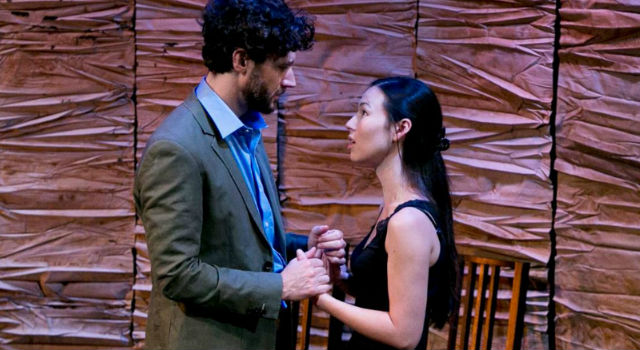
Through an international love story, Sue Smith’s Kryptonite examines the relationship between the personal realm and our wider circumstances. When Lian first met Dylan at an Australian University in pre-Tiananmen 1989, she was a new immigrant from China and Dylan had looked every bit the quintessential middle class Australian preoccupied with surfing and student protests. Over the years, Lian returns to Dylan for a series of brief but dramatic encounters, and by 2014, they are almost entirely different people, and we question if the countries from which they emerge, have evolved correspondingly, into virtually unrecognisable entities.

Freedom, idealism and innocence are put through the wringer in Smith’s play, in which we witness the ravages of time on the beauty of youth. Growing old is a tragedy, but not because of the inevitable deterioration of flesh. It is what happens to the heart and soul as time wears on, not just for each person, but also for the worlds in which we dwell. We cannot travel back in time, and our nations will never revert to a purer state. Indeed, the past is painted as though through rose-coloured glasses, but it is a persuasive picture that Smith creates. In Kryptonite, the loss of our innocence is certain, and sad. Smith’s work is emotional and powerful, with a perspective of our recent histories that feels accurate and is deeply perceptive.

The character Lian is particularly well-written, with an authenticity in speech and sense of humour that is quite outstanding. Performed by the brilliantly astute Ursula Mills, the role becomes thoroughly familiar, even though realistic Chinese women are rarely seen on our stages. She is surprisingly funny, and her motivations in each sequence are concise, keeping us engaged with her storytelling in a plot that can be a little convoluted at times. Mills is required to speak and sing in Chinese languages over the course of the show, but proficiency is lacking although her conviction remains strong. There is an oversimplification in some of Lian’s darker moments, but the actor never fails to bring a delicious fire to the drama when required. Also captivating is Tim Walter who is yin to Mills’ yang. Chemistry between the two are not quite exceptional, but they find a harmonious balance that brings great elucidation to the play’s themes and concepts. Walter’s work is thoughtful and confident, but the lightness in his presence, while delightful for the younger Dylan, is a hindrance in several of his graver moments. His depiction of a jaded politician in his late forties is not entirely convincing, but as a young man confused and enchanted by the object of his affections, Walter is charmingly captivating.

Geordie Brookman’s direction retains the challenging nature of the plot’s non-chronological timeline, but provides a good sense of clarity to the narrative. He succeeds in manufacturing a believable romance out of a complex framework of dramatic shifts in time and spaces, but some of the script’s political details are subsumed by his emphasis on pace and rhythms. The show is an enjoyable one. Its scenes are dynamic and unpredictable, always introducing fresh elements to ensure a gripping experience. Design aspects are not greatly ambitious, but they help tell the story with efficiency and elegance.

Kryptonite talks about how we have changed as nations of people, but its views of China are more exacting than how it sees its own country. The Australian play shows the evolution of a foreign land through its distinct junctures of transformation, but it is less brutal with its self-reflection. Yet again, we find meaning through the definition of an other, but this time, we move focus from our perverse European obsession to a place closer to home. China is a significant trading partner, with an astronomical rise in recent times that sees its influence spread across the world, not only in monetary terms, but also cultural and social. The first officially recorded Chinese migrant arrived in 1818 and today, Australians with Asian heritage number at 2.4 million. While we still seem to avoid it like a comic hero avoids a mythical adversary, the importance of finding a way to articulate that experience and relationship is impossible to overstate.

www.sydneytheatre.com.au

Review: Calpurnia Descending (Sisters Grimm / Sydney Theatre Company)

sistersgrimmVenue: Wharf 2 Sydney Theatre Company (Walsh Bay NSW), Oct 9 – Nov 8, 2014
Playwright: Ash Flanders, Declan Greene
Director: Declan Greene
Cast: Paul Capsis, Ash Flanders, Sandy Gore, Peter Paltos
Image by Brett Boardman

Theatre review
Calpurnia Descending borrows heavily from the 1950 Hollywood films, All About Eve and Sunset Boulevard. With an exploration into the evolution of show business and media, we observe that artifice and female rivalry persist as dominating themes that shape our consumption of popular culture through the years. Ash Flanders and Declan Greene’s script is a decadent high camp romp that exercises its creators’ eccentric and original vision, with a resulting beast that is more about heresy and iconoclasm than it is about entertainment or storytelling. In spite of its meaningful central ideas, the work does not aim to deliver poignancy but is interested instead, in unusual perspectives of theatre and innovative modes of experiencing live performance.

Half of the show is seen on a cinema sized screen. We can hear sounds from the live action emanating from behind the projection, so we know that the actors are creating the show in real time, but the significant length of the filmic portion means that it feels strangely close to being at the movies. It is understandable that Greene, as director, chooses the video format to discuss our obsession with screens big and small, but placing the production in a theatrical context is a curious decision, given the obvious affiliation with film and its possibilities. Nevertheless, Greene’s work is vibrant, colourful and thoroughly quirky, often with an air of vaudeville permeating the atmosphere. He is sensitive to energy levels, and although the show’s sense of humour is specific, he maintains a pace that is tight and lively, ensuring an amusing experience for most audiences.

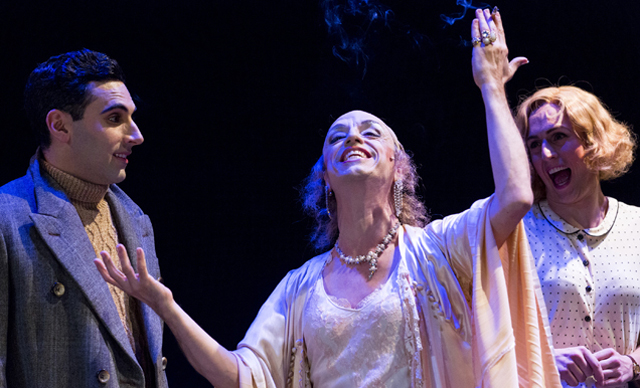
Paul Capsis does his best Norma Desmond in the role of Beverly Dumont, a star of the Broadway stage poised to make a sensational comeback at the ten-year anniversary of her misreported death. Capsis brings a drama and grandiosity that the part requires, along with excellent comic timing and a gripping presence. The role is simple, but the actor’s work is beautifully complex, adding gravitas to something that is determined to revel in its silliness. Calpurnia Descending‘s version of Eve Harrington is the duplicitous Violet St Clair, played with mischievous exuberance by Flanders whose wide range of camp extends from delightful to macabre. The actors form a strong and balanced team in their portrayal of a malevolent sisterhood, but not much is made of the inevasible drag element. There is no obvious commentary that arises from the casting of male performers, and the production would not present too differently without it, so perhaps a point is made about the irrelevance of gender in the narratives we weave.

At a time when some of us can spend virtually every waking moment in front of a screen of some description, the production should be able to provide some resonance with its interest in the way we relate to mass media and its celebrities, but its preoccupation with depicting shallowness prevents us from connecting in an authentic way. Be that as it may, the show is memorable for being adventurous and rich with original thought, and it is the artists who dare to push the boundaries that we must value the most.

www.sydneytheatre.com.au | www.sistersgrimm.com.au

Review: Children Of The Sun (Sydney Theatre Company)

Venue: Sydney Opera House (Sydney NSW), Sep 8 – Oct 25, 2014
Playwright: Maxim Gorky (adapted by Andrew Upton)
Director: Kip Williams
Cast: Valerie Bader, James Bell, Justine Clarke, Yure Covich, Jay Laga’aia, Jacqueline McKenzie, Hamish Michael, Julia Ohannessian, Chris Ryan, Helen Thomson, Contessa Treffone, Toby Truslove
Images by Brett Boardman

Theatre review (originally published at Auditorium Magazine)
In Andrew Upton’s adaptation of Maxim Gorky’s Children Of The Sun, 12 characters of distinct and diverse personalities intermingle in the privileged Protasov household, each with their own sets of concerns and each holding world views that struggle to find cohesion and alliance. Written in 1905, but set 50 years earlier, Gorky’s play looks to the past in order that we may speak of the now. Created at a time of great political and social unrest, a fictional history was used to illustrate the disquiet of the day. The work is about the anxieties and uncertainties inherent in the process of revolution, and the troubling consequences of fragmentation in communities. In our age of technological modernity, we relate instinctively to its theme of individualistic narcissism, and the increasingly fracturing nature of our local and world affairs allows us to empathise with the writer’s angst and trepidation in the face of social upheaval.

The disharmony of relationships is strikingly enhanced in Upton’s version. Its farcical comedy is relentlessly witty and often surprisingly clever, but always subservient to the greater tension of unrest that gradually unfolds. The language we hear is modern, almost colloquially Australian, which not only makes for sharper punchlines, but also allows us to readily identify personality archetypes and status structures. The disconnect between the household’s apolitical characters and the political movement that intensifies on the outside is fascinating to observe. Upton’s dialogue portrays the insularity of daily life, with the characters unknowingly providing reverberations for a larger context. It is classic social commentary that seems immortal, because its necessity never seems to diminish.

Kip Williams’ marvelous direction of the piece works with all the nuances and philosophies of the script to deliver an irresistible production that is both entertaining and thought-provoking. Every character is intriguing and authentic, and Williams injects in each a dimension of dignity, refusing to make convenient fools of anyone. Herein lies the poignancy of work. The range of personalities is diverse, and even though we are unable to identify with everyone, we recognise the humanity in all of them. The vulnerability that they display is familiar, which means that the danger they encounter rings true for us.

Williams achieves a deliciously precarious balance between comedy and drama, effectively vacillating between frivolity and severity throughout the production. It is an intensely engaging show that manipulates our responses almost at will. There is an unpredictability to its plot that takes us off the beaten track and rejects our expectations, but it always enthralls our senses. Its rhythm is perfectly orchestrated in collaboration with our fluctuating emotions, and we become utterly lost in all its trials and tribulations.

Giving the narrative an impressive clarity is its extremely colourful and dynamic cast, many of whom exhibit extraordinary theatrical abilities that look very much like genius. Helen Thomson gives an unforgettable performance as Melaniya, a blundering seductress whose desperation is matched only by her beauty. Thomson’s work is precise and studied, but her instinctive timing creates a deceptive sense of spontaneity. Hilarious, playful, and larger than life, her every entrance is commanding and powerful. Thomson finds comedy in unexpected places, making us laugh while leaving us stupefied at the magnitude of her talents. Even more flamboyant is Hamish Michael, who is delightfully hammy as the painter Dimitri. His humour is unfettered and extravagant, always keen to highlight the vacuous pretensions of his role. Michael relishes the opportunity to play jester, with a wildness to his performance that is certainly amusing, and absolutely suited to the grand scale of the venue.

Pavel is the childlike patriarch, whose devotion to science renders him feckless in all other areas. Toby Truslove embodies the character’s eccentricity perfectly. The actor is slightly betrayed by his youthful appearance but his use of voice and physicality is very well-considered. Truslove’s ability to aggrandise what is basically an introspective personality helps establish Pavel as the charming man who finds himself the object of two women’s affections. Pavel’s sister Liza is his opposite. She is a creature of intuition and emotion, whose ill health is a symbolic manifestation of all the worries she carries for the world. Actor Jacqueline McKenzie is sensitive, elegant and tremendously affecting in the role. She demonstrates excellent range and an acute intellect that carves out the most intricate character on this stage.

Production design is restrained but highly evocative. David Fleischer’s big revolving stage holds several minimal structures that demarcate spaces, but all are in full view for the duration. The aesthetic is modern, but its sentiment is traditional. Significant plot devices like rain and fire are introduced gently, without causing a distraction from the story. Costumes and props are beautifully coordinated, with a sense of historical accuracy. Time and space is manufactured efficiently with minimal fuss, but every moment looks harmonious and beautiful.

This production of Children Of The Sun gives theatre lovers everything their hearts desire. It entertains, educates and thrills us, and it gives us so much to admire in the talent and skills that it showcases, but it does not provide answers to its own pressing questions. It is a quietly controversial work that makes statements about community, equity and political action. It makes us recognise the importance of social advancement, but seeks not to be divisive. It leaves with us a plea for progress and perhaps a yearning for a new revolution, but it relies on our own benevolence and intelligence to find a way.

www.sydneytheatre.com.au

Review: Macbeth (Sydney Theatre Company)

stc
Venue: Sydney Theatre at Walsh Bay (Sydney NSW), Jul 21 – Sep 27, 2014
Playwright: William Shakespeare
Director: Kip Williams
Cast: Paula Arundell, Kate Box, Ivan Donato, Eden Falk, John Gaden, Melita Jurisic, Robert Menzies, Hugo Weaving
Images by Brett Boardman

Theatre review (originally published Auditorium Magazine Peace Issue 2014)
In the process of art-making, it is often the spirit of experimentation that elevates a work to heights of significance and esteem. Major theatre companies around the world with greater access to funding and other resources do not always prioritise innovation in their repertoire, often choosing instead to deliver entertainment that their patrons would readily embrace. The decision to stage a version of Shakespeare’s Macbeth with a prominent actor in the title role, exemplifies the kind of tension that exists where a show’s anticipated mass popularity and the expectations that come along with it, threatens the commitment to artistic risk, in the trepidation of alienating audiences or indeed, underestimating their ability to relate to unconventional interpretations.

Kip Williams’ direction of the piece reflects an awareness of the diversity in his audience’s tastes. Shakespeare is left untainted and the celebrity actor is given ample room to flex his dramatic muscles for his legions of fans, but the stage is thoroughly explored around those prerequisites. Williams gives the crowd what they have come for, but also offers up fresh concepts and unexpected flourishes that prevent the production from ever appearing unoriginal or unambitious. Williams’ vision does not rewrite the 400 year-old play, and neither does it add significantly to its themes and ideas, but he uses the text to explore the nature of the art form in all its physical and emotive possibilities. The audience’s early excitement is further amplified, when we discover upon stepping into the venue, that our tickets point to seats located on the stage itself, and we are positioned so that the auditorium come into full view and our more familiar chairs have become the backdrop. The meaning of this radical reversion is open and unexplained, but it seems the director wishes to keep us close to the action by placing us directly on stage with the performers.

The production begins as though we are observing a casual reading, with the only discernible element of set design being a simple table (that seems to find its way into every rehearsal space). The cast appears in nondescript clothing, looking more regular than average Joes on the streets of Sydney. None of the grandeur of fictitious kingdoms, or the formalities associated with Shakespeare are present. Disappointment in the production’s minimalism is soon dispelled when the first murder takes place, and a series of fantastical effects begins to unfold. Supernaturalism figures heavily in Shakespeare’s writing, and the depiction of a world that is half earth, half hell is a striking gesture from Williams’ directorial hand. His ghostly atmospherics are deftly created by production designer Alice Babidge’s ingenuity, together with the adventurous efforts of lighting designer Nick Schlieper and the insidious talents of Max Lyandvert, composer and sound designer. It comes as no surprise that Sydney Theatre Company delivers a technically proficient show, but the stage craft in their production of Macbeth, shows flair and intuition in addition to expertise.

Hugo Weaving as Macbeth is absolutely captivating, perhaps unsurprisingly so. The role is wildly imagined and Weaving’s impressive range is exposed dramatically. The actor’s control of voice and body is confident and skilled, and his thorough exploration of the text translates into a dynamic performance that keeps us delighted and entertained. Acting on this stage is professional and committed, but characters are distant. We watch their stories with fascination, but we are not always emotionally engaged. Performances are thoughtful and calculated, but they do not always resonate viscerally, and can sometimes lack an intuitive energy. Weaving’s work in the “dagger scene” is clear in its motivations, showing us the onset of the character’s descent into madness, but the impending consequences that befall him do not translate with enough power. We do not sense sufficiently the grave danger that awaits him, but when emotions of regret take hold later in the piece, Weaving’s mastery truly shines.

The other famed soliloquy, Lady Macbeth’s sleepwalking scene, is similarly underwhelming. Melita Jurisic plays her role with an alluring extravagance, but the heightened lunacy at her final scene feels almost too predictable after presenting a Lady Macbeth who had already seemed quite deranged from the start. Nevertheless, Jurisic’s intensity adds a sensational energy of avant-gardism that gives the production a sophisticated modern edge. Her anti-naturalist style fits beautifully with the show’s paranormal quality, and the toughness that she injects into the role keeps us mesmerised. Paula Arundell crosses gender and ethnic boundaries to play a compelling Banquo. Arundell’s work has a natural authenticity that helps create a character that is consistently believable, and her considerable stage presence gives Banquo an effortless palpability. Her star quality is pronounced even at the scene of the feast, where she plays an apparition, wordless and with little movement. There is an appealing stillness that she delivers, which our eyes very readily gravitate towards.

Williams’ use of space is a greater achievement than his use of Shakespeare’s script. His determination and love for theatrical experimentation is exhilarating to witness, and while his concepts might have been inspired by Macbeth, they can appear quite divorced from the text itself. Furthermore, the story and its characters often feel subsumed by the grandness of his aspirations. The narrative is a majestic one and it resists abatement. We want to be swept away by its drama and tragedy, but our indulgence in all the spectacle takes precedence and our senses struggle to form a meaningful reconciliation between form and content. This is a strong production with artistic merit emerging from all aspects and faculties, and although it connects more with our senses that it does with our emotions, what we see and hear is utterly breathtaking.

www.sydneytheatre.com.au

Review: Mojo (Sydney Theatre Company)

mojoVenue: Wharf 1 Sydney Theatre Company (Walsh Bay NSW), May 17 – Jul 5, 2014
Playwright: Jez Butterworth
Director: Iain Sinclair
Cast: Tony Martin, Lindsay Farris, Eamon Farren, Ben O’Toole, Josh McConville
Images by Brett Boardman

Theatre review (originally published at auditoriummag.com)
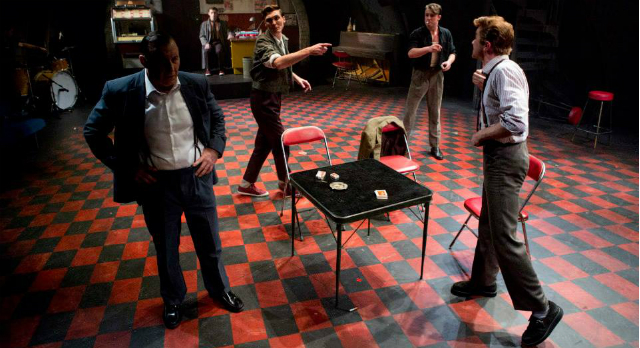
When boys grow up and begin to find their feet in the adult world as men of stature, the acquisition of masculinity often becomes critically important. The characters in Jez Butterworth’s Mojo seem to spend all their waking moments satisfying that overwhelming and insatiable need to be seen and treated as men of worth, and in the London underground gangland of the late 1950s, this involves unthinkable violence, and outrageous criminality. Butterworth’s daring and extravagantly brutal 1995 script illustrates a world of sex, drugs and rock and roll, where sons are raped, fathers are murdered, and honour is maleficently displaced.

Butterworth’s work starts up in high gear. He gets to the mayhem quickly without setting up thorough introductions for its story. There is a disorientation that occurs in the beginning, and the viewer is required to be alert, in order to decipher manic events while keeping up with the fantastically rich dialogue. Iain Sinclair’s direction in the initial scenes emphasises speed and energy, which can be a challenge for the plot, but a hyper-reality is firmly established for the play’s time and space. We are transported to a past that fits our imagination in part, but also controversial. The play’s rampant drug taking and extreme profanity is a far cry from the innocence of Grease, and the sophistication of Orson Welles’ Touch Of Evil. Sinclair’s work owes more to David Lynch’s 1986 masterpiece Blue Velvet in its handling of ultraviolence and surreal personalities. An air of menace sets in quickly and the pressure it exerts is unrelenting. The production has a magnetic quality in spite of its obscure otherness. It plays like a riddle, glutted with suspense and eccentricity, and we are seduced at every step, desperate to peek around every impending corner.

Indeed, the production succeeds as a piece of narrative-driven entertainment. It is engrossing, amusing and thrilling, with a good amount of shock value thrown in for a sense of gangster authenticity that also gives the show a cool edge. Its themes are not immediately evident, but they resonate afterward. The show does not ask questions directly, but it certainly encourages us to question what had been seen. Sinclair might be comfortable with dramatics that strike like a sledgehammer, but his ability to probe our conscience about bigger issues is as accomplished as it is subtle.

Also displaying excellence is Sinclair’s design team. Visual aspects, including lighting, costumes and sets are adventurously creative and intelligent. Nicholas Rayment’s lights are exhaustively explored, fulfilling functional and aesthetic requirements equally brilliantly. There are moments of beauty that look to be inspired by film noir, and also memorable incidences of dread that are as sinister as a dank lane way in any cosmopolitan city at 3am. Pip Runciman’s set design ingeniously creates spaces out of the usually nondescript Wharf Theatre stage. Levels and doorways are introduced to great effect, and the representation of a nightclub that is attractive in front, and dilapidated behind, is efficiently managed.

Percussionist Alon Ilsar’s work is perhaps the most inventive. He provides accompaniment for most of the scenes, underscoring action by amplifying mood and manufacturing tension. Ilsar’s background sounds are noticeable but not intrusive. When it does come to the fore, it is in the style of experimental jazz, which adds considerable sophistication to the production.

Chemistry in the cast is strong, and mesmerising. The actors are perfectly in tune, and together, they present a microcosm that we find believable in spite of its irrationality, and irresistible even though it is deeply repulsive. Josh McConville is comically frantic as the amphetamine fuelled Potts. His consistent buoyancy gives the play a propelling energy, and prevents the darker sections from becoming too melancholic. There is an enjoyable vibrancy to his performance that keeps an important sense of youth and juvenility in the story. Together with Ben O’Toole’s slightly more innocent Sweet, they portray a couple of young men keen to prove themselves, and to make a mark in their sordid world. Lindsay Farris is enigmatic as Baby, a deranged personality who is central to the play’s interest in maturity and manhood. Farris takes the opportunity to depict his unorthodox character with a liberal measure of offbeat artistic choices, and carves out a fascinating performance that is simultaneously alluring and poignant.

The young men in Mojo are in a state of confusion. We see them exercise the impulse to impress, to emulate, and to succeed, but their role models are severely impaired. Masculinity is highly valued, and in many of our lives, it is through acquiring masculinity that men achieve social acceptance and establish status. The definition of masculinity is then a matter of great concern. Greed, violence, destruction, deception, betrayal and criminality are all inextricably linked with notions of success and fulfillment in Mojo. It is a bleak picture painted of the past, but it seems that the proposition made here is that evolution is illusory, and that boys will be boys.

www.sydneytheatre.com.au