Review: Henna Night (Mercury Theatre)

mercuryVenue: Old Fitzroy Theatre (Woolloomooloo NSW), Jul 5 – 9, 2016
Playwright: Amy Rosenthal
Director: Glen Hamilton
Cast: Jane Angharad, Romney Stanton

Theatre review
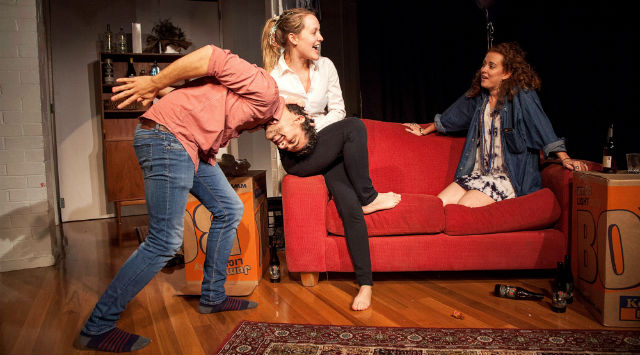
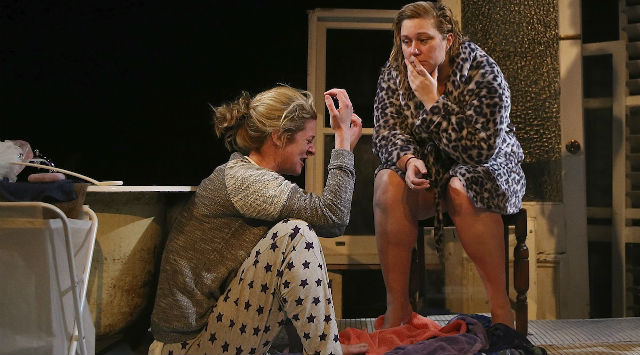
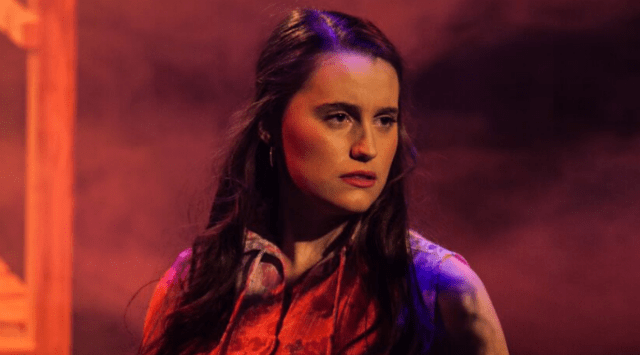
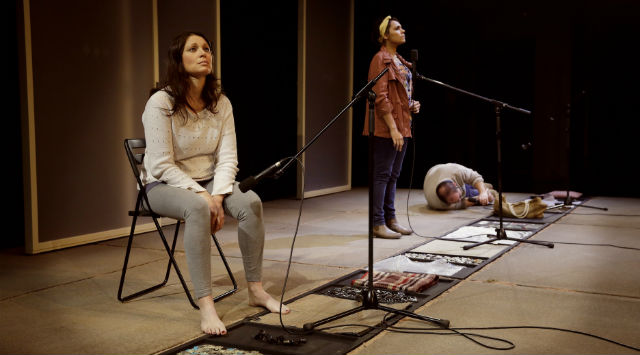
Two women are brought together by their love of one man. They are not particularly inspiring people, but theatre does not have the responsibility to only give us role models. Judith and Ros are in a confrontation, both projecting their resentments onto the other, eventually finding commonality in their romantic dissatisfaction that allows them to discover a bond, unexpected of themselves, but completely predictable for their audience. They languish in all the imperfections of their love lives, but never question the futility of their efforts. Amy Rosenthal’s Henna Night is a story about desperation that shows an unflattering picture of what we look like when feeble and fallible.

It is a mildly comical work, with an emphasis on naturalism that tends to subdue the funnier lines of the script. The clash of rivals is conveyed with insufficient theatricality, but the show has a coherence that communicates logically in the absence of great dramatic tension. Actors Jane Anghard and Romney Stanton are convincing in their portrayals, if a little lacking in dynamism. The production’s shifts in mood and atmosphere could be more amplified for better sensory variation to keep us engaged further with nuances of the piece. Director Glen Hamilton attempts to unearth the truth in these women’s experiences, and is successful in bringing an honesty to the stage, but he requires more spice to accompany this overly polite creation, laden with too much sugar.

It is arguable if nice girls always finish last, but in Henna Night, we yearn for Judith and Ros to throw punches and smash vases. We want to see them lash out, because our own angers and frustrations need a safe space to experience a moment of salvation. Thespians are given the license to behave badly in their worlds of make belief, so that we can benefit from that exorcism of our shared demons. The people in the play have a message for us, but they appear gently and disappear too quietly, leaving little more than a dent in our memory.

www.facebook.com/…

Review: The Viagra Monologues (Off The Avenue Productions)

offtheavenueVenue: Blood Moon Theatre (Potts Point NSW), Jun 16 – Jul 2, 2016
Playwright: Geraldine Brophy
Director: Samuel Allen
Cast: Tom Matthews, John Molyneux, Meynard Penalosa

Theatre review
Three male actors present a series of small episodes offering perspectives on life and humanity, through experiences of male sexuality. Like its very famous feminine predecessor, characters in The Viagra Monologues centre their stories on their genitalia. The pharmaceutical referenced in the title does not make frequent appearances, but its presence is a conspicuous metaphor figuring alongside ideas of masculinity and emasculation, which form the play’s main focus. An erect penis alone does not maketh the man, and we explore what it is that today’s man needs in order to find strength and spirit for his existence. Geraldine Brophy’s script is appropriately diverse in scope, with an admirable objective of portraying vulnerability within its very wide range of personality types. Virtually everything we see in the theatrical landscape involves men, but it is not a regular occurrence to see them only at their most vulnerable, stripped of every macho pretence.

Director Samuel Allen does well to create on the stage, distinct scenes and people who appeal in differing ways. The use of space has a tendency to be too basic and repetitive (and lighting design leaves much to be desired), but Allen’s attention to detail in performances provides an effective realism to all the stories we hear. It is an accomplished cast, balanced and cohesive in their efforts but each with their own idiosyncrasies. Tom Matthews entertains with a flamboyant edge to each of his depictions, John Molyneux is charismatic especially when playing young children, and Meynard Penalosa is captivating in his portrayals of emotional intensity. There are inconsistencies in their ability to delve into the fragility of each sequence, but when successful, the monologues take on a powerful poignancy that speaks deeply about the way we are, and how we treat each other.

These are stories about men, but written by a woman. The best of feminism benefits all, and it is the acknowledgement of the destructive qualities of manhood in these stories that make them meaningful. We observe a series of male characters in varying stages of intimate vulnerability, each exposing themselves in a way that real life (outside of the theatre) disallows. The men are beautiful when they bare all under this spotlight, but these are moments of imagination that, although truthful, are rarely encountered face to face, even with the ones we love. We make our men resilient, powerful and hard, as a matter of course, without stopping to think about the sacrifices involved. They soldier on, with all their softer sides buried and suppressed, but dark monsters manifest when we fail to take care.

www.offtheavenue.com.au

Review: Godface (Matriark Theatre)

matriarkVenue: 107 Projects (Redfern NSW), Jun 28 – Jul 10, 2016
Playwright: Robert den Engelsman, Murray Lambert
Director: Scott Parker
Cast: Murray Lambert, Emily McGowan, David Molloy, Jesse Northam, Sam Flack
Image by Alinta Haydock-Burton

Theatre review
In Godface we find a familiar reflection of our scepticism and distrust of government and the adversarial political system. There is an accuracy to the way Robert den Engelsman and Murray Lambert’s writing represents our feelings about politicians and their operations, but its insights and perspectives on the subject are hardly unusual. It shares our disillusionment with all things political, featuring characters that need little introduction, for a simple tale of corruption and exploitation.

Scott Parker’s enthusiastic direction brings to the stage a liveliness that many will enjoy, using puppetry and techniques of commedia dell’arte to spark our imagination as it forms a commentary on the state of the world. Delightfully performed by a unified cast of actors, the production is memorable for its sense of variety, established by a keen interest in a non-naturalistic mode of expression. Sam Flack leaves a remarkable impression in a range of characters including the head of the New God Party, a wolf gangster and a pair of opinionated giraffes. The actor is vibrant and humorous, with excellent charisma that gives each of his transfigurations considerable appeal. Designer Aleisa Jelbart’s work on puppets, props and set is especially noteworthy, with an exceptional eye for detail and refinement that provides touches of stylistic elevation to the production.

At the 2013 elections, 739,872 informal votes were recorded. There is little hope to be found in Godface, for good reason, and we see clear as day, the alienation felt by many of our population. Modern democracy is deeply flawed, but remains the only system we deem acceptable. It is a conundrum that we learn to live with, and on occasions such as this weekend’s federal elections, we have no alternative but to indulge in a moment of delusion that the world might just be ready to make a change for the better.

www.matriarktheatre.com

Review: No Exit (Throwing Shade Theatre Company)

throwingshadeVenue: The Factory Theatre (Marrickville NSW), Jun 23 – 25, 2016
Playwright: Jean-Paul Sartre
Director: Andrew Langcake
Cast: Harley Connor, Courtney Powell, Darcie Irwin-Simpson

Theatre review
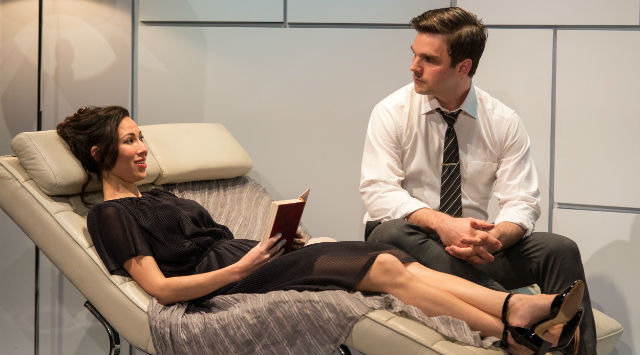
Sartre’s 1944 play No Exit is about three people coming to grips with their new existence post-mortality. The famous line “hell is other people” is heard late in the piece, and like the myriad ways in which it can be interpreted, the play is abstract, to be given meaning as one wishes. The concept of hell is a powerful one, considering its uncompromising permanence. Life may not be much more pleasant than hell for some, but hell’s eternal inescapability is truly terrifying.

The staging, directed by Andrew Langcake, is a simple rendering that attempts to bring realism to the absurdist piece, with an emphasis on finding character coherence over philosophical expression. Sound and lighting are strangely neglected, resulting in a supernatural realm that is unfortunately devoid of atmosphere. Performances are committed, and each personality is distinctly shaped by a cast of spirited actors, but chemistry is often lacking. Relationships are key in No Exit, and unable to portray them with enough clarity and dynamism, the production struggles to communicate beyond the superficial.

Individuals experience life from perspectives we know to be personal, but it is debatable if anything is ever unique in how we each see the world. We can only understand things from our singular positions, but in every transaction that we inevitably conduct with other beings, we become transformed, objectified and absorbed into another consciousness. The self is unable to remain separate, and meaning can only come from that act of concurrence, voluntary or involuntary. If other people will give you hell, they are also your only source of pleasure. How much the self can do to manipulate the other will always be limited, but happiness is always best managed within one’s own hermitage.

www.throwingshade.com.au

Review: Back At The Dojo (Belvoir St Theatre)

belvoirVenue: Belvoir St Theatre (Surry Hills NSW), Jun 18 – Jul 17, 2016
Playwright: Lally Katz
Director: Chris Kohn
Cast: Fayssal Bazzi, Dara Clear, Catherine Davies, Harry Greenwood, Brian Lipson, Natsuko Mineghishi, Luke Mullins, Shari Sebbens
Image by Brett Boardman

Theatre review
Lois lays in a hospital bed, with her husband Dan by her side waiting for her to gain consciousness. Their granddaughter Patti appears unannounced and drugged out, after disappearing for two years working on her gender transition. Dan and Patti take time to mend their bond, and in the process we witness parallels between Dan’s life in the late sixties, becoming his own man through the discovery of karate, and Patti’s own frustrations in her journey into womanhood. Back At The Dojo by Lally Katz is an emotional work, but gently so. It does not create big scenes of heightened family drama, taking its time instead to build on our involvement with its characters and their stories. Through excellent humour and a moving depiction of relationships, we gradually become invested in the people before us, although its slow burn may prove to be too demanding of some audiences. Katz’s writing is amusing and colourful, with an undeniable poetic beauty, but the play takes a long time to get to its point, resulting in a plot that can feel somewhat aimless before we arrive at its later, more poignant sequences.

The decision to cast a male actor in the role of Patti is a distasteful one that reflects a surprising callousness, given the impressive level of sensitivity evident throughout the rest of the production. Patti’s is one woman’s story, but due to the rarity of transgender representation in our theatres, it is also every trans person’s story, and no trans woman would ever want to see herself portrayed by a man, on any stage or screen. We do not see Patti’s early days in masculine expressions of gender, so to choose a male actor over a female one (trans or cis), only goes to demonstrate the production’s inability and refusal to accept Patti’s gender as she now presents. To be misgendered is one of the most appalling things any trans person could experience, and Back At The Dojo‘s misgendering, deliberate or unintentional, is an unacceptable transgression.

It must be said however, that Luke Mullins’ performance as Patti is a captivating one, and very powerful. He is obviously unable to convincingly depict the physical transformations that his character has had to endure, but there is a beautiful psychological accuracy in his work, in addition to the passionate yet nuanced drama that he sustains in every stage moment. Director Chris Kohn extracts very believable performances from all his actors. It is essentially a simple tale, with few opportunities for a more ostentatious approach, but every personality and relationship feels meticulously refined, with a palpable omnipresence of truthfulness and vulnerability that gives the show an enchanting soulful quality. The role of Dan is played by Brian Lipson, a gentle giant, full of strength and tenderness in his mesmerising interpretation of an older man dealing with immense loss, that will touch the hardest of hearts. Natsuko Mineghishi steals many scenes as the dojo Sensei, a real-life action hero with thrilling karate showmanship, lethal comic timing and a spectacular singing voice.

A profound connection exists between generations, but modern life seems to prevent many of us from experiencing and reaping its rewards. The disintegration of the family unit, and the ever rising regard for individuality means that few of us maintain significant intergenerational relationships. In Back At The Dojo, a distraught woman finds purpose and meaning by learning about her grandfather’s own obstacles in life, and by recognising her kinship responsibilities. We come to a realisation that both Patti and Dan are sinking under the weight of loneliness, and that the frailty of their existences are to be salvaged by the perennial tie that binds. They are fortunate to have one another, like we all have our own families, but how we value them is what the play brings into question.

www.belvoir.com.au

Review: Bicycle (Lies, Lies And Propaganda)

liesliespropagandaVenue: Old Fitzroy Theatre (Woolloomooloo NSW), Jun 21 – Jul 2, 2016
Playwright: Danielle Baynes
Director: Michael Dean
Cast: Danielle Baynes, Pip Dracakis

Theatre review
It is one woman against the world in Danielle Baynes’ Bicycle. The odds are stacked against our 19th century protagonist as she discovers not only her life’s passion, but also the injustices that women face when trying to carve out a self-determined existence. Coming of age in Baynes’ play means realising the discrimination that is systematically entrenched in a world that had previously seemed innocent. An awakening of desires demands that her eyes are open to truths, and her story of tragic enlightenment is told in a way that disallows us from denying its persisting relevance. The nameless Lady’s feelings and experiences, her perspective of the world, and her hunger for what is right, all find connection with our 21st century sensibilities, and shock us into seeing the intimate parallels between what we had considered to be bygone history and what we continue to retain. It is a passionate piece of writing, insightful and brilliantly elucidating through a narrative that is at once personal and universal. At the core of its many colourful permutations of form, is its unmistakeable feminist advocacy that many will find irresistibly inspiring.

Baynes plays the Lady in the hour-long monologue, with Pip Dracakis providing an added female omnipresence with her person and violin. Space is restrictive, and the production relies squarely on the leading lady’s ability to keep our attention and imagination engaged, which she accomplishes remarkably well. Scenes are thoughtfully demarcated and given distinct flavour by director Michael Dean, but some sequences are more effective than others, resulting in a plot trajectory that can feel uneven in its resonance. Dracakis’ live music gives the show a dynamism that works seamlessly alongside Baynes’ actorly endeavours for a powerful statement about art, and the struggles in its creation.

Sex and art are linked in Bicycle, both are appetites ferocious in nature and indomitable. The Lady’s liberties are completely usurped by a patriarchy that is determined to diminish her wishes and talents. We live in a world where powerful people go to great lengths to maintain the status quo, for their position necessitates the subjugation of many. This seems to be part of human nature, never to change, but processes where disenfranchised groups work to destabilise and subvert oppressive forces are always ongoing. Not all will succeed, but the battle continues for the human spirit is at its most potent when the downtrodden are left with nothing else to lose. Her rights as a sexual being and an artist, are a threat to her father and his conspirators, who do all they can to disempower her, but we are glad to see her fight to the end, whether or not she comes out on top.

www.liesliesandpropaganda.com

Review: Straight (Brilliant Adventures)

brilliantadventuresVenue: Kings Cross Theatre (Kings Cross NSW), Jun 16 – Jul 2, 2016
Playwright: D.C. Moore
Director: Shane Bosher
Cast: Danielle Cormack, Sean Hawkins, Simon London, Madeleine Jones

Theatre review
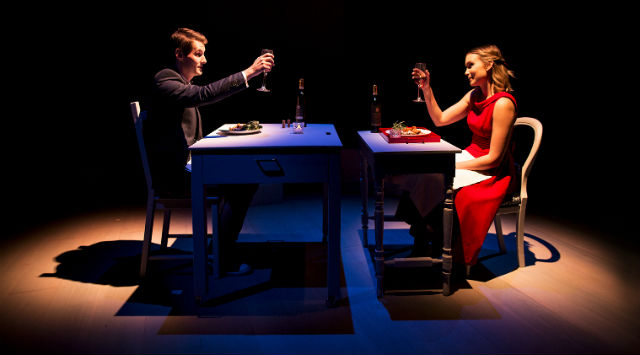
Lewis and Waldorf are old friends from university days, reunited several years after their lives have taken different turns. While intoxicated, they decide to make an amateur porn film with each other. Lewis is married, with a history of just 2 sexual partners, and the happily single Waldorf is more experienced with 71, but neither have had encounters with men. Based on the 2009 film Humpday by Lynn Shelton, D.C. Moore’s Straight is about transgression. It explores issues around the constraints of sexual identity, along with an investigation into boundaries of friendship, and takes a look at the rules of monogamy in modern marriages.

Taboos are confronted with a vehement directness in Straight, which locates our cosy assumptions of human sexuality and puts them through a series of thorough and provocative interrogations. The script is a gripping one, made even more enthralling by director Shane Bosher’s very effective delivery of plot tension and believability for what is actually an absurd context. A brilliantly awkward sense of humour permeates Moore’s consistently nuanced writing, but the production has an air of unrelenting seriousness that compromises its potential for comedy. The mischievous Danielle Cormack delivers the biggest number of laughs as Steph, and leaves an excellent impression even though the actor only appears once in an early scene. Also noteworthy is Madeleine Jones who performs the role of Morgan with excellent psychological accuracy and a sharp intuition.

Lead role Lewis is played by Simon London whose thoughtful and intelligent approach creates a character that we are able to connect with, in spite of his quite incredible decisions. Sean Hawkins is the charming Waldorf, who keeps proceedings buoyant with an unpredictable and aggressive energy. The two turn up the sexual heat in the show’s crucial moments, creating an exceptionally libidinous stage that many will find titillating, while some others will be left embarrassed. Their work demonstrates pure conviction, but it is the ambiguity of their characterisations that inspire the biggest questions.

Art is eternally preoccupied with sex as a topic because it is universal, and one that can be examined extensively, and ceaselessly. The diversity of individual experiences and the plurality of our beliefs mean that new perspectives can always be added to the ever-expanding discussion and hence, comprehension of the nature of sex. We however, live in societies that suppress these interchanges, so we become accustom to presuming an uniformity in our hidden sexualities. We fool ourselves into thinking that we know how other people do sex, and furthermore we often place those same limitations on our own individual sex lives. Straight is about people who give themselves a chance, and who dare to go into the unknown, in the voyage of self-discovery that we call life. It is about defining identities by first experiencing what one is not, before settling on what one is.

www.facebook.com/…

Review: The Olympians (NIDA)

nidaVenue: NIDA Parade Theatres (Kensington NSW), June 11 – 18, 2016
Playwright: Stephen Sewell
Director: Jeff Janisheski
Cast: Saxon Blackett, Callan Colley, Laura Djanegara, Megan Hind, Imogen Morgan, Wil Ridley, Louis Seguier, Emele Ugavule, Ross Walker

Theatre review
We take sport very seriously in Australia. Billions of dollars have been generated from the industry, and countless personalities have attained national iconic status over the years. Stephen Sewell’s The Olympians attempts to deconstruct the sporting hero, with a story set in the Olympic village of the 2016 Rio games. It is a piece of writing highly critical of sporting and popular culture, using a narrative about a fallen star lost in sex and drugs, appealing to the same need in our audienceship that keeps tabloid journalism in business. Its characters are familiar but caricatured, and although hugely ambitious in scope, the play would probably be more effective if scaled down to its simple essence. Greek tragedy meets television realism in The Olympians for a curious exploration of dramatic form, but the play would make a stronger point if its many subtexts are trimmed down to a more succinct articulation of its thoughtful message.

Direction by Jeff Janiesheski is equally adventurous and imaginative with its approach. The very generously sized stage poses a challenge that Janiesheski responds by delivering amplified theatrical expressions for every scene, resulting in a work that can often feel too obvious with how it chooses to communicate, leaving little room for nuance or irony. The production’s humour is rarely effective but energy from a tireless cast and vigorous lighting effects by Ross Graham help retain our attention. Lead actor Wil Ridley shows good precision and discipline as the dishonoured Porter, especially proficient in some of the play’s more heightened sequences of sentimentality. Imogen Morgan is memorable as Jess, a bimbo type who encounters the goddess Aphrodite. Morgan’s ability to convey consistent authenticity in her role sets her apart in a group that seems to work more intently on exterior presentations than on emotional efficacy and psychological believability.

In an arena where individuals are ruthlessly pitted against each other, the sporting field allows only one winner at a time. Perhaps it is the idea of making concrete the abstract concept of “the best” that gives sport an allure that art has been unable to compete with. Awards are given out in artistic communities the world over, but there is nothing definitive about the good and bad in art, and certainly, the judgements we may bestow upon them are almost never more than irrelevant privileged perspective. People are drawn to the certainties of sport, and the creation of winners and losers in its equations. The nature of art resists that singular objectivity. Great art dismantles systems of segregation and exclusion to speak with universality as though at the Olympics, except all are to emerge victorious.

www.nida.edu.au

Review: Inner Voices (Don’t Look Away Theatre Company)

dontlookawayVenue: Old Fitzroy Theatre (Woolloomooloo NSW), Jun 15 – Jul 9, 2016
Playwright: Louis Nowra
Director: Phil Rouse
Cast: Annie Byron, Julian Garner, Emily Goddard, Nicholas Papademetriou, Anthony Gooley, Francesa Savige, and Damien Strouthos
Image by Ross Waldron

Theatre review
Ivan VI lived 23 short years in Russia, but in Louis Nowra’s Inner Voices, his destiny is transformed dramatically to tell a story about how kings are made, and how countries are ruled. Originally published in 1977, Nowra’s words in the play remain fresh and humorous, and although its political edge seems to have worn with time, Inner Voices‘ punk sensibility is still evident today in its iconoclastic characterisations and anti-authoritarian outlook.

It is a very exuberant production that Phil Rouse has directed. Notwithstanding our unfamiliarity with its context, the unrelenting and spirited acerbity of his style keeps us engrossed. The thoroughness at which the text’s comedy is explored, is not only endlessly amusing, it also helps provide depth of meaning to an outlandish narrative. Thoughtfully designed, the production’s aesthetic values are textured and powerful. Anna Gardiner’s set and Katelyn Shaw’s sound design are especially remarkable in the degree to which they are able to consistently add surprising dimension to the play.

Inner Voices‘ cast of seven is an exceptionally dynamic bunch. Ivan is played by Damien Strouthos, whose uncanny ability to portray eccentricity is a perfect fit for the quirky role. The actor takes the opportunity to showcase excellent range in a part that goes through several significant transformations, and we see various facets to Strouthos’ talents, all equally accomplished. Anthony Gooley is absolutely memorable as Mirovich, with razor sharp wit and a flamboyant theatricality that knows no bounds. Enthralling and hilarious, Gooley is outstanding on this stage and we are kept amazed by the genius inventiveness he injects into every line of dialogue.

It is the eve of another federal election in Australia, and we think about the likely candidates who will rule us for another three years. Inner Voices reflects our prevailing cynicism, and exposes the falsities associated with the state of our politics and governments. We want truth and honesty from those who represent us, but we have become all too aware of the hypocrisies and cunning that are required for people to attain positions of power. If good people cannot win in a broken system, all we have are at best, compromised and substandard. Nowra’s play does not offer us any solutions, but it certainly is a reminder that we should want to do better.

www.facebook.com/dontlookawaytc

Review: Flame Trees (Tunks Productions)

tunksVenue: The Depot Theatre (Marrickville NSW), Jun 15 – Jul 2, 2016
Playwright: Wayne Tunks
Director: Simeon Yialeloglou
Cast: Ryan Bown, Karina Bracken, Rebecca Clay, Isabel Dickson, Jace Pickard, Wayne Tunks
Image by Isobel Markus-Dunworth

Theatre review (of a preview performance)
Wayne Tunks’ Flame Trees is a lot like soap opera. Its characters are highly emotional, and all their families get entangled in the melodrama, which involve moral conflict, infidelity and bushfires. Unlike the most popular tv shows of the genre however, we do not have years of history with the personalities of Flame Trees, and consequently, their grievances are of little concern to us. Causing further alienation is the lack of authenticity that comes from the play’s desperation to arrive at heightened emotion without first engaging us appropriately with the high stakes that it sets up for itself. The script is unoriginal, and hollow where it attempts to induce passion, but is thankfully fast-paced in getting to its conclusion.

Staging of the work is appropriately cheesy, with every creative decision going with the conventional and obvious. Actors put on unnatural voices and indulge in extravagant eruptions of passion and anger, in service of a narrative that is devoid of depth and often unbearably silly. The cast shows conviction nevertheless, and is fairly well-rehearsed, with Rebecca Clay leaving a good impression by finding nuance in her role despite its inherent incoherences.

Emotion must emerge from meaning, and it is a storyteller’s responsibility to locate resonance with the audience. A work can achieve a lot with its surfaces, but without truth at its foundation, big gestures on the exterior will only appear pretentious and absurd. Going to the theatre is a sacred event for communities to share and connect. Commerce will no doubt be a part of its equation, but it must never be the overriding factor, or our participation will only leave us empty and resentful. Theatre is not the idiot box, and the audience deserves much better.

www.tunks.com.au