Review: TickTickBoom (Subtlenuance Theatre)

Venue: The Actors Pulse (Redfern NSW), Oct 10 – 20, 2018
Playwright: Melissa Lee Speyer
Director: Paul Gilchrist
Cast: Rose Marel, Emily McKnight

Theatre review
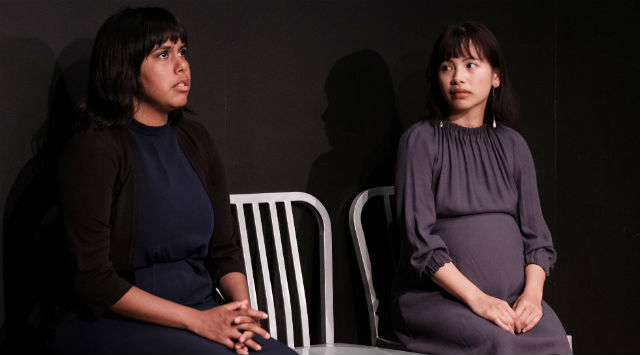
When the story begins, Jodie is seventeen and finishing up high school, but instead of exams and puppy love, it is her failing health that becomes all-consuming. To have her dug out of doldrums, chirpy schoolmate Clara is sent by parents to be the gallant lifter of spirits. In Melissa Lee Speyer’s TickTickBoom, the heart is the subject, literal and figurative, as we observe two young women navigate life and friendship, with a constant and unassailable reminder that death is always around the corner.

Big existential themes are cogently woven together by Speyer, who presents her observations in a manner that is indelibly tender and benevolent. The production struggles to establish an effective sense of humour, but its heavier sections are certainly sensitively rendered. Director Paul Gilchrist’s earnest approach makes for a warm, contemplative experience, and although chemistry between actors can seem inconsistent, both demonstrate undeniable talent, as they proceed to find authenticity, as well as integrity, for their respective roles. Rose Marel brings a valuable vulnerability to Clara, so that we can have an appreciation of the character beyond her shiny exterior. Emily McKnight is convincing in her performance of Jodie’s recalcitrance, for a portrait of teenage angst that we are all familiar with.

Time means nothing to this earth. It is the vanity of our mortal selves that creates the notion of time, and the notion of life running out. When Jodie is fearful of death, she is paralysed, unable to pay reverence to the ticking seconds that she so anxiously counts. To believe in time, is to imbue it with meaning. Species can come and go, but the world will evolve regardless of our individual fates. For each of our personal domains however, to make this fleeting existence bearable, will require a thing we name spirit, whatever one would like for it to mean.

www.subtlenuance.com

Review: The Feather In The Web (Griffin Theatre Company)

Venue: SBW Stables Theatre (Kings Cross NSW), Oct 5 – Nov 17, 2018
Playwright: Nick Coyle
Director: Ben Winspear
Cast: Tina Bursill, Gareth Davies, Michelle Lim Davidson, Claire Lovering
Images by Brett Boardman

Theatre review
At one point in the show, the protagonist declares that she has MS, but of what we are able to observe, Kimberly exhibits no symptoms of multiple sclerosis. We are nonetheless, tempted to pathologise her, to interpret all her absurd behaviour as evidence of some kind of mental disorder, to label her crazy. Nick Coyle’s The Feather In The Web is a tale of obsessive love, but one that is grounded in little reality. It is doubtful if audiences in general will be able to find points of meaningful connection with the play’s outlandish situations, but its wild imagination is certainly entertaining.

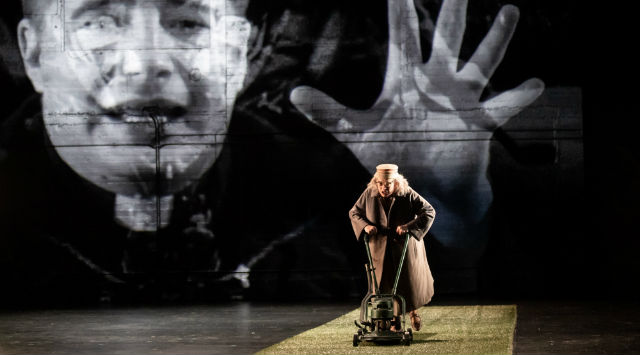
Director Ben Winspear’s creation is highly sophisticated, marvellously polished, and very funny indeed. It is a thoroughly engrossing production, full of mystery and always bursting with energy, featuring dynamic and seamless collaborations from an excellent design team. Sophie Fletcher and Mic Gruchy work wonders for a series of backdrops and projections that are as whimsical as they are functional. Lights by Trent Suidgeest are versatile and unpredictable, able to traverse mundane and surreal with ease, and sound by Steve Toulmini is bold and humorous, powerful in its control over the audience’s emotional responses.

The magnificent Claire Lovering is dazzling as Kimberly, exceptional in her ability to simultaneously deliver uproarious comedy with a grave solemnity. Brilliantly amusing, she sweeps us away to places that are completely nonsensical, but all the while, keeping us keenly aware of the troubling psyche that underlies her character’s strangeness. Lovering’s own vivacity and strength, represents a valuable female presence that offers balance, to moments where the text comes precariously close to misogyny. We are bewildered and upset by Kimberly’s incapacity for agency and self-determination, but are won over by her resolute attitude. Ultimately, we have to let a woman want what she wants.

Three supporting players take on a range of kooky types, with Gareth Davies particularly memorable for his unrelenting propensity for insisting on our laughter; his work is enjoyable no matter the personality he assumes. Michelle Lim Davidson introduces surprising depth in later sections, urging us to shift focus to something considerably more poignant. Tina Bursill’s nonchalant cruelty as Regina is acerbic and accurate, deliciously biting in one of the show’s more believable roles.

The Feather In The Web is often unsettling, because we cannot help but feel disturbed by the abnormality put on display. It is true however, that we have no right to want Kimberly to transform into someone normal and palatable. She is non-compliant and non-conformist, and much to our chagrin, she can think of nothing else but for her affections to be reciprocated. Her heart’s desire may be objectionable, but when we look at the things she has absolutely no interest in; conventionality, respectability, mediocrity, and other markers of social acceptability, Kimberly turns into someone quite remarkable.

www.griffintheatre.com.au

Review: An Enemy Of The People (Belvoir St Theatre)

Venue: Belvoir St Theatre (Surry Hills NSW), Oct 7 – Nov 4, 2018
Playwright: Melissa Reeves (after Henrik Ibsen)
Director: Anne-Louise Sarks
Cast: Peter Carroll, Catherine Davies, Leon Ford, Steve Le Marquand, Kenneth Moraleda, Kate Mulvany, Nikita Waldron, Charles Wu
Images by Brett Boardman

Theatre review
Dr Stockman is wellness consultant at the local spa resort, where business is booming, resulting in great prosperity for the township. When contamination is discovered in the water and patients are developing diseases as a consequence, she proceeds to reveal all in order that harm can be minimised, and that the town can find the right way forward. Her good intentions however, are met with opposition by men in power, who are motivated only by self-interest, refusing to let emerge, the truth that will cost them severely. In Melissa Reeves’ version of Henrik Ibsen’s An Enemy Of The People, there is the added dimension of Dr Stockman’s gender, that fuels the actions of these deplorable men.

This revision of the 1882 classic arrives at a time of heightened consciousness, in matters relating to the deep-rooted, long-established and systematic deprivation of power as experienced by women everywhere. There is no explicit naming of misogyny in Reeves’ reinvention, but director Anne-Louise Sarks makes it abundantly clear, that what we are talking about here is not only Ibsen’s concerns over democracy and corruption, but also the currently pertinent topic, on the pervasive abuse of women, in this undeniably and resolutely patriarchal world. The show suffers a slow start, with tentative humour and uncomfortable chemistry between personalities, but things escalate for a spectacular second half, enthralling and powerful in its exposition of political ills and challenges that we face as a community.

The addition of a scene involving Stockman’s cleaning lady, Randine chastising the middle classes, along with the theatre-going bourgeoisie, expands our understanding of the body politic. In efforts to make our nations great again, it seems we inevitably become embroiled in discussions that turn increasingly petty in their scope; as we drill down deeper and get closer to the bone of what we think our problems are, we habitually turn exclusionary, always putting ourselves first and forgetting the rest. Intersectionality is not yet the custom, and in Reeves’ An Enemy Of The People, we watch it explained with agonising clarity.

Actor Kate Mulvany is strong as Dr Stockman, particularly persuasive when the role gets emotionally intense. There is an infallible sense of confidence in Mulvany that allows her audience to engage deeply in the arguments being made, and we find our philosophical and ideological selves gratifyingly enriched by the experience. The aforementioned Randine is played by Catherine Davies, who impresses with exquisite nuance and a robust presence. Also memorable is Kenneth Moraleda as the obnoxious Aslaksen, delightfully comical in his animated depiction of a crooked, repugnant undesirable.

2018 could be remembered for the unprecedented number of elected women officials quitting Australian politics, with names like Julia Banks, Emma Husar and Ann Sudmalis making the news, telling stories about bullying and intimidation taking place in quarters where we should be demanding the highest of integrity. The numbers reveal, plain and simple, that women are being deliberately shut out from positions of power, but myths around notions of biology and meritocracy have formed narratives that prevent us from carrying out justice, whether or not we are personally invested. Dr Stockman says she will fight to the bitter end, but our reality demonstrates that her solitary perseverance is no match for the glass ceiling.

www.belvoir.com.au

Review: Maggie Stone (Darlinghurst Theatre Company)

Venue: Eternity Playhouse (Darlinghurst NSW), Sep 30 – Oct 21, 2018
Playwright: Caleb Lewis
Director: Sandra Eldridge
Cast: Kate Bookallil, Branden Christine, Alan Dukes, Anna Lee, Thuso Lekwape, Eliza Logan
Images by Robert Catto

Theatre review
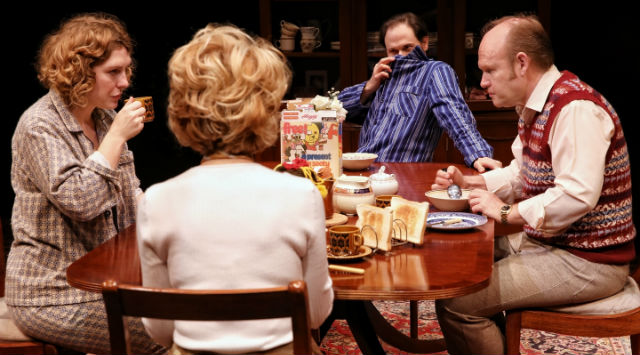
Maggie is a racist. We know this not only because we see her make racial insults about black people to their faces, but she also admits to not approving loans at the bank where she works, when encountering applicants who are of African descent. Maggie does not feel bad or embarrassed about her behaviour, and part of the pleasure of Caleb Lewis’ Maggie Stone, is to see white Australians being upfront about their racism. The main focus of the play however, is Maggie’s accidental embroilment in Amath’s life, after begrudgingly approving the latter’s loan application. Amath is a recent migrant from Sudan, struggling to make ends meet after the sudden death of her husband. When Maggie begins to see Amath as a real person deserving of compassion, the story turns into one of redemption and reconciliation.

It is hard not to see Maggie Stone as a play suffering tediously from white saviour complex, when a substantial portion of it features the unlikely heroine running around kicking down doors to help fix a black family’s problems, but its central message about white people having to transcend racial ignorance is never out of fashion. The themes are undoubtedly pertinent, but the mediocrity of its perspectives makes the show a predictable one. Everything about it feels derivative, and for a subject matter that is so much a part of our daily consciousness, its inability to proffer fresh or more sophisticated ideas, is disappointing.

The production is adequately assembled, and Sandra Eldridge’s direction, although lacking in innovation, keeps the action moving along swiftly. As Maggie, actor Eliza Logan is a very endearing presence, able to prevent us feeling too alienated by her character’s unforgivable qualities. Branden Christine brings conviction and integrity to her interpretation of Amath, a less than meaty role that has a tendency to feel perfunctorily, or maybe too cautiously, written.

Amath’s story is likely a better one to tell than Maggie’s, but Australian writers who can speak appropriately to that experience, are perhaps still in the process of being nurtured and discovered. When talking about race, it is not often that a white person can present something new to help make meaningful progress. Abolitionists of racism do not all have to be people of colour, but this is a job that cannot be done with black and brown people on the outside. It is a crucial point that none of the white characters in Maggie Stone prove themselves able to satisfactorily acquiesce space, in symbolic or practical ways, in this discussion about racial relations on this colonised land. There is an obvious desire for a clear conscience, but the hard work required of all of us, is not yet invested.

www.darlinghursttheatre.com

Review: Yen (New Ghosts Theatre Company)

Venue: Kings Cross Theatre (Kings Cross NSW), Sep 27 – Oct 13, 2018
Playwright: Anna Jordan
Director: Lucy Clements
Cast: Jeremi Campese, Meg Clarke, Ryan Hodson, Hayley Pearl
Images by Clare Hawley

Theatre review
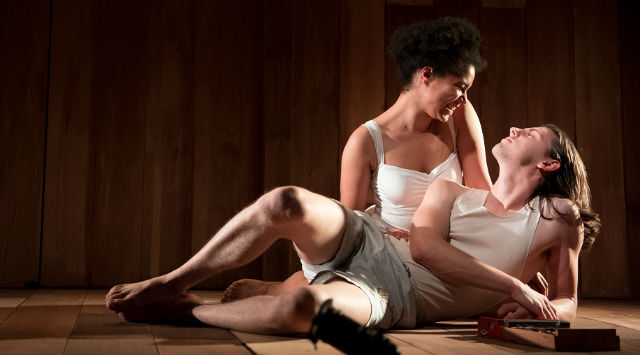
Brothers Bobbie and Hench are young teenagers, left to fend for themselves with only media screens and addicts as role models. Maggie is their desperately incompetent single mother, having lost both her sons’ fathers to early deaths, in this world of substance abuse and poverty. A neighbour Jennifer enters their life as a ray of hope, but in Anna Jordan’s Yen, our capacity for optimism is put to the test, as we interrogate the nature of social change and its delusory qualities, in this hyperrealist depiction of inter-generational disadvantage.

Situated in the dingiest corners of an English council estate, where the boys disintegrate in the most spectacular fashion, we observe their loss of innocence, and in its place, all the evidence of imminent wasted lives. Jordan’s writing is undeniably moving, but also marvellously thrilling. Yen is a showcase that consolidates the many deficiencies of our communities, with pointed critiques that never feel excessively didactic.

It is very gripping drama, and under the astute direction of Lucy Clements, entertaining and immensely involving. Clements has us breathless for the show’s two-hour entirety, as the story takes us through universal themes of family, love, sex, violence and redemption. Visually compelling, the production is meticulously designed by Ester Karuso-Thurn (set and costumes) and Louise Mason (lights) who deliver a surprising range of spatial transformations within restrictive confines of the stifling context. Sound by Chrysoulla Markoulli is impressively exacting, in all its manipulations of atmosphere. There is remarkable sensitivity from all disciplines, that allows its audience to engage at exceptional depth.

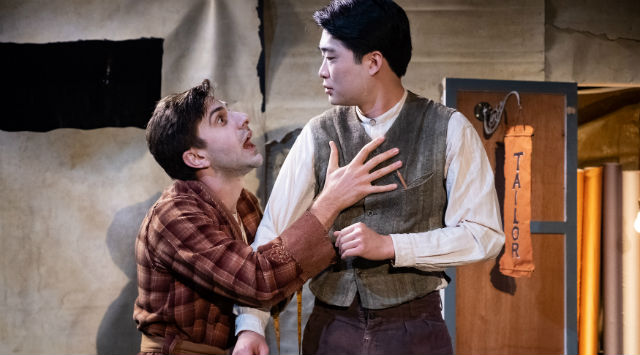
The staging features four fantastic actors, each one convincing and enthralling in their respective parts. 14-year-old Bobbie is played by the very industrious Jeremi Campese, whose extremely detailed approach offers up an interminably fascinating study of troubling juvenility. His extraordinary vitality insists on our compassion, even when the going gets tough. Hayley Pearl’s portrayal of the neglectful mother, has us angered and heartbroken. It is a controversial character uncompromisingly presented, by a very sharp and daring performer. Meg Clarke and Ryan Hodson are the not-so-sweet sixteens, both authentic, and tremendously revelatory of the adolescent experience, through their beautifully naturalistic renderings of Jennifer and Hench. The coupling of vulnerability and aggression in all these interpretations, are a joy to behold, as well as being meaningfully confronting.

In Yen, we see our structural failures take place within spaces that are personal and isolated. We come to an understanding that the only way for individual lives to flourish, is for the environments in which they exist to actively promote that betterment. Little can be achieved, when we leave the needy to their own devices. We chastise and condemn those who suffer, unwilling to see our complicity in people’s inability to grow, choosing only to attribute blame to their otherness. Good lives cannot exist in isolation; it takes a village to raise a child, and to lavish care on most everything else.

www.newghoststheatre.com

Review: Scarecrow (Blood Moon Theatre)

Venue: Blood Moon Theatre (Potts Point NSW), Sep 25 – 29, 2018
Playwright: Don Nigro
Directors: Deborah Jones, Naomi Livingstone
Cast: Gemma Scoble, Romney Stanton, Blake Wells
Image by Lauren Orrell

Theatre review
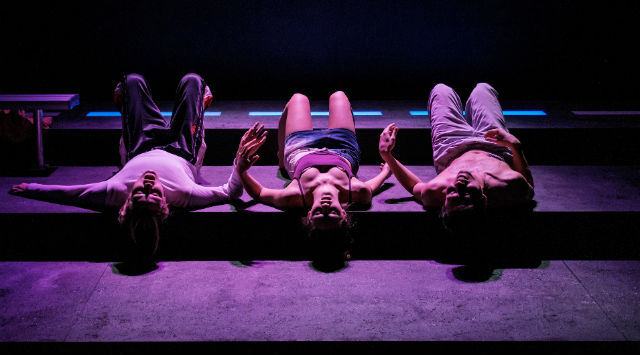
Cally and her mother Rose, live an isolated life in the cornfields, somewhere in North America. Having turned 18, Cally is experiencing a libidinal push that is making her wander from the house, into the nefarious grasp of a mysterious stranger. A scarecrow stands on the farmland, protecting its harvest and the two lonely women. In Don Nigro’s play Scarecrow, we are unsure if its mystical powers are doing good or harm, as we watch the women’s miserable lives unfold. Semblances of a family curse in the story give it a surprising complexity, as we observe the cyclical effects of trauma overwhelm the household’s two generations.

Romney Stanton is spectacular in the role of the deranged and very dramatic matriarch, using the character’s obsessive vigilance to deliver some deliciously operatic moments, full of flamboyant intensity. Stanton is mesmerising, wonderfully convincing as the mad rambling Rose. The vivacious young Cally is played by Gemma Scoble, whose portrayal of naive rebellion is memorably passionate, especially effective when called upon to demonstrate the unimaginable anguish of a teenager having to tolerate an invisible existence. Blake Wells is suitably seductive as the testosteroned stranger who instigates discord between the women, subtle but solid in his support of the leading ladies.

Directed by Deborah Jones and Naomi Livingstone, the production is elegantly assembled, for a no frills staging of a fascinating play. As we watch the women disintegrate, we question their circumstances and their capacity for agency within those circumstances. In Nigro’s narrative, fearful women channel their strength into cruelty. A cautionary tale perhaps, reminding us of the contradictory truth, that our strength, far from causing harm to other women, actually keeps us from self-destruction. Strong women know to lift each other up, because we know the forces determined to keep us down, are perennial, pervasive and persistent.

www.bloodmoontheatre.com

Review: Aphrodite And The Invisible Consumer Gods (The Sydney Fringe)

Venue: Kings Cross Hotel (Kings Cross NSW), Sep 25 – 29, 2018
Playwright: Sam Donvito
Director: Christopher Bond
Cast: Sam Donvito, Ellen Graham

Theatre review
The goddess of all things beautiful and fecund, Aphrodite arrives in Sydney, and even she is no match for the misogyny that rules this town. Guided by unbridled desire, Aphrodite finds herself vulnerable and exposed to the pervasive commodification of everything that relates to femininity and sex. From chocolate and selfies, to beauty pageants and cosmetic surgery, Aphrodite’s attempts at experiencing life as an earthling in Sydney, all involve attempts to degrade and humiliate her, and in Sam Donvito’s Aphrodite And The Invisible Consumer Gods, we watch the very thing we consider to be normal everyday life, determined to put the goddess through a relentless process of self-loathing.

It is an exuberant presentation, featuring two spirited performers, Donvito and Ellen Graham on a bare stage, with only their bodies occupying our gaze. Their communication style is admirably bold, for the urgent and unequivocal message that they wish to convey. As Aphrodite, Donvito is seductive and mischievous, and as Paige Burn beauty pageant cum reality show host, Graham is beguilingly malicious. Aphrodite And The Invisible Consumer Gods may not be a subtle work, but what it has to say, is substantial and pertinently consequential.

Men have always sought to control our bodies and our very existence. Industrialisation has channelled that ancient chauvinism into the creation of endless superfluous wants that have overwhelmed and contaminated our lives, by selling to us, an interminable sense of inadequacy. We respond by living in a constant state of commercial consumption, acquiescing to the every demand of capitalism as shaped by its sexist foundations. We spend money to feel better about ourselves, but that money circulates and returns as a further haunting that tells us, we are as yet incomplete. When the goddess concedes her power, a vacuum is formed that nefarious parties will seek to fill. Most of us however, can reclaim that magic at any time, and make ourselves whole again.

www.samdonvito.com.au

Review: Stalker The Musical (The Depot Theatre)

Venue: The Depot Theatre (Marrickville NSW), Sep 19 – Oct 6, 2018
Music: Andy Peterson
Book and lyrics: Alex Giles, David Russell
Director: Kaleigh Wilkie-Smith
Cast: Melody Beck, Levi Burrows, Steph Edmonds, Luke Lamond, Michele Lansdown, Peter Meredith, Haji Myrteza, Harrison Riley, Emma Taviani
Images by Grant Leslie

Theatre review
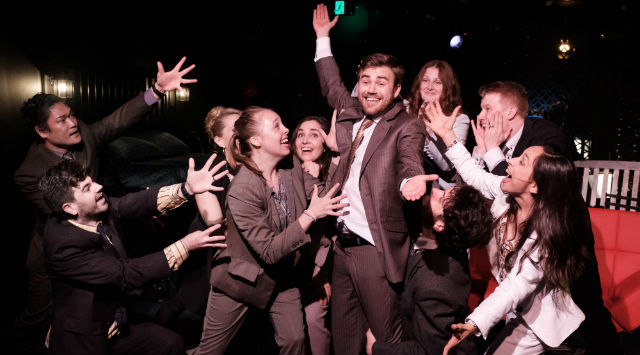
The story takes place in a town ruled by the heartbroken, where all physical contact is forbidden, but where its inhabitants are encouraged to police and lust after each other, using only their eyes and binoculars. In Stalker The Musical by Alex Giles, Andy Peterson and David Russell, a fantasy world is created out of dejection, with a great deal of palpable ambition, but neither its creativity nor its imagination prove convincing enough, to entice us into its outlandish manifestations. We observe it to be an oddity, a strange concoction of ideas, that struggles to find resonance on any level.

Every song sounds overly familiar, as though a paint-by-numbers take on the musical theatre genre, unoriginal and painfully predictable. Problems with sound engineering on opening night, certainly do not help with the experience.

The cast, although likeable and committed, struggle with the production’s attempts at comedy and drama, unable to make any meaningful or lasting impact with the material. There is an abundance of energy and conviction on stage, with Zoe Ioannou’s clever choreography bringing some visual coherence to the show, but the performers are consistently let down by the writing’s deficiencies.

Love is a bad word in Stalker, and those who have denounced romance, however momentary, will understand the necessity of being able to see one’s own existence as independent and sovereign, before the joys of life can be truly appreciated. Characters in the show may or may not find their romantic match, but more important is their capacity to love, whatever the objects of desire turn out to be.

www.stalkerthemusical.com

Review: Evita (Opera Australia / Sydney Opera House)

Venue: Sydney Opera House (Sydney NSW), from Sep 13 – Nov 3, 2018
Music: Andrew Lloyd Webber
Lyrics: Tim Rice
Director: Hal Prince
Cast: Tina Arena, Michael Falzon, Kurt Kansley, Paulo Szot, Alexis van Maanen
Images by Jeff Busby

Theatre review
Eva Perón’s legend is one regarding power, at all cost. Charting the meteoric rise of the historical figure from humble beginnings, the musical Evita features a narrator, a character based on the guerrilla leader and famed revolutionary Che Guevara, who takes us through the story of the Argentinian First Lady, from a critical, but widely shared, standpoint. Our female protagonist is not deprived of a voice however. Andrew Lloyd Webber and Tim Rice’s show is often a feud of perspectives, reflective of opposing attitudes pertaining to the controversial personality. It is also often a battle of the sexes that happens on stage, as we see a woman defending herself in the masculine world of politics, and we grapple with the uncomfortable coupling of misogyny and the less than honourable conduct of our heroine.

The production is a faithful recreation of the West End and Broadway original from the late 1970’s, directed by Hal Prince, with a notable addition of the Oscar-winning song “You Must Love Me”, from the 1996 Alan Parker film. Surprisingly fast-paced, the show leaves it to us to formulate more extensive interpretations of Perón’s life and times, but it certainly gives us plenty to chew on. “Don’t Cry For Me Argentina” is one of the most well-known Broadway hits, and to have the lyrics “and as for fortune, and as for fame, I never invited them in,” performed in resplendent bejewelled dress (designed by Timothy O’Brien), reveals a complexity to the character that is perhaps impossible to encapsulate in any single theatrical work.

Tina Arena proves herself an unequivocal superstar in the title role, vocally flawless for a splendid rendition of some very famously challenging tunes. She brings an electrifying passion to the stage, creating a feisty character who remains endearing, even when her actions turn dubious. It is tremendously satisfying to see one of Australia’s biggest talents take on a challenge of this magnitude, and emerge victorious. Che is played by Kurt Kansley, a charming presence, but whose diction as the South American can at times, be frustrating to decipher. Paulo Szot is an excellent President Juan Perón, impressive in all aspects, and very alluring, making the entire stint look a mere walk in the park.

The Peróns were loved because they had acted perfectly their part in the public eye. We see them here, in private, absorbed in vanity, hardly ever sparing a thought for their hungry millions. It is a familiar image of politicians, of individuals more concerned with their own careers than the actual responsibilities they have sworn to undertake. Observing the masses of Eva Perón’s devotees, we are warned of being blind to the poor behaviour of those we elect into positions of authority and prestige. The space we allow for leaders to carry out work for the common good, reside behind heavy curtains that form limits to our democracy. They may assume the appearance of kings and lords, but never to be forgotten, is the servitude that they owe.

www.evitathemusical.com.au

Review: Accidental Death Of An Anarchist (Sydney Theatre Company)

Venue: Sydney Opera House (Sydney NSW), Sep 10 – Oct 27, 2018
Playwright: Dario Fo (adapted by Francis Greenslade & Sarah Giles)
Director: Sarah Giles
Cast: Caroline Brazier, Julie Forsyth, Bessie Holland, Annie Maynard, Amber McMahon, Susie Youssef
Images by Daniel Boud

Theatre review
It is all over the news that an anarchist had fallen to his death from a Milan police station. The official word claims it a suicide, but there are suspicions of foul play. For Accidental Death Of An Anarchist, Dario Fo took inspiration from an actual incident of 1969, and inserted a Maniac into his 1970 imagination of events following the controversy, essentially accusing authorities of murder and corruption. It was a spectacularly clumsy cover up that required questioning, and Fo’s play has proven itself a timeless piece of writing that can always be relied on to help civilians weather any political storm. It reminds us that we are pawns in the game of the powerful, and that we have to endeavour to see beyond the wool that is constantly being pulled over our eyes.

This new adaptation by Francis Greenslade and Sarah Giles is a refresh, but a faithful one that retains the extravagantly farcical spirit of its original. Dialogue is given a stylistic update, but time, place and characters are left unmarred. Giles’ direction of the work is raucous, vigorously so, for a very broad comedy that might take some getting used to, but laughs are certainly to be had.

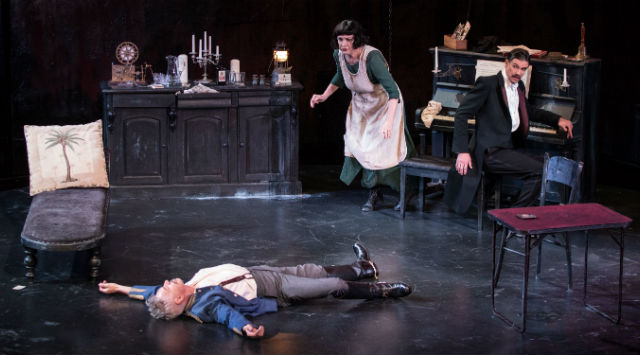
An all-female cast is charged with the joyful task of lampooning men in power, with Amber McMahon occupying the central role, exhibiting extraordinary verve and inventiveness as the irrepressible Maniac. Julie Forsyth is genuinely hilarious as Inspector Bertozzo, distilling masculinity to its ugliest components, for a cutting study in physicality and speech that conspires flawlessly with her remarkable theatrical timing. Also delivering uproarious hijinks is Bessie Holland, whose Inspector Pisani is a breathtaking invention of caricature at its finest, astute and acerbic in her observations of repugnant boys club behaviour.

The media landscape feeds us endless morsels of information that fight for our attention and outrage. An unexplained death today, is replaced by a racial slur tomorrow; even with the best intentions, we are unable to decipher the truth, much less find the wherewithal to contest the wrongs of the world. Those in power understand this, so they disseminate frivolous scandals that seem so important in the moment, and absorb all our time and bandwidth, until there is no way we can hold them to account.

www.sydneytheatre.com.au