Review: Haircuts (Mantouridion Theatre)

haircutsVenue: Mantouridion Theatre (Marrickville NSW), Apr 15 – 26, 2015
Playwright: Con Nats
Director: Lex Marinos
Cast: Demitra Alexandria, Valentino Arico, John Derum, Barbara Gouskos, Adam Hatzimanolis, Richard Hilliar, Tim Ressos

Theatre review
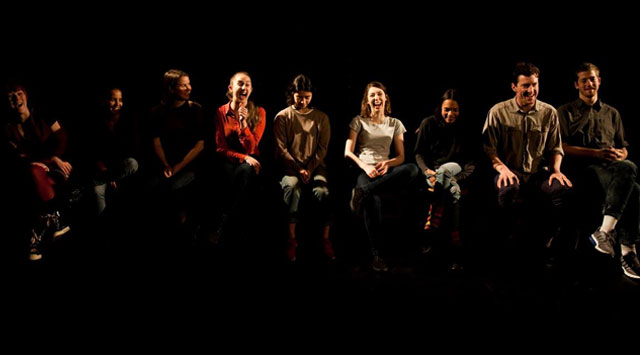
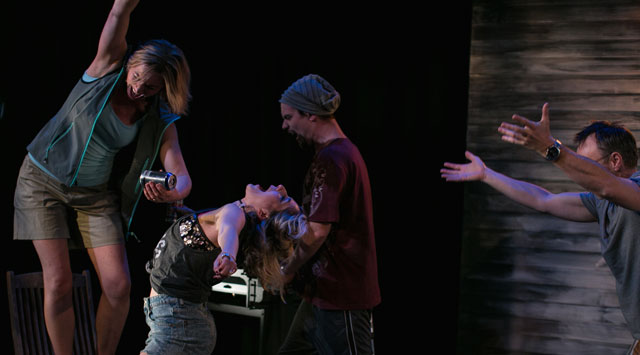
Successful plays encapsulate a slice of life and represent to its audience something meaningful. Con Nats’ Haircuts is an ambitious work that tries to bring many different threads together, revealing a hunger to tell many stories and an urgency for committing a wealth of ideas to the stage. Its narrative style is conventional, but its structure is less so. Focus shifts regularly, and subplots become overwhelming, resulting in a disorienting uncertainty about the show’s main plot and its centre. There is a big emphasis on multiculturalism, which although interesting, does not contribute directly to the way key narratives unfold. Machismo is also explored thoroughly, and frequently used for laughs, but it contributes to an uncomfortable gender imbalance where all the women in the play are constantly defined against their husbands, fathers and sons.

Direction of the work by Lex Marinos is a passionate effort, and individual scenes are carefully explored, but the production does not assemble into a cohesive whole. The awkward imbalances between amusing asides that take up too much time, and poignant character developments that go past too gently, cause important elements to lose clarity and the play can often seem undecided about what it intends to convey. Performances are uneven but strong players include Barbara Gouskos who brings a beautiful gravity to the role of Angela, delivering a convincing, albeit brief, portrayal of a woman who has experienced very dark days. Her measured approach is authentically emotional and with it, she introduces to us a special and resonant moment of shared humanity. Richard Hilliar’s Stanley is a quiet and tender contrast to the clamorous goings-on, and offers up the only well-rounded personality in a throng of unoriginal stereotypes. His chemistry with co-actors can be improved, but the actor does his best to anchor the show in a position of subtlety that helps us relate to the world being depicted.

The production requires distillation, but even in its imperfect form, it is not without strengths. Some of the dialogue is beautifully deep, and much of the acting is energetic and earnest, in fact it might be said that there is often too much of a good thing, which could only lead to the ridiculously obvious conclusion that Haircuts needs a bit of shearing.

conats.wix.com/haircuts

Review: Jerry And Tom (Insomniac Theatre)

insomniactheatreVenue: Exchange Hotel (Balmain NSW), Apr 9 – 30, 2015
Playwright: Rick Cleveland
Director: Maggie Scott
Cast: Boris Bkric, Steve Maresca, Andrew Mead
Image by GiGee Photography

Theatre review
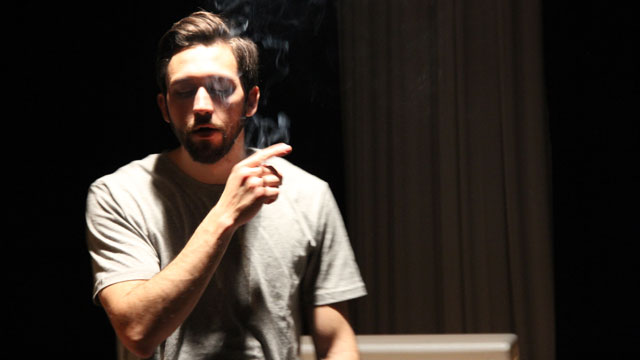
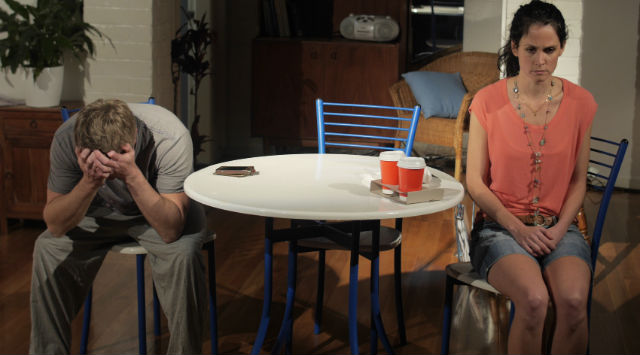
Rick Cleveland’s Jerry And Tom is a fairly uncomplicated comedy about two family men who also happen to moonlight as ruthless hitmen. We go from one humorous scenario to another, depicting their gruesome murders, all with a charming Bronx-type accent. Maggie Scott’s direction is a simple, no frills approach that focuses on character dynamics and chemistry. Pacing of the piece is jaunty and very light, with a delightful clarity in the way its plot is conveyed. The comedy is consistent but mild, and given the exaggerated context, a greater sense of irony would probably provide the show with a stronger edge.

Performances are polished and compelling, with all three actors showing good commitment and enthusiasm. Boris Brkic has a laid-back charm that makes his portrayal believable, and a keen sense of timing that allows a hint of authenticity to elevate his role Tom from mere caricature. Jerry is played by Steve Maresca whose infectious enjoyment of the stage connects with us, and although the actor’s serious side is quite obviously less developed than his funny side, he holds his own against more seasoned counterparts. Andrew Mead plays the remaining characters with excellent energy, although more versatility is required for a greater differentiation between personalities. There is a general cautiousness that feels too safe for the material at hand. We need a playfulness to meet with the reckless attitude of the narratives, but the performers seem too careful or apprehensive perhaps, to give the show the wild abandon it deserves.

Music from the television series Dexter underscores most of the blacked out scene changes, but unlike Dexter, we explore very little of the “dark passenger” that compels Jerry And Tom to do the things they do. Without enough psychological bite, the show ends up feeling a little too frothy, and after 90 minutes of senseless killing, we try to find meaning but discover emptiness instead. The production is not always satisfying, but the good work of karma does prevail in the story, and sometimes, that is all than we can bargain for.

www.facebook.com/insomniact.page

Review: Endgame (Sydney Theatre Company)

Venue: Roslyn Packer Theatre at Walsh Bay (Sydney NSW), Mar 31 – May 9, 2015
Playwright: Samuel Beckett
Director: Andrew Upton
Cast: Tom Budge, Sarah Peirse, Bruce Spence, Hugo Weaving
Images by Lisa Tomasetti

Theatre review (originally published at Auditorium Magazine)
On stage, artists can communicate ideas that they believe to be of interest to the wider community. They can also use it as grounds for exploration, to develop an improved understanding of the nature of their practice, or to investigate issues surrounding our lives. Stories are shared and concepts are illustrated, that may or may not connect with audiences but we never quite leave the theatre the same as when we first arrived. Samuel Beckett’s Endgame is light on narrative, but heavy on inventiveness, guided by a profound curiosity that brutally interrogates the fundamentals of existence. It is the most self-aware of texts, constantly drawing attention to the very act of writing, and also to the fragile artifice of its theatricality. If philosophy is its fixation, then any sense of conventionality must be removed from its structure, in order that everything may come under scrutiny, including basic notions of character and plot.

The play is both accessible and inaccessible. It challenges the way we read, and how we make sense, in the theatrical space, of language and signs, but it does not intend to alienate. Director Andrew Upton retains the integrity of Beckett’s words, sometimes impenetrable but always marvellous, and creates around them an intoxicating live experience that fascinates at every moment. Unreservedly intellectual, it is no surprise that one can be made to feel out of their depth at times, but the work’s density constantly morphs so that a switch in tone or subject inevitably occurs, and we become engaged again, only more thoroughly than ever, as our capacities gradually grow in their level of receptiveness. Upton’s voice increases in clarity over time, and the piece gains power accordingly.

Hugo Weaving is mesmeric as the hideous and hateful Hamm. Even in a wheelchair with legs bound and eyes obscured behind opaque spectacles, the star is irresistibly charismatic, and completely enthralling. Edith Piaf was said to have declared that she could sing the phone book and make it sound great. Similarly, Weaving captivates us with every word, even when we find our minds struggling to match the depth of what is being expounded. The extreme meticulousness of his approach seizes our attention, and the wild and unpredictable flourishes he builds into every scene and stanza is truly magnificent to witness. Endgame discusses the distinctions between meaninglessness and meaningfulness. Under Weaving’s spell, all that unfolds feels meaningful, and we are encouraged to seek a cerebral equivalent to the emotional sensations delivered to our gut. Also turning in a stunning performance is Tom Budge in the role of Clov, the voluntary slave who waits on Hamm for no straightforward reason. The actor opens the play in a wordless sequence, impressing us with his extraordinary physical expression. Part mime and part dance, the beauty of his execution shines in spite of the depressively ominous context he helps set up. Budge goes on to prove himself sensitive to the needs of black comedy, constantly toying with the delicate balance between morbidity and humour, much to our twisted delight. His dynamic range is quite exceptional, and the character he creates is fascinating from every perspective.

The single-act play does not require nor permit much flamboyance with design, but there is no shortage of creativity on show here. Nick Schlieper’s set is a dungeon built so horrifying, it could only have been dreamt up by a healthy dose of genius irony. The generous Roslyn Packer stage is expertly curtailed to evoke the oppressiveness explored in Beckett’s writing, and that shrunken performance space provides amplification for the performance energies so brilliantly harnessed. Lights also by Schlieper, and sound by Max Lyandvert are restrained but unquestionably satisfying, always in subtle control over our sensory reactions. Renée Mulder flexes her costume design muscles within the narrow demands of the piece, embellishing characters with objects and textures of interest and creating extraordinary colours out of a dark, sombre vista.

Difficult texts must exist, or our artistic landscape is worth nothing. If everything is within one’s grasp, one ceases to evolve. Endgame is about two hours long, but it contains wisdom from entire lifetimes by several outstanding minds. This production seduces with entertaining touches and intriguing elements, then presents life’s big questions in rarely articulated ways. If its propositions are unfamiliar, revisiting them seems necessary, like a good book that engages and bewilders, it tempts you at its end, to return to the start for another bout.

www.sydneytheatre.com.au

Review: Pvt. Wars (Dudley St Productions)

dudleystVenue: Old Fitz Theatre (Woolloomooloo NSW), Mar 17 – Apr 5, 2015
Writer: James McLure
Director: Mark Lee
Cast: Michael Booth, Thomas Campbell, Tom Oakley
Image by Rupert Reid

Theatre review
In James McLure’s Pvt. Wars we visit three injured soldiers at a rehabilitation facility. The play was first staged in 1979, but there is no clear indication of the time at which the action takes place. It could be the aftermath of any war, because the ramifications of sending young people to battle never seem to change. Some return victorious, but many end up dead or damaged. It is not a fiercely anti-war piece, but McLure’s writing does place focus on these individuals’ physical and psychological afflictions. Comedy is created from the interplay of their mental dysfunctions, as well as from the tensions derived from their divergent social classes and from the points of dissent, and assent, as cohabitants of the hospital.

Direction of the work by Mark Lee is gentle and elegant. The resultant work is funny, but its laughter comes naturally from the honest exploration of characters, rather than it being a desperate priority. The show is about trauma, but it is kept light-hearted by an evasive masculine approach to pain. The three men come face to face with each other’s terror, but they skirt around the issues, rarely able to address them directly.

Michael Booth plays Silvio, the overcompensating alpha male who brings energy and a sense of danger to the stage. The actor appears to be distracted at several points, but his timing is effective nonetheless, and the sense of barely hidden distress and anxiety he introduces, is a significant contributor to the dynamic pace of the show. The more sophisticated Natwick is performed by Thomas Campbell, an actor with a disarmingly sensitive presence that provides an air of authenticity to proceedings. His very regular sequences of letter-writing to Natwick’s mother is let down by poor sound design, but his warmth is an inviting quality that we connect well with. Tom Oakley’s character Gately sits centre stage for virtually the entire duration, repairing an old radio. He is perennially hopeful, but struggles every day to find direction and meaning. Oakley’s portrayal resists theatrical gesticulation and embellishment, but conveys that confused determination beautifully, with a confident and touching simplicity.

The play comes to a conclusion that intends to be poignant, but a sudden loss of clarity interferes. The story surprises us at the end when it takes an abstract and abrupt turn, leaving us to our own beliefs about war, soldiers and manhood. It does not make any persuasive arguments to change our political affiliations, and its social commentary is subtle. Perhaps all it requires is for us to remember that individual lives are affected, often dramatically, while we become increasingly numbed by headlines that are no longer able to occupy more than a few moments each morning.

www.oldfitztheatre.com

Review: Jumpy (Sydney Theatre Company / Melbourne Theatre Company)

Venue: Sydney Opera House (Sydney NSW), Mar 26 – May 16, 2015
Playwright: April De Angelis
Director: Pamela Rabe
Cast: Laurence Boxhall, Caroline Brazier, John Lloyd Fillingham, Brenna Harding, Tariro Mavondo, Marina Prior, David Tredinnick, Jane Turner, Dylan Watson
Images by Brett Boardman

Theatre review
With each scene of Jumpy, pieces of furniture travel across the stage on castor wheels, moving past its protagonist Hilary. She is fifty of age, her only daughter Tilly has turned sixteen and is beginning her own sex life, and we meet them at a time when Hilary has come to realise that a period of stasis is coming to an end. Like the set that keeps rolling past, life seems to have left her behind while she dutifully plays the role of mother and wife. April De Angelis’ script is concerned with women who had grown up with second-wave feminism, particularly those from the era marked by the legacies of Germaine Greer, Gloria Steinem and Helen Reddy. Idealism and militancy fades or perhaps evolves into a modernity that bears little resemblance to the dreams that were birthed, like Hilary, half a century ago. Tilly is in some ways, a disappointment for her mother. De Angelis is critical as well, of the young woman’s need to build her identity around the male gaze. She allows many of her decisions to be determined by a need for the affections of men, and the dissatisfaction she derives from those behaviour evade her self-awareness. Hilary is confounded, and we all wonder how it has come to be that a generation can grow so contrary to its parental intentions. The text does not however, go so far as to say that child-bearing is pointless (although there is a tendency to characterise some parents as being selfish and afraid of loneliness), but we are certainly encouraged to assess the choices Hilary had made for herself.

The context is simple, with a sense of the everyday found in all aspects of its plot. Characters and events are familiar, but De Angelis’ ironic humour is omnipresent. Her comedy depicts middle class existence with a healthy cynicism, and is indeed, thoroughly entertaining. Each personality’s flaws are exposed shamelessly, but the writer’s compassionate approach prevents anyone from turning into clowns or villains. In fact, we identify with all of them, and find most to be very charming. Pamela Rabe’s direction is nuanced and gentle, with no big political proclamations and few dramatic gestures. Relationships are established convincingly, and every narrative is delivered clearly to make us care, and to keep us engaged.

Star of the show, Jane Turner’s outstanding ability and likeability as one of Australia’s top comic performers is well utilised in the production. We are always on her side, and we laugh whenever she wants us to. Turner’s trademark vaudevillian style of performance keeps her at some distance from her role, but there is enough authenticity and commitment in her portrayal to keep things believable. Reasons for the production not being transposed to an Australian context is unclear, but Turner’s British accent is less than satisfactory. It is an unnatural and overly posh affectation that can be uncomfortable to hear, and slightly inappropriate for the story being told. Other cast members are more adept speech-wise, and every supporting character is colourfully performed and memorable. Hilary’s best friend Frances is played by Marina Prior whose captivating vibrancy and self-deprecating humour keep the show buoyant. The contrast, and similarities, between the two middle-aged women are fascinating to observe, and their friendship is deeply meaningful, even though other relationships are given greater weight in the text. Also impressive is Tariro Mavondo’s performance as Lyndsey, the sixteen year-old new mother who treads the fine line between ignorance and purity, spouting pearls of wisdom when least expected. A heart of gold can be tricky to inhabit, but the actor’s effortless charisma turns her character’s innocence into a thing of beauty, and poses a challenge to the way we think about teen moms.

The production is a hugely enjoyable one that keeps our attention firmly under its control. There is a mildness in tone that reflects the theme of maturation, but it finds ways to amuse us from start to end. Its message arrives in the form of questions, but it leaves answers ambiguous. Middle class lives are full of anxiety, and Jumpy shows that the state of peacefulness does not emerge spontaneously with age and happiness does not necessarily materialise upon the fulfilment of duties of one’s choosing. The show does not hold the key to peace and happiness, but it provides inspiration, or at least a reminder, that it is never too late.

www.sydneytheatre.com.au | www.mtc.com.au

Review: A Little Night Music (Sydney University Musical Theatre Ensemble)

muse2Venue: Seymour Centre (Chippendale NSW), Mar 25 – 28, 2015
Book: Hugh Wheeler
Music & Lyrics: Stephen Sondheim
Director: Alexander Andrews
Cast: Stuart Bryan, Emma Elsley, Owen Elsley, Harry Flitcroft, Louise Flynn, Sarah Gaul, Bronwyn Hicks, Christie New
Image by Wenray Wang

Theatre review
Desiree and Frederik are middle-aged but they are yet to find fulfilling relationships. Sondheim’s A Little Night Music is a very adult love story that contains more farce than it does romance, and speaks to a slightly jaded audience that understands the complexities and illusions of love. The text is an intelligent but mischievous one, offering interesting insight into the personal aspects of mature lives. The most popular song of Sondheim’s entire oeuvre, “Send In The Clowns” is a prominent feature that encapsulates the experience of longing and regret. The decision by MUSE (Sydney University Musical Theatre Ensemble) to stage the work is ambitious on many fronts, but the greatest challenge is for its very young team to convincingly portray the show’s main characters who are at least twice their age. The humour and pathos of the narrative, and its musical numbers, are heavily nuanced and demanding of any cast, but to expect those who have yet to taste all the flavours of life to interpret A Little Night Music with depth and poignancy is a very tall order indeed.

Director Alexander Andrews may not have the most seasoned performers at his disposal, but his flair for musical theatre is undeniable. Andrews is careful to keep the stage active with movement and surprise, so that we are visually engaged throughout the three hour production. Dramatic tension is not always present, and the piece often lacks exuberance, but sequences are paced quickly, with fresh events unfolding consistently to retain our attention. Stronger performers include Christie New, who creates a very funny Charlotte Malcolm, endearing us with sharp self-deprecation, and a knack for delivering powerful punchlines in both speech and song. Also memorable is Madame Armfeldt, the brilliantly zany matriarch presented by Sarah Gaul with gusto and flamboyance. Stuart Bryan cuts a fine figure as the show’s leading man, but his approach is too reserved, and his self-consciousness distracts from Frederik’s emotional journey. Quality of singing in the production is accomplished. Clare Richards’ powerful soprano is a standout, and Conrad Hamill’s work as Music Director, while being fairly rigid is delightfully detailed and precise.
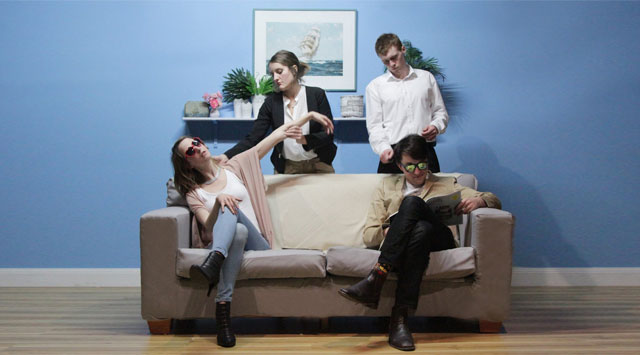
Mr Sondheim’s work is quite literally second to none. He is an original and an undisputed genius, whose creations are ubiquitous and magnificent. Good productions of his body of work make for sublime nights of unparalleled theatrical pleasure, but lesser attempts can still be enjoyable by virtue of the sheer prowess of foundations already laid down years before. Musical theatre is rarely reinvented, and young practitioners of the genre subject themselves to emulating successes they had witnessed before. There is a sense of duplication that exists, whether effort is put into matching what had been great, or intentions are to supercede prior manifestations. It is a true conundrum, when one considers the true essence of art and the pursuit of all that is new.

www.museatusyd.com

Review: Fallout (Smoking Gum Theatre)

smokinggum1Venue: Exchange Hotel (Balmain NSW), Mar 18 – 27, 2015
Playwright: Lauren Pearce
Director: Finn Davis
Actors: Michele Conyngham, Ian Ferrington, Jim Fishwick, Louise Harding, Moreblessing Maturure, Patrick Trumper

Theatre review
It is admirably audacious that artists go out on a limb, almost as part of their job description, to experiment in public and to risk failure in spectacular style for all to see. The nature of theatre as a commercial experience requires that strict deadlines are to be adhered to, so that a show has to have at least a semblance of readiness on its advertised opening night. Smoking Gum Theatre’s Fallout needs, among other things, more time in its creative process. Lauren Pearce makes her debut with an apocalyptic script, ambitious with big ideas, but her characters are not sufficiently formed, and its structure is not yet settled.

Most things can be said to have room for improvement, especially in art where nothing is perfect, but Fallout is a distance away from being able to communicate its intentions. Direction by Finn Davis does not deviate from the writing, and he show signs of an adventurous spirit in the way he choreographs physical movement for the piece. Performances are apprehensively grounded. It is a very quiet approach that shows little inventiveness, but actors Moreblessing Maturure and Patrick Trumper demonstrate good focus and conviction. Design is a challenge in the makeshift venue, and the creative team’s efforts are evident especially Angela Toomey’s video projections, which add a touch of polish to the production.

Outside of our education institutions, young artists have to brave the same conditions as all other theatre practitioners. Any paying audience will have expectations, and it can be a cruel world for those who achieve less than desired. Fortunately, it is rarely a dramatic case of sink or swim, because the factor of time is crucial to all artistic practice. It is the body of work over the expanse of a career that matters, and it is longevity and tenacity of the last persons standing that will make an impact.

www.smokinggumtheatre.com

Review: The Big Funk (Suspicious Woman Productions)

suspiciouswomanVenue: TAP Gallery (Darlinghurst NSW), Mar 11 – 21, 2015
Playwright: John Patrick Shanley
Director: Michael Dean
Cast: Michael Drysdale, Jasper Garner-Gore, Alixandra Kupcik, Jess Loudon, Bali Padda

Theatre review
Philosophy and theatre are bosom buddies. Theatre means little without an attitude that is intent on questioning the nature of things, and philosophy becomes significantly more meaningful when brought to flesh beyond the realm of ink and paper. John Patrick Shanley’s The Big Funk looks at life with wonderment and passion. The writer’s words are powerful and his ideas are exciting, with an abstraction at its core that disallows narrative and simple logic from diluting its sophisticated concepts. The play positions itself outside of real life, examining it at a distance, always extricating itself when it becomes too involved in drama and emotions. There is a great deal of intellectualism to enjoy, but what a viewer can garner here, as is for every piece of complex work of art, depends largely on their own worldview and mental capacities.

Michael Dean’s direction adds a playful dimension to the piece, with an eagerness for creating a lively theatre that locates all the physical and interactive potentialities in Shanley’s writing, turning a cerebral text into an effervescent stage experience. Dean does well at introducing some elucidation to the often convoluted existential reflections of characters in The Big Funk, but much of their rumination remains out of reach. Original thought is rarely easy, and we should probably not expect to be able to absorb everything from a single encounter of a dense script, especially when presented at a jaunty pace. Nevertheless, moments of resonance occur throughout the production, and although inconsistent, they are often effective and poignant.

Performances are thoughtful and well-crafted, with excellent chemistry between all members of cast. Alixandra Kupcik is memorable for her vulnerability, and Jasper Garner-Gore for his exuberant and authentic presence, but both are to be lauded for their extremely confident approach to their prolonged sequences of nudity at Sydney’s most intimate venue. Annabel Blackman does solid work as designer, with a set that does very much with very little, and elegant costuming that helps with characterisations and storytelling. Lights and sound, however, do not contribute sufficiently to manufacturing ambience that would live up to the extravagant surrealism and absurdity of contexts being explored.

We live in a world filled with uncertainty and angst, but life is how we choose to interpret and understand it, and in The Big Funk, we are encouraged to reflect upon the way we think about our environment and how we interact with it. It is important that life has a sense of meaning, and Shanley is right in saying that each person should determine their own relationship with their own existence, without the burden of inheritance and baggage. There is a way to make rules and to establish codes from one’s own consciousness, to provide guidance for our days on this earth but it is the ambiguous and tricky hazard of the human conscience that we need to be mindful of.

www.suspiciouswomanproductions.com

Review: And Now To Bed (Subtlenuance Theatre)

subtlenuanceVenue: Kings Cross Hotel (Kings Cross NSW), Mar 11 – 22, 2015
Playwrights: Con Nats, Donna Abela, Mark Langham, Sarah Carradine, Margaret Davis, Melissa Lee Speyer, Katie Pollock
Director: Paul Gilchrist
Cast: Paul Armstrong, Shauntelle Benjamin, Erica Brennan, Richard Cornally, Jennie Dibley, Edric Hong, Eleanor Stankiewicz

Theatre review
Sex can reveal all of a person, but awareness of its machinations and psychological implications for any individual is rarely a thorough one. We let our sexualities be, because, contrary to Freudian theories, knowing too much can sometimes be destructive, as pleasures can fade away when they come under excessive scrutiny. Also, it is in our nature to guard our privacies, and self-preservation dictates that we rarely articulate what it is that turns us on. And Now To Bed features seven actors performing their own biographies. Each is teamed up with a writer who creates a text out of their understanding of each subject and their sexual lives. The actor-writer relationship should be an intimate one, but there is no telling how secrets are handled in this process. There are vivid moments, but much of the writing is coy. We cannot be sure if it is the subject or the author who maintains a sense of non-disclosure, but talking about sex requires that we are frank about things, or the purpose is defeated. There is beautiful writing to be found in every segment, but those who choose to be obscure or abstract do not leave the same impression as the ones who confront us more directly. Like in sex, art is at its most meaningful when people connect.

Shauntelle Benjamin and Donna Abela’s partnership is a powerful one. Their explicit depiction of sex acts exposes not only the brutality many people are capable of, but also the quality of masochism that resides in many of our experiences. Benjamin’s enthusiasm for the stage reflects the workings of libido, and its ferocious honesty. Her portrayal highlights the uniqueness that resides in each person, with an idiosyncrasy that rejects notions of simple and universal understandings of sexuality. Jennie Dibley and Margaret Davis create a romantic narrative that traverses decades. Dibley’s maturity in attitude brings to her not unusual story, an unorthodox emotional dimension that encompasses forgiveness and kindness, in place of melancholic drama. We observe the healing quality of time, and a surprising purity that can come with age. Even though there seems a deliberate rejection of angst and sorrow in Dibley’s work, she remains a delightful actor with an endearing and captivating authenticity.

Direction is provided by Paul Gilchrist who is faithful to each of the pieces, allowing his collaborative artists divergent contexts that are required for their individualistic modes of expression. Consequently, the program is colourful in tone, and pluralistic in its approach to the theme of discussion. Gilchrist’s sensitivity to the material can be seen in the confident cast of actors who all bring a warm earnestness to what they are willing to share. The production is eighty minutes long, with segments that would appeal to different tastes, but there is a somewhat bizarre lack of erotic energy indicating an exploration of sex that is a lot about the head, and very little about the body. Talking about sex in public is difficult, for very good reason. Our reluctance to go in too deep is understandable, for only a select few would see the appeal of such vulnerable divulgences, and fortunately for us, they tend to be artists.

www.subtlenuance.com

Review: Freak Winds (Old Fitz Theatre / Red Line Productions)

redline3Venue: Old Fitzroy Theatre (Woolloomooloo NSW), Mar 10 – Apr 11, 2015
Playwright: Marshall Napier
Director: Marshall Napier
Cast: Anna Bamford, Marshall Napier, Ben O’Toole
Image by Tim Levy

Theatre review
Marshall Napier’s very Hitchcockian Freak Winds has all the suspenseful intrigue, perverse humour and subversive eroticism that keeps an audience simultaneously repelled and seduced by its story. Unlike Hitchock, Napier’s work is of the twenty-first century, with much less censorial restrictions, so what we get is an update for the genre and style. It does not resort to gore and constant bloodletting, but it delivers thrills and creates tension with a rather more explicit incorporation of sex, murder and terror. Napier’s lines are quirky and cheekily controversial, and the structure of his play is unpredictable, with an edgy sense of danger at every turn.

Direction of the piece is sharp and dramatic, with beguiling characters that feel enigmatic, but always able to reveal just enough for their plot to work its magic on the audience. Aside from a couple of unexplained touches like the mysterious appearance of a wheelchair at the start of Act 2, and a bizarre moment involving a red light at the conclusion, Napier shows himself to be a director with an untameable creative flair and a knack for conveying complex, multi-dimensional narratives that could be read in a variety of ways by different viewers. His style is elegant, but brave. There is no hesitation in exploring absurdist territory when appropriate, and a distinct eagerness to tantalize with taboo subjects that really satisfies (except for the unveiling of a disappointingly modest dildo after quite a substantial build up).

Ben O’Toole plays Henry, a young and ambitious insurance salesman in the middle of a living nightmare. The role is comparatively simple, but O’Toole works through it aggressively, with an energy that can only be described as exuberant. His entertaining performance is a necessary contrast to the mysterious and somber quality of the show’s other elements, and the actor leaves a strong impression characterised by excellent commitment and passion. In the role of the very creepy Ernest is Napier himself, who brings experience and an intelligence that keeps us on our toes. His work is efficient, often impactful without needing to push very hard at all, but the performer’s eyes seem to always evade our gaze, rejecting our appetite for the truth in Earnest’s world. The play’s third character is Myra, thoroughly weird and unquestionably mad. Anna Bamford is feisty enough for the part, but her interpretation feels repetitive where we expect extremes coming from all sides. Nevertheless, the unorthodox and precarious sexual atmosphere created by Bamford’s chemistry with her cohorts is an unexpected delight for any theatrical space.

Freak Winds is beautifully designed by a creative team that has addressed every aspect of sight and sound with good taste and sensitivity. Nate Edmondson’s sound design rumbles beneath our feet to taunt us into a space of horror, and along with Alexander Berlage’s lights, the small venue is dissected into a hundred different spots, adventurously explored in all their possibilities. The highly effective set and costumes by Lisa Mimmocchi provide a strong context with immediate visual signifiers that help tell the story almost on a subconscious level, from curtains up to the very bitter end.

Freak Winds‘ macabre comedy mixes with spine-tingling gothic influences and dark erotica to spawn an unusual piece of theatre, yet scary tales seem to have been with humanity since time immemorial, existing in different forms in all our cultures. They remind us of our mortality, and of the arbitrary membrane that keeps us separate from harm. We rely on rules and regulations, laws and legislation, but mostly, we count on the kindness of strangers so that we can live unhindered or protected, but all it takes is one person losing their mind for catastrophe to engulf another, such is the fragility of our existence.

www.oldfitztheatre.com