Review: My Mother And Other Catastrophes (Pop Up Theatre)

20150307_193636Venue: Gleebooks (Glebe NSW), Mar 7 & 14, 2015
Playwright: Rivka Hartman
Director: Rivka Hartman
Cast: Florette Cohen, John Grinston, Elaine Hudson, Taylor Owynns, Anne Tenney, Madeleine Withington

Theatre review
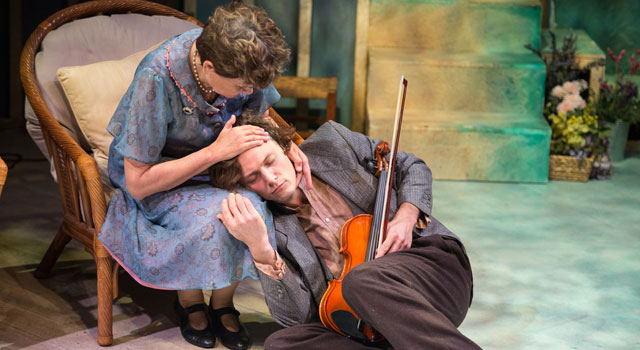
This staged reading of Rivka Hartman’s My Mother And Other Catastrophes is deeply revelatory of Hartman’s inner world, with several broad themes brought into focus through the filter of personal and lived experience. Hartman discusses the Jewish diaspora from an Australian perspective, the inter-generational transference of tradition through motherhood, and the karmic effects of catastrophes that seem to endure an eternity. The play does not break new ground, but it is in the nature of storytelling that what remains relevant, will always resurface. Where suffering remains, old stories never fade, although they may take on new forms, morphing with the times. Hartman’s script is not quite feminist theatre of the militant variety, but it certainly features strong and interesting women expressing their vulnerabilities, flaws and triumphs.

The structure of the work is swift and sharp, never overly self indulgent. Its anti-chronological timeline keeps things unpredictable and engaging, and encourages rumination about the evolutionary, as well as the repetitive, nature of how people live. We question what it means to be free, even though the script is not convincingly optimistic. Hatman’s words are charming and witty, but there is little variance between characters to create distinctions in speech styles and patterns. They seem to share one voice, which is reasonable for a show about one family, but more dramatic effect might be achieved if each character’s use of language demonstrates greater juxtaposition with each other.

Creative work exploring the Holocaust rarely provide new insights, but they are almost always poignant. Hartman creates vivid and emotional imagery from her stage directions, narrated by Taylor Owynns, and also through the lines of 117 year old survivor Gitl, performed with extraordinary gravity by Elaine Hudson. Indeed, the dark side of My Mother And Other Catastrophes is captivating, because its universality allows us to connect with it almost spontaneously, but its comedy is less compelling. It truly is a significant thing, to find humour when days are tough, and it is the belief that laughter can exist no matter how dire the circumstance, that helps keep our humanity perpetuating.

www.stickytickets.com.au/popuptheatre

Review: Queen Bette (G.bod Theatre / The Old 505 Theatre)

Venue: Old 505 Theatre (Surry Hills NSW), Feb 25 – Mar 15, 2015
Devised by: Jeanette Cronin, Peter Mountford
Director: Peter Mountford
Cast: Jeanette Cronin
Images by Richard Hedger

Theatre review
Heroes are worshiped for their exceptional lives and for their extensive contributions to society. Legends persist through the passage of time, especially when they are trailblazers who provide inspiration and guidance, showing us extraordinary ways to be. Examining how someone leaves a mark on the world, is how we can come to find the meaning of life, for their legacies hold the key to our existential angst. Queen Bette is a biographical tribute to one of the greatest screen sirens of the Hollywood golden age, Bette Davis. The text draws material from Davis’ autobiography and from various interviews she had given, not intending to give an in-depth account of sordid gossip, but to depict a great talent, her brilliant career, and an incredibly formidable drive. Davis’ outspokenness allows for the play’s devisors to assemble a script that is vibrant, funny, and tremendously expressive, and the largely chronological plot is a sensible mechanism to satisfy our need for creating a sense of coherence from fragments of a very big life.

In Jeanette Cronin’s company, the show’s 60 minutes go by in a flash. The performer’s work is more exciting and engaging than anyone can hope for in a role this iconic, and like Queen Bette Davis herself, Cronin’s ability to have us fall in love simultaneously with both actor and character, is sublime. We feel as though suspended in time, watching her genius in action, with all its technical proficiencies, emotional astuteness and physical splendour. Her mastery turns the audience into putty in her hands, captivated and gleeful at every twist and turn she introduces to the theatrical experience that we are subject to. Direction by Peter Mountford is dynamically paced, with unexpected stylistic changes developing between scenes to keep us attentive and fascinated. There is a conscious use of Davis’ words to spark activity, colour and energy on stage, so that the work is more than just the recitation of her admittedly engrossing speeches. Interesting perspectives and commentary are added to the star’s history, and a seemingly endless range of variance is achieved in the creation of her presence, so that we come into contact with a Bette Davis who evolves before our eyes, and who is always capable of surprising us.

Queen Bette may be about a departed film idol, but it keeps its sentimentality firmly in check. There is little intrusion into the personal, only revealing very key events, or situations that have an impact on her work. What we see are her professional achievements, how she had attained them and her basking in many moments of glory. It is not the whole story, but it is how we want to remember a role model, and how we want to tell stories so that there is a basis for emulation, or at least, an indication of our human spirit’s magnitude. Women like Davis, and Cronin, help us envision what success looks like, and their magnificence is a reminder that we too, can be brighter and better. We too can be sovereign.

www.gbodtheatre.com

Review: Blue Wizard (Belvoir St Theatre)

belvoirVenue: Belvoir St Theatre (Surry Hills NSW), Feb 19 – Mar 15, 2015
Playwright: Nick Coyle
Dramaturg: Adena Jacobs
Cast: Nick Coyle
Image by Lisa Tomasetti

Theatre review
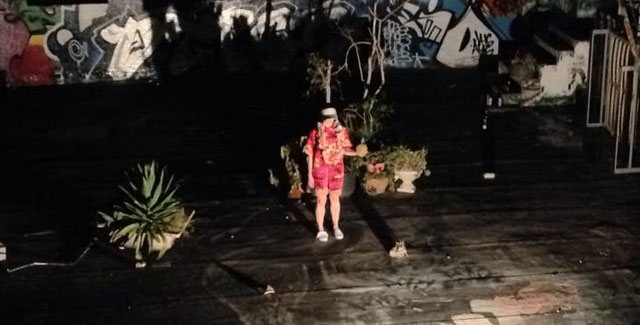
Post-apocalyptic stories are intrinsically moralistic. They make us think about our actions today that may lead to the utter devastation that is being presented. In Blue Wizard, an alien arrives from outer space but there is no longer any sign of human inhabitation. He is stranded, alone, except for an egg and its subsequent incarnations. Blue Wizard is unfamiliar with our planet but the very human-like visitor’s quest for survival and his disorientation are instantly recognisable, and our empathy for the misplaced being is effectively cultivated by an intuitively playful script by Nick Coyle. He declares upon arrival that he hails from a planet where all are gay, establishing a parallel with our own need for identity definitions based on sexuality orientation. Indeed, the one-man show is filled with cultural signifiers of male gayness and their affectations. Music by Britney Spears, Karen Carpenter and Cher add inspiration to the already camp sensibility of the artist, and his costuming, which is derivative of transvestism and drag.

The staging relies heavily on its talented team of designers to deliver a compelling context in which the action takes place. Damien Cooper’s lights are often show-stealing, and Steve Toulmin’s music and sound provide some of the most entertaining moments of the piece. Coyle’s performance is quirky and lighthearted, with the actor’s mischievous presence providing the absurd comedy with a playfulness that helps make the narrative strangely believable. His skills as a puppeteer are most impressive, with characterisations of the young aliens, Grubby and “Meryl Streep”, leaving powerful and lasting impressions. Dramaturg Adena Jacobs has guided Blue Wizard from its previous frankly bizarre manifestation when performed some seventeen months ago at PACT Centre for Emerging Artists, to its current form which is an engaging and brightly humorous show that sometimes surprises us, but always thoroughly amusing.

There is a sincere and earnest expression that underlies the frivolous tone of the production, and while its deeper meanings, if they do exist, are unclear, we do not feel as though we had been taken for a hollow ride. The moral of the story is one that the audience can decide for itself, but it is work of this nature that recalls the eternal question of whether art needs to serve any specific purpose. In other words, what is taken away from the theatre on this occasion is probably a lot more about the viewer than the creator.

www.belvoir.com.au

Review: Vampire Lesbians Of Sodom (Brevity Theatre)

brevityVenue: Kings Cross Hotel (Kings Cross NSW), Feb 25 – Mar 7, 2015
Playwright: Charles Busch
Director: Samantha Young
Actors: Jamie Collette, Skyler Ellis, Nick Gell, Pollyanna Nowicki, Olivia O’Flynn, Eliza Reilly

Theatre review

Queer culture and art are intrinsically anarchic. They are concerned with destabilising the status quo, not just for the things we talk about, but also for the ways in which they are discussed. Charles Busch’s Vampire Lesbians Of Sodom is a comedy that imagines an absurd narrative, and places it in an absurdist theatrical structure. There are rules to making a show work, and while they are not entirely disregarded in Busch’s writing, there is a thorough subversion of conventions that results in a highly unusual text that not only makes us laugh, but also encourages a more enlightened and evolved way of looking at social dynamics.

Adding to the already decadent flavour of Busch’s script, is a burlesque sensibility brought on by the incorporation of Musical Director Matthew Predny’s original compositions. The songs are sharp-witted and rousing, helping to propel our glee to dizzying euphoric heights. Also wonderful is Benjamin Brockman’s lighting design, successfully transforming a very ordinary venue into a theatre buzzing with a sordid and libidinous fecundity.

Central to the show’s themes is a playful but resolutely emancipated view of gender and sexuality, and emanating from that, a kind of paradigm that challenges the heteronormative imperative that affects every life. Director Samantha Young does exemplary work with the comedy as well as the politics of the piece. Part John Waters and part Mel Brooks, she brings a powerful and specific sense of humour that will prove to be curiously amusing to some, and uproarious for others. There is an intense and adventurous spirit that seeks to explore the limits of performance, philosophy and taste, conjuring a night of wild entertainment that pushes the right buttons.

The cast of six is cheeky and exuberant, with a unified comedic tone that truly delights, although it must be noted that each impressive player is given ample space to showcase their distinct and considerable talents. Eliza Reilly as Madeleine Astarte is sure-footed and engaging, adding an unexpected polish to the very bawdy material. Her Mae West-style delivery of punch lines is charming and effective, and the actor displays a natural flair for timing that endears herself to the audience with seemingly little effort. Astarte’s arch nemesis La Condessa is played by Nicholas Gell, whose very energetic and extravagant performance never feels out of place no matter how over the top he pitches it. It is a rare opportunity to witness an actor be completely ridiculous, and enthralling us with the hammiest presentation one can possibly imagine.

Edgy theatre is easier to dream up than to actualise (especially in conservative spaces like the Sydney theatre scene), but this version of Vampire Lesbians Of Sodom is certainly mad, bad, and dangerous to know. There will be some who find it too frivolous, and yet others who think it too gruff, but this is not a show that aims to please everyone, for it knows its crowd, and caters only for its own kind.

www.brevitytheatre.com.au

Review: As You Like It (Bell Shakespeare)

Venue: Sydney Opera House (Sydney NSW), Feb 21 – Mar 28, 2015
Playwright: William Shakespeare
Director: Peter Evans
Cast: George Banders, John Bell, Gareth Davies, Alan Dukes, Emily Eskell, Charlie Garber, Zahra Newman, Kelly Paterniti, Dorje Swallow, Tony Taylor, Abi Tucker
Images by Rush

Theatre review
As You Like It is not one of Shakespeare’s phenomenally poignant stories, nor is it an exceptional work of fantastical exuberance. It offers interesting personalities and amusing situations, but lacks a sense of grandeur and elements of surprise. Shakespeare might be idolised in all the right quarters, but his writing is certainly not without its detractors. His use of language especially, can be alienating for twenty-first century audiences, and when handled with less than expert proficiency, productions rarely deliver good results. Peter Evans’ direction never quite takes flight. There is plenty of investment into characters who seem to be dynamic and colourful, but we struggle to relate to anyone. Action on stage is lively and confident, but nobody connects with authenticity.

It is never certain where the centre of the play lies. The obvious focus would be on the love story between Rosalind and Orlando, but the remarkably poor chemistry between the two leads leave us searching for something more meaningful, or at least with some level of appeal. Zahra Newman as Rosalind is effervescent and a joy to watch when given the opportunity to take centre stage, but the important quality of romance in her narrative does not convince. Playing Orlando is the regrettably miscast Charlie Garber, whose charming presence and considerable comedic talents prove not to be sufficient for the role to take shape in our imagination. He does his best to exhibit commitment to the more dramatic sequences, but his efforts pale in comparison to when he gets to play the fool.

The stars of the show are its designers. Michael Hankin’s set brings to the stage a glorious interpretation of a Shakespearean forest, with floral garlands cascading from above, adding beautiful dimension and breathtaking hues to the performance space. Lighting by Paul Jackson is sensual but also varied, effectively depicting the movement of time and transformation of space. Kate Aubrey’s costumes are subtle and elegant, with just enough theatrical flourish to help actors establish mood and traits of individuality. Music and sound are utilised with great impact to influence atmosphere and to provide a sense of unpredictability. Kelly Ryall’s songs are pure entertainment, and an excellent touch that helps enrich an otherwise unexciting plot structure.

John Bell plays Jacques, and late in the second act, delivers the famous “all the world’s a stage” monologue. For a moment, the theatre turns electric, and descends into an attentive hush. The magic is real, and there is no mistaking its existence when it does take over. It takes a village to raise a child, and it takes a very big team of talents to put on a show of Bell Shakespeare’s usual ambitious scale, but on this occasion, it seems that the sum of its parts has not resulted in a collaboration greater than the whole.

www.bellshakespeare.com.au

Review: Pope Head (Théâtre Excentrique)

r0_3_1200_678_w1200_h678_fmax[1]Venue: Old Fitzroy Theatre (Woolloomooloo NSW), Feb 24 – Mar 6, 2015
Playwright: Garry Roost
Director: Paul Garnault
Cast: Garry Roost

Theatre review
Francis Bacon’s art is among the most revered of the twentieth century. His paintings continue to travel the world’s museums, and his following grows with each year and generation.The power of his work is immediate and compelling, often arousing visceral responses in the viewer before their intellectual, political and historical dimensions can even begin to be explored. Garry Roost’s play is a biography on Bacon that takes cues from stage conventions, as well as from Bacon’s work with its sense of abstraction and energetic expressionism.

Roost’s writing is manic and intense, with a pace and structure that presents a serious challenge to any actor. The unconfined and free-wheeling thought and speech patterns that emerge from the text is frequently incoherent, but fascinating. The words have a definite rhythm that reflects an understanding of the personality it represents, one that is unrelenting, passionate and thoroughly original. An actor usually takes to the stage in order to share narratives and ideas, but Roost is not quite a storyteller on this occasion. His performance focuses on a re-creation of Bacon’s very being that delivers, his idiosyncratic presence and unique mannerisms. We are presented with something of an apparition, accurately imitated and fabulously convincing, but also alienating and at times, puzzling. There is a difference between knowing someone through facts and figures, and gaining insight from observing a creature as it goes about its business, as though from a detached and empirical position. We learn a little about the painter from Roost’s script, but it is from his intuitive portrayal that we acquire a greater appreciation of the man whose legacy has touched many.

We rely on artists to do things differently. It is a thankless task to discover rules and then dismantle them in the public sphere. Audiences need to be disoriented and provoked, even though we prefer to be fed the same formulaic nonsense at every outing. Bacon’s paintings are at their best, upsetting and offensive, and this theatrical manifestation of Pope Head does its best to pay tribute. It is not an easy show to digest, and it is not the most amusing hour of live entertainment, but it does reinforce the memory of a great career and provides the most valuable of all creative endeavours, divine inspiration.

www.theatrexcentrique.com

Review: Kill The Messenger (Belvoir St Theatre)

belvoir1Venue: Belvoir St Theatre (Surry Hills NSW), Feb 14 – Mar 8, 2015
Playwright: Nakkiah Lui
Director: Anthea Williams
Cast: Matthew Backer, Katie Beckett, Nakkiah Lui, Sam O’Sullivan, Lasarus Ratuere
Image by Brett Boardman

Theatre review
Nakkiah Lui has a sadness to share. Lui is a young Gamillaroi and Torres Strait Islander woman who has seen and experienced the extraordinary injustices suffered by our Aboriginal communities, and she brings a passionate commitment to the writing of a work that attempts to articulate the incredible complexities unique to our first Australians. She aims for truth on all fronts, because the need to expose history, emotions, hopes and confused turbulence is an urgent one, and it is clear that the expression and release of an inconceivable darkness is an imperative that resists any suppression. Lui’s script is a coherent but fragile one with seams that threaten to unravel at any moment. The difficulty of representing deep, personal wounds in text form is addressed directly in the play itself, with Lui speaking as its autobiographical protagonist and declaring the conundrum of maintaining authenticity in the process of creating a work for an audience. Indeed, the play is imperfectly structured, but its message is communicated with magnificent saliency and the poignancy it carries is exceptionally profound.

It is not the kind of presentation that provides solutions to our problems, because it works hard to avoid fiction. There is humour in much of the dialogue but the comedy is black, and the reality it makes us face is desperate and sombre. Kill The Messenger embodies a sorrow that is entrenched in many of our lands and its peoples, but it is never without hope. Lui’s fighting spirit is the loud voice that instigates every line and action, and it is one that refuses to surrender. Anthea Williams makes the right decision to place words at the very forefront of the show. Her directorial style is minimalist so that no theatrical factor is allowed to become an obfuscating agent, and all we can hear is the script, and consequently, all we see is the stark cruelty that some of our society is capable of. Performances, while not always consistent, are passionate and engaging. The strongest player is Lasarus Ratuere in the role of Paul, a tragic figure and an unfortunate stereotype perhaps, but depicted with sensitive nuance so that his humanity manifests infinitely larger than his faults. The actor’s work is impressively dynamic, with a surprising gravity barely hiding beneath an ability to portray hardship and misfortune in deceptive nonchalance. Also very moving is the playwright’s own presence on stage.  Lui can sometimes be overly animated in scenes with co-actors, but her many soliloquies are beautifully tuned. Her confidence is obvious, and her conviction, immense. When Lui speaks to (and confronts) us, her every intention and emotion reverberates, leaving us nowhere to hide.

Kill The Messenger is art at its most important and social activism at its most necessary. It is also a colourful and vibrant piece of theatre that has an irresistible power to captivate and engage. Nakkiah Lui’s work has all the bleak honesty of youth, but none of the pretension. Her play is barely resolved because she sees through the state of our affairs and recognises the dire plight that many of her sisters and brothers are living in. She does not pretend to know the way out, but her determination to find it is the foundation of this compelling work. We must cry, if only to acknowledge the undeniable grief that exists in the blood that pumps through the veins of this great continent, but afterwards, we will find clarity, if only in our hearts.

www.belvoir.com.au

Review: Piccolo Tales (Piccolo Bar)

piccolotalesVenue: Piccolo Bar (Kings Cross NSW), Feb 3 – May 28, 2015
Playwright: Vashti Hughes
Director: James Winter
Cast: Vashti Hughes, Vittorio
Image by Roslyn Sharp

Theatre review
Vittorio has been operating the coffee machine at Kings Cross’ Piccolo Bar for 50 years. He has seen the area through phases of evolution, and calls himself “the last man standing”. Vashti Hughes’ Piccolo Tales chronicles Vittorio’s experiences, observations and reflections on the people and life of Kings Cross, perhaps the most colourful locality in Australia. The script lovingly captures a character full of verve and vigour, and details the ups and downs of his days as a stalwart of an extraordinary community composed of people from every class and vocation. Hughes’ writing is documentary, but rich with comedy and drama, powerfully assisted by Ross Johnston’s music (original and curated) that works to further amplify emotional dimensions of each wistful anecdote.

The production takes place in the very café from which Vittoria sees the world. Ten members of the audience are squeezed inside the tiny interior, and others contend with watching from outside through windows and a doorway. Hughes performs the key role, as well as several diverse incidental characters. Vittoria is himself positioned inside so that he is free to interject and on occasion, take over the stage for short, but very satisfying, spurts of flamboyant displays. Hughes’ remarkable skills as entertainer and storyteller are beautifully showcased in depictions of exciting personalities, with complex shades of light and dark, and an ubiquitous, tender pathos. The largely monologue format requires that the actor finds strong rapport with her very intimate audience, and she connects impressively, whether scenes are buoyant or introspective. Direction by James Winter is consistently sensitive and thoughtful. His work is melancholic, but has an optimistic sensibility, with an irresistible comedic tone that never has to try too hard. A generous spirit that embraces humanity in its many unfathomable forms is evident in the production, and we luxuriate in its unique glowing warmth.

Inter-generational dialogue is not always easy, but we have much to learn from our elders. The histories of our homes are of utmost importance, but finding out about them are seldom part of our daily priorities. Piccolo Tales addresses the need to preserve priceless memories, so that all who live in Kings Cross, and those who go through it, can gain a better understanding of its enigmatic glory. Without legends and connections to history and community, homes are only houses, and the meanings of things are banished to emptiness.

www.piccolobar.com.au

Review: The Plot (Mantouridion Theatre)

theplot1Venue: Mantouridion Theatre (Marrickville NSW), Feb 13 – Mar 1, 2015
Playwright: Evdokia Katahanas
Director: Sophie Kelly
Cast: Dina Panozzo, Deborah Galanos, Dina Gillespie, Maggie Blinco, Jennifer White, Julie Hudspeth, Matt Charleston, Nicholas Papademetriou, Michael Kotsohilis
Image by Mark Micaleff Photography

Theatre review
Stories about the underdog hold an everlasting appeal. We identify with the struggles of a person facing odds that are almost too much to endure, and the dramatic tensions that can be derived from those circumstances are unmistakable. Evdokia Katahanas’ The Plot talks about a social worker’s fight against the powers that be, at an aged care facility. Lily is an intimate confidante of the people she cares for, but their best interest are not always a priority for the directors, who are more concerned with keeping up appearances and a pleasing bottom line. Katahanas’ script includes elements that entertain and amuse, as well as characters that are colourfully diverse, but the structure of her writing prevents a comfortable rhythm from taking hold. Scenes of realism are interrupted by monologues, creating a plot that although rich in variety, can tend toward feeling fractured and uneven.

The production is performed by an accomplished and confident cast, led by the eminently energetic Dina Panozzo. In the role of Lily, Panozzo is full of empathy and passion, and she puts us firmly on her side from her very first appearance. Her warm presence connects with audience and co-actors, and her valiant and generous approach gives the production a sense of enthusiastic benevolence. The performance space is a large hall, and director Sophie Kelly addresses that daunting vastness effectively. She prevents any hint of dull stasis from occurring by encouraging movement and introducing sonic dimensions that fill the room beautifully. Composer Stephen Rae and sound designer Daniel Natoli both contribute strong work to the production. Kelly’s penchant for drawing out quite extravagant styles of acting ensures that the show remains entertaining for its duration.

How we treat the elderly can often be disgraceful. All our lives owe a debt to generations before, and when our seniors are no longer able to fend for themselves, it is completely reprehensible when they suffer mistreatment and abuse. The Plot shows that there are many admirable people devoted to providing care for those who are in need, but their honourable motives can be impeded by bureaucracy and the ineptitude of those in more powerful positions. Lily’s fight is a good one, even if every battle cannot be won.

www.facebook.com/Plot2015

Review: Mother Clap’s Molly House (New Theatre)

Venue: New Theatre (Newtown NSW), Feb 11 – Mar 7, 2015
Playwright: Mark Ravenhill
Music: Matthew Scott
Director: Louise Fischer
Cast: Debra Bryan, Bradley Bulger, Stephanie Begg, Steve Corner, Andrew Grogan, Patrick Howard, Deborah Jones, Chantel Leseberg, Tess Marshall, Brendan Miles, Thomas Pidd, Garth Saville, Dave Todd
Photographs © Bob Seary

Theatre review
Mark Ravenhill’s writing is wild and exuberant. He uses theatre to express parts of life that are passionate, fun, taboo and brutal. In Mother Clap’s Molly House, Ravenhill places gay life under scrutiny, examining its relationship with capitalism, and the implications of an increasingly liberated community that loses its way in the struggle for freedom and acceptance. The play’s in-depth look at the subculture may not be accessible to general audiences, but it is a necessary and unflinching reflection at a significant segment of modern societies. Louise Fletcher’s direction addresses the political aspects of the play, as well as the deeply carnal flavour of its live experience. The production begins in an abundance of confused frivolity, but takes shape when its more serious themes set in and when the cast becomes more vibrant in its endeavour.

Mother Clap is played by Deborah Jones, who takes her character through drastic transformations over the course of two-and-a-half hours. As the narrow-minded version of Clap in early scenes, Jones is less convincing, but upon emancipation in the production’s second half, Jones is a spirited and confident performer, who delivers an interesting allegorical embodiment of queer empowerment. Steve Corner’s portrayal of Princess Serafina is complex and delightfully intriguing. His thoughtful approach is balanced nicely with an enthusiasm for broad comedy, although the actor can benefit from slightly less restraint. Chantel Leseberg brings a professional polish to the show, impressive in two dynamic and diverse roles, Amy and Tina. Her understanding of her parts is thorough, and her execution is consistently creative and exciting. The cast brings a warmth to the stage, and there is a charming intimacy that many of them share, but performances in general can be sharper and tighter for a greater sense of urgency, and while comic timing is not poor, there is room for improvement.

The term “molly” referred in the past, to male homosexuals and transvestites. Today, the word connotes recreational drug use. Ravenhill’s script is concerned with the evolution of gay identities, and the way societal permissiveness and the profit motive have encouraged a false sense of freedom, where men are made to believe that the pleasure principle equates to liberation and happiness. The show does not pass harsh judgement on “misguided” individuals, but it is critical of how gay communities can sometimes view themselves. To elucidate his point, Ravenhill makes a dichotomous relationship out of money and love. Of course, there is no need to think of them as essentially oppositional concepts, and we can expect to have both in our lives, but finding the right balance in moderation, as always, is key.

www.newtheatre.org.au