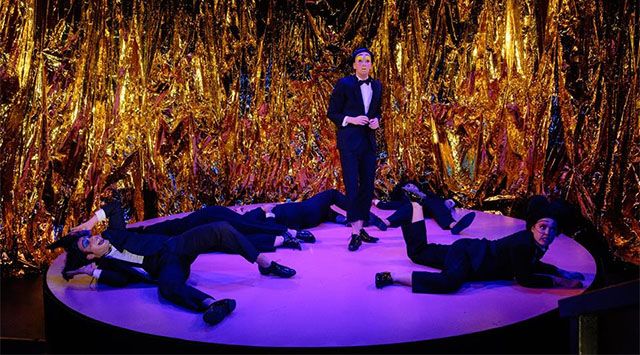
Review: The Natural Conservatorium For Wise Women (Clockfire Theatre)

Venue: Old 505 Theatre (Newtown NSW), Oct 3 – 21, 2017
Director: Emily Ayoub
Cast: Alicia Gonzalez, Sam Newing-Stern, Catherine Parle, Laura Turner, Tony Weir
Image by Geoff Magee

Theatre review
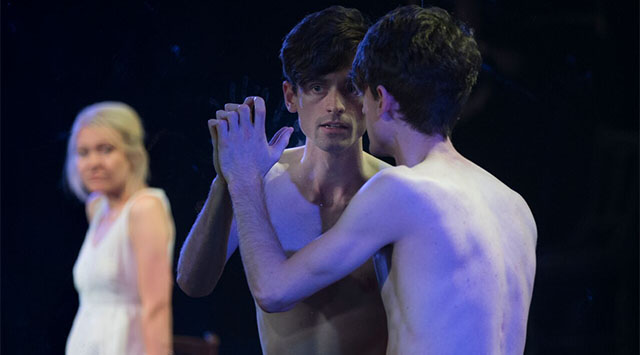
The patriarchy is constantly at war. In a system that benefits few, it has to protect itself from many enemies, especially those who have awoken from its deceptive manipulations, and are now aware of the injustices it generates. The Natural Conservatorium For Wise Women is an allegorical expression of the nature of patriarchy, in which we meet a man sitting atop a lonely throne, inside the strict boundaries of his miserable home, whilst others are outside engaged in blood-drenched combat on his behalf.

A highly imaginative work with only a slight reliance on dialogue, it is the sheer theatricality we encounter that truly excites. The characters tell a meaningful story, but it is the craft being put on display that is most captivating. There is much to admire, in the very specific discipline cultivated by this team of artists, with its strong emphasis on human physicality, rather than a more conventional use of emotional and verbal capacities as devices of communication. Informed by traditions of dance and mime, it is a style of performance that we rarely see in the landscapes of Australian art and is hence, an immediately refreshing experience for our audiences.

It is a very accomplished cast, with Tony Weir sensational as the decaying patriarch. Mesmerised, we watch closely as he mobilises every fibre of his being to turn the stage into a living, breathing thing that insists on our undivided attention. Weir’s commanding presence, and his powerfully seductive eyes, guide us through each moment with commendable precision and an inspiring sense of wonder. Alicia Gonzalez and Catherine Parle too, are terrific with their eccentric concoction of personalities, and the beautiful simplicity built into their unique language, is quite sublime. Space and atmosphere are finely tuned by director Emily Ayoub, who delivers a creation elegantly minimal in its aesthetic, but rich in resonance.

There is no end to the things we can talk about in the theatre, and there is no end to the different ways in which we can have those conversations, yet we seem to go about things in predictable fashion, choosing to persist with refining usual modes of presentation, instead of investing in the new. Our conservative art is symptomatic of the conservative times in which we live, and one might begin to interpret this unmistakable apathy as though there is nothing left to fight for. The opposite is true of course, but until we wake from the dulled and disillusioned dormancy of an existence that has resigned itself to the parochial, events like The Natural Conservatorium For Wise Women can only be an exception and not the norm.

www.clockfiretheatre.com

Review: The Gloveman (Blood Moon Theatre)

Venue: Blood Moon Theatre (Potts Point NSW), Oct 4 – 14, 2017
Playwright: C.J. Naylor
Director: Michael Block
Cast: Chris Argirousis, Brinley Meyer, Chris Miller, Matt Blake, Janine Penfold, Ben Dewstow
Image by Hayden Brotchie

Theatre review
Edith has an unfulfilling life, working in a small town pub in Leeds, England. Restricted by a minor disability, she had all but resigned herself to a life of discontentment, until a pivotal encounter with Hugh, a shady figure in the local football circuit. C.J. Naylor’s story involves corruption and ambition, but for all its enthusiasm, The Gloveman serves up little drama. The stakes never seem to feel high enough, and the various divergent narratives contributed by each of its characters, add up to a plot that is consequently haphazard. Naylor’s approach to dialogue however, is often delightful, with colourful and lively exchanges that some will find amusing.

It is an energetic show, featuring an exaggerated tone to acting styles that can be charming at times, and comical at others. The decision to use Australian accents instead of a very specific Northern England one is understandable, but the effect is disorienting. The role of Edith is played by Brinley Meyer, whose warm and confident presence keeps us endeared. Personalities in The Gloveman are portrayed with little complexity, but director Michael Block provides a sense of familiarity akin to everyday television presentations that helps us relate. Supporting actor Janine Penfold is particularly memorable, for her interpretation of journalist Gabe as a woman of substance and grit.

When Edith goes missing, presumed abducted by baddies, the menfolk she takes care of at home, preoccupy themselves with arguments about who amongst them is the best goalkeeper in town. It is not uncommon that the woman imagines herself indispensable, persisting with her servitude convinced that the greater good justifies her personal suffering. Meanwhile, all the glory and dirty money that circulates within her community, bypasses Edith, as her elbow grease continues to be called upon to support their sporting economy.

www.bloodmoontheatre.com

Review: The Winter’s Tale (The Depot Theatre)

Venue: The Depot Theatre (Marrickville NSW), Sep 27 – Oct 7, 2017
Playwright: William Shakespeare
Director: Sean O’Riordan
Cast: Jane Angharad, Alison Benstead, Alana Birtles, Russell Cronin, Laura Djanegara, Alec Ebert, Neil Sun Hyland, Derbail Kinsella, Dave Kirkham, Grace Naoum, Roger Smith, James Smithers, Romney Stanton, Charles Upton, Richard Woodhouse, Emma Wright, Danen Young
Image by Liam O’Keefe

Theatre review
No one can really claim to know Shakespeare’s personal politics, and the further along we progress, the harder it is to investigate with any objectivity, how he would have thought about the way societies should be managed. In The Winter’s Tale however, there is no doubt that modern standards can only judge him deeply misogynist.

Leontes is a king who decides on his own whim, that his pregnant wife is being unfaithful, then proceeds subsequently, to cause the death of both mother and their newborn daughter. Later in the piece, we witness the king becoming consumed by guilt, until the end, where he is unjustly rewarded with their resurrection, in the play’s quite absurd happy ending. Like Leontes, Shakespeare inflicts beastly harm on the two women, in order that his own purposes of creating presumably sensational drama may be served, then summons them back for a tidy and convenient conclusion.

Domestic violence is hugely topical, but The Winter’s Tale is clearly not the right story for our times. There is no need in any contemporary existence, to see an abuser get away with murder, and subsequently be absolved of all his sins.

Nonetheless, the production is an earnestly assembled tribute to the literary great. Isabel Hudson’s meticulous work on set design is laudable, and Liam O’Keefe’s dynamic lights are a crucial element in the many tonal transformations between scenes. Director Sean O’Riordan works closely with his young actors to create opportunities for their talent, where they exist, to be displayed, or at least to demonstrate a sense of exuberance where a natural flair for the stage may be absent. There are issues with blocking, if solved, that could improve the efficacy of what the cast attempts to provide.

Leontes is played by Charles Upton, who although lacks the appropriate level of maturity, is a sturdy and persuasive presence, providing a centrifugal vitality that the play’s narratives rely on to develop. Laura Djanegara is memorable as Camillo, with a confidently naturalist approach that feels authentic and refreshing. Also noteworthy is Russell Cronin who offers excellent timing as the Clown, energetic and adorable, with an unmistakable intuition for performance.

It is appalling that one Australian woman is killed every week by her partner (as reported by the Australian Institute of Criminology), yet our national consciousness continues to struggle with the severity of that fact. We spend inordinate effort on debating things like border protection, while all the real atrocities are happening inside our homes. The inability to see the evil within, is unquestionably harmful. We have to be vigilant with that which is too often taken for granted, including those we consider heroes of our artistic experience.

www.secrethouse.com.au

Review: Puntila Matti (MKA Theatre / Doppelgangster)

Venue: Kings Cross Theatre (Kings Cross NSW), Sep 25 – Oct 14, 2017
Playwright: Tobias Manderson-Galvin (after Bertolt Brecht and Hella Wuolijoki)
Director: Tobias Manderson Galvin
Cast: Antoniette Barboutis, Grace Lauer, Tobias Manderson-Galvin
Image by Rupert Reid

Theatre review
We are told that the show’s departure point is Brecht’s 1940 script Mr Puntila And His Man Matti, but not much else can be certain in anyone’s reading of Tobias Manderson-Galvin’s Puntila Matti. Its deliberately bewildering enactment of a chaotic aesthetic, places us in a theatre that is less about stories, and more about experience and experiment, with time as a foregrounded instrument of its artistic practice. We look at a juxtaposition of bodies within time (and space) to garner meaning from any work of theatre, and in the case of Puntila Matti, we are challenged to find a way to appreciate and to comprehend all the riotous action, when its creators intentions seem to be to obfuscate the original narratives on which the show is built.

Manderson-Galvin acknowledges the European history so intimately entangled in the Western art of Australia. If Bertolt Brecht is present in every official form of theatre education disseminated on our land, then this relationship we endure, with a distant past from a faraway region, has to be interrogated. We can try to ignore old Europe’s stifling domination, and pretend to create new voices that are transparently offshoots of that heritage, or we can examine it with irreverence and subversion, as is done in Puntila Matti. Manderson-Galvin reframes Brecht in his own words, then makes them distorted and unintelligible, almost Dadaist in style. This is not a play about dependable dialogue and consistent characters. It is about the establishment, and how we can confront it.

The centrepiece is Manderson-Galvin himself, an imposing figure, wildly energetic and disarmingly intuitive as live performer. A fearlessness in his approach provides assurance of a man in charge, but it also keeps us on our toes, compelled and vigilant in the absence of the fourth wall convention. Grace Lauer provides a sense of anchor to proceedings, a necessary counterbalance that gives texture and dynamism to the presentation. Antoinette Barboutis is on the periphery, playing disoriented narrator with remarkable comedy, consistently, and delightfully, stealing the show from under the key performers.

When we come to recognise the bad in our inheritance, the brave will seek reparation. If our art is broken, it only makes sense that the most innovative of us, will attempt to find solutions. Reacting to the racist, sexist, homophobic, classist (you get the drift) systems in which we have to operate, requires that all participants, practitioners as well as audiences, must learn to face up to the new. It will be awkward, perplexing, even distressing, but those are sensations inherent in any true and radical emancipation. We may never be able to entirely abandon the past, but in rejecting the familiar and the comforting, we know that a genuine progression is in process.

www.mka.org.auwww.doppelgangster.com

Review: Beautiful The Carole King Musical (Sydney Lyric Theatre)

Venue: Sydney Lyric Theatre (Sydney NSW), Sep 17 , 2017 – Jan 21, 2018
Book: Douglas McGrath
Music & Lyrics: Gerry Goffin, Carole King, Barry Mann, Cynthia Weil
Director: Marc Bruni
Cast: Jason Arrow, Stephanie Caccamo, Doron Chester, Barry Conrad, Andrew Cook, Marcus Corowa, Julia Dray, Akina Edmonds, Esther Hannaford, Amy Lehpamer, Cameron Macdonald, Nana Matapule, Mike McLeish, Lorinda Merrypor, Joseph Naim, Ruva Ngwenya, Josh Piterman, Naomi Price, Rebecca Selley, Sean Sinclair, Angelina Thomson, Mat Verevis, Anne Wood, Chloé Zuel
Image by Joan Marcus

Theatre review
It was 1958 when 16 year-old Carole King sold her first song to Dimension Records, thus beginning her career as a trailblazing female of the music industry. Featuring her hits, and others of the era, Beautiful the musical charts King’s early years as a songwriter, depicting personal and professional challenges that had come her way, as she evolved into the legendary figure we have come to know.

Douglas McGrath’s book is tender, gently but effectively sentimental, and memorable for its surprising humour. The soulful songs are arresting, with an immediacy of appeal derived from the unabashedly catchy style of 3-minute hit factories typical of the time. Powerfully nostalgic, there is no other way to respond to the music than to gush with excitement, at the beginning of each familiar tune.

Esther Hannaford is deeply endearing in the lead role, effortlessly sassy but with a startling quality of earthy humility that closely approximates our impression of the woman herself. Hannaford’s voice is scintillating in ballads and in numbers that convert easily to the musical theatre format, but grittier fare like “Natural Woman” and “I Feel The Earth Move” expose the rift in genres that remains to be ameliorated.

It is a large and talented cast, with moments of brilliance emerging from each member, to our immense delight, as the show progresses. Beautiful is a simple story, but rich with theatrical pleasures. Director Marc Bruni’s creation seems always to be perfectly gauged. It fulfils predictable requirements of a conventional Broadway show, but is fundamentally elegant in all its approaches. There are bells and whistles everywhere we look, but nothing ever goes overboard.

It is not a regular occurrence on stage, that a tale is told of a woman who reaches great heights of success, without her having to make enemies, or to lose integrity. Beautiful is about women making it in showbusiness, without demeaning themselves or anybody else. The show is unquestionably enjoyable, and it delivers all the frivolous fun one asks of the format, but its quiet representation of a sovereign womanhood, is the reason for our elation.

wwww.beautifulmusical.com.au

Review: Assassins (Hayes Theatre)

Venue: Hayes Theatre Co (Potts Point NSW), Sep 16 – Oct 22, 2017
Book: John Weidman
Music & Lyrics: Stephen Sondheim
Director: Dean Bryant
Cast: Laura Bunting, David Campbell, Connor Crawford, Martin Crewes, Kate Cole, Bobby Fox, Hannah Fredericksen, Jason Kos, Rob McDougall, Maxwell Simon, Justin Smith
Images by Philip Erbacher

Theatre review
Australia does not believe in capital punishment, and we certainly never condone murder under any circumstance, but this principled conception of the world relies entirely, on a justice system that convinces us of its adequacy. If men in high places get off scot-free after committing egregious acts of immorality, we begin to think in terms of vigilantism. In Stephen Sondheim and John Weidman’s Assassins, a congregation of women and men remembered for the dubious accolade of having attempted to shoot and kill American presidents, are gathered for a history lesson, that talks about the phenomenon of political assassinations, and the meanings it represents in our modern democracies.

It is a great joy to be able to take pleasure in a work of musical theatre, that is not frivolously romantic, or twee, or excessively sentimental with its concerns. Some might argue that its topic is of particular relevance in 2017, but Assassins is thematically pertinent as long as our governments are a thing of contention, and for true democracy to exist, that sense of discordant anxiety must surely be ever-present. Whether or not the leader is to your tastes, there will always be a substantial portion of the population that is against them, if we are to uphold the fundamental doctrines surrounding our shared understanding of freedom.

Brilliantly conceived for the Sydney stage by director Dean Bryant, who balances spectacle with nuance, to deliver a show that is as entertaining as it is meaningful. In perpetual and harmonious motion, Bryant and choreographer Andrew Hallsworth, have created a sophisticated interpretation of Assassins, that addresses the genre’s need to tease and dazzle, whilst maintaining an air of gravity to proceedings. The production is a visual delight. Alicia Clements’ set and Ross Graham’s lights continually steal the show, with surprises that unfurl through every scene, splendid and ravishing from beginning to end.

An impressive ensemble takes charge of the material. Although not evenly skilled, their spirited cohesion makes for a performance that is firmly captivating. David Campbell is compelling as John Wilkes Booth, the man responsible for Lincoln’s death. Fabulously gifted in voice, and delicately studied with his acting, Campbell may not be a leading man on this occasion, but proves himself to be the unequivocal star of Assassins. Justin Smith’s marvellous acting chops too, make a fascinating Samuel Byck, the all too familiar loony who would very likely be a regular caller on talkback radio if alive today. Also memorable, is Martin Crewes, whose passionate singing and radiant presence, are reliable, as always, for adding vibrancy to the presentation.

There is always a temptation to imagine a world suddenly better, after a terrible tyrant is killed, but history has proven time and time again, that the removal of a head, does not automatically bring peace to the body politic. If there is anything worth celebrating about our Western democracies, it is our ability to argue for the greater good to prevail. As long as our conscience leads the way, harm can be minimised, but by the same token, the imperfections of our societies will remain salient. Murder can be sweet revenge, but it solves nothing, serving only to prolong the torment of injustice.

www.hayestheatre.com.au

Review: All Our Lesbians Are Dead (Zenowa Productions)

Venue: New Theatre (Newtown NSW), Sep 16 – 19, 2017
Playwright: Natalie Krikowa
Director: Natalie Krikowa
Cast: Teneale Clifford, Stephanie Hamer, Felicity Keep, Laura Nash, Gemma Scoble

Theatre review
Only 2% of all television characters are lesbian or bisexual women, but they account for 10% of deaths. As the representation of gay women increases in our media, it seems that they are being killed off at an even higher rate. These are the alarming statistics we hear about in Natalie Krikowa’s All Our Lesbians Are Dead, a comedy that presents this wanton massacre on our TV sets, as conspiracy theory.

There are men in high places who understand that the inclusion of queer characters is advantageous to the bottom line, but are unwilling to accept the validity of queer lives. Lesbians are added to shows, to serve their purpose as profit-making commodities, but are routinely murdered to maintain the heteronormative status quo, established since the inception of television almost a century ago.

The plot involves a private investigator being hired by a couple of lesbian couch potatoes, to investigate the reasons behind these rampant TV deaths of queer women. There are scintillating data and intriguing hypotheses in Krikowa’s script, but dialogue is stilted, with unrealistic personalities constructing narratives that are rarely engaging. The cast exhibits good conviction, with actors Teneale Clifford and Gemma Scoble providing a level of proficiency that offer us moments of invigoration, in what is a very basic effort at making theatre.

Bianca says in the play, that it is better not to see yourself at all, than to see yourself dying over and over again. LGBTQI people should not have to choose between invisibility and destruction. Neither should we still be begging for legitimacy in the twenty-first century, but the truth is that our oppression persists. To see ourselves portrayed with fairness in mainstream media may or may not happen in this lifetime, but the alternative underground is where we have always thrived, and it is here that we find our voice and solidarity. Long may we reign.

www.newtheatre.org.au

Review: The Night Alive (O’Punksky’s Theatre)

Venue: Old Fitzroy Theatre (Woolloomooloo NSW), Sep 13 – Oct 14, 2017
Playwright: Conor McPherson
Director: Maeliosa Stafford
Cast: Laurence Coy, Patrick Dickson, Sarah Jane Kelly, John O’Hare, Darren Sabadina
Image by Rupert Reid

Theatre review
In a run-down home in Dublin, surrounded by insidious violence, its inhabitants go about their simple lives, acculturated and unperturbed. Conor McPherson’s The Night Alive begins with Aimee’s bloodied face, and we are struck by the astonishing ease at which everyone is able to recover from the savage episode. These are people who live rough, and we watch them get on with it, like most humans do, trying to figure things out in a world that always seems to be on the verge of turning dystopian.

Director Maeliosa Stafford brings to the stage, the quintessential Irishness of its characters, offering an intriguing glimpse into a culture that oscillates between familiar and exotic. Our Australian sensibilities at times run parallel, but can often seem divergent. With McPherson’s very fascinating dialogue, the other side of the planet is turned immediate, and even though the slow pace at which Stafford allows for things to happen can prove demanding, The Night Alive is a whimsical piece with definite charm.

Tommy is down on his luck, but John O’Hare’s naturalistic portrayal of a man who soldiers on, gives the show its tenacious optimism. Sarah Jane Kelly is spiritedly valiant, in her attempts at preventing the sole female in The Night Alive from dissolving into a subjugated accessory for the men’s stories. It must be said however, that romance blooms unconvincingly between the two.

Laurence Coy and Patrick Dickson are memorable in the play’s quirkier roles, both delightful presences with a sense of precision in their respective approaches. Kenneth is a slightly cliché bad guy type, but Darren Sabadina’s energy is refreshing, and a much needed boost for a production that tends to fall too languorous.

It may be hard out there, but we brave it. There are forces that work against Tommy and his friends, and not a day passes without its challenges, yet they remain hopeful. We can be certain that without hope, all our tomorrows may as well cease to exist. To live, we must keep on dreaming, for it is only in how we manufacture anticipation, that time can derive its meaning.

www.opunkskystheatre.com

Review: Dinner (Sydney Theatre Company)

Venue: Sydney Opera House (Sydney NSW), Sep 11 – Oct 28, 2017
Playwright: Moira Buffini
Director: Imara Savage
Cast: Caroline Brazier, Brandon Burke, Claire Lovering, Rebecca Massey, Aleks Mikić, Sean O’Shea, Bruce Spence
Image by Brett Boardman

Theatre review
Paige is throwing a pretentious dinner party, for people she dislikes. Moira Buffini’s takedown of the English upper class, Dinner, begins promisingly enough, with pathetic women and impotent men tearing into each other, to expose the ignorant indulgences of those at the top, who seem to have things much easier for no good reason. Touches of surrealism give the play an enjoyable whimsy, but we quickly discover its plot and dialogue to be unoriginal, almost generic in its castigation of the rich. Characters with a depraved sense of entitlement, all in broken relationships, engaging in hateful exchanges over an expensive meal; none of it ever ceases to feel a tad too familiar.

The action takes place in a glorious dining room (designed by Elizabeth Gadsby), behind a big glass window. Either the great unwashed has to be kept at bay, or the theatre patrons need to be protected from some big mess that is poised to take place on stage. Three words, “fuck things up”, are given grand emphasis several times in the course of the production, but the wait for radical activity proves fruitless. Director Imara Savage makes several obtuse gestures in her staging, attempting to introduce the idea of subversion to her work, but it all feels much too polite, and they fall regrettably flat.

Caroline Brazier gives a polished performance as Paige, and although we can certainly see the disquiet and the deceptive fragile glamour of the lady of the house, we never really come to an understanding of the source of her immense toxicity, which underpins the entire narrative of Dinner. Aleks Mikić plays Mike, the outsider who stumbles in, representing the working class, in a juxtaposition of the privileged against the concept of an everyman. In spite of the actor’s strange and unexplained use of a posh accent, the enigmatic qualities created for his persona, makes him one of the more intriguing aspects of this production.

There are laughs to be had, and valuable concepts to chew on, but Dinner needs a lot more spice if its ambitions are to be fulfilled. Social inequity is a problem of great severity, especially troubling in the Trump age, and when we decide to challenge the imbalance of wealth, any hint of the perfunctory would risk the exercise turning inadequate and hypocritical. It is never sufficient that artists are well-meaning. We rely on them to tell the truth in a way that the truth may have an effect on how we think and live, and when the message is hard to digest, their arguments need to find a way to make themselves persuasive. A gentle simmer might be an easy way to broach the subject, but it rarely manages to get the job done.

www.sydneytheatre.com.au

Review: Diving For Pearls (Griffin Theatre Company)

Venue: SBW Stables Theatre (Kings Cross NSW), Sep 8 – Oct 28, 2017
Playwright: Katherine Thomson
Director: Darren Yap
Cast: Michelle Doake, Jack Finsterer, Steve Rodgers, Ebony Vagulans, Ursula Yovich
Image by Brett Boardman

Theatre review
We ascribe only noble values to the Aussie battler, because we believe hard and honest work to be the greatest of virtues. In our celebration of the underdog, it is easy to forget the injustices that society inflicts on our disadvantaged. Katherine Thomson’s Diving For Pearls shows us the struggles of the poor, but instead of indulging in a pointless admiration of their fortitude, we question how it is that we allow these extreme discrepancies in wealth to exist, as though it is a completely natural and healthy phenomenon.

Barbara is a brassy broad who is more than willing to give life a go, naive in her trust that dreams do come true, that all you have to do is to play your cards right, and all the appropriate rewards will eventually be delivered. She dates Den, less ambitious but equally accepting of his place in the world. The couple do not complain about their lot in life, hardly aware of the forces at work that are determined to keep them at the bottom of the food chain.

Steve Rodgers and Ursula Yovich are the charismatic leads, both tremendously likeable and hence highly effective, in having us empathise with the stories they present, even as their characters make some very questionable choices. Playing young Verge is the remarkable Ebony Vagulans, who leaves a strong impression with her vibrant and animated presence. She brings to the role exceptional nuance, in both physical and psychological terms, that reflects sensitivity and a sophisticated theatrical instinct. The production does not always speak with great power, but audiences will find the tale nonetheless meaningful.

Poverty is required so that the wealthy can retain social dominance. Those at the bottom are made to believe that they are owed nothing by society, and that all the riches of the universe are available to them, if only they were smarter, worked harder, or simply luckier. When Barbara and Den find themselves unfulfilled, we wonder if there is ever recourse for those in their position. If we are comfortable with access becoming increasingly restricted, it will only be radical action that can bring us to something fair and balanced.

www.griffintheatre.com.au