Review: Mortido (Belvoir St Theatre)

belvoirVenue: Belvoir St Theatre (Surry Hills NSW), Nov 7 – Dec 23, 2015
Playwright: Angela Betzien
Director: Leticia Cáceres
Cast: Toby Challenor, Tom Conroy, Colin Friels, Louisa Mignone, Renato Musolino, David Valencia
Image by Brett Boardman

Theatre review
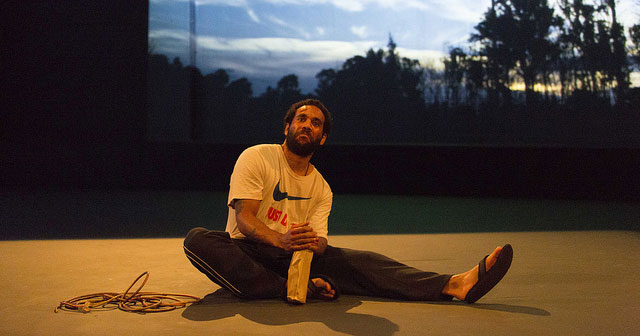
At the centre of Angela Betzien’s Mortido, is a wretched life. Jimmy is a soft and kind soul, misguided by family and exploited by every person he trusts. Emerging into adulthood from a background of poverty and addiction, the only barometer he possesses for a better life is a need for acceptance, along with our definitive measure of success, money. Without the support of anyone who has Jimmy’s own interests at heart, and with no education to speak of, his fate is sealed, and doomed. The story is a dark one about the underbelly of Sydney, and how our affluence is built upon the perpetuation of an underclass, kept aspirational and concurrently ignorant.

Betzien’s script is highly ambitious and vast in scope. It encompasses themes of family, money and addiction, set against historical contexts, to explore attitudes and machinations of our current sociopolitical environment. The play looks at our problems with narcotics and poverty from micro and macro perspectives, refusing to diminish their complex enormity for convenient storytelling. What results is a piece of writing that is detailed and intricate, but also challenging, for audiences and theatre makers alike.

Director Leticia Cáceres does well at providing the production with tension and intrigue, but the plot’s clarity suffers from that tautness of pace. In its second half especially, too much is revealed too quickly, and our minds struggle to process every poignancy. Each revelation is an important one that contributes, not only to our appreciation of each character’s circumstances, but also to our understanding of the real world. Many of the story’s elements will resonate deeply if given the chance, but the show seems to rush quickly past and we are left wondering if we had learned everything that is worth knowing.

Nevertheless, Mortido is gripping, and very exciting, with each scene holding surprises, frequently overwhelming with its keen portrayal of brutality, both physical and psychological. Composer The Sweats and Sound Designer Nate Edmondson do exceptional work with their manipulations of atmosphere. The production relies heavily on its sounds to control our responses, and the precision at which it guides our emotions through every sequence and transition is remarkable. A disappointing contrast does occasionally occur however, when it takes a back seat, leaving the actors to their own devices, and we begin to feel the emptiness of space.

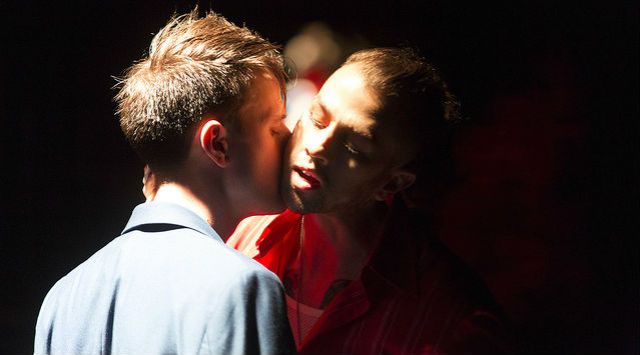
There is plenty of impressive acting to be found, including the very young but very compelling Toby Challenor, whose immovable focus on each task in every appearance, belies his tender age. Colin Friels plays several disparate characters, displaying a good level of versatility and enthusiasm, but is probably most effective as Detective Grubbe and El Carnicero. The star’s presence is undeniable and the intensity he brings to the stage has an effortless drama that is absolutely captivating. The central character Jimmy is performed by Tom Conroy with a faultless vulnerability. For all of Jimmy’s regrettable mistakes, we are always on his side, hurting for his every adversity and hoping that a twist of fate appears. Conroy excels in the role, successfully depicting Jimmy’s personal difficulties as well as the social connotations of a problematic life. We understand the responsibilities that are due young people like Jimmy, and realise how we have failed those who share his disadvantage. Also noteworthy is David Valencia as the enigmatic Spanish-speaking El Gallito, memorable for his simultaneous delivery of danger and ethereality, and an aggressive sex appeal that electrifies the stage.

The title of the work refers to our human tendencies toward self-destruction. It is a discussion about weakness, and along with that, we encounter ideas surrounding ethics, responsibility and social harmony. Mortido is a cautionary tale about the seduction of death, and the perils involved when allowing lives to be less than honourable. It confronts the inequity that exists in our wealthy cities, and our complicity in maintaining that damaging status quo. We can always identify good from bad, but we do not always make the right decisions.

www.belvoir.com.au

Review: Ivanov (Belvoir St Theatre)

Venue: Belvoir St Theatre (Surry Hills NSW), Sep 19 – Nov 1, 2015
Playwright: Anton Chekhov (adaptation by Eamon Flack)
Director: Eamon Flack
Cast: Fayssal Bazzi, John Bell, Blazey Best, Airlie Dodds, John Howard, Ewen Leslie, Zahra Newman, Yalin Ozucelik, Helen Thomson
Images by Brett Boardman

Theatre review
The word is not explicitly mentioned in Eamon Flack’s adaptation, but his Ivanov shows all the signs of a modern man deeply depressed. He is unable to work, and everything seems to be a source of anxiety. As an educated man of some social standing, Nikolai Ivanov is expected to do better, and everyone waits for him to get his act together. Nikolai himself blames no one else for his predicament, although it is clear that his disdain for things are beyond the personal.

We think about depression today increasingly as a medical condition pertaining to the individual. Circumstances and environment are diminished in importance, and one is required simply to find ways and means to weather the harsh realities surrounding themselves, or to accept the inherent deficiencies of one’s constitution. We no longer talk about the problems of society and their effect on persons. In Flack’s Ivanov, we are encouraged to examine the world in which Nikolai lives, and in our impatience for him to buck up, to also consider if there is anything indeed that would make his life truly worthwhile. Flack’s version is authentically pessimistic, but full of comedic power. Its laughter comes from the sad and absurd elements of life, with attention paid closely to the elements that control us. It discusses government and the economy, money and property, marriage and family, and the strain of masculinity, all troubling aspects that Nikolai has to deal with, and that are perversely familiar to us.

The show’s tone is surprisingly farcical, with a unique sensibility that straddles both Australia and Russia. It is a make believe time and space, with language that freely traverses geography and genre, but it rings true at all points. The places might be strange and the characters equally foreign, but we know the themes, and the play speaks sensitively and coherently through Chekhov’s now antiquated scenarios. The production is designed with intelligence, sophistication and flair. Michael Hankin’s set is immediately evocative, but also cheeky with symbols that add significantly to its overall and ubiquitous social commentary. As director, Flack’s ability to make every scene come to life ensures that the show is as emotionally engaging as it is thoughtful. Each character is exuberant and distinctive, and their exchanges are frenzied with fire and chemistry. Their stage is a thoroughly playful one, and we cannot resist pouring ourselves into their carousal, even if it is mad and miserable. Music and songs by Steve Toulmin and Francis Merson are party to much of that delirious energy.

It is a formidable cast, with memorable performances from all nine actors. The title role by Ewen Leslie is suitably angsty and frustrating, and he rumbles with extravagant drama at each of his key revelatory moments. The actor is also able to tame his darkness for many of the show’s amusing sequences, for a finely balanced portrayal of a man disintegrating in the middle of a riotous comedy. Blazey Best and Helen Thomson play obnoxious women of means, taking the opportunity to present offensively loud personalities in brilliant displays of sublime but exaggerated humour (wonderfully supported by Mel Page’s outrageous costuming). John Bell and John Howard turn up the charm with characters that are as flawed as they are endearing, transforming significant imperfections into figures of palpable humanity. The superb quality of acting in Ivanov is theatrical magic. Inspiring, uplifting and poignant, it takes Chekhov from history to tangible, and in this rare episode, provides an interpretation that exceeds our expectations of the master’s bequeathed words.

Chekhov had a definite interest in firearms and suicide. In any reflection of life, its opposite will always be implicated. In thinking about death, especially suicide, we are made to consider the decisions to remain alive. If that discovery of life’s meaning is elusive, then the mystery of how we stop from killing ourselves becomes potent. Nikolai reads a lot, and the more that he knows, the closer his gun is held. In Ivanov‘s world, ignorance is bliss, and pessimism struggles to find relief. Fortunately, hope is independent of reason, and we persist albeit devoid of certainty and replete with insecurity.

www.belvoir.com.au

Review: La Traviata (Belvoir St Theatre / Sisters Grimm)

Venue: Belvoir St Theatre (Surry Hills NSW), Aug 27 – Sep 20, 2015
Creators: Ash Flanders, Declan Greene
Director: Declan Greene
Cast: Ash Flanders, Emma Maye Gibson, Michael Lewis, Zindzi Okenyo
Images by Patrick Boland

Theatre review
Giuseppe Verdi’s opera La Traviata is about love and money. In Ash Flanders and Declan Greene’s radical re-imagination, a third theme of art is added to create a work of theatre that moves emphasis away from sentimental indulgence, to something that is altogether more contemporary, and intellectual. The exploration of ideas becomes an explicit one. Through five separate sequences, we are encouraged to think about our economy and consider the extent to which our lives are required to be commodified in order to survive, or at least to be able to find justification for our social existences.

Flanders and Greene are interested in the problems of thinking about art as product, and in their attempt to determine what it is that gives art a sense of value, a series of funny but thoughtful scenes are created. Each one a different genre, their presentation also addresses the clichés of art reflecting upon itself, and the difficulties in producing anything original, especially within this contemporary and introspective concept. The same operas are staged every year, yet artists are pressured to be innovative, and in our current political climate, the capitalistic ideal of “excellence” is applied to art in an attempt to understand and indeed, control how artists do their work. These absurdities are effectively, and entertainingly, encapsulated in Flanders and Greene’s show. Each section is executed with charm and sharp humour, but the transitions between them are not always managed with the same amount of flair. One also questions the straightforward division of scenes, which comes across too simple and convenient. The fourth sequence involves a question and answer format that aims to perform a sort of “reality” genre that accurately depicts the state of communications today, but the discussions demystify the abstractions that had come before, and the transformation of what was ephemerally beautiful into plainer terms is unfortunate. Perhaps a statement is made about the diminishment of romance and mystery in our lives, but it is an ironic and disappointing loss.

Greene’s talent with aesthetic and atmosphere is a drawcard of the production. Along with designers Marg Horwell (set and costumes), Matthew Marshall (lighting) and Steve Toulmin (music and sound), this overhaul of La Traviata is a consistently fascinating one, particularly at its more classically operatic moments. There is a strong desire for the work to connect, which often results in an appealing brashness that matches its quite madcap humour. It takes every opportunity to express itself with flamboyance and extravagance, but unlike the lavish operas at bigger venues, its sensibility is firmly anti-establishment. Quirky and queer, the world it creates is adventurous, dynamic and consistently idiosyncratic, with compelling symbols that interrogate our imagination and delight our eyes and ears. Performers Emma Maye Gibson and Michael Lewis leave an impression with their accomplished voices late in the piece, surprising us with morsels of operatic singing that we had all but given up expecting. It is a strong cast, each with solid presences and a confidence in their material that helps us appreciate the topics being dissected. In the absence of narrative, their cohesion in energy and comedy styles gives the show its compelling driving force.

Our hero Violetta chooses love over money at every stage of her life story. There is never a hint that money could ever mean more than her one true love. The sacrifices she makes for Alfredo eventually destroys her, and although we observe in sadness her tragic death, the profound meanings of integrity and truth emerge clearer than ever. Death pales in comparison to passion. When one is able to identify the greatest love of all, life is worth living.

www.belvoir.com.au | www.sistersgrimm.com.au

Review: Seventeen (Belvoir St Theatre)

Venue: Belvoir St Theatre (Surry Hills NSW), Aug 1 – Sep 13, 2015
Playwright: Matthew Whittet
Director: Anne-Louise Sarks
Cast: Peter Carroll, Maggie Dence, John Gaden, Genevieve Lemon, Barry Otto, Anna Volska
Images by Brett Boardman

Theatre review
It is the last day of school, and five seventeen year-olds are celebrating the milestone with great happiness and too much booze. Performed by actors in their seventies, the play promises to offer refreshing perspectives of a rite of passage that most of us are familiar with. Matthew Whittet’s script for Seventeen explores teenage life at its later stages, when adolescents begin to think about the future, and the choices they inevitably have to make. The writing’s approach is a gentle one that shows a mainstream idea of youth that does not use its characters to shock or sensationalize. The group seems thoroughly regular, and it is worthwhile giving them a voice, without requiring them to be controversial or achieving anything particularly extraordinary or dramatic. Their concerns and interests are revealed with honesty, and the play derives its dynamism from the colourful optimism of its teenage personalities, but challenges exist in dealing with what is essentially quite pedestrian experiences. The text has enough vibrancy and surprises peppered through its plot, but if it is to be performed by age appropriate actors, one can imagine the work to lack a sense of theatricality, and come across too ordinary. If casting much older players is the only way the play gains its edge, it can be interpreted that the manoeuvre is somewhat gimmicky, but the production does manage to use the age discrepancy in fascinating ways at many points.

The comedic components of the show are effective and very memorable. Watching these seniors mimic the physical and verbal expressions of persons much younger is a joy, and we never tire of the immediate and awkward juxtaposition of behaviour against body, young against old. Director Anne-Louise Sarks introduces that humorous sense of contemporariness into much of the piece, and the cast executes them with triumphant results, no matter how juvenile or, at times, embarrassing. Less successful however, are the many scenes of quite serious conversations in the latter half, where its characters indulge in romantic squabbles, and the performances loses its ironic charm. The tone of the show turns earnest, and as it moves away from comedy, it simultaneously loses energy and tension, and the strong focus placed on puppy love shifts the production from a thoroughly amusing one, to something altogether less involving.

At the centre of Seventeen is a meditation on how we conceive of the future, at different stages of life. A particularly moving scene involves Tom declaring his feelings about leaving his town and his friends, at the conclusion of his high school education. Actor Peter Carroll performs the scene with outstanding sensitivity and intuition, communicating the duality of his character’s sadness, and the undeniable poignancy of an older man saying goodbye to the mortal world. Carroll’s power on stage comes not only from his ability to tug at our heartstrings but also from his amazing agility that defies our beliefs about ageing. Equally magnetic is Barry Otto as the kooky and childlike Ronny, a character on the periphery, unpopular but undefeated, always exuberant and full of kindness. The role needs better integration into the play’s main narratives, but his presence is a touch of innocent tenderness that provides a balance to the boisterous and libidinous goings on that gives cohesion to the stories. Genevieve Lemon plays the very cheeky and adorable fifteen year-old Lizzy with expert comic timing and a very pronounced stage presence. We welcome each of her entrances and anticipate every one of her hilarious punchlines.

Time may not always be linear, but in Seventeen, we are reminded that turning back the clock is impossible, and that the desire to do so, is misguided. The elderly are able to contribute so much to society that cannot be matched by the young. Of course, the reverse is also true, but wisdom that comes from age and experience cannot be replaced or surpassed. What we witness in the show are stories about the very immature of our communities, presented by a group with centuries worth of combined insight and intelligence. They do not say very much more than what is asked of them, but we are glad to have them in our midst, putting on display their talent and skill, all for our benefit.

www.belvoir.com.au

Review: Mother Courage And Her Children (Belvoir St Theatre)

Venue: Belvoir St Theatre (Surry Hills NSW), Jun 6 – Jul 26, 2015
Playwright: Bertolt Brecht (translated by Michael Gow)
Director: Eamon Flack
Cast: Paula Arundell, Tom Conroy, Lena Cruz, Michael McStay, Alex Menglet, Arky Michael, Robyn Nevin, Anthony Phelan, Richard Pyros, Hazem Shammas, Emele Ugavule
Images by Heidrun Lohr

Theatre review
It cannot be denied that war is a part of human nature. We can certainly imagine a world with no battles, but history proves that it is in fact inevitable, that people will fight, over religion, money and land, no matter how catastrophic the results may be. We are however, resilient and optimistic, with a survival instinct that does not easily give in to threats and destruction. Bertolt Brecht made the association between capitalism and war, in his seminal work Mother Courage And Her Children, first staged in 1941, during the Second World War. It is concerned with decisions made by individuals in the face of social upheaval at wartime, and characteristically, Brecht had aimed to encourage a specific way of thinking through the play.

Politics is always crucial to discussions and renderings of Brecht’s legacy. He made theatre with the intention of influencing his public about contemporary issues, and whenever productions are materialised today, it is still imperative that a political message is at the core of whatever transpires. Story and politics are intimately bound, and for Brecht’s writing, separation is quite impossible. Michael Gow’s translation provides a newer cadence to the text, but the poetic style of language requires a delivery that is sensitive to the ears of its audience, and the production fails to find a way to connect with our sensibilities and emotions.

Eamon Flack’s direction leaves us confused for long stretches of the show, with unclear depictions of characters, timelines and narratival details. There is a good focus on theatrics, which provides an energetic and colourful atmosphere, but we are never quite certain what the plot is trying to reveal. The iconic use of Brechtian placards are sorely missed in our periods of perplexity. The players engage confidently with each other, and their presences feel authentic, but not enough effort is put into including us in their interactions, which means that we are never able to gain insight into how and why things are happening. The experience is frustrating as events on stage often seem interesting, but we only have access to surfaces. The lack of depth in our understanding, coupled with an emotional detachment makes it increasingly challenging to pay attention as time passes. At 150 minutes, our commitment to participate as an engrossed crowd is thoroughly tested.

Performances in the piece have a quality of confidence and gravity that give the production an unmissable polish. The cast, including leading lady Robyn Nevin, seems well-rehearsed and they rise to the challenge of a show with complex transformations and frequent scene changes that can be wildly different in tone from one another. For the entire duration, the actors are in powerful command of all that happens on stage, even though they rarely create significant impact beyond that periphery. Speech is presented in a naturalistic manner, which is inappropriate for a script that is quite dense and florid. Without sufficient assistance with nuances of the writing, the lines seem to hurry past our consciousness, and characters begin to sound as though mumbling throughout their lives. Paula Arundell leaves the strongest impression in her role of Yvette, with an appealing vivacity that communicates more than the others. Arundell seems to project her portrayal with greater specificity to allow for audience connection, resulting in one of the more successful elements of the production.

It is an expertly designed show, with Benjamin Cisterne’s lights and Robert Cousins’ set creating both an air of theatrical fantasy and wartime grittiness via a surprising minimal approach. That sophistication extends to Stefan Gregory’s delightfully intricate music compositions, which are probably the greatest achievement of this staging. Evocative of Brecht and Kurt Weill’s distinctive style, each interlude provides an opportunity for us to focus on the state of minds and affairs being explored, as they find articulation at a more lyrical pace.

We are in the midst of war when our governments and communities identify explicit enemies, whether asylum seekers, terrorists, paedophiles or drug dealers. As individuals in democracies, our ethical standpoints must always be examined. Bad things happen when good people do nothing, or if they submit to dominant ideologies that are unconscionable. We live in a time where dubious ethics are encouraged, in the name of things like nationalism, or the profit motive. Capitalism can provide an excuse for unjust behaviour, and fabricate permission for bad things to happen. Mother Courage should not be a divisive personality, but on this occasion, we cannot be sure that the right message is consistently delivered, or whether the spectators can even be concerned at all for the moral of her story.

www.belvoir.com.au

Review: Elektra / Orestes (Belvoir St Theatre)

Venue: Belvoir St Theatre (Surry Hills NSW), Mar 14 – Apr 26, 2015
Playwrights: Jada Alberts, Anne-Louise Sarks
Director: Anne-Louise Sarks
Cast: Linda Cropper, Ursula Mills, Hunter Page-Lochard, Katherine Tonkin, Ben Winspear
Images by Brett Boardman

Theatre review (originally published at Auditorium Magazine)
Classic Greek tragedies depict life at its extremities to explore the human condition. Elektra and Orestes are siblings, separated by grievous circumstances, but eventually united by a need for revenge. The death of their father King Agamemnon had torn the family apart. Murdered by their mother Clytemnestra and her lover Aegisthus, the legacy is one of blood drenched tragedy. In Jada Alberts and Anne-Louise Sarks’ retelling of the ancient tale, the female voice is given emphasis by placing attention on Clytemnestra’s narrative. The traditional villain is given fresh dimension, and the convenient diminishment of her person is transformed so that her legend is presented much closer in essence to our common beings. For centuries, men have ruled the world, and women’s stories are used to serve their purposes. Today, Clytemnestra states her case, and although Agamemnon’s demise remains unforgivable, we gain an understanding of her often buried rationale and arguments.

In addition to providing a new perspective, Alberts and Sarks’ script successfully creates a language that blends classic sensibilities with today’s colloquialisms. Combining the flavours from an epic yesteryear with contemporary domesticity, Elektra / Orestes invites us to relate to its royal characters with a new familiarity. They speak like we do, so their circumstances, although extraordinary, become accessible. The work intends to put focus on the parallels between us and them, finding points of connection through our attitudes toward family discord, and with its emotional universality. Although not unique to the genre, intense sentiments and passionate expression are characteristic. Direction of the piece by Sarks attempts to adapt that extravagant mode of performance for the updated context, with mixed results. Conversations in the play are often pedestrian in style, but with a heavy undertone coloured by sorrow, remorse and fury. The narrative is communicated with crystal clarity but the rejection of a more consistently melodramatic approach requires of its audience, a stronger reliance on logic, thereby sacrificing the more potent visceral effects of being in the presence of rupturing emotion. The story remains engaging, but one questions its relevance when told in a more subdued manifestation.

Performances are generally of a polished standard, but some of its characters are not sufficiently convincing. Linda Cropper as Clytemnestra shines in the second act when her warmer maternal qualities are called upon for a scene of tenderness, but the queen is never quite majestic and intimidating enough. The love for her children is evident, but it is difficult to believe that she is capable of committing the atrocity for which she is known for. Her son, Orestes is played by Hunter Page-Lochard whose star quality is clear to see. He makes his entrance at midpoint after much anticipation, but his interpretation needs greater depth in order for it to live up to our expectations of a broken young man caught in an enormously painful situation. Page-Lochard portrays the confusion of his role with excellent energy, but the qualities of anger and sadness crucial to his narrative does not reach its necessary boiling point. The complex character of Elektra is managed creatively by Katherine Tonkin whose unconventional choices give the show its cool, unconventional feel. Tonkin’s focused conviction is the propulsive force that keeps the entire first act moving quickly and unpredictably, but her chemistry with colleagues is not always strong. Elektra is the instigator of many moments of conflict, and the drama only comes when she manages to make the sparks fly.

The production is minimally designed, with a set by Ralph Myers that conveys a brutal coldness, and in spite of its simplicity, an impression of great wealth and status is achieved by a sense of sophisticated precision. The whiteness of its many bare surfaces represents an emptiness in the household that is waiting to be disrupted. Stage blood is introduced to upset the uncomfortable serenity, but it must be noted that its use is oddly restrained. The space, and the story, demand a bolder attack of red that do not materialise. Sound and lights are similarly conservative. The production is elegant in style, but greater tension could be achieved with a more vivid use of those design elements.

Vengeance is the darkest of human propensities. It is an urge that can be incredibly persuasive, but the price to pay for it afterwards is high, not least of which are the inevitable repercussive effects on the conscience. Sixteenth century philosopher Francis Bacon said that “in taking revenge, a man is but even with his enemy; but in passing it over, he is superior”. The challenge for the wronged is to find salvation without any dependency on the perpetrator’s state of mind or being. We experience this struggle on many levels, from our very personal selves, to the nationalistic ways our governments operate. Religion might lose its resonance with every passing year, but beliefs about the power of forgiveness are true and eternal.

www.belvoir.com.au

Review: Blue Wizard (Belvoir St Theatre)

belvoirVenue: Belvoir St Theatre (Surry Hills NSW), Feb 19 – Mar 15, 2015
Playwright: Nick Coyle
Dramaturg: Adena Jacobs
Cast: Nick Coyle
Image by Lisa Tomasetti

Theatre review
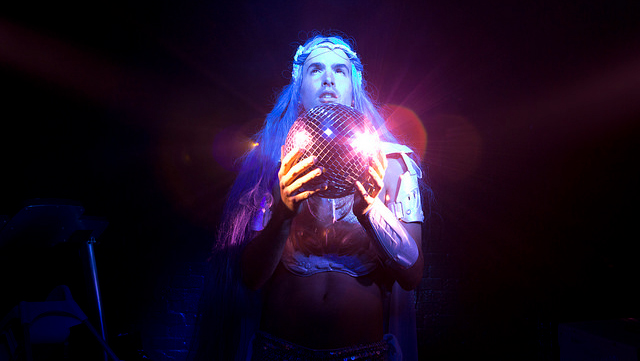
Post-apocalyptic stories are intrinsically moralistic. They make us think about our actions today that may lead to the utter devastation that is being presented. In Blue Wizard, an alien arrives from outer space but there is no longer any sign of human inhabitation. He is stranded, alone, except for an egg and its subsequent incarnations. Blue Wizard is unfamiliar with our planet but the very human-like visitor’s quest for survival and his disorientation are instantly recognisable, and our empathy for the misplaced being is effectively cultivated by an intuitively playful script by Nick Coyle. He declares upon arrival that he hails from a planet where all are gay, establishing a parallel with our own need for identity definitions based on sexuality orientation. Indeed, the one-man show is filled with cultural signifiers of male gayness and their affectations. Music by Britney Spears, Karen Carpenter and Cher add inspiration to the already camp sensibility of the artist, and his costuming, which is derivative of transvestism and drag.

The staging relies heavily on its talented team of designers to deliver a compelling context in which the action takes place. Damien Cooper’s lights are often show-stealing, and Steve Toulmin’s music and sound provide some of the most entertaining moments of the piece. Coyle’s performance is quirky and lighthearted, with the actor’s mischievous presence providing the absurd comedy with a playfulness that helps make the narrative strangely believable. His skills as a puppeteer are most impressive, with characterisations of the young aliens, Grubby and “Meryl Streep”, leaving powerful and lasting impressions. Dramaturg Adena Jacobs has guided Blue Wizard from its previous frankly bizarre manifestation when performed some seventeen months ago at PACT Centre for Emerging Artists, to its current form which is an engaging and brightly humorous show that sometimes surprises us, but always thoroughly amusing.

There is a sincere and earnest expression that underlies the frivolous tone of the production, and while its deeper meanings, if they do exist, are unclear, we do not feel as though we had been taken for a hollow ride. The moral of the story is one that the audience can decide for itself, but it is work of this nature that recalls the eternal question of whether art needs to serve any specific purpose. In other words, what is taken away from the theatre on this occasion is probably a lot more about the viewer than the creator.

www.belvoir.com.au

Review: Kill The Messenger (Belvoir St Theatre)

belvoir1Venue: Belvoir St Theatre (Surry Hills NSW), Feb 14 – Mar 8, 2015
Playwright: Nakkiah Lui
Director: Anthea Williams
Cast: Matthew Backer, Katie Beckett, Nakkiah Lui, Sam O’Sullivan, Lasarus Ratuere
Image by Brett Boardman

Theatre review
Nakkiah Lui has a sadness to share. Lui is a young Gamillaroi and Torres Strait Islander woman who has seen and experienced the extraordinary injustices suffered by our Aboriginal communities, and she brings a passionate commitment to the writing of a work that attempts to articulate the incredible complexities unique to our first Australians. She aims for truth on all fronts, because the need to expose history, emotions, hopes and confused turbulence is an urgent one, and it is clear that the expression and release of an inconceivable darkness is an imperative that resists any suppression. Lui’s script is a coherent but fragile one with seams that threaten to unravel at any moment. The difficulty of representing deep, personal wounds in text form is addressed directly in the play itself, with Lui speaking as its autobiographical protagonist and declaring the conundrum of maintaining authenticity in the process of creating a work for an audience. Indeed, the play is imperfectly structured, but its message is communicated with magnificent saliency and the poignancy it carries is exceptionally profound.

It is not the kind of presentation that provides solutions to our problems, because it works hard to avoid fiction. There is humour in much of the dialogue but the comedy is black, and the reality it makes us face is desperate and sombre. Kill The Messenger embodies a sorrow that is entrenched in many of our lands and its peoples, but it is never without hope. Lui’s fighting spirit is the loud voice that instigates every line and action, and it is one that refuses to surrender. Anthea Williams makes the right decision to place words at the very forefront of the show. Her directorial style is minimalist so that no theatrical factor is allowed to become an obfuscating agent, and all we can hear is the script, and consequently, all we see is the stark cruelty that some of our society is capable of. Performances, while not always consistent, are passionate and engaging. The strongest player is Lasarus Ratuere in the role of Paul, a tragic figure and an unfortunate stereotype perhaps, but depicted with sensitive nuance so that his humanity manifests infinitely larger than his faults. The actor’s work is impressively dynamic, with a surprising gravity barely hiding beneath an ability to portray hardship and misfortune in deceptive nonchalance. Also very moving is the playwright’s own presence on stage.  Lui can sometimes be overly animated in scenes with co-actors, but her many soliloquies are beautifully tuned. Her confidence is obvious, and her conviction, immense. When Lui speaks to (and confronts) us, her every intention and emotion reverberates, leaving us nowhere to hide.

Kill The Messenger is art at its most important and social activism at its most necessary. It is also a colourful and vibrant piece of theatre that has an irresistible power to captivate and engage. Nakkiah Lui’s work has all the bleak honesty of youth, but none of the pretension. Her play is barely resolved because she sees through the state of our affairs and recognises the dire plight that many of her sisters and brothers are living in. She does not pretend to know the way out, but her determination to find it is the foundation of this compelling work. We must cry, if only to acknowledge the undeniable grief that exists in the blood that pumps through the veins of this great continent, but afterwards, we will find clarity, if only in our hearts.

www.belvoir.com.au

Review: Radiance (Belvoir St Theatre)

belvoirVenue: Belvoir St Theatre (Surry Hills NSW), Jan 3 – Feb 8, 2015


Playwright: Louis Nowra
Director: Leah Purcell
Cast: Leah Purcell, Shari Sebbens, Miranda Tapsell
Image by Brett Boardman

Theatre review
Our relationships with parents may not all be bad, but they are certainly complex. Louis Nowra’s Radiance offers a look at the way one woman’s human errors reverberate for generations after, and accordingly, we observe the inevitable karmic inheritance from predecessors. Cressy, Mae and Nona are three sisters who have reunited in North Queensland for their mother’s funeral. Their personalities are vastly different, and there is no shortage of friction as they navigate their rare time together in the old house where they had grown up. Nowra’s script is dramatic and sensual, with an aggressive but beautiful energy that surprises in a milieu that is frequently dark and plagued with anxiety.

Leah Purcell’s direction suffers from her additional responsibilities as actor in the role of Cressy. The play is uneven, with group dynamics feeling lacklustre even though the portrayal of closeness between the women is successful. Their interchanges are believable but come across oddly tame, notwithstanding some quite sensational themes. There is an understated elegance to the piece, but it is needlessly subdued, with many missed opportunities for bigger laughs and more heightened drama. It is noteworthy however, that Purcell is able to find authenticity in the writing, and the emotions of the text are adequately played out so that we feel in touch with the essence of the narrative, despite the scarcity of a sense of theatricality.

As actor, Purcell is never convincing as an opera diva who has found success overseas, and her overly restrained interpretation not only does little to embody class, it also detracts from some of the more flamboyant sections of the play. Fortunately, Purcell’s ability to deliver gravity in key revelatory moments holds our attention, and she gives the plot an enjoyable coherence. Middle child Mae is played by Shari Sebbens whose presence is noticeably weaker than her counterparts’. Her work is focused and strong, but her depiction of seriousness can read a little dreary, and consequently, her character becomes too distant. On the other hand, the youngest role of Nona is engagingly and empathetically performed by Miranda Tapsell, who connects with us from her very first entrance. The vibrancy she introduces to her scenes is remarkable, if only that energy is sustained by the other players. Tapsell has an easy confidence that keeps us on her side, and the compassion she brings to her character allows us to believe the extraordinary circumstances we witness unfolding.

Sound design by Brendan O’Brien is thorough and thoughtful, adding a dimension to the show that facilitates the articulation of a complicated and deep emotional universe. Dale Ferguson’s set is sophisticatedly beautiful, but his design forces a substantial portion of the play to be performed quite far upstage, prohibiting us from getting more involved.

Louis Nowra’s script is undeniably rich and seductive. It deals with familiar difficulties of real life, but the world it inhabits is almost exotic. Radiance uncovers a wildness that exists in our own homes, one that hides in plain sight yet begs to be examined. Secrets are associated with shame, but it is the abandonment of shame that will ultimately set us free.

www.belvoir.com.au

Suzy Goes See’s Best Of 2014

sgs-best2014

2014 has been a busy year. Choosing memorable moments from the 194 shows I had reviewed in these 12 months is a mind-bending exercise, but a wonderful opportunity that shows just how amazing and vibrant, theatre people are in Sydney. Thank you to artists, companies, publicists and punters who continue to support Suzy Goes See. Have a lovely holiday season and a happy new year! Now on to the Best Of 2014 list (all in random order)…

Suzy x

 Avant Garde Angels
The bravest and most creatively experimental works in 2014.

 Quirky Questers
The most unusual and colourful characters to appear on our stages in 2014.

♥ Design Doyennes
Outstanding visual design in 2014. Fabulous lights, sets and costumes.

♥ Darlings Of Dance
Breathtaking brilliance in the dance space of 2014.

♥ Musical Marvels
Outstanding performers in cabaret and musicals in 2014.

♥ Second Fiddle Superstars
Scene-stealers of 2014 in supporting roles.

♥ Ensemble Excellence
Casts in 2014 rich with chemistry and talent.

♥ Champs Of Comedy
Best comedic performances of 2014.

♥ Daredevils Of Drama
Best actors in dramatic roles in 2014.

♥ Wise With Words
Best new scripts of 2014.

 Directorial Dominance
Best direction in 2014.

♥ Shows Of The Year
The mighty Top 10.

♥ Suzy’s Special Soft Spot
A special mention for the diversity of cultures that have featured in its programming this year.

  • ATYP

End

sgs-best2014a

Photography by Roderick Ng, Dec 2014

End

Best of 2018 | Best of 2017 | Best of 2016Best of 2015Best Of 2013