Review: #Lads (Kings Cross Theatre)

kxtVenue: Kings Cross Theatre (Kings Cross NSW), Jan 13 – 14, 2017
Director: Danny Ball
Cast: Callan Colley, Ryan Morgan, Ben Schumann, Ross Walker

Theatre review
Presented early in its developmental stages, #Lads is unpolished and unresolved, but like any work of art fuelled by conviction, it is ready to be interacted with. Longstanding ideas about masculinity and youth are framed within contemporary, and trendy, concepts of entitlement and privilege, for a slightly updated look at the perennial problem of manhood, as seen through social distinctions of money, race, gender and sexuality.

The show sets up contexts that are perhaps too familiar, but the questions it inspires are nonetheless potent. We are always worried about the young, because their mistakes are always spectacularly glaring. The team is thankfully very conscious of its generation’s failures, and spends the entirety of the presentation expressing all that is undesired. There is no hint however, at what a better life would look like. The rebel without a cause, it seems, is here to stay.

A more refreshing perspective that #Lads touches on, is the dysfunction friendship that exists between the four boys. We want to know what keeps them together, and what they require of each other, to satisfy their individual twenty-first century narcissisms. We are interested to know how each of their impairments differ, and the extent to which they are isolated within their fragile facade of unity.

As Australians become increasingly wealthy, the problems and difficulties of bring up our children take on new dimensions. As our lives become more liberated and autonomous, our middle-classes are able to decide to procreate only when we become confident in our ability to provide, but offspring that have never witnessed poverty and other forms of struggle, cannot be expected to understand easily, the nature of hardship, and its accompanying qualities of humility and compassion. The millennials, like everyone else, will come into their own, and as always, time is the only one who holds the key to that revelation.

www.kingsxtheatre.com

5 Questions with Jeanette Cronin and Simen Glømmen Bostad

Jeanette Cronin

Jeanette Cronin

Simen Glømmen Bostad: You have a very successful career as an actor. Did you always write as well? And how did this other side of you emerge?
Jeanette Cronin: I’ve always jotted down ideas. Scraps of paper everywhere. One day I turned one of those scraps into a story. Perhaps it was because I was older and less busy, so I started writing
things for senior chicks. I didn’t really think about that, though, I just had a little story to tell.
In I Hate You My Mother we meet four women who in some ways share the qualities of the Bean
Nighe or the Cannard Noz, the washerwomen of Irish Folklore who drown men by the riverside.

How did this interest come about?
Couldn’t tell you now. Something took me there…

What do you want the audience to be left with after watching this play?
That love is king, and if you mangle it, you mangle everything. And also the slightest glimmer of hope.

If you got your hands on one of those highly sought after time-machines, what time and place would you visit?
The Neanderthals are tempting. But then those 1930’s frocks do suit me. And there are a few famous disappearances I would like to sort out…

If you could change one thing in this world what would it be?
Everyone would have imagination. And with it, empathy.

Simen Glømmen Bostad

Simen Glømmen Bostad

Jeanette Cronin: Simen, you play five characters in I Hate You My Mother – well, four characters and a prologue. Do you have a favourite?
Simen Glømmen Bostad: Favourite? Well, there is this Dr. Carreaux, a narcissistic hypocritical new-age
psychotherapist. Just try to say it.

Is this play something you would want your mother to see?
Of course. I want my mum to see everything I do, even if it might be unpleasant or shocking to her. I think we always need to be reminded of the bad in us, not just the good.

If you had to describe I Hate You My Mother in one word, what would it be?
Radiant.

What was the last play you did in your native Norway? Is there a theatre at home that you might
describe as a sister theatre to The Fitz? We could suss about a little cultural exchange…

Last thing I did in Norway was an interpretation of Romeo And Juliet, where there were 5
actors playing Romeo and 5 actors playing Juliet. There is a really cool theatre company in Oslo called, AntiTheatre. They give Oslo a flare of something dangerous in the theatre scene. I’m a huge supporter for international collaborations. I will be able to set up a dialogue straight away if its wanted by Old Fitz.

What do you miss most about home?
Parent’s cooking and the four seasons.

Jeanette Cronin and Simen Glømmen Bostad can be seen in I Hate You My Mother by Cronin.
Dates: 24 Jan – 11 Feb, 2017
Venue: Old Fitz Theatre

Review: Nosferatutu… Or Bleeding At The Ballet (Griffin Theatre Company)

griffinVenue: SBW Stables Theatre (Kings Cross NSW), Jan 7 – 21, 2017
Playwrights: Tommy Bradson
Director: Sheridan Harbridge
Cast: Tommy Bradson, Sheridan Harbridge, Brandyn Kaczmarczyk
Musicians: Steven Kreamer, Sally Schinckel-Brown, Olga Solar
Image by Lucy Parakhina

Theatre review
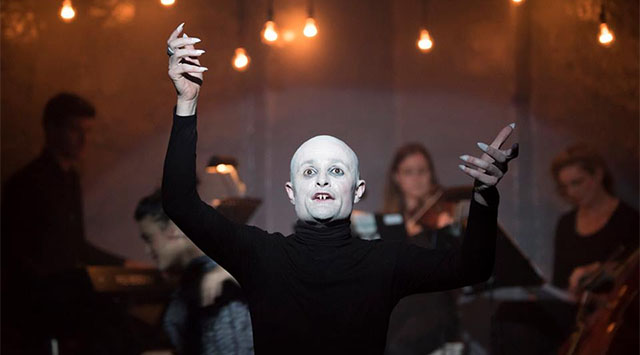
We find ourselves at a ballet performance, but a vampire hijacks the proceedings. What he offers is something entirely different from the Swan Lake that had been intended, but is no less beautiful and captivating. Tommy Bradson’s Nosferatutu… Or Bleeding At The Ballet is a tale of jealousy and unrealised ambition. It is about the manifestation of envy as a destructive force, alongside a subversive creativity that can result from the darkness of life as a struggling artist.

On stage, Bradson is an enchanting performer, a Frankenstein monster assembled from our memories of Rowan Atkinson and Marc Almond at their respective best. He wields a kind of magic that is bizarre and confusing, but mostly, it is transportative, taking us effortlessly away to, well, anywhere else but here. Bradson is no ballerina, but every gesture is seductive and powerful. His eyes are mesmerising, full of intense but unresolved emotion, and his voice, a stunning cacophony made of wild imagination and an unbridled passion for high drama.

Direction by Sheridan Harbridge is spirited and adventurous, charming in its embrace of a kind of theatrical madness that the protagonist inspires. The incorporation of live music, headed by Steven Kreamer, is highly effective, with a surprising sophistication in what it allows the production to convey. Also noteworthy are Alex Berlage’s lights and Ashisha Cunningham’s set, both impressive in their interpretation of space for this quirky but bold experiment of non-narrative storytelling.

When Nosferatutu attacks and murders his nemesis, the blood that splatters is a celebration of the avant-garde, and an expression of the innovation that all art requires. It is a messy affair, but anarchy is never convenient, and disruption is always necessary for greater meanings to be unearthed.

www.griffintheatre.com.au

Review: Prize Fighter (La Boite Theatre Company / Belvoir St Theatre)

laboiteVenue: Belvoir St Theatre (Surry Hills NSW), Jan 6 – 22, 2017
Playwright: Future D. Fidel
Director: Todd MacDonald
Cast: Margi Brown-Ash, Thuso Lekwape, Gideon Mzembe, Pacharo Mzembe, Zindzi Okenyo, Kenneth Ransom
Image by Brett Boardman

Theatre review
We meet Isa as he tries to make a new life in Australia. After experiencing years of trauma in Congo, he now focuses aggression onto the fighting ring, and as he boxes his way through flashbacks of unimaginably tough times, we witness his tragic biography unfold onstage.

Prize Fighter involves a young man making sense of the world, in order that healing and a brighter future become possible. It is also about a migrant reaching out to his adopted land, asking for understanding and acceptance. Future D. Fidel’s writing is concise and simple. The play knows what it wishes to say and says it clearly, but its inability to delve deeper into our protagonist’s psychological and emotional complexities, results in a story that has a tendency to feel generic.

Direction by Todd MacDonald gives the show exciting vigour, with an athletic cast providing a beautiful sense of visual animation. Lighting design by David Walters is creative, surprising and very polished, but the production often feels distant, or perhaps elusive. Its dim dreamlike quality seems to prevent us from connecting firmly with the characters, and we struggle to connect with an intensity that would befit Isa’s plight.

We hear about humanitarian crises, on the news every day. Reports are made by people in positions of privilege, for the consumption of people with privilege. These stories affect us all, but the stakes are infinitely higher for those seeking refuge, yet their voices are rarely heard in our cacophonous landscape of upper-class broadcast culture. Prize Fighter is a rare opportunity for a first-person account, an important contribution to unceasing discussions on who are allowed to occupy this land. If the world is one, our boundaries can only be false, but humans have always been at war, and even though utopia is only imagined, life means little if we are unable to conceive of something better.

www.laboite.com.auwww.belvoir.com.au

Review: Ladies In Black (Sydney Lyric Theatre / Queensland Theatre)

ladiesinblackVenue: Sydney Lyric Theatre (Sydney NSW), Jan 3 – 22, 2017
Book: Carolyn Burns
Music & Lyrics: Tim Finn (based on Madeleine St John’s novel, “The Women In Black”)
Director: Simon Phillips
Cast: Kate Cole, Carita Farrer, Bobby Fox, Natalie Gamsu, Madeleine Jones, Kathryn McIntyre, Sarah Morrison, Ellen Simpson, Greg Stone, Trisha Noble
Image by Lisa Tomasetti

Theatre review
There is no question that the world needs more stories about women and our solidarity. Examples of how we tear each other down are aplenty, but the ways we offer love and support need to be better envisioned in art and in life, so that we may begin to subvert systems of patriarchy that rely on our disunity to thrive.

Ladies In Black features a group of “shop girls” at a Sydney department store in the 50’s, each of them consummate professionals, all of whom get on remarkably well. There however, is little else to enjoy about the musical. Thoroughly lacklustre, unable to deliver the exuberance and glamour it wishes for its characters to portray. Its humour is underwhelming, with narratives that fail to resonate, and even though Tim Finn’s songwriting could be admired for its slightly unconventional take on the musical theatre format, much of it is uninspiring and forgettable.

For a show that makes fashion one of its central interests, the production is designed with little imagination or innovation. Choreography never offers anything more than the bog-standard, and the cast rarely looks to be challenged or excited by what they have to present. Occasional appearances by Natalie Gamsu, Greg Stone and Bobby Fox as “continental migrants” introduce moments of exhilaration, but they are few and far between.

Young Lisa confronts parochial Australia in Ladies In Black. She is at a crossroads, encountering choices that stoke her passions, versus others that feel easy and normal. We observe a blandness that can take hold, and ways of living that can pale our existences into insignificance. The women go to work everyday, and in their camaraderie, attempt to find deeper meanings to their existences, but the struggle to prevent their black clothed power from fading into a repugnant beige is ever-present, and often defeated.

wwww.queenslandtheatre.com.au

Suzy Goes See’s Best Of 2016

Suzy Goes See Best of 2016

I wrote a total of 198 reviews for Suzy Goes See this year. Sydney may not be a city that never sleeps, but our theatre community is certainly a tireless bunch that does a lot with very little, and we have so, so much to be proud of. I adore being a part of this phenomenal group of passionate individuals who share this raison d’etre. Merry Christmas to you, my dear reader, may the New Year bring wondrous gifts in abundance. Best Of 2016, here we go…

Suzy x

 Avant Garde Angels
The bravest and most creative.

 Quirky Questers
The most colourful characters.

♥ Design Doyennes
Outstanding visual design; lights, sets and costumes.

♥ Musical Marvels
Outstanding cabaret and musicals performers.

♥ Best Supporting Actors

♥ Best Ensembles

♥ Best Actors (Comedy)

Best Actors (Drama)

♥ Best New Writing

 Best Directors

♥ Shows Of The Year
The mighty Top 10.


End

Best of 2018 | Best of 2017 | Best of 2015Best of 2014Best Of 2013

Review: Babes In The Woods – Australian Purity Defil’d (Don’t Look Away Theatre Company)

dontlookawayVenue: Old Fitzroy Theatre (Woolloomooloo NSW), Dec 13, 2016 – Jan 21, 2017
Playwright: Phil Rouse
Music: Phillipe Klaus
Director: Phil Rouse
Cast: Annie Byron, Gabriel Fancourt, Sean Hawkins, Alex Malone, Eliza Reilly, Ildiko Susany
Image by Ross Waldron

Theatre review
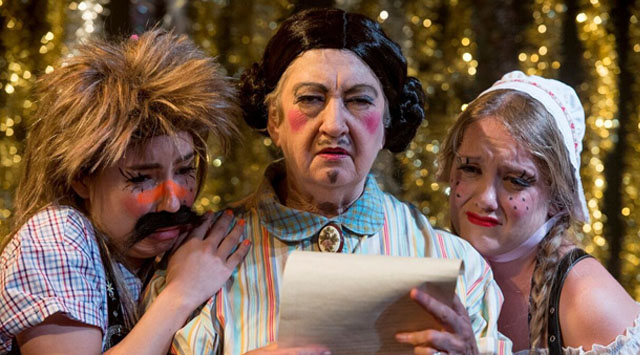
It is Christmas time, and in Australia, we go absolutely bonkers. Phil Rouse’s pantomime take on Babes In The Woods is a wild, wacky jaunt that marks the end of 2016, celebratory in tone but fiercely castigating of our ever-frustrating sociopolitical climate. If the show is a summation of the way we were, these 12 months are, once again, nothing to be proud of.

Rouse’s production however, is a triumph. Exuberant, inventive, poignant, and very funny, his creation is both frivolous and meaningful, targeting issues that concern us all, but always in the right shade of humour, no matter how dark the subject. The big and brash style of presentation allows the worst of our behaviour to be put on display, all in the name of comedy, but its need to keep things frothy can seem to diminish the severity and gravity of what is being discussed. Nevertheless, it is an admirable effort that does not forget the downtrodden, as we indulge in the unrestrained merriment and mirth characteristic of our silly season.

Phillipe Klaus’ spirited work as composer and musical director keeps the show structured and cohesive. Not all performers are impressive with their singing, but Eliza Reilly is delightfully memorable as the powerfully voiced Angel of White Privilege, allowing white children Australia-wide to act recklessly, and delivering more than a few laughs to her captive audience. Sean Hawkins is hilarious and shameless as Jack the himbo lumberjack, flexing muscles, both comedic and anatomic, to get us going. It is a remarkable cast, infectiously enthusiastic and impressive with their uninhibited creativity and imagination.

The final musical number in Babes In The Woods lampoons the lip service we often pay to the less fortunate. It makes fun of the $50 we might give to charity each month for absolution from the first-world evils that we commit. Theatre is a powerful medium, but it can also be ineffectual. Our art should always aim to do more, but if catharsis is the best we can manage on the night, there needs to be an accompanying sense of enlightenment that would take us to brighter days. A happy new year is incumbent upon how much we are able to learn from yesterday, so that tomorrow can be made better.

www.facebook.com/dontlookawaytc

Review: Route Dash Niner (Re:group Performance Collective)

merrigongVenue: Giant Dwarf (Redfern NSW), Dec 13, 2016
Written and performed by: Jackson Davis, James Harding, Mark Rogers, Steve Wilson-Alexander, Carly Young

Theatre review
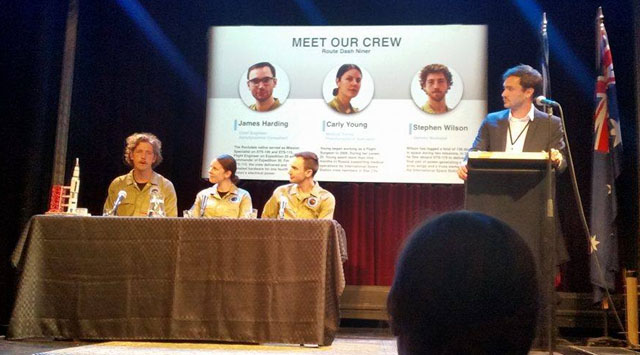
We meet a group of Australian astronauts as they prepare to travel light years into deep space. It is a formal set up, something like a press conference perhaps, where we are furnished with information on this monumental undertaking. Route Dash Niner is a very droll, very stoic work of comedy. There are certainly moments where the audience laughs out loud, but the show seems more interested in simply keeping us amused, with a sense of humour that is about a captivating subtlety, rather than relying on a standard formula of delivering one punchline after another.

The performers are incredibly serious within their deadpan approach, and coupled with the gravity of the context being manufactured, we find ourselves in a curious situation where nothing is believable, yet everything feels real. Our reaction to the details of their absurd journey oscillates between laughter and logic. We participate as audience at a comedy show for half the time, and serious journalists participating in a sombre occasion the other half. It is an unusual theatrical experience, unnerving at times but ultimately, and surprisingly, compelling.

The quiet confidence of Route Dash Niner‘s unusual humour wins us over. Its science fiction may not feature remarkable intellect, but the creators’ refusal to underestimate their audience’s level of receptiveness, as many comics are want to do, gives the show a certain sophistication. The astronauts are expected to return in six months. What happens at the next symposium is anybody’s guess, but smart money is on something funny and more than a little odd.

www.regroupperformancecollective.orgwww.routedashniner.com

5 Questions with Annie Byron and Ildiko Susany

Annie Byron

Annie Byron

Ildiko Susany: What would be one piece of advice you would give an emerging actor breaking into the industry?
Annie Byron: To thine own self be true. Train, meditate, exercise, read, forge your inner resources – you’ll need them. Pursue your passion. If the challenges start to sour your love of your craft, stop it and do something else. Persisting makes no sense if you are not being enriched by the experiences, and having fun.

How do you think things have changed for women in theatre since the time you started in the industry to now?
Well, not enough. It was astonishing to sit in those early Women In Theatre meetings last year and hear exactly the same things being said as in the Limited Life funding meetings of almost FOUR decades ago. But look! Within a year a whole Festival Fatale organised, that’s women working with women for women. Women have always supported each other. Maybe what’s changed is that companies generally take more seriously the need to be conscious of gender equity. I think we might be better organised and more articulate. I’d like to think the work of those who have gone before has made taking new steps easier. I’m not sure I can answer this question. It’s depressing that it still needs answering.

What do you think is the naughtiest part of this production of Babes In The Woods?
I think it has to be the relationship between Phyllis and Jack, with a moment of leg licking being one among numerous exquisite high points.

What is your biggest challenge in playing ‘The Dame’ (or, a woman playing a man, playing a woman)?
Before we started rehearsal, this is what I thought about most. Perhaps it says something about the level of subtlety of my performance (!) that now that we are in to it, I have kind of forgotten all about those layers, and I’m just going for a character, and for clarity of story telling. And enjoying the possibility of facial hair. There is a generous allocation of gender bending in this show, and I’m trusting it is something to be played with and enjoyed – without too much depth of thought.

If you could sing any song in this production (regardless of rights) what would it be?
“37 Babies” – the one I WILL be singing! It’s fierce and black and cheeky and political, and I adore it. Having been told repeatedly as a child that I couldn’t sing (and even instructed to mime in the school choir!) this is a major victory for me. I’m delighted that it is so steeped in the feel of Kurt Weill, and I intend to have a lot of fun with it!

Ildiko Susany

Ildiko Susany

Annie Byron: What do you experience as the things most needing to change for young women in our profession?
Ildio Susany: Gender parity. The erroneous view is that women require more training; women aren’t ready; women aren’t as talented or produce as good work as men in the industry (this is also the perception of artists of diverse backgrounds). This is completely false. We need to change this view from the outset. An example of this is that statistics show that roughly 50% of film school graduates are women and yet these women are only represented at less than 30% across all fields in the film industry. Women are in greater audience numbers than men and according to the Geena Davis Institute on Gender in Media, films with female leads made considerable more money than films with male leads. Women don’t need further training or internships – women need access to work and opportunity. Women need to be trusted for their work and skills and insights and capability in the same way that men are. Young women need to own this conversation. Be a part of Women In Theatre & Screen (WITS) and Women In Film and Television (WIFT). The industry is not a meritocracy – unconscious bias and notions of historic gender roles are still in effect today. We need to work together to change this.

Working with full commitment for little or no money, what makes being in an ‘independent’ production worthwhile?
Independent theatre is a place where artists can test their muscle, take risks and break new ground. I think this space can be the best for creating change and bringing major issues to light. I perform in independent theatre and create independent productions because I love to work, I love to be able to tell the stories that I want to tell (stories which may not be featured on the mainstage); stories which might be more inclusive and reflective of our society in terms of gender and diversity and the issues that we need to be exploring in society.

What is the best thing about being in our panto, Babes In The Woods?
The team. I’m working with some of the best artists, actors and creatives who are highly astute with excellent comic timing! It is a joy to play and improvise in this work space. I also love the themes and politics explored in this play which are centred on Australian identity and landscape.

What do you most enjoy about playing a male role?
My favourite part about playing the male role of Robbie is debunking the myths of masculinity and exploring issues of feminism, white privilege and male privilege from my perspective as a woman of colour.

Can you name 5 roles you would like to play by the time you are 60?
Lady Anne. Lady Macbeth. Eliza Schuyler Hamilton or Angelica Schuyler. Any other strong and complex female character – who might have to do some stunts or fight choreography!

Annie Byron and Ildiko Susany can be seen in Babes In The Woods by Phil Rouse (based on the good works of Tom Wright).
Dates: 13 – 21 Dec, 2016 and 6 – 21 Jan, 2017
Venue: Old Fitz Theatre

Review: The Taming Of The Shrew (Montague Basement)

montaguebasementVenue: PACT Centre for Emerging Artists (Erskineville NSW), Nov 29 – Dec 10, 2016
Playwright: William Shakespeare
Director: Caitlin West
Cast: Travis Ash, Tel Benjamin, Robert Boddington, Sam Brewer, Hannah Cox, Jane Watt
Image by Zaina Ahmed

Theatre review
Shakespeare’s The Taming Of The Shrew is about society’s need to subjugate women. The play takes issue with Katherine, characterising her as headstrong and troublesome, a young woman to be brought under control. The plot is kept basically the same under Caitlin West’s direction, but comedy is turned into tragedy in her version of events.

The production is a heavily edited, compressed revision of the, now objectionable tale. A more detailed approach to Katherine’s and her beau, Petruchio’s perspective backgrounds would allow us to feel more involved in the story, but the main concern here is the argument between West and Shakespeare, between where we are today and how we had been yesterday. The ideas are simple but powerful, and although the methodology would benefit from finding more nuance in its expressions, the resultant show is nonetheless, an exciting one.

There is good conviction from the actors who take the stage. The rapidity of their performance keeps things enjoyable, but by the same token, we are prevented from getting to know any of the characters very well. Robert Boddington and Hannah Cox are combustive as the lead couple, both passionate for the work, and able to achieve a valuable volatile connection that gives the show its dangerous, astringent quality.

We can leave the past behind, but have to acknowledge its influence on how we think and behave. In order to move forward, we must look back and address history. This cyclical concept of time requires that the scars we carry are being attended to, in order that progress may be found. Much of Shakespeare’s legacy involves the ugliness of humanity. Each generation of theatre makers that comes along will have amongst them, those who fall for the Bard’s words, and who must bear the burden of his failures.

www.montaguebasement.com