Review: (Extra)ordinary, (Un)usual Episode III (The Monologue Project)

themonologueprojectVenue: New Theatre (Newtown NSW), May 13 – 27, 2015
Playwright: Pete Malicki
Director: Pete Malicki
Cast: Debbie Neilson, Glenn Wanstall, Luke Reeves, Matt Friedman, Raechel Carlsen, Rosemary Ghazi, Tiffany Hoy, Yannick Lawry, Miss Suzie Q

Theatre review
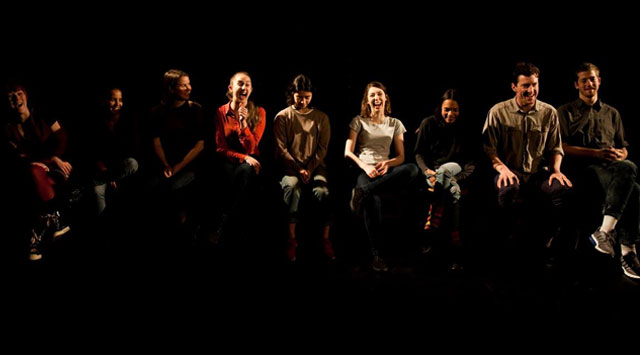
The production comprises eight monologues, all written and directed by Pete Malicki. His writing is mainly concerned with the ordinariness of Australian lives, but he delves into fantastical inventions on occasion, to create stories that aim to entertain and amuse. Malicki finds the small and mundane parts of existence and places them in the spotlight. His characters all seem neurotic, as their solitude allows them to reveal their deepest idiosyncrasies. The programme is a light-hearted one, with little room for gloom or poignancy, but it does offer social observations through sarcastic jabs and slapstick comedy.

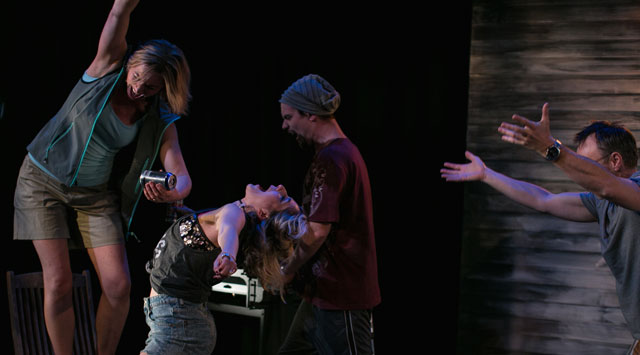
Malicki’s direction is not particularly versatile, but he ensures that each segment is energetic and vibrantly quirky. He has a knack for extracting confident and quite wild performances from his cast, all of whom appear to bubble with excitement when placed centre stage. Glenn Wanstall’s performance in That Time Harold Borgenstein Went Speed Dating And Got Taken Over By All Of The Greek Gods, is impressively athletic and irresistibly funny. The actor’s intuition is remarkably precise, and the level of conviction he displays is entirely captivating. The piece is somewhat pointless, but it serves as a secure platform for Wanstall to present some of the most outrageous and flamboyant spectacles one is likely to encounter.

Artists often need boundaries to instigate the creative flow, and in Malicki’s case, the short monologue format is a framework that he is clearly very comfortable in. His ability to find tension and humour within his preferred structure is well-honed, but like the faces in his cast, greater diversity is required. Presenting eight works together is an appealing idea, and as much as it is a showcase of one’s strengths, it is able also to unwittingly expose one’s weaknesses. Malicki may not speak universally, but he is certainly an expert in his chosen field.

www.monologues.com.au

Review: Decay (Eclective Productions)

eclectiveVenue: Old 505 Theatre (Surry Hills NSW), May 19 – 24, 2015
Playwright: Melissa Lee Speyer
Director: Rachel Chant
Cast: Joel Horwood, Rosie Lourde
Image by Pamela Amores

Theatre review
The act of storytelling can sometimes be more interesting than the actual content being shared. This is an important feature of theatrical experiences, because original stories are hard to come by, but finding new ways to relay old tales is what keeps us challenged and excited. Melissa Lee Speye’s Decay experiments with timelines and plot structures, using very little words, to create a work that depicts the human condition in a truthful but unusual light. The context involves death and disaster, but the production is not particularly moving. Instead, it connects with our curiosity and intellect for a seventy-minute journey that is more cerebral than visceral. It interacts with us by prompting a series of questions that may be about the characters on stage, but mostly, of the world in general.

Centre stage is Joel Horwood, who takes on the challenge of portraying extreme emotions but without the indulgence of a conventional narrative flow. The actor manufactures tension well, and it is clear to see that he invests heavily into the role’s emotional arc. Horwood is dynamic and focused, but the mysterious nature of the play prevents us from getting too caught up with the protagonist in all his drama. Direction by Rachel Chant gives the production a tautness in pace and atmosphere, and her commitment to an unconventional and sometimes surreal theatrical form is refreshing and quite courageous. Nate Edmondson’s sound design is cleverly imagined, and beautifully realised. Without many spoken lines to occupy our minds with, Edmondson’s contribution takes on greater importance than usual. More than any other element of the show, it is the sound that provides us with the information required to help make sense of the intriguing chaos that unfolds.

Toying with conventions is always risky, and in the case of Decay, it ticks many boxes but leaves us cold. It does not entertain sufficiently, but it satisfies in other ways. With a defined artistic vision, we are impressed by the way it bends rules and negotiates boundaries. There is good work to be admired herein, and like most daring ventures, it will unsettle a little, and at times, it might even disappoint, but we can be certain that what is served is not rehashed rubbish rolled in glitter or painting by numbers, which is very comforting indeed.

www.facebook.com/EclectiveProductions

Review: The House Of Ramon Iglesia (Mophead Productions / Red Line Productions)

mopheadVenue: Old Fitzroy Theatre (Woolloomooloo NSW), May 12 – Jun 6, 2015
Playwright: José Rivera
Director: Anthony Skuse
Cast: Christian Charisiou, Deborah Galanos, Nicholas Papademetriou, Ronny Jon Paul Mouawad, Stephen Multari, Eloise Snape, David Soncin
Image by Clare Hawley

Theatre review
No man is an island. We need to feel a sense of belonging, not only with other people, but also with places. José Rivera’s The House Of Ramon Iglesia investigates the significance of ancestry and roots, through the experience of Puerto Rican migrants in 1980 New York. The Iglesia family is dislocated in a space between San Juan and Holbrook, and its two generations illustrate the complexity of human attachment to a sense of country and home. In our modern times, populations are in constant flux, and the arbitrariness of borders is negotiated to allow for opportunities and interested parties to collide. The matter of nationalities is no longer a straightforward concept for many, and Rivera’s work questions its importance and indeed, its relevance to individual lives.

Anthony Skuse’s direction of the piece is a passionate rendering that delivers an engaging and energetic theatre, but our empathy for its characters only arrives several scenes after it begins. Early sequences feel distant, perhaps a result of their estranged temporal and geographic contexts. Its themes take time to connect, and even though many of its ideas can be universal, we only recognise them after some investment of imagination and patience, but when the show shifts into a gear of high drama, the play becomes a dynamic one, with performances that impress with emotional depth, and a compelling cast chemistry that creates an extraordinarily believable family unit.

When actors are focused and psychologically accurate, we surrender our trust and follow their journeys without hesitation. Deborah Galanos’ intensity gives her Dolores an admirable strength and although quite flamboyant in her approach, we do not question the authenticity of what is being presented. The melodrama Galanos introduces is delightfully entertaining, and allows the actor to expand her characterisation beyond the scripted lines, so that who we meet is greater than an archetypal maternal figure. In the smaller role of Charlie is David Soncin, whose memorable performance is coloured with a natural exuberance and an effortless magnetism. He plays his role with clear and simple intentions, but always discovers powerful subtleties that add surprising dimension to his work. Stephen Multari’s conviction and emotional sonority is a highlight in many scenes of confrontation and feuding. Javier’s inner world is central to the effectiveness of the play, and Multari’s depiction of it is beautifully resonant. The actor’s vigour and earnestness however, can seem out of place in the show’s more tranquil moments, and opportunities are missed that could allow the character to be more endearing, so that we care more about the lead and all the people surrounding him.

When we think of identity, we inevitably go to beliefs about bloodlines and origin. Place is important, but how we manufacture meaning between lived experience and geography is idiosyncratic and personal, yet collectivism is always a part of the discussion. We talk of nations of peoples, and we talk of partners and kins. Rivera’s story is about that conundrum, not just of how we use identity labels, but also how these labels intersect between friends and family. Each person can have an intimate and private understanding of their own space in the big scheme of things, but arbitration will always exist, even for the strongest.

www.oldfitztheatre.com | www.mophead.com.au

Review: The Dream (The Australian Ballet)

ausballetVenue: Sydney Opera House (Sydney NSW), Apr 29 – May 16, 2015
Choreographer: Frederick Ashton (reproduced by Francis Croese)
Image by Daniel Boud

Theatre review
Frederick Ashton’s adaptation of Shakespeare’s A Midsummer Night’s Dream distils all the magic and fantasy of Titania and Oberon’s Fairyland, and uses the ethereal qualities of ballet to provide lyrical expression. Familiar characters are vividly brought to life in dance form, with performers from The Australian Ballet investing in their roles surprising colour and fitting charm. Particularly engaging is Chengwu Guo as Puck, whose powerful and nuanced work is an effervescent highlight of the production.

Retaining original visual design elements for the programme is perhaps unexpectedly effective, especially for Ashton’s Symphonic Variations, which is presented as a prelude to The Dream. Sophie Fedorovitch’s delightful set and costumes for the 1946 piece looks as modern today as it must have seven decades ago, with a stunning backdrop reflective of the early emergence of post modern design at the end of the second World War and in the wake of the Art Deco movement. Ashton’s work features six dancers, all of whom remain on stage for its entire duration, and although adventurous and dynamic by nature, its presentation on this occasion seems too aloof, and energy levels too consistent, to portray the multi-dimensional qualities of its choreography.

The first (of three) Ashton works in the schedule is Monotones II, created in the mid 1960’s to the music of Erik Satie. With just three dancers and a disarming starkness to its visual language, the piece is absolutely unforgiving, and requires of its performers, the utmost in precision, focus and cohesion. When moments coalesce, we obtain the kind of sublime beauty that we seek of the art form, and as inevitable imperfections reveal themselves, one is reminded of the “wabi-sabi” philosophy from Japanese aesthetic principles. Absence makes the heart grow fonder, but it also gives greater meaning to the rest that are present. Perhaps more than any other discipline, ballet’s incessant pursuit of perfection is fundamental to its very meaning and existence. For those of us who deny the possibility of perfection (and hence probably not possess the traits required of professional dancers), it is that very act of pursuance that appeals. The spirit is always willing and pure in our best performers, so even if the body can never live up to our abstract fabrications, what we witness in good theatre is always that passionate belief in something greater, something borne of the brave hearts of our most courageous idealists.

www.australianballet.com.au

Review: Storm Boy (Barking Gecko / Sydney Theatre Company)

Venue: Wharf 1 Sydney Theatre Company (Walsh Bay NSW), Apr 24 – May 17, 2015
Playwright: Tom Holloway (based on the book by Colin Thiele)
Director: John Sheedy
Cast: Jimi Bani, Julian Garner, Kai Lewins, Rory Potter, Phil Dean Walford, Anthony Mayor
Images by Brett Boardman

Theatre review
Christians believe that “Man is more valuable to God than animals,” and “men were created in the image of God”. Indeed, humankind often thinks of itself as separate from nature, and superior to it. We then give ourselves permission to devour and ravage the planet as though a commodity at our disposal, without its own rights and destinies. Colin Thiele’s book Storm Boy was published in 1964, and in 1976, its film version was released. Theatre productions are staged regularly to introduce new generations of children to the story, and its lessons, not only of environment conservation, but also of death, grief, and for Australian audiences, the relationship between Aboriginal and European cultures on our land.

John Sheedy’s direction of the piece is intelligent, creative and tender. It is a soulful rendition of an innocent tale that can touch the hardest of hearts. The expert level of stagecraft being incorporated is sophisticated and dynamic, with its puppetry elements a breathtaking stand out. Phil Dean Walford and Anthony Mayor are dancers who provide an indigenous omnipresence to the show, while simultaneously, and marvellously, operating the pelicans that share centre stage with its protagonist. Peter Wilson is Puppetry Director, and along with Michael Scott-Mitchell who is designer for set, costumes and the puppets, their artful vision is successfully translated to convey Thiele’s magical tale with great poignancy. Lighting Designer Damien Cooper and Sound Designer Kingsley Reeve both contribute extraordinarily inventive work that help form a fantastical experience that is truly amazing.

The lead role of Storm Boy is played by Rory Potter who impresses with an almighty focus and a deep understanding of his character’s journey. We see him completely absorbed, and believe unreservedly in all that he portrays. His father Tom is performed with subtle complexity by Julian Garner, an efficient and restrained actor who manages to reveal a world of emotion with a beautifully minimal approach. Jimi Bani is the boy’s mentor and friend, Fingerbone, an animated and passionate personality manifested by Bani’s excellent use of gesture and movement. Chemistry between the cast is natural, strong and joyful. Together, their work is consistently engaging, in a show that speaks intimately to our humanity and remarkable in its capacity to move us. Theatre can do many things, but one of its greatest accomplishments is to remind us of the enormity and largesse of the universe, beyond our selfish daily concerns. Life is meaningless when we refuse to look at the big picture, and that is exactly what Storm Boy wants us to see.

www.barkinggecko.com.auwww.sydneytheatre.com.au

Review: Antigone (Théâtre Excentrique)

theatreexcentriqueVenue: PACT Theatre (Erskineville NSW), Apr 23 – May 2, 2015
Playwright: Jean Anouilh (translated by Kris Shalvey and Anna Jahjah)
Director: Anna Jahjah
Cast: Roslyn Blake, Kate Fraser, Kirsty Jordan, Aurora Kinsella, Karl Kinsella, Philippe Klaus, Neil Modra, Gerry Sont, Ellen Williams, and students from Blacktown Girls High

Theatre review
The word “wilful” is usually applied to the young, along with connotations of idealism and immaturity. We think of them as “not knowing any better” to explain away their inconvenient behaviour. The lead character in Jean Anouilh’s Antigone is all of the above, but she is also virtuous. Like us, her world is one that has too many things gone awry, yet everyone is required to stick to its rules in order that an illusory sense of order can be preserved. Anarchic activity is often classed criminal, regardless of intentions good, bad or ugly. This twenty year-old woman knows the dire consequences that await but she is fearless, and proceeds to do what she believes to be right. Anouilh’s version of the Greek tragedy is passionate, philosophical and political. It is a stirring piece of writing that provides inspiration for the way we make choices, and the way we create theatre. Its incorporation of a chorus and narrator allows for ideas to be articulated directly, while sequences of realism (beautifully preserved in this English language translation by Kris Shalvey and Anna Jahjah) puts us in scenarios that feel familiar in spite of their contextual distance.

Direction of the piece by Jahjah is energetic and suitably expressive. The use of a chorus comprising only of young girls, puts focus on the dimension of gender in the play’s arguments. All dressed in white, their innocence and purity of spirit are the physical embodiment of the text’s key motifs. Use of space is inventive and thoughtful. Characters are positioned freely within the dynamically designed space, and their movements contribute to the depiction of emotional states and of narratives unfolding. Jahjah’s work may not always be affecting, but her production is a surprisingly entertaining one.

Ellen Williams is impressive as our heroine, with a deeply authentic fury and righteousness that gives the show its poignant foundations. We share Antigone’s beliefs, and are thrilled to see her fighting with conviction and wild abandon. Williams shows glimpses of tenderness and sadness that helps us connect with her role’s humanity, but these do not surface often enough. The cast works well to keep us amused and engaged, but many of the key roles are not explored with enough complexity and nuance. Creon is Antigone’s uncle and adversary, whose strong oppositional points of view raise the stakes and add to the drama, but Neil Modra’s work, while exuberant and charmingly idiosyncratic, does not convey his character’s beliefs with sufficient clarity. The central struggle of the show then becomes unbalanced and disappointingly, weakened.

There are many things we want for our children, but courage is not always at the top of lists. We are afraid of what might result, and prefer instead for them to grow up cautious, sensible and safe. It is our responsibility after all, to be their shelter from harm. In Antigone, honour comes at a price, although glory is nowhere to be found. In a tragedy where nobody wins, the moral of the story can be ambiguous. The value of a life is usually determined by how well we live it, and how long we are able to experience it. Only in rare cases are we able to judge a life by the legacy it leaves behind.

www.theatrexcentrique.com

Review: Ali McGregor’s Alchemy (Hayes Theatre Co)

alimcgregorVenue: Hayes Theatre Co (Potts Point NSW), Apr 21 – 26, 2014
Musical Director: Sam Keevers
Cast: Ali McGregor

Theatre review
Ali McGregor has the kind of talent that we all wish to have. She is a singer who can sing anything across every genre, and she does them all incredibly well. In Alchemy, she showcases her frankly amazing ability at opera, rap, pop, rock, and all shades of jazz. There is nothing her voice is incapable of, and everything sounds authentic. Switching from musical theatre torch songs to hip hop à la Salt-N-Pepa is entirely effortless for McGregor. We never feel that the performer is more comfortable in one style than another, and the confidence she presents with each number is thoroughly enthralling and quite overwhelming.

When the diva sings, we are captivated and suspended in a timeless space; we lose ourselves and all our cares evaporate. McGregor says that Alchemy is about turning trash to treasure. The set list includes well known chart hits from the 80’s and 90’s, but rearranged to fit a jazz cabaret mode featuring Sam Keevers on the piano, Jonathan Zwartz on double bass and Tim Firth on drums. The programme is beautifully paced and constantly surprising, with an enjoyable juxtaposition of the familiar with the unexpected, providing amusement and delight. McGregor is a keen entertainer who engages her crowd with gestures and glances, and a lot of talking between songs. She is without question, a funny lady, and uses comedy well to create contexts for song choices, but unlike the music, her style and content of her chit-chat can become repetitive. She also shies away from more serious moments, frequently introducing a self-deprecating humour that is sometimes charming, but can also be disruptive. McGregor is capable of a lot of beauty with her presence and performance, and should allow more of her sublime qualities to resonate, instead of reverting to a persistent display of modesty and down-to-earthness.

It must be noted that lighting design for the show is inventive and very dynamic, transforming the simplest of stagings into something quite visually stunning. Sound however, does not show off McGregor’s range with enough effectiveness. The singer sounds impressive through the venue’s speakers for most of the duration but when she belts the bigger notes with her extraordinary power, the technical facilities seems to falter, losing dimension at these crucial points. Fortunately, the star’s determination and infallibility smooths over every flaw, and we cannot help but stay in love with her until the very end.

www.hayestheatre.com.au

Review: Vice (Emu Productions)

emuproductionsVenue: King Street Theatre (Newtown NSW), Apr 21 – May 9, 2015
Playwright: Melvyn Morrow
Director: Elaine Hudson
Cast: Margi De Ferranti, Jonathan Deves, Roger Gimblett, Christopher Hamilton, Jess Loudon, Benjamin McCann

Theatre review
Writing a play about hot topics of the day is a delicate operation. Reiterating dominant schools of thought without adding new perspectives will make the work seem lightweight and redundant, but proffering alternative ideas can be dangerous, especially when the issue is a sensitive one. Melvyn Morrow’s Vice joins the very contemporary discussion on the sexual assault of children by authority figures in religious institutions. We meet Jasper, a manipulative eighteen year-old who uses his burgeoning sexuality as currency, and the guardians at his affluent high school who exploit their custodial positions over students in their care. The illusion of consent that exists between people in hierarchical organisations become further complicated by the issue of age. Society acknowledges a certain legal age where people become adults, but within the paradigm of school and family, we believe in a sacred sense of protection that must prevail for all our daughters and sons. Morrow writes with an ambiguity that inspires thought, and although unlikely to change anyone’s moral position, his story opens up points in a hackneyed argument that may have been previously overlooked. The play’s structure is engaging and tight, with character transformations and edgy dialogue that provide drama and intellectual stimulation.

Direction by Elaine Hudson is punchy and passionate, and although personalities are not always convincing, their narratives are conveyed with enough clarity so that the plot retains its complexities without losing too much coherence. Morrow’s script is often witty, but comedy is not handled well in the production. The cast is under-rehearsed with an inordinate frequency of actors tripping over lines, and several key roles are approached with insufficient depth, resulting in emotions that lack accuracy. The play is situated in modern day Sydney, but its speech emulates an artificial upper class affectation that seems to have been awkwardly derived from mid twentieth century English film and television, that can occasionally cause a troubling dislocation of space and time. On a brighter note, all performances are energetic, with an enjoyable urgency that holds our attention. Playing Olivia Fox is Jess Loudon who attacks with conviction and a charming boldness. Her part is simpler than the other darker characters, but Loudon brings nuance and texture to create a presence on stage that the audience can relate to.

Societal progression involves the dismantlement of old organisations that have proven themselves contrary to democratic ideologies. The pervasiveness and influence of religion in our lives run thorough and broad. Many profit from archaic power structures, and are determined to sustain them by deceptive and cowardly means. The rich and powerful choose a status quo that requires poverty and powerlessness to exist, so resistance and change can only occur at snail place (if at all). Communities are divided and conquered by a 1% of humanity, that insist we continue to participate, knowingly and unconsciously, in all the rituals of daily life that perpetuate our own oppression, in ignorance and isolation. Only when we find an appetite for destruction big enough and brave enough, that revolution can happen. There is a gentle flame in Vice that can inspire, and perhaps provide a spark that can lead to a solution for these disturbing circumstances that we should all be very concerned about.

www.kingstreettheatre.com.au

Review: Deathtrap (Darlinghurst Theatre Company)

darlinghursttheatreVenue: Eternity Playhouse (Darlinghurst NSW), Apr 10 – May 10, 2015
Playwright: Ira Levin
Director: Jo Turner
Cast: Timothy Dashwood, Drew Fairley, Sophie Gregg, Andrew McFarlane, Georgina Symes
Image by Helen White

Theatre review
In Ira Levin’s Deathtrap, the chief ingredient for a hit theatre show is thought to be the script on which a production is based. The characters scheme and struggle to find a golden ticket that would lead to fame and fortune on Broadway, believing that nothing is out of bounds in that pursuit. Murder and betrayal are but part of the process in their creation of a smash manuscript. Levin’s own writing is witty and wild. His comedy is derived from an enthusiasm for irony, which finds its way through the entire text. Nothing can be taken seriously, yet everything rings with a hint of truth.

Jo Turner’s direction of the production is suitably morbid, and in spite of its outlandish contexts, he ensures that the personalities we meet are always believable. The plot makes good sense under his guidance, but tension never quite reaches a feverish pitch, and the humour is oddly subtle. Mystery and thriller elements are more effectively manufactured, with substantial assistance from composer and sound designer Marty Jamieson whose work here is unquestionably outstanding. Also delightful is Michael Hankin’s set, which introduces a sophisticated aesthetic to the stage, and establishes a very elegant solution to the show’s many entrances and exits.

Leading man Andrew McFarlane owns the stage with a larger than life presence as the conceited celebrity playwright, Sidney Bruhl. McFarlane works beautifully with the cynical tone of Levin’s writing to acknowledge the theatrical self-awareness of the play and to invite us along to its in-joke style of presentation. He is ably supported by Timothy Dashwood who brings energy and conviction to his role as the young apprentice writer, Clifford Anderson. The cast connects on a level of narrative accuracy, but there is little comic chemistry to be found. There is a flamboyant spirit at the heart of the material that its actual execution does not always live up to.

Scripts are often the starting point of a show, but no amount of genius writing can guarantee an impressive live experience. Deathtrap seems to have all the qualities of a gripping and intelligent comedy/thriller, but what actually happens on stage, although amusing, is not very powerful. The play talks a lot about ambition, and the team that has put this version together is clearly aiming at something quite spectacular, but its landing spot is not quite as planned.

www.darlinghursttheatre.com

Review: Haircuts (Mantouridion Theatre)

haircutsVenue: Mantouridion Theatre (Marrickville NSW), Apr 15 – 26, 2015
Playwright: Con Nats
Director: Lex Marinos
Cast: Demitra Alexandria, Valentino Arico, John Derum, Barbara Gouskos, Adam Hatzimanolis, Richard Hilliar, Tim Ressos

Theatre review
Successful plays encapsulate a slice of life and represent to its audience something meaningful. Con Nats’ Haircuts is an ambitious work that tries to bring many different threads together, revealing a hunger to tell many stories and an urgency for committing a wealth of ideas to the stage. Its narrative style is conventional, but its structure is less so. Focus shifts regularly, and subplots become overwhelming, resulting in a disorienting uncertainty about the show’s main plot and its centre. There is a big emphasis on multiculturalism, which although interesting, does not contribute directly to the way key narratives unfold. Machismo is also explored thoroughly, and frequently used for laughs, but it contributes to an uncomfortable gender imbalance where all the women in the play are constantly defined against their husbands, fathers and sons.

Direction of the work by Lex Marinos is a passionate effort, and individual scenes are carefully explored, but the production does not assemble into a cohesive whole. The awkward imbalances between amusing asides that take up too much time, and poignant character developments that go past too gently, cause important elements to lose clarity and the play can often seem undecided about what it intends to convey. Performances are uneven but strong players include Barbara Gouskos who brings a beautiful gravity to the role of Angela, delivering a convincing, albeit brief, portrayal of a woman who has experienced very dark days. Her measured approach is authentically emotional and with it, she introduces to us a special and resonant moment of shared humanity. Richard Hilliar’s Stanley is a quiet and tender contrast to the clamorous goings-on, and offers up the only well-rounded personality in a throng of unoriginal stereotypes. His chemistry with co-actors can be improved, but the actor does his best to anchor the show in a position of subtlety that helps us relate to the world being depicted.

The production requires distillation, but even in its imperfect form, it is not without strengths. Some of the dialogue is beautifully deep, and much of the acting is energetic and earnest, in fact it might be said that there is often too much of a good thing, which could only lead to the ridiculously obvious conclusion that Haircuts needs a bit of shearing.

conats.wix.com/haircuts