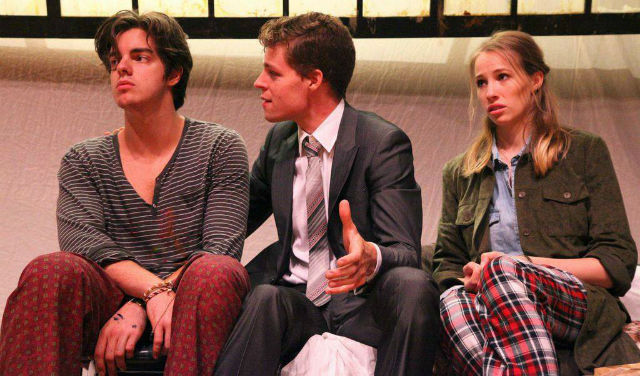
5 Questions with Anna Colless

annacollessWhat is your favourite swear word?
I heard a friend say fudgeknuckles the other day and I’ve rather taken to it. Mostly because I can’t figure out what on earth inspired her to come up with it.

What are you wearing?
A luxurious fur, elbow-length gloves and a suave new hat. Oh wait that’s not a mirror, that’s a painting… Nevermind.

What is love?
Love is everything.

What was the last show you saw, and how many stars do you give it?
I saw Doorstep Arts’ production of Next To Normal at the Hayes Theatre, and I’d give it a solid 4 stars. Or to put it another way, 1 star for every time I was moved to tears. It was a phenomenal show.

Is your new show going to be any good?
If the little I have seen so far is anything to judge by, it’s going to be a heck of a lot more than good! You really don’t want to miss this chance to see such an incredible show performed by what is truly a stellar cast!

Anna Colless is in A Little Night Music by The Sydney University Musical Theatre Ensemble.
Show dates: 25 -28 Mar, 2015
Show venue: Seymour Centre

Suzy Goes See’s Best Of 2014

sgs-best2014

2014 has been a busy year. Choosing memorable moments from the 194 shows I had reviewed in these 12 months is a mind-bending exercise, but a wonderful opportunity that shows just how amazing and vibrant, theatre people are in Sydney. Thank you to artists, companies, publicists and punters who continue to support Suzy Goes See. Have a lovely holiday season and a happy new year! Now on to the Best Of 2014 list (all in random order)…

Suzy x

 Avant Garde Angels
The bravest and most creatively experimental works in 2014.

 Quirky Questers
The most unusual and colourful characters to appear on our stages in 2014.

♥ Design Doyennes
Outstanding visual design in 2014. Fabulous lights, sets and costumes.

♥ Darlings Of Dance
Breathtaking brilliance in the dance space of 2014.

♥ Musical Marvels
Outstanding performers in cabaret and musicals in 2014.

♥ Second Fiddle Superstars
Scene-stealers of 2014 in supporting roles.

♥ Ensemble Excellence
Casts in 2014 rich with chemistry and talent.

♥ Champs Of Comedy
Best comedic performances of 2014.

♥ Daredevils Of Drama
Best actors in dramatic roles in 2014.

♥ Wise With Words
Best new scripts of 2014.

 Directorial Dominance
Best direction in 2014.

♥ Shows Of The Year
The mighty Top 10.

♥ Suzy’s Special Soft Spot
A special mention for the diversity of cultures that have featured in its programming this year.

  • ATYP

End

sgs-best2014a

Photography by Roderick Ng, Dec 2014

End

Best of 2018 | Best of 2017 | Best of 2016Best of 2015Best Of 2013

5 Questions with Candy Royalle

candyroyalleWhat is your favourite swear word?
Cunt. But I don’t use it to swear. I use it for what its meant for – simply another name by which we call that part of a woman’s body. CUNT. You should say it right now – let it roll around in your mouth for a second. Nice and slow like. C U N T. See? It’s not that bad is it? In fact, it’s rather nice sounding…

What are you wearing?
Acid wash shorts, boy cut underwear in the colour of black, denim shirt (yes, I love double denim), black lace bra. Oh wait. Do you mean what labels am I wearing this season? Was that too much information?

What is love?
The essence of being human. Our single saving grace. It’s what separates us from the monsters we detest (those reflections we abhor). It’s the action of conscious beings. It is a radical act. It is my meaning of life.

What was the last show you saw, and how many stars do you give it?
Is This Thing On? at the Belvoir. 3/5 stars.

Is your new show going to be any good?
It’s going to be so good, that if you don’t like it, I’ll give you your money back (after costs).

Candy Royalle is appearing in Frida People, alongside Sloppy Joe and Betty Grumble.
Show dates: 20 Nov – 4 Dec, 2014
Show venue: Seymour Centre

Review: Journey’s End (The Theatre Troupe)

theatretroupeVenue: Seymour Centre (Chippendale NSW), Oct 21 – Nov 15, 2014
Playwright: R.C. Sherriff
Director: Will Usic
Cast: Andrew George, Will Usic, Yannick Lawry, Jack Douglas, Jeremy Bridie, Richard Cotter, Ian Bezzina, Jim Robison, Steve Tait
Image by Toby Zerna

Theatre review
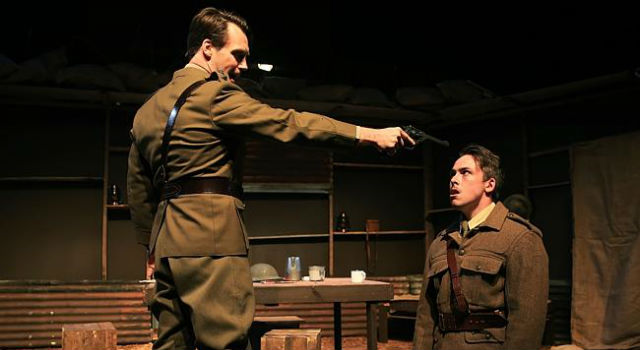
Journey’s End was first performed in 1928, ten years after the end of World War I. Its playwright R.C. Sherriff based the play on his experiences as a British officer in the trenches, and what he had provided is a perspective that feels unusually personal and specific. Focus is moved from the big picture of ideology and territories, to looking at individual lives of those “boots on the ground” as they try to cope with persistent threat, danger and fear.

Will Usic’s work in directing actors is strong. He extracts thoughtful performances from the entire cast, and all are able to instil in their portrayals something that feels genuine and dignified. There are some issues with plot that indicate a need for the very long text to be edited, and while many character interchanges are dynamic and moving, several scenes of dialogue fail to ignite. Poetic license is required but not often utilised in the production. Sherriff’s writing is borne out of stiff upper lip England, so sentiment and passion are extremely restrained, and can make for uncomfortable viewing by today’s conventions.

Usic in the role of Osbourne is the stand out performance of the piece. He is palpably present, and sensitively conscious of conveying the very subtle emotional shifts that exist in those highly precarious situations of battle. His reactions to his comrade’s lines reveal as much as the words themselves do. Also engaging is Yannick Lawry’s humorous take on Trotter, who brings charming levity to the grave proceedings. Lawry pitches his character’s jolliness just right, so as to deliver comedy but also to retain the dark qualities of the narrative. Young Raleigh is played by Jack Douglas with excellent conviction, who maps out the part’s evolution beautifully and convincingly. Leading man Andrew George is believable as Captain Stanhope, with his effortlessly domineering stature, but there is a monotony to his depiction of the role’s depression that detracts from the dramatics of the production.

Set design (uncredited) is ambitious and effective. The stage is pleasantly transformed, and acting space is elegantly accommodated. Sound design (also uncredited) and Toby Knyvett’s lighting are under-explored in the first two acts, which adds to the aforementioned monotony, but both are intelligently conceived and executed thereafter to represent the horrific destruction of lives at war.

There is a delicate balance to be found when discussing the honour of people who serve in battle. Journey’s End does not glorify war, but it shows camaraderie at its deepest. The exaltation of those who have sacrificed can be worthwhile, but the condemnation of war must prevail.

www.facebook.com/TheTheatreTroupe

5 Questions with Phil Rouse

philrouseWhat is your favourite swear word?
OhForFucksake.

What are you wearing?
Topman top and YD Jeans. Second hand, op-shop styling.

What is love?
Branson Coach House Barossa Valley Rare Single Vineyard Shiraz 2005, shared with good friends.

What was the last show you saw, and how many stars do you give it?
The Complexity Of Belonging at Melbourne Festival. I give it an OK out of 5.

Is your new show going to be any good?
Well, it kicked arse in Melbourne. Only makes sense it will kick arse in Sydney.

Phil Rouse, artistic director of Don’t Look Away, is directing The Legend Of King O’Malley by Bob Ellis and Michael Boddy.
Show dates: 26 Nov – 13 Dec, 2014
Show venue: Seymour Centre

Review: Sondheim On Sondheim (Squabbalogic Independent Music Theatre)

squabbalogicVenue: Seymour Centre (Sydney NSW), Oct 1 – 18, 2014
Music & Lyrics: Stephen Sondheim
Conceived and Originally Directed by: James Lapine
Director: Jay James-Moody
Cast: Blake Erickson, Rob Johnson, Louise Kelly, Debora Krizak, Phillip Lowe, Monique Sallé, Christy Sullivan, Dean Vince
Image by Michael Francis

Theatre review
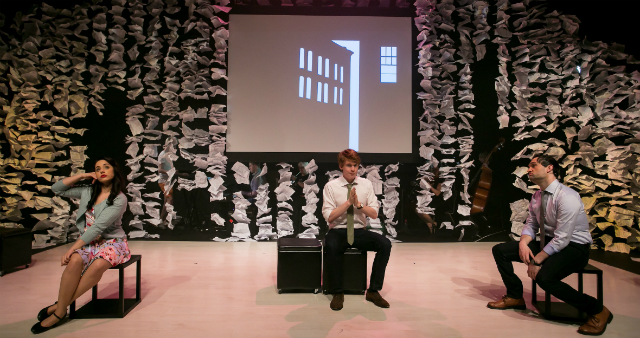
The second act of Stephen Sondheim’s musical about himself starts with the number, God. Written in 2010 for Sondheim On Sondheim, the song is obviously tongue-in-cheek, but it reflects the adoration, if not obsession, that many lovers of the genre have for him. Conceived and originally directed on Broadway by James Lapine, this biographical work juxtaposes live performance with a film composed almost entirely of Sondheim’s interview footage, old and new. We hear a little about his personal life, as well as vignettes about the origins of certain songs, but perhaps more interestingly, he provides insight into his artistic process. Interspersed with the master’s candid introspection is a cast of eight interpreting his creations, with songs from as far back as 1946 included in the programme. It feels a lot like a greatest hits compilation, except most audiences would probably only find half the selection familiar.

The show is a tribute, and tributes can involve a level of fanaticism. For musical theatre geeks, this is a gift from heaven, and for the rest of us, it is a variety show featuring magnificent singers. Director Jay James-Moody and choreographer Monique Sallé provide the cast with solid emotional and physical structures to navigate around, but focus is kept simple; we hear Sondheim speak, and we hear the cast sing his compositions. It is a challenge to prevent repetitiveness without surprise guest performers and big visual trickery, as variety shows are want to do, and on this occasion, the production does lose a little steam halfway through act two.

It is a tricky thing to perform musical theatre numbers out of context. Without a narrative, some of the more emotive sequences cannot help but feel trite and corny. At a running time of over two hours, there is a good chance that persistent levity would turn sour. Most scenes are not set up sufficiently for the songs to communicate at depth, but an exception is the segment featuring a medley from Sondheim’s 1994 work, Passion, which gives us background information for characters and circumstance, thus allowing us to connect with the tragic love story. Louise Kelly’s sensitive and powerful portrayal of the lovelorn Fosca is beautifully moving, and a reminder of the importance of story and empathy in any theatrical work.

Dynamic work by Mikey Rice on lighting design and Jessica James-Moody on sound, give the independent production a surprising polish. The set design is highly effective, although its resemblance to Brevity Theatre’s Wittenberg at the Old Fitzroy Theatre earlier this year must be noted. Costumes (uncredited) are a disappointment, with many unflattering and unimaginative pieces sabotaging an otherwise pleasant vista.

Sondheim On Sondheim can be thought of as being about heroes and vanity. We sit back and admire phenomenal work by the songwriter and turn green with envy at this excellent collection of voices. We can also think about great art as being a source of inspiration for all. The way we live our lives, and indeed the reasons for living, are infinitely diverse, but a commonality exists in our universal need for a vision of something greater. There is no doubt that greatness presides on this stage, and bearing witness to their extraordinary talent is almost necessary.

www.squabbalogic.com.au

Review: Europe (Slip Of The Tongue)

slipofthetongueVenue: Seymour Centre (Chippendale NSW), Sep 10 – 27, 2014

Playwright: Michael Gow
Director: James Beach
Cast: Pippa Grandison, Andrew Henry
Image by Kurt Sneddon

Theatre review
Making sense of humanity requires that we look at history. History gives us meaning and inspiration, it tells us how we should progress. The same follows for the concept of nationhood. The conceit of nations is a discussion about identity in relation to histories. Australia is thought of by many as a derivation of sorts. Its European settlement and ancestry has shaped its public image into one that is invariably referential. It constantly negates its first cultures and its recent migrations, to place emphasis on its ties with the European continent. We are spurned, forgotten and disparaged, yet we are desperate, supplicant and nostalgic. We define ourselves in European terms, and our score cards are created in their image. We wait for acceptance and approval like abandoned babies suffering from developmental retardation. We live in the shadows of parents who no longer remember our birth.

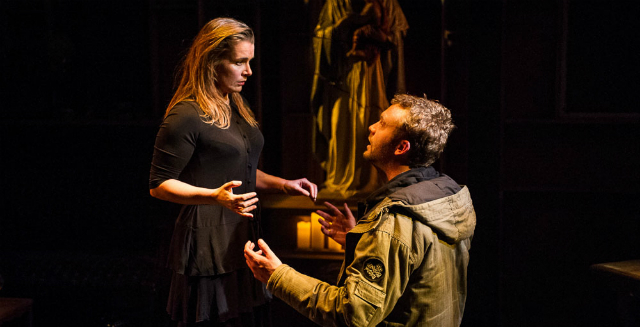
Douglas sacrifices every dollar on flights to Europe. He seeks to rekindle a week long romance with Barbara who had visited Australia briefly. Douglas believes that his life would be perfect if he wins her over. Barbara is perplexed that a flippant moment from the past has returned to haunt her. Douglas is surprised by her reaction and says repeatedly that he would leave, but misses every train. Michael Gow’s script is a comical love story, and a meditation on Australian whiteness. It examines tenuous connections with a motherland, and the existential angst of the castaway. James Beach’s direction is thoughtful and gentle. The duplicitous nature of the narrative is conveyed successfully, and the minimalism of his staging creates a tenderness that reflects Douglas’ internal complexion. There is a languidness that detracts from humour in the early scenes, but the resulting show is an elegant one that speaks intelligently, with an openness that welcomes interpretation.

Pippa Grandison is suitably continental in her approach. She succeeds in portraying the foreignness of Barbara, and her conscious efforts at creating a sense of exotic otherness is well considered and entertaining. Barbara is a stage actor, and Grandison could benefit from playing up her theatricality further, especially in the early segments where more energy could be put into the comedy of the characters’ encounters. Aussie country boy Douglas is played by Andrew Henry who uses just enough stereotyped conventionality to depict cultural relevance, but more appealing is the authentic naiveté he brings to the role. Henry’s work is confidently simple, which ensures that small gestures speak volumes, and dialogue is allowed to resonate. It must also be noted that his performance of intoxication at the play’s conclusion is completely delightful.

Romance provides spice to life. We long for attention and adoration to be reciprocated, so that some kind of affirmation can be established, but that attainment is only temporarily satisfactory, for romance is a need that can never be sated. As long as we keep thinking of ourselves as a chip off the old block, or as the apple that has fallen a little too far from the tree, we will forever be an inferior echo that fails to be its own self determining entity. There is much to love about our own place on earth. We need to acknowledge our histories but we need to make the best of the here and now, wherever we may be.

www.slipofthetongue.com.au

5 Questions with Pippa Grandison

Pippa GrandisonWhat is your favourite swear word?
Well, now that I’m a mum it’s ‘flaps!’, but it used to be something in that general anatomical vicinity.

What are you wearing?
My pj’s.

What is love?
The best teacher I’ve ever had.

What was the last show you saw, and how many stars do you give it?
Ugly Mugs at The Griffin and I give it four and a half, plus an extra half because my hubby’s in it – so five.

Is your new show going to be any good?
As long as I don’t stuff it up, yes! Please come and see for yourselves…


Pippa Grandison is appearing in Europe, by Michael Gow.
Show dates: 10 – 27 Sep, 2014
Show venue: Seymour Centre

Review: A Doll’s House (Sport For Jove Theatre)

sportforjoveVenue: Seymour Centre (Chippendale NSW), Jul 17 – Aug 2, 2014
Playwright: Henrik Ibsen (adapted by Adam Cook)
Director: Adam Cook
Cast: Annie Byron, Barry French, Anthony Gooley, Douglas Hansell, Matilda Ridgway, Francesca Savige
Image by Seiya Taguchi

Theatre review
It has been well over a century since Henrik Ibsen’s A Doll’s House first appeared on a Copenhagen stage in 1879, but the play is still a popular choice in Australia today. Its story and characters continue to resonate, and its social commentary remains relevant to many of our lives. The themes of gender politics, marriage and self-actualisation are no less significant than they were in Ibsen’s day. The sexual revolution might have come and gone, but judging by the power of Sport For Jove’s current production, the societal dysfunctions illustrated in A Doll’s House are not yet a relic of the past. Indeed, we face the question of whether these injustices can ever be eradicated, or if it is human nature that insists on power structures that subjugate and oppress.

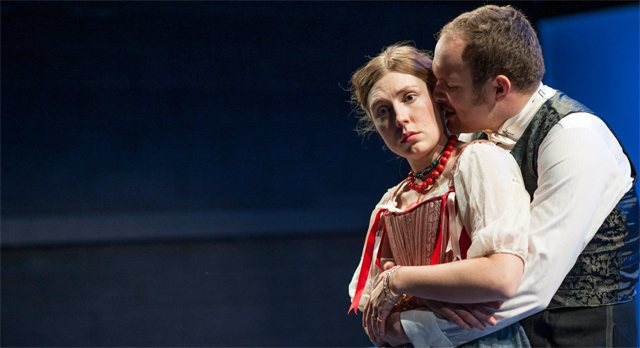
Adam Cook’s adaptation gives the language a vernacular update, which allows Nora’s world to be accessible by contemporary Australian audiences. There is a familiarity to their speech that positions them as our peers rather than historical literary figures, and we are encouraged to relate to the unfolding events on a personal level. Cook’s flair as a director makes the issues at hand feel immediate and palpable. The realism he creates on stage is a nod to Ibsen’s legacy, and an effective avenue to communicate a sense of the everyday realities that we share with the personalities on stage. Cook is especially thoughtful in his handling of the more politically biting portions of the script. He makes sure that meanings are highlighted, and we are never allowed to ignore the elements that make this a landmark work.

Set and costumes are designed by Hugh O’Connor, who turns in excellent work on both fronts. Set pieces are elegantly selected and coordinated, and the space created is appropriately quaint. The sense of a nouveau riche class is gently evoked in its purposefully elegant blend of blues, greys and wood. The doors in Ibsen’s script are frequently cited, and they do come into focus often but unfortunately, the ones chosen are too modern for the context and can appear disharmonious with the established aesthetic. Costumes are beautiful and flattering, and every ensemble helps with character portrayals. They inspire postures and mannerisms for the actors, and also ignite our imagination with notions of time, space and personalities. It must be noted though, that Torvald’s tuxedo in the final scenes is severely ill-fitted and a disruption to the otherwise charming visuals that O’Connor has created.

Nora is played by Matilda Ridgway with outstanding dynamism and depth. Her delivery is a thorough study of one of Western theatre’s most celebrated characters. Ridgway’s deep understanding of the work’s nuances as well as her intelligent awareness of the audience’s expectations, contribute to a compelling and impressive performance. Her decision to play up Nora’s twee qualities is an interesting one. It pulls into sharp focus the falsity of her marriage, but loses somewhat, the dimension of someone of great fortitude, and someone who is capable of cunning when necessary. Nevertheless, Ridgway’s work in the penultimate scene of upheaval will be fondly remembered for its sheer dramatic force and emotional impact.

Douglas Hansell is an entertaining actor who creates a Torvald that is lively and intriguing. Humour always bubbles under his surface, which makes Torvald’s objectionable features amusing to observe, but by the same token, the presence Hansell provides tends to feel slightly flippant. Anthony Gooley is magnetic when he exhibits Krogstad’s menacing side. The danger he unleashes is thrilling and seductive, but his depiction of desperation is uneven. His love scene with Kristine (played with an alluring stoicism by Francesca Savige) is a little lacking in polish, but it ends on a high note with ardently moving results.

The audacity of the play’s conclusion will never fade. Nora’s eventual decisions are simultaneously controversial and heroic. She justifies her actions with great conviction, and even though Ibsen leaves us little room for doubt, the play ends with a stinging hint of discomfort. Adam Cook and Matilda Ridgway have achieved something quite remarkable. We rejoice in their Nora’s exaltation, but we do not forget the dangers that lie ahead. Like their Nora, we too choose to risk everything, for everything counts for nothing, if all that is lived is a lie.

www.sportforjove.com.au

Review: Ruthless! (The Theatre Division)

theatredivisionVenue: Seymour Centre (Sydney NSW), Jun 19 – Jul 12, 2014
Book & Lyrics: Joel Paley
Music: Marvin Laird
Director: Lisa Freshwater
Cast: Katrina Retallick, Meredith O’Reilly, Margi de Ferranti, Caitlin Berry, Madison Russo, Geraldine Turner

Theatre review
The value of camp is found in its affiliation with irony and black comedy, but its inherent darkness is masked by insolent loudness, and often, political meanings are so extensively subverted that they become near invisible. Camp heroes like Carmen Miranda, Liza Minnelli, Bob Downe and seventies pop star Sylvester (to name just a few), are all iconic figures remembered for a certain frivolity, but they each represent something far more serious, which we can choose either to acknowledge, or ignore. Joel Paley and Marvin Laird’ Ruthless! is utterly and irrevocably camp, but it is also highly intelligent and sophisticated in its approach. Its themes of feminism, family and the American dream are key impetuses for its jokes and plot development, even if they are not explicitly dissertated. Instead, front and centre are the wittiest of lines, the most charming of show tunes, and the savagest of stories. This is a musical that has all the constituents of a cult hit, which is to say that it is not for everyone, but for those with whom it resonates, Ruthless! is a very special show indeed.

Lisa Freshwater’s direction is suitably bold. The material needs a brazen and fearless attitude, and Freshwater is certainly no shrinking violet. Wickedness lurks in every corner, and the director is never afraid to take full advantage of it for our benefit. The writing is a minefield of laughter, and she detonates at every opportunity. The characters have few redeeming features, but Freshwater manages to make each one bewitching. By ensuring that these women never seem realistic, their misdeeds are prevented from descending into too dark and threatening a space. Instead, they are always beguiling and glamorous, like the women in Disney films, only more animated.

Choreography by Christopher Horsey is dynamic and astute. He is always in on the joke, and provides a rich suite of tools for the performers to articulate in movement. The stage is always vibrant, and the women are always confident. Each gesture and posture is full of flair and calculated, forming part of the rich visual language that establishes the production’s brilliant effervescence. Also noteworthy is Mason Browne’s work as set and costume designer. His use of colour is exemplary, and the vividness he achieves with quite minimal elements is truly inspired.

The lead role Judy Denmark is played by Katrina Retallick with inconceivable talent and flair. It is sublime to witness an elite performer at the top of her game, and this is such an occasion. The performer glows throughout the show, with supreme grace, a flawless voice and a surprising mastery over the dark humour at hand. The role is a tricky one. It is challenging, technical, unconventional and confronting, and Retallick achieves it all with flying colours and devastating splendour.

Young performer Madison Russo is a revelation as the scene stealing Tina Denmark. Her vocal and dance abilities are impressive, and crucial to the effectiveness of the narrative. Caitlin Berry’s versatility is showcased perfectly, along with a stunning singing voice and a keen sense of acerbic humour. Margi de Ferranti plays both Miss Block and Myrna Thorn with exuberance, and claims the biggest laugh of the show with a gag about Miss Block’s sexuality and dress sense. Geraldine Turner is positively terrifying as the theatre critic who “hates anything to do with the theatre, that’s my job”, Lita Encore. Her performance of “I Hate Musicals” is reason enough to buy a second ticket for another viewing. Meredith O’Reilly as Sylvia St Croix displays professional savvy and a stage presence that are impossible to ignore.

As Les Misérables celebrates its umpteenth opening in Melbourne this month, it is important to remember that popularity in the arts might mean fame and fortune, but excelling in smaller theatres under ridiculous constraints of all kinds is a greater glory. Ruthless! will never see the financial success of Phantom and Saigon (“if I want helicopters, I’d go to the airport!” says Lita Encore), but for those of us who yearn for something with bite, and that provides its cast with nowhere to hide but to rely only on sheer talent, this is a show to ruthlessly champion for.

www.thetheatredivision.com