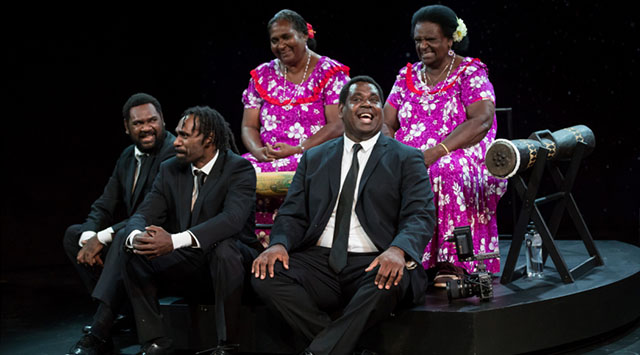
Review: Virgins And Cowboys (Motherboard Productions)

Venue: SBW Stables Theatre (Kings Cross NSW), Nov 30 – Dec 16, 2017
Playwright: Morgan Rose
Director: Dave Sleswick
Cast: Katrina Cornwall, George Lingard, James Deeth, Penny Harpham, Kieran Law
Image by Ashley de Prazer

Theatre review
The characters in Morgan Rose’s Virgins And Cowboys are in a constant state of struggle. Unable to identify anything authentic in their lives, they go about their days acting upon desires that never seem to come from within. We observe these derivative existences, and wonder how much of our own being, is a result of the control that others exert. The question of self-determination, it appears, is always a tricky one, even though it is clear that narcissism is never in short supply.

The play is a cryptic and therefore challenging one, although the nature of our libido is unquestionably at the centre of its explorations. Sexuality motivates the five personalities, and fuels our imagination. The things we do as a matter of course; the fucking, the procreation, the careers, are put under a microscope, devoid of delusion and romance, so that we may examine our behaviours, with perhaps, some sense of objective accuracy. It is an interrogation into our unconscious masochism, an attempt to locate what it is that we do to ourselves, that makes us so miserable.

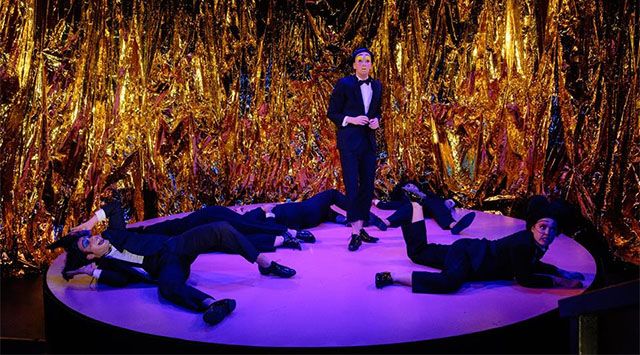
Beautiful and quietly surreal, the production is inventively designed by a team of creatives impressive in their artistic rigour. Sound by Liam Barton is edgy, often quirky, in its definition of a space, both fragile and phantasmal. Lisa Mibus’ lights are sensual, surprising, and entertainingly dynamic. The evocative set and costumes establish the tone of the show, succinctly assembled by Yvette Turnbull.

Director Dave Sleswick’s academic approach can be confounding, but his ability to manufacture intrigue, keeps us on tenterhooks. There is a lot to be curious about, and Sleswick does a marvellous job of sustaining our attention without ever damaging the mysterious qualities of Virgins And Cowboys. He never reveals too much, and only very little is explained.

The cast is splendid. Uniformly and cohesively vivacious, each actor brings a sense of luxuriant depth to the discussions that they facilitate. Even when we lose sight of the point being made, the people on stage are full of conviction, infallible with their undisclosed narratives at the heart of Virgins And Cowboys‘ absurdist aesthetic.

We can show each other all kinds of practices and all manners of wanting, but for an individual to discover the essence and truth of their own being, the exercise of introspection is imperative. So much of how we spend each day is reliant on emulation; people will tell us how we should act, and what is required of us, but it is not always clear to the self, when the social and personal are melded, and confused. When we observe the dissatisfaction of characters in Virgins And Cowboys, and recognise our universal conundrum, the impulse is to stop, for a moment of evaluation. Consumed by the world, we rarely take stock of things habitual. We settle for being lesser, when we forget to question.

www.motherboardproductions.com.au

Review: Jobready (Feckful Theatre)

Venue: 107 Projects (Redfern NSW), Nov 30 – Dec 1, 2017
Playwright: Caitlin Doyle-Markwick
Cast: Sabrina D’Angelo, Caitlin Doyle-Markwick, Sarah Easterman, Matte Rochford

Theatre review
Matte is a musician in need of an income. Australian bureaucracy dictates that he goes through onerous channels, to find a job that addresses that need, without concern for the talents that he possesses. It certainly pays no attention to any of the interests that he may have as a sentient being.

In Caitlin Doyle-Markwick’s Jobready, we see our economy determined to dehumanise those who rely on it to survive. We allow money to drive the way communities operate, and as we become increasingly consumed by financial pragmatism, and the accompanying concept of productivity, what makes us human is reduced into a process of monetisation that seems to value only that which can be commodified. It is just too bad that Matte’s abilities are judged to be worthless.

The ideas are sombre, but the show is uproarious. We watch our ludicrous beliefs presented in a comedy unhinged with an exaggerated absurdity, but feel only its accuracy. Although a straightforward piece of writing, the self-directed cast of Jobready brings to the stage, something that is quite extraordinary in its acerbity and exuberance. Its commedia dell’arte style of presentation is joyful, and marvellously entertaining; the laughs in this show are nothing short of rambunctious.

As Matte is put through the system, his transformation into something robotic, reminds us of technological advancements that are now said to be poised to take over most of our jobs. The things that we are grooming Matte for, will soon be taken over by machines. He will then have to exploit parts of himself that artificial intelligence is unable to replicate, and in that process become more human than ever before. This is a future we should not be afraid of. Utopia might still require money, but it is up to our most optimistic humanity to re-imagine that iteration of a new economy.

www.107.org.au

Review: Taking Steps (Ensemble Theatre)

Venue: Ensemble Theatre (Kirribilli NSW), Nov 23, 2017 – Jan 13, 2018
Playwright: Alan Ayckbourn
Director: Mark Kilmurry
Cast: Emma Harvie, Peter Kowitz, Drew Livingston, Simon London, Christa Nicola, Andrew Tighe
Image by Prudence Upton

Theatre review
We can all have an appetite for a silly comedy, but how much frivolity a person is able to handle in one sitting, is certainly a variable factor between individuals. There is nothing in Alan Ayckbourn’s Taking Steps that pretends to offer more than simple laughs, but the 1979 play does seem to think, erroneously, that its sense of humour has stood the test of time. It is all terribly old-fashioned, and at two-and-a-half-hours, very arduous indeed for those of us who have moved on from Fawlty Towers and The Two Ronnies.

The production is a sleek one, with good energy from a well-rehearsed cast that has figured out their ordered trajectories within the erratic chaos of a classic farce. Some actors do however, appear to be more naturally suited to the genre than others. Peter Kowitz is particularly credible in this presentation style, appropriately nostalgic in approach and effortlessly charming in the part of Roland. Emma Harvie and Drew Livingston are refreshing presences, who bring a sensibility that is slightly more au courant, through their idiosyncratic interpretations of supporting roles.

Humour can be general or very specific, but there is perhaps not one show, that will make every person laugh. Taking Steps still has an audience; its jokes have after all, been tried and tested. Theatre has the responsibility to do many things, and providing comfort has always been one of them. The familiarity of an old play, that transports us back to an idea of better times, is valuable, and for some, that reminiscence represents the best form of entertainment. There is always the temptation to live in the past, when the present and future look to be persistently disappointing. This is understandable of course, but tomorrow will come, come hell or high water, and we need to find a way to just get on with it.

www.ensemble.com.au

Review: The Caretaker (Throwing Shade Theatre Company)

Venue: The Actors Pulse (Redfern NSW), Nov 22 – Dec 2, 2017
Playwright: Harold Pinter
Director: Courtney Powell
Cast: Alex Bryant-Smith, Andrew Langcake, Nicholas Papademetriou

Theatre review
The house is dilapidated, but its three male inhabitants do nothing to improve conditions, choosing instead to involve themselves in mind games, finding ways to exert power over one another, as they while the days away, never achieving anything.

Harold Pinter’s The Caretaker themes are many. Talking about things social, political and psychological, the 1960 play does not make explicit any of its concerns, but creates scenarios and dialogue that may inspire us to find associations with the real world. Resonances have faded with time, as the issue of relevance comes into question, but it is doubtless that Pinter’s characters are fascinating, and their interactions, fabulously theatrical.

The production is often an intriguing one, with director Courtney Powell facilitating our questioning of all the activity that takes place. A naturalistic style, carefully orchestrated, prevents us from dismissing scenes as simply bizarre, and lures us in, to consider the dynamics and meanings in operation.

A strong cast keeps us involved in the many unlikely exchanges. Nicholas Papademetriou manipulates us in his interpretation of a central figure, a vagrant who finds himself in the middle of two brothers, becoming increasingly sinister, and surprising us quite delightfully, through subtle transformations of personality. Alex Bryan-Smith is a convincing ruffian, animated in his portrayal of a menacing type, bringing excellent energy to the show as Mick. In diametric opposition is Andrew Langcake who plays a quiet, possibly disturbed Aston, offering perfect balance to the noise of his counterparts.

The character of the house has changed, since the play’s inception 57 years ago. The meaning of property ownership informs the way we see The Caretaker, and in hyper-commercialised Sydney today, divorcing ourselves from the economics of the story is impossible. We observe the three men in hierarchical terms, the landlord, the tenant and the temporary resident, and we wonder how money, along with the disparity between rich and poor, affects the way we live with one another. The root of all evil is perhaps perennial, but its nature seems to morph with the passage of time.

www.throwingshade.com.au

Review: Shifting > Shapes / Fem Menace (PACT)


Venue: PACT Centre for Emerging Artists (Erskineville NSW), Nov 22 – 25, 2017

Shifting > Shapes
Choreographer and composer: Thomas E.S. Kelly
Collaborator and performer: Taree Sansbury

Fem Menace
Creator and performer: Cheryn Frost
Co-creators and performers: Cath McNamara, Tahlee Kianda Leeson

Theatre review
Presented as part of PACT’s “Afterglow” season, two works Shifting > Shapes and Fem Menace, feature young women dancing to the beat of their own drums. We watch them finding physical languages that could reveal their identities, that help express feelings and thoughts, to make their mark maybe, to be seen and heard, in a world that is determined to subdue creativity and art.

Shifting > Shapes explores humanity through the idea of shape-shifting, in which a person adopts the consciousness of animals, and begins to think and move like them. When performer Taree Sansbury becomes a goanna (or Dirawong) and a rainbow serpent, she sinks close to the ground. The relationship between body and earth looks never to be more intimate, than when Sansbury takes on the physical specificity of a different species. In the moments that she reverts to human, we observe the discord between being and space, as though we are the only ones alien to our own planet.

Fem Menace is concerned with the anxieties about being contemporary women, in this latest wave of feminism. A key point of its discussion is sexuality, as an essentially social undertaking, private but always in relation with the world outside of the self. In the honest representation of woman as sexual being, the conundrum of objectification seems to be omnipresent. Cheryn Frost, Cath McNamara and Tahlee Kianda Leeson present an uncompromising wildness that dares us to regard their presence as anything other than as intended.

Both pieces are conceived and executed with a sense of purity; faithful and authentic in their transition from inspiration to stage. For Shifting > Shapes, the unapologetically minimalist approach of choreographer and composer Thomas E.S. Kelly, maintains a razor sharp focus on its theme, whilst asserting his Aboriginality as legitimate and authoritative. The women in Fem Menace are experimental, putting their minds and bodies through exhaustive interrogation. The results of which are deeply fascinating, and often very beautiful. There is perhaps no way to look at ourselves with absolute objectivity, but it is in our art, that we can best know each other.

www.pact.net.au

Review: Night Slows Down (Don’t Look Away Theatre Company)

Venue: Kings Cross Theatre (Kings Cross NSW), Nov 17 – Dec 9, 2017
Playwright: Phillip James Rouse
Director: Phillip James Rouse
Cast: Andre de Vanny, Danielle King, Johnny Nasser
Image by Ross Waldron

Theatre review
It is no secret that something very sinister is happening to our politics. For a variety of reasons, Australians have gradually become more extreme in our views, increasingly unable to tolerate differences, of opinions, lifestyles and backgrounds. In Phillip James Rouse’s Night Slows Down, a disastrous scenario presents itself, and the dark fantasy of those we call the alt-right or neo-Nazis, becomes reality.

The fascists have taken over, and they run the country by unleashing all the menacing impulses that have hitherto been forbidden. It is a regime based purely on unexamined emotion, where logic and level heads mean little. This is not the first time that we see a Nazi government, but unlike stories from the previous century, Night Slows Down is immediate, urgent and real. We recognise the people and places, and are unable to relegate these atrocities to a hazy past, a distant history that we tell ourselves is all but vanquished. Rouse’s stunning play is about a very near future, when we have taken one too many missteps, and the last straw finally breaks the camel’s back.

It is a fierce indictment of whiteness in cultures like ours; an ethnic majority that continually feels the need to exert its dominance. Even as it retains power, it never stops imagining a demise, and its imperialistic drive seems unable to be tamed. Their war cry in the play is “For The Future” through which enemies are constantly identified, for the now is never enough.

Fascism is not an idealistic state of being, but a never-ending project that discriminates and destroys. It has no meaning unto itself, except as an apparatus of ceaseless segregation and eradication. It pretends to be protecting something pure, but in fact its only true objective is to annihilate. The meaning of white is never stable, and those who seek preservation through its identification, are wholly responsible for their own anxiety.

Actor Andre de Vanny is outstanding as Seth, the racist bigot with no talent except for divisive politics. Like all the idiots in government we know who operate in the same way, it is a pointless exercise trying to reach a satisfactory understanding of their psychology, yet de Vanny has us entirely convinced of the villain’s whys and wherefores. His powerful portrayal of a simpleton overcome with hate, is as thrilling as it is distressing.

Also remarkable is leading lady Danielle King, who has us entranced with a profound capacity for depth and nuance. The emotional and intellectual scope she brings to the role of Sharon, allows us to interpret the story beyond the surfaces of good and bad. We are inspired to investigate the resonance she delivers, to discover for ourselves, what it is that consumes us as a society today, and whether we are able to offer effective resistance to corrupting forces. Johnny Nasser is a quieter presence, but no less affecting a performer, leaving an excellent impression, with a dignified emphasis on delivering authenticity to the role of Martin and his shocking persecution.

Lighting design by Sian James-Holland adds dynamism to proceedings, with a creative intricacy that sets a precise tone for each scene. The set is imagined with appropriate restraint, and cleverly executed by production designers Anna Gardiner and Martelle Hunt, to facilitate optimum showmanship by the very compelling cast. Night Slows Down is a tightly orchestrated work, brilliantly helmed by Phillip James Rouse as writer and director, to tell us something irrefutable and pertinent.

It is a discussion shaped by the most pressing issues of today. So much that is conceptual, buzzing in the ether, is consolidated here, for a catastrophic manifestation of our worst nightmares. It functions as warning and premonition. The drama captivates because it speaks our truth so loudly, even though the circumstances it describes, are grandiose in its fictiveness. We are terrified, because we know that the worst is only a hair away.

http://www.kingsxtheatre.com | www.facebook.com/DLATheatre

Review: Violent Extremism & Other Adult Party Games (The Depot Theatre)

Venue: The Depot Theatre (Marrickville NSW), Nov 15 – 25, 2017
Playwright: Richie Black
Director: Michael Campbell
Cast: Thomas G. Burt, Julia Christensen, Dave Kirkham, Jodine Muir, Thomas Pidd, Eleanor Stankiewicz
Image by Josh Mawer

Theatre review
Robert is a reality TV star, known for deplorable and sensationalist views, characteristic of what has come to be known as the alt-right. Richie Black’s Violent Extremism & Other Adult Party Games commences at the point where he meets a young neo-Nazi Twitter celebrity, as they try to leverage each other, thinking that each is able to advance his own agenda by making use of the other’s influence. A comedy of errors ensues, and people are killed in quick succession, as a result of this unholy union.

It is a cleverly written play, consistently funny, and powerful with its social criticisms. Michael Campbell’s direction of the piece is exhilarating, if slightly overzealous in his doggedly high energy rendering of confrontation and chaos. Every scene in Violent Extremism is amusing, with its satire and irony proving to be highly satisfying, but the production rarely resonates deep enough for its political meanings to be truly impactful. We are certainly entertained, but for all its sociopolitical assertions, we struggle to find a breath that will allow us to think intently enough, about the matters Violent Extremism is keen to discuss.

The look of the staging is excessively raw, but we are impressed by a very well-rehearsed cast of six performers. Thomas Pidd is an effective leading man, comfortably orchestrating the hectic activity orbiting around him. Charismatic, and animated in his portrayal of a comical, himbo type character, his ability to have us endear to Robert is crucial, in sustaining our interest for a show full of unsavoury personalities.

On the battlefield, blood is shed on both sides, because both sides are aggressors. It is our nature to decipher good from bad, but as long as we understand that violence is never the answer, we must learn to appreciate that there are no good guys in wars. It is true that there are deranged white Australians who are the cause of damage to much of our social fabric, and although they are currently obsessed with positioning themselves in direct opposition to “Islamic fundamentalists”, it is the similarities, rather than differences, between these groups that should be acknowledged.

www.thedepottheatre.com

Review: Asylum (Brave New Word Theatre Company)

Venue: Comber Street Studios (Paddington NSW), Nov 15 – 25, 2017
Playwright: Ruth Fingret
Director: Richard Hilliar
Cast: Joshua McElroy, Katherine Shearer, David Woodland, Eli Saad, Hannah Raven
Image by David Hooley

Theatre review
Craig is a draconian protector of Australia’s borders, spending his work days assessing the legitimacy of asylum seekers from war torn countries. At home however, he is incapable of caring for those he calls family. Ruth Fingret’s Asylum talks about our national obsession with blaming external factors as the cause of our problems, whilst neglecting obvious and urgent dysfunctions that have nothing to do with the world outside.

It is a simple story, presented in a straightforward manner. Director Richard Hilliar’s refusal of ornamentation in this bare bones staging, creates a clinical atmosphere appropriate for Craig’s coldness, and is indicative of the increasingly brutal approach in how our government operates. Dialogue is dry, often sacrificing nuance for dramatic effect, but strong performances keep the show buoyant.

David Woodland plays Craig as an everyday guy, letting the villainous qualities of his character stay an undercurrent in his portrayal. Joshua McElroy is particularly memorable as Jason, a young offender starved of love, unable to connect without having to resort to drastic measures. Simultaneously intense and vulnerable, the actor’s confidence is unflappable even in the venue’s extremely close quarters.

The Australians we see in Asylum have forgotten kindness. The insecurity of inhabiting a land that was never ceded by rightful owners, makes us paranoid and shameful. Instead of addressing our illicit presence, we channel our disgrace onto those who have a more rightful claim to being here. Guilt is a powerful emotion, that unless managed veraciously, would only exert itself in harmful ways.

www.bnwtheatre.com.au

Review: Silent Night (Darlinghurst Theatre Company)

Venue: Eternity Playhouse (Darlinghurst NSW), Nov 10 – Dec 10, 2017
Playwright: Mary Rachel Brown
Director: Glynn Nicholas
Cast: Amanda Bishop, Richard Sydenham, Aaron Glenane, Michael Denkha
Image by Brett Boardman

Theatre review
It is Christmas in the suburbs of Sydney, and the Lickfolds are freaking out, because of course, there is just so much to be done. In Silent Night by Mary Rachel Brown, we take a look at our behaviour during what is meant to be the most sacred time of the year. We may not be a religiously homogeneous nation, but the silly season of December insists that we all act at a surprising degree of uniformity.

Australians take Christmas seriously, but rarely for the right reasons. In the Lickfold household, an occasion for charity and goodwill is turned into an opportunity for exacerbated narcissism and magnified paranoia. Anne wants at all costs, to win her neighbourhood’s annual competition for the best decorated house and yard. Her husband Bill’s doomsday preparations are at fever pitch, fuelled by the incessant talk of diversity, in politically correct representations of Jesus’ birth on rooftops, and other places. Their son Rodney is determined to get in the way of everything; even at Christmas time, he refuses to share his parents’ attention with anyone, God included.

It is a moralistic tale, predictable in its messaging although imaginatively conceived. Clever ideas abound in Brown’s play, but they are not presented well. Its comedy is relentlessly laboured in the first half, and when things get serious later on, its dialogue turns confusing. Director Glynn Nicholas makes sure that we know when punchlines are delivered, but moments of genuine laughter are few and far between. There is no doubting the grace and spirit that motivate the creation of Silent Night, but intentions on their own are rarely insufficient.

Production design is competently rendered, as are performances from the cast of four. Energy and conviction are delivered in spades; we see the actors work hard, and their determination to keep us engaged is, to some extent, effective. Richard Sydenham impresses as Bill, animated and precise in his approach, able to communicate a hint of complexity that is absent from other characters.

It is true that Christmas makes our ugly sides more pronounced. When we compare our lives to the best of the Bible’s stories, we can only see beings contemptible and profane. All the wasteful decadence and hollow frivolity that inevitably take over our celebrations of that sacred dawn, expose our values to be no more than utterly dismal. We are not bad people, but when we are careless, there is little than can differentiate us from the scum of the earth.

www.darlinghursttheatre.com

Review: Three Sisters (Sydney Theatre Company)

Venue: Sydney Opera House (Sydney NSW), Nov 6 – Dec 16, 2017
Playwright: Anton Chekhov (adapted by Andrew Upton)
Director: Kip Williams
Cast: Alison Bell, Peter Carroll, Callan Colley, Miranda Daughtry, Harry Greenwood, Melita Jurisic, Brandon McClelland, Eryn Jean Norvill, Rahel Romahn, Chris Ryan, Nikki Shiels, Mark Leonard Winter, Anthony Brandon Wong, Charles Wu
Images by Brett Boardman

Theatre review
The existential angst in Chekhov’s Three Sisters is timeless; the need to understand what we are here for, and how we can find happiness, are fundamentally human and eternal. Once again, we see Olga, Irina, Masha and all their friends babble on for three hours, about how hard it is to do life. Andrew Upton’s adaptation gives the play a slight refresh, but it is a predictably faithful rendering that takes on the burden of the original’s dreariness, as it ruminates on the tedium of the bourgeoisie.

As is characteristic of director Kip Williams’ style, the show is presented with remarkable polish and an impressive elegance. Alice Babidge’s set design establishes an inescapable air of glamour for the production’s minimalist aesthetic, while Nick Schlieper’s delicate lights bring sumptuous beauty to proceedings. Music by The Sweats and sound by Nate Edmondson help us locate the contemporary relevance in Chekhov’s story, whilst retaining its intrinsic sense of Russian austerity.

It comes as no surprise that this is yet another dry and dreary rendition of Three Sisters. For all the reverence associate with the play, it is at its core, a work about the lifelessness of the privileged. The point is its stasis, that nothing happens for years, and that these women are mysteriously incapable of taking meaningful action.

Williams is inventive in the first half, introducing energy wherever possible, but the depressive quality of the text proves insurmountable. Although some of the flourishes can be distracting and excessive, there is no denying our appreciation for the effort put into injecting animation and comedy, derived from the sheer desire to see some theatricality.

Actor Miranda Daughtry is memorable as Irina, with explosive emotions that are both captivating and genuine. The cast understandably adopts an extravagantly declarative approach to performance, but Daughtry’s way of connecting with her audience is particularly truthful. Alison Bell’s droll humour as Olga shines a light on the often neglected irony in Chekhov’s writing, and Eryn Jean Norvill’s exaggerated comedy as Masha is similarly delightful. We are glad to be spared too much bleakness, but it is arguable if these interpretations are effective, in helping us absorb the philosophies in Chekhov and Upton’s writing.

There always seems to be a Chekhov play on a stage in Australia somewhere. We are so much like the sisters, understanding the concept of progress but unable to extricate ourselves from the old and deficient. We may not be able to create anything without being informed by tradition, but this Three Sisters draws attention to the parts of us that refuse to move on, that are rigid in their worship of a conceptual “home”, undeviating from sacred points of origin. These parts of us that are backward and regressive must be interrogated, if not demolished.

www.sydneytheatre.com.au