Review: Gruesome Playground Injuries (Queerspace)

Venue: The Actors Pulse (Redfern NSW), Apr 12 – 14, 2019
Playwright: Rajiv Joseph
Director: Mackinnley Bowden
Cast: Ricki Jade, Laura Morris

Theatre review
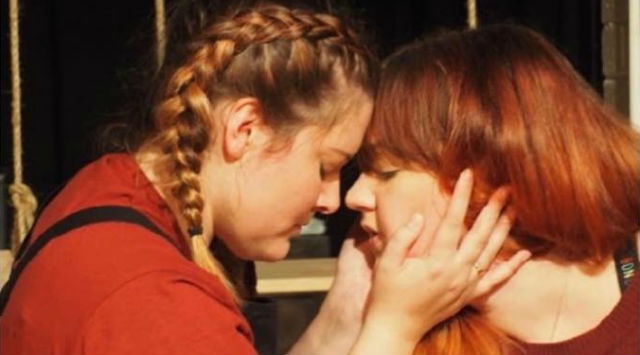
Kayleen and Doug should think of themselves as soul mates, but they make no promises to each other, never talking about a future beyond today. Having first met as children, with the accident-prone Doug always getting into trouble, and Kayleen on hand to offer assistance, the two set up a pattern of random encounters, based on mishaps and adversity, that would see them through thirty years. Rajiv Joseph’s Gruesome Playground Injuries is quirky, a funny piece of writing about friendship, or a kind of love that defies categorisation. If we believe that death can occur at any moment, each meeting could well be the last, with a goodbye that is absolute in its finality.

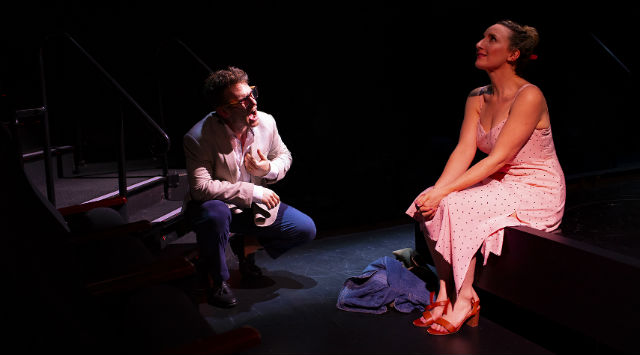
The production is simply assembled. Set designer Steve Stafford’s no frills presentation is memorable for its inclusion of two naked Barbie dolls, crucified and resonantly flanking centre stage. The show is performed by two young women, effectively turning the narrative queer, especially in romantic sections of the play. Ricki Jade and Laura Morris are raw talents yet to communicate rich nuances for their characters, but they are energetic in presence, able to bring some vibrancy to the staging. Director Mackinnley Bowden’s work is spirited, if slightly lacking in depth with what he wishes to convey.

When we try to get plays right, we often forget to be playful. The personalities in Gruesome Playground Injuries are full of mischief, reminding us that being able to find joy in what we do, must always be maintained a priority. Humour especially, is a force that we must harness. It only works when people connect. Where we are able to laugh, lies evidence of consensus and unity, and that uplifting sensation it provides, is one that we know unequivocally, to be able to offer soothe for every ache and ailment.

www.queerspacearts.com.au

Review: Mosquitoes (Sydney Theatre Company)

Venue: Sydney Opera House (Sydney NSW), Apr 8 – May 18, 2019
Playwright: Lucy Kirkwood
Director: Jessica Arthur
Cast: Annie Byron, Jason Chong, Mandy McElhinney, Jacqueline McKenzie, Angela Nica Sullen, Louis Seguier, Nikita Waldron, Charles Wu
Images by Daniel Boud

Theatre review
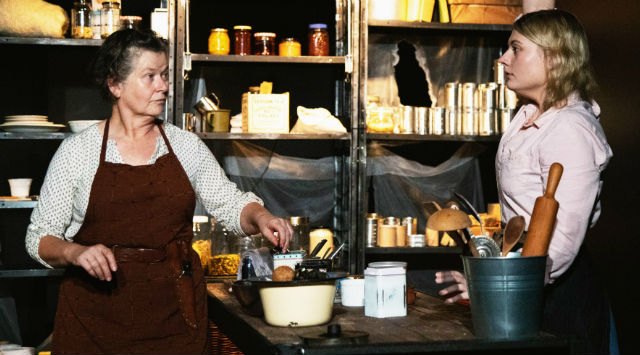
The two sisters could not be more different. Alice is a high-achieving scientist, and Jenny is an anti-vaxxer; it would seem that all the brains had gone to one sibling, leaving the other quite the imbecile by comparison. Lucy Kirkwood’s Mosquitoes sets up a dynamic that tempts us to think in binary terms, but guides us away from forming false equivalences in our estimation of its characters. Although we see good and bad, smart and stupid, the play is able to convince us that people are people, that to determine some life as more valuable than others, would always be tenuous and quite indecent.

After one very big mistake, Jenny’s messy life appears to be going resolutely downhill. The reverberations of her self-destruction are felt by Alice, whose own existence begins to unravel, perhaps as a result of her sister’s chaotic proximity. Playwright Kirkwood sets the family drama against a backdrop of science and nature, with Alice’s career in physics providing context for us to ruminate on both the separateness and inseparable-ness of things. We isolate things to understand them, but forget their indissolubility in the bigger scheme. Our minds are able to conceive of distinct particles, but none exists in absolute detachment. Families are made of individuals, who are at once autonomous and conjoined.

Mosquitoes‘ small domestic scenes are not an easy fit on this vast stage, and although production designer Elizabeth Gadsby and lighting designer Nick Shlieper do not always succeed at containing and concentrating our vision, there is an alluring quality in the elegance that they do achieve. Some very big acting by Annie Byron, Louis Seguier and Charles Wu in supporting roles, are risky choices that prove helpful, and satisfying, in getting us involved. Director Jessica Arthur brings excellent amplification to personal emotions for the characters we meet, but her show is insufficiently provocative, able to communicate effectively only on surface levels. We want more insight into our contemporary times, and more philosophy in general, from a piece of writing that seems to promise so much intellectual rigour.

Jenny is played by Mandy McElhinney, whose humour is a striking feature, full of confidence and impressive verve. Jacqueline McKenzie’s Alice is appropriately high-strung, with an admirable intensity, although slightly one-note in her approach. Their work is assisted by James Brown’s music and sound design, who does marvellous work when tensions are rising, but is occasionally deflating, when in contradiction with the comedy being presented by the cast.

When we find Alice at the end of her tether, rationality turns her ironically monstrous, almost fascistic in attitude, as she tries to put order back into life. At that moment, the shiny appeal of her intelligence and sophistication, reveals something inhumane, and we begin to perceive Jenny’s prior weaknesses with disarming empathy. It is a magical instance of equalisation that transpires, if only in our irresistible urge to place judgement. At these times of extraordinary factiousness, there is perhaps no greater need than the urgency to look for similarities in between. In our efforts to make things better, we identify problems, and relegate them to imagined groups of others, and forget the ultimately inextricable culpability of the self. It is easy to think of the cosmos as one, but to prevent it from falling to pieces, in this day and age, looks to be impossible.

www.sydneytheatre.com.au

Review: Venus In Fur (107 Projects)

Venue: 107 Projects (Redfern NSW), Apr 10 – 13, 2019
Playwright: David Ives
Director: Emma Burns
Cast: Zach Selmes, Caitlin Williams
Images by Andrea Mudbidri

Theatre review
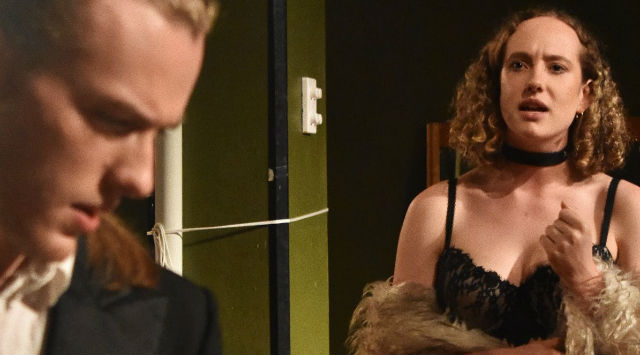
Thomas is casting for his play, a new rendition of Leopold von Sacher-Masoch’s novella Venus In Furs from 1870, about a man who is so infatuated that he asks to be the woman’s slave. Vanda arrives late, but is exceedingly well-prepared for her audition; it begins to look as though the actor knows the work better than its author. In David Ives’ marvellous reinvention entitled Venus In Fur, Thomas’ misogyny is exposed from the very start, as a sort of commentary on the hypocrisy of American liberalism, where the straight white male often fools no one but himself, with his twenty-first century wokeness.

Thomas argues that he writes about a man’s surrender, but Vanda understands all the manipulations involved, not only in the role she is charged to play, but also as it pertains her status in the rehearsal room. Ives’ play is dark and delightful, especially scintillating for those with a penchant for BDSM and sapiosexuality. It is smart, playful and dangerous, constantly teasing us with its language and plot, beguiling as it cajoles us into asking “who is the master”, and “who is the slave.”

Splendid direction by Emma Burns keeps us hopelessly enthralled. Intensely mysterious, but saliently expounded, Venus In Fur is made to feel as delicious as it is complex. Design elements are rudimentary, but Burns ensures that the action is always intriguing, and also deeply satisfying. Actor Caitlin Williams is wonderful as Vanda, aggressively intelligent with her interpretation of the enigmatic female. She makes the dialogue come to glorious life. Zach Selmes is similarly powerful, and convincing as the reprehensible Thomas. The performance is thoroughly rehearsed, and although not particularly inventive with what they bring to the stage, their show is unequivocally captivating.

Thomas is taught the important lesson, that to present himself as a feminist on his own terms, is a disgraceful transgression. He imagines that to put his fictive heroine in a position of power, absolves his neglect of her own desires. His slave’s submission is entirely conditional and self-serving; we learn that it is the slave and Thomas’ desires that come first. The world does not need a feminism that simply focuses on shifting power from one gender to another. We must learn to conceive of new societies in which hierarchies that require anyone to be positioned at the bottom, burdened with disadvantage, are no longer acceptable. In the bedroom, however, we can play with more sadistic parameters, as long as nobody gets hurt, and everybody gets what they want.

www.facebook.com/…

Review: Exhale (Black Birds / Griffin Theatre Company)

Venue: SBW Stables Theatre (Kings Cross NSW), Apr 9 – 13, 2019
Creators & Cast: Ayeesha Ash, Emele Ugavule

Theatre review
They live in Sydney, but they struggle to call it home. Ayeesha Ash is Māori Grenadian, and Emele Ugavule is Tokelauan Fijian. Their work Exhale relates to the sense of displacement that many experience in the metropolis, and the questions inevitably raised about background and origin, when examining notions of belonging. The artists identify in each other, the alienation that results from complex historical and ongoing operations of colonialism. They connect through a yearning for indigeneity, and it is this reclamation of cultural roots, that forms the substance on which, we too, can connect.

A thoughtful compilation of audio recordings and visual projections, help us visualise the women’s longing, but it is their very presence, as individuals and as a pair, that speak most saliently. Ash and Ugavule are compelling performers, both captivating with everything that they bring on stage. Their fifty-minute presentation is enjoyable and though-provoking, but explorations in Exhale have a tendency to feel too polite. The production is gentle, with moments of tenderness that are genuinely beautiful. Its spirit is evident, but it feels contained, perhaps hesitant with what it wishes to reveal.

Ash and Ugavule speak with their elders, who prove to be evasive, intentionally forgetful in their efforts to get on with life. We see in the young women, a frustration and a disquiet perhaps, but we wonder if a more urgent anger, could be helpful in the advancement of their stories. Not many of us are natural soldiers, but there are aggressors who will come to violate those who are peaceful, and when push comes to shove, one has to find the warrior within, even just for a brief theatrical sojourn.

www.black-birds.net

Review: Ditch (Dream Plane Productions)

Venue: Limelight on Oxford (Darlinghurst NSW), Apr 3 – 13, 2019
Playwright: Beth Steel
Director: Kim Hardwick
Cast: Laurence Coy, Angus Evans, Giles Gartrell-Mills, Fiona Press, Martin Quinn, Jasmin Simmons
Images by Becky Matthews

Theatre review
Beth Steel wrote about a very near future in her 2010 play Ditch, describing a nightmare scenario that seems to prophesy the currently ongoing Brexit ordeal, eventuating at the very worst possible place. We find ourselves in the middle of World War III, but this time, Great Britain is fighting as a fascist state, whilst its land is fast becoming submerged by rising sea levels. Steel’s work offers an alarming look at the world we are turning into. It shows us the horrors we are travelling towards, without dwelling on how we are getting ourselves there, leaving the audience to figure out the root of these problems, and making us go through a process of soul-searching, for an agonising reflective examination of the people that we are.

The play is heavy, but never alienating. A very strong cast turns what should be inconceivable, into an immediate and pressing tale full of frightening resonance. Fiona Press is a persuasive Mrs Peel, of an older generation (which makes her our contemporary) and has a lot to answer for. She keeps calm and carries on, trying to forge ahead as though blameless, or maybe more accurately, suppressing the guilty conscience that must plague her. The other elder of the group, Burns is played by a very nuanced Laurence Coy, able to distinctly represent both fragility and brutishness of the banal male archetype. Young Megan’s powerful presence is embodied by Jasmin Simmons, who impresses with her remarkably textured approach.

As the appropriately domineering and repulsive alpha soldier Turner, Giles Gartrel-Mills adds a subtle dimension of deception to the role, further enhancing the drama that he brings. Angus Evans is wonderfully authentic with the conviction, and precision, so discernible in his depiction of the traumatised Bug. New recruit James is effortlessly innocent, as performed by the incredibly earnest Martin Quinn.

Director Kim Hardwick’s insistence on her actors delivering accuracy and dynamism, proves to be very rewarding. The show’s crescendo grabs hold of us slowly and incrementally, as it builds to an explosive, and very satisfying, conclusion. The production is well designed on all fronts. Set and costumes by Victor Kalka, lights by Martin Kinnane, and sound by Stephanie Kelly, are all cleverly rendered for our easy suspension of disbelief, and for maximum tension. Ditch will not let us off the hook, in its tragedy about all our sins.

Completed pre-Brexit, about a post-Brexit world, Steel knew about the darkness that we were heading for, not because of some supernatural precognitive perception ability, but because our self-destruction is always written on the wall. Much as our catastrophes are unimaginable in scale, they were always foreseeable. Ditch does not wish expressly to be pessimistic, but the truth that it presents, would be challenging even for the most ardent of optimists. At this juncture of our evolution, or some might say devolution, the question seems to be moving away from “how do we survive this?” to something much more like “do we deserve to survive this?”

www.facebook.com/dreamplaneproductions

Review: The Rime Of The Ancient Mariner (Jackrabbit Theatre / Little Eggs Collective)

Venue: Kings Cross Theatre (Kings Cross NSW), Apr 2 – 13, 2019
Poet: Samuel Taylor Coleridge
Director: Julia Robertson
Cast: Lloyd Allison-Young, Mathew Lee, Nicholas Papademetriou, Nicole Pingon, Callan Purcell, Annie Stafford, Grace Stamnas, Mike Ugo, Laura Wilson
Images by Brett Boardman

Theatre review
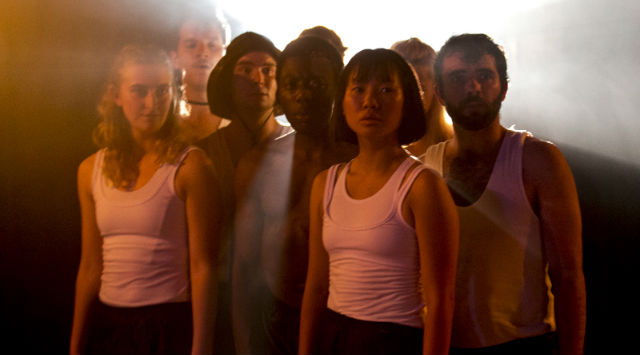
The theatrical action takes place in a rectangular sandpit, with nine people in disciplined formations, illustrating the 1798 poem by Samuel Taylor Coleridge. The Romanticist’s words are turned tangible, as we watch his ship’s adventures unfold, from an optimistic start, into a journey that becomes increasingly perilous. The Rime Of The Ancient Mariner is parsed through the bodies of performers, for a transformation that takes the storytelling from one artistic form to another, and in the process, bending time to create a channel in which the past can visit the palpable present.

Directed by Julia Robertson, the production is whimsical, resolutely so, but it is insufficiently engaging, due mainly to the traverse arrangement of seating, which disallows the visual dimensions of the show to truly fulfil their intentions. Without an adequate backdrop, and without a raised stage, our eyes become restricted in what they are able to absorb and discern. The ensemble is focused, exquisitely cohesive with their offering. It is a spirited effort, especially inventive with the music and sounds that they generate, and along with composer Oliver Shermacher, auditory pleasures are a principal accomplishment of this work.

The Rime Of The Ancient Mariner may not connect as potently as it should, but it bears an integrity that is reassuring. There is a purity to its approach that feels artistically uncompromising and, therefore, admirable. In what we term “independent theatre”, nobody pays your bills but yourself. The sacrifices involved in undertaking this often thankless work are mammoth, and artists should not placate or ingratiate, in the hope of some imaginary professional advancement that will result. Their only responsibility is to the truth, and that is what we are here for, wherever we find ourselves to be.

www.jackrabbittheatre.com | www.facebook.com/littleeggscollective

Review: The Last Five Years (Ensemble Theatre)

Venue: Ensemble Theatre (Kirribilli NSW), Mar 29 – Apr 27, 2019
Writer/Composer: Jason Robert Brown
Director: Elsie Edgerton-Till
Cast: Christian Charisiou, Elise McCann
Images by Phil Erbacher

Theatre review
Jamie has no idea what he is getting himself into, when asking for Cathy’s hand in marriage. His writing career is going “gangbusters” and girls are throwing themselves at him, but he decides instead to get bogged down by the old ball-and-chain, who is herself a naggy talentless nobody, and who demands too much of her husband. The Last Five Years by Jason Robert Brown is an ill-advised musical about the disintegration of a relationship, in which misogyny is lavished right from the start, when Cathy is sobbing over her asshole husband moving out.

Things clearly can only get worse as the show progresses, as Jamie’s misplaced resentment becomes all-important, and he sings such charming lyrics as “I will not fail so you can be comfortable, Cathy, I will not lose because you can’t win,” and “I could never rescue you, all you ever wanted, but I could never rescue you, no matter how I tried.” The story ends with little resolution, but it does not take prodigious imagination to see Jamie turning to digital incel communities after the separation.

Director Elsie Edgerton-Till may not succeed at glossing over the many gendered affronts, but her production is undeniably polished, able to make the simple two-hander feel confident and dynamic. Daryl Wallis’ musical direction is satisfying in its sophistication, and as pianist, he is particularly memorable in “Climbing Uphill”, with a sense of humour to his accompaniment that almost makes the whining wife’s desperation tolerable. Playing Jamie and Cathy are a couple of incontrovertibly excellent performers; Christian Charisiou and Elise McCann are both charismatic and enormously talented. They explore the material with impressive zeal, bringing to the stage extraordinary vigour and skill, trying to keep us delightfully engaged.

The Last Five Years reminds us that, for all the heartache associated with it, divorce is always a wonderful relief. In the throes of passion, and romantic naivety, we make mistakes, because being human, we never fail to want to make promises to horrible people, or to people who will eventually turn horrible. Love is natural and necessary, but rarely eternal. When time comes to call it quits, the apparatus is available to leave them to rot in their own filth. Cathy does not see it yet, but it is clear to us that although five years were lost, she has dodged one very toxic bullet.

www.ensemble.com.au

Review: Saturday Night Fever (Sydney Lyric Theatre)

Venue: Sydney Lyric Theatre (Sydney NSW), Mar 27 – Jun 2, 2019
Book: Robert Stigwood, in collaboration with Bill Oakes (based on the film by Nik Cohn)
Director: Karen Johnson Mortimer
Cast: Angelique Cassimatis, Natalie Conway, Paulini Curuenavuli, Euan Doidge, Bobby Fox, Melanie Hawkins, Marcia Hines, Stephen Mahy, Nana Matapule, Ryan Morgan, Tim ‘Timomatic’ Omaji
Images by Heidi Victoria

Theatre review
The plot was always flimsy in Saturday Night Fever, but all its music and dance sequences have made it an unequivocal icon of the disco era. With a soundtrack album that has sold over 45 million copies worldwide, its songs and their accompanying decadent style, proceeded to define entertainment in the immediate years after its 1977 release, and continue to retain significant cultural cache for generations thereafter. This live theatre version first appeared 1998 in the West End, predictably stirring with the deeply familiar and seductive song list, and this 2019 rendition is similarly appealing.

Accepting that the story is largely irrelevant to how one should enjoy the piece, song and dance is then allowed to become the focus. Choreography by Malik Le Nost is exhilarating, and faithfully nostalgic. Paul Herbert’s orchestrations amplify the pizzazz and schmaltz that the audience adores. We want the big productions to never end, but alas, several extended scenes that attempt to deliver drama, or at least some sense of narrative, only prove themselves to be unsought distractions that bring the energy down, along with our excitement, between the genuinely gratifying episodes of discotheque fabulosity.

Leading man Euan Doidge is a very average actor in the role of Tony Manero, but thankfully shows himself to be a sensational dancer, and doubtless for many an audience member, a real looker. Even with the completely disco-erroneous short haircut and tight trousers, Doidge is a breathtaking specimen who almost has us forgiving everything. His dance partner is the impossibly perfect Melanie Hawkins, who makes every one of Stephanie Mangano’s entrances look like an angel descending from above. Club DJ Monty is played by the thoroughly engaging Tim ‘Timomatic’ Omaji, who absolutely shines in the supporting role, with timing and moves that have us eating out of his palm. All the hits are sung marvellously, mainly by a fantastic group of four (Natalie Conway, Paulini Curuenavuli, Bobby Fox and Nana Matapule), but there is no denying the superstar power of Marcia Hines, who is called upon to inspire awe with each of her brief appearances.

Saturday Night Fever tries to give us more than what we bargain for, where it should know better its own strengths. Like legendary party animals of the late 70’s and their penchant for amphetamines and cocaine, we come to the show as hedonists with no time for emotion. Between bumps of pleasure, we have to endure moments of tedium, but we stay for the duration, because we know exactly what the next peak is going to bring.

wwww.saturdaynightfever.com.au

Review: The Dog, The Night And The Knife (The Other Theatre)

Playwright: Marius von Mayenburg (translated by Maja Zade)
Director: Eugene Lynch
Cast: Thomas G Burt, Tom Crotty, Samantha Lambert
Images by Shayan Askari

Theatre review
It is always 5:05 o’clock, in Marius von Mayenburg’s nightmarish The Dog, The Night And The Knife. A man is trapped inside a surreal landscape, encountering strange people who all seem to have nefarious intentions, it seems, of wanting to eat him up. The anxiety-riddled work takes us on a bizarre trip, into a space that feels like the semiconscious, where reality exists only in states of compromise. Paranoia is about things that hide beneath the surface, and in von Mayenburg’s play, things are certainly never quite what they seem.

Actor Tom Crotty demonstrates good focus as the protagonist, full of mental concentration, but lacking in physical agility. The production is staid, probably overly serious in its interpretation of von Mayenburg’s writing. Director Eugene Lynch is able to create a sense of macabre for the piece, but the show proves less funny than it could be.

In a variety of roles are Thomas G Burt and Samantha Lambert, both performers introducing an enjoyable theatricality with the ghostly quality they bring to their characters. Burt is particularly delightful with the dynamism he is able to bring to the stage. Also noteworthy is music composer Kailesh Reitmans, who delivers clever atmospheric enhancements for the production, especially effective with the suspense he is able to convey.

There is no denying that art can help deal with psychological and emotional baggage of which no one is excepted. At the theatre, whether we come in contact with cannibals or with the average Joe, there is always opportunity to know ourselves better, and in that process, find a more expansive view of existence that will keep our disquiet in check. In The Dog, The Night And The Knife, von Mayenburg comes to terms with the idea that people are not always kind to one another. It might be a pessimistic realisation, but an acceptance of reality is always a necessary start, before attaining greater epiphanies.

www.facebook.com/theothertheatre

Review: Leopardskin (Jackrabbit Theatre)

Venue: Kings Cross Theatre (Kings Cross NSW), Mar 26 – Apr 6, 2019
Playwright: Michael McStay
Director: Samantha Young
Cast: Nick Gell, Travis Jeffery, Zoe Jensen, Emma Kew, Guy O’Grady, Ella Watson-Russell
Images by Clare Hawley

Theatre review
Luka and Val are petty thieves trying to make the big leagues. They hear of an Italian billionaire philanthropist giving away his priceless antique clock, and make a beeline for an opportunity to nab the prize. Michael McStay’s play is a farce in the classic vein, reminiscent of Molière, Fo and Brecht, complete with bumbling cops, mixed identities and love triangles. Witty and wild, extremely quirky and downright silly, the work is almost astonishing in its ability to steer clear of anything that could be classed deep and meaningful. Amusement is of course, one of the main reasons we go to the theatre, and Leopardskin delivers it in spades.

Samantha Young directs a wonderfully flamboyant show, very loud and very mad, quite the counter-cultural statement in what feels to be a terribly conservative milieu. With just enough attention placed on making sense of the frankly perfunctory narrative, Young puts her energy into making every second count, so that the audience’s synapses are firing, all of us tickled and fascinated, from beginning to end. When not laughing out loud, we find ourselves grinning from ear to ear, in deep enjoyment of this peculiar beast of an unapologetic, outlandish comedy.

Six very excitable performers can be seen luxuriating on stage, in full throttle madcap mode. Luka is played by Guy O’Grady, sarcastic in his unexpectedly pompous rendition of the small-time crook. Zoe Jensen is vibrant as Val, the rookie pickpocket who defies underestimation. The idiosyncratic tycoon Giuseppe Monterverdi is made an effervescent joy by Travis Jeffery, who brings surprising texture to his performance. Nick Gell takes all four of his characters to high camp territory, unforgettably gregarious with his vaudeville style. Also very effective in multiple roles is Emma Kew, whose timing is surpassed only by her effortless comedic presence. Senator Olive Darling is depicted with precision and a lot of exaggeration, by Ella Watson-Russell who contributes to the exceptional mischievousness of the production.

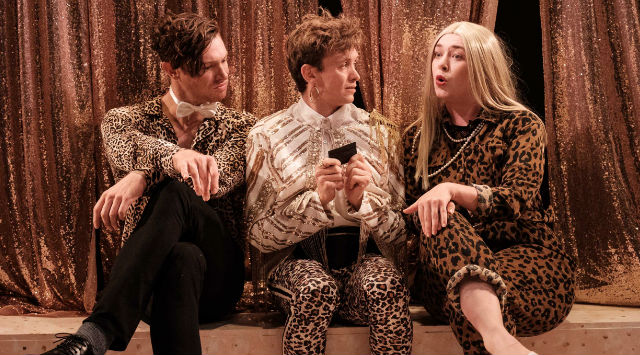
In accordance with its title, the show features costume pieces in all manner of leopard spots, that perennial symbol of bad taste in Anglo-Saxon societies. Indeed, in Leopardskin‘s embrace of all things brash and obnoxious, we encounter an anti-conformist aesthetic that tells so much about what constitutes normal and respectable, in our art and in our lives. When we scrutinise each other, to police an idea of tastefulness in the way we look and behave, we reveal a set of values determined to separate people into classes. When we dare to disrupt those codes, bad traditions can begin to be dispelled, and more than that, a shitload of fun will be had.

www.jackrabbittheatre.com