Review: Green Park (Griffin Theatre Company)

Venue: Green Park (Darlinghurst NSW), Feb 5 – Mar 6, 2021
Playwright: Elias Jamieson Brown
Director: Declan Greene
Cast: Joseph Althouse, Steve Le Marquand
Images by Brett Boardman

Theatre review
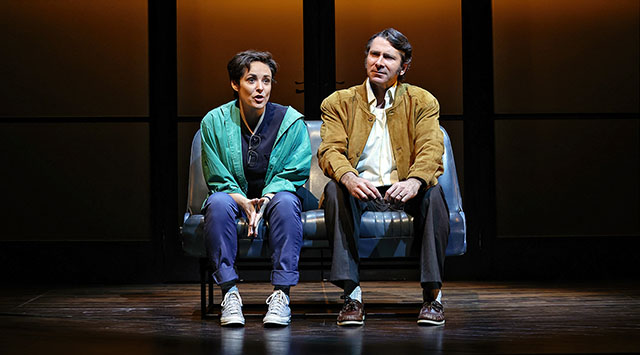
Two men meet in a park, after having connected on a hook up app. Edden is young, out and Black, and Warren is middle-aged, closeted and White. In Elias Jamieson Brown’s Green Park, it is the sexual dalliance that brings different worlds together. Juxtaposing the most intimate of human acts against the severe divisions of twenty-first century life, the two characters engage in a constant tug-of-war, as we meditate on hopes of camaraderie and unity. Sex is by nature a binding force, yet it is able to reveal so poignantly, the fractures that exist between individuals.

It is a passionate and deeply truthful piece of writing from Jamieson Brown. His tragically flawed personalities offer insight into the ills of the day, shedding light on what we lack as a society, including the unfinished business of what many may consider the fulfilled destiny of the twentieth-century gay movement. We can now marry people of our own sex, but as we see in Green Park, so much harm continues to be inflicted on those unable to adhere to the straight and narrow. There is a lot that is painful and profound in the work, but the clandestine quality of this illicit and salacious encounter, makes for a rivetingly enjoyable show.

Directed by Declan Greene, who places the action inside the actual Green Park of Darlinghurst, with all walls of a usual theatrical space removed, insisting that the audience sees not only the performers, but also the historically significant location that lends its name to the play. Unintended supporting actors surround the action, offering real life noise that make us look over our shoulders, as we sense the omnipresent threat of violence that queer people must live with, everyday of our lives. Greene imbues an uncanny realism that draws us in, for both the theatrical moment unfolding, and the palpable non-fiction concerns to which his work refers.

Actor Joseph Althouse is remarkably convincing as the erratic Edden, powerfully embodying the risky existence of a young lost soul. He introduces a resonant defiance to his nuanced depiction of a sexual masochist, confronting us with the disturbing notion of a Black man roaming the streets (and the internet), asking to be dominated, albeit in his own terms. Steve Le Marquand skillfully turns a sad cliché of a man into someone whose story proves to be surprisingly moving. It is a complicated range of emotions that the role requires, and Le Marquand’s deftness at bringing clear articulation to each of Warren’s interior states, is very impressive. Also laudable is the degree to which the pair is in sync with one another. They move through the show’s many tonal fluctuations in tight unison, always keeping in mutual rhythm, no matter how the narrative alters its trajectory.

It is noteworthy that performances are enhanced by the provision of headphones, that prevent us from losing any word of dialogue to the open air conditions. David Bergman’s sound design is effective in manufacturing a sense of the natural to accompany the outdoors context of the production, and equally potent when dialing up the theatrical, for sequences that involve greater sensory elevation.

Edden and Warren think all they want is some no-strings sex, but it is evident that to compartmentalise sexuality, to separate it from the rest of our lives, is not as simple as it may seem. We are made from sex, and we continue to live in cultures that are always partially, but fundamentally, defined by sex. It creates conventions, tells us what is acceptable and what is not; it upholds hierarchies, aggrandising certain people and oppressing others. Both men in Green Park suffer as a result of their libidinal impulses. They are punished by others, as well as by themselves, for something that occurs naturally between consenting adults. The play Green Park, like its namesake on which the Gay and Lesbian Holocaust Memorial stands, is a reminder that so much of what underpins our ways of lives, is dreadfully unkind. Hence, no matter which stripe of the rainbow one aligns with, complacency is not quite yet, a luxury any of us can afford.

www.griffintheatre.com.au

Review: Videotape (Montague Basement)

Venue: Kings Cross Theatre (Kings Cross NSW), Jan 29 – Feb 13, 2021
Playwright: Saro Lusty-Cavallari
Director: Saro Lusty-Cavallari
Cast: Laura Djanegara, Jake Fryer-Hornsby, Lucinda Howes
Images by Zaina Ahmed

Theatre review
Juliette and David are a young couple, isolated in their Sydney apartment, in the middle of this pandemic. They live together because there is an unmitigated conventionality to their relationship, although we are never sure if there is any love between the two. Saro Lusty-Cavallari’s Videotape borrows its premise from David Lynch’s 1997 film Lost Highway, where a mysterious videotape is delivered, containing frightening visions that threaten to discombobulate a household. The pleasure in Lusty-Cavallari’s creation, lies in the unexpected amalgamation of comedy, drama and horror; although not perfectly harmonised, the mishmash of intonations does deliver something with an enjoyable quirky charm.

In Lynch’s deeply misogynistic original, the femme fatale comes in two guises, both of whom are helpless yet maligned. In Videotape, we wonder if Juliette stays with David because of the virus, or if she is a sucker for punishment. The work’s occasionally obtuse intimations provide a sense of texture to an otherwise uncomplicated plot, and although ambiguous in its intentions, allows the audience plentiful room for wide ranging interpretations.

Production design by Grace Deacon is noteworthy for its ability to convey wealth and polish, in a succinct manner. Lights by Sophie Pekbilimli too, help to tell the story in an economical way. Jake Fryer-Hornsby and Lucinda Howes are engrossing as lead performers, both evocative with what they bring to the stage. Laura Djanegara is effective in her smaller roles, offering a valuable hint of the surreal to the show.

We are stuck being humans, and in many ways, trapped in the past. The VHS tapes function as a device of excavation, opening wormholes that make us reach back, whilst materially positioned in the present. Videotape is both a new story, and an old one, not only with its intertextual obsessions, but also in its examinations of how history repeats. The cassette tape stands as an allegory, in our understanding of humanity, and in our experience of it. Rewinding it, fast forwarding, recording over, pause, play or stop, it is its finiteness that is truly chilling.

www.montaguebasement.com

Review: The Apologists (Unlikely Productions)

Venue: Old 505 Theatre (Newtown NSW), Jan 20 – 31, 2021
Playwrights: Lucinda Burnett (New Universe), Cordelia O’Neill (Seven, The Sweetest Hour), Iskandar Sharazuddin (Excuses)
Director: Jane Moriarty
Cast: Gabrielle Scawthorn
Images by Steve Gregson

Theatre review
Comprised of three monologues, each one utilising the concept of an apology as starting point, the appropriately titled The Apologists deals not only with personal turmoil that accompanies any event that necessitates an admission of guilt, but also the public aspects to which these difficult situations pertain.

In Iskandar Sharazuddin’s Excuses, it is the Chief Executive of the UK’s National Health Service, who takes a very public tumble. Cordelia O’Neill’s Seven, The Sweetest Hour involves a social media influencer whose self-obsession leads to an innocent victim paying the ultimate price. New Universe by Lucinda Burnett talks about the revelations of an NGO overlooking sexual abuse taking place where aid is meant to be implemented.

Although relatively short in length, each of the pieces are intricately conceived, and exhaustively explored. They involve high stakes and familiar situations, delving deep into characters beyond the pithy news headlines their stories would no doubt inspire, on millions of mobile scrolls.

The incomparable Gabrielle Scawthorn performs three separate roles, eschewing all things superficial, so that we can access the heart of each matter expeditiously. The unambiguity of her delivery style, ensures that our immersion into these narratives are gripping and powerful. Scawthorn’s ability to elicit empathy for the personalities we meet, is quite extraordinary, and a welcome antidote for these times of pervasive and succumbing apathy.

Jane Moriarty’s direction is crisp and concise, always able to locate a purpose, and drive home a point for each moment of the show. Lights by Saul Valiunas and sound by Rob Donnelly-Jackson, offer uncomplicated solutions to enhance dramatic effect at crucial junctures, of this otherwise barebones presentation.

It is easy to say sorry, and get away with it. We see organisations, big and small, express remorse over countless things on countless occasions, but rarely do we see any structural changes that will ensure improvements. Too often we chastise individuals, wanting them to be served their just desserts, but in the process, we neglect the machinations of systems that have facilitated these misdeeds. History is then allowed to keep repeating, which reduces apologies to being essentially meaningless.

www.unlikelyproductions.co.uk

Review: Dorr-e Dari: A Poetic Crash Course In The Language Of Love (PYT Fairfield)

Venue: Carriageworks (Eveleigh NSW), Jan 20 – 24, 2021
Director: Paul Dwyer
Cast: Mahdi Mohammadi, Bibi Goul Mossavi, Jawad Yaqoubi
Images by Anna Kucera

Theatre review
In Dorr-e Dari, the aspect of Sydney we call a cultural melting pot, comes to life, as artists with roots in Kabul, Tehran and Quetta collaborate to present a work based on Persian poetry. Subtitled “A Poetic Crash Course in the Language of Love” we are treated to philosophical perspectives on affairs of the heart, not restricted to the romantic, but relevant to all tender parts of humanity. Many of the words are foreign, but the sentiments of Dorr-e Dari feel to be wholly universal.

On stage for the entirety, a trio of artists Mahdi Mohammadi, Bibi Goul Mossavi and Jawad Yaqoubi present a bilingual show that often deals with tradition, but tailored to a modern Australian sensibility. With an English-speaking audience in mind, they find ways to cross bridges, and formulate translations, so that through these ancient writings, a new cohesion can be forged, especially between tribes that seem, on the surface, to be incompatible. It appears that to locate commonalities in the details of how our emotions work, is to create a sense of peace in how we experience and understand the world. For a work about love, it is indeed the nature of our shared existence on this one land that becomes fundamental.

Directed by Paul Dwyer, the show is unexpectedly beautiful in its somewhat fragmented form. Sequences can be naturalistic or theatrical, conversational or ceremonial, spiritual or didactical; there are dance sequences, comedic anecdotes, and videophone footage (live and pre-recorded), Dorr-e Dari is unconstrained in the ways it wishes to communicate. The tone is however, pleasantly cohesive, with all three performers proving to be highly likeable, and very welcoming presences, even if slightly unseasoned by conventional standards.

As we become used to the notion of having to bring diversity to all our social and professional endeavours, we gain a new appreciation for a post-assimilation world, where cultures of colonisation should no longer dominate our conversations. It is of great significance that Dorr-e Dari commences with a welcome to country by Indigenous elder, Aunty Rhonda Dixon-Grovenor (who also contributes her own love poem). As a people with roots from all over the planet, the only point of convergence for Australians, should we ever feel the need to have only one, must always have a First Nations emphasis. This is the most rational, and the most just, way for us to advance as a nation. The future of Australia needs to provide dignity for all, not only for the most barbaric.

www.pyt.com.au

Review: Maureen: Harbinger Of Death (Seymour Centre)

Venue: Seymour Centre (Chippendale NSW), Jan 15 – 23, 2021
Playwright: Jonny Hawkins
Director: Nell Ranney
Cast: Jonny Hawkins
Images by Yaya Stempler

Theatre review
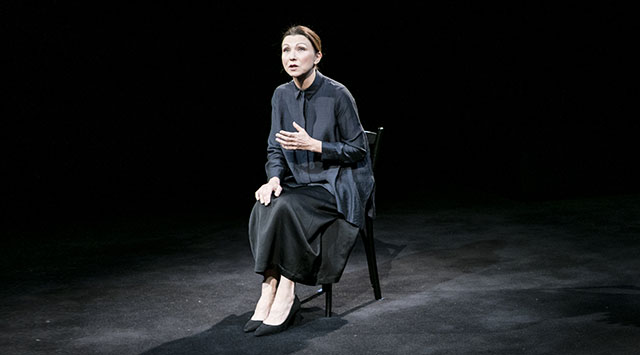
In the prologue, we learn that some of Jonny Hawkins’ best friends are old ladies. It is a somewhat strange declaration to make, but the truth is that very few young Australians, can say that they spend much time at all with the elderly. As a colonised nation, we routinely ignore the old. Youth is money, and money is everything, in this Western style civilisation we all have to live. Thank heavens then, that Hawkins has created a play that shifts our focus, making us look intently at a woman in her glorious eighties. Maureen: Harbinger Of Death may not be an entirely true story, but none of it ever feels less than real.

This one-person show involves Hawkins themself performing as Maureen, sat permanently in a chair, never tiring of a nice, long chat. Her advanced years lead her to believe that she has the ability to foreshadow the death of friends, for she has seen them depart one by one. The writing is witty, extremely warm and often very poignant. Direction by Nell Ranney is extraordinarily elegant, for an appropriately restrained production featuring a larger than life character. Lights by Nick Schlieper and sound design by Steve Toulmin, are quietly resolved but always just right. Isabel Hudson’s work on set and costume is delicately considered, and a visual delight.

As performer, Hawkins is remarkable. They inhabit and convey wonderfully, the luminous essence of Maureen, a woman any audience will find instantly loveable. Their generosity of spirit offers a bridge, one that invites us to regard the octogenarian in the same way. Hawkins’ sharp comedic sense ensures that we are riveted, and the ease with which they command the stage, is quite a marvel to observe.

Maureen: Harbinger Of Death is a dignified portrait, of a person otherwise overlooked and forgotten. All of us are valuable cogs of the same machine, yet only a few at the top are ever celebrated. Our way of life requires that each must give till it hurts, but how we are rewarded for the same pain, is certainly unequal and unjust. So many are chewed up and spat out; so many are given use-by dates, and mercilessly abandoned thereafter. By contrast, many of our minority cultures revere the elderly. If only we knew to make better choices.

www.nellranney.com.au

Review: Sunshine Super Girl (Performing Lines)

Venue: Sydney Town Hall (Sydney NSW), Jan 8 – 17, 2021
Playwright: Andrea James
Director: Andrea James
Cast: Luke Carroll, Jax Compton, Tuuli Narkle, Katina Olsen, Kyle Shilling
Images by Yaya Stempler

Theatre review
Living legend Evonne Goolagong ruled tennis through the 1970s, a remarkable feat by anyone’s standards, but her successes as a young Aboriginal woman can never be underemphasised. Systemic forces put in place through all these years of colonisation, means that any instances of excellence by the Indigenous population of our land, represents a defiant tenacity, whether or not the individual chooses to identify along political lines. In Andrea James’ Sunshine Super Girl, our heroine thinks of herself as apolitical, however there is no mistaking her achievements as anything but an immense source of pride and inspiration for Australians of all stripes.

Written and directed by James, the work is a captivating study of not just the sporting icon, but also the environment in which all Indigenous women have to endure. Sunshine Super Girl‘s discussions of gender and race, although handled with a lightness of touch, does not shy away from the hard realities that women of colour deal with every day and everywhere. The actual narrative of Goolagong’s glory years is uncomplicated and rarely overtly dramatic, but James’ meticulous direction, along with marvelous choreography by Katina Olsen and Vicki Van Hout, work in collaboration to deliver a rich and soulful creation, that many will find genuinely moving.

There is a tender sincerity to the production that makes its 90-minute duration a terrific experience. Music and sound by Gail Priest are intricate and sensitive, while lights by Karen Norris and projections by Mic Gruchy help us reach emotional depths beyond that which dialogue can provide. Set and costumes by Romanie Harper and Melanie Liertz convey contextual information with great efficiency, able to manufacture a sophisticated aesthetic that is elegant, authentic and very pleasing to the eye.

Leading lady Tuuli Narkle is a charismatic and truthful presence, who impresses with the thoroughness of her reflections, and the precision with which she executes her creative ideas. As a young Goolagong, Narkle is confident, nuanced and simply brilliant. The supporting cast comprises Luke Carroll, Jax Compton, Katina Olsen, Kyle Shilling, a formidable team beautifully cohesive at every turn, yet each performer is able to demonstrate distinct strengths that appeal to the audience in varied ways.

The importance of success stories and role models for minority communities, are often overlooked. Without sufficient examples of accomplishments by people like us, it is easy to think that everything is out of reach. On the other hand, these extraordinary personalities draw attention to the irregularity of people like us making it big. We must place attention on structural mechanisms that are hindrances for particular groups. This often means that dominant cultures have to consciously cede power, before parity can ever have a chance to be attained. Not many of us can be Evonne Goolagong, and we should not have to be exceptional in order to walk this earth with joy and dignity.

www.performinglines.org.au

Review: The Last Season (Force Majeure)

Venue: Carriageworks (Eveleigh NSW), Jan 6 – 10, 2021
Director: Danielle Micich
Cast: Paul Capsis, Olwen Fouéré, Pamela Rabe, Isabel Bantog, Owen Beckman-Scott, Luka Brett-Hall, Maddie Brett-Hall, Imala Cush, Niamh Cush, Nicholas Edwards, Ember Henninger, Piper Kemp, Poppy McKinnon, Julia Piazza, Tallulah Pickard, Louis Ting
Images by Brett Boardman

Theatre review
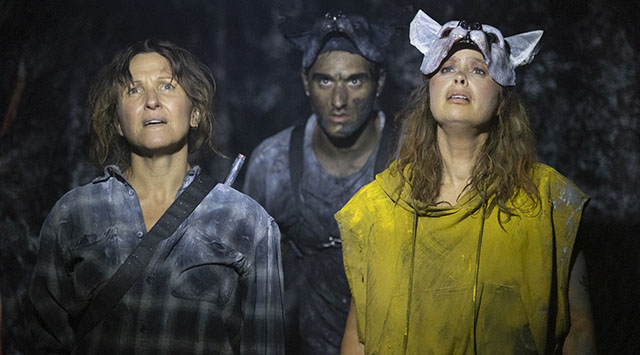
Thirteen young creatures are hatched at the beginning of The Last Season, and we follow them through their first year, witnessing transformations alongside as they progress through the months commencing in Summer. The first three sections of the 4-part show feature a central character, a mature personality juxtaposing against these tender entities. Presented in a non-narrative format, it suggests ideas of legacy and progeniture, placing focus on past/future and parent/child, to ask fundamental questions about our very existence.

Directed by Danielle Micich, The Last Season is an ambitious work. Marg Howell’s set and costumes, Damien Cooper’s lights, and Kelly Ryall’s music, all conspire to create something that indicates an unmissable sense of the epic; the themes under investigation certainly are of that grandiose scale. Transcendental in its tone and feel, the production however never really moves us to the sublime. Its abstraction places us in a cerebral state, yet what it wishes to say, seems to remain in the pedestrian.

Although insufficiently inventive, The Last Season‘s experimental nature is to be lauded. The youthful ensemble is full of intensity and concentration, with every member displaying admirable generosity in their commitment to the art form. Senior performers bring colourful variation, each one distinct and memorable. Paul Capsis is especially powerful, with the poignant humour and sincerity that they are able to introduce to the piece. Olwen Fouéré’s extraordinary style and energy provide a remarkable sense of elevation, and Pamela Rabe’s august theatricality establishes a necessary gravity that keeps us attentive.

With each generation, we wonder if it is just history repeating, or if a new frontier is being forged. Life is a mystery, but we know for sure that there will always be individuals who refuse to toe the line, and new innovators who will create something never before seen. Conformity is death, so it is fortunate that living amongst us, are those who will ensure that our extinction is kept at bay, for a little while longer.

www.forcemajeure.com.au

Review: My Brilliant Career (Belvoir St Theatre)

Venue: Belvoir St Theatre (Surry Hills NSW), Dec 5, 2020 – Jan 31, 2021
Playwright: Kendall Feaver (based on the novel by Miles Franklin)
Director: Kate Champion
Cast: Blazey Best, Jason Chong, Tom Conroy, Emma Harvie, Tracy Mann, Nikki Shiels, Guy Simon
Images by Brett Boardman

Theatre review
The play begins with Sybylla making unapologetic pronouncements, declaring that this is all going to be about herself. Miles Franklin’s 1901 novel My Brilliant Career, features a feisty woman in a man’s world, and although the story takes place during what we now acknowledge as being the first wave of feminism, Sybylla seems terribly alone in her defiance. In the Australian outback, the teenager dreams of an existence beyond marriage and child-bearing, and for some inexplicable yet gratifying reason, we discover that unlike all the other women in her life, Sybylla finds the hubris to see things through.

The old-fashioned tale is rejuvenated by playwright Kendall Feaver, who manufactures engaging scenes for her stage version. Although frustratingly conservative in style and vision, it is nevertheless a compelling portrait of a radical young woman from our fabled past. Kate Champion directs with excellent humour, buoyed by an infectious and irrepressible sense of playfulness. Production design by Robert Cousins is restrained, but effective in helping us keep focus on characters and relationships. Occasional dazzling manoeuvres by lighting designer Amelia Lever-Davidson, deliver an enjoyable theatricality, as do composer Chrysoulla Markoulli and sound designer Steve Francis, who prove themselves cheeky collaborators with the whimsy that they so cleverly inject.

Actor Nikki Shiels too is adept at playing with irony, as she successfully bridges the many decades, between the original conception of the protagonist and our modern times, with a memorable sass and confidence. Shiels’ passion fills the space, allowing us to connect with the uplifting and spirited qualities of Sybylla. It is a strong supporting cast that we encounter, with a notable Guy Simon, whose romantic rendition of a love interest is effortlessly convincing and quite splendid, and Tracy Mann who steals the show with all of her roles, each one considered and arresting.

My Brilliant Career offers nothing new, yet the resonances it provides, are disarmingly powerful. After all these years, we can still recognise that so many Australian women face the same problems, as though we are stuck in the 19th Century. We still talk about how we can “have it all”, and we still think it extraordinary and audacious that a whole story can be told about our hopes and dreams. Of course, in many ways, we have progressed, and feminism has improved many things, but there must be something about us that is trapped in the past, when we notice Sybylla’s story striking a chord.

www.belvoir.com.au

Review: The Picture Of Dorian Gray (Sydney Theatre Company)

Venue: Roslyn Packer Theatre (Sydney NSW), Nov 25 – Dec 19, 2020
Playwright: Kip Williams (adapted from the Oscar Wilde novel)
Director: Kip Williams
Cast: Eryn Jean Norvill
Images by Daniel Boud

Theatre review
Self-preservation is in our human nature, but when it manifests in forms of narcissism, we have to wonder if that urge of vanity, is in fact paradoxically self-destructive. Oscar Wilde’s The Picture Of Dorian Gray tells the story of a man so taken by his own beauty, he sells his soul in order to forever retain it. That juxtaposition of soul and beauty sets up a dichotomy, that makes us consider the inextricability of one with the other. If the soul is essentially good, Wilde wants us to think that beauty is ultimately impossible, in those who are fundamentally bad. His narrative is compelling, although the evidence in our real lives, may prove those beliefs less convincing.

Kip Williams’ ultra modern version places on the stage, front and centre, screens that display digitalised imagery, most of which can be thought of as selfies of Wilde’s nineteenth century characters, seeming to represent something more tangible than the flimsy yet seductive pixels we encounter in cinematic style. It is a thrilling production, fast-paced and very attractive, able to hold us captive with stunning sights and sounds, inventive from start to finish. Appropriate for our culture, one that has been taken over by mobile devices, and that the show so fervently interrogates, causing the viewer to oscillate between suspecting that it might all be slightly facile, and thinking that maybe there is something to be said about existence in 2020, as we obsess over all things pertaining to facades. In some ways, one could go away thinking that Williams has proven Wilde wrong.

It is the surface that we find glorious in Williams’ vision, with Marg Horwell’s work as designer, and Nick Schlieper’s lights providing an endless stream of breathtaking moments, along with David Bergman’s very sophisticated and thoughtful video work, bringing Australian theatre into a futuristic new era. Clemence Williams too, excels with sound and music, especially memorable when her approach turns baroque, and we feel aroused by the surprising dimensions she is able to build for our senses. Stage Manager Minka Stevens, along with all the crew, must be congratulated for their valiant and expert fulfillment of an exceptionally complex undertaking.

Actor Eryn Jean Norvill plays Dorian Gray and all the other 25 roles. It is the tallest of orders, not only having to switch between personalities at lightning speed for the entire two-hour duration, but also for the extreme demands of an impossibly technical show, involving multiple cameras, and interactions with pre-recorded footage. Norvill’s spirit is indomitable, but we wonder if any human is able to meet every requirement of this merciless challenge.

There is no question that our lives are turning increasingly digital. Some of us might still hang on to ideas that our analogue selves will always be ultimately more genuine, but forces that want us to relinquish remaining parts that are private and physical, are winning every battle. As we transform into pixels and data, at the insistence of those capitalistic entities, we begin to learn that the digital is no longer merely a representation of something else. Images on a screen are becoming more real than what we see without devices as conduit. Also not forgetting, that we are marching towards a time, when the only images we see are either digital or dreams. No one will ever get to Dorian Gray’s flesh, only the evidence of his being, in computerised forms. There is a narcissism in our resistance to this future. We want to believe in our supremacy over technology, as we had believed in our supremacy over nature and other species. Humans seem never to learn that the world is not about us.

www.sydneytheatre.com.au

Review: Rules For Living (Sydney Theatre Company)

Venue: Sydney Opera House (Sydney NSW), Nov 2 – Dec 19, 2020
Playwright: Sam Holcroft
Director: Susanna Dowling
Cast: Ella Jacob, Keegan Joyce, Amber McMahon, Hazem Shammas, Bruce Spence, Sonia Todd, Nikita Waldron
Images by Daniel Boud

Theatre review
It is Christmas lunch at Francis’ home in the affluent North Shore. He is a successful lawyer, and both his sons are desperately trying to follow in his footsteps, although their authentic passions lie clearly in other fields. A lot of Sam Holcroft’s Rules For Living talks about the conflict between who we are, and who we are expected to be. It is about the standards set by society, by family, friends and lovers, that have very little to do with what one needs for a satisfying existence, and everything to do with obedience, and for keeping up with the joneses. An examination of middle class mirage is plat du jour, as served up by this predictable comedy, giving us nothing edgy or indeed revelatory.

Actor Sonia Todd plays Edith, mother to the boys, especially effective when bringing emphasis to the irony of narcissistic anguish in people who have it all. Everything is too stressful in her perfect world, where not a hair is allowed to be out of place. Todd offers an accurate sense of bourgeois uptight-ness, that is valuable in our understanding of early twenty-first century Western civilisation, even though the noisy ensemble piece does ultimately prevent anything meaningful or profound to be properly conveyed.

Directed by Susanna Dowling, the show is consistently energetic, but bewilderingly unfunny. The performers work extraordinarily hard to entertain, but none seems to have located any significant humour in the piece, that they so laboriously bring to the stage. Their approaches range from realist to absurdist, all of which miss the mark, although it can often appear that there is little in the writing that is inherently amusing. Design aspects are elegant and polished, but conservatively rendered, for a production that looks, sounds and feels like the hundred Christmas comedies that have come before, always unthreatening, but banal at best.

As we try to survive a living hell comprised of Trumpism and COVID-19, telling stories about vicious family dynamics in 2020, proves to be an exercise that feels little more than a slightly quaint distraction from real life. What might have been important theatre in 2015, when Rules For Living had made its international premiere, now lacks pertinence in a vastly transformed world. There are much bigger fish to fry, and art needs to keep up.

www.sydneytheatre.com.au