Review: Home, I’m Darling (Sydney Theatre Company)

Venue: Sydney Opera House (Sydney NSW), Apr 6 – May 15, 2021
Playwright: Laura Wade
Director: Jessica Arthur
Cast: Gareth Davies, Andrea Demetriades, Chantelle Jamieson, Tracy Mann, Kirsty Marillier, Anthony Taufa
Images by

Theatre review
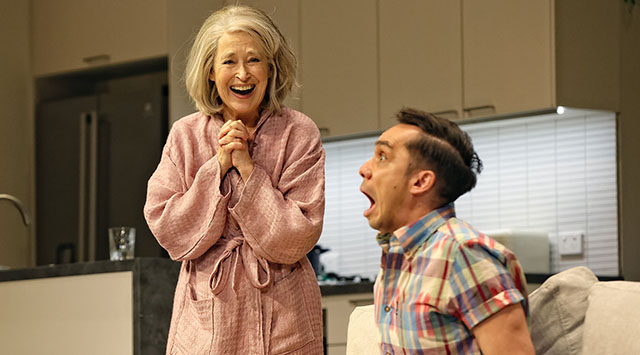
Judy seems to live the most idyllic existence, having shaped her life after the prototypical 1950s British housewife. From her head to her shoes, from her kitchen to her bathroom, everything is authentic of the era. Even her meals are prepared with historical accuracy. Her husband Johnny the realtor, too is required to adhere to these rules, as he dresses in suspenders and a trilby hat, driving off to work in the right model of car, with a very vintage lunch box in tow.

Judy’s world is quite strange indeed, considering that the year in which we meet her, is actually 2018. In Laura Wade’s Home, I’m Darling, we see a woman desperately trying to find a sense of harmony, by retreating into a space where she feels control over, and where she has decided that moving back 60 years in time, is how she is going to manufacture order out of chaos. Inside her inner sanctum, Judy wears high heels, girdles and swing skirts. She cleans behind furniture, in addition to cooking and baking all day. It never quite occurs to her, that to attain the peace and freedom that have evaded her outside in the real world, she has paradoxically locked herself into a past that we know to be anything but emancipatory, for women especially.

Home, I’m Darling is an intriguing work. Wade’s writing inspires curiosity from the very beginning, with Judy’s strange choices provoking us to ponder on the conditions outside of her house, ergo our collective realities, that have driven a woman to seek refuge in such an extreme manner. We come up with some very big questions, that the play may not necessarily be equipped to answer. It relies on our imaginations, and that intellectual process is certainly enjoyable, but a certain coyness in Wade’s style, seems to prevent Judy’s story from being as deeply affecting as it should.

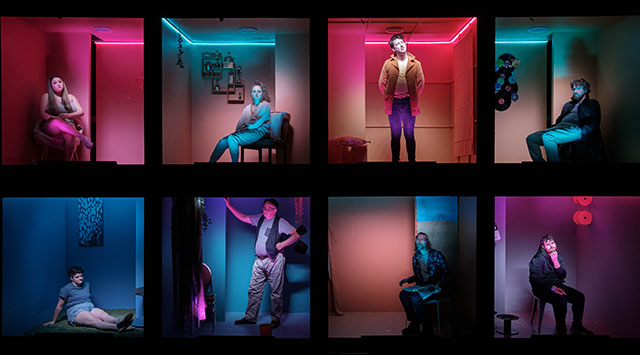
With a set and costumes by Genevieve Blanchett, the production looks a candy coloured concoction of cartoonish artifice, at once pleasurable and alarming. Together with Verity Hampson’s lighting design, the imagery presented is exaggeratedly twee, a commentary perhaps on the conflicting ways one may feel about the very concepts of femininity and prettiness.

Home, I’m Darling is clearly about gender politics, but Director Jessica Arthur takes care to prevent the show from being reduced to only that one thing. Judy is allowed to be complicated, an inconvenient protagonist, neither a feminist champion nor a victim of misogyny. Even though we might crave easy and passionate theatrical proclamations in a more militant style, we are asked to see Judy the way she sees herself, which must be the best way to honour a central character, from a feminist perspective. Even though Arthur says all the right things with the show, there is a tendency to be overly cautious in approach, that can cause the staging to feel somewhat restrained. Judy is really quite mad, but the comedy never gets very wild.

Actor Andrea Demetriades is glorious as Judy. In a triumphant performance, Demetriades conveys all the difficult layers of the lead character, able to accommodate our conflicting feelings about a woman and her dubious choices, keeping us simultaneously challenged, enthralled and entertained.

Husband Johnny is appropriately rendered with a sheen of Disneyesque innocence, by an eminently likeable Anthony Taufa. His boss Alex is given a refreshing effervescence by an engaging Kirsty Marillier. Judy’s best friend, Fran proves a welcome respite with every one of Chantelle Jamieson’s humorous and energetic appearances. Fran’s husband Marcus is played by Gareth Davies, irrepressible and genuinely hilarious, although less effective when the tone turns sombre. Tracy Mann is marvellous as Sylvia, old school feminist and Judy’s mother, particularly endearing when called on to deliver a pivotal and rousing speech, that helps us place the story in proper perspective.

One of the strategies of dealing with social and economic systems that are unsatisfactory or indeed unjust, is to attempt to withdraw from participation. It is of course arguable if it is ever possible to entirely extricate oneself from these pervasive systems, as evidenced in Home, I’m Darling. Much as Judy tries to live by her own rules and stays firmly inside her own home, seepages will come through, to disrupt every best laid plan.

It is easy to be derisive of Judy’s 50s fantasy, but ways to attempt deviation from the hegemony, are extremely limited. The real world is unsuitable for many, not just Judy, and those of us who find ourselves disadvantaged, have to find ways to make do. Compromises are a constant, as are disappointments. When one comes to a realisation that the investment of time and energy, does not bear fruit as promised, it is understandable that one would retreat, and look for alternate courses. In breaking the mould, one can only look an oddball. For some, this is more tolerable than an enduring commitment to blind conformity.

www.sydneytheatre.com.au

Review: Dead Skin (White Box Theatre)

Venue: Kings Cross Theatre (Kings Cross NSW), Apr 2 – 17, 2021
Playwright: Laneikka Denne
Director: Kim Hardwick
Cast: Ruby Maishman, Sarah Jane Kelly, Abe Mitchell, Laneikka Denne, Camila Ponti-Alvarez
Images by Jasmin Simmons

Theatre review
When high schooler Andie falls in love, it is not only her new girlfriend Maggie who occupies her mind. Visions of her mother Andrea come flooding relentlessly in. Laneikka Denne’s Dead Skin talks about teenage love, in tandem with the complications of a girl coming of age, without the presence of her mother. Young Andie needs to know what it is to become a woman, and in that transitionary process, the urge to understand a mother she never knew, becomes irresistible.

Much of the story is about the things we suppress, in order that we may survive, and the breaking points that occur, to open the gates for the confrontation of truth. As a child, Andie never received satisfactory information about Andrea’s disappearance, only knowing that life has to go on, imperfect as it may be. Things change however, when she is no longer able to experience the world as a child, and the truth of a woman’s being, must come to the fore.

Denne’s ideas are expressed meaningfully in her piece. Abstract concepts are juxtaposed comfortably against naturalistic scenes, using the theatrical form cleverly to explore curious facets of human psychology. The fragmented nature of the writing’s structure however, has a tendency to work against the audience’s capacity to sufficiently invest in its characters. Dialogue for Dead Skin whilst charming in its authentic representation of contemporary youth culture, can expose a superficiality in its efforts to capture painful aspects of emotional growth.

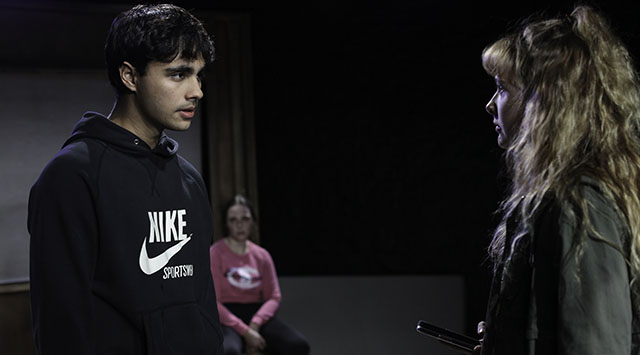
As performer, Denne is intense in the role of Andie. Very believable, if slightly monotonous, in her depiction of the awkward teenager; we never question the authentic voice she brings to the stage. Her new love is played by Ruby Maishman, charismatic and confident as the comical Maggie. Camila Ponti-Alvarez leaves a strong impression as Audrey, an unlikely maternal figure, especially captivating in moments of heightened drama. Sarah Jane Kelly and Abe Mitchell are mother Andrea and father Harry, respectively, both demonstrating excellent commitment, for somewhat perfunctorily conceived personalities.

Production design by Angus Consti offers clean lines on a very black stage, to denote a space that is about accuracy in the mind, rather than somewhere more tangibly material. Lights by Martin Kinnane provide much needed variation to atmosphere, but Chrysoulla Markoulli’s near constant drone for sound design, proves challenging.

Much of the show, directed by Kim Hardwick, feels like a dream state. We fluctuate between different levels of lucidity, with resonances that hit and miss. Dead Skin ebbs and flows, more interested in its own discoveries, than in driving home a point. Let artists do their art, and be grateful in our participation from the perimeters, as we observe and glean what we can. Together at the theatre, let us delight in curiosity, and hold each other safe, in an inevitable evolution of our species, whichever direction it may take us.

www.whiteboxtheatre.com.au

Review: Stop Girl (Belvoir St Theatre)

Venue: Belvoir St Theatre (Surry Hills NSW), Mar 20 – Apr 25, 2021
Playwright: Sally Sara
Director: Anne-Louise Sarks
Cast: Deborah Galanos, Sheridan Harbridge, Amber McMahon, Mansoor Noor, Toni Scanlan
Images by Brett Boardman

Theatre review
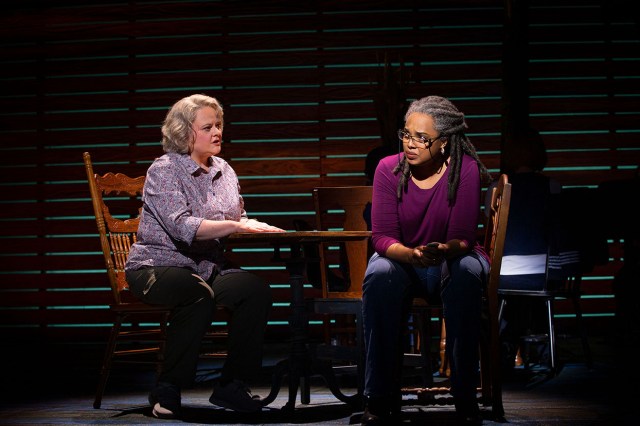
When Suzie returned from Kabul in 2011, it was the shock of the normal, that started her on an agonising downward spiral. In prominent Australian journalist Sally Sara’s semi-autobiographical playwrighting debut Stop Girl, Suzie is her doppelganger, through which stories of trauma and of healing, could be told. After years covering the war in Afghanistan, in addition to other disasters all over the world prior, Suzie intends to buy a home, ready to put down her roots in Sydney for a new phase in life. What greets her however, is a torrent of mental health disintegrations, preventing her from experiencing the comparative peace on this land, that the rest of us almost always takes for granted.

There is unequivocal passion and honesty in Sara’s writing, but an undue conventionality, in form and style, unfortunately delivers a show that can feel predictable and repetitive. Much has been written about post-traumatic stress disorder, often in more affecting ways, and although Sara’s critical need to share her story cannot be denied, Stop Girl sadly, brings nothing new to stories about the aftermath of war, that we have heard countless times before.

Directed by Anne-Louise Sarks, relationships between characters are conveyed with believability and warmth. There is a stilted quality to the delivery of dialogue, but each personality in the play is convincingly depicted, even though the production never quite attains the level of naturalism that it aspires. Stop Girl has a simple point to make, about the lack of care for those returning after having made unimaginable sacrifices, and Sarks leaves us fully persuaded.

In the lead role is actor Sheridan Harbridge, who comes to life when Suzie falls into a state of psychological torment, allowing us valuable insight into the workings of severe upheaval on the human mind and body. Best friend Bec is played by a spirited Amber McMahon, offering an effective point of reference and contrast, that demonstrates the degree to which our protagonist has deteriorated. Mansoor Noor is memorable as Suzie’s resilient fixer and producer Atal, an important embodiment of our responsibilities towards those in war-torn countries. Also very accomplished are Deborah Galanos and Toni Scanlan, both performers showing admirable commitment to their parts as psychologist and mother, respectively.

Intermittent video projections documenting Susie’s memories of Afghanistan, created by Jack Saltmiras and Susie Henderson, bring a sense of dynamism to the presentation. Music by Stefan Gregory and Hamed Sadeghi, are reliable in manufacturing swift transformations of atmosphere, and along with Paul Jackson’s lights, take us succinctly through each dramatic fluctuation of Susie’s emotional journey. Robert Cousin’s set design is elegant if slightly unambitious, and Mel Page’s costumes offer thoughtful solutions for a production that looks appropriately understated.

Keeping the Australian people ignorant, is advantageous for big business and career politicians. The less we know, the better. When we are in the dark, we can be sold anything they want. Journalists who go against all odds, risking life and limb, to bring us the whole and awful truth, are our unsung heroes. When they are no longer able to contribute, it appears that we discard them, on a metaphorical human trash heap, courtesy of our endlessly intensifying obsession with a capitalistic way of life. Even when we know that all humans have a use-by date under this system of running things, we do little to save ourselves from this inevitable consequence. All we have, is to prescribe to capitalistic principles of “every man for himself”, to be selfish and to hoard, should we hope to live with any dignity in our final days. For those who wish to do better, their concluding scenes, it seems, are likely to be grim.

www.belvoir.com.au

Review: Exit The King (Red Line Productions)

Venue: Old Fitzroy Theatre (Woolloomooloo NSW), Mar 20 – Apr 10, 2021
Playwright: Eugène Ionesco
Director: Megan Wilding
Cast: Toby Blome, Shakira Clanton, Jonny Hawkins, Rob Johnson, Emma O’Sullivan, Dalara Williams
Images by Robert Catto

Theatre review
The King has ruled for hundreds of years, but it is now time to retire. His body is failing, as well as his mind, and even though the will remains strong, there is no turning back. The end is nigh in Eugène Ionesco’s 1962 absurdist Exit the King, although it gradually becomes clear that it is in fact, a new beginning that the people really need. It is a timeless tale, an appealing lament that addresses our seemingly ever present desire for institutional change, and for better government.

Ionesco’s writing however, offers the viewer more than an enjoyable narrative. His work goes on endless tangents, often contradictory and deliberately obtuse, but when in the hands of the right creators, a rare form of theatrical magic is delivered. Director Megan Wilding revels in the mischievous and unpredictable qualities of the script, taking care to marry comedy with meaning, for a show that has us engaged on multiple levels, simultaneously. Wilding’s take on Exit the King is often very funny, but even more admirable, is her ability to keep our intellect keenly stimulated through all its jokes.

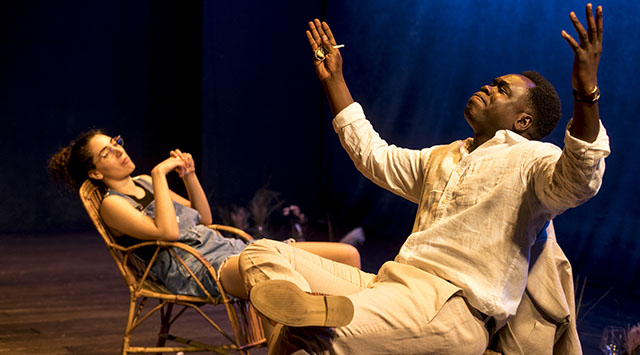
A highly amusing team of performers, is headed by Jonny Hawkins, who gives a thrilling depiction of King Berenger, the decrepit has-been determined to outstay his welcome. Incredibly nuanced, endlessly imaginative and brimming with generosity, watching the fierce talents of Hawkins in action, is pure inspiration. The divine Shakira Clanton plays a strong, imposing Queen Marguerite, making her support character rumble with danger, whether or not she is positioned centre stage. The devastating drama between a white king and a Black queen, is the immutable focal point of the show, no matter what shenanigans are thrown our way. All other actors in the piece are equal parts idiosyncratic and inventive, working with extraordinary cohesiveness for something that seriously satisfies.

The production is energised by Alexander Berlage’s lighting design, dynamic at every turn, as is Ben Pierpoint’s work on sound and music, reliably enhancing all the wonderful activity taking place on stage. Veronique Bennett transforms the space into a Warhol Factory, silver surfaces everywhere for a set that perhaps evokes flashbacks of facile rulers throughout history, who had done more harm than good for their peoples. The pop aesthetic is extended into costuming by Aleisa Jelbart, very au courant and very tongue-in-cheek.

There is likely no dignified way to overthrow a government, but in Exit the King, the fantasy of nature taking charge, intervening to simply kill off the problem, is certainly enticing. The truth is that although individuals who hold power do die away, structures will sustain themselves, and it appears that the more malevolent those systems, the more likely they will persist. The Black queen waits patiently for her white king to die, and in Ionesco’s fiction, her strategy proves successful. Real life however permits no passivity should we want the pale, male and stale to abdicate. There is a fight underway, and those invested, have no luxury of waiting.

www.redlineproductions.com.au

Review: Appropriate (Sydney Theatre Company)

Venue: Roslyn Packer Theatre (Sydney NSW), Mar 15 – Apr 10, 2021
Playwright: Branden Jacobs-Jenkins
Director: Wesley Enoch
Cast: Lucy Bell, Joel Bishop, Johnny Carr, James Fraser, Brenna Harding, Ella Jacob, Mandy McElhinney, Robbi Morgan, Sam Worthington
Images by Prudence Upton

Theatre review
Three siblings return, after the death of their father, to their Arkansas family home, in anticipation of the estate’s imminent sale. They are an unhappy bunch, and like many classics of stage and screen from the United States, these white Americans squabble and weep in each other’s presence, putting on display interpersonal conflicts and psychological trauma, as though resolution could eventually be found through performative acts of catharsis. In Branden Jacobs-Jenkins’ Appropriate however, characters ignore the most serious problems underpinning their very existence, unable to acknowledge fundamental faults that are more about a legacy relating to their Confederate history, than they are about individual infirmity.

Jacob-Jenkins draws a link between a sick society, and private lives constantly in search of emancipation. We are familiar with the idea that personal anguish compels us to seek remedies, but we rarely think about addressing wider contexts (in the case of Appropriate, both societal and familial), as being crucial in efforts to achieve a sense of well-being, or peace. This is especially true for those in positions of privilege. Jacob-Jenkins’ play features an all-white family, none of whom accept that the racism propagated by their forebears, has anything to do with their disquiet, much less be attentive to the racism that they continue to reinforce in their own daily lives.

This political statement, although a hugely consequential one, is made almost surreptitiously. The characters sweep these things under the carpet, and in the absence of an outside world that includes people of colour, none of what the play wishes to say, is presented explicitly. Director Wesley Enoch too, does not bring abundant emphasis to these matters, trusting instead that the message will resonate for those who want to hear it. Positioning the show as a somewhat conventional family drama however, means that Appropriate is not always satisfying. The reliance on a sense of realism, in efforts to make the narrative engrossing, has a tendency to reduce the drama to something slightly pedestrian. The play is much more than rich people fighting and being upset about their parochial concerns, but we are only provided glimpses of the real stakes that are actually involved.

An unevenness in the cast is largely responsible, for the production not conveying as much nuance and depth as required. Sam Worthington demonstrates good focus and intention, but an unfortunate lack in control over his voice and physicality in the role of Bo, makes for a confused, and confusing, performance that leaves us cold. Doing most of the heavy lifting is Mandy McElhinney, who shines brightly as resentful sister Toni, able to inject exuberance and irony into the dark comedy. Johnny Carr plays the intriguingly ambiguous Franz, proving himself a captivating actor, if a little too convincing as the reformed sex offender.

Work on design aspects is accomplished in general, with the closing minutes showcasing a dilapidating house, without actors, leaving a particularly strong impression. Set by Elizabeth Gadsby, lights by Trent Suidgeest, and sound by Steve Francis, combine to create the production’s most striking moments. We witness the house literally falling into disrepair, ravaged by time and by ghosts. We watch the spectacle unfold, and without words, hear the important questions ring through the chilly air. What had been left unsaid, is finally unleashed, but one wonders if this obtuse conclusion, although beautiful, is enough to drive home the moral of the story.

Observing white people in places like American and Australia, deny their racism, is nothing new for people of colour. It is always someone else at fault, and it is always a problem too big to fix today. There is always disowning of liability, and there is always a diminishment of responsibility. They routinely try to make everything vanish into thin air, as though out of sight, out of mind. They are terrified of being labelled racists, but every day prolong and extend the effects of racism. They say they did not create the system, but refuse to acknowledge that they are often its sole beneficiaries. The people in Appropriate will say that the worst is behind us, but what we see before our eyes, is a tragedy that rages on, only in hushed tones.

www.sydneytheatre.com.au

Review: Jali (Griffin Theatre Company)

Venue: SBW Stables Theatre (Darlinghurst NSW), Mar 16 – 27, 2021
Playwright: Oliver Twist
Director: Erin Taylor
Cast: Oliver Twist
Images by Estelle Yoon

Theatre review
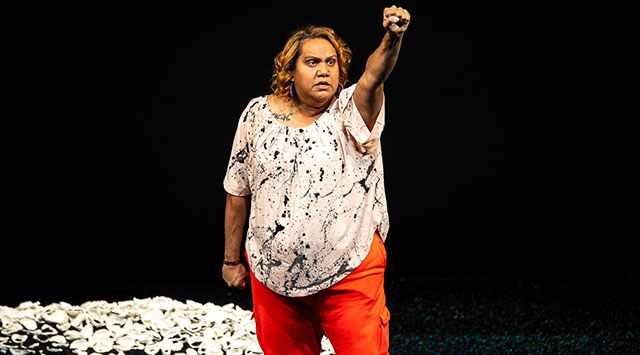
There is an unmistakeable irony to the artist choosing for himself, the name Oliver Twist. Unlike Dickens’ famed character, this Australian Twist does not for a moment, ask for sympathy, even though his experiences as a child refugee were often abhorrent and harrowing. In the hour-long one-person show Jali, writer and performer Twist charts his difficult journey from Rwanda to Ipswich, Queensland, not as a piece of overwrought melodrama, but with an exquisite scintillating humour. To our “first-world” sensibilities, this is perhaps a surprising turn of events, having become used to stories of this nature being framed as a sort of “tragi-porn”, offering perverse catharsis, for viewers who have done more contributing to the hardship of asylum seekers, than to actually helping them.

In Jali, we see a protagonist emerge victorious, in spite of the obstacles we put in his way. Twist’s writing alternates between a sublime sense of the poetic, and a disarming realism derived from his burgeoning career as a stand-up comic. Moving back and forth in time, we observe Twist’s personal growth over the years, whilst gaining an understanding of trauma, and memories of traumatic events, as omnipresent forces, carved into our beings, and playing out their effects, even when we are unconscious of their existence. Twist is on a joyful trajectory in Jali, but a bright future does not mean a forgotten past.

As performer, Twist is full of charm, and remarkably at ease with his audience. Consistently engaged and present, he holds our attention effortlessly, able to gain his audience’s trust from the outset. Bringing a reassuring warmth to his stories, we feel securely cradled, as we bear witness to these first-hand accounts, of information we usually obtain, reliably and otherwise, from a deteriorating news media.

Jali however, is rarely a dark experience. Twist is irrepressibly humorous, with wonderful timing and an unusual deadpan approach, that somehow manages to persuade us of an indomitable strength within the human spirit. It is indeed admirable, when people can overcome adversities of this magnitude, but more important, is to allow these anecdotes to teach us, not only of our resilience, but that we need to prevent these horrors from occurring to anyone, anywhere.

Erin Taylor’s direction of the work capitalises on Twist’s formidable likeability. She ensures that we perceive vulnerability, without any need for humiliation, and showcases her subject’s vital optimism in a manner that proves irresistible. Taylor offers up a vision of a new Australia, or maybe an everchanging Australia, that we all feel invested in, and that we want to do better for.

Production and lighting design are gently harnessed by Kelsey Lee, to enhance the show’s intimate qualities. There is a quietness to the atmosphere that emphasises the gravity of issues being discussed, and that simultaneously allows the performer’s natural vibrancy to shine. In a similarly sensitive fashion, Chrysoulla Markoulli’s precisely measured music helps punctuate both the comedy and the drama, whilst assisting our imaginations to travel the continents along with our storyteller.

All the borders that we build can be thought of as arbitrary. No human is born to be separate from earth, yet decisions have been made to deprive individuals of access to infinite spaces, in the belief that certain lands belong to certain people, and that some are simply to do without. In truth, we can only think of ourselves as custodians of places, and to think that we own anything, that the earth is not entirely autonomous, is pure arrogance. There is something in us that wishes to hoard, and in the process cause dispossession to other people. Some might argue that that is our nature. If that is indeed the case, it might be worthwhile to learn to act against our nature, if we truly care about discerning right from wrong.

www.griffintheatre.com.au

Review: You’re Not Special (Rogue Projects)

Venue: Kings Cross Theatre (Kings Cross NSW), Mar 5 – 20, 2021
Playwright: Sam O’Sullivan
Director: Samantha Young
Cast: Arkia Ashraf, Kate Skinner, Ariadne Sgouros
Images by Kate Williams and Australian Theatre Live

Theatre review
Dan and Ellie are moving in together, as is the convention when humans decide to couple up. They expect to become closer as a matter of course, but like many others, these new living arrangements begin to test their mettle. You’re Not Special by Sam O’Sullivan is thankfully, not another rom-com on the humorous pitfalls of heteronormativity, but an intensely thought-provoking work about the tensions between organic and synthetic, in our age of unprecedented technological advancement. Characters in the play are caught up in their virtual lives on all their electronic devices, and at varying degrees, struggle to negotiate the nature of reality as it stands in the twenty-first century.

O’Sullivan’s writing is wonderfully engaging, with an intellectual curiosity that sustains our keen interest. There is a passion in the way its ideas are disseminated, that gives You’re Not Special a delicious sense of urgency, even though what it wishes to effect can feel somewhat didactic. Director Samantha Young does a splendid job of bringing to life, these concepts of right and wrong, in scenes featuring dramatic confrontations that always feel authentic and powerful. The show is very persuasive.

Arkia Ashraf’s uncompromising naturalism in his approach to the depiction of central character Dan, conveys a valuable quality of the everyman, one that invites the viewer to relate his story to each of our own lives. It is a solid, heavily introspective performance, that benefits tremendously from the intimacy of the space. Ellie is played by an exquisite Kate Skinner, scintillating in moments of vigour, and genuinely delightful when delivering comedy. In the enigmatic and pivotal role of April, is Ariadne Sgouros, who demonstrates excellent capacity for complexity. She revels in the many layers offered by the unusual personality, and challenges us to bring interpretations that are as expansive as the work she presents.

Design aspects are comparatively low-key, although appropriately so. Set and costumes by Anna Gardiner evoke a familiarity that helps us place the action at close psychological proximity. Martin Kinnane’s lights contribute a sense of dynamism to the narrative’s unfolding turmoil, and Kaitlyn Crocker’s sound design is memorable for surprising touches that hint at the surreal.

You’re Not Special asks important questions, but is perhaps too strident in its need to provide answers. Its default position of honouring an imagined point of human origin, and of what is traditionally thought of as “natural”, puts restrictions on the efficacy of its own artistic possibilities. The discussion of humanity and technology, when framed strictly as a duelling dichotomy, can feel mundane and old-fashioned. Technology can be thought of as essentially human, and at this point of our evolution, one could argue that a more futurist appreciation of lifestyles could be beneficial.

Quite certainly, truths often reside in all factions of our debates, and to participate in society, should not require that we must take sides on all issues, all the time. In 2021, it seems we have been conditioned to be irrepressibly opinionated over every matter. Maybe to remain impartial on some things, especially when the ethics involved are not cut-and-dried, means to keep an open mind.

www.rogueprojects.com.au

Review: Playing Beatie Bow (Sydney Theatre Company)

Venue: Wharf 1 Sydney Theatre Company (Walsh Bay NSW), Feb 22 – May 1, 2021
Playwright: Kate Mulvany (based on the novel by Ruth Park)
Director: Kip Williams
Cast: Tony Cogin, Lena Cruz, Claire Lovering, Heather Mitchell, Sofia Nolan, Rory O’Keeffe, Guy Simon, Catherine Văn-Davies, Ryan Yeates
Images by Daniel Boud
Theatre review
Two Sydney girls connect across centuries, through supernatural means, leaving indelible marks upon one another’s destinies. In Kate Mulvany’s brand new revision of Ruth Park’s 1980 novel Playing Beatie Bow, teenager Abigail wormholes from 2021 to 1873, meeting young Beatie Bow and her migrant Scottish family, in a story that broaches the sensitive subject of our colonial history. It also touches upon themes of female solidarity, of matrilineality, and on the nature of love, for places and for people, in a three-hour long epic that is as expansive as it is adventurous.

Abigail and Beatie are able to time travel, because they were born spaewives, ready to transcend physical realms of earthly existence. Mulvany as writer too, ventures beyond the obvious, so that the audience is never allowed to linger in the mundane. With Playing Beatie Bow, she insists that we look under every surface, to reach for a deeper appreciation and understanding about the people we like to think we are. The action takes place at The Rocks, where our history is especially rich, and where its cultural influence is particularly far reaching. To excavate at that location, is to uncover the gems, and the dross, that shape our Australian identities.

Direction by Kip Williams takes care to address both the issues, of who we are and who we ought to be. His work is honest, but also highly aspirational. It provides so much that is warm and fuzzy, through the nostalgia of the piece, and the saccharine sweetness of the relationships being depicted. The notion that we are good people, is reinforced through the classic, if slightly hackneyed, salt-of-the-earth tone of the staging. Concurrent though, is the refreshing incorporation of Aboriginal and Asian perspectives, that prove fundamental in encouraging a reimagination of community. The inclusion of people of colour within this context of an “Australian classic” addresses the exclusionary strategies, that have informed the ways we have been permitted, and not permitted, to conceive of ourselves, over centuries of white imperialism. Williams’ reformation of our collective attitude, is somewhat surreptitious but undoubtedly political.

David Fleischer’s set design takes full advantage of a very deep stage (at the extravagantly renovated Wharf Theatres), utilising configurations of sparseness to communicate elements of time and distance, that are central to a story that has us frequently thrust into moments of magical abyss. Lights by Nick Schlieper are appropriately ethereal, reliably transporting us through one translucent apparitional scene after another. Renée Mulder’s costumes provide great assistance, so that characters are convincing from the get-go. Music by Clemence Williams and Matthew Doyle, are sentimental and beautiful, and along with David Bergman’s restrained sound design, provide us with meditative spaces so that our thoughts and emotions can be activated, in the audience’s pursuit of interpretation and introspection.

A remarkable warmth emanates from the cast; they seem to be saying that this tale is for all of us, and that we are in this together. Catherine Văn-Davies is powerful as Abigail, an urgent and compelling presence whose sense of precision, keeps us attentive to all the valuable dimensions of what we discover to be a surprisingly complex exercise. Văn-Davies brings an authentic earthiness that anchors the production in a place that feels universal and meaningful, even when its flights of fancy take us far away from reality. It is often a deeply moving performance, one that tethers us to humanity, of the self and of others.

Guy Simon is unforgettable in his various roles, but as Johnny Whites, his controlled delivery of an Indigenous man whose daughters have been stolen by the crown, is utterly devastating. Heather Mitchell is a sheer delight as two vastly different matriarchs, both wonderfully comical, yet profound with what they convey. The precocious Beatie is played by Sofia Nolan, with excellent timing and a formidable exuberance. The show requires of its actors, a high level of technical proficiency, but they are unrelenting with the heart and soul of the piece, and as a result, the audience cannot help but be thoroughly affected.

We need to know our origins, in order that our destinations can be properly mapped out. We have for the longest time, misunderstood our past, and therefore so many have to suffer painful consequences. This is a task that has no room for delusions. We can no longer pretend to be wholly benevolent. People need to own up to their mistakes, make reparations, and correct our pathways. Travelling back in time to face the demons is hard, but for the brave, it is the only way forward.

www.sydneytheatre.com.au

Review: Symphonie Fantastique (Little Eggs Collective)

Venue: Kings Cross Theatre (Kings Cross NSW), Feb 17 – 27, 2021
Director: Mathew Lee
Cast: Lloyd Allison-Young, Alex Beauman, Cassie Hamilton, Clare Hennessy, Annie Stafford, Nicole Pingon, Chemon Theys, LJ Wilson
Images by Patrick Boland, Julia Robertson

Theatre review
In 1830, French composer Hector Berlioz created Fantastical Symphony: Episode in the Life of an Artist… in Five Sections, a work from the Romantic period that is now considered seminal in what is known to be the Program music genre. The piece involves obsessive love and morbid fantasies, which the Little Eggs Collective, under the direction of Mathew Lee, extracts to use as central themes in their 45-minute theatrical presentation, named Symphonie Fantastique after the original French. Examined through contemporary eyes, Berlioz is less romantic, and a lot more rapey.

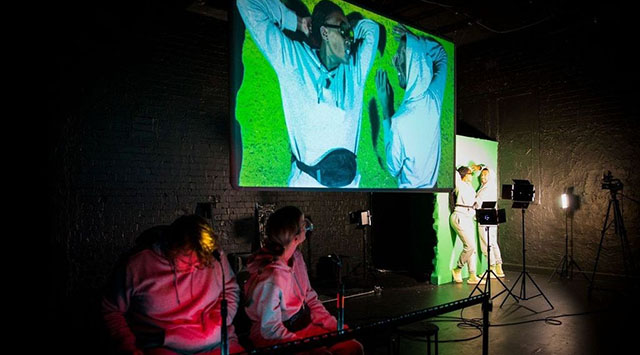
Transformed into a genderless protagonist, the reimagined maestro is frustrated, cowardly, out of control. Grandiose and insufferable, their story is reminiscent of Fellini’s , in which we see an artistic genius trapped inside their own paranoia-filled process, filtering everything they encounter into a self-serving narrative, as though the world has been created in their own image. The play Symphonie Fantastique is virtually wordless, with deconstructed interpretations of Berlioz’s music (by Oliver Shermacher’s inventive and inspired musical direction) forming a foundation, on which the show is built.

The ensemble of eight are called on to dance, act, sing and even to play musical instruments, for a multidisciplinary exploration of the performing arts, that audiences will find captivating, at least on sensorial levels. Director Lee has a tendency to be overly literal with his storytelling, but the unfettered impulse to surprise, makes for an enjoyable experience. Performer LJ Wilson offers a strong portrayal of the lead character; not always detailed with emotions being conveyed, but certainly a magnetic presence. As a team, the eight are tightly rehearsed, and extraordinarily cohesive with the constantly undulating energies they bring to the stage.

Visual concepts are ambitiously concocted, and manufactured, for this Symphonie Fantastique. Costumes, hair and makeup by Aleisa Jelbart are marvellously assembled, with an impressive eye for sophistication and finish. Lighting and set designer Benjamin Brockman’s combination of mirrored surfaces and bold colours, insist on firing up our synapses, for unforgettably transcendent moments that are nothing less than electric.

There is a considerable amount of gender bending in this iteration of Symphonie Fantastique, and if the dissolution of gender parameters is essential in approaching, or perhaps advancing, a feminist theatre, then this production is on the right path. There are conundrums, of course, as is the case whenever we attempt to address problems of a sexual nature, whilst working simultaneously to dismantle old frames of thought. We want to bring justice to victims, yet we wish to deny hierarchical power structures their persistence. Feminism is the key to a future where no one is powerless, but it also presents the greatest challenge, for us to understand our world, without tops and bottoms.

www.littleeggscollective.com

Review: The Pass (Seymour Centre)

Venue: Seymour Centre (Chippendale NSW), Feb 11 – Mar 6, 2021
Playwright: John Donnelly
Director: Ed Wightman
Cast: Ben Chapple, Deng Deng, Cassie Howarth, Tom Rodgers
Images by Becky Matthews

Theatre review
Jason is an English superstar on the football field. Spectacularly talented, and with an unquestionable dedication to his sport, but the fame and fortune bestowed upon him, as is the case with many in his position, are completely beyond reason. In John Donnelly’s The Pass, Jason’s excesses come at a high price, one that is disproportionate to the actual activity that he is ostensibly being rewarded for. The story is ultimately about human dignity, and how individuals in these modern times, can so easily and unknowingly, find their souls peddled off to the highest bidder.

We understand that to make a living requires a certain amount of sacrifice, that for the vast majority, trading labour and skill are the only ways to secure money for paying off bills. As part of that exchange, we think it reasonable to concede to things like codes of behaviour and of clothing, or to concepts pertaining to company and professional culture. It is a persistent commodification of our minutes and days, that slowly erodes away idiosyncrasies and sometimes humanity, in service of an economic system with dubious priorities.

In The Pass, it is Jason’s sexuality that suffers the worst, in a process of dehumanisation that accompanies what he perceives to be the pursuit of success. As he becomes increasingly well-known, the need escalates, to sublimate everything personal that might contradict the longstanding image of an idolised footballer. To play the part of an invulnerable straight white male, he pushes away his sexual attraction to men, gives up on his relationship with his Black best friend, and hides in hotel rooms drowning his sorrows in drugs and alcohol. To be a lean mean money-making machine, Jason constantly finds himself at breaking points, unable to retreat or reform, only knowing to endure the anguish that he clearly thinks to be justified.

Donnelly’s writing is a strong, powerfully observed piece on what may be termed advanced capitalism, and its devastating effects on a person’s nature. The protagonist’s fear of his own homosexuality is juxtaposed against conventional parameters of success, to offer a meaningful perspective into one of the ways money can turn into a destructive force, in each of our lives. This theatrical cautionary tale is directed effectively by Ed Wightman, who brings purposeful attention to central themes of The Pass; whiteness, heteronormativity and misogyny, all of which are usually invisible, due to their insidiously mundane prevalence.

Set design by Hamish Elliot delivers a series of convincingly swish hotel rooms, in a resolutely cool palette that communicates the detachedness with which Jason regards his existence. Matt Cox’s lights help us navigate a variety of moods, as we watch Jason go through a gamut of volatile emotional states. Gay pop star Ricky Martin’s 1998 hit She Bangs, now resonant for its connotations of closeted sexuality, is featured throughout, in a sound design by Daryl Wallace.

Leading man Ben Chapple gives a rhapsodic performance as the very lost Jason, with an enjoyable intensity that makes him a compelling watch. The actor’s robust energy is memorable, but a greater exploration into nuances would allow audiences a richer appreciation of the text. Cassie Howarth is gloriously sassy and remarkably intricate in her portrayal of Lyndsey, adult entertainer with a heart of gold, who brings valuable depth to a production that can sometimes, gloss over less dramatic but nonetheless important portions of dialogue. Jason’s intimate confidante Ade is played by Deng Deng, a likeable and sensitive, if slightly too introspective performer. The very comical Tom Rodgers brings to life, the young hotel attendant Harry, raucous and genuinely funny, but whose poor execution of a transphobic joke, leaves a bad taste in the mouth.

In dealing with the downfall of a sporting hero, The Pass presents an opportunity to talk about ubiquitous power structures that benefit few, yet are upheld by virtually everyone. We can focus the story to talk about white supremacy and racism, misogyny and the patriarchy, homophobia and transphobia, ableism, poverty, etc., but that requires us to acknowledge that the way we rally around heroes, sporting or otherwise, is symptomatic of the problems we suffer. It seems to be a natural impulse for us to create gods out of humans, but once systems of hierarchies are manufactured, it is always easy to forget those at the bottom rungs. It is only logical to submit to the fact that any disadvantage is inherently abhorrent, but for us to give up our idols, is clearly not something we seem ever to be capable of. Even if the gods themselves, would be better off, taking a step down from their pedestals.

www.fixedfootproductions.com