Review: The Whale (Red Line Productions)

redlineVenue: Old Fitzroy Theatre (Woolloomooloo NSW), Feb 12 – Mar 4, 2016
Playwright: Samuel D. Hunter
Director: Shane Anthony
Cast: Keith Agius, Chloe Bayliss, Alex Beauman, Meredith Penman, Hannah Waterman

Theatre review
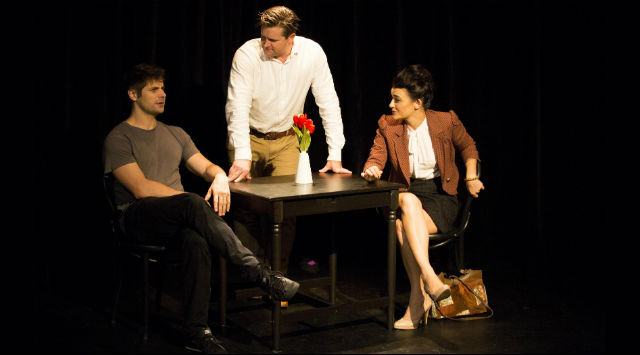
There is no question more fundamental than to consider why it is that we choose to live. In Samuel D. Hunter’s The Whale, a kind of suicidal impulse is explored, but the dramatic gesture is not a sudden one. Alan and Charlie let themselves waste away by withdrawing from the very living of life, allowing their bodies to approach certain and hastened death. The writing is powerful, poignant and sensitive, with a clever plot structure to fascinate and to provide plentiful food for thought.

Direction of the work by Shane Anthony is replete with tenderness and compassion, eager for us to find points of identification with its quirky characters. The show needs a more pronounced sense of humour for its overall emotional arc to make a greater impact, but its effect is nonetheless strong. Anthony’s use of space is dynamic and thoughtful, beautifully aided by Charlie Davis’ very accomplished and evocative set design.

Performances are well-rehearsed, with excellent chemistry to be found, but character interpretations can at times tend to be too straightforward. Keith Agius brings a valuable vibrancy to Charlie’s sad story, and although his portrayal of the role’s profound sorrow is not always convincing, we achieve a thorough understanding of his mind and spirit, and it is the actor’s work that provides his audience with many of the show’s reflective and meaningful moments. Also moving is Hannah Waterman as Mary, whose life struggles are immediately evident in spite of her brief stage time. Waterman’s approach brings a surprising complexity that makes her part the most authentic and empathetic of the group.

In The Whale, Charlie is crippled by regret and heartache. We watch him go through immense suffering, and although we appreciate the difficulties he faces, the play allows us to see the possibilities of a better life that is only a hair away. It is a lesson that we can all learn; about choice, strength and hope. Charlie might be an abomination to many, especially to himself, but to those of us who know his parable, he will serve as a reminder on our darker days, for a long time to come.

www.oldfitztheatre.com

Review: Tender Napalm (Brevity Theatre)

brevityVenue: Old Fitzroy Theatre (Woolloomooloo NSW), Jan 19 – 30, 2016
Playwright: Phillip Ridley
Director: Alexander Butt
Cast: Jordan Cowan, Tim Franklin
Image by Andre Vasquez

Theatre review
People who work in theatre know how to tell stories. Whether simple truths or tall tales, their creativity determines how a narrative takes shape. In Phillip Ridley’s Tender Napalm, a pair of lovers recite passages of extravagant fantasy, making sense of their relationship by constructing worlds far from reality, but ones that reveal the struggles they experience. Ridley provides his characters with outlandish words, but little happens in terms of plot. We catch meaningful glimpses of the relationship’s tensions, and fleeting poignancies that allow us to make sense, but the writing is fanciful and deliberately embellished, feeling as though it is more suited for the page than it does on the stage.

The work is demanding of its audience’s imagination. Both actors are presented in the plainest way possible, on a bare stage with ample room to conjure up the wild scenarios of the text. Katelyn Shaw’s sound design and Ben Brockman’s lights help significantly in manipulating ambience and energy, but the effectiveness of the show relies squarely on performances by the young duo of Jordan Cowan and Tim Franklin, both of whom tackle the script with gusto and impressive determination. Cowan has a vibrant theatricality that holds our attention effortlessly, with an endearing warmth in the personalities she inhabits. Equally charming but with a more laid-back approach is Franklin, whose natural sense of humour is omnipresent and delightful.

The performers give their all for a dynamic and engaging performance, but there is a surprising and strange emptiness to be discovered after the curtain call. No matter how accomplished, any hit show will have its detractors, and no matter how obtuse, a presentation can still find an appreciative audience. What makes a theatrical piece connect with its audience can be analysed and deconstructed into a multitude of things, but there is nothing that can guarantee all to be satisfied. It is not the responsibility of artists to please everyone, in fact it is harmful to conceive of one’s career thus. There are many other greater values that can guide one’s art, and as long as those are vested and present, the creation is valid.

www.oldfitztheatre.com | www.brevitytheatre.com.au

Review: Masterclass 2 – Flames Of The Forge (Red Line Productions)

redlineVenue: Old Fitzroy Theatre (Woolloomooloo NSW), Jan 12 – 30, 2016


Playwrights: Gareth Davies, Charlie Garber
Directors: Gareth Davies, Charlie Garber
Cast: Gareth Davies, Charlie Garber

Theatre review
In order for artists to embark upon a creative endeavour, they have to locate a certain level of self-belief. This may or may not be justified, or even essentially real, but a kind of confidence needs to be present for potent expression to occur, and actors especially, must be able to cultivate a layer of thick skin in order that they may present their work to the public with any conviction at all. Some have to try harder than others to attain that quality of egotism, but in Masterclass 2, Gareth Davies and Charlie Garber put on unhinged arrogance to provide comical insight into the theatrical process, and behind that false bravado, allow themselves to manufacture an hour of amusing and intelligent reflections on their art form.

The piece has a playful and silly façade, but there is something covertly sophisticated about their approach. Surprising nuance and obtuse concepts betray their unassuming style of delivery. There is a genuine spirit of adventure in Masterclass 2 that makes it more meaningful and elevated than what it claims to be; there is a lot of self-deprecation in how the characters articulate themselves, but seeing through that sense of modesty will reveal thoughtful and intriguing ideas.

The live experience that Davies and Garber provide is full of chemistry and dramatic tautness. Along with Ross Graham’s lights, the show is compelling and always humorous, with captivating sequences that keep our senses bemused and our minds invigorated. It may be difficult to find personal affiliations with their subject matter, but strong performances ensure that we remain interested, at least for the duration.

Davies and Garber half-pretend to be geniuses in their field, and with that calculated and transparent mockery, their true talents are able to shine through. To get to the truth of experience, theatre uses falsities and deception so that we may come to a genuine understanding of our lives and our worlds. The comedy of Masterclass 2 points to something bigger and better than the things it chooses to talk about. Looking beyond its obfuscations is where the real rewards lie.

www.oldfitztheatre.com

5 Questions with Jordan Cowan and Tim Franklin

Jordan Cowan

Jordan Cowan

Tim Franklin: What about Tender Napalm drew you in?
Jordan Cowan:The way in which Phillip uses language is so powerful and beautiful. There is something about the way he uses heightened language in such a domestic way that took me by surprise. It’s really fucking honest and intimate and doesn’t shy away from the hard stuff and I really dig that.

How do you find the Sydney theatre scene compared to your home town Radelaide?
I love the Sydney theatre scene, it is a lot more diverse and there seems to be a lot more companies just doing what they do best and finding an audience for that. I love Adelaide don’t get me wrong but there simply isn’t as many people so it’s hard for indie companies to get off the ground.

How are you feeling about performing in such an intimate space like the Old Fitz?
I love the Fitz, there is something so magical about the space it is simple and honest and won’t hold anything but the truth and I love that. It’s the perfect space for the show and I’m excited to just be able to talk to people and tell this beautiful story. That’s what theatre is all about right?

What is your favourite line in the play?
Ahhh there are so many but I think, “My cry of grief was so loud it created a black hole in the universe” is pretty beautiful.

What was it like working with the amazing Tim Franklin?
I would like to say how much of a loser he is BUT he is one of the most generous actors I have ever worked with and I couldn’t imagine doing the show with anyone else. He is as honest as they get. Oh, and a total goob.

Tim Franklin

Tim Franklin

Jordan Cowan: What do you love most about Tender Napalm?
Tim Franklin: At the moment I’m having a serious love affair with the poetic nature of Phillip Ridley’s writing. The play has such a dark subtext but the chinks of light that break through are blindingly beautiful.

What has been the most challenging part of the rehearsal process?
I hate to say it but it’s the answer to the age old, “how did you learn all those lines?” I usually say something like “its how you do anything, you do it again and again until you get it” but fuck me there are a lot of lines! My brain is leaking.

What do you think the audiences will love about the show?
I think the audiences will love the fantastical imaginary world that we will create in this extremely intimate space. Hopefully they will like the way we say the words and how our face moves too.

What is your favourite line in the play?
That’s a hostile question. I can’t choose, I wont choose, I refuse to choose. So I’m going to pick three.

“Oh her eyes! Its like gazing into a universe, I see stars and dinosaurs and whales and skeletons and spaceships.” Yummy

“I remember… at one point, as we were struggling with him on the bed, dad’s eyes sort of locked with mine and it was like… like gazing into a million years of stuff.” Ahhhh that one makes my heart hurt.

And last but not least

“your cunt…. Its such a precocious thing”

….yep

Three words that best describe the show?
Fantastical. Poetic. Tragic.

Jordan Cowan and Tim Franklin can be seen in Tender Napalm by Phillip Ridley.
Dates: 19 – 30 January, 2016
Venue: Old Fitz Theatre

Review: Dropped (The Goods Theatre Company)

redlineVenue: Old Fitzroy Theatre (Woolloomooloo NSW), Dec 8 – 20, 2015
Playwright: Katy Warner
Director: Anthony Skuse
Cast: Deborah Galanos, Olivia Rose
Image by Christine Chahoud

Theatre review
Two soldiers are in a war zone, boots on the ground as it were. They are buddies, joined at the hip, supporting each other through the calamity in which they find themselves. Life could hardly be more vulnerable or dangerous, but they are upbeat, perhaps a result of the training they had received, or the innate strength that they had brought to their vocation. They also seem to be losing their minds a little. In their struggle for survival, the women let themselves drift in and out of fantasy, and we never know for sure which of their dialogue is fact, or fiction; it is all too distant from our comfy vantage point.

Katy Warner’s script is ambitious and difficult. Dropped is at times abstract, often turning surreal, and even though it offers effective points of reference for a sense of coherence, the play can be disorienting. It contains sentimental elements to help with an emotional connection, but Anthony Skuse’s direction seems to steer the show for a cerebral experience, attempting to engage our logic instead. The production is a polished one, with Verity Hampson’s lights especially memorable, but it is also alienating. It talks about hope and death, themes that are unquestionably universal, but its profundity escapes us.

Accomplished performances by Deborah Galanos and Olivia Rose keep the energy up, and their palpable commitment to the challenging parts is admirable. Galanos’ sincerity and Rose’s vivacity are appropriately showcased, making their respective characters affable, in spite of the unimaginably horrific circumstance they portray.

It is a new realisation that we no longer live in peaceful times. Stories about war and disaster must now come to the fore, and our consciousness must be reminded of the horrors that many are facing. It is unacceptable to hide behind delusions while our worlds are experiencing carnage. If we send people off to fight, the least we could do is to observe the bloodshed. The damage is real. As long as we fail to find solutions, we must all suffer the consequences.

www.thegoodstheatrecompany.com.au

Review: Swansong (Red Line Productions)

redlineproductionsVenue: Old Fitzroy Theatre (Woolloomooloo NSW), Dec 1 – 5, 2015
Playwright: Connor McDermottroe
Director: Greg Carroll
Cast: Andre de Vanny

Theatre review
Occi is a young man in Ireland, suffering from mental illness and an uncontrollable tendency for violence. He does have moments of tranquillity though, and in between those two extremes, we discover qualities of a complex character that simultaneously repulses and attracts us. It is a tale about isolation, and therefore a statement about community. The monsters that live amongst us are cultivated by the forces surrounding them, and our complicity in the development of people like Occi must be examined. Connor McDermottroe’s Swansong may not contain people or places that we can easily relate to, but it is ultimately an exploration into human nature that we can all understand.

The play is structured with ample amounts of intrigue and tension built into an absorbing plot line that incorporates a satisfying string of revelations and surprises. It offers little insight or new perspectives into its concerns, but the writing provides extraordinary scope for a dynamic staging that can range from very quiet to very wild, within the sometimes restrictive monologue format. Director Greg Carroll and actor Andre de Vanny’s seamless collaboration focuses entirely on the performance of the piece. The production comes without a set design or props, and there is no sound design. Relying only on a simple costume and occasional lighting changes, Swansong is a mighty tour de force featuring an indisputable talent and his boundless energy and commitment. What de Vanny brings to the stage is faultlessly executed. Voice, face and body are operated at capacity, with a sense of euphoria that can only come with total abandonment. Nothing is kept in reserve, and the audience can only respond with an earnestness parallel to the show’s thorough and powerful vulnerability.

Occi’s life is full of struggles, but Swansong is not interested in our sympathies. We are free to look and judge him how we will, as we are want to do in our every day, but our eyes are opened to the experiences of an unusual existence, one that has tasted extremities that thankfully elude many of us. At the theatre, we seek our reflections, but what can be equally rewarding, is to catch a glimpse of some strange life that will never touch us otherwise. Our individual worlds can often be too small, and art is the antidote.

www.oldfitztheatre.com

Review: Debris (Red Line Productions)

redlineVenue: Old Fitzroy Theatre (Woolloomooloo NSW), Nov 24 – 28, 2015
Playwright: Dennis Kelly
Director: Sean Hawkins
Cast: Felix Jozeps, Megan McGlinchey

Theatre review
Two small children, isolated and severely neglected, completely unaware about how the rest of the world lives. Their normal is in fact horrific, but they are none the wiser. We bring innocent lives to be, and imagine that every baby is given love and care because the alternative is unfathomable and simply unbearable. Dennis Kelly’s Debris illustrates a truth that we know exist but rarely acknowledge. It exposes the ugliest of humanity, and amplifies their brutality by having them voiced by the very young, removing any possibility of moral justification on our part as viewers.

The script is highly evocative and poetic in its surreal, or perhaps fantastical approach, inspired by the minds of children, and their unbridled way of interpreting things that they encounter, but the production is a simple one, with emphasis on performance by two fine actors and not much else. Our own artistry is called upon to visualise a more vivid experience than what is actually presented on stage. Lighting has a tendency to be too obvious in its creative choices, but sound design by Tom Hogan is delicate, thoughtful and effective. Felix Jozeps and Megan McGlinchey play the forsaken children with an enormous energy that keeps the show fast paced and taut. Their roles are harrowing but ultimately straightforward, with insufficient complexity built into the performance that could deliver nuances beyond the predictable.

Debris is an intense and emotionally violent show that demands our attention, but has nothing unusual to say. It is an excellent platform for actors who wish to flex their dramatic muscles, and we are certainly entertained by the display of extraordinary passion, but for all the pain that we see unleashed, we feel little of it. The fact that there are children suffering is not news to anyone, but it is information that bears repeating. We can think about how to make lives better, but it is also true that we do not need to create more lives at all.

www.oldfitztheatre.com

Review: I Am My Own Wife (Oriel Group / Red Line Productions)

orielVenue: Old Fitzroy Theatre (Woolloomooloo NSW), Nov 17 – Dec 5, 2015
Playwright: Doug Wright
Director: Shaun Rennie
Cast: Ben Gerrard
Image by Rupert Reid

Theatre review
There is something unique about representing queer life on stage. Like many minority groups who have experienced persecution, LGBT stories need to create a legacy from hardship and struggles, so that injustices are prevented from recurring, and also for future generations to understand the histories from which they emerge. Unlike issues around ethnicity and religion that can have greater levels of visibility, LGBT identities have a tendency to be subsumed by a sense of normativity. The more gender and sexual diversity becomes accepted, the more it disappears from public discourse. A tension exists between the attainment of equality and the loss of nuances in individual differences.

Doug Wright’s I Am My Own Wife documents the controversial life of Charlotte von Mahlsdorf, a German museum curator and transgender celebrity, through the tumultuous years of the Third Reich and East Berlin. The play takes the form of a monologue, but does feature a multitude of minor characters, including the playwright himself. As von Mahlsdorf’s story unfolds, we are reminded of Wright’s presence as an interpretor of events, and correspondingly, the ambiguities between truth and fiction in the details being uncovered. The writing is full of charm and humour, with a plot that intrigues at every juncture. Vividly descriptive, we find ourselves immersed effortlessly in its slightly alien but seductive narrative.

Direction is provided by Shaun Rennie, whose outstanding use of space keeps our senses engaged and active, astutely controlling our perceptions of the show’s frequent contextual transformations, in terms of personalities, time and place. Excellent work on lighting by Hugh Hamilton and a subtle but highly effective set by Caroline Comino add greatly to the quality of unpredictability of the viewing experience. Nate Edmondson’s complex sound design is executed with impressive refinement and is noticeably adventurous with its concepts.

The play could however, benefit from a graver exploration into the darker aspects of von Mahlsdorf’s story. There seems a reluctance to portray her duplicitous nature with a stronger sinister edge, and we are kept somewhat distanced by that jovial artifice, perhaps just the way she would have wanted. Ben Gerrard is marvellous in the production. The speed and clarity at which he alters voice and physicality to depict all his different characters, whilst maintaining psychological accuracy and an air of authenticity through every change, is astounding, and very satisfying theatre. The actor exhibits wonderful commitment, along with an exquisite creativity that is remarkably intelligent and sensitive.

I Am My Own Wife entertains and fascinates. It is strangely lighthearted, given the brutalities that appear in the text. The production should hold more poignancy in its observations of war, Nazism and queerness, but as though borrowing from Charlotte von Mahlsdorf’s strength of character, unpleasant parts of the story are diminished with an unconscious ease. There certainly are lessons to be learned here, that may pertain to personal identity or to social concerns, but they require an investment of thought and attention. Alternatively, a very pleasant jaunt is offered by the show, with resonances that last until the inevitably enthusiastic curtain call.

www.iammyownwife.com.au | www.oldfitztheatre.com

Review: A Girl With Sun In Her Eyes (Red Line Productions)

redlineVenue: Old Fitzroy Theatre (Woolloomooloo NSW), Oct 27 – Nov 14, 2015
Playwright: Joshua Rollins
Director: Andrew Henry
Cast: Martin Crewes, Kai Paynter, Gabrielle Rogers, Jeremy Waters, Kate Williams, Ezekiel Simat
Image by Vanessa Wright

Theatre review
Life is not a bed of roses. It is a hard fact to come to terms with, but we live with evil around us, and people make decisions everyday that cause harm to others. In Joshua Rollins’ A Girl With Sun In Her Eyes, we see law enforcers at work, and as they confront the darkest sides of human nature, what they reveal are some of the worst that we are capable of. The filmic script jumps between short scenes to concoct a sense of intrigue and to manufacture a plot that can be placed squarely in the suspense genre. Characters are not created with great complexity, but their narratives are strong. There are sequences that aim to shock, and even though they border on the exploitative, their effects are unquestionably powerful.

Director Andrew Henry focuses on bringing intensity to individual performances, but chemistry between actors is lacking. Leading man is the magnetic Jeremy Waters who puts on a very high energy show, but counterparts do not often meet on his level. The staging and interpretation of scenes are straightforward, with little theatricality involved. The choice for a naturalistic approach is logical, but it seems to prevent the exploration of its quite brutal themes to extend beyond the surface. The production’s literal spacial configurations also create issues with scene transitions requiring an excessive number of blackouts that inevitably cause dramatic tension to dissipate repeatedly. Sound and lights help with a sense of continuity, but the piece struggles to find a coherent and sophisticated theatrical realisation of the episodic writing.

A Girl With Sun In Her Eyes is deeply pessimistic, but its ugliness is recognisable. It exposes the duplicity that we all share, of the possibilities for good and bad that reside in all our decisions. We may not wish to acknowledge personal intentions as ever being purposely harmful, but there is no doubt that people around us act with less than honourable motives, and one can never be too careful about becoming entangled. Innocence is a beautiful thing, especially when out of reach.

www.oldfitztheatre.com

Review: Dead Centre | Sea Wall (Red Stitch Actors Theatre)

redstitchVenue: Old Fitzroy Theatre (Woolloomooloo NSW), Oct 20 – Nov 14, 2015
Playwrights: Tom Holloway, Simon Stephens
Director: Julian Meyrick
Cast: Rosie Lockhart, Ben Prendergast
Image by Jodie Hutchinson

Theatre review
The more we hurt, the more difficult it is to find expression for our internal struggles. We compartmentalise pain, and with time, become more adept at denying their existence, but their effects do not fade. Tom Holloway’s Dead Centre and Simon Stephens’ Sea Wall are two half hour monologues that deal with sorrow and depression. We encounter the protagonists in traumatic states, and see them fumbling through life trying to find a way out of their anguish. Holloway’s piece is vividly descriptive, with evocative fragments that softly, but actively, fire up our imagination. Stephens’ work is equally poetic, but takes a completely different tone. Focussing on the grieving process, he uses the difficulties in articulating painful experiences as a basis for the text, and creates a quiet work that escalates suddenly at the end to deliver a powerful revelation.

The two pieces are presented one after another, but visual elements suggest an entwinement between both stories. Design of the production is understated, but elegant and sensual. Matthew Adey’s lights and Katie Cavanagh’s video projections, along with Ian Moorhead’s sound design, establish an understated but concentrated atmosphere in which the actors offer their very delicate tales. Direction by Julian Meyrick gives a beautiful cohesiveness to the two halves, with a sensitive approach that highlights the similarities between each character’s experiences. We witness the fragility in our humanity, and realise the importance of accepting and understanding the weaker moments of our personal lives.

Rosie Lockhart plays Helen in Dead Centre, fleeing England for Uluru, in search of an answer to her indescribable troubles. The actor’s engaging presence grips us from the start, but it is her ability to communicate a wealth of emotion with a seemingly minimal mode of performance that truly impresses. Helen never tells us what her problems are, but Lockhart leaves us in no doubt about the depth of her torment. Also remarkable are the flashes of humour that emerge, brief but effective, and key to installing a solid connection between actor and audience. Alex in Sea Wall is played by Ben Prendergast, whose portrayal of loss and bewilderment resonates with an intimate familiarity. The evasiveness and fear of sentimentality that he exhibits is a perceptive interpretation of how we deal (or do not deal) with immense emotions, but concluding moments see outbursts of intensity that appear too suddenly, and we question the accuracy of those dramatics.

Catharsis frequently occurs through the artistic process, but not usually at the same degree for all involved. Artists can indulge boundlessly in their excavations of private feelings, but the inspiration brought to their audience must not be ignored. In Dead Centre | Sea Wall, emotions run high, but they tend to stay safely on stage. The poignancies that it imparts are muted, but they are also real. We do not get embroiled too closely with Helen or Alex, but we study them intently and learn about the nature of suffering. The stories are theirs, but the way they help us explain and comprehend life, becomes universal.

www.redstitch.net